
So, are carbon offsets effective? It’s a complicated question, and the honest answer is: it depends. The impact of offsets ranges from genuinely helpful to completely useless, which is a huge problem for travellers trying to do the right thing.
For an eco-minded nomad, this means that cheap offset you added to your flight booking might be little more than greenwashing. Many older projects, it turns out, just don’t deliver the climate benefits they promised on paper.
Understanding why not all carbon offsets are equal is the first step. The idea of neutralizing your flight emissions with a quick purchase is definitely appealing. Who wouldn’t want that? The trouble is, the carbon offset market is flooded with projects of wildly different quality.
Key Takeaways
- Effectiveness Varies: The answer to “are carbon offsets effective” is “it depends.” High-integrity, verified projects can work, but many low-cost options are ineffective.
- Price is a Quality Signal: Extremely cheap offsets (e.g., under $10 per ton) are a major red flag for greenwashing. Real projects with verification and monitoring cost more.
- Reduce First, Offset Last: The most sustainable action is always to reduce your travel emissions first. Offsetting should only be used for the unavoidable remainder.
- Look for Third-Party Verification: Only purchase offsets from projects certified by reputable standards like Gold Standard or Verra to ensure they meet criteria for additionality and permanence.
- Project Type Matters: Projects with high permanence and low risk, like methane capture or biochar, are often more reliable than forestry projects, which can suffer from wildfires or logging.
- Avoid Airline Offsets: It’s generally better to buy offsets independently from a trusted provider rather than choosing the cheap, opaque options offered during flight checkout.
Understanding Why Not All Carbon Offsets Are Equal
Choosing the right one is the only way to make a real difference. The key is learning to spot the difference between high-integrity offsets that deliver measurable climate benefits and the low-integrity ones that simply fall short.
Simply put, a high-quality offset represents a real, measurable, and permanent reduction or removal of one metric ton of CO₂. That’s about 2,205 pounds. And crucially, that reduction would not have happened otherwise.
In contrast, many of the cheaper offsets out there, especially older forest-based projects, have come under heavy fire for failing to meet these basic standards.

The Problem with Cheap Offsets
Recent research has really pulled back the curtain on the problems with many forestry projects. For instance, a major 2023 study found that an incredible 94% of the scrutinized credits from 27 different forest-based projects were essentially “phantom credits.”
The study concluded their claims of avoided deforestation were “grossly overstated.” In plain English, that means most of the money spent on those offsets didn’t lead to any actual climate benefit.
This is a critical point for travellers. When an airline offers to offset a long-haul flight for just a few US dollars, they’re almost certainly selling credits from these less effective, low-cost projects. Real carbon removal and robust emission reduction projects cost a lot more because they demand rigorous verification, long-term monitoring, and real-world results.
Gold Standard for High-Integrity Offsets
For travelers seeking assurance that their contribution makes a real impact, purchasing offsets from projects certified by Gold Standard is a reliable choice. This registry is known for its rigorous requirements, ensuring projects are not only additional and permanent but also contribute to sustainable development goals in local communities. It’s a straightforward way to filter out low-quality options.
Navigating this messy landscape is a core part of achieving truly carbon-neutral travel, which always starts with reducing your footprint first, not just buying offsets.
High-Integrity vs. Low-Integrity Carbon Offsets at a Glance
To help you tell the good from the bad, the table below gives you a quick snapshot of what to look for. Think of it as a cheat sheet for spotting the defining features of an effective offset versus the red flags of an ineffective one.
| Characteristic | High-Integrity Offset (Effective) | Low-Integrity Offset (Ineffective) |
|---|---|---|
| Verification | Verified by credible, independent third-party standards (e.g., Gold Standard). | Lacks transparent third-party verification or uses questionable standards. |
| Additionality | Funds a project that would not have happened without the offset investment. | Funds a project that was already planned or financially viable on its own. |
| Permanence | Ensures carbon is stored long-term with low risk of reversal (e.g., geological storage). | High risk of reversal (e.g., a forest that could burn down or be logged later). |
| Transparency | Publicly available documentation and tracking on a third-party registry. | Opaque operations with little to no publicly accessible data or project details. |
Using this simple framework will help you ask the right questions and make a much more informed choice, ensuring your efforts to travel more sustainably aren’t wasted.
How Carbon Offsets Are Supposed to Work
Before we get into where this system often goes wrong, it’s worth understanding the basic idea. At its core, the concept is simple: it’s all about balance.
Imagine your journey tips a scale to one side by creating emissions. A carbon offset is supposed to be a counterweight on the other side, bringing that scale back to neutral. Simple enough, right?
This counterweight comes from projects designed to either reduce greenhouse gases or pull them straight out of the atmosphere. To keep things standardized, the impact is measured in carbon credits. One credit represents one metric ton of carbon dioxide equivalent (CO₂e) being avoided or removed—that’s about 2,205 pounds.
When you buy an offset, you’re funding one of these projects. First, you get a clear picture of your impact using a tool like a travel carbon footprint calculator. Then, you buy the number of credits needed to match those emissions. In theory, your trip is now “carbon neutral.”
Carbon Avoidance vs. Carbon Removal Projects
The projects that generate these credits fall into two main camps: avoidance and removal. The difference between them is a huge factor in judging their real-world impact.
Carbon avoidance projects are all about preventing greenhouse gases from entering the atmosphere in the first place. Think of it as preventative medicine for the planet. These projects step in to displace activities that would have otherwise created new emissions.
A few common examples include:
- Renewable Energy: Building a wind or solar farm that provides clean electricity, replacing power that would have come from a coal plant.
- Methane Capture: Installing equipment at a landfill or farm to capture potent methane gas and burn it for energy instead of letting it leak.
- Forest Protection (REDD+): Funding the conservation of an existing, healthy forest that is under a real and immediate threat of being chopped down.
Carbon removal projects, on the other hand, are designed to actively pull existing CO₂ out of the air and lock it away. This is more like cleaning up a spill that has already happened.
Examples of removal projects include:
- Reforestation & Afforestation: Planting new trees in areas that were cleared (reforestation) or that never had forests before (afforestation).
- Biochar: Taking agricultural waste, converting it into a stable, carbon-rich charcoal, and burying it in the soil to lock that carbon away for centuries.
- Direct Air Capture (DAC): Using industrial technology to literally filter CO₂ from the ambient air and store it permanently underground.
While both approaches are vital, they aren’t created equal. They come with different risks and levels of certainty. As we’ll see next, this distinction is the first step in spotting the critical weak points where the whole system often breaks down.
The Four Pitfalls of Ineffective Carbon Offsets

The idea behind carbon offsetting is pretty straightforward, but making it work in the real world is where things get messy. To really get a handle on are carbon offsets effective, you have to understand the four critical challenges that can make a project completely useless.
Think of these as the four major hurdles any offset project has to clear to be considered legit. If it stumbles on even one, the climate benefit you paid for might just vanish into thin air.
Getting these four concepts down is the single most important skill you can have to tell real climate action apart from clever greenwashing. Let’s break them down.
1. The Additionality Problem
This is the big one, the first question you should always ask: Would this emissions reduction have happened anyway, even without my money? If the answer is yes, the project isn’t “additional,” and your money didn’t actually create any new climate benefit.
Imagine you pay to offset your flight by helping fund a solar farm in a sunny region. Sounds great, right? But if that solar farm was already profitable and going to be built anyway, your contribution didn’t add anything. The emissions were going to be reduced with or without you.
A truly additional project is one that could only happen because of funding from carbon credit sales. It has to pass the “but for” test: but for your investment, this climate-positive action would not have occurred.
This is a massive issue in the offset market. A lot of projects that were already financially viable on their own have sold credits, meaning people paid for a climate benefit that was already a done deal.
2. The Permanence Predicament
Next up is permanence. This one asks: Will the carbon we’ve stored stay locked away for the long haul? This is a huge deal, especially for nature-based projects like planting trees.
The CO₂ from your flight is going to hang around in the atmosphere for centuries. To truly balance the scales, the offset needs to provide a benefit for a comparable amount of time.
- The Wildfire Risk: You could fund a reforestation project to cancel out your trip. But what if that forest burns down in a wildfire 15 years from now? That’s a growing risk with climate change, and if it happens, all that stored carbon goes right back into the atmosphere. Your offset is literally gone in a puff of smoke.
- The Logging Risk: In the same way, if the protected land gets sold and logged 20 years down the road, the carbon benefit is completely reversed.
High-quality projects have to plan for this with robust, long-term protection plans and insurance-like “buffer pools” of extra credits to cover any unexpected losses. This is why projects involving geological storage (like direct air capture) or destroying methane are often more reliable—they eliminate the greenhouse gas for good.
3. The Leakage Loophole
The third major challenge is leakage. This is what happens when stopping an emissions-producing activity in one spot just pushes that same activity somewhere else. The problem isn’t solved; it just moved next door.
The classic example is protecting a forest. Let’s say a project successfully stops loggers from clearing a specific 500-acre parcel of rainforest you helped fund.
But if the logging company just moves its equipment to an unprotected 500-acre plot right outside the project’s boundary, what has really been achieved? Nothing. The deforestation still happened; it just “leaked” out of the protected zone. To fix this, a project has to address the wider economic pressures driving deforestation, which is connected to the bigger picture of your travel carbon footprint emissions.
4. The Double Counting Dilemma
Finally, there’s double counting. This is basically an accounting error where a single ton of reduced emissions gets claimed by more than one person or group.
It can happen in a couple of ways:
- Two buyers claim the same credit: An unethical project developer could sell the exact same carbon credit to two different people.
- A country and a buyer claim the same credit: A country might count a new wind farm’s emissions cuts towards its national climate targets (under the Paris Agreement), while the wind farm developer also sells those same cuts as offsets to travelers.
In either case, one ton of real-world reduction is being used on paper to justify two tons of emissions, which defeats the whole purpose. Reputable projects must be listed on transparent public registries that track who owns each credit and when it’s “retired,” making sure it can only be claimed once.
Why Cheap Carbon Offsets Are Often Ineffective
Ever seen an airline offer to offset your round-trip flight to Europe for the price of a fancy coffee? If that felt a little too easy, your instincts are right. A healthy dose of skepticism is your best tool here.
This scenario gets to the heart of a huge problem in the carbon market: the direct link between cheap offsets and low quality. When the price seems too good to be true, it’s almost always a sign of greenwashing, not genuine climate action.
The simple truth is that the real, verified work of removing or reducing one ton of carbon from the atmosphere costs significantly more than a few dollars. Projects that are rigorously monitored, transparent, and can prove they are making a permanent difference have higher operational costs. These are the projects worth supporting.
Bargain-basement prices, on the other hand, are a major red flag. They often mean a project has cut corners on one of the four critical pillars: additionality, permanence, leakage, or double-counting. For you, the traveler, this means a cheap offset might feel good in the moment but accomplishes little for the planet.
The Corporate Rush for Cheap Credits
This isn’t just a travel issue; it’s a systemic problem driven by big-business behavior. For years, many companies have scooped up ineffective credits to improve their environmental, social, and governance (ESG) scores without making real changes to their operations. It’s a shortcut to looking green without doing the hard work.
An analysis of 866 publicly traded firms that used offsets revealed a telling pattern. It found that over 70% of the retired credits cost less than $4 USD per ton—a price far below what most economists believe is needed for real decarbonization. This trend allows firms to climb ESG rankings on the cheap, a classic symptom of greenwashing that travelers should watch out for. You can discover more about these corporate offset trends and their climate impact.
This behavior floods the market with low-quality options, making it harder for conscientious consumers to find offsets that actually work. It’s a similar challenge to trying to identify truly sustainable stays and avoid hotel greenwashing.
Why Higher Cost Signals Higher Quality
Understanding the true cost is crucial. A high-quality carbon offset isn’t just about planting a tree. It’s about ensuring that tree grows to maturity, stays protected for a century, and has its carbon benefit accurately measured and tracked the whole time.
Think about the different types of projects:
- Nature-Based Solutions: Reforestation projects require long-term land management, monitoring against wildfires or illegal logging, and holding “buffer pools” of extra credits to insure against losses. This all costs money.
- Technology-Based Solutions: High-tech projects like direct air capture, which physically pulls CO₂ from the air, are even more expensive. Costs here can run into the hundreds of US dollars per ton.
When you pay more for a verified, high-integrity offset, you are funding the very infrastructure that makes it credible. This includes third-party audits, public registry fees, and community engagement programs that prevent problems like leakage.
For travelers, this context is key to spotting red flags. Instead of defaulting to the cheapest option offered at checkout, view carbon offsetting as a deliberate investment in a specific, verifiable climate outcome. This approach transforms the question from are carbon offsets effective to how do I find one that is? And while you’re carefully planning your trip’s climate impact, remember to also plan for seamless connectivity with a reliable eSIM from a provider like Airalo to stay connected sustainably and efficiently.
How to Find Carbon Offsets That Actually Work
Despite the market’s flaws, it’s not all doom and gloom. High-integrity carbon offsets that deliver real, verifiable climate benefits absolutely exist. The challenge for a conscious traveler isn’t finding a project, but vetting one. Answering the question “are carbon offsets effective?” requires shifting your focus from a simple purchase to a thoughtful investment.
Navigating this space means becoming a savvy consumer. The key is to look for transparency, rigorous standards, and project types with a lower risk of failure. This guide will walk you through the practical steps to identify credible projects, helping you move past the noise and find offsets that genuinely make a difference.
This process transforms you from a passive buyer into an active participant in climate solutions. It’s about knowing which questions to ask and where to look for the answers, ensuring your contribution supports legitimate climate action, not just a marketing claim.
Start with Third-Party Certification
The single most important step is to only consider projects certified by a reputable, independent third-party standard. These organizations act as the referees of the carbon market. They set the rules and verify that projects meet critical criteria like additionality and permanence.
While no system is perfect, certification is your first and best line of defense against low-quality credits. The main players to look for are:
- Gold Standard: Widely considered the benchmark for high quality, it was established by environmental NGOs to ensure projects not only reduce emissions but also contribute to sustainable development goals, like clean water access or job creation.
- Verra (Verified Carbon Standard – VCS): This is the world’s most widely used standard, covering a huge range of project types. While it has faced criticism for some of its older forestry projects, it remains a crucial part of the market, and its methodologies are continually being updated.
Looking for these labels on a project’s documentation is non-negotiable.
Prioritize Lower-Risk Project Types
Not all offset projects are created equal. While protecting a rainforest sounds appealing, these projects face significant permanence and leakage challenges. For a more certain impact, consider prioritizing projects where the climate benefit is easier to measure and less likely to be reversed.
This infographic provides a simple decision-making flow to help you quickly screen potential offsets.
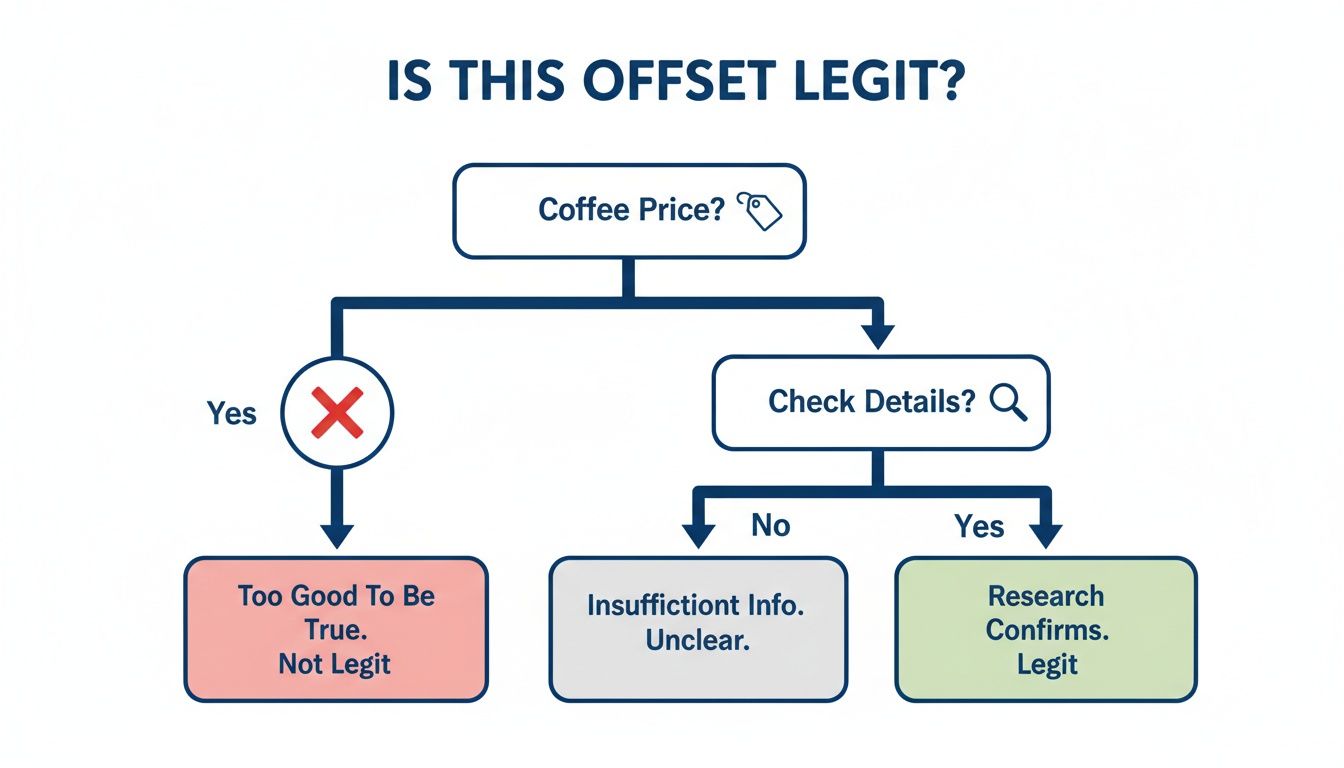
As the chart illustrates, an unusually low price is the first major red flag, prompting a much deeper look into a project’s credentials.
Consider these less risky project categories:
- Methane Capture: Projects that capture methane from landfills or abandoned coal mines are highly effective. Methane is a potent greenhouse gas, and destroying it provides a clear, permanent, and easily measured climate benefit.
- Renewable Energy: In regions where renewables are not yet economically competitive, your funding can be truly additional, helping to build a wind or solar farm that displaces fossil fuel generation.
- Biochar: This innovative approach involves converting agricultural waste into a stable, carbon-rich charcoal that is then buried. It effectively locks carbon away in the soil for centuries, making it a highly permanent form of carbon removal.
Comparing Top Carbon Offset Certification Standards
To help you tell the good from the bad, it helps to know the major players in the certification world. This table breaks down the key features, project focus, and verification processes of the most recognized standards. Think of it as your cheat sheet for identifying credible projects.
| Standard | Primary Focus | Key Verification Features | Common Project Types |
|---|---|---|---|
| Gold Standard | High-impact projects with strong sustainable development co-benefits. | Requires local stakeholder consultation and proof of contribution to UN SDGs. | Renewable energy, clean cookstoves, water purification, community reforestation. |
| Verra (VCS) | Largest global registry covering a wide range of methodologies. | Robust accounting methodologies; uses independent auditors for verification and validation. | Large-scale renewable energy, industrial efficiency, REDD+ forestry projects. |
| Climate Action Reserve (CAR) | Focus on high-quality standards, primarily in the North American market. | Standardized, performance-based protocols; transparent public registry. | Methane capture (landfills, mines), forestry, ozone-depleting substance destruction. |
| American Carbon Registry (ACR) | The first private voluntary greenhouse gas registry in the world. | Strong scientific oversight; develops new, rigorous methodologies. | Reforestation, improved forest management, carbon capture and storage (CCS). |
While each standard has its strengths, Gold Standard is often seen as the top tier due to its strict requirements for community benefits. However, well-vetted projects from Verra, CAR, and ACR can also offer legitimate climate impact.
Dig Into the Project Documentation
Once you find a certified project, take a moment to look at its public registry page on the certifier’s website (like the Gold Standard or Verra registry). You don’t need to be an expert, but look for a few key things:
- Project Start Date: Be wary of projects that started many years ago. It raises serious questions about whether they are truly additional or if they would have continued anyway.
- Public Comments: See if other organizations have raised concerns about the project’s design or impact. This is often where you’ll find red flags.
- Transparency: A good project will have clear, detailed documentation available for public review. If information is hard to find or missing, that’s a warning sign.
This level of due diligence is essential, and it’s a core part of our evaluation process when we review the best carbon offset programs for travelers. By following these steps, you can confidently find a project that aligns with your values and delivers a real climate benefit.
Reducing Your Travel Footprint Before You Offset
While the debate over carbon offsets is a big one, a simpler truth cuts through the noise: the most powerful climate action you can take is to stop emissions from happening in the first place. This reframes the entire conversation. Offsets become a final, thoughtful step for emissions you genuinely couldn’t avoid—not a free pass to live a high-impact life.
This is the heart of the ‘Reduce, then Offset’ mindset. It’s a simple but powerful idea: design your journey to be lower-impact from the start, and only then look at balancing what remains. For an eco-minded traveller, the choices you make during planning have far more weight than the credits you buy at the end.
Thinking this way brings a lot of clarity to your decisions. It shifts the goal from just cancelling out a negative to actively creating a more positive footprint through mindful travel design.
Practical Ways to Shrink Your Footprint
Putting this “reduce first” idea into action is easier than you might think. It’s all about making strategic choices that slash your travel emissions long before you even consider an offset.
Here are a few high-impact moves to get you started:
- Choose Rails Over Runways: For any trip under 500 miles (about 800 kilometers) in Europe or Asia, high-speed trains are a game-changer. A train journey can cut your carbon footprint by up to 90% compared to a short-haul flight. You can even book multi-country train tickets for Europe and Asia on platforms like Trip.com.
- Embrace Slower Travel: Go for one long, immersive stay instead of several short weekend trips. This simple shift dramatically cuts down on your transit emissions—by far the most carbon-intensive part of travel—and almost always leads to a richer experience.
- Pack Light: Every single pound counts. A lighter suitcase means the plane burns less fuel, especially during takeoff. It’s a small habit with a real, cumulative impact.
- Select Certified Accommodations: Look for hotels and lodges that hold credible sustainability certifications. These places are audited for things like energy efficiency, water conservation, and waste reduction, so you know your stay aligns with your values.
Measure First, Then Mitigate
Before you can responsibly offset anything, you need a clear picture of what you’re actually offsetting. Guesswork just isn’t good enough. Using a detailed travel carbon footprint calculator is a non-negotiable first step.
By measuring your impact, you make the invisible visible. It transforms an abstract concept like “carbon footprint” into a tangible number, empowering you to see exactly where you can make the biggest reductions.
The global carbon offset market is huge—valued at around $414.8 billion USD in 2023 and still growing. But here’s the interesting part: the voluntary carbon market, where most individuals buy their credits, has seen its transaction volume fall for two straight years. This tells us that buyers are getting much smarter and more selective about quality. Learn more about the shifting carbon market outlook on JSHeld.com. This growing scrutiny makes it even more important to shrink your own footprint first, ensuring that any offsets you do buy are for emissions that were truly unavoidable.
The takeaway here is clear. While a high-quality, verified offset is a responsible final move, the most powerful choices you can make happen long before you click “buy.” By designing a lower-impact journey from the ground up, you take control of your travel footprint in the most meaningful way possible.
Frequently Asked Questions About Carbon Offsets
Carbon Offset FAQs
1) What exactly is a carbon offset?
A carbon offset is a certificate representing the reduction or removal of one metric ton (about 2,205 pounds) of carbon dioxide equivalent (CO₂e) from the atmosphere. You purchase these certificates to compensate for the emissions your travel creates.
2) Are all carbon offsets the same?
No, not at all. Their quality and effectiveness vary dramatically. A high-integrity offset is verified, additional, permanent, and doesn’t suffer from leakage or double counting. Many cheaper options fail to meet these critical standards.
3) What’s the difference between carbon avoidance and carbon removal?
Avoidance projects prevent emissions from happening (e.g., a wind farm replacing a coal plant). Removal projects actively pull existing carbon out of the air (e.g., planting trees or direct air capture technology). Both are needed, but removals are often considered a more direct counterbalance to emissions that have already occurred.
4) How much does a good carbon offset cost?
Prices vary, but you should be skeptical of anything under $15–$20 USD per ton. High-quality removal projects can cost $50, $100, or even more per ton. If an offset for a long-haul flight costs less than a cup of coffee, it’s likely ineffective.
5) Is offsetting my flight enough to be a sustainable traveler?
No. The most sustainable action is always to reduce your emissions first. Offsetting should be the final step for emissions you cannot avoid. Prioritize traveling less, choosing trains over planes for short distances, and staying longer in one place.
6) What is the biggest red flag to watch out for?
An extremely low price. The real cost of verifying, monitoring, and executing an effective carbon project is significant. Bargain-basement prices almost always indicate a low-quality project that cuts corners on essentials like additionality and permanence.
7) How do I know if a project is “additional”?
This is hard for an individual to verify, which is why third-party certification is so important. Look for projects certified by standards like Gold Standard, which have strict rules to ensure the project would not have been built without the funding from carbon credits.
8) Are forestry projects a good choice for offsetting?
They can be, but they carry higher risks of impermanence (wildfires, logging) and leakage. While good forestry projects exist, projects like methane capture or renewable energy often have more certain outcomes.
9) What are the most reliable types of offset projects?
Projects with high permanence and low leakage risk are generally most reliable. This can include plugging orphaned oil and gas wells, capturing methane from landfills, or carbon removal like biochar and direct air capture.
10) Where can I find trustworthy carbon offset providers?
Look for providers that are transparent about their projects, certified by reputable standards, and offer a portfolio of project types. Your “best carbon offset programs for travelers” guide is the right place to point readers for vetted options.
11) Should I buy the offset offered by the airline?
Generally, it’s better to buy offsets independently. Airline offsets are often cheap, low-quality, and lack transparency. Buying from a dedicated provider gives you more control and visibility over where your money is going.
12) How do I calculate the emissions for my trip?
Use a detailed travel carbon footprint calculator. These tools account for factors like distance, cabin class, and transport mode to estimate your CO₂e and the amount you’d need to offset.
13) When should I purchase my offsets?
You can do it before or after your trip. Many travelers prefer doing it during planning because it makes the climate cost of decisions feel more tangible.
14) Can I offset things other than flights?
Yes. You can calculate emissions from accommodation, ground transport, and activities to estimate your overall footprint—not just flights.
15) What does it mean when a credit is “retired”?
Retiring a credit means it has been permanently removed from the market and claimed for your emissions. This helps prevent double counting. Ideally, retirement is visible on a public registry.
16) What is the “Reduce, then Offset” hierarchy?
It’s the core principle: first reduce emissions as much as possible, then use high-quality offsets for the remaining unavoidable footprint.
17) How can I reduce my travel emissions?
Choose trains over short flights, pack light, take fewer trips but stay longer, and pick accommodations with credible sustainability practices.
18) Are trains really that much better than flying?
Often, yes—especially for short-haul routes. Rail can be dramatically lower emissions per passenger than flying, depending on the country’s electricity mix and the specific route.
19) What is a “walkable base city”?
A city with walkable neighborhoods and strong public transit that you use as a hub for longer stays—reducing car use and frequent transport hops.
20) Does choosing an eco-hotel make a difference?
It can. Look for credible certifications and measurable practices (energy efficiency, water conservation, waste reduction) rather than vague “green” claims.
Join the Sustainable Work Movement
Want more rail-first itineraries, low-impact packing systems, and walkable base-city ideas?

Explore Eco Nomad Travel
📚 Core Guides
🧭 Planning & Logistics
🗺️ Destinations & Seasons
Jeremy Jarvis — founder of Eco Nomad Travel, sustainable travel writer, and advocate for regenerative tourism. His work focuses on low-impact mobility, eco-friendly digital nomad life, and climate-positive travel.
Legal
Affiliate DisclaimerPrivacy Policy
Terms of Service
Image & Media Notice
Cookie Policy
Contact
Affiliate Disclosure: Some links on Eco Nomad Travel are affiliate links, meaning we may earn a small commission at no extra cost to you. This supports our mission to inspire responsible and low-impact travel worldwide.
Connect
✅ Trusted Official Sources
Plan smarter eco trips
Try our free Sustainable Travel Tools for Digital Nomads – carbon calculator, train vs plane comparator, and more.
Open Tools Hub