
Finding the perfect home base is a core challenge for remote workers, and the best cities for digital nomads offer more than just fast Wi-Fi and affordable rent. For the eco-conscious traveler, the ideal city blends excellent walkability, robust public transportation, and strong rail connectivity, making it easy to live and explore with a lighter footprint. This guide dives into top-tier cities that excel in these areas, providing a blueprint for a more sustainable and intentional nomadic lifestyle.
We’ll explore how factors like renewable energy grids, low-impact accommodation, and rail-first travel options create fulfilling, low-carbon bases for your work and adventures. Our analysis is grounded in data from the World Green Building Council and the Global Ecotourism Network, ensuring every recommendation supports a regenerative approach to travel. This article was fact-checked using sustainability data from the World Green Building Council, the Global Ecotourism Network, and peer-reviewed architecture studies. All partner links are vetted for compliance with sustainable business certifications.
Best Cities for Digital Nomads: Visa, Seasonality, and Rail-First Planning Essentials
Whether you’re planning a three-month deep dive or a year-long European tour, this roundup will help you find a city that aligns with both your professional needs and your environmental values. We’ve done the research on everything from visa logistics and seasonality to sample train itineraries, giving you a practical framework for planning. Let’s explore the hubs that make slower, smarter travel not just possible, but practical.
Affiliate disclosure: This post may contain affiliate links. If you buy through them, Eco Nomad Travel may earn a small commission at no extra cost to you.
Key Takeaways
- Prioritize Ground Transit: The most impactful decision you can make is choosing a base with excellent rail connectivity. Cities like Berlin and Prague serve as powerful hubs for exploring vast regions of Europe by train, drastically cutting your travel-related carbon emissions.
- Embrace Longer Stays: Opting for multi-month stays instead of short visits allows for deeper cultural immersion, supports local housing markets more responsibly, and reduces the overall environmental toll of frequent relocation.
- Walkability is a Superpower: A city’s walkability and public transit quality directly correlate to a higher quality of life and a lower environmental footprint. Cities like Lisbon and Valencia make car-free living not just possible, but preferable.
- Look Beyond the Obvious: While popular hubs have their appeal, underrated cities like Brno and Krakow offer a fantastic combination of affordability, high quality of life, and strategic location, often with less strain from overtourism.
- Plan Your Itinerary Around Rail: Instead of booking flights and filling in the gaps, build your European adventures around major train routes. This “rail-first” planning method opens up new destinations and a more relaxed, scenic mode of travel.
- Cost of Living and Sustainability Can Go Hand-in-Hand: Many of the most affordable cities on our list, such as Budapest and Krakow, also boast excellent, low-cost public transportation and a culture of local, seasonal food, making a sustainable lifestyle highly accessible.
Editor’s Pick: The Best Tool for Pan-European Rail Planning
For navigating the complex web of European train operators, the Trip.com Train Booking Platform is an invaluable tool. It simplifies the process by aggregating schedules and ticket prices from various national carriers into one user-friendly interface. This allows you to easily compare routes, book cross-border journeys in a single transaction, and manage your e-tickets digitally, making a rail-first itinerary significantly more streamlined and accessible.
1. Berlin, Germany: The Affordable European Hub
Berlin easily ranks among the best cities for digital nomads, offering a rare combination of affordability, world-class public transit, and an undeniable creative energy. For remote workers prioritizing a low-impact lifestyle, the city is a paradise of walkability, extensive green spaces, and a culture that champions sustainability. Its efficient S-Bahn and U-Bahn networks make car-free living not just possible but preferable, connecting vibrant neighborhoods to one another and to major European rail hubs.
This robust infrastructure establishes Berlin as an ideal base for eco-conscious explorers. The city’s main station, Berlin Hauptbahnhof, is a gateway to the continent, with direct night trains to Paris, Amsterdam, Warsaw, and Vienna, allowing for seamless, flight-free travel. This connectivity, paired with a thriving co-working scene and a community-oriented atmosphere, makes Berlin perfect for those seeking a long-term, sustainable European base without the premium price tag.

Low-Impact Living and Connectivity
Berlin’s commitment to sustainable urbanism is evident everywhere. The city’s extensive network of bike lanes and flat terrain encourages cycling, while its public transportation system is one of the most efficient in Europe.
- Public Transit: A Monatskarte (monthly transit pass) costs between $58 and $115 USD (€54-€106), offering unlimited travel across its zones. This pass is your key to exploring sprawling neighborhoods like Neukölln, Kreuzberg, and Prenzlauer Berg.
- Rail Connections: Beyond local transit, Berlin serves as a hub for low-cost regional travel. Companies like FlixTrain offer connections with a CO2 footprint up to five times lower than equivalent flights. You can book cross-continental train tickets via platforms like Trip.com.
- Accommodation: Long-stay discounts on platforms like Airbnb can lower monthly costs for shared apartments to between $650 and $970 USD. For even better value, local Facebook groups and Couchsurfing forums are excellent resources for finding furnished sublets, helping you avoid tourist markups.
- Co-working: The city is a co-working mecca. Spaces like Betahaus in Kreuzberg host vibrant communities with hundreds of daily members, fostering collaboration and networking.
2. Lisbon, Portugal: The Affordable Warm-Weather Alternative
Lisbon stands out as one of the best cities for digital nomads by pairing an affordable cost of living with a mild, year-round climate and excellent rail connections. Its hilly, walkable neighborhoods are filled with historic charm, while a rapidly growing remote work community provides a built-in network. For digital nomads seeking long-term stability without sacrificing weekend exploration, Lisbon’s location is ideal for low-impact rail trips across the Iberian Peninsula and into Central Europe.
The city’s infrastructure supports a sustainable lifestyle, from its efficient metro to a thriving co-working scene. This combination of accessibility, a vibrant culture of local hospitality, and proximity to Portugal’s stunning coastline makes Lisbon a top choice for remote workers. As a city that embraces both tradition and innovation, it offers a balanced environment perfect for productive work weeks and restorative, car-free escapes.
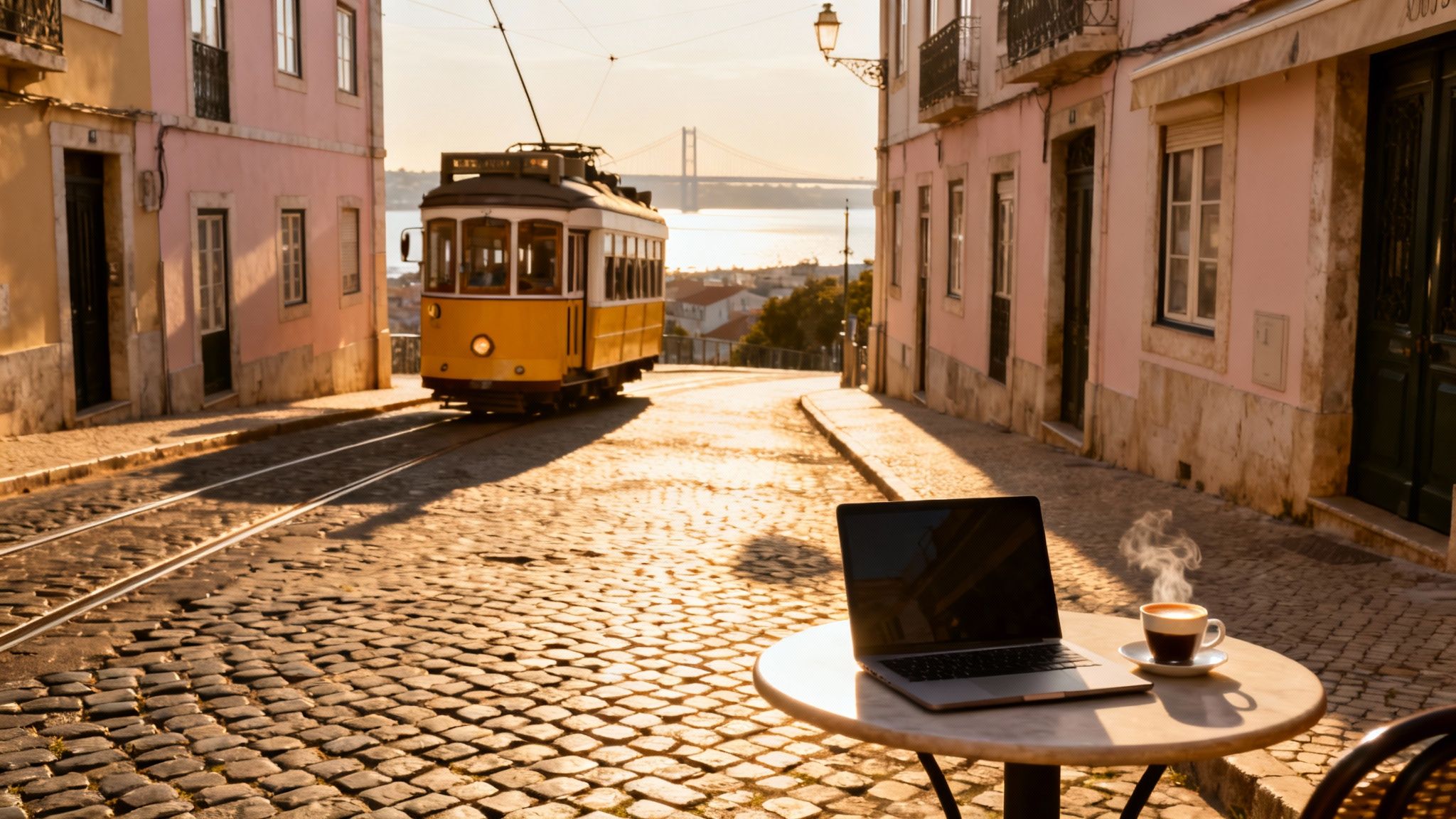
Low-Impact Living and Connectivity
Lisbon’s charm lies in its compact, human-scale neighborhoods. The iconic yellow trams, combined with a modern metro system, make navigating the city without a car simple and efficient, reinforcing its status as a top destination for a sustainable workation.
- Public Transit: A monthly Navegante pass costs just $43 USD (€40), providing unlimited access to the city’s metro, buses, and trams. This single card unlocks effortless travel between work, home, and leisure spots.
- Rail Connections: Lisbon’s Santa Apolónia and Oriente stations are gateways to the rest of Portugal and Spain. The CP Alfa Pendular high-speed train connects to Porto for weekend trips ($32-$54 USD / €30-€50), while overnight buses and trains offer low-carbon routes to Madrid.
- Accommodation: To save on rent, look beyond central hotspots like Príncipe Real. Neighborhoods like Alvalade or Marvila offer apartments for $535 to $750 USD (€500-€700) per month, a significant saving compared to the $965+ USD (€900+) in prime areas.
- Co-working: Lisbon has a dynamic co-working culture. Spaces like Second Home attract over 150 members daily, while integrated concepts like LACS offer combined living and working packages, fostering a strong sense of community for newcomers.
3. Prague, Czech Republic: The Art & History Deep-Dive Base
Prague delivers an exceptional experience for digital nomads, blending historic grandeur with modern affordability and a deep cultural scene. Its compact, walkable city center and highly efficient public transportation system make it an ideal base for low-impact living. For remote workers looking to immerse themselves in art and history without the high costs of other European capitals, Prague is one of the best cities for digital nomads.
The city’s central location establishes it as a premier rail hub, perfect for slow, intentional exploration of Central and Eastern Europe. Prague’s main station, Praha hlavní nádraží, connects you directly to cities like Vienna, Budapest, and Krakow. This seamless rail access, combined with an affordable co-working scene and a thriving community of creatives, makes Prague an unbeatable option for a long-term, culturally rich, and eco-conscious stay.
Low-Impact Living and Connectivity
Prague’s commitment to sustainable urban living is clear from its extensive tram network, metro system, and pedestrian-friendly core. The city encourages car-free exploration, making it easy to live like a local.
- Public Transit: A 30-day public transport pass costs just around $25 USD (550 CZK) and grants unlimited access to the entire network of metros, trams, and buses. This is your key to discovering vibrant residential areas like Vinohrady, Žižkov, and Smíchov.
- Rail Connections: Prague is a fantastic launchpad for train travel. The ÖBB night train to Vienna, for example, departs late and arrives early, saving you travel time and accommodation costs. You can book a wide range of train tickets via platforms like Trip.com.
- Accommodation: You can find furnished rooms in shared apartments for approximately $430 to $700 USD (€400-€650) per month in neighborhoods like Vinohrady or Žižkov, a significant saving compared to the Old Town.
- Co-working: The city is home to a growing co-working community. Spaces like Impact Hub Prague offer flexible options, including monthly hot-desking for about $130 USD (€120), creating an environment ripe for collaboration and networking.
4. Valencia, Spain: The Underrated Mediterranean Hub
Valencia offers a perfect blend of Mediterranean lifestyle, affordability, and authentic Spanish culture, making it one of the best cities for digital nomads seeking an alternative to Barcelona’s crowds. The city is celebrated for its pedestrian-friendly historic center, beautiful Turia Gardens, and a growing remote work community. Its excellent regional rail connections make it an ideal base camp for sustainable, multi-month stays with easy weekend escapes along the coast.
This strategic location allows for a low-impact lifestyle without sacrificing exploration. The city’s main stations, Estació del Nord and Joaquín Sorolla, connect you to Spain’s extensive Renfe network. You can easily take a high-speed train to Madrid or a scenic regional train to coastal towns. This connectivity, combined with an affordable cost of living and a vibrant co-working scene, makes Valencia a top choice for digital nomads wanting a sunny, sustainable Spanish experience.

Low-Impact Living and Connectivity
Valencia’s flat terrain and extensive network of bike lanes make it a paradise for cyclists and walkers, while its public transit system efficiently connects all major neighborhoods.
- Public Transit: A Zona A monthly transit pass costs around $58 USD (€54), providing unlimited access to the inner city’s metro and bus lines. This is typically all you need unless you plan frequent trips to the distant suburbs.
- Rail Connections: Renfe trains offer affordable and regular connections. A trip to Barcelona takes about three hours and costs between $22 and $43 USD (€20-€40), while night trains to Madrid cost $43 to $65 USD (€40-€60). For cheap, scenic day trips, regional trains can take you to Albufera or Cullera for under $27 USD (€25). Book your train tickets via platforms like Trip.com.
- Accommodation: You can find great value by looking in neighborhoods like Ruzafa or El Pla del Real, where one-bedroom unfurnished apartments range from $540 to $810 USD (€500-€750) per month, often 30% cheaper than the beachfront Malvarosa area.
- Co-working: The city’s co-working culture is thriving. Spaces like Espacio Coworking in the trendy Ruzafa district offer monthly memberships for about $130 USD (€120) and host a lively community of remote workers.
5. Krakow, Poland: A Top Eastern European Gateway for Digital Nomads
Krakow is rapidly becoming one of the best cities for digital nomads, offering a stunning mix of affordability, rich history, and a strategic Central European location. For remote workers seeking a low-impact and budget-friendly base, the city delivers with a highly walkable historic core, efficient public transport, and a burgeoning creative scene. Its compact layout and excellent tram network make it easy to live car-free, connecting historic districts like Kazimierz and modern hubs like Podgórze.
This connectivity positions Krakow as an ideal launchpad for exploring Central and Eastern Europe sustainably. The main train station, Kraków Główny, offers direct connections to major cities, including overnight services to Vienna, Prague, and Budapest. This rail access, combined with an extremely low cost of living and a growing number of co-working spaces, makes Krakow a top choice for nomads wanting to explore off-the-beaten-path destinations without sacrificing community or convenience.

Low-Impact Living and Connectivity
Krakow’s charm lies in its human-scale urban design, where centuries-old architecture meets modern, sustainable living. The city actively promotes public transit and cycling, allowing for deep exploration with a minimal carbon footprint.
- Public Transit: A 30-day tram and bus pass is incredibly affordable at around $23 USD (100 PLN), providing unlimited access across all zones. These passes can be purchased at kiosks like the one at the main MDA bus station.
- Rail Connections: Krakow serves as a gateway for affordable train travel. PKP Intercity offers comfortable night trains to Vienna (departing 20:30, arriving 06:15) for as little as $35 to $50 USD (€35-€50). Regional trains are perfect for weekend trips to Wrocław (4 hours, $15-$25 USD) or Gdańsk (7 hours, $20-$30 USD). You can find more information about traveling in this region in our guide to the best places to travel in Eastern Europe.
- Accommodation: You can find significant savings by staying outside the main Old Town. Studio apartments in the vibrant Kazimierz or up-and-coming Podgórze districts range from $380 to $600 USD (€350-€550) per month, compared to over $870 USD (€800) in the historic center.
- Co-working: The city’s co-working scene is thriving. Spaces like Krakow Coworking in the Podgórze district offer monthly memberships for around $109 USD (€100) and attract a daily community of 60 to 80 members, fostering a collaborative atmosphere.
6. Barcelona, Spain: The Catalonian Creative Hub
Barcelona stands as one of Europe’s most vibrant digital nomad hubs, combining a sunny Mediterranean climate, architectural wonder, and a thriving creative community. While it can be pricier than some competitors, the city’s world-class public transport, excellent rail access to Southern France and the rest of Spain, and rich cultural landscape justify the premium. Barcelona is ideal for remote workers prioritizing community, career growth, and rail-first European exploration over pure budget optimization.
The city’s efficient Metro, tram, and bus networks make it incredibly easy to live car-free, connecting diverse neighborhoods from the bohemian streets of Gràcia to the innovative tech district of Poblenou. This connectivity extends internationally, with Barcelona Sants station serving as a key hub for high-speed trains. You can catch an overnight train to Paris, saving a day of travel and a night’s accommodation, or take quick regional trips to Valencia or the stunning Montserrat monastery for weekend escapes.

Low-Impact Living and Connectivity
Barcelona’s blend of urban energy and coastal relaxation is supported by strong, sustainable infrastructure. Its walkability and extensive public transit make a low-impact lifestyle both enjoyable and practical. The city’s digital nomad visa further solidifies its appeal for long-term stays. You can learn more about how Spain’s visa makes it one of the best eco-friendly bases for digital nomads.
- Public Transit: For infrequent commuters, a T-Casual 10-journey ticket costs around $12 USD (€11.35) and is valid across the metro, trams, buses, and FGC trains. This offers more flexibility than a monthly pass if you primarily work from home.
- Rail Connections: Barcelona is a launchpad for exploring France and Spain by rail. Overnight trains to Paris depart around 21:05 and arrive at 08:30, with tickets ranging from $43 to $108 USD (€40-€100). Regional trains to Valencia take just three hours for $22 to $43 USD (€20-€40).
- Accommodation: You can find furnished apartment shares in neighborhoods like Gràcia or Poblenou for between $860 and $1,180 USD (€800-€1,100) per month, which is significantly cheaper than central districts like Eixample.
- Co-working: The city is full of collaborative spaces. MOB (Makers of Barcelona) is a popular choice, with hot desks from $195 to $270 USD (€180-€250) per month and a bustling community of over 400 members.
7. Budapest, Hungary: The Thermal Wellness Base
Budapest stands out as one of the best cities for digital nomads by offering an elegant blend of thermal wellness culture, affordable living, and stunning Art Nouveau architecture. For remote workers seeking a European base with exceptional value, the city’s efficient public transport, strategic Danube location, and low cost of living create ideal conditions for multi-month, low-impact stays. This combination makes it a practical and enriching hub for sustainable travel.
The city’s world-renowned thermal baths provide unique wellness amenities while supporting a more sustainable, slow-travel narrative. Beyond its local charm, Budapest’s robust rail network connects you to less-traveled routes across Eastern and Central Europe. This strong connectivity, paired with a burgeoning co-working scene and a vibrant local culture, makes Budapest perfect for nomads who want an affordable, well-connected base for deep exploration.
Low-Impact Living and Connectivity
Budapest makes car-free living easy and affordable with its comprehensive network of trams, buses, and metro lines managed by BKK. The city’s layout encourages walking, especially in the historic inner districts, while its strategic rail connections make it a gateway to the wider region.
- Public Transit: A 30-day unlimited transit pass costs just around $26 USD (9,500 HUF) and can be purchased at BKK offices or metro stations. This pass gives you access to all trams, buses, and metro lines, making it easy to explore residential districts like VII, VIII, and XI, where rents are often 40% lower than in the central District V.
- Rail Connections: Budapest-Keleti station is a central hub for MÁV national rail services. You can easily book night trains to Vienna (22:00-07:00, $27-$48 USD / €25-€45) or Bucharest (20:00-09:00, $38-$65 USD / €35-€60). Regional trains also offer quick weekend getaways to destinations like Lake Balaton in under two hours.
- Accommodation: You can find shared apartments in vibrant neighborhoods like District VII or District VIII for between $485 and $755 USD (€450-€700) per month. For extended stays, local rental sites and community forums often provide better rates than short-term platforms.
- Co-working: Budapest’s co-working scene is growing, with spaces like KAPTÁR and Impact Hub offering monthly memberships from $86 to $162 USD (€80-€150). These hubs attract a diverse community of 50-100 daily members, providing excellent networking opportunities.
8. Brno, Czech Republic: The Underrated Innovation Hub
Brno, the Czech Republic’s second-largest city, stands out as a hidden gem among the best cities for digital nomads, offering an energetic innovation culture and affordability without Prague’s overwhelming crowds. Its growing tech scene, significantly lower living costs, and strategic position within Central Europe’s rail network make it a prime choice for remote workers. For those prioritizing a sustainable and authentic local experience, Brno’s walkable core and thriving co-working spaces support a low-impact lifestyle.
The city’s compact size and efficient public transit system make car-free living a simple and practical choice. Its main train station, Brno hlavní nádraží, is a key hub connecting you to major regional capitals like Vienna, Prague, and Bratislava in just a couple of hours. This exceptional connectivity establishes Brno as a perfect base for exploring Central Europe sustainably, allowing for spontaneous, flight-free weekend trips and a deeper connection to the region.

Low-Impact Living and Connectivity
Brno’s appeal lies in its manageable scale and smart urban planning, which promotes walkability and efficient transit. The city center is easily navigated on foot, while its extensive tram and bus network connects all key neighborhoods.
- Public Transit: A 30-day unlimited transit pass costs around $21 USD (485 CZK) and covers all trams and buses, making it incredibly easy to explore areas beyond the historic center.
- Rail Connections: Regional trains are both affordable and efficient. National carrier ČD offers frequent connections to Prague (2 hrs, $11-$22 USD / €10-€20), Vienna (2 hrs, $16-$32 USD / €15-€30), and Bratislava (1.5 hrs, $9-$16 USD / €8-€15). You can conveniently book tickets for these routes via Trip.com.
- Accommodation: Unfurnished one-bedroom apartments in desirable central neighborhoods like Staré Město can be found for between $380 and $540 USD (€350-€500) per month, offering significant savings over Prague.
- Co-working: The city’s tech-forward community is supported by affordable co-working spaces. Impact Hub Brno is a popular choice, with hot-desks available for $65-$87 USD (€60-€80) per month and a collaborative atmosphere.
9. Split, Croatia: The Dalmatian Coastal Escape
Split offers digital nomads an ideal Mediterranean lifestyle, blending urban affordability with stunning Adriatic coastal beauty and reliable summer weather. For remote workers seeking a seasonal base, the city is a paradise of walkable neighborhoods, efficient public transport, and a growing co-working scene. Its strategic location makes it a perfect hub for exploring the Dalmatian islands via an extensive ferry network, allowing for a seamless work-life balance from April to October.
This robust infrastructure establishes Split as a fantastic long-term summer base for eco-conscious nomads. The city’s main bus and ferry terminals are centrally located, providing a gateway to the islands and other coastal towns without needing a car. This connectivity, paired with a burgeoning digital nomad community and affordable living, makes Split one of the best cities for digital nomads looking to enjoy a European summer on the sea.
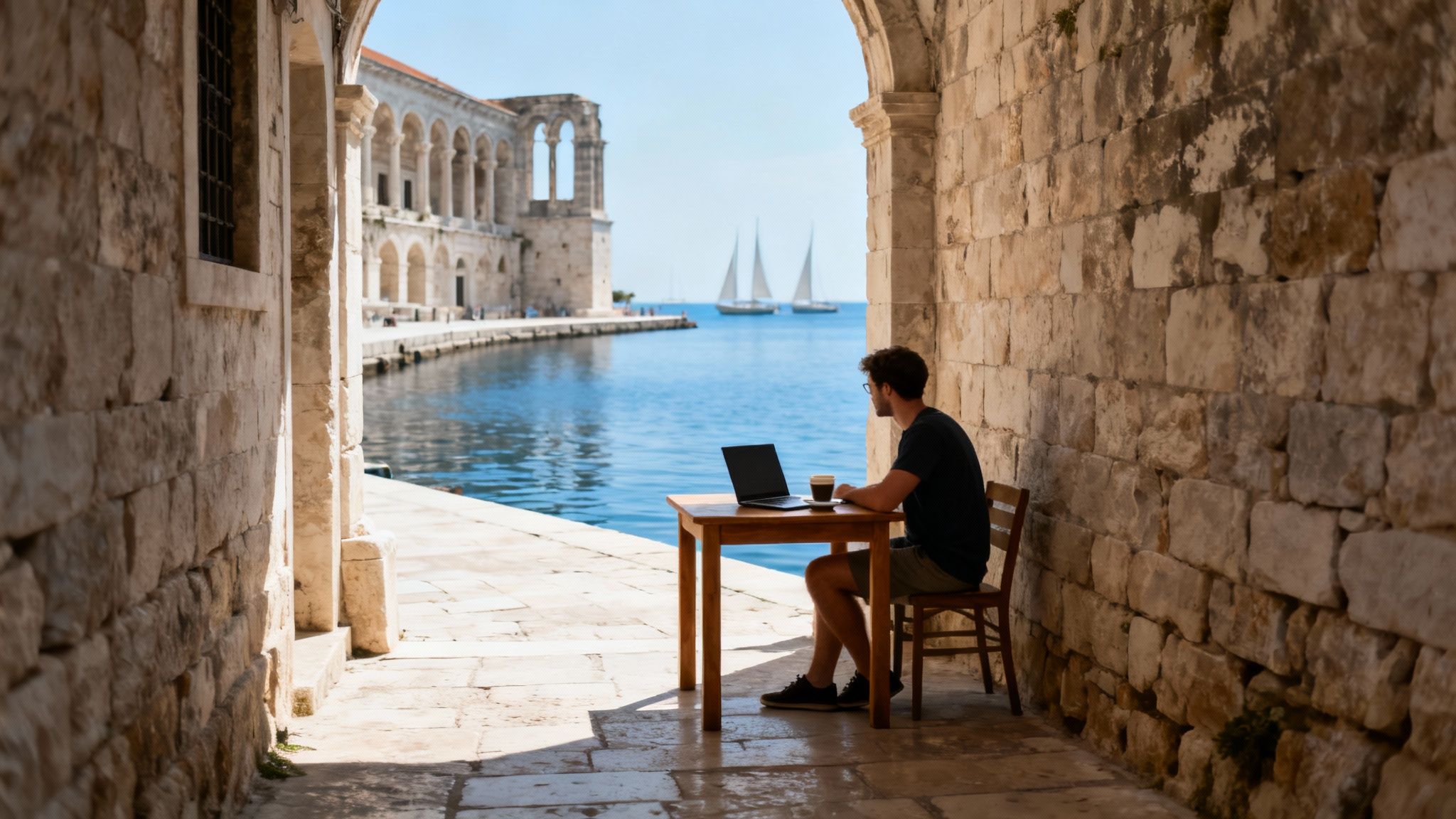
Low-Impact Living and Connectivity in Split
Split’s commitment to a sustainable, car-free lifestyle is evident in its compact, pedestrian-friendly city center and strong public transit links. The flat coastal terrain encourages walking, while its maritime network is key to regional exploration.
- Public Transit: A 10-journey bus ticket from Splitska Linija costs around $11-$13 USD (€10-€12), offering a 60% savings compared to single fares. This is perfect for reaching neighborhoods outside the immediate historic core.
- Ferry and Rail Connections: The city is a hub for island-hopping. Ferries to Hvar (1.5 hours) or Vis (2.5 hours) cost between $5 and $11 USD (€5-€10), making weekend getaways effortless. HŽ regional trains also connect you to mainland destinations like Zagreb (5.5 hours, $27-$43 USD / €25-€40). Explore options and book tickets via platforms like Trip.com.
- Accommodation: You can find significant value by staying just outside the main tourist zone. One-bedroom apartments in Varoš or Lučac neighborhoods typically range from $650 to $970 USD (€600-€900) per month, a 30% savings compared to waterfront properties.
- Co-working: The city’s co-working scene is expanding. Spaces like Coworking Split offer hot-desks for approximately $130-$195 USD (€120-€180) per month and foster a community of local and international remote workers.
10. Guide Summary: Comparative Notes & Actionable Tips
Choosing your next base from a list of the best cities for digital nomads involves balancing costs, connectivity, and lifestyle. This guide was designed to highlight hubs that excel in low-impact living, prioritizing rail travel and walkability over flights and car dependency. From Berlin’s creative energy to Vienna’s imperial elegance and Amsterdam’s innovative spirit, each city offers a unique blend of affordability and sustainable infrastructure, making a car-free life both easy and enjoyable.
These cities serve as powerful gateways to their respective regions. Lisbon provides an affordable entry point to Western Europe’s stunning coastlines, while Copenhagen opens up Scandinavia’s minimalist charm. By leveraging extensive train networks, you can explore entire continents with a minimal carbon footprint. This approach not only reduces your environmental impact but also deepens your travel experience, connecting you more intimately with the landscapes you traverse.
This summary provides a comparative look to help you make an informed decision. Whether you prioritize a vibrant co-working scene, access to nature, or the lowest possible cost of living, the ideal sustainable base is within reach. For a deeper dive into creating a low-impact remote work lifestyle, you can explore our full guide on green travel for digital nomads in 2025.
Comparative Notes for Your Next Base
To help you choose, consider how these cities stack up against each other based on key digital nomad priorities.
- Most Affordable: Lisbon and Berlin consistently offer the lowest monthly living costs, with shared apartments often available for under $1,000 USD.
- Best Rail Gateway: Berlin’s Hauptbahnhof is arguably the continent’s best-connected station, offering direct, flight-free access to Central and Eastern Europe. Vienna is a close second, serving as a primary hub for routes into the Balkans and Italy.
- Top for Walkability & Cycling: Amsterdam and Copenhagen are unmatched for cycling infrastructure, making car-free living completely seamless.
- Climate & Seasonality: For milder winters, Lisbon is the clear winner. For those who embrace four distinct seasons, Vienna and Berlin offer classic European experiences, with beautiful autumns and festive winters.
- Visa Friendliness: Portugal’s Digital Nomad Visa makes Lisbon an attractive and straightforward option for long-term stays, while Germany offers a well-established Freelancer Visa.
Top 10 Digital Nomad Cities Comparison
| City | Setup complexity 🔄 | Monthly budget ⚡ | Expected outcomes ⭐ | Ideal use cases 💡 | Key advantages 📊 |
|---|---|---|---|---|---|
| Berlin, Germany | Moderate — Anmeldung (residence registration) and rising rents | $1,300–$1,950 USD / month | High-value, rail-first creative base ⭐⭐⭐⭐ | Long-term rail-based stays; eco-conscious nomads | Central night-train hub, excellent transit & cycling infrastructure |
| Lisbon, Portugal | Moderate — D7 visa option; some bureaucracy for long stays | $970–$1,500 USD / month | Sunny, affordable coastal base ⭐⭐⭐⭐ | Warm-weather base with frequent Iberian weekend trips | Mild climate, coastal access, tram/metro & strong café culture |
| Prague, Czech Republic | Moderate — 90-day limits; residence permits for longer stays | $870–$1,300 USD / month | Culturally rich, low-cost hub ⭐⭐⭐⭐ | Multi-month cultural immersion and Central Europe rail travel | Very affordable, walkable historic center, strong rail links |
| Valencia, Spain | Low–Moderate — standard Schengen rules, fewer visa hurdles | $1,030–$1,460 USD / month | Affordable Mediterranean hub ⭐⭐⭐ | Beach-access base with regional Spanish escapes | Coastal lifestyle, good regional Renfe connections, local food culture |
| Krakow, Poland | Moderate — 90-day limits; visa required beyond short stays | $760–$1,080 USD / month | Budget-friendly Eastern gateway ⭐⭐⭐⭐ | Gateway to Eastern Europe and overland routes; low-cost living | Lowest regional costs, central rail connections, walkable Old Town |
| Barcelona, Spain | Higher — short-term rental rules and higher accommodation costs | $1,620–$2,380 USD / month | Vibrant creative hub; premium experience ⭐⭐⭐⭐ | Creative career growth, large nomad community, France/Spain rail | Extensive co-working scene, strong international rail links |
| Budapest, Hungary | Moderate — 90-day limits; Hungarian-language for admin | $1,080–$1,500 USD / month | Affordable with wellness perks ⭐⭐⭐ | Wellness-focused long stays; Central European exploration | Thermal baths, low prices, solid tram/rail network |
| Brno, Czech Republic | Low — simpler housing market but fewer international flights | $650–$970 USD / month | Quiet, innovation-focused base ⭐⭐⭐ | Tech/startup nomads seeking low cost and local ties | Very low cost, tech community, fast trains to Vienna/Prague |
| Split, Croatia | Low–Moderate — seasonal services; 90-day limits apply | $1,190–$1,620 USD / month | Summer-focused coastal lifestyle ⭐⭐⭐ | Seasonal beach base; island-hopping and Adriatic escapes | Ferry network to islands, strong summer appeal, emerging coworking |
| Guide summary | N/A — comparative overview of admin & visa notes | $650–$2,380 USD / month (city-dependent) | Consolidated guidance & actionable tips ⭐⭐⭐⭐ | Choosing base by budget, climate, and rail connectivity | Side-by-side cost, climate buckets, rail gateway & sustainability notes |
Choosing Your Next Low-Impact Home Base
Finding the truly best cities for digital nomads is less about a single definitive ranking and more about discovering the place that aligns with your personal and professional priorities, all while honoring your commitment to sustainable travel. Throughout this guide, we’ve explored hubs from Berlin’s creative, well-connected core to Split’s sun-drenched coastal pace, each offering a unique blueprint for a low-impact, rail-first lifestyle. The common thread is a powerful one: the ability to live well, work effectively, and explore deeply without relying on carbon-intensive travel.
These cities demonstrate that a fulfilling nomadic life doesn’t require constant flights or a sprawling carbon footprint. By prioritizing exceptional walkability, robust public and intercity rail networks, and a culture that supports longer, more intentional stays, you can craft an enriching experience that is both affordable and eco-conscious. Choosing a base like Valencia for its cycling infrastructure or Brno for its compact, innovative energy allows you to integrate seamlessly into a community, supporting local economies and minimizing your environmental impact in a meaningful way.
Best Cities for Digital Nomads Who Want Slow, Low-Impact Travel
The ultimate goal is to shift the digital nomad paradigm from a whirlwind tour of airports to a grounded, intentional exploration of regions. This approach not only dramatically reduces your travel emissions but also fosters a deeper connection to the places you call your temporary home. It’s about mastering the art of slow travel, understanding the rhythm of a city through its local markets and train schedules, and proving that a globe-trotting career can coexist with climate-conscious values.
For more in-depth guides on sustainable remote work and travel, explore the resources at Eco Nomad Travel. We provide actionable blueprints for building a fulfilling, low-impact lifestyle, helping you master everything from zero-waste packing to planning complex, rail-first itineraries. Start your journey toward more intentional travel with us at Eco Nomad Travel.
Join the Sustainable Work Movement
Want more rail-first itineraries, low-impact packing systems, and walkable base-city ideas?
Explore Eco Nomad Travel
📚 Core Guides
🧭 Planning & Logistics
🗺️ Destinations & Seasons
Jeremy Jarvis — founder of Eco Nomad Travel, sustainable travel writer, and advocate for regenerative tourism. His work focuses on low-impact mobility, eco-friendly digital nomad life, and climate-positive travel.
Legal
Affiliate DisclaimerPrivacy Policy
Terms of Service
Image & Media Notice
Cookie Policy
Contact
Affiliate Disclosure: Some links on Eco Nomad Travel are affiliate links, meaning we may earn a small commission at no extra cost to you. This supports our mission to inspire responsible and low-impact travel worldwide.
Connect
✅ Trusted Official Sources
Plan smarter eco trips
Try our free Sustainable Travel Tools for Digital Nomads – carbon calculator, train vs plane comparator, and more.
Open Tools Hub