Navigating Europe by train is one of the best ways to see the continent—it’s scenic, low-carbon, and puts you right in the heart of cities. But figuring out the best rail passes for Europe can feel overwhelming at first. The two big names you’ll see everywhere are the Eurail Pass (for non-European residents) and the Interrail Pass (for European residents).
Functionally, they’re the same pass, giving you access to a massive network that covers over 33,000 destinations in 33 countries. This makes them a fantastic tool for anyone planning a flexible, multi-country adventure.
To help you decide, it’s smart to compare pass options with individual tickets from reliable platforms like Trip.com, which can offer insights into the cost of specific legs of your journey.
Key Takeaways
- Eurail vs. Interrail: It all comes down to where you live. Eurail is for travelers from outside Europe; Interrail is for European residents. The network and benefits are identical.
- Is a pass worth it? Usually, yes—if your trip involves several long-distance train journeys across multiple countries. For short hops or a fixed route, point-to-point tickets might save you money.
- Watch for hidden costs: High-speed and night trains almost always require a mandatory seat reservation. Budget an extra **$10–$40 USD (€10–€35)** for each of these rides.
- Flexibility is the real prize: The biggest win with a pass is the freedom to change your plans on the fly. This is a game-changer for slow travelers and digital nomads.
- Lower your carbon footprint: Choosing the train over a short-haul flight is a huge win for the planet, making a rail pass a cornerstone of sustainable European travel.
Editor’s Pick: Eurail Global Pass
For non-European residents planning a trip across several countries, the Eurail Global Pass hits the sweet spot between flexibility, value, and sheer geographic reach. With options ranging from a few travel days to a full month of continuous travel, it’s the most versatile pass out there for exploring Europe by train, whether you’re on a whirlwind tour or a slow, meandering journey.
Choosing Your Ideal European Rail Pass
Picking the right rail pass comes down to a simple trade-off: cost versus flexibility. The central question you need to answer is whether a single comprehensive pass will offer better value than buying individual tickets for each leg of your trip.
A rail pass really proves its worth when your itinerary is packed with long-distance or high-speed journeys crossing several borders. Think of a classic route like Paris to Amsterdam, then on to Berlin and finishing in Prague. Trying to buy those tickets last-minute would be painfully expensive, but with a pass, the cost is predictable. You get a set travel budget and zero stress about booking every single ride.
On the other hand, if your plans are locked in months ahead of time or you’re sticking to one region with cheap local trains, point-to-point tickets could be the smarter financial move. Booking 60–90 days in advance directly with national rail operators can unlock some serious discounts.
To figure this out, start by sketching out a rough itinerary. Our guide on how to use a train travel route planner can help you map your journey and get a feel for the potential costs.
Key Factors to Consider
Before you buy a pass, run through these questions. Your answers will point you in the right direction.
- How much spontaneity do you need? If you love the idea of changing your destination on a whim, a rail pass is almost always the better choice. It’s built for freedom.
- Which countries are on your list? Train ticket prices vary wildly across Europe. A pass delivers fantastic value in pricier countries like Switzerland and Germany but might be overkill in parts of Eastern Europe where individual tickets are already cheap.
- What’s your travel pace? A “flexi” pass, which gives you a certain number of travel days within a month or two, is perfect for slow travelers who linger in each city. A continuous pass is better for those who are on the move every couple of days.
Comparing Pass Value to Point-to-Point Tickets
Here’s a quick breakdown of how a rail pass stacks up against buying individual tickets for your European train journeys.
| Feature | Rail Pass (e.g., Eurail Global) | Point-to-Point Tickets |
|---|---|---|
| Best For | Spontaneous, multi-country trips with long-distance travel. | Fixed itineraries, short trips, or budget-focused travel. |
| Cost | Higher upfront cost, but predictable per-journey expense. | Can be cheaper if booked far in advance; very expensive last-minute. |
| Flexibility | High. Change your plans anytime without financial penalty. | Low. Tickets are often tied to a specific train and time. |
| Convenience | Excellent. One pass for multiple journeys across different networks. | Requires separate bookings for each leg of the journey. |
Eurail Global Pass vs Interrail Global Pass: Best Rail Passes for Europe
If you’ve started looking into the best rail passes for Europe, you’ve already run into two big names: Eurail and Interrail. While they sound like competitors, they’re really just two sides of the same coin. Both passes unlock the exact same network, giving you access to over 33,000 destinations across 33 countries.
So, what’s the difference? It all comes down to one simple thing: where you live.
If you’re a resident of a non-European country—say, the USA, Canada, or Australia—the Eurail Global Pass is the one for you. If you’re a European resident (and yes, that includes the UK), you’ll be buying the Interrail Global Pass. That’s it. It’s a straightforward rule designed to distinguish between travelers visiting from abroad and those already living on the continent.
From the trains you can ride to the discounts you get on things like ferries, the benefits are identical. The product is the same, so your choice is already made based on your passport or legal residency.
So, What’s The Big Difference? (Spoiler: Not Much)
The core decision between Eurail and Interrail is completely out of your hands—it’s based on residency, full stop. Here’s a quick breakdown to show you just how similar they are.
This table breaks down the core differences and similarities between the Eurail and Interrail Global Passes to help you quickly identify the right option based on your residency.
Eurail vs Interrail Feature Breakdown
| Feature | Eurail Global Pass | Interrail Global Pass |
|---|---|---|
| Who Can Buy It? | Non-European residents. | European residents (including UK). |
| Network Coverage | 33 countries, 33,000+ destinations. | 33 countries, 33,000+ destinations. |
| Pass Types | Flexi (e.g., 7 days in 1 month) and Continuous. | Flexi (e.g., 7 days in 1 month) and Continuous. |
| Benefits | Same discounts on ferries, attractions, etc. | Same discounts on ferries, attractions, etc. |
| Mobile Pass | Yes, fully digital option available. | Yes, fully digital option available. |
| Pricing | Priced in USD/CAD etc., but near-identical value. | Priced in EUR/GBP, but near-identical value. |
As you can see, once you get past the name on the ticket, the experience is exactly the same. Your travel freedom, the trains you can board, and the perks you receive are identical.
Comparing Pass Structures: Flexi vs. Continuous
Both Eurail and Interrail offer their passes in two main flavors: Flexi and Continuous.
A Flexi Pass is designed for slower, more immersive travel. It gives you a set number of travel days to use within a larger window—for example, 7 travel days within a one-month period. This is perfect if you want to spend a week in one city before moving on, as you only use a “travel day” when you’re actually on a train between destinations.
On the other hand, a Continuous Pass is for those whirlwind trips. It gives you unlimited train travel every single day for its entire validity, like for 15 straight days or a full month. This suits a fast-paced itinerary where you’re constantly on the move. Prices for a youth Eurail Global Pass can start around $231 USD for a 4-day Flexi Pass and go up to $782 USD for a 3-month continuous pass.
This flowchart makes the residency rule crystal clear.
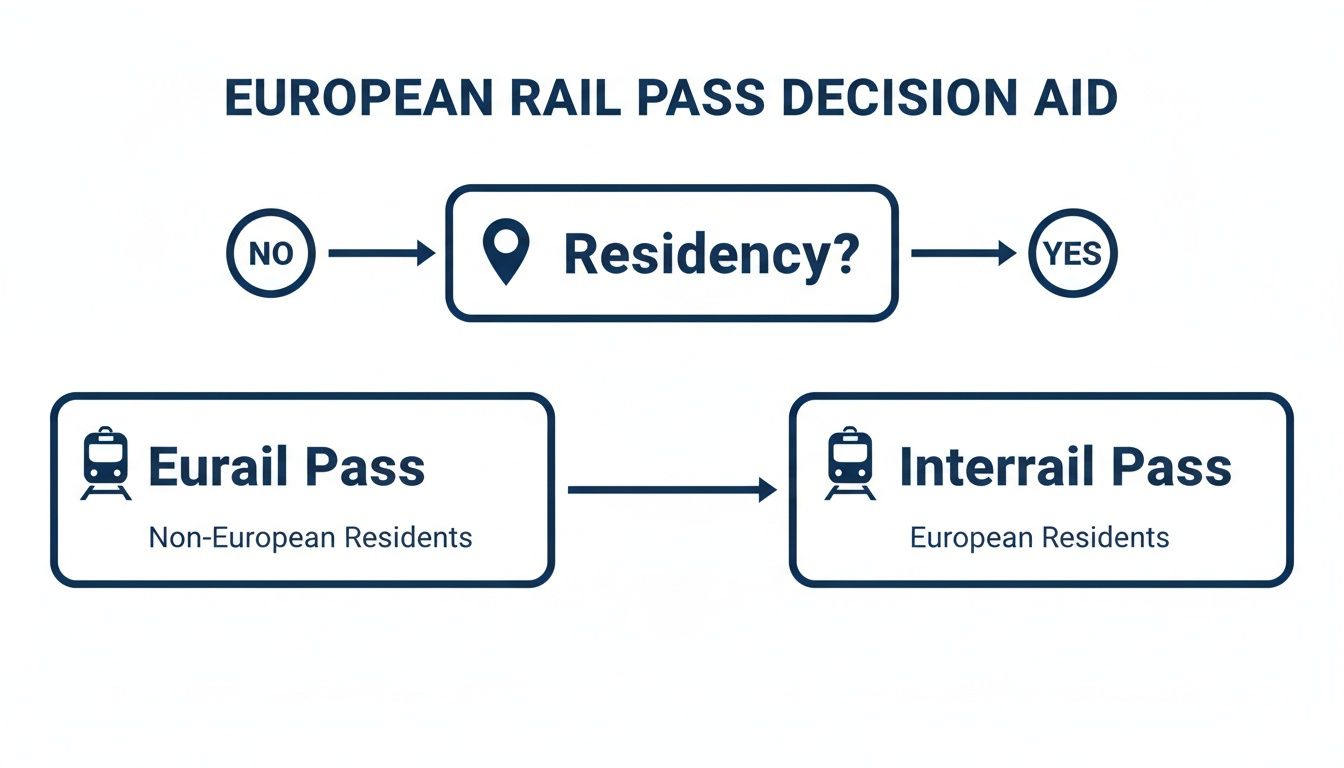
As the diagram shows, figuring out which pass to get is the easiest decision you’ll make. The real work is in choosing your route!
The Rise of Rail for Slow, Sustainable Travel
For digital nomads and conscious travelers, a rail pass has become a powerful tool for seamless, low-impact exploration. 2023 was a record-breaking year for Interrail sales, fueled by a renewed interest in eco-friendly travel after the pandemic.
With rail accounting for just 8% of transport in most EU countries, there’s massive room for growth. Passes like these are key to encouraging a shift away from short-haul flights. Every long-distance train journey you take replaces a flight, which is a significant win for the environment. By choosing the train, you’re actively reducing your carbon footprint while enjoying a more scenic and relaxed way to travel.
Our guide on how to travel Europe by train dives deeper into planning a low-carbon itinerary from start to finish.
The Real Environmental Choice: Train vs. Plane
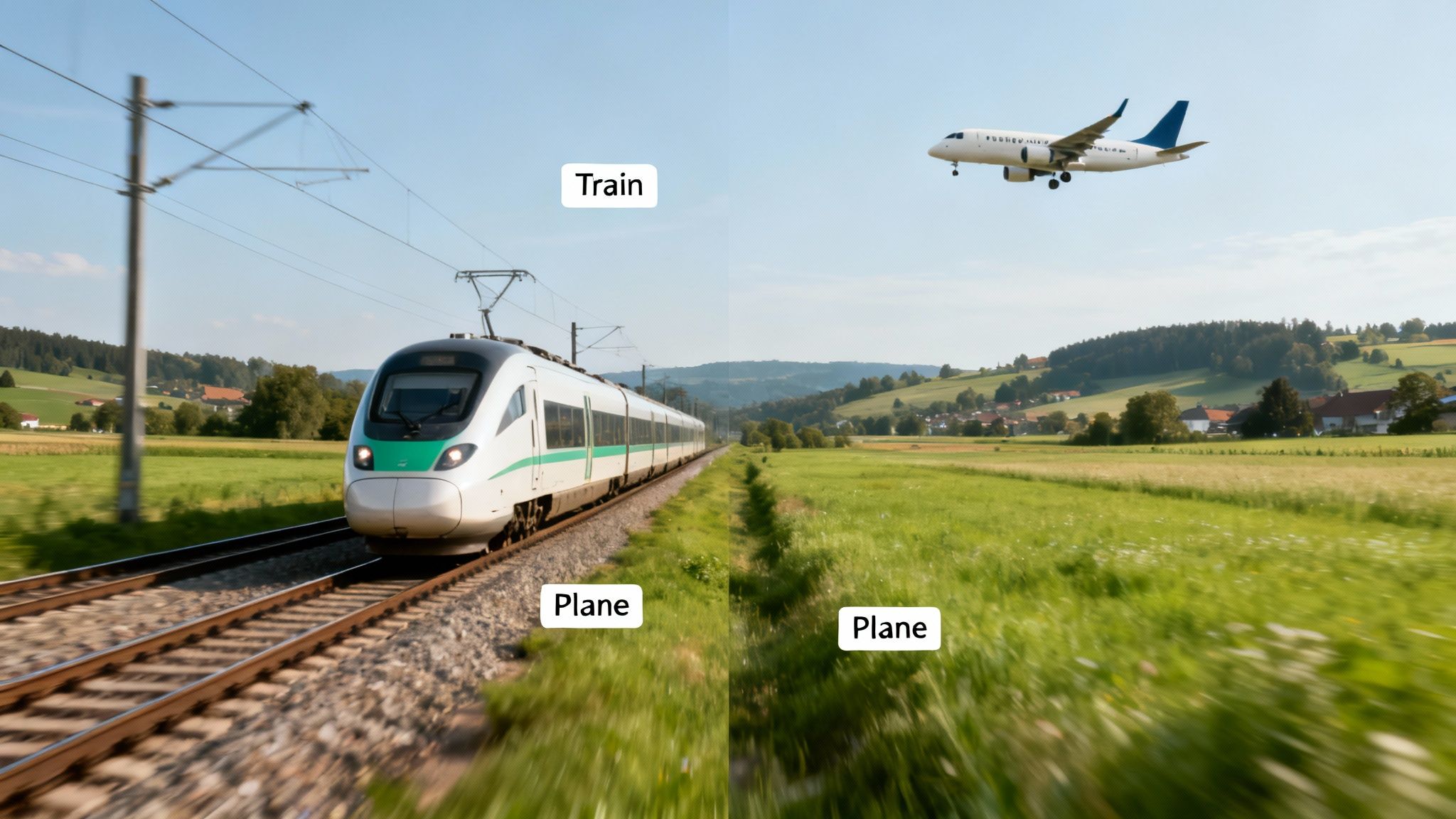
For any traveler trying to keep their footprint low, the train versus plane debate is a big one. The data, however, makes a pretty compelling case for the rails. Trains generate a tiny fraction of the CO₂ emissions per passenger compared to flights, and that difference is starkest on the short-haul routes that stitch Europe’s major cities together.
[carbon_calculator_2025]
Choosing the train over a plane for a popular route like Amsterdam to Paris, for example, can slash your personal carbon emissions for that single journey by up to 90%. When you repeat that choice across a multi-city trip, it becomes one of the most powerful sustainable travel decisions you can make. It’s why a good rail pass is such a fantastic tool for low-impact exploration. Staying connected while you travel is also important; consider an eSIM from a provider like Airalo to avoid hefty roaming charges.
This tool helps turn abstract numbers into a concrete choice, letting you plan trips that align with your values. But the benefits of choosing the train go well beyond just CO₂.
Beyond Carbon: The Other Wins for Rail Travel
When you opt for the train, you’re not just cutting emissions. You’re also helping to:
- Reduce Noise Pollution: Trains are so much quieter than planes, especially around takeoff and landing. This means less disruption for the communities living near transport hubs.
- Ease Airport Overcrowding: We’ve all felt the pain of packed airports and delayed flights. Shifting more travelers onto the rails helps relieve that immense strain on aviation infrastructure.
- Support a Greener Grid: Every ticket bought encourages more investment in high-speed rail and cleaner energy to power it. This directly supports the EU’s ambitious goals for a truly sustainable transport network.
If you want to dive deeper into the specific numbers, check out our complete guide to train vs. plane emissions.
Ultimately, every journey taken by train instead of a plane nudges travel culture in a healthier direction. By using one of the best rail passes for Europe, you’re not just saving money and gaining freedom—you’re actively choosing a better, lower-impact way to see the world.
One-Country & Regional Passes: Diving Deeper
While the freedom of a Global Pass is incredible for sprawling, multi-country adventures, it isn’t always the most economical tool for the job. Sometimes, the best rail passes for Europe are the ones that focus on a smaller area.
This is where One-Country and regional passes come in, offering a smarter, more cost-effective way to travel if your plans are concentrated in a specific region.
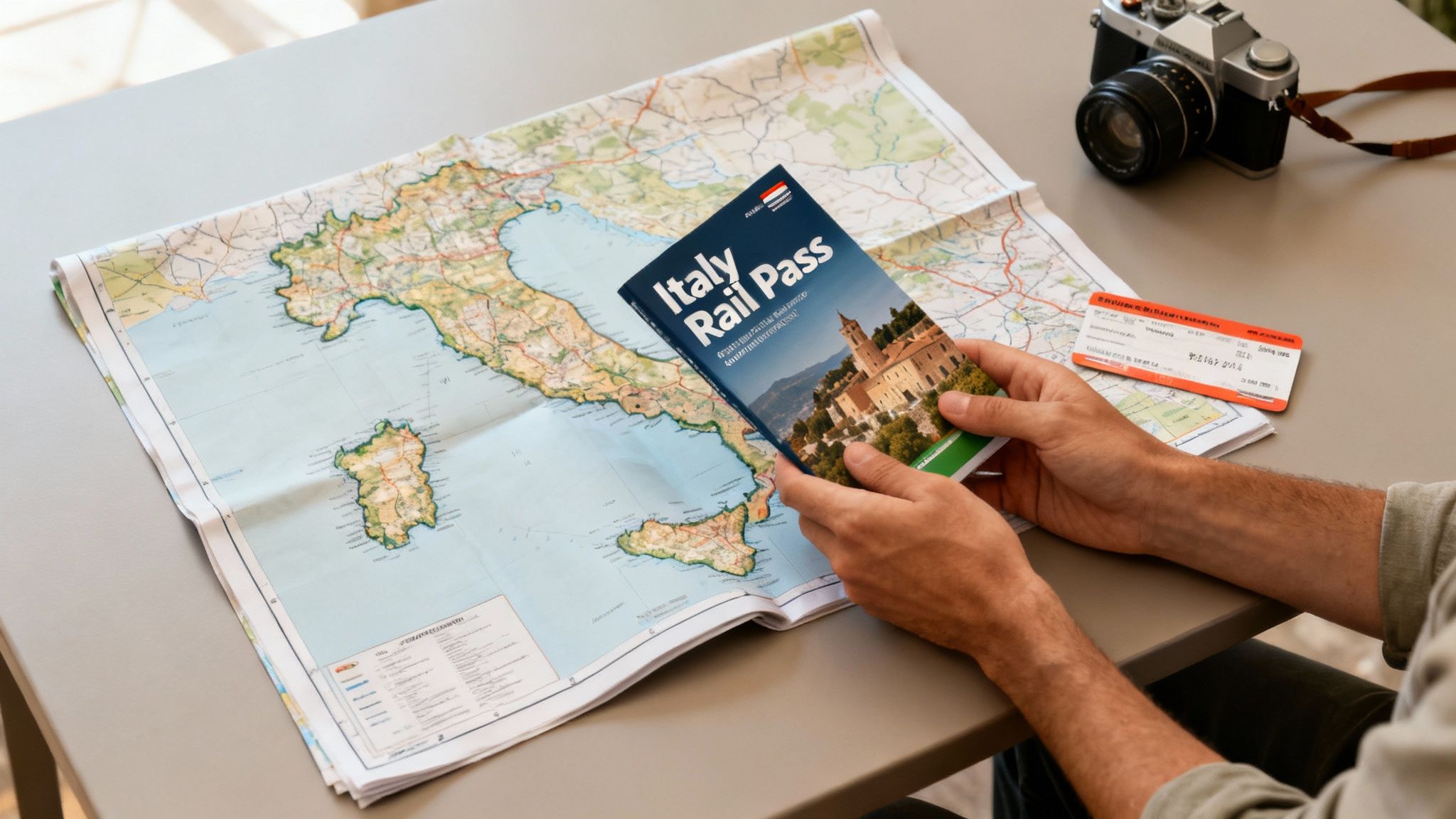
These passes are designed for deep dives. Think of an immersive journey through Italy, exploring everything from the high-speed lines connecting Rome and Florence to the slower, scenic routes in Sicily. Or a focused trip through Switzerland, where a dedicated pass makes hopping between iconic scenic trains like the Bernina and Glacier Express far more affordable.
Choosing a localized pass stops you from overpaying for access to 32 other countries you have no plans to visit. It encourages a more thoughtful travel experience, letting you truly connect with a single country’s culture and landscapes.
Doing the Math: One-Country vs Global Pass
Let’s break down the costs with a real-world example. Imagine you’re planning an eight-day deep dive into Italy’s extensive rail network.
- A Eurail Italy Pass with 4 travel days in 1 month costs approximately $216 USD for an adult in 2nd class.
- A Eurail Global Pass with 4 travel days in 1 month costs around $308 USD.
By choosing the One-Country Pass, you save $92 USD right out of the gate—money that could cover your seat reservations or a few nice meals. This simple calculation shows why it’s so important to match the pass to your itinerary.
The rule of thumb is simple: If your entire trip, or a significant chunk of it, is within one country known for its excellent (and often pricey) rail system, a One-Country Pass will almost certainly offer better value.
Top Scenarios for a One-Country Pass
Certain countries are perfectly suited for this focused approach, thanks to their dense networks and high point-to-point ticket costs.
- Switzerland: Swiss trains are notoriously expensive. A Swiss Travel Pass (a unique, highly inclusive country pass) covers not only trains but also boats, buses, and entry to over 500 museums, delivering exceptional value for an immersive trip.
- Germany: With its vast, efficient ICE network and minimal reservation requirements, a German Rail Pass offers incredible flexibility. You can explore cities from Hamburg to Munich without the high cost of last-minute tickets.
- Italy: The high-speed Frecciarossa trains are fantastic but can get expensive. An Italy Pass makes zipping between Venice, Florence, Rome, and Naples much more affordable than buying individual tickets on the fly.
The Power of Regional Passes
What if your trip spans a few neighboring countries? Regional passes fill this gap perfectly, offering a middle ground between a single-country focus and a continent-wide pass.
The most popular options include:
- Benelux Pass: Covers Belgium, the Netherlands, and Luxembourg, making it ideal for a compact tour of these tightly connected nations.
- Scandinavia Pass: Includes Denmark, Finland, Norway, and Sweden, perfect for exploring the Nordic region by rail.
These passes are priced competitively against the Global Pass for travelers whose itineraries are geographically clustered. They give you the cross-border freedom you need without the price tag of a pass that covers Portugal to Poland. It’s all about paying for what you’ll actually use—a core principle of smart, sustainable travel.
The appeal of rail travel is growing, especially for eco-conscious travelers. Eurail’s recent data highlights this trend, showing that travelers from Australia—Europe’s second-largest market after the US—took an average of 11 train journeys per trip in 2024, covering over 1,000 miles (1,652 km). This demonstrates a clear preference for ditching airport hassles in favor of the rhythmic sway of the train, a movement that localized passes make even more accessible. Find out more about 2024 Eurail travel trends.
The Hidden Costs: Reservations and Supplements
One of the biggest mistakes travelers make with European rail passes is assuming they cover everything. They don’t. While a pass handles the base fare on most trains, it’s not a golden ticket for every single journey. Getting your head around the extra costs—namely mandatory seat reservations and supplements—is the key to keeping your budget from derailing.
These extra fees pop up most often on high-speed services like France’s TGV, Italy’s Frecciarossa, and the international Eurostar. If your itinerary leans on these fast, convenient trains, you’ll have to book a specific seat in advance for a fee. It’s a system designed to stop pass holders from overwhelming services filled with full-fare ticket holders, but it does add an extra planning step.
Reservation costs swing wildly depending on the route’s popularity and how far out you book. As a rule of thumb, budget between $10–$40 USD (€10–€35) for each high-speed leg. It might not sound like much, but those fees can stack up fast on a packed itinerary.
How to Book Your Seat Reservations
Booking your seats is simple enough, but you need to do it early—especially during peak season from June to August. The most popular routes can sell out their limited allotment of pass holder seats weeks, or even months, in advance.
You have a few ways to lock in your spot:
- The Rail Planner App: The official Eurail/Interrail app is by far the most convenient tool. You can search your route, see which trains demand a reservation, and book right inside the app for a small service fee.
- Official National Rail Websites: Going directly to national rail sites like Deutsche Bahn (Germany) or ÖBB (Austria) is often the cheapest way to book, as they sometimes waive the extra fees.
- At the Train Station: The old-school method still works. You can always make reservations in person at a ticket counter in any major European station. It’s a reliable fallback but can be a real time-sink if you hit a long queue.
Estimated Reservation Fees on Popular European Routes
To give you a clearer picture, here’s a table with typical mandatory seat reservation fees for popular high-speed and international trains when you’re using a rail pass. These are just estimates, of course, and prices can fluctuate.
| Route | Train Type | Estimated Reservation Fee (USD/EUR) | Booking Recommendation |
|---|---|---|---|
| Paris to Amsterdam/Brussels/Cologne | Eurostar (Thalys) | $30–$40 USD (€27–€37) | Book 2-3 months ahead; pass seats are limited. |
| London to Paris/Brussels/Amsterdam | Eurostar | $35–$45 USD (€32–€42) | Book 3+ months ahead; sells out very quickly. |
| Paris to Barcelona | TGV | $35–$45 USD (€32–€42) | Book well in advance, especially for summer. |
| Domestic France (e.g., Paris to Nice) | TGV inOui | $12–$24 USD (€11–€22) | Book at least a week ahead; price doubles last minute. |
| Domestic Italy (e.g., Rome to Venice) | Frecciarossa | $14 USD (€13) | Book a few days ahead; generally good availability. |
| Amsterdam to Berlin | Intercity (IC) | $5–$7 USD (€4.90–€5.90) | Optional but recommended in peak season. |
| Prague to Berlin/Vienna | Railjet | $3–$4 USD (€3) | Optional but highly recommended. |
| Madrid to Barcelona | AVE | $11 USD (€10) | Mandatory; book a few days ahead. |
This table isn’t exhaustive, but it shows the pattern: the faster and more international the train, the higher the fee and the more critical it is to book early.
The Special Case of Night Trains
Night trains are a fantastic, sustainable way to travel, saving you the cost of a hotel and a full day of transit. However, they almost always require a reservation and a supplement. Your pass covers the journey itself, but you have to pay extra for your bunk.
Here’s what to expect:
- Reclining Seats: The cheapest way to ride, usually with a small reservation fee around $15 USD (€14). Not exactly comfortable, but it gets the job done.
- Couchettes: These are shared bunk-style compartments with 4 or 6 beds. They hit a sweet spot of comfort and cost, with supplements from $25–$50 USD (€23–€47) per person.
- Sleepers: For real privacy and comfort, you can book a private or semi-private cabin with 1, 2, or 3 beds, often with its own sink. Expect to pay anywhere from $60–$150 USD (€56–€140) or more.
Booking these sleeper trains far in advance is absolutely essential. For a deeper dive, our guide on how to book European sleeper trains walks you through the entire process.
Strategies to Keep Extra Costs Down
While some fees are unavoidable, you can absolutely minimize them with a bit of smart planning.
The key is prioritizing regional trains whenever possible. These slower, reservation-free services might add time to your journey, but they offer a more scenic ride and a peek into smaller towns—all while saving you cash on booking fees.
To keep your budget healthy, try these tactics:
- Filter Your Search: When using the Rail Planner app, filter for “trains without compulsory reservation.” This will instantly reveal alternative routes that won’t cost you an extra cent.
- Travel in Reservation-Free Countries: Countries like Germany, Switzerland, Austria, and the Netherlands have very few mandatory reservation rules on domestic trains, making them fantastic value for pass holders.
- Book Way in Advance: For routes where a reservation is a must (like the Eurostar), booking 2-3 months ahead gives you the best shot at snagging the cheapest pass holder seats before they’re gone.
When Point-to-Point Tickets Are the Smarter Choice
While rail passes offer incredible freedom, sometimes the smartest move is to skip the pass entirely. Going for individual point-to-point tickets can be a much better deal in a few common scenarios, especially for travelers on shorter trips with only a handful of train journeys planned.
If your adventure is a quick one—say, a long weekend hopping between one or two cities—the high upfront cost of a pass is tough to justify. The same logic applies if your itinerary is focused on regions where train travel is already a bargain, like much of Eastern Europe. In those cases, you’ll almost always save money by booking tickets one by one.
The biggest win for point-to-point tickets comes from planning ahead. If your travel dates are locked in months in advance, you can snap up deep discounts on high-speed routes that make individual fares far cheaper than the daily cost of a pass.
How to Do the Math and Decide
To make the right call, you have to run the numbers: compare the total cost of individual tickets against the price of the best rail pass for your trip. This isn’t as intimidating as it sounds, and doing this quick check empowers you to pick the right path for your specific itinerary without overspending.
Here’s a simple way to break it down:
- Outline Your Itinerary: List every single train journey you plan to take, from major international legs down to the shorter regional hops.
- Research Ticket Prices: Use a reliable booking platform like Trip.com or head to the official national railway websites (like Germany’s Deutsche Bahn or Italy’s Trenitalia) to look up the price for each leg.
- Check for “Sparpreis” Fares: Keep an eye out for “early-bird” or “saver” fares. These are non-refundable, deeply discounted tickets usually available 60-90 days ahead of time.
- Total the Costs: Add up the price of every ticket to get your grand total.
- Compare with a Pass: Figure out the per-journey cost of the rail pass that fits your trip. For example, a $308 USD Eurail Global Pass with 4 travel days in 1 month works out to $77 USD per travel day. Don’t forget to add the estimated reservation fees for any high-speed or night trains you’ll be taking.
If your point-to-point total comes in significantly lower than the pass price plus reservations, buying tickets individually is the clear winner.
Key Insight: The value of a rail pass is tied directly to flexibility and the high cost of last-minute travel. If you’re an organized planner who books everything well in advance, point-to-point tickets will almost always be cheaper.
When Individual Tickets Make More Sense
Certain travel styles and destinations just naturally favor the pay-as-you-go approach.
- Short and Simple Trips: For an itinerary like Paris to Brussels and back, two individual tickets booked ahead of time will be far cheaper than any pass.
- Budget-Focused Travel in Eastern Europe: Countries like Poland, Hungary, and the Czech Republic offer incredibly affordable train travel. A pass is usually overkill here.
- Hyper-Organized Planners: If your accommodation and activities are locked in months early, you can take full advantage of early-bird discounts without worrying about changing plans.
- “Trip Chaining” Itineraries: If you’re blending transport modes—taking a train, then a budget flight, then another train—a rail pass quickly loses its value. Our guide on trip chaining for rail adventures explains how to mix and match travel modes effectively.
Ultimately, choosing between a pass and point-to-point tickets is a trade-off between cost and convenience. With a little bit of research, you can confidently pick the option that best fits your travel style and your budget.
Editor’s Note: This article was fact-checked using sustainability data from the World Green Building Council, the Global Ecotourism Network, and peer-reviewed architecture studies. All partner links are vetted for compliance with sustainable business certifications.
Join the Sustainable Work Movement
Want more rail-first itineraries, low-impact packing systems, and walkable base-city ideas?
Your European Rail Pass Questions, Answered
Planning a train trip across Europe always brings up a few questions. Below are answers to the most common ones I hear, drawn from years of crisscrossing the continent by rail. Think of this as the practical advice you’d get from a seasoned traveler over a coffee.
Is a Eurail Pass Worth It for a Two-Week Trip?
It absolutely can be, but it really hinges on your travel style. If your two-week plan is packed with four or more long-distance or high-speed journeys between cities, a pass will almost certainly save you money compared to buying individual tickets.
On the other hand, if you’re only planning two or three train rides, you should do the math. Tally up the cost of those point-to-point tickets and see how it stacks up against the price of the pass. Sometimes, simpler is cheaper.
How Far in Advance Should I Book Seat Reservations?
For popular routes, high-speed trains like the TGV or Eurostar, and especially night trains, book as far ahead as you possibly can. My rule of thumb is to aim for 1-2 months in advance.
This becomes non-negotiable during peak season (June to August) and around major holidays. The number of seats allocated to pass holders is limited, and they get snapped up fast. Waiting until the last minute is a surefire way to find your preferred train is already full.
Can I Use My Rail Pass on Local City Transport?
Generally, no. Eurail and Interrail passes are designed for the big picture: the national and international train networks that connect cities and countries. They don’t typically cover local transport like subways, trams, or city buses.
However, some passes do offer nice little perks, like discounts on certain city transit systems or related transport like ferries. It’s always worth checking the specific benefits listed for your pass and destination—you might find some unexpected savings on local travel.
What Is the Difference Between First and Second Class?
The main differences come down to space, comfort, and amenities. Think of it like the gap between economy and business class on a flight.
First class offers a more premium experience. You get wider, more comfortable seats, fewer passengers per carriage, and often some welcome extras like at-seat power outlets, complimentary snacks or drinks, and sometimes even access to exclusive station lounges.
Second class is the standard, and it’s perfectly comfortable for most travelers. It’s a reliable and efficient way to get around Europe, just with more basic amenities and a fuller carriage. For the majority of journeys, it does the job beautifully.

Explore Eco Nomad Travel
📚 Core Guides
🧭 Planning & Logistics
🗺️ Destinations & Seasons
Jeremy Jarvis — founder of Eco Nomad Travel, sustainable travel writer, and advocate for regenerative tourism. His work focuses on low-impact mobility, eco-friendly digital nomad life, and climate-positive travel.
Legal
Affiliate DisclaimerPrivacy Policy
Terms of Service
Image & Media Notice
Cookie Policy
Contact
Affiliate Disclosure: Some links on Eco Nomad Travel are affiliate links, meaning we may earn a small commission at no extra cost to you. This supports our mission to inspire responsible and low-impact travel worldwide.
Connect
✅ Trusted Official Sources
Plan smarter eco trips
Try our free Sustainable Travel Tools for Digital Nomads – carbon calculator, train vs plane comparator, and more.
Open Tools Hub
Book a Sustainable Stay That Fits This Trip
Explore eco lodges, villas, and resorts that match the slower, lower-impact travel style featured on Eco Nomad Travel.
Affiliate disclosure: We may earn a commission if you book through these links at no extra cost to you.


Sustainable Ecolodge at Lauwersmeer National Park and Wadden Sea
Nature-focused stay near wetlands and coast
Check Rates