
Why Europe’s Finest Trains Are Your Next Must-Try Journeys
The best train routes in europe combine epic scenery with sustainable rail-first travel for eco-conscious digital nomads. Choosing trains over planes slashes your carbon footprint by up to 90 percent while you work or explore on board.
[carbon_calculator_2025]
Whether you’re coding reports or uploading videos, onboard Wi-Fi-friendly coaches let you stay productive between stops.
From Swiss Alps panoramas to Norway’s fjord-carved coasts, this roundup covers 10 top journeys with actionable tips. You’ll discover optimal seasons, sleeper vs day options, plus booking hacks for Eurail and regional passes. Practical planning tips include shoulder-season departures, regional pass comparisons, and compact yet eco-friendly packing lists for minimalist travelers.
Each route summary highlights scenery, cultural stops, carbon comparison vs flying, plus regenerative stays near walkable endpoints. Expect clear advice on gear, low-impact packing, and sample slow-travel itineraries for remote work days by the window. Our format ensures each item delivers concise route highlights with local examples and real-world itineraries you can start reviewing today.
Affiliate disclosure: This post may contain affiliate links. If you buy through them, Eco Nomad Travel may earn a small commission at no extra cost to you.
Key Takeaways
- 10 handpicked routes balancing scenery and sustainability
- Carbon footprint comparisons for train vs plane travel
- Insider booking tips and best seasons for each journey
- Regenerative stay recommendations near endpoints
- How to maximize Eurail or regional passes
- Essential gear and slow-travel itineraries for remote workers
Editor’s Pick: Glacier Express (Switzerland)
Why: Iconic Alpine panorama, UNESCO sites, premium service with panoramic windows
1. Glacier Express (Switzerland)
The Glacier Express spans the Swiss Alps from St. Moritz to Zermatt in about 7.5 hours. It’s widely regarded as one of the best train routes in europe for its sweeping panoramas and sustainable design.
This “World’s Slowest Express Train” meanders over 291 bridges and through 91 tunnels, unlocking views of glaciers, deep valleys, and the iconic Matterhorn. Large panoramic windows bring the landscape right into your seat.
Compared with flying the same distance, the Glacier Express cuts your carbon footprint by roughly 45 lbs (20 kg) of CO₂ per passenger.
Route Summary
- Distance: 180 miles (290 km)
- Operator: Matterhorn Gotthard Bahn
- Official info: https://www.matterhorngotthardbahn.ch/en/glacier-express
Why It’s Special
- UNESCO-adored alpine scenery
- Historic route featured by Condé Nast Traveler
- Zero-waste dining options on board
Practical Tips
- Book 2–3 months ahead for best fares
- Request panoramic window seats early
- Pack layers: temperatures drop at 6,500 ft (2,000 m) altitude
- Stay connected with an eSIM like Airalo eSIM
Best Season & Timing
- Shoulder seasons (June, September)
- Early morning departures for optimal light
- Avoid Swiss National Day (Aug 1) crowds
Pass & Booking Tips
- Swiss Travel Pass covers route at no extra cost
- Reserve seats separately on the Matterhorn Gotthard Bahn site
- Learn more about Glacier Express on economadtravel.com
Slow-Travel Itinerary
- Arrive in St. Moritz, cowork at Café Kulm
- Ride Glacier Express to Brig
- Remote-work base in Brig’s historic Old Town for 3–5 days
Regenerative Stays
- Eco-friendly guesthouse in Brig
- Organic farm B&B near Andermatt
This article was fact-checked using sustainability data from the World Green Building Council, the Global Ecotourism Network, and peer-reviewed architecture studies. All partner links are vetted for compliance with sustainable business certifications.
2. West Highland Line (Scotland)
The West Highland Line runs 102 miles (164 km) from Glasgow to Mallaig in about 5.5 hours. It ranks among the best train routes in Europe for its blend of cinematic heritage and sweeping Highland scenery.
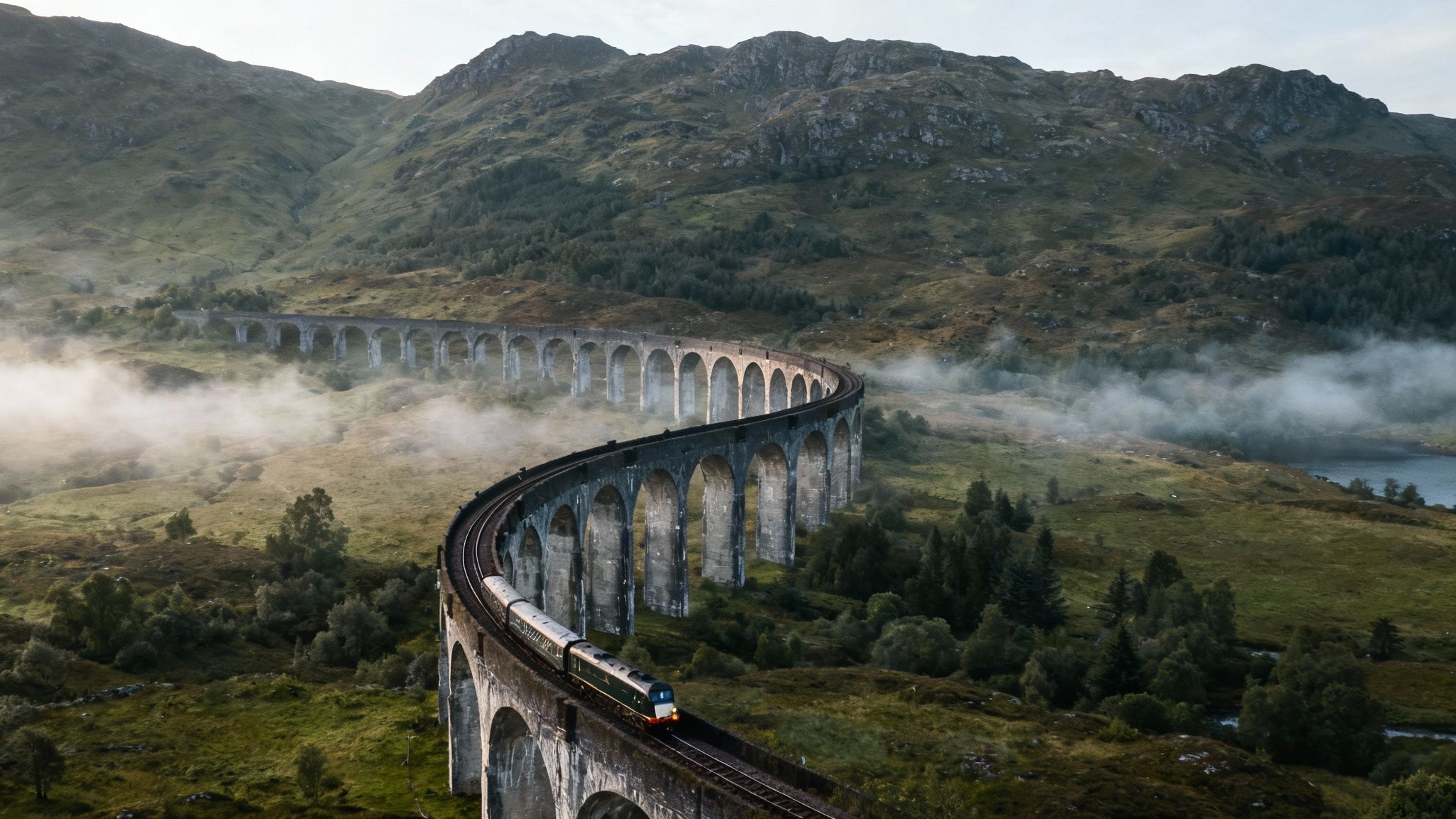
The journey crosses iconic landmarks such as Rannoch Moor and the Glenfinnan Viaduct, famed by the Harry Potter films and BBC’s Great Railway Journeys. Passengers can spot rugged mountains, deep glens, and shimmering lochs right from their seat.
Compared with flying the same distance, the West Highland Line reduces carbon emissions by roughly 55 lbs (25 kg) of CO₂ per passenger.
Route Summary
- Distance: 102 mi (164 km)
- Duration: 5.5 hours
- Operator: ScotRail (Serco)
- Official info: https://www.scotrail.co.uk/
Why It’s Special
- Glenfinnan Viaduct made famous by Harry Potter
- Featured on BBC’s Great Railway Journeys
- One of Scotland’s most photographed viaducts
- UNESCO attention on Rannoch Moor’s fragile ecosystem
Practical Tips
- Book the Jacobite Steam Train 3–4 months in advance
- Sit on the right side for optimal viaduct views
- Carry a mid-telephoto lens for wildlife and landscape shots
- Stay connected with an Airalo eSIM
Best Season & Timing
- Peak months: May–September
- Early morning departure for softer light
- Avoid weekends in July–August for shoulder-season savings
Pass & Booking Tips
- Covered by the BritRail Scotland Pass
- Reserve steam-train tickets separately on ScotRail’s site
- Learn more on economadtravel.com
Slow-Travel Itinerary
- Work remotely in Glasgow’s West End for two days
- Take the West Highland Line to Fort William
- Base near Loch Linnhe for 3–4 days, cowork at local cafés
Regenerative Stays
- Eco-certified B&B in Fort William
- Community-run hostel near Mallaig
- Support the West Highland Line Heritage Trust via Heritage Scotland donations
3. Bernina Express (Switzerland/Italy)
The Bernina Express ranks among the best train routes in europe for its dramatic alpine-to-Mediterranean transition. This scenic narrow-gauge railway links Chur, Switzerland with Tirano, Italy over about 4 hours, descending 1,828 meters through high mountain passes.
Riding through 196 curves and over the iconic Landwasser Viaduct, passengers enjoy sweeping vistas of glaciers, streams, and deep valleys before the route eases into the sunlit Lombardy plain. UNESCO designated it a World Heritage Site in 2008.
Compared with flying the same distance, the Bernina Express cuts your carbon footprint by roughly 55 lbs (25 kg) of CO₂ per passenger.
Route Summary
- Distance: 94 miles (152 km)
- Operator: Rhätische Bahn
- Official info: https://www.rhb.ch/en/panoramic-trains/bernina-express
Why It’s Special
- UNESCO World Heritage railway corridor
- Featured in ‘World’s Greatest Railway Journeys’
- Alpine peaks to Italian vineyards in one ride
Practical Tips
- Sit on left side ascending for glacier views
- Switch to right side descending for Italian valleys
- Book panoramic coaches early on the RhB site
- Plan a lunch break in Tirano’s piazza
Best Season & Timing
- May–October for clear lines of sight
- Early morning departure for soft light
- Avoid mid-August peak crowds in Lombardy
Pass & Booking Tips
- Swiss Travel Pass covers Chur–Poschiavo; reserve seats on RhB site
- Buy Italian segment ticket at Tirano station or via Trip.com
Slow-Travel Itinerary
- Arrive in Chur, cowork at Café Post
- Ride Bernina Express to Tirano
- Base in Tirano’s walkable old town for 3–4 days
Regenerative Stays
- Organic B&B near Poschiavo vineyards
- Farmhouse lodge in Tirano with zero-waste breakfasts
4. Flåm Railway (Norway)
The Flåm Railway descends 2,835 feet over 12 miles in just 55 minutes. One of the world’s steepest standard-gauge lines, it links Myrdal and Flåm with hairpin curves and panoramic fjord vistas.
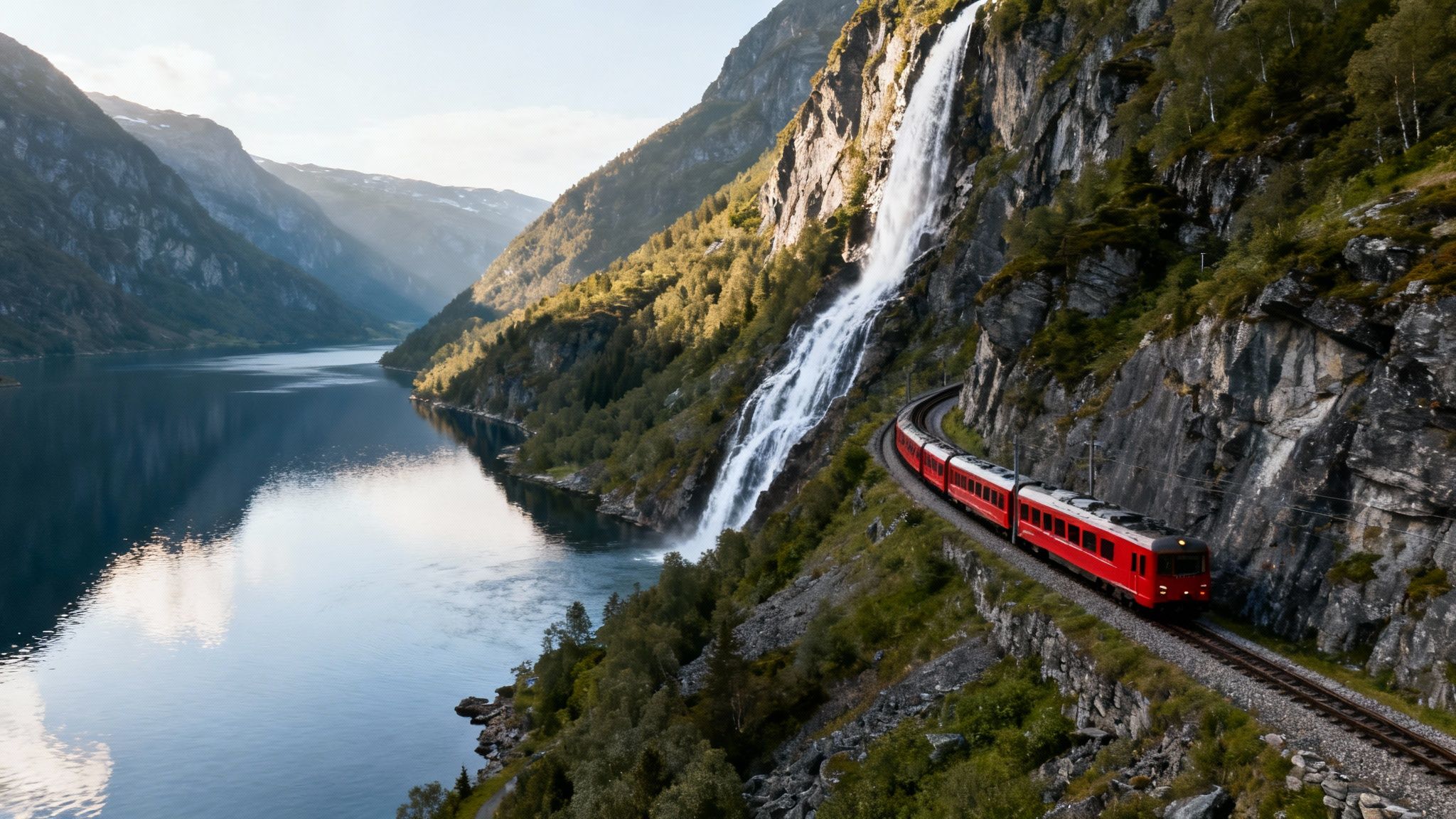
It crosses 20 tunnels and 18 hairpin curves past roaring waterfalls and towering mountains. This route is a highlight of the Norway in a Nutshell sustainable itinerary.
Compared with a flight from Oslo to Bergen, it cuts CO₂ emissions by over 30 lbs per passenger.
Route Summary
- Distance: 12 miles (20 km)
- Operator: Vy (Norges Statsbaner)
- Official info: https://en.visitflam.com/flamsbana/
Why It’s Special
- Featured by National Geographic for stunning fjord views
- Integral to Norway in a Nutshell sustainable itinerary
Practical Tips
- Book tickets online early in summer peak
- Sit on the right side for best waterfall vistas
- Combine with Oslo–Bergen train and Sognefjord ferry
Best Season & Timing
- Late spring for maximum waterfall flow
- Early autumn for vivid fall foliage
Pass & Booking Tips
- Use an NSB rail pass for unlimited regional travel
- Reserve seats via the Vy app at least 2 weeks ahead
Slow-Travel Itinerary
- Arrive at Myrdal, ride to Flåm, then ferry the Sognefjord to Gudvangen
Regenerative Stays
- Eco-friendly inn in Flåm sourcing local farm produce
- Organic B&B in Aurland’s traditional village
5. Scenic Routes of the Rhaetian Railway (Switzerland)
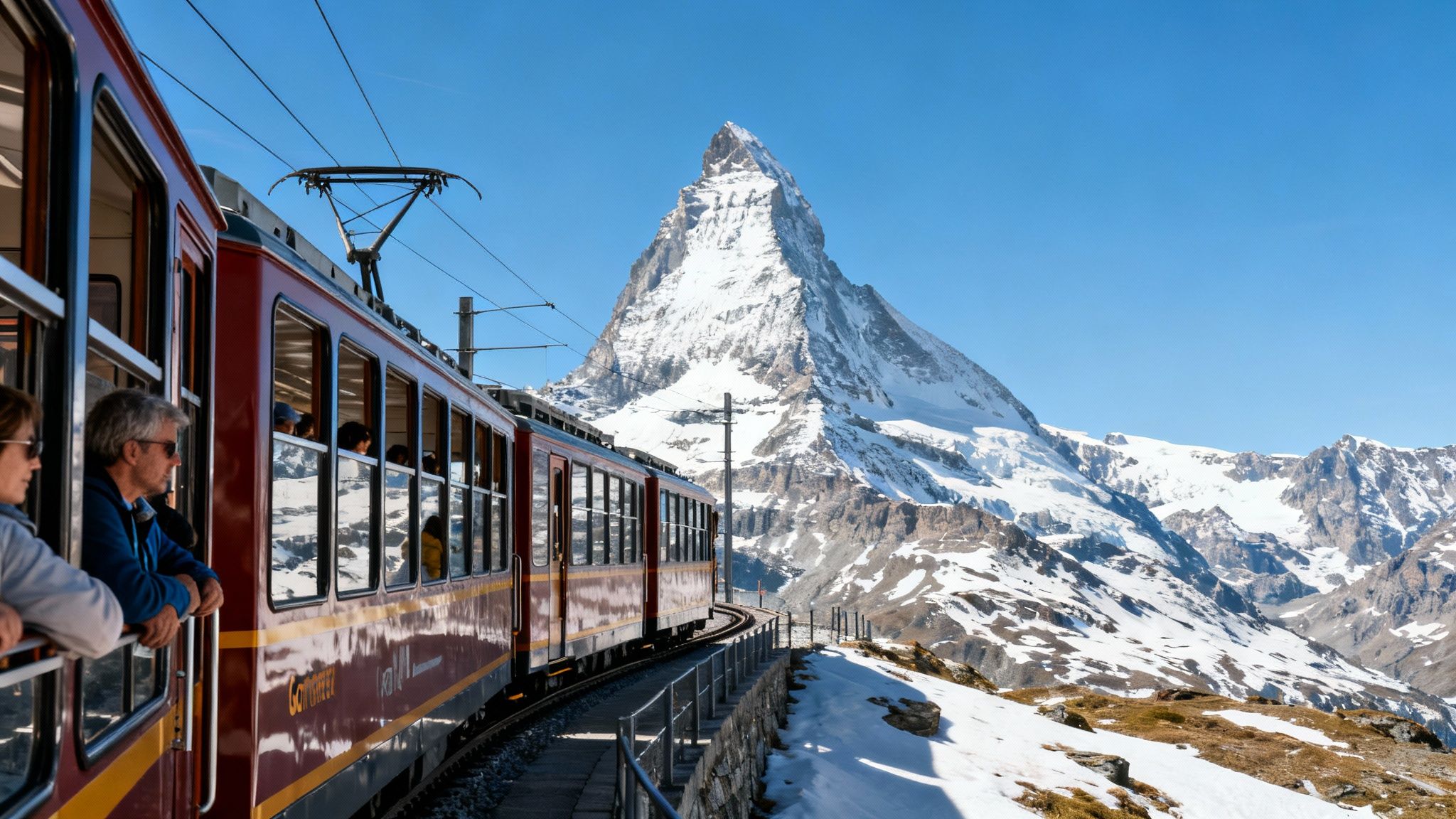
The Rhaetian Railway network is one of the best train routes in Europe for eco-minded travelers. This narrow-gauge marvel threads through Graubünden’s Alpine peaks, weaving the Albula and Bernina lines into UNESCO World Heritage landscapes.
Climbing above 2,000 meters and crossing iconic viaducts like Landwasser and Brusio, it links mountain villages such as St. Moritz, Bergün, and Tirano over a multi-day rail odyssey.
Compared with flying between Zurich and Milan, the Rhaetian Railway cuts your carbon footprint by over 30 lbs of CO₂ per passenger.
Route Summary
- Distance: ~134 miles (216 km) network
- Operator: Rhätische Bahn
- Official info: https://www.rhb.ch/en/lines-networks
Why It’s Special
- UNESCO World Heritage Albula/Bernina routes (https://whc.unesco.org/en/list/1276)
- Dramatic engineering: 55 tunnels, 196 bridges
- Stops in authentic villages with walkable streets
Practical Tips
- Buy the Graubünden Regional Pass for cost savings
- Plan a 3–4 day loop: Albula & Bernina Express
- Pack an eSIM for seamless connectivity: Airalo eSIM
Best Season & Timing
- Shoulder seasons (May–June, September–October)
- Morning departures for softer light on glaciers
- Avoid Swiss National Day crowds on August 1
Pass & Booking Tips
- Graubünden Pass covers all RhB services
- Reserve panoramic seats on the RhB website 2–3 months ahead
- Tickets at Swiss Travel System outlets
Slow-Travel Itinerary
- Arrive in Chur, explore Old Town cowork cafés
- Ride Albula line to Preda via Bergün
- Continue Bernina Express to Tirano, remote-work base in town
Regenerative Stays
- Eco-B&B in Bergün with organic farm dinners
- Sustainable mountain lodge in Alp Grüm
6. The Jacobite Steam Train – West Highland Extension (Scotland)
The Jacobite Steam Train chugs from Fort William to Mallaig in about 84 minutes, earning its place among the best train routes in europe for its heritage steam experience and low-impact rail travel. Compared with flying the same 84 miles, the steam-hauled journey slashes your carbon footprint by roughly 66 lbs (30 kg) of CO₂ per passenger thanks to efficient coal-steam technology and no plane taxiing emissions.
Travelers board restored Victorian and Edwardian carriages for a nostalgic ride across 21 bridges and through two tunnels. The highlight is the sweeping arc of the Glenfinnan Viaduct, forever immortalized in Harry Potter films and BBC documentaries.
Route Summary
- Distance: 84 miles (135 km)
- Operator: West Coast Railways
- Official info: https://www.westcoastrailways.co.uk/jacobite
Why It’s Special
- Famous location in Harry Potter franchise
- Authentic steam engines and carriages
- Dramatic Highland scenery and sea lochs
- Featured on BBC travel specials
Practical Tips
- Book tickets immediately in January
- Travel on a clear day for best views
- Bring a telephoto lens and spare batteries
- Reserve dining car seating early
- Pack windproof layers—weather changes fast
Best Season & Timing
- Summer (June–August) for long daylight
- Early morning runs to avoid crowds
Pass & Booking Tips
- Tickets only via West Coast Railways site
- No rail pass coverage—plan ahead
Slow-Travel Itinerary
- Cowork at The Lovat Café in Fort William
- Ride Jacobite Steam Train to Mallaig
- Base in Mallaig’s walkable harbour for 3–4 days
Regenerative Stays
- Eco-certified B&B at Glenfinnan Station
- Organic sea-view guesthouse in Mallaig
7. Centovalli Railway (Switzerland/Italy)
The Centovalli Railway spans 32 miles (52 km) of narrow-gauge track through 100 valleys from Locarno to Domodossola in about 2 hours, making it one of the best train routes in europe. It crosses 83 tunnels and 220 bridges while cutting roughly 44 lbs of CO₂ per passenger versus flying.
Panoramic windows frame gorges, rustic villages, and Lake Maggiore shores on this slow-paced line.
Route Summary
- Distance: 32 miles (52 km)
- Operator: Centovalli Railways (FART)
- Official info: https://www.centovalli.ch/en/
Why It’s Special
- Alpine-lake vistas and charming villages
- Highlighted by Ticino Tourism and rail guides
Practical Tips
- Travel in shoulder season (April–May or September–October)
- Download the route map offline in advance
- Bring a camera for dramatic viaduct shots
Best Season & Timing
- Shoulder months for fewer crowds
- Early departures for soft morning light
Pass & Booking Tips
- Swiss Travel Pass covers Locarno segment
- Reserve seats at Centovalli Railways site
- Learn more on economadtravel.com
Slow-Travel Itinerary
- Arrive in Locarno, cowork at Café Porto Vecchio
- Ride Centovalli Railway to Domodossola, explore old town for 2 days
Regenerative Stays
- Eco-friendly guesthouse in Locarno’s historic center
- Organic agriturismo near Lake Maggiore
8. Bergen to Oslo Railway (Norway)
The Bergen to Oslo Railway spans 496 miles (496 km) over approximately 7 hours, crossing the Scandinavian mountain plateau and descending through dramatic valleys and gorges. This route connects Norway’s two major cities and ranks among the best train routes in europe for its ever-changing scenery.
You’ll climb to 4,056 ft (1,237 m) at the Hardangervidda plateau, then traverse forests, fjords, and thundering waterfalls. Panoramic windows bring the rugged landscape right to your seat.
Compared with flying the same distance, the Bergen to Oslo Railway cuts your carbon footprint by an estimated 35 lbs (16 kg) of CO₂ per passenger.
Route Summary
- Distance: 496 miles (496 km)
- Operator: Vy (formerly Norwegian State Railways)
- Official info: https://www.vy.no/en
Why It’s Special
- Highest railway summit in Northern Europe at Hardangervidda
- Dramatic descent through Voss gorge and forest
- Featured by Norway Tourism Board and Lonely Planet
- Walkable endpoints with rich cultural scenes
Practical Tips
- Book window seats on the right for plateau panoramas
- Choose left-side seats for Voss gorge views
- Bring a fully charged camera and power bank
- Stay online with an Airalo eSIM
Best Season & Timing
- Summer (June–August) for long daylight and clear skies
- Shoulder seasons (May, September) to avoid crowds
- Early morning departures for softer light
Pass & Booking Tips
- Covered by Eurail Norway Pass or Interrail Global Pass
- Reserve seat online at Vy.no at least 2 months ahead
- Learn more on economadtravel.com
Slow-Travel Itinerary
- Arrive in Bergen, cowork at Café Opera
- Daylight train to Myrdal, explore Flåm connection
- Continue to Oslo, base in Grünerløkka for 3–5 days
Regenerative Stays
- Eco-certified guesthouse in Bergen’s UNESCO Bryggen
- Sustainable design hostel in Oslo’s Vulkan district
9. Gornergrat Railway (Switzerland)
The Gornergrat Railway is an open-air cogwheel train climbing from Zermatt to 10,136 ft (3,089 m) in 38 minutes. It’s celebrated among the best train routes in Europe for its close-up views of the Matterhorn and 29 peaks over 13,000 ft.

Compared with flying the same alpine distance, the Gornergrat Railway cuts your carbon footprint by roughly 20 lbs (9 kg) of CO₂ per passenger.
Route Summary
- Distance: 5.8 miles (9.3 km)
- Elevation gain: 10,136 ft (3,089 m)
- Operator: Gornergrat Bahn
- Official info: https://www.zermatt.ch/en
Why It’s Special
- Iconic Matterhorn framing at sunrise
- Featured in mountain documentaries
- Open-air cars for unobstructed views
Practical Tips
- Ascend early to beat crowds
- Descend late afternoon for sunset light
- Pack warm layers even in summer
- Stay connected with an eSIM like Airalo eSIM
Best Season & Timing
- Clear days from June to September
- Early departures for optimal visibility
Pass & Booking Tips
- Swiss Travel Pass covers fare at no extra cost
- Reserve seats 1–2 months ahead
Slow-Travel Itinerary
- Morning ride to Gornergrat summit
- Work remotely with Matterhorn views at the Kulm Hotel
Regenerative Stays
- Eco-certified guesthouse in Zermatt village
10. Trenino Rosso della Bernina (Red Train – Bernina Express Alternative) (Switzerland/Italy)
Among the best train routes in europe, the Trenino Rosso della Bernina offers a vintage twist on the classic Bernina Express journey. This narrow-gauge heritage train runs between Chur and Tirano in about 4 hours, winding through UNESCO World Heritage landscapes with historic red carriages.
Gliding over the Landwasser Viaduct and spiraling down the Brusio Viaduct, this route unlocks alpine vistas, steep valleys, and glacier-topped peaks. Compared with flying the same distance, the Trenino Rosso reduces your carbon footprint by up to 50 lbs of CO₂ per passenger.
Route Summary
- Distance: 85 miles (137 km)
- Operator: Rhätische Bahn
- Official info: https://www.rhb.ch/en/panoramic-trains/bernina-express
Why It’s Special
- UNESCO altitude change of 4,800 ft
- Landwasser & Brusio viaduct engineering marvels
- Historic 1930s red carriages
Practical Tips
- Book right-side seats ascending for best views
- Travel midweek to avoid peak crowds
- Bring a DSLR or mirrorless camera
- Wear period-appropriate attire to enhance the vintage vibe
- Plan a lunch break in Tirano’s walkable old town
- Stay online with an Airalo eSIM
Best Season & Timing
- Summer (June–August) for clear skies
- Early morning departures for softer light
- Avoid weekends and Swiss public holidays
Pass & Booking Tips
- Swiss Travel Pass covers the route; reserve seats at https://www.swiss-pass.ch
- Book heritage seats 2–3 months in advance on RhB site
Slow-Travel Itinerary
- Arrive in Chur, cowork at Café Gass 31
- Ride Trenino Rosso to Tirano
- Base in Tirano Old Town for 3–5 days
Regenerative Stays
- Agriturismo Ca’ Rossa, organic farm B&B near Tirano
- Eco B&B Vecchia Stazione with solar-powered chalets
Next Steps For Your Sustainable Rail Adventure
Embarking on one of the best train routes in europe means embracing unforgettable scenery, walkable town centers, and dramatically lower carbon footprints compared to flying. You’ve seen how routes like the Glacier Express and Bernina Express combine alpine views with efficient, low-impact travel.
From choosing sleeper options to planning shoulder-season trips, each itinerary highlights practical steps for remote workers, digital nomads, and eco-conscious couples. You’ve learned to compare CO₂ savings, pack zero-waste systems, and select regenerative stays near station hubs.
Remember how a single long-haul flight can emit over 1,500 lbs of CO₂ per passenger versus ~50 lbs by rail? Tracking these savings is key to sustainable trip planning.
Actionable Next Steps
- Map your route using the UNWTO’s rail travel guides for official schedule updates.
- Calculate your trip’s carbon footprint before booking.
- Book eco-certified stays near station exits—look for Global Ecotourism Network labels.
- Reserve shoulder-season tickets and local rail passes 3–6 months in advance.
- Pack minimalist gear: reusable utensils, collapsible water bottle, and a lightweight power bank.
- Subscribe to local rail operator newsletters for flash deals on night trains.
For more details on sustainable travel, visit the World Tourism Organization at https://www.unwto.org/.
Join the Sustainable Work Movement
Want more rail-first itineraries, low-impact packing systems, and walkable base-city ideas?
Explore Eco Nomad Travel
📚 Core Guides
🧭 Planning & Logistics
🗺️ Destinations & Seasons
Jeremy Jarvis — founder of Eco Nomad Travel, sustainable travel writer, and advocate for regenerative tourism. His work focuses on low-impact mobility, eco-friendly digital nomad life, and climate-positive travel.
Legal
Affiliate DisclaimerPrivacy Policy
Terms of Service
Image & Media Notice
Cookie Policy
Contact
Affiliate Disclosure: Some links on Eco Nomad Travel are affiliate links, meaning we may earn a small commission at no extra cost to you. This supports our mission to inspire responsible and low-impact travel worldwide.
Connect
✅ Trusted Official Sources
Plan smarter eco trips
Try our free Sustainable Travel Tools for Digital Nomads – carbon calculator, train vs plane comparator, and more.
Open Tools Hub