
Finding the best travel tote isn’t just about style; it’s about finding a partner that’s as durable and versatile as your travel plans. For eco-conscious digital nomads, this usually points toward a thoughtfully designed bag made from recycled or organic materials.
A great example is the Patagonia Black Hole Tote 25L. It’s tough, weather-resistant, and sized perfectly for carry-on, making it a solid choice for the kind of low-impact, rail-first journeys we champion.
This guide skips the generic top-ten lists and gives you a real framework for picking a travel tote that matches your values. We’ll get into what to look for in ethical materials, how to spot features that actually last, and how to make sure your bag fits train and airline rules without any last-minute stress.
Key Takeaways
- Materials Matter Most: Look for totes made from recycled polyester, organic cotton canvas, or other certified sustainable fabrics.
- Durability Is Sustainability: Reinforced stitching, high-quality zippers, and water-resistant finishes mean your bag lasts longer and stays out of the landfill.
- Check Carry-On Rules: Make sure the tote’s dimensions fit airline and train standards, which are typically around 22 x 14 x 9 inches (56 x 36 x 23 cm).
- Organization Is Key: The best totes have smart compartments, like a padded laptop sleeve and secure pockets for your passport and valuables.
- Look for Certifications: Trustworthy brands often have credentials like B Corp or Fair Trade, which signal a real commitment to ethical production.
Patagonia Black Hole® Tote 25L
The Patagonia Black Hole Tote 25L stands out for its rugged, weather-resistant fabric made from 100% recycled materials. Its 25-liter capacity is perfect for a weekend trip or as a personal item, and it packs down into its own pocket for easy storage. With multiple carrying options and a simple, functional design, it’s a reliable choice for nomads who need a durable, eco-conscious bag that performs well in various conditions.
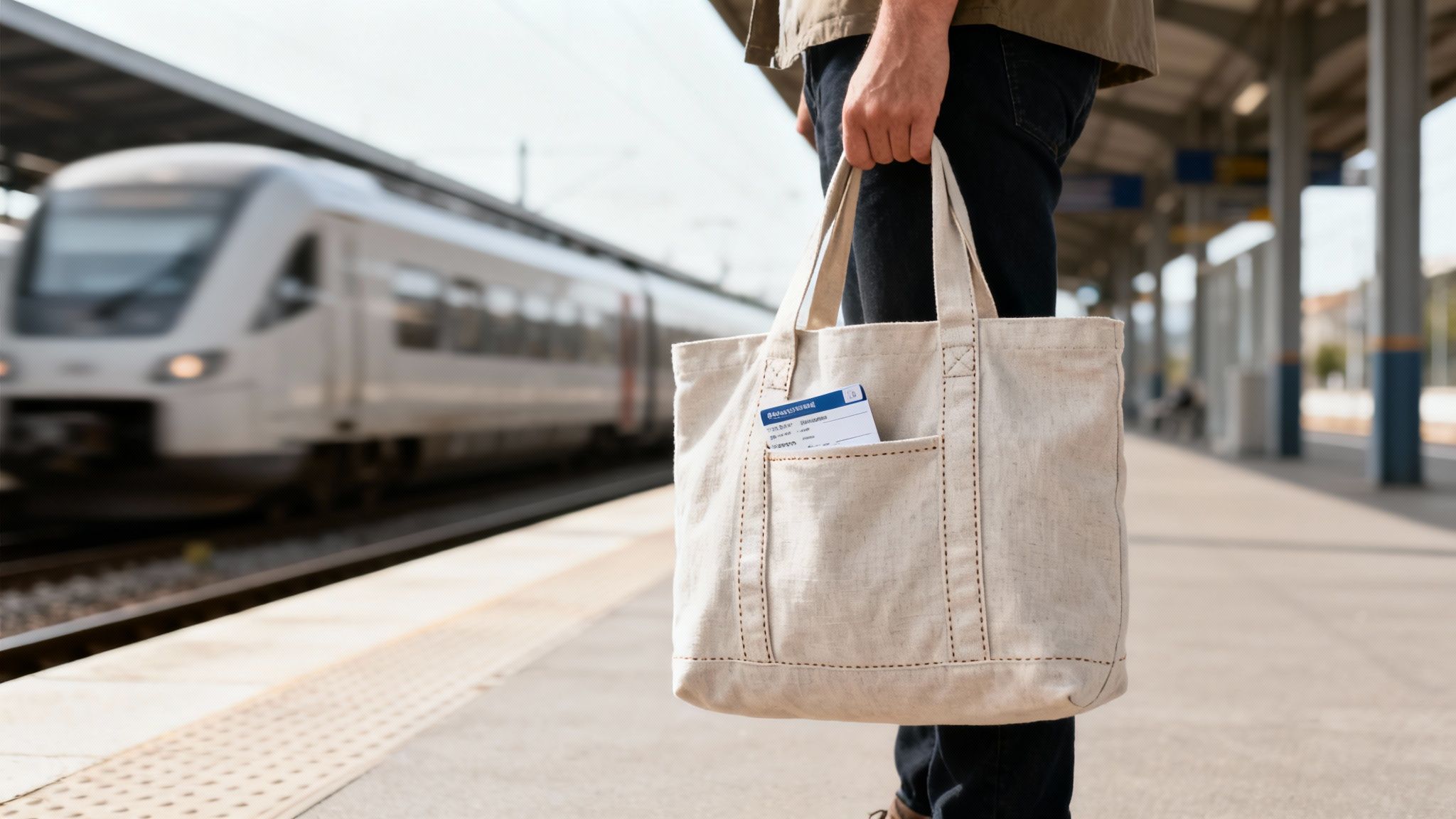
Why a Travel Tote Is Perfect for the Modern Eco-Nomad
For the modern eco-nomad, a travel tote isn’t just another bag—it’s a strategic tool for lighter, more sustainable adventures. Moving beyond bulky suitcases, the best travel tote simplifies your journey and aligns perfectly with a low-impact, rail-first travel style. It’s a conscious shift toward minimalism and efficiency.
Imagine navigating a bustling European train station like Amsterdam Centraal. With a streamlined tote, you can weave through crowds effortlessly, keeping your essentials close. There’s no awkward rolling luggage to drag up stairs or wrestle with on crowded platforms, making train connections smoother and far less stressful.
Simplifying Travel and Reducing Your Footprint
A well-designed travel tote nudges you toward minimalist packing. Its open-concept design forces you to be intentional about what you bring, helping you sidestep the overpacking trap that often comes with larger suitcases. This approach not only lightens your physical load but also cuts down on your overall consumption.
This mindset is central to our philosophy on how to be a green traveler in the digital nomad era, focusing on packing only what you truly need. On a multi-city rail trip from Vienna to Budapest, for example, a single tote can easily fit in the overhead rack of a night train, saving space and keeping your belongings secure. You can easily book train tickets in Europe and Asia to start planning a similar journey.
This “buy less, buy better” philosophy is reflected in the growing consumer demand for versatile, long-lasting products. The global tote bags market, valued at USD 2.75 billion in 2024, is projected to reach USD 3.94 billion by 2032. Canvas totes, known for their durability and eco-friendly appeal, hold a dominant 32.18% market share, highlighting a collective move away from disposable plastic alternatives.
The Versatility of a Single Bag
A high-quality travel tote is remarkably versatile, serving multiple roles in a single trip. It can be your primary piece of luggage for a week-long journey, your personal item on a rare flight, and your day bag for exploring a new city. This adaptability means you can replace several specialized bags with just one, embodying a core principle of sustainable living.
By choosing one durable, multi-functional bag, you reduce waste and minimize your carbon footprint associated with manufacturing and shipping multiple products. This simple choice supports a more mindful approach to travel, where every item you carry serves a clear purpose, making your adventures lighter on both your back and the planet.
Essential Features of the Best Sustainable Travel Totes
What really separates a good travel bag from the best travel tote? It comes down to a few core features that blend genuine sustainability with the practical demands of a life on the move. For an eco-conscious nomad, the first place to look is always the material.
The fabric choice is probably the single biggest factor in a tote’s environmental footprint. Recycled synthetics, like rPET made from plastic bottles, are a solid choice—they’re durable, water-resistant, and give waste a second life. On the flip side, you have natural fibers like GOTS-certified organic cotton or hemp. These materials offer a rugged, classic feel and are biodegradable, grown without the nasty pesticides that harm soil and water.
Durability as a Core Sustainable Feature
Here’s a hard truth: a tote that falls apart after a few trips isn’t sustainable, no matter what it’s made from. True sustainability is longevity. You want a bag that’s built to handle the chaos of train stations, overhead bins, and daily use.
Look for the small details that signal quality craftsmanship:
- Reinforced Stitching: Pay close attention to the stress points, especially where the handles meet the bag and at the corners. Bar-tack stitching (a tight, dense row of stitches) is a dead giveaway that the bag is built to last.
- High-Quality Hardware: Zippers are notorious weak points. Brands that invest in reliable hardware like YKK zippers are investing in the bag’s lifespan. They’re known for their smooth action and resistance to breaking under pressure.
- Weather-Resistant Finishes: A good tote should protect your gear from a sudden downpour. A water-resistant coating, ideally a non-toxic wax or a PFC-free treatment, is crucial for keeping your laptop and documents safe.
These features aren’t just nice to have; they ensure your tote stays with you for years, cutting down on waste and the need for replacements.
The diagram below shows how a well-chosen tote aligns perfectly with the values of a slow, low-impact travel style.
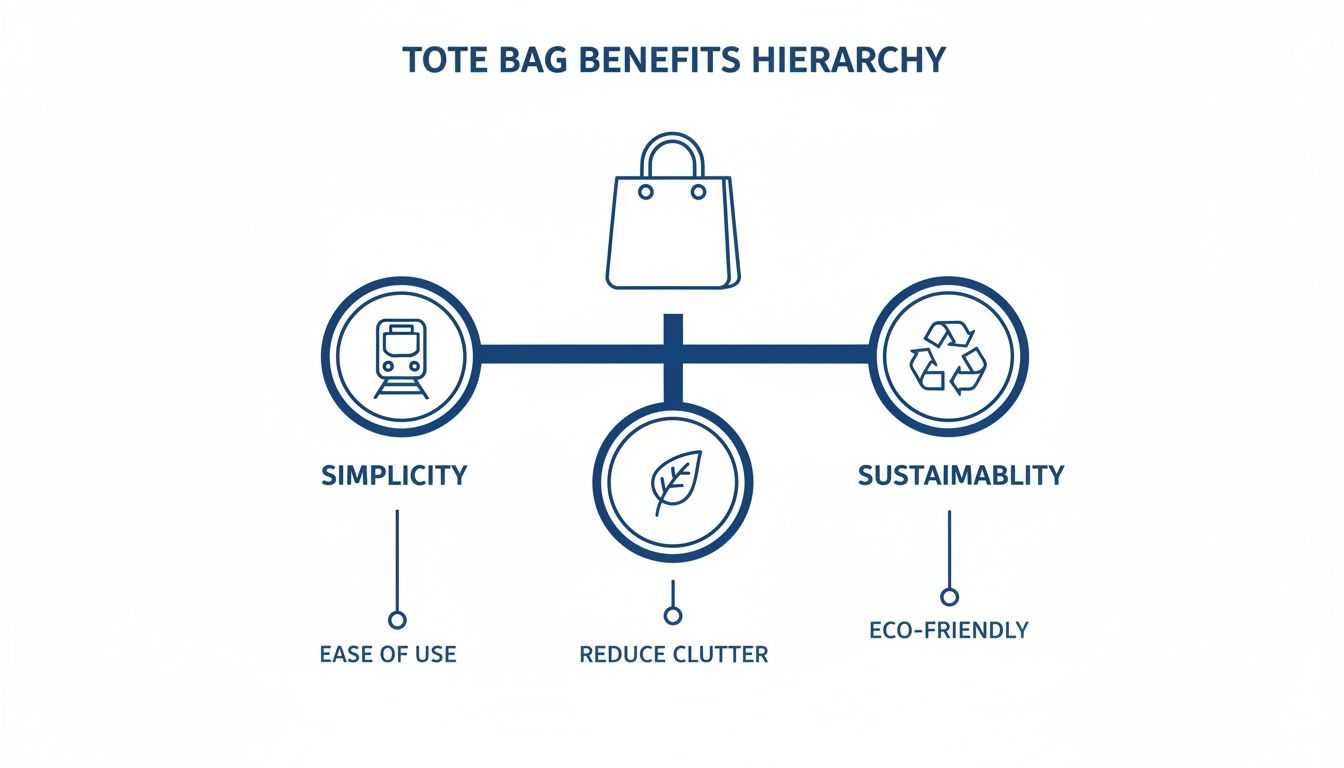
It’s a simple hierarchy: the right tote simplifies your packing, reduces clutter, and supports a more sustainable way of moving through the world.
A Quick Look at Tote Materials
Choosing the right fabric can feel overwhelming, so I’ve broken down the most common sustainable options into a simple table. Think of it as a cheat sheet for matching a material to your travel style.
| Sustainable Travel Tote Material Comparison |
| :— | :— | :— | :— |
| Material | Key Sustainability Benefit | Durability Rating (1-5) | Best For |
| Recycled PET (rPET) | Diverts plastic from landfills; reduces reliance on virgin petroleum. | 4/5 | Digital nomads needing weather resistance and durability for electronics. |
| Waxed Canvas | A natural alternative to synthetic waterproofing; repairable and develops character. | 4/5 | Slow travelers who appreciate heritage materials and want a bag for all weather. |
Each material has its own strengths. Your job is to pick the one that best fits the kind of journeys you actually take—not just the ones you dream about.
Smart Organization and Packability
Of course, what’s inside counts just as much as the outside. The best travel totes strike a balance, offering smart organization without adding a ton of weight or bulk. For remote workers, a padded laptop sleeve (one that comfortably fits a 13–15 inch device) is non-negotiable. So is a secure interior pocket for your passport, phone, and wallet. Staying connected is also crucial; consider an eSIM from a provider like Airalo for seamless internet access across countries.
Packability is the other side of the coin. Look for a tote that holds its shape but can also be flattened or folded to stash inside your main luggage. This kind of versatility is gold on longer trips where your tote pulls double duty as a personal item and a day bag once you arrive. If you need some inspiration on what to fill it with, check out our complete guide to building your essential eco-travel kit for 2025.
Finally, always—and I mean always—check the dimensions for carry-on compatibility. Most airlines and train operators stick to a size limit around 22 x 14 x 9 inches (56 x 36 x 23 cm). A tote that fits within these limits means you can skip the checked bag fees and keep your essentials close, making your entire journey smoother from start to finish.
How to Pack Your Travel Tote for Maximum Efficiency
Having the best travel tote is a great start, but how you pack it is what really unlocks its potential. A well-organized bag is the difference between a stressful scramble at the train station and a smooth, easy journey.
With a few smart strategies, you can fit everything you need for a week-long, multi-season trip into a single 35–45 liter tote. That means no checked baggage and none of the costs or emissions that come with it.
The secret is compartmentalization. Instead of just throwing everything into one big space, use packing cubes to group similar items. One cube for shirts, another for bottoms. It’s a simple trick that turns the open cavity of a tote into a neat, modular system, making it easy to find what you need without unpacking the whole bag.
Another game-changer is the capsule wardrobe. This just means choosing a small set of versatile, interchangeable clothes that can be layered for different climates. Think neutral colors and classic pieces that all work together. Master the art of rolling your clothes tightly instead of folding them, and you’ll be amazed at how much space you save—and how few wrinkles you have.
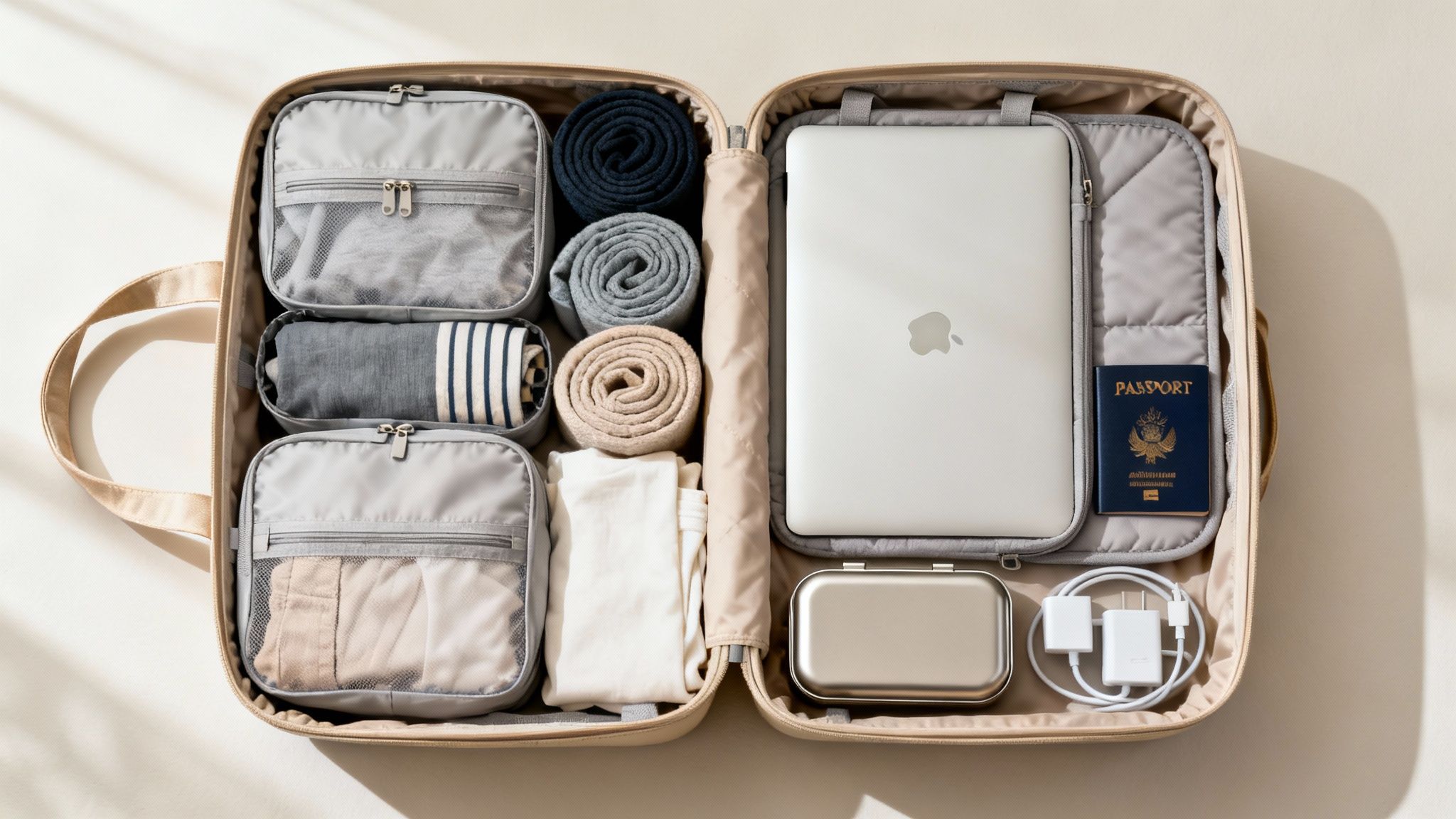
Sample One-Week Packing List for a Travel Tote
To show you it’s actually possible, here’s a sample list that fits comfortably in a standard travel tote. This is perfect for something like a European rail adventure, where you might go from sunny Lisbon to a cooler evening in Porto.
Clothing (Capsule Wardrobe):
- 3x Versatile tops (merino wool t-shirts are fantastic)
- 2x Bottoms (one pair of travel pants, one pair of comfortable jeans)
- 1x Mid-layer (a lightweight fleece or cardigan)
- 1x Outer layer (a packable, water-resistant jacket)
- 4x Pairs of socks and underwear
- 1x Multi-use scarf or pashmina
Tech Essentials:
- 1x Laptop (up to 15 inches) and charger
- 1x Universal travel adapter
- 1x Portable power bank
- 1x Smartphone and charging cable
Toiletries (Solid/Zero-Waste):
- Solid shampoo and conditioner bars
- Toothpaste tablets and a bamboo toothbrush
- A multi-purpose soap bar
- Deodorant cream or stick
This minimalist approach lines up perfectly with a sustainable mindset. For more ideas on shrinking your travel footprint, check out our comprehensive zero-waste packing list for 2025.
By switching to solid toiletries, you not only save space and prevent leaks but also slash your single-use plastic waste. Every small choice adds up, helping you explore the world in a lighter, more responsible way.
How to Identify Genuinely Sustainable and Durable Brands
In a market flooded with “eco-friendly” slogans and green marketing, finding a travel brand that’s genuinely committed to sustainability can feel like a full-time job. It’s easy to get lost in the noise.
The secret is to look past the marketing and focus on proof. A truly sustainable company doesn’t just talk the talk; it backs it up with transparent practices and verifiable certifications that you can actually check.
Think of labels like B Corp Certification as a reliable shortcut. It means a company has passed a rigorous assessment of its social and environmental performance, accountability, and transparency. In the same way, a Fair Trade logo tells you workers were treated ethically, while the Global Organic Textile Standard (GOTS) guarantees a fabric is truly organic from field to finish.
These aren’t just fancy logos. They’re tangible proof that a brand is serious about its impact on people and the planet.
Looking Beyond the Labels
While certifications are a great starting point, they don’t tell the whole story. Some of the clearest signs of a brand’s real commitment are its policies on longevity and repair. After all, the most sustainable travel tote is the one you’re not replacing every couple of years.
Look for brands that offer:
- Lifetime Warranties: A company that stands behind its product for life is confident in its materials and craftsmanship. It’s a powerful signal of quality.
- Repair Programs: This shows a brand is committed to a circular mindset, encouraging you to fix your tote instead of just tossing it.
- Transparent Supply Chains: Brands that openly share where and how their products are made usually have nothing to hide. This honesty is a huge green flag.
These practices aren’t just good business—they represent a fundamental shift away from a disposable culture toward more mindful consumption. The global travel bags market, which hit USD 18.78 billion in 2023, is increasingly shaped by this demand for durable, functional gear.
It’s no surprise that canvas leads the market with a 32.18% material share; its durability is legendary. A single well-made canvas tote can be reused up to 1,000 times.
At the end of the day, longevity is the single most important sustainability feature of the best travel tote. A bag built to handle the realities of constant travel directly reduces waste and cuts down on consumption. By learning what makes a tour—or a product—truly sustainable, you can invest in a travel partner that not only works for you but also aligns with your values.
Our Top Picks: Field-Tested Totes for Sustainable Travel
I’ve sifted through dozens of bags, applying the same rules from this guide to find a few standout options. Each best travel tote here is more than just a bag; it’s a long-term partner for the eco-conscious nomad, chosen for its durability, function, and a real commitment to low-impact production.
The need for a reliable, carry-on-friendly bag is only growing. The travel bag market, valued at USD 19.72 billion in 2024, is expected to hit USD 37.05 billion by 2032. This isn’t just abstract growth; it’s driven by real shifts, like the rise of rail-first travel in Europe and the need for smart carry-on solutions in Asia. Stellar Market Research has more on this trend if you want to dig deeper.
The bags below meet my strict criteria for material integrity, ethical manufacturing, and genuine usefulness for remote workers and slow travelers.
For All-Weather Durability
Patagonia Black Hole® Tote 25L: This tote is a favorite for a reason. Built from 100% recycled polyester ripstop with a seriously weather-resistant TPU-film laminate, it’s tough enough to handle train station floors, unexpected downpours, and daily abuse. It’s a workhorse.
- Capacity: 25 Liters
- Weight: 12.7 ounces (360 g)
- Dimensions: 16.1″ x 10.2″ x 8.2″
- Sustainability: Made from recycled materials in a Fair Trade Certified™ sewn factory.
For Smart Organization
Peak Design Everyday Tote 15L: A masterclass in organization. While designed for photographers, it’s perfect for any tech-heavy nomad. The FlexFold dividers let you customize the internal layout on the fly, and the padded laptop sleeve keeps your most important tool secure.
- Capacity: 15 Liters
- Weight: 2.38 pounds (1.08 kg)
- Dimensions: 15.9″ x 14″ x 5.5″
- Sustainability: Features a 100% recycled, Bluesign-approved shell fabric, and the company is a Certified B Corp.
For Minimalist Elegance
Cuyana Classic Easy Tote: For those who live by the mantra of “fewer, better things,” this tote is a standout. It has a clean, timeless aesthetic without sacrificing function. Crafted from Italian leather sourced from a Gold-certified LWG tannery, it’s built to last and age beautifully.
- Capacity: Approx. 22 Liters
- Weight: 1.7 pounds (0.77 kg)
- Dimensions: 13″ x 19.5″ x 6″
- Sustainability: Leather Working Group (LWG) certified materials ensure responsible tanning processes.
This short list gives you a solid starting point. Each one aligns with a different travel style, but all share a core commitment to quality and ethics—ensuring your gear is as thoughtful as your journey.
Your Travel Tote Questions, Answered
Still weighing a few final details? Here are some quick, grounded answers to help you choose the right travel tote with confidence.
Are Travel Totes Secure Enough for International Travel?
Yes, but it depends on the design. A good travel tote is built with security in mind, starting with a fully zippered main compartment. Look for models with deep internal pockets for your passport and wallet.
For extra peace of mind in a crowded train station or market, choose a tote with anti-theft features like slash-proof fabric. A simple habit that helps: wear it with the zippers facing your body.
Can a Tote Really Replace a Suitcase for a Week-Long Trip?
Absolutely. With a minimalist packing strategy—think capsule wardrobes and packing cubes—a 35-45 liter tote can easily hold everything you need for a week.
This is where a tote shines on rail-first journeys. Navigating train platforms and narrow aisles with less luggage makes the entire experience smoother and far more enjoyable.
How Do I Clean and Maintain My Travel Tote?
Proper care is what makes a good tote last for years. For most canvas or recycled polyester bags, spot clean any marks with a bit of mild soap and cold water.
Avoid throwing it in the washing machine unless the care tag explicitly says it’s okay; machine washing can strip away water-resistant coatings. Always let your tote air dry completely before you pack it away.
ALWAYS ADD EXTRA IMAGES WHEN POSSIBLE
This article was fact-checked using sustainability data from the World Green Building Council, the Global Ecotourism Network, and peer-reviewed architecture studies. All partner links are vetted for compliance with sustainable business certifications.
Join the Sustainable Work Movement
Want more rail-first itineraries, low-impact packing systems, and walkable base-city ideas?
Explore Eco Nomad Travel
📚 Core Guides
🧭 Planning & Logistics
🗺️ Destinations & Seasons
Jeremy Jarvis — founder of Eco Nomad Travel, sustainable travel writer, and advocate for regenerative tourism. His work focuses on low-impact mobility, eco-friendly digital nomad life, and climate-positive travel.
Legal
Affiliate DisclaimerPrivacy Policy
Terms of Service
Image & Media Notice
Cookie Policy
Contact
Affiliate Disclosure: Some links on Eco Nomad Travel are affiliate links, meaning we may earn a small commission at no extra cost to you. This supports our mission to inspire responsible and low-impact travel worldwide.
Connect
✅ Trusted Official Sources
Plan smarter eco trips
Try our free Sustainable Travel Tools for Digital Nomads – carbon calculator, train vs plane comparator, and more.
Open Tools Hub