
Deciding on the best way to travel in Europe is all about balancing cost, time, and your carbon footprint with the kind of trip you actually want to have. For most city-to-city journeys under 500 miles (about 800 kilometers), high-speed rail is the clear winner, offering a brilliant mix of efficiency, comfort, and low environmental impact. This guide breaks down the main ways to travel so you can pick the right one for each leg of your adventure.
You’ll see why a scenic train ride, pulling directly into a city center, often beats the total door-to-door time of flying. We’ll look at how centrally located train stations save you hours and money compared to airports stuck miles outside your real destination.
Key Takeaways
- Trains are best for efficiency and sustainability on routes under 500 miles (800 km), as high-speed rail often beats flying on door-to-door travel time.
- Planes are necessary for long distances or crossing water, making them the only practical option for trips like Lisbon to Warsaw or reaching the Greek islands.
- Rental cars offer unmatched flexibility for rural exploration, allowing you to discover hidden gems and villages off the main tourist path.
- Long-distance buses are the ultimate budget-friendly choice, ideal for travelers who are prioritizing low costs over speed.
- Smart planning is crucial for saving money and reducing stress, especially when booking transportation and accommodations in advance.
- A reliable eSIM keeps you connected affordably, with options like Airalo helping you avoid expensive roaming fees.
Editor’s Pick
For most travelers planning multi-city European trips, the Omio platform is an invaluable tool. It lets you compare train, bus, and flight options in a single search, showing clear prices and timelines. This simplifies the messy task of weighing cost against convenience, helping you find the most efficient and budget-friendly routes without having to check dozens of different websites.
Comparing Your European Travel Options
Choosing the best way to travel in Europe isn’t about finding a single right answer; it’s about understanding the trade-offs. Each mode of transport—train, plane, car, and bus—serves a different purpose, shining in certain situations while falling short in others. Your decision will always come down to your budget, your itinerary, and your personal travel style.
This guide gives you a clear framework for making those choices. We’ll compare each option across the factors that matter most: total cost, door-to-door travel time, sustainability, and overall convenience. Whether you’re a digital nomad on a work-ation or a couple planning a slow-travel adventure, you’ll find what you need to build your perfect journey.
A Quick Overview of European Travel Modes
To help you see the best use case for each option, here’s a simple breakdown of the main transport methods and where they shine. Think of this as your starting point for deeper planning.
| Travel Mode | Best For | Average Cost (USD) | Key Advantage | Main Drawback |
|---|---|---|---|---|
| Train | City-to-city travel under 500 miles, scenic routes | $50 – $150 | City center access, comfort, sustainability | Can be pricey if not booked in advance |
| Plane | Long distances, crossing water, non-contiguous countries | $40 – $200 | Speed for long hauls, extensive network | Airport hassles, high carbon footprint |
| Car | Rural exploration, ultimate flexibility, family travel | $60 – $100 per day | Freedom to explore off-the-beaten-path | Parking, tolls, city driving stress |
| Bus | Budget-conscious travelers, short to medium distances | $15 – $50 | Extremely low cost, wide coverage | Slower travel times, less comfort |
The Best Ways to Travel Europe: Key Factors to Consider
Picking the best way to travel around Europe means weighing your options. Each mode—train, plane, car, and bus—has its own rhythm and its own trade-offs across cost, speed, sustainability, and simple convenience. To really make a smart choice, you have to look beyond the headline ticket price and think about the entire journey.
That means adding in the hidden costs, like baggage fees or a pricey taxi to an out-of-town airport that can make a “budget” flight not so budget after all. Real travel time isn’t just wheels up to wheels down; it’s the full door-to-door experience, from your old hotel to your new one. Getting this right is the key to a smoother, more enjoyable trip.
Cost Versus Convenience
When you’re comparing costs, always look at the full picture. A $40 (about €37) flight looks like a steal next to a $90 (about €83) train ticket, but the story changes once you tack on a $25 (about €23) airport transfer and a $50 (about €46) fee for your checked bag. Buses almost always win on price alone—you can find fares as low as $15 (about €14)—but you’ll pay for it with your time and comfort.
For pure convenience, trains are tough to beat. Stations are almost always right in the city center, saving you the time and money it takes to get to a distant airport. Once you’re on board, things like Wi-Fi, power outlets, and generous luggage policies make the journey feel productive and relaxed. It’s a world away from the cramped, nickel-and-dime experience of budget airlines. A car offers ultimate freedom for exploring the countryside, but it quickly becomes a liability in Europe’s congested cities, where parking is both a nightmare and a major expense.
Speed and Door-to-Door Travel Time
Speed is another area where the obvious answer isn’t always the right one. A plane is faster in the air, sure, but for any journey under 500 miles (about 800 km), the train is often faster door-to-door. Think about it: you have to travel to the airport, get through security, wait at the gate, fly, and then travel from the destination airport into the city. That all adds up.
High-speed rail just keeps getting better, connecting major hubs at over 155 mph (250 km/h). In 2023, rail travel made up 7.1% of all passenger-kilometers in the EU, proving just how practical it is for routes like Paris to Lyon or Madrid to Barcelona. These are trips you can knock out in just 2–4 hours, city center to city center. You can dig into the official numbers on the Eurostat website.
Sustainability and Environmental Impact
For anyone trying to travel with a lighter footprint, the choice is usually clear. Trains have a much smaller carbon footprint than planes, especially on the short-haul routes where flying is least efficient. The emissions from just one short flight can eat up a huge chunk of a person’s annual carbon budget. Choosing the train is one of the single biggest things you can do to shrink your environmental impact while traveling.
[carbon_calculator_2025]
This chart gives you a simple rule of thumb for deciding between train and plane based on how far you’re going.
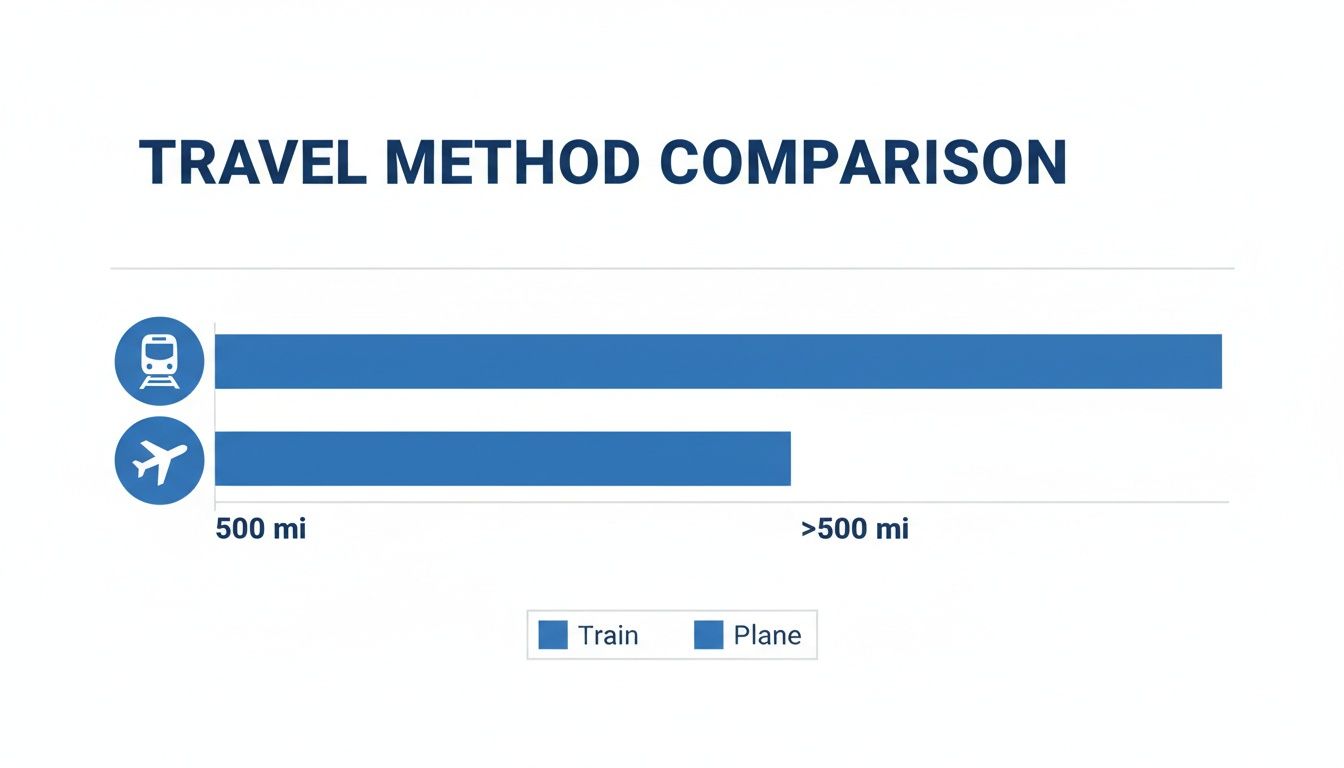
As you can see, for most city-to-city travel in Europe (under 500 miles), the train just makes more sense. Planes really only become necessary for those longer, cross-continental hops.
Key Insight: The true cost of travel isn’t just financial. It includes your time, your stress levels, and your environmental impact. A balanced approach that weighs all these factors will lead to a much more rewarding and sustainable European adventure.
To put all these trade-offs in one place, here’s a quick overview of how the main travel methods stack up. If you want to go deeper on the environmental side, check out our comprehensive guide on train vs. plane emissions.
Europe Travel Methods at a Glance
This table gives you a comparative look at the main ways to get around Europe, helping you quickly match a travel mode to your specific needs and priorities.
| Travel Mode | Best For | Average Cost (USD) | Typical Speed (Door-to-Door) | Sustainability (CO₂/km) | Convenience |
|---|---|---|---|---|---|
| Train | Trips under 500 miles, scenic journeys | $50 – $150 | Moderate to Fast | Very Low (14g) | High (city center access, ample luggage) |
| Plane | Trips over 500 miles, crossing water | $40 – $200 | Fastest (for long distances) | Very High (145g) | Low (airport transfers, security, fees) |
| Car | Rural exploration, ultimate flexibility | $60 – $100+ per day | Varies | High (104g) | High (freedom) / Low (city parking) |
| Bus | Extreme budget travel, shorter routes | $15 – $50 | Slowest | Low (27g) | Moderate (wide network but less comfort) |
Each option has its moment. The trick is knowing which one fits the leg of the journey you’re on, your budget, and the kind of experience you want to have.
Booking Your European Train Journey: A How-To Guide
Deciding that rail is the best way to travel through Europe is the easy part. Actually booking the tickets? That can feel like a different beast altogether. Europe’s train networks are incredible, but they’re also diverse and sometimes complex. A few smart strategies, however, will help you sort through the options and find the best routes and fares without the headache.
Your whole approach will hinge on your itinerary—are you planning a few specific city-to-city hops, or are you embarking on a spontaneous, multi-country adventure? The first decision you need to make is whether to buy individual tickets or invest in a rail pass. Getting this right will save you a surprising amount of time and money.
This choice really does shape everything that follows, so it’s the right place to start.
Key Takeaways
- Book High-Speed Routes Early: For popular services in France, Italy, Spain, and Germany, booking 2–3 months in advance is the key to locking in the best prices.
- Point-to-Point Is Often Cheaper: If your itinerary includes fewer than 4-5 long-distance train journeys, buying individual tickets almost always works out to be more cost-effective than a rail pass.
- Rail Passes Are for Flexibility: A Eurail or Interrail pass is built for spontaneous, long-term travelers who plan on taking a lot of trains across multiple countries.
- Use Aggregator Sites for Simplicity: Platforms like Trip.com are great for booking across different national rail operators, letting you compare and buy tickets in one place.
- Night Trains Maximize Your Time: Don’t overlook sleeper trains for long distances. They save you the cost of a night’s accommodation and give you back a full day of travel.
Editor’s Pick
For most travelers with a clear plan, buying tickets 2-3 months ahead on a reliable platform like Trip.com strikes the perfect balance of price and convenience. It cuts through the complexity of booking with different national rail companies and secures the lowest fares on high-speed routes, making it a much simpler option than a rail pass for straightforward itineraries.
Rail Passes vs Point-to-Point Tickets
Understanding the trade-offs between a rail pass and individual tickets is the single most important part of planning a budget-conscious trip.
A Eurail Pass (for non-European residents) or Interrail Pass (for European residents) gives you unlimited train travel for a set number of days within a specific period. This is perfect if you crave flexibility. If you’re planning a multi-week trip with a ton of long-haul journeys and want the freedom to change your mind on a whim, a pass can be a brilliant investment.
For most travelers with a more defined itinerary, however, point-to-point tickets are almost always the cheaper route. This is especially true if you’re only taking a few train trips or traveling mainly in countries with lower rail fares, like Portugal or anywhere in Eastern Europe. Booking these tickets 60 to 90 days in advance for high-speed routes can land you fares that are significantly lower than the per-day cost of a rail pass.
Strategies for Finding the Best Deals
Nabbing cheap train tickets is all about timing and knowing where to look. Just like with airlines, dynamic pricing means the early bird gets the best fares.
- Book in Advance: This is the golden rule for international and high-speed services (like France’s TGV or Italy’s Frecciarossa). Booking two to three months ahead is your best bet, as prices can easily double or even triple as the departure date nears.
- Travel Off-Peak: Fares are usually lower on weekdays (think Tuesday-Thursday) and outside of the morning and evening commuter rush. Traveling during the shoulder seasons—spring and autumn—also helps bring costs down.
- Check National Rail Websites: For domestic journeys, it’s sometimes worth checking the national carrier’s own website (like Deutsche Bahn in Germany or Trenitalia in Italy). They occasionally have special deals you won’t find anywhere else.
- Consider Sleeper Trains: For long hauls like Paris to Vienna, a night train is a smart move. Our in-depth guide explains everything you need to know about how to book European sleeper trains for a comfortable and time-saving journey.
Navigating Stations and Timetables
Even if it’s your first time, you’ll find that European train stations are generally very easy to navigate. Most major hubs have clear signage in both the local language and English.
The departure board is your best friend. Find your train number (which is on your ticket) to see the correct platform (“Voie” in French, “Binario” in Italian, “Gleis” in German). Platforms are usually announced just 15–20 minutes before departure, so don’t panic if you don’t see it listed hours ahead of time.
Most modern train systems are incredibly punctual. Arriving 20–30 minutes before your train is scheduled to leave is almost always plenty of time.
When to Choose a Flight, Car, or Bus
While I’m a huge advocate for high-speed rail, it’s not a silver bullet for every European journey. Let’s be realistic. There are times when flying, driving, or taking the bus is simply the smarter, more practical choice. Knowing when to swap the train tracks for the tarmac or the open road is the key to building a trip that actually works.
Sometimes, geography and distance make the decision for you. For sprawling, cross-continental journeys like Lisbon to Warsaw, a train just isn’t feasible. The same goes for crossing a body of water to reach places like the Greek islands or the UK. When hundreds of miles or the sea stand in your way, flying is the only logical move.
Key Takeaways
- Fly for Long Distances: For any trip over 500 miles (800 km) or those that involve crossing water (like getting to the UK or the Greek islands), flying is the most practical choice.
- Rent a Car for Rural Freedom: If you want to explore the countryside, tiny villages, and national parks, a car gives you a level of flexibility that public transport just can’t match.
- Buses Are the Ultimate Budget Option: When cost is your absolute top priority, long-distance buses offer rock-bottom fares, but you’ll trade speed and comfort for the savings.
- Use Comparison Tools: Platforms like Aviasales are brilliant for quickly finding deals on budget airlines for those necessary flights.
- Factor in All Costs: A cheap flight or rental car price tag can be misleading. Always account for baggage fees, tolls, fuel, and parking before you decide.
Editor’s Pick
For travelers wanting to explore beyond the major cities, GetRentACar is a fantastic resource. It often has more competitive rates and a wider selection of vehicles than the traditional rental agencies, including options from smaller local providers. This gives you the freedom to plan a scenic road trip through regions like Tuscany or the Scottish Highlands on your own terms.
When Flying Makes the Most Sense
Beyond the obvious long-haul routes, budget airlines can sometimes offer a surprisingly good deal, even on shorter trips. The trick is to book well in advance and travel light to sidestep those hefty baggage fees.
To find these deals, a flight aggregator is your best friend. A tool like Aviasales scans multiple budget carriers like Ryanair and EasyJet at once, saving you the hassle of checking each website individually. Just remember to factor in the total door-to-door time—including airport transfers and security—before you hit “book.”
Embracing the Freedom of a Rental Car
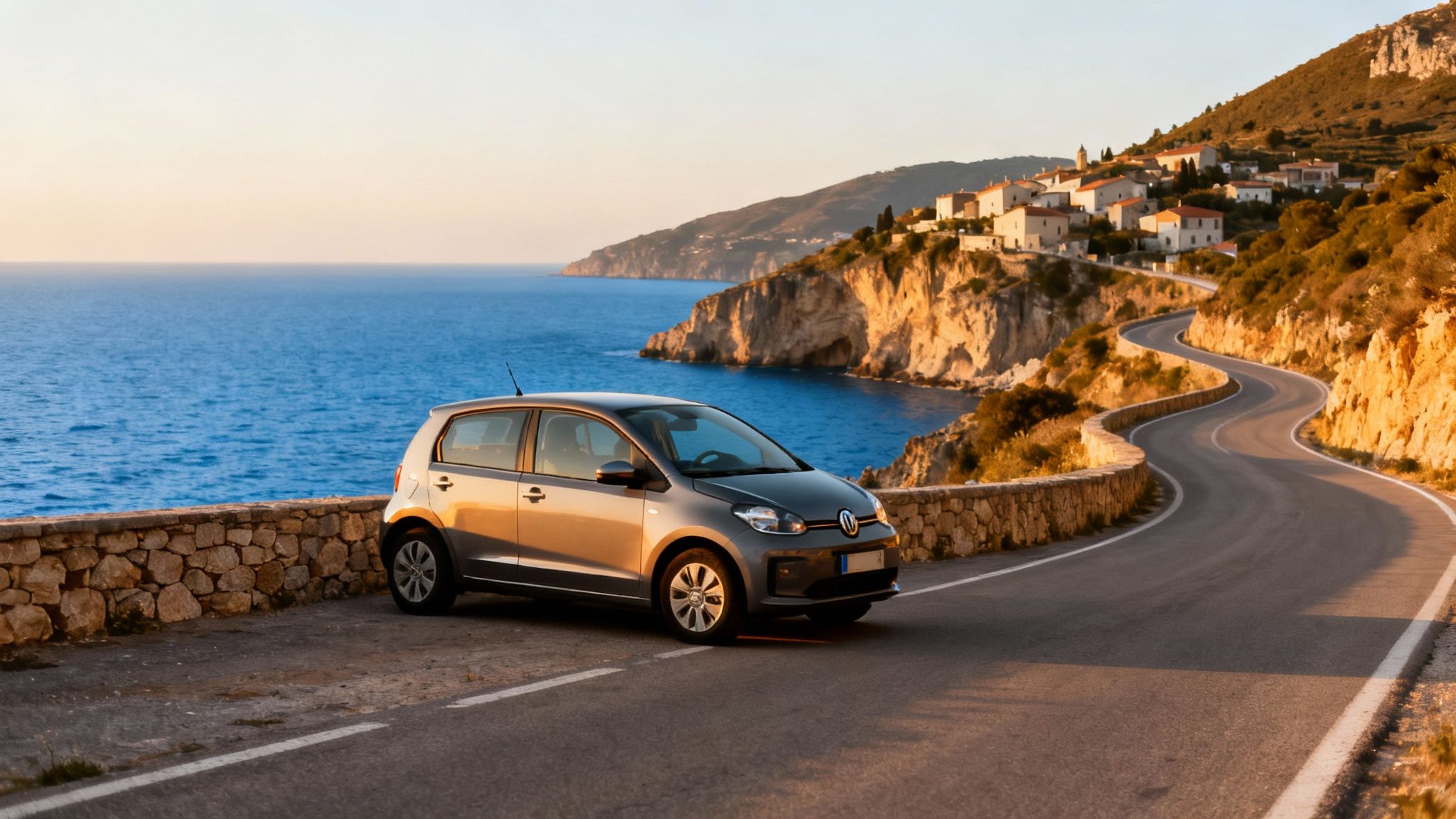
For many, the best way to travel in Europe is with the complete freedom that only a car can provide. If your itinerary involves exploring the rolling hills of Bavaria, the charming villages of the Cotswolds, or the dramatic coastlines of Norway, a rental car isn’t just a good idea—it’s essential. It allows you to stop whenever you want, discover hidden gems, and get far off the beaten path.
But a word of warning: a car is a liability in major cities. Parking is expensive and scarce, and navigating congested, ancient streets is a nightmare. The ideal strategy is to combine travel modes. Use trains to hop between the big cities, then rent a car for a few days to explore a specific region. For more tips on this approach, see our guide to planning sustainable road trip vacations.
The Ultimate Budget Choice: Buses
When your budget is the number one priority, nothing beats the long-distance bus. Companies like FlixBus have built a massive network across the continent with fares that can be shockingly low—sometimes just a few dollars for a multi-hour journey.
The trade-off, of course, is time and comfort. Bus journeys are significantly slower than trains, and the amenities are more basic. But for the shoestring traveler, or for shorter regional trips where the time difference isn’t a dealbreaker, the savings can be well worth it.
Smart Itineraries and Modern Travel Tips
Theory is one thing, but putting it into practice is how you build confidence for a European adventure. Crafting a smart, rail-first itinerary lets you connect iconic cities efficiently while dialing down the environmental impact and travel stress. This section pulls everything together with sample routes and essential tips for modern travel.
We’ll start with a classic itinerary that shows the power of train travel: a Western Europe loop connecting Paris, Brussels, and Amsterdam. It’s a perfect example of how to see a lot without spending your whole trip in transit.
This route includes estimated costs and travel times, helping you see just how smooth and low-stress a European trip can be. With the right plan, you spend less time moving and more time soaking in the culture.
Key Takeaways
- Rail-first itineraries are efficient: A well-planned train route like Paris-Brussels-Amsterdam can be covered in just a few hours of travel per leg.
- Book accommodations near stations: Staying near central train stations simplifies arrivals and departures, saving time and money on local transport.
- Stay connected with an eSIM: Avoid high roaming fees with a digital SIM card from providers like Airalo or Yesim for affordable data.
- Pack light and smart: A versatile carry-on measuring around 22 x 14 x 9 inches (55 x 35 x 23 cm) is perfect for easy train travel.
- Arrange transfers in advance: For stress-free arrivals, pre-booking a service like Welcome Pickups ensures a smooth transition from the station to your hotel.
Classic Western Europe Loop By Train
This itinerary is perfect for first-timers, linking three of Europe’s most dynamic capital cities with short, comfortable train journeys that barely give you time to finish your coffee.
- Paris to Brussels: The high-speed Thalys makes this trip in about 1 hour and 22 minutes. A one-way ticket booked in advance can cost between $35 and $70 USD (€32 to €65 EUR).
- Brussels to Amsterdam: From Brussels, the journey to Amsterdam takes just under 2 hours. Fares are similar, typically ranging from $40 to $80 USD (€37 to €74 EUR).
Pro Tip: By chaining these destinations together, you create an efficient route that minimizes backtracking. For more advanced strategies, explore our guide on trip chaining for amazing rail adventures, which dives deeper into creating seamless multi-city itineraries.
Essential Tips for the Modern European Traveler
Beyond the route itself, a few modern tools can make a huge difference. For digital nomads and anyone relying on maps, staying connected is non-negotiable. An eSIM is the simplest solution. Providers like Airalo let you download a data plan directly to your phone, giving you affordable internet the moment you land without fumbling with physical SIM cards.
For seamless arrivals, pre-booking an airport or station transfer with a service like Welcome Pickups eliminates the stress of navigating a new city with luggage. A driver meets you at the arrivals hall, ready to take you straight to your accommodation. It’s a small thing that makes the first hour feel incredibly calm.
Finally, smart packing is crucial for train travel. Stick to a carry-on of approximately 22 x 14 x 9 inches (55 x 35 x 23 cm) and keep the weight under 22 pounds (10 kg). This makes navigating train stations, cobblestone streets, and hotel stairs so much easier.
This article was fact-checked using sustainability data from the World Green Building Council, the Global Ecotourism Network, and peer-reviewed architecture studies. All partner links are vetted for compliance with sustainable business certifications.
Join the Sustainable Work Movement
Want more rail-first itineraries, low-impact packing systems, and walkable base-city ideas?
Your Top European Travel Questions Answered
Planning a trip across Europe brings up a lot of practical questions, especially if it’s your first time weaving together different countries and transport systems. Sorting out the best way to travel often boils down to a few key decisions on passes, booking windows, and budget.
Here are some clear answers to the questions we see most often.
Is a Eurail Pass Actually Worth It?
A Eurail Pass can be fantastic value if your itinerary is packed with multiple long-distance or high-speed train journeys in a short window. The flexibility is its biggest selling point.
However, if you’re only planning a few short trips or traveling mostly in countries with cheap rail systems (like much of Eastern Europe), buying individual point-to-point tickets almost always works out to be cheaper.
The best way to decide is to sketch out your must-do routes. Then, compare the total price of buying those tickets one-by-one against the cost of the pass.
How Far Ahead Should I Book Train Tickets?
For the best prices on popular high-speed routes—think France, Italy, and Germany—you really want to book two to three months in advance. Fares on these lines work a lot like airline tickets; they’re dynamic, and last-minute prices can be painfully high.
On the other hand, for regional trains covering shorter distances, booking ahead isn’t nearly as critical. You can often just buy your tickets on the day of travel without seeing a major price jump.
What’s the Most Budget-Friendly Way to Travel in Europe?
When it comes down to pure cost, long-distance buses like FlixBus are generally the cheapest way to get between European cities. The trade-off is time. Journeys take longer than by train or plane, but the ticket prices are consistently rock-bottom.
Budget airlines can also dangle some incredibly cheap fares, especially if you book far in advance and travel with only a small backpack. But always—always—factor in the extra fees for luggage and seat selection. Those add-ons can quickly make a “cheap” flight more expensive than it first appeared.

Explore Eco Nomad Travel
📚 Core Guides
🧭 Planning & Logistics
🗺️ Destinations & Seasons
Jeremy Jarvis — founder of Eco Nomad Travel, sustainable travel writer, and advocate for regenerative tourism. His work focuses on low-impact mobility, eco-friendly digital nomad life, and climate-positive travel.
Legal
Affiliate DisclaimerPrivacy Policy
Terms of Service
Image & Media Notice
Cookie Policy
Contact
Affiliate Disclosure: Some links on Eco Nomad Travel are affiliate links, meaning we may earn a small commission at no extra cost to you. This supports our mission to inspire responsible and low-impact travel worldwide.
Connect
✅ Trusted Official Sources
Plan smarter eco trips
Try our free Sustainable Travel Tools for Digital Nomads – carbon calculator, train vs plane comparator, and more.
Open Tools Hub