
For most people, the best way to travel Italy, especially if you value your time and want a lower-impact trip, is by high-speed train. The country’s rail network is a dream—fast, scenic, and a genuinely low-carbon way to move between major cities without the hassle of domestic flights or rental cars.
This guide gets straight to the point, showing you why a rail-first plan is the smartest move for exploring Italy’s most iconic places. We’ll compare trains, cars, and buses on the things that actually matter—cost, environmental footprint, and pure convenience—to help you build a relaxed Italian adventure, whether it’s your first visit or your tenth.
A train-focused journey lets you experience the country at a more human pace, skipping the stress of city driving and endless airport lines. You’ll spend less time in transit and more time soaking in the culture, from the canals of Venice to the ancient streets of Rome. It’s a slower, more immersive style of travel that truly honors the Italian way of life.
Key Takeaways
- Trains are king for city-hopping: High-speed rail is the most efficient, cost-effective, and sustainable way to travel between major hubs like Rome, Florence, and Milan.
- Book high-speed rail in advance: To get the best prices on Frecciarossa and Italo trains, book your tickets at least two to four weeks ahead. You can save up to 70%.
- A car is for rural detours only: Renting a car makes sense only for specific goals, like exploring the rolling hills of Tuscany or the remote coastlines of Puglia where train access is thin.
- Embrace a slower pace: Italy is meant to be enjoyed slowly. Rushing between destinations means losing huge chunks of your trip to travel days. Focus on fewer places for a richer experience.
- Prioritize walkable base cities: Choose central spots near main train stations. This makes it easy to explore cities on foot and take day trips without ever needing a car.
- Stay connected easily: Get an eSIM from a provider like Airalo before you go. This gives you instant data upon arrival for maps, translations, and booking tickets on the fly.
Editor’s Pick
Best Tool for Rail Planning: Trip.com
For navigating Italy’s rail system, Trip.com is our go-to platform. It offers a user-friendly interface that simplifies booking tickets on both major operators, Trenitalia and Italo, often in a single transaction. The platform’s clear schedules and competitive pricing make planning a multi-city rail itinerary straightforward and hassle-free.
Comparing Your Italy Travel Options
Deciding how to get around Italy means balancing speed, cost, flexibility, and your environmental footprint. While the romantic idea of a road trip is tempting, the reality often involves wrestling with complex traffic zones (ZTLs), steep tolls, and non-existent parking.
High-speed rail, on the other hand, drops you right in the city center, ready to explore. To help you decide what works best for your trip, let’s compare the main options side-by-side.
Train vs. Car vs. Bus: A Quick Comparison
Each mode of transport has its place. Understanding where each one shines will help you build a smarter, less stressful itinerary.
| Travel Mode | Ideal For | Typical Cost (USD) | Sustainability | Convenience & Speed |
|---|---|---|---|---|
| Train | City-hopping, long-distance travel, eco-conscious trips | $25–$150+ per leg (booked early) | Lowest Footprint | Excellent (fast, central stations) |
| Car | Rural Tuscany, remote coastlines, family travel | $50–$100+ per day (plus fuel/tolls) | Highest Footprint | Poor for cities, great for remote areas |
| Bus | Budget travelers, routes not served by rail | $10–$40 per leg | Low Footprint | Slowest option, best for last-minute trips |
The numbers don’t lie: trains offer a superior balance of speed, cost, and sustainability for the most popular Italian itineraries. According to the European Environment Agency, rail travel has the lowest greenhouse gas emissions per kilometer, making it the clear winner for anyone traveling with the planet in mind.
A rental car might feel like freedom, but the hidden costs and logistical headaches in urban areas can quickly sour the experience.
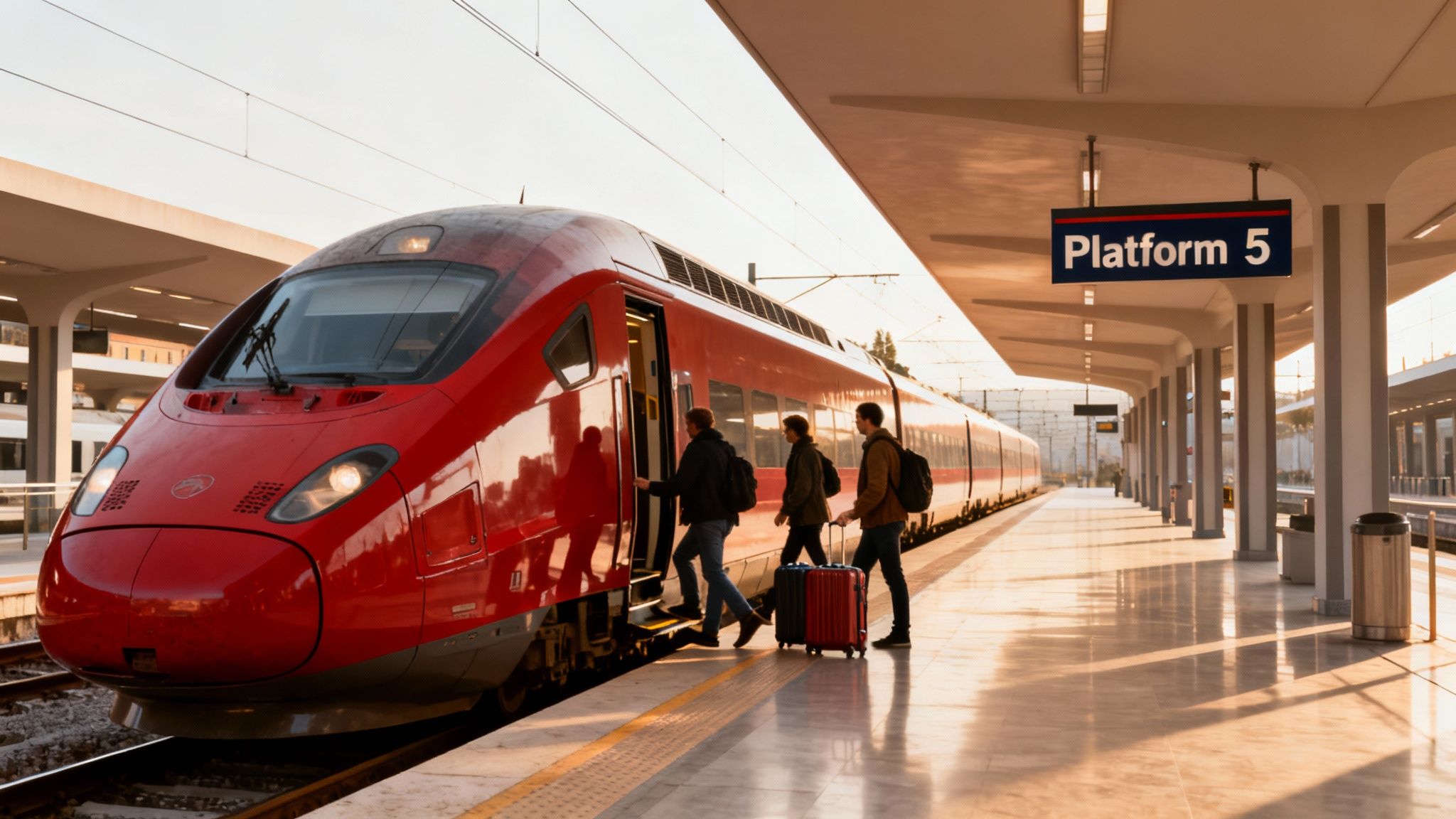
How to Get Around Italy: Trains, Cars, or Buses?
Deciding on the best way to travel Italy is about balancing speed, cost, flexibility, and your environmental footprint. The classic idea of a Tuscan road trip sounds romantic, but the reality often involves navigating baffling traffic zones (ZTLs), paying steep highway tolls, and circling for non-existent parking.
This isn’t just a simple pro-con list. We’ll look at trains, rental cars, and buses through the lens of what matters to a modern, eco-conscious traveler—the true costs, the real-world convenience, and the sustainability of your journey.
Environmental Impact: Your Carbon Footprint
Your choice of transport has a massive impact on your travel emissions. For pretty much any journey between Italian cities, trains are the undisputed champion of sustainable travel. Italy’s modern, electrified high-speed rail network produces just a fraction of the CO₂ per passenger compared to driving the same route.
A high-speed train trip from Rome to Florence, for example, emits around 79% less CO₂ per passenger than making the same journey by car. To see the specific impact of your own planned routes, you can run the numbers with our tool.
[carbon_calculator_2025]
Long-distance buses also offer a solid low-carbon alternative, often on par with trains. But the clear environmental loser is the rental car, especially if you’re a solo traveler or a couple. For a deeper dive into the data, check out the analysis of transport emissions from Our World in Data.

The Real Cost: Looking Beyond the Ticket Price
When comparing costs, it’s crucial to look beyond the sticker price. A rental car’s daily rate is just the start; the “true cost” includes a stack of other expenses that add up fast.
- Rental Car: The daily rate (think $50-$100 USD) is just the beginning. You’ll add mandatory insurance, fuel (gasoline can top $7.50 USD per gallon or €1.90 per liter), expensive highway tolls (autostrade), and city parking fees. A single, accidental ZTL violation—captured by a camera you never saw—can land you a fine of over $100 USD (€90+). A car from a platform like GetRentACar can seem like a good deal, but always factor in these extras.
- High-Speed Train: Train tickets are priced dynamically. If you book a Frecciarossa or Italo ticket two to four weeks ahead on a site like Trip.com, you can often snag fares for as low as $25-$50 USD on major routes like Rome to Florence. The price you see is the price you pay—no hidden fees for fuel or tolls.
- Bus: Buses are always the cheapest option, with tickets frequently under $20 USD, even at the last minute. This makes them a fantastic choice for budget travelers, especially on routes that aren’t well-served by rail.
For a typical week-long trip connecting Rome, Florence, and Venice, a solo traveler who books trains in advance will almost always spend significantly less than someone renting a car.
To make the decision clearer, here’s a side-by-side look at how each travel mode stacks up across the most important factors for eco-minded nomads and slow travelers.
Italy Travel Options Compared: Cost, Sustainability, and Convenience
| Travel Mode | Ideal For | Typical Cost (USD) | Sustainability Impact | Speed and Convenience | Flexibility |
|---|---|---|---|---|---|
| High-Speed Train | City-to-city travel, major hubs (Rome, Florence, Milan, Venice, Naples) | $25–$80 per leg (booked in advance) | Very Low | Very High: Center-to-center in minutes, no traffic or parking stress. | Low: Fixed routes and schedules. |
| Rental Car | Rural exploration, Tuscany agriturismos, remote national parks | $70–$150+ per day (all-in) | High | Low in cities (traffic, ZTLs), High in countryside. | Very High: Go anywhere, anytime, stop on a whim. |
| Long-Distance Bus | Budget travel, routes not covered by rail, last-minute trips | $10–$30 per leg | Low | Moderate: Slower than trains, subject to traffic. | Low: Fixed routes, less frequent than trains. |
This table shows a clear pattern: for itineraries focused on Italy’s famous cities, the train is the logical, stress-free choice. But if your heart is set on the rolling hills and quiet backroads, a car becomes a necessary tool—just be prepared for the true cost.
Convenience vs. Flexibility: The Real Trade-Off
Convenience isn’t just about speed; it’s about minimizing stress and maximizing your precious time. High-speed trains are masters of this, connecting you from one city center to another. You arrive ready to explore, not needing a taxi from a distant airport or a long walk from a parking garage. The journey from Rome Termini to Florence Santa Maria Novella takes just 90 minutes—a trip that would take over three hours by car with traffic.
But a train-only approach has its limits. This is where a rental car offers unbeatable flexibility for digging into rural regions.
- When to Rent a Car: If your plan involves staying at an agriturismo in the Tuscan countryside, driving the Amalfi Coast (not for the faint of heart!), or reaching remote national parks in Abruzzo, a car is essential. It lets you make spontaneous stops and discover places untouched by rail lines.
- When to Take the Train: For any itinerary focused on Italy’s major and secondary cities—Rome, Florence, Venice, Milan, Bologna, Naples—the train is faster, cheaper, and infinitely less stressful.
The smartest approach is often a hybrid one. Use trains as your backbone for travel between cities. Then, consider a short-term car rental for just two or three days to explore a specific rural area before dropping it off and hopping back on the train. This multi-modal strategy truly gives you the best of both worlds.
Why a Rail-First Approach Is the Best Way to Travel Italy
For the vast majority of trips in Italy, thinking “rail-first” isn’t just another option—it’s genuinely the smartest way to travel the country. This approach means building your itinerary around Italy’s world-class train network, turning what could be a logistical headache into a relaxing, scenic part of the adventure. You simply glide from one city center to the next, completely skipping traffic jams, toll booths, and the stress of figuring out unfamiliar roads.
This isn’t just a niche travel style anymore. Sustainable tourism in Italy is seeing massive growth, showing a clear demand for the kind of low-stress, eco-friendly journeys that trains deliver so well.
This decision tree helps visualize when it makes sense to stick with the train, or when a car or bus might be a better fit for your specific goals.
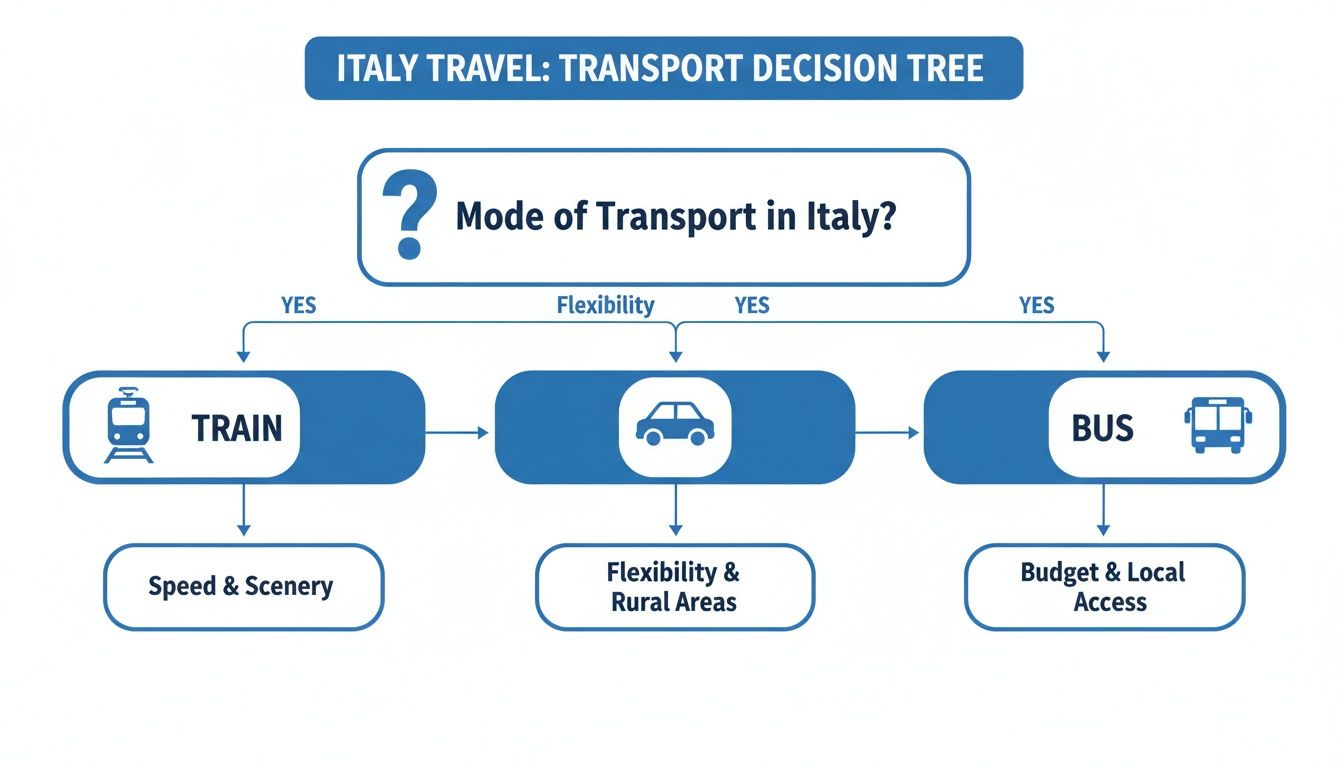
As you can see, if your itinerary is focused on Italy’s magnificent cities, the train is the clear and logical winner for both efficiency and ease.
Italy’s Premier Train Operators
When you travel by high-speed rail here, you’ll mainly be choosing between two operators:
- Trenitalia: This is the national railway company. Its flagship Frecciarossa (“Red Arrow”) trains are the backbone of the system, connecting major hubs like Milan, Venice, Florence, Rome, and Naples at speeds up to 186 mph (300 km/h).
- Italo: A private competitor that runs sleek, modern trains on the most popular high-speed routes. Italo is known for comfort and competitive pricing, making it a fantastic alternative to Trenitalia.
For most travelers, the choice between them just comes down to who has the better schedule and price for your specific route. I find platforms like Trip.com invaluable because they let you compare and book tickets from both operators in one place, so you know you’re getting the best deal.
Booking Tip: High-speed train fares are dynamic, just like airline tickets. Booking your journey two to four weeks in advance can slash your costs by up to 70%, especially on popular routes. Spontaneity is great for ordering a coffee, not so much for a Rome-to-Milan train ticket.
Beyond High-Speed: Regional and Night Trains
While the fast trains are perfect for zipping between major cities, Italy’s rail network has much more to offer. Understanding the different train types is the key to building a truly flexible itinerary.
Regionale Veloce (Fast Regional) Trains
Think of these as your workhorses for reaching smaller towns and charming villages that aren’t on the high-speed lines. They’re slower, make more stops, and have fixed, affordable fares. You don’t need to book these in advance; just buy a ticket at the station on the day you travel. This freedom is perfect for spontaneous day trips from a base city, like Florence to Lucca or Bologna to Modena.
Intercity Notte (Night Trains)
For long-haul journeys, like from Milan all the way down to Sicily, night trains are a brilliant, time-saving solution. You cover huge distances while you sleep, saving on a night’s accommodation and waking up in a completely new destination. While they may not be as luxurious as some other European night trains, they are a practical and adventurous way to maximize your time. To learn more about mastering train travel across the continent, check out our comprehensive guide on how to travel Europe by train.
Crafting Your Perfect Rail-First Italy Itinerary
Alright, we’ve made the case for why a rail-first strategy is the best way to travel Italy. Now, let’s put that theory into practice. When you build an itinerary around Italy’s superb train network, you’re choosing a more relaxed, immersive experience—one that frees you from the stress of navigating ZTL zones, finding parking, and sitting in traffic.
The whole approach hinges on a simple idea: pick walkable base cities, then use Italy’s mix of high-speed and regional trains to explore from there.
The trend towards slower, more thoughtful travel is clear. Visitors are staying longer, a sign of a shift toward the train-centric trip that allows for deeper immersion.
Below are three sample itineraries I’ve designed for different trip lengths and travel styles. Each one is built to maximize your time enjoying Italy and minimize the hours spent just getting from A to B. We’ll also touch on why minimalist packing is your best friend on the rails.
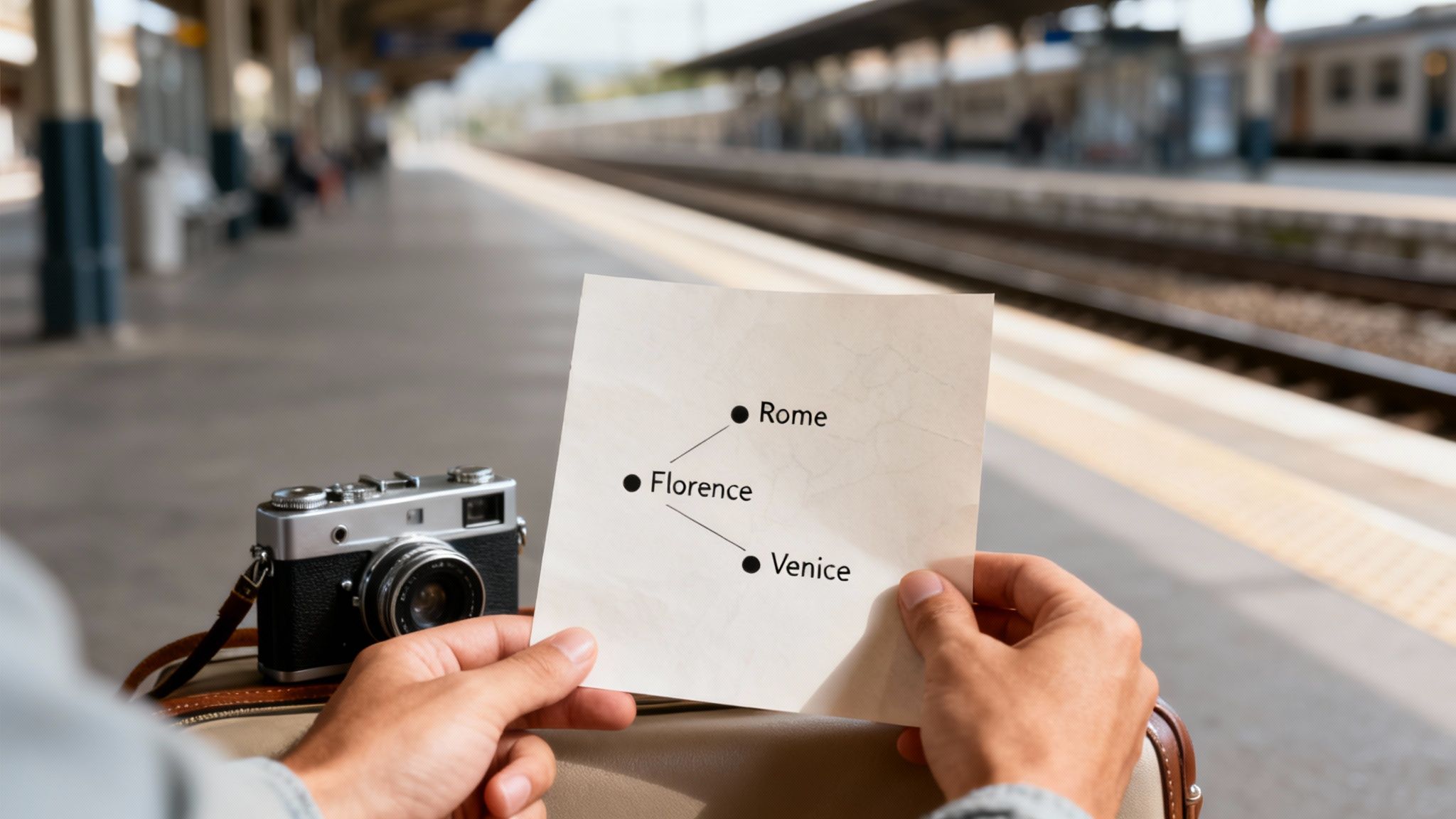
The Classic Italian Trio: A 7 To 10 Day Itinerary
This is the quintessential route for a first trip to Italy, connecting the “big three” with hyper-efficient high-speed trains. It’s the perfect, stress-free introduction to the country.
- Route: Rome → Florence → Venice
- Key Train Routes:
- Rome (Termini) to Florence (Santa Maria Novella): ~1 hour 30 minutes on Frecciarossa.
- Florence (SMN) to Venice (Santa Lucia): ~2 hours 15 minutes on Frecciarossa or Italo.
- Walkable Base Cities: Stay near the main train stations in each city to make your life easier. In Rome, the areas around Termini or the nearby Monti neighborhood are great. In Florence, anywhere within a 15-minute walk of Santa Maria Novella station is ideal.
The Northern Explorer: A 14 Day Itinerary
For those who have already seen the classics or just crave a mix of urban energy and staggering nature, this northern loop is a fantastic choice.
- Route: Milan → Lake Como → Bologna → Venice
- Key Train Routes:
- Milan (Centrale) to Varenna-Esino (Lake Como): ~1 hour on a simple regional train.
- Milan to Bologna (Centrale): ~1 hour on a high-speed train.
- Bologna to Venice (Santa Lucia): ~1 hour 30 minutes on a high-speed train.
- Multi-Modal Tip: To explore the Dolomites from this route, take a train to Bolzano. From there, you can connect to the excellent local bus network that serves the mountain villages. This is a perfect example of combining rail’s efficiency with the flexibility you need for alpine terrain.
The Southern Italy Slow Journey: A 21+ Day Itinerary
If you have a bit more time and want to really soak in the vibrant culture of the South, this extended journey is for you. It uses a mix of all train types for a truly comprehensive experience.
- Route: Naples → Amalfi Coast → Sicily (Palermo/Catania)
- Key Train Routes:
- Rome to Naples (Centrale): ~1 hour 15 minutes on a high-speed train.
- Naples to Salerno: Use the local Circumvesuviana or regional trains to reach the gateway to the Amalfi Coast. From Salerno, you can connect by bus or ferry.
- Naples to Sicily: This is a special one. Take the unique Intercity Notte (night train) that literally boards a ferry to cross the Strait of Messina—it’s an unforgettable travel experience.
- Pro Tip: This itinerary is a perfect example of a powerful concept I call “trip-chaining.” You can learn how to master these multi-stop rail adventures in our dedicated guide.
When to Choose a Car or Bus Instead
While a rail-first plan is absolutely the best way to travel Italy for most city-to-city journeys, a smart itinerary knows when to step off the tracks. A train ticket won’t do you much good if your destination is a remote Tuscan farmhouse.
Certain trips and travel styles don’t just benefit from a car or bus—they pretty much demand them. Knowing when to swap the train for the road is the key to seeing all of Italy, especially the rural heartlands that the rail network often misses.
When a Rental Car Is the Right Choice
Nothing beats the freedom of a rental car for specific kinds of adventures. If your vision of Italy involves navigating winding country roads, making spontaneous stops at vineyards, and reaching places miles from any station, then driving becomes essential.
Here are the moments where renting a car makes perfect sense:
- Exploring Agriturismos: To really experience the iconic rolling hills of Tuscany or Umbria and stay at a traditional farmhouse (agriturismo), a car is non-negotiable. By design, these beautiful properties are deep in the countryside, often a long way from the nearest train.
- Reaching Remote National Parks: If your goal is hiking in parks like Abruzzo, Lazio e Molise or exploring the wild beauty of Sila National Park in Calabria, a car is the only practical way to get to trailheads and tiny mountain villages.
- Navigating Less-Connected Coastlines: While some coastal areas have decent train service, regions like Puglia’s Salento Peninsula or the rugged interior of Sardinia are best explored with a vehicle. A car lets you hop between secluded beaches and small fishing towns on your own schedule.
Driving in Italy’s major cities is a nightmare. Think ZTLs (Limited Traffic Zones with hefty fines), impossible parking, and nerve-wracking traffic. The best strategy is often a hybrid one: use trains for the long hauls between cities, then rent a car for just 2-3 days for a specific rural excursion before dropping it off.

The Strategic Use of Buses
For travelers keeping an eye on their budget, long-distance buses are a practical and surprisingly efficient alternative. They’re slower than the high-speed trains, sure, but they serve countless routes that trains simply don’t, connecting smaller towns and offering a lifeline when train tickets are sold out or ridiculously expensive.
Companies like FlixBus run extensive networks across the country, with tickets often costing less than $20 USD (€18). Buses are especially useful for:
- Budget Travel: On routes where last-minute train prices have soared, buses can be a financial lifesaver.
- Connecting Underserved Towns: Buses often provide the most direct link between two smaller towns that would otherwise require several train changes and a lot of waiting around.
- Last-Minute Plans: When high-speed train fares are at their peak for same-day travel, a bus is almost always a cheaper bet.
By weaving in short-term car rentals for deep dives into the countryside and using buses for those niche routes, you can build a brilliant itinerary around a rail-first core. For more on crafting these multi-modal journeys, check out our guide to planning sustainable road trip vacations. This balanced approach ensures you experience the full breadth of Italy, from its buzzing city centers to its quiet, rustic soul.
Practical Tips for Getting Around Italy Smoothly
Knowing the best way to travel through Italy is one thing, but making the trip happen without a hitch is another. It’s time to move from the big picture to the on-the-ground details—the small, practical choices that make a good itinerary feel effortless.
This section is all about those actionable tips that turn a plan into a great, stress-free experience. We’ll cover everything from staying connected with an eSIM to mastering local transport and, most importantly, packing light enough to make train travel a breeze.
Think of this as your pre-departure checklist for navigating Italy like you’ve been there a dozen times.
Staying Connected
An eSIM is your best friend for modern travel. Use a provider like Airalo to manage train bookings on the go, pull up maps, and use translation apps without hunting for Wi-Fi.
Packing Smart for Train Travel
The single biggest mistake I see travelers make is overpacking. Dragging a heavy suitcase over cobblestone streets and hoisting it onto a train is miserable. It’s time to embrace a minimalist mindset.
For train travel, mobility is everything. A single carry-on-sized backpack (under 22 lbs or 10 kg) or a small roller bag allows you to move quickly through stations and find a spot for your luggage without a struggle. This approach forces you to pack only what you actually need, making your entire trip more flexible and far less draining.
For more on this, check out our guide on the best luggage for train travel.
Mastering Local Transport and Logistics
Once you arrive in a city, figuring out the local transit is key. In Rome and Milan, the metro is the fastest way to cover longer distances. In Venice, the vaporetto system is your lifeline. A multi-day pass almost always pays for itself.
A critical rule for local and regional transport: you must validate (convalidare) your paper ticket before boarding. Look for the small green or yellow machines on the platform or near the bus entrance. A conductor will not care if you bought a ticket; if it isn’t validated, you risk a fine of $55 USD (€50) or more.
Choosing Sustainable Stays
Your accommodation choice has a big impact on your trip’s footprint. Look for properties with recognized eco-certifications like Green Key or EU Ecolabel. Better yet, prioritize hotels in central, walkable neighborhoods near the main train stations to minimize your reliance on taxis.
For an early morning flight or a late-night arrival, pre-booking a transfer with a service like Welcome Pickups eliminates stress and locks in a fixed price.
A Few Final Questions About Travel in Italy
Sorting out the logistics for a trip to Italy always brings up a few common questions. Here are some quick, practical answers that pull together the main ideas from this guide, so you can lock in your plans and travel with confidence.
Is It Cheaper to Travel by Train or Car in Italy?
For solo digital nomads or couples moving between big cities, the train almost always wins on cost. Once you factor in a rental car, fuel (often over $7.50 USD per gallon), hefty highway tolls (autostrade), and parking fees, the train is a much cleaner deal. High-speed tickets booked in advance offer the best value.
A car starts to make financial sense for groups of three or four exploring rural areas like the Tuscan countryside, but you absolutely have to budget for all those extras beyond the daily rental rate. They add up fast.
Should I Book Italy Train Tickets in Advance?
Yes—for the fast trains, it’s a must. High-speed (Frecciarossa, Italo) and Intercity services use dynamic pricing, which means fares climb dramatically as you get closer to your travel date. Booking your main routes on a platform like Trip.com two to four weeks ahead can save you up to 70%.
For the slower regional (Regionale) trains, however, the fares are fixed. You can buy these tickets right before you board with no price penalty, giving you total flexibility for spontaneous day trips.
What Is the Most Eco-Friendly Way to Travel in Italy?
The train, by a huge margin. Italy’s modern, electrified rail network has a tiny carbon footprint per passenger compared to cars or domestic flights. It’s the most sustainable way to cover medium to long distances in the country. If you want to dig deeper into how transport choices affect the environment, the Global Ecotourism Network has some excellent resources on sustainable practices.
The best low-impact strategy? Combine train travel between cities with walking and local public transport once you arrive.
Can I Travel in Italy Without Speaking Italian?
Yes, absolutely. In major hubs and tourist centers like Rome, Florence, and Venice, you’ll find English is widely spoken in hotels, restaurants, and at train stations. You can easily get by without being fluent in Italian.
That said, learning a few basic phrases shows respect and almost always leads to warmer, more genuine interactions. Simple greetings like ‘Buongiorno’ (Good morning) and ‘Grazie’ (Thank you) go a long way. In smaller, more remote towns, a good translation app on your phone is an invaluable backup.
This article was fact-checked using sustainability data from the World Green Building Council, the Global Ecotourism Network, and peer-reviewed architecture studies. All partner links are vetted for compliance with sustainable business certifications.
Join the Sustainable Work Movement
Want more rail-first itineraries, low-impact packing systems, and walkable base-city ideas?
Explore Eco Nomad Travel
📚 Core Guides
🧭 Planning & Logistics
🗺️ Destinations & Seasons
Jeremy Jarvis — founder of Eco Nomad Travel, sustainable travel writer, and advocate for regenerative tourism. His work focuses on low-impact mobility, eco-friendly digital nomad life, and climate-positive travel.
Legal
Affiliate DisclaimerPrivacy Policy
Terms of Service
Image & Media Notice
Cookie Policy
Contact
Affiliate Disclosure: Some links on Eco Nomad Travel are affiliate links, meaning we may earn a small commission at no extra cost to you. This supports our mission to inspire responsible and low-impact travel worldwide.
Connect
✅ Trusted Official Sources
Plan smarter eco trips
Try our free Sustainable Travel Tools for Digital Nomads – carbon calculator, train vs plane comparator, and more.
Open Tools Hub