
Discovering the world doesn’t have to drain your bank account or harm the planet. With the right budget travel tips, you can design enriching, long-term journeys that are both affordable and eco-conscious. This comprehensive guide moves beyond generic advice, offering an actionable roundup of strategies tailored for digital nomads and remote workers who prioritize rail-first, low-impact travel. We focus on practical, sustainable choices that significantly reduce your costs and your carbon footprint.
Forget vague suggestions. Here, you’ll learn exactly how to leverage European rail passes for deep savings, master a zero-waste packing system that lets you travel for 7-10 days between laundry cycles, and find regenerative, budget-friendly lodging that supports local communities. We’ll cover everything from booking night trains to save on accommodation to shopping at local markets to slash your daily food expenses. These aren’t just ideas; they are specific, data-backed methods designed for long-stay, slow-travel itineraries.
By integrating these strategies, you can realistically reduce your overall travel expenses by 40–60% while deepening your connection to the places you visit. This listicle provides the blueprint for building a smarter, more sustainable travel lifestyle, proving that thoughtful exploration can be both accessible and responsible. Let’s dive into the practical steps that make it possible.
1. Embrace Rail Passes and Point-to-Point Train Travel Over Flights
For digital nomads and slow travelers, one of the most effective budget travel tips is to prioritize trains over planes. Swapping short-haul flights for rail journeys dramatically reduces your carbon footprint and often unlocks significant savings. European rail passes like the Eurail or Interrail Pass allow travelers to cover vast distances for a fixed, affordable price, eliminating the high costs and emissions of regional flights. This strategy is central to a low-impact, budget-conscious travel style.
Point-to-point tickets offer another layer of savings. When booked in advance, train tickets can cost 40–70% less than a comparable flight. The real game-changer, however, is the night train. Operators like ÖBB Nightjet, Renfe, and SNCF combine your transit and accommodation into one ticket, saving you $55–$110 per night on lodging. This approach not only shrinks your daily budget but also adds an element of classic, romantic travel to your itinerary.

Why Rail Passes Are a Budget-Friendly Choice
A rail pass offers unparalleled flexibility and value for multi-city trips. For instance, an Interrail Pass ($195–$435) provides access to rail networks in over 40 European countries. A digital nomad completing a 30-day European loop could save over $1,600 compared to booking individual flights. Similarly, the Japan Rail Pass ($280–$400) allows 7 to 21 days of unlimited travel, often costing 40% less than buying point-to-point tickets for a similar itinerary.
Actionable Tips for Maximizing Rail Savings
To make the most of train travel, strategic planning is key. Follow these tips to reduce costs and enhance your experience:
- Book Night Trains in Advance: Secure your spot on popular routes like the ÖBB Nightjet from Vienna to Italy by booking 6–12 weeks ahead, especially for peak seasons. A couchette can cost as little as $42–$86, replacing an $87–$163 hotel stay.
- Compare Regional vs. Global Passes: For single-country explorations in places like France, Italy, or Spain, a regional pass is often 30–40% cheaper than a comprehensive Eurail Pass.
- Utilize Booking Platforms: Use sites like Trainline, Omio, or the official Nightjet website to compare prices and lock in advance-purchase discounts.
- Plan ‘Base City’ Weeks: To avoid transit fatigue and amortize costs, alternate train travel days with longer stays in a “base city.” This reduces the total number of moves and deepens your local experience.
- Combine Passes with Overnight Journeys: The ultimate budget hack is layering a rail pass with one or two long-distance overnight trips. This strategy significantly cuts accommodation expenses over the course of your journey.
2. Choose Walkable Base Cities and Extended Stays Over Multi-City Hotel Hops
Instead of constant movement, one of the most impactful budget travel tips for digital nomads is to establish a “base city” for an extended stay. Swapping rapid, 2-3 day hotel hops for a 1-4 week stay in a single walkable location drastically cuts accommodation and transit costs while lowering your carbon footprint. This slow travel approach fosters a deeper connection with a place and supports a more sustainable, low-impact lifestyle.
Choosing cities with excellent public transit and walkability, like Prague, Lisbon, or Chiang Mai, unlocks immense savings. Weekly apartment rentals in these hubs can cost as little as $160–$325, which breaks down to a nightly rate of just $23–$47. This represents a 60–75% saving compared to the average nightly hotel price. An extended stay also allows you to discover local grocery stores, neighborhood cafes, and affordable laundry services, which significantly reduces your daily expenses.
Why Extended Stays Are a Budget-Friendly Choice
Settling into a base city transforms your travel budget from a tourist’s expense sheet to a resident’s. For example, a week in Lisbon could involve a $215 apartment and $130 for groceries, averaging just $49 per day. This compares favorably to a typical tourist budget of $87–$130 per night for a hotel plus restaurant meals. In Chiang Mai, the savings are even greater: a $130 weekly apartment and $75 for food can bring your total daily cost down to an incredible $29. This strategy is the cornerstone of long-term, affordable travel.
Actionable Tips for Maximizing Base-City Savings
To make the most of an extended stay, a little planning goes a long way. Use these tips to find the best deals and fully integrate into your temporary home:
- Filter for Weekly/Monthly Discounts: On platforms like Airbnb, filter for ‘Entire place’ and sort by weekly or monthly discounts to reveal significant savings. Also, check for promo codes before booking.
- Explore Long-Stay Platforms: Use sites like Spotahome, Uniplaces, or the ‘monthly stays’ feature on Booking.com for verified listings geared toward longer-term tenants.
- Negotiate Directly with Hosts: Before committing, message hosts to inquire about unlisted monthly rates. A polite request can often secure a 10–20% discount.
- Prioritize Transit-Rich Neighborhoods: Choose a base in a neighborhood with excellent metro access, local markets, and affordable eateries, often found just a mile or two from the main tourist centers.
- Locate Local Groceries Immediately: On your first day, find the nearest Lidl, Carrefour, or local market. Cooking your own meals is the single biggest way to cut daily food costs.
- Pay Smart with a Multi-Currency Account: Use an app like Wise to pay for your deposit and rent in the local currency, which helps you avoid the 3–4% foreign exchange fees charged by traditional banks.
3. Travel During Shoulder Seasons and Off-Peak Months for 40–60% Cost Savings
One of the most powerful budget travel tips for digital nomads is to avoid peak season entirely. By planning your journeys during shoulder seasons (typically April–May and September–October in Europe) or off-peak months, you can unlock savings of 40–60% on accommodation and transport. This strategy involves traveling just before or after the high-demand summer and winter holiday periods, when crowds thin out, prices drop, and the weather is often ideal for exploration.
This approach is about more than just cost savings; it enhances the travel experience. Imagine exploring Barcelona or Prague without navigating shoulder-to-shoulder crowds. For example, a stay in Lisbon during April or May can cost just $27–$49 per night, compared to $76–$130 in July. Similarly, visiting Japan in October or November offers pleasant 68°F (20°C) weather and rail fares up to 35% cheaper than during the peak cherry blossom season in April.
Why Shoulder Season Is a Budget Traveler’s Best Friend
Shoulder season travel directly counters the inflated pricing of peak tourist months. Airlines, rail operators, and hotels use dynamic pricing models that surge during school holidays (June–August) and major holidays (December–January). By simply shifting your travel dates, you sidestep these price hikes. For instance, an apartment in Prague might cost $22–$33 per night in September with comfortable 64°F (18°C) temperatures, while the same unit could fetch $55–$87 in the summer heat. This simple adjustment can cut your accommodation budget in half.
Actionable Tips for Maximizing Shoulder Season Savings
Strategic planning is essential to capitalize on off-peak travel. Use these tips to secure the best deals and have a more enjoyable trip:
- Map Weather and Holidays: Before booking, use sites like Timeanddate.com to check historical weather patterns and cross-reference them with national school holiday calendars to pinpoint the true shoulder season.
- Use Price Calendar Views: Platforms like Airbnb offer a 7-month calendar view that visually displays price fluctuations. Use this feature to easily identify the cheapest weeks to book your stay.
- Book Trains in Advance: Even in shoulder season, booking rail tickets 8–12 weeks ahead is wise. Prices are lower than in peak season but will still increase about two weeks before your travel date.
- Pack for Temperature Swings: Shoulder season weather can be variable. Plan a layered wardrobe with 3–4 core items that work for temperature shifts between 50–59°F (10–15°C).
- Combine with a ‘Base City’ Strategy: Maximize savings by pairing shoulder-season travel with a long-stay in a base city. A daily budget of $27 for lodging and $16 for food becomes achievable, totaling just $43 per day.
4. Master Zero-Waste Packing: 7–10 Days Between Laundry Cycles
Adopting a minimalist, zero-waste packing strategy is one of the most impactful budget travel tips for digital nomads and slow travelers. Sticking to a carry-on only (11–22 lbs or 5–10 kg) eliminates checked baggage fees, reduces transit-related emissions, and makes navigating cities on foot or via public transport effortless. By creating a capsule wardrobe with high-performance, multi-use garments, you can comfortably go 7–10 days between laundry cycles, reducing your packing weight by 40–60%. This approach not only saves money but also enables you to opt for smaller, more affordable accommodations like studio apartments.
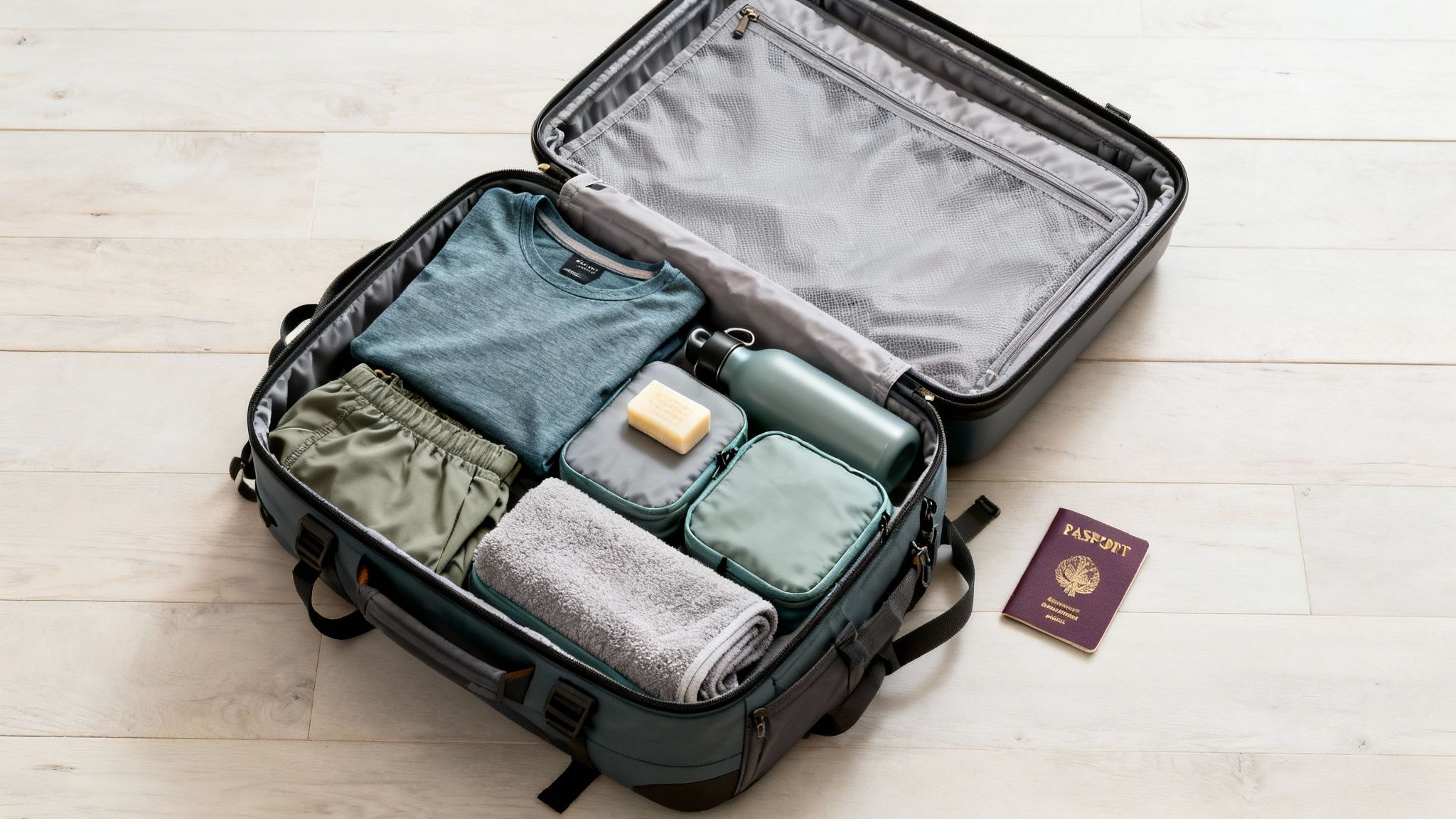
The core principle is investing in quality over quantity. Garments made from merino wool or advanced synthetic blends, like Patagonia’s Capilene, can be worn for days without retaining odor, replacing 3–4 cotton shirts with a single item. For example, a digital nomad with a 42L backpack can build a versatile 7-day capsule wardrobe weighing just 13.6 lbs (6.2 kg), avoiding baggage fees and staying mobile. This minimalist kit, often built around 2 pairs of trousers/shorts, 6 shirts, and one fleece, costs around $160–$215 and can last for over 80 travel days before needing a refresh.
Why Minimalist Packing Is a Budget-Friendly Choice
Zero-waste packing creates a positive feedback loop for your budget. By eliminating checked bag fees (often $30–$60 per flight), you immediately save on transit costs. More importantly, traveling light opens up a wider range of affordable lodging. You no longer need a large apartment to store bulky luggage, making compact, centrally-located studios and co-living spaces a viable option. This can reduce accommodation costs by 20–30%. The investment in versatile clothing, like a $21–$43 merino wool shirt, pays for itself by reducing the total number of items you need to buy, pack, and maintain.
Actionable Tips for Mastering Zero-Waste Packing
Strategic gear selection and maintenance habits are key to a successful lightweight setup. Follow these tips to minimize weight and maximize your budget:
- Invest in Merino Wool: Prioritize 2–3 merino wool base layers ($32–$54 each). They are the cornerstone of a minimalist wardrobe due to their odor resistance and temperature regulation.
- Adopt a Neutral Color Scheme: Choose neutrals like black, grey, and navy to ensure every item of clothing can be mixed and matched, maximizing outfit combinations from a minimal closet.
- Use Packing Cubes: Compress your clothing by 15–20% and keep your bag organized with packing cubes ($16–$32).
- Pack for Hand-Washing: Carry a universal sink stopper and a travel-sized laundry detergent ($5). This allows you to hand-wash essentials every 5–7 days in your accommodation, extending your laundry cycle.
- Choose Lodging with Laundry: When booking your stay, filter for accommodations with an in-unit washer or a nearby laundromat to simplify your routine.
5. Use Local Public Transit, Bikes, and Walking Over Taxis, Uber, and Car Rentals
For long-stay remote workers, one of the most impactful budget travel tips is to ditch expensive private transport. Daily costs for taxis ($16–$33), Uber ($13–$27), and car rentals ($43–$87) can quickly surpass your accommodation budget. By contrast, monthly public transit passes, affordable bike rentals, and simply walking eliminate these per-trip fees and foster a truly low-carbon, car-free itinerary.
This approach is especially effective in highly walkable European and Asian cities, where integrated metro, tram, and bus systems cover over 95% of key destinations. In Prague, a monthly transit pass costs just $32, saving you over $585 compared to daily taxi use. Similarly, a Lisbon transit pass ($43) combined with a bike rental subscription ($13) provides comprehensive mobility for a fraction of the cost of ride-sharing apps.
Why Local Transit is a Superior Budget Choice
Opting for public transit over private rides delivers substantial monthly savings and a deeper connection to your base city. A monthly pass grants you unlimited freedom to explore without the mental friction of calculating fares for every trip. For example, a one-month unlimited metro pass in Tokyo costs around $65 and covers nearly 97% of the city’s vast landscape, making a rental car completely unnecessary and impractical.
In Barcelona, a service like Nextbike offers unlimited rides for just $16 per month, covering over 25 miles (40 km) of the city. This strategy not only saves you money compared to a metro pass but also transforms your daily commute into an active, enjoyable experience. This method, popularized by city transit authorities and apps like Citymapper, is a cornerstone of sustainable, budget-conscious travel.
Actionable Tips for Maximizing Local Transit Savings
To fully leverage local transport, a little planning upon arrival goes a long way. Follow these tips to minimize costs and maximize convenience:
- Buy a Monthly Pass Immediately: Purchase and validate a monthly transit pass within the first 24 hours of your arrival to start saving from day one.
- Use Route-Planning Apps: Download Google Maps, Citymapper, or Moovit to plan routes, compare walk/bike/metro times, and receive real-time service alerts.
- Invest in a Good Lock: If you plan to rely on a personal or shared bike, buy a sturdy cable lock ($22–$33) to protect it from theft.
- Balance Walking and Riding: Combine 2–3 mile (3–5 km) walks with one or two transit journeys daily. This balances healthy movement with comfort and efficiency.
- Map Out Key Locations: During your first week, identify bike-share docks and transit stops near your accommodation, co-working spaces, and favorite cafes to create seamless travel patterns.
6. Shop at Local Markets and Budget Supermarkets Instead of Tourist Restaurants
One of the most impactful budget travel tips for long-stay digital nomads is to bypass tourist-trap restaurants and embrace local food sources. Eateries in prime tourist zones often charge 3 to 5 times more than neighborhood alternatives, significantly inflating your daily expenses. By shifting your spending to local markets, budget supermarkets like Lidl or Carrefour, and street food stalls, you can drastically reduce your food costs while enjoying more authentic culinary experiences.

Cooking 50–70% of your meals in an apartment kitchen is a cornerstone of this strategy. This approach can slash a typical food budget from $33–$50 per day down to a more manageable $13–$22. For example, in Lisbon, a week’s worth of fresh produce and protein from the Mercado da Ribeira might cost around $16, whereas just three modest restaurant meals could easily cost over $65. This simple habit is a game-changer for extending your travels sustainably.
Why Local Markets Offer the Best Value
Local markets and budget-friendly supermarket chains like Aldi, Dia, or Mercadona offer fresh, high-quality ingredients at a fraction of restaurant prices. In Valencia, Spain, you can buy fresh fruit at the Mercado Central for about $0.40–$0.70 per pound (€0.80–1.50/kg), while a single glass of juice at a nearby café could cost $4.30 (€4). Similarly, a delicious Pad Thai from a street vendor in Thailand costs just $1.60–$2.20, compared to $6.50–$8.60 in a tourist-focused restaurant. An Eco Nomad Travel case study in Prague found that cooking 60% of meals cut a traveler’s weekly food bill from a potential $215 to just $90.
Actionable Tips for Smart Food Shopping
To maximize savings and eat well, integrate food shopping into your travel routine. These practical steps can help you master the art of budget-conscious eating:
- Explore Markets Early: Visit local markets within the first 48 hours of arriving to identify the best vendors and prices. Shop between 8:00 and 10:00 AM for the freshest selection and to avoid crowds.
- Utilize Loyalty Apps: Download local supermarket apps like Lidl Plus or the Carrefour app. They often provide instant digital coupons that can offer 20–30% in discounts on groceries.
- Buy Staples in Bulk: For longer stays, purchasing staples like an 11-pound (5 kg) bag of potatoes or rice is often 40% cheaper per unit than buying smaller quantities.
- Plan Simple, Rotational Meals: Stick to 3–4 easy recipes like pasta, stir-fries, or soups that you can rotate weekly. This reduces decision fatigue and streamlines your shopping list.
- Balance Cooking with Street Food: A highly effective model is to eat one substantial, home-cooked meal and two smaller street-food meals or snacks daily. This balances cost, time, and local culinary discovery.
7. Leverage Free and Low-Cost Activities: Museums, Parks, Festivals, and Walking Tours
One of the most impactful budget travel tips is to prioritize free and low-cost cultural experiences over expensive attractions. In major European cities, a single museum ticket can cost $16–$32, quickly depleting your daily budget. By strategically planning your itinerary around free-entry hours, tip-based walking tours, and local festivals, you can immerse yourself in the culture without spending a dime. This approach transforms your travel from a series of transactions into a genuine exploration.

Many world-class institutions, from the Prado in Madrid to the Uffizi in Florence, offer designated free-entry windows, typically on specific evenings or one Sunday per month. Supplementing these visits with self-guided neighborhood walks, picnics in public parks, and attending free local events provides a rich, authentic experience. City passes that bundle attractions and transit only offer value if you plan to visit three or more paid sites daily; for the slow traveler, selective, free activities almost always yield greater savings.
Why Free Activities Are a Budget Traveler’s Best Friend
Tapping into a city’s free offerings provides immense value and deepens your connection to the place. In Lisbon, you can explore the entire Belém neighborhood and visit museums like the Gulbenkian for free on Sundays, saving over $32 per person. Similarly, a free walking tour in Prague (tipping the guide $8–$13) offers a more personal and affordable alternative to a $22 paid tour. A digital nomad staying for a month could save $215–$325 by substituting just two paid attractions per week with free alternatives.
Actionable Tips for Maximizing Free and Low-Cost Fun
To effectively integrate zero-cost activities into your travel, proactive research is essential. Follow these tips to stretch your budget further:
- Bookmark Free Museum Hours: Before your trip, check the official websites for top museums like the Prado (free 6:00–8:00 PM Mon–Sat) or Florence’s state museums (free on the first Sunday of the month). Note these times in your calendar.
- Arrive Early for Free Entry: Queues for free-entry windows form quickly. Plan to arrive 20–30 minutes before the start time to secure your spot without a long wait.
- Book Tip-Based Walking Tours: Use platforms like FreeToursByFoot or Withlocals to find and book free walking tours. These offer fantastic introductions to a city’s history and layout.
- Use Google Maps “Explore”: Before you arrive, use the “Explore” feature in Google Maps to pinpoint public parks, street art hotspots, and scenic walking routes near your accommodation.
- Find Local Events and Festivals: Check city-specific event calendars or sites like Time Out upon arrival. Attending a local festival or outdoor concert is a great way to experience authentic culture for free.
8. Use Currency Converters, Wise Transfers, and Local Withdrawal Strategies to Minimize FX Fees
Foreign exchange (FX) fees are a silent budget killer for long-term travelers, often eroding your funds by 2–8% on every transaction. One of the most impactful budget travel tips for digital nomads is to ditch traditional banks for modern fintech solutions. Platforms like Wise (formerly TransferWise) and Revolut are designed for international use, dramatically cutting currency conversion markups from a typical 3–5% down to a transparent 0.5–1.5%. This simple switch can save you hundreds over the course of a multi-month journey.
These services provide multi-currency accounts and linked debit cards, allowing you to hold and spend money in local currencies without punitive fees. The core advantage is access to the mid-market exchange rate, the real rate banks use between themselves. For example, a monthly spend of $3,200 could incur $95–$160 in fees with a traditional bank, while Wise would charge just $16–$32. This strategy is essential for preserving your travel budget and avoiding unnecessary costs.
Why Fintech Solutions Are a Budget Traveler’s Best Friend
Fintech cards offer substantial savings and superior control over your finances abroad. When paying at a restaurant in Prague, for instance, a “dynamic currency conversion” offer might bill your home account $110 for a $100 meal. By using a Wise card and choosing to pay in Czech Koruna (CZK), you are only charged the equivalent of $100 at the real exchange rate. Similarly, these apps often include fee-free ATM withdrawal allowances from partner networks, saving you $2–$5 per transaction compared to using your home bank’s card.
Actionable Tips for Minimizing Foreign Exchange Fees
To get the most out of these powerful financial tools, a little planning goes a long way. Follow these steps to maximize your savings:
- Set Up Accounts Early: Open your Wise and Revolut accounts at least two weeks before your trip to allow 3–5 business days for card delivery.
- Link to Travel Platforms: Connect your new fintech accounts to PayPal, Airbnb, and other booking sites to sidestep credit card FX fees on large, pre-trip purchases.
- Use In-App ATM Locators: Before you need cash, use the app’s built-in map to find a partner ATM network that offers fee-free withdrawals.
- Always Decline Dynamic Currency Conversion: When a card terminal asks if you want to pay in your home currency, always select “no” and choose the local currency to get the best rate.
- Pre-load Your Wallet: If you know you’re heading to a specific country, you can pre-load your Wise balance with that currency ahead of time to lock in a favorable rate.
- Rely on Fintech for Daily Spending: Use your Wise or Revolut card for all daily purchases and relegate your traditional bank cards to emergency-only backup status.
9. Book Regenerative and Budget Eco-Stays: Hostels, Homestays, Farm Stays Over Commercial Hotels
Choosing where you stay is one of the most impactful budget travel tips for reducing costs and environmental impact. Swapping commercial hotels for regenerative, community-focused accommodations like hostels, homestays, and farm stays can cut lodging expenses by 50–80%. These options not only save money but also foster genuine cultural exchange and directly support local economies, aligning perfectly with a low-impact travel ethos.

Hostels offer dorm beds for as little as $16–$33 per night, while farm stays provide a room and meals for $27–$49 in exchange for a few hours of work. For the ultimate budget hack, hospitality networks like Warmshowers or Couchsurfing offer free stays with local hosts. Opting for these stays, especially in walkable neighborhoods with kitchen access, dramatically reduces your daily spend on food and transport, saving an additional $11 or more per day. This strategy is a cornerstone of sustainable, budget-conscious travel.
Why Eco-Stays Are a Budget-Friendly Choice
Regenerative stays offer unmatched value by combining low costs with immersive experiences. A private room in a Prague hostel might cost $49, compared to a mid-range hotel at $81–$120. A WWOOF farm stay in Spain can cost $0 per night with meals included for about four hours of daily farm work, saving you over $38 daily compared to a hostel and food costs. Platforms like Warmshowers, a hospitality network for touring cyclists, offer free lodging, potentially saving a traveler over $100 per month on accommodation.
Actionable Tips for Maximizing Eco-Stay Savings
Strategic booking is essential to find the best regenerative and budget-friendly stays. Use these tips to secure affordable, high-quality, and impactful lodging:
- Vet Hostel Reviews Carefully: Use filters on Hostelworld or TripAdvisor to find properties praised for cleanliness and community. A well-rated hostel is a hub for connection and local tips.
- Join Work-Exchange Programs Early: Sign up for WWOOF or HelpX 6–8 weeks before your trip. Select farms with clear work-hour and meal agreements to ensure a positive experience.
- Leverage Hospitality Networks Safely: When using Couchsurfing, prioritize hosts with over 50 positive references and a 4.8-star rating or higher to ensure safety and reliability.
- Book Farm Stays Ahead: Reserve your spot on a farm stay 4–6 weeks in advance, as availability is often tied to seasonal events like harvests.
- Verify Sustainability Claims: For eco-lodges or Airbnbs charging a premium, look for certifications like Green Key or GSTC to ensure their claims are legitimate and your money supports genuine sustainable practices.
10. Combine Strategies: Sample Budget + Sustainable Itinerary and Final Notes
The most powerful of all budget travel tips is to combine multiple cost-saving and sustainable practices into a cohesive strategy. Instead of applying tips in isolation, layering them creates a powerful multiplier effect. By integrating shoulder-season travel, walkable base cities, rail transport, minimalist packing, local food sourcing, and low-impact lodging, you design an itinerary that is both exceptionally affordable and genuinely low-impact. This holistic approach transforms travel from a series of disconnected expenses into a seamless, intentional experience.
This combined method is about creating a travel framework that aligns with your values and budget from the ground up. For instance, a 30-day European trip could start by flying into Lisbon in April (shoulder season). You’d establish a three-week base in a weekly apartment rental for around $220, then embark on a one-week rail loop to Porto and Madrid using night trains. This sample plan keeps the total trip cost between $985 and $1,315, excluding the initial flight, demonstrating how a combined strategy maximizes both savings and cultural immersion.
Why a Combined Strategy Is the Ultimate Budget Hack
A combined strategy offers deep savings and a more authentic travel experience. For example, a digital nomad could set up a four-week base in Prague, cooking 60% of their meals from local markets and using a monthly transit pass. With two short rail trips included, the estimated monthly cost could be as low as $765–$1,095. Another eco-blend approach might involve two nights in a hostel, five nights on a WWOOF farm-stay, and 23 nights in an apartment. This mix provides cultural variety while drastically reducing accommodation costs and environmental impact.
Actionable Tips for Building Your Combined Itinerary
To successfully integrate these budget travel tips, focus on smart pre-planning and on-the-ground execution. Follow these steps for a seamless, low-cost journey:
- Plan Core Bookings in Advance: Before departure, secure your first 7–10 nights of accommodation, book at least one key night train journey, and set up your Wise or Revolut accounts.
- Allocate an ‘Adjustment Week’: Use your first week to settle in. Get a local SIM card, buy a transit pass, and learn the layout of nearby grocery stores and markets.
- Model Your Daily Burn Rate: Use a simple spreadsheet to track your daily spending. This helps you monitor your budget and understand foreign exchange conversions in real time.
- Prioritize One Sustainable Choice Per Category: Don’t try to be perfect. Choose one high-impact action for each area: rail over flights for transit, market food over restaurants for dining, and a homestay over a hotel for lodging.
- Keep an Emergency Payment Method: While using fintech cards like Wise for daily spending, always keep a traditional bank card separate as a reliable backup.
Top 10 Budget Travel Strategies Comparison
| Strategy | 🔄 Implementation complexity | ⚡ Resource requirements | 📊 Expected outcomes | 💡 Ideal use cases | ⭐ Key advantages |
|---|---|---|---|---|---|
| Embrace Rail Passes & Point-to-Point Trains Over Flights | 🔄🔄🔄 — advance booking for passes/reservations | ⚡⚡ — pass cost, possible supplements, travel time | 📊 ⭐⭐⭐⭐ — large cost savings; ~85–90% lower CO2 vs flights | Multi-city European/Asian loops; night-train overnighting | Lowest km cost, night trains replace hotels, city-center arrivals |
| Choose Walkable Base Cities & Extended Stays Over Hotel Hops | 🔄🔄 — longer commitments, apartment vetting | ⚡⚡ — weekly/monthly rent, utilities, longer stays | 📊 ⭐⭐⭐⭐ — 50–75% lower per-night accommodation; lower transport emissions | Remote work, slow travel, budget long stays (1–4 weeks+) | Big accommodation savings, kitchen access, routine & local integration |
| Travel During Shoulder Seasons & Off‑Peak Months | 🔄🔄 — timing research, calendar checks | ⚡⚡ — flexible dates, potential variable weather gear | 📊 ⭐⭐⭐⭐ — 40–60% lower costs; fewer crowds; better photography | Flexible date travelers, weather-tolerant itineraries | Cheaper rates, authentic local events, reduced queues |
| Master Zero‑Waste Packing (7–10 day laundry cycle) | 🔄🔄 — disciplined packing & laundry planning | ⚡⚡⚡ — upfront investment in merino/high‑performance gear | 📊 ⭐⭐⭐ — saves baggage fees, easier mobility, reduced laundry/resource use | Frequent movers, train travel, base‑city stays | No checked-bag fees, lighter luggage, less packing time |
| Use Local Public Transit, Bikes & Walking Over Cars/Taxis | 🔄🔄 — learn local networks, pass purchase | ⚡⚡ — transit pass or bike subscription, small locks | 📊 ⭐⭐⭐⭐ — 40–80% transport cost reduction; ~2 kg CO2/day saved | Walkable cities, urban exploration, daily commuting while traveling | Low cost, low emissions, better local access and savings |
| Shop at Local Markets & Budget Supermarkets Instead of Tourist Restaurants | 🔄🔄 — meal planning and basic cooking skills | ⚡⚡ — kitchen access, weekly grocery budget, market time | 📊 ⭐⭐⭐⭐ — food costs cut ~50–70%; less packaging waste | Apartment stays, base-cities, budget-conscious travelers | Major food-cost savings, local flavors, reduced waste |
| Leverage Free & Low‑Cost Activities: Museums, Parks, Tours | 🔄🔄 — research free hours and schedules | ⚡ — time investment; booking tip-based tours | 📊 ⭐⭐⭐ — significant attraction-cost reductions; rich cultural value | Casual sightseers, families, slow travelers | Free cultural immersion, flexible days, social local tours |
| Use Wise/Revolut & Local Withdrawal Strategies to Minimize FX Fees | 🔄🔄🔄 — account setup, card delivery, app use | ⚡⚡ — internet-enabled phone, fintech cards, preloads | 📊 ⭐⭐⭐⭐ — saves 0.5–3% on FX; $20–150+/month for typical spends | Multi-country trips, medium–high monthly spending | Lower FX fees, transparent rates, multi-currency wallets |
| Book Regenerative & Budget Eco‑Stays: Hostels, Farm & Homestays | 🔄🔄🔄 — vetting hosts, possible work-exchange setup | ⚡⚡ — lower nightly costs, possible labour/time exchange | 📊 ⭐⭐⭐⭐ — 50–80% cheaper than mid-range hotels; high cultural value | Budget travelers, volunteers, those seeking local immersion | Cheaper stays, community connections, kitchen use, local economic support |
| Combine Strategies: Integrated Budget + Sustainable Itinerary | 🔄🔄🔄🔄 — coordination of multiple bookings and timing | ⚡⚡⚡ — upfront planning time, small gear/fintech investments | 📊 ⭐⭐⭐⭐⭐ — compounding savings; lowest cumulative CO2 and daily burn | Month‑long loops, digital nomads, sustainability-focused trips | Maximum cost & emissions reductions, flexible slow-travel quality |
Your Next Step to Affordable, Low-Impact Travel
Embracing this comprehensive set of budget travel tips is more than just a method to save money; it’s a fundamental shift in how we approach exploration. The journey from a high-speed tourist to a slow, intentional traveler unlocks a world of deeper connections, richer experiences, and a significantly smaller environmental footprint. We’ve moved beyond generic advice, providing you with a tactical playbook for affordable, sustainable adventures. You now have the tools to analyze the true cost of your journey, weighing both dollars and carbon emissions to make choices that align with your values.
The strategies detailed in this guide work in synergy. Choosing a walkable base city for a long-stay rental isn’t just about saving on accommodation; it naturally leads to lower daily transport costs and encourages you to shop at local markets, reducing food expenses. Mastering minimalist, zero-waste packing doesn’t just lighten your luggage; it eliminates checked bag fees and makes rail travel infinitely more manageable. Similarly, leveraging regional rail passes and night trains replaces costly, high-emission flights with scenic, ground-level experiences that double as transport and lodging.
Budget Travel Tips: Save More in Shoulder Season with Smart Cards, Low-Fee Travel, and Regenerative Stays
This integrated approach proves that sustainable travel is not a luxury reserved for the wealthy. It is an accessible, intelligent, and deeply rewarding way to see the world. By prioritizing shoulder season travel, you not only slash costs on everything from trains to lodging but also enjoy popular destinations without the overwhelming crowds, fostering a more authentic connection with the places you visit. Each tip, from using a Wise card to avoid hidden bank fees to opting for a regenerative farm stay, is a piece of a larger puzzle that, when assembled, creates a blueprint for long-term, responsible nomadism.
This article was fact-checked using sustainability data from the World Green Building Council, the Global Ecotourism Network, and peer-reviewed architecture studies. All partner links are vetted for compliance with sustainable business certifications.
Editor’s Pick: The Interrail/Eurail Global Pass
For any traveler planning a multi-country, rail-first journey through Europe, the Interrail/Eurail Global Pass is an unparalleled tool for both budgeting and sustainable travel. It provides predictable, fixed-cost transportation across 33 countries, allowing for immense flexibility. Instead of booking dozens of expensive point-to-point tickets, a single pass can cover months of travel, making it one of the most effective budget travel tips for long-term explorers. The pass encourages spontaneous detours and slow travel, fitting perfectly with the low-impact, deep-immersion ethos. It simplifies complex itineraries and eliminates the financial barrier to choosing the train over a cheap, last-minute flight.
Key Takeaways
- Integrate, Don’t Isolate: The most effective budget strategy combines multiple tips. Pair a shoulder-season trip with a long-stay apartment rental in a walkable city to maximize savings.
- Slow is Smart: Slower travel reduces transportation costs, minimizes your carbon footprint, and allows for deeper cultural immersion. Extended stays often unlock significant weekly or monthly accommodation discounts.
- Think Like a Local: Eating from markets, using public transit, and enjoying free parks or museums are not just cost-saving measures; they are pathways to a more authentic travel experience.
- Pack for Purpose, Not “Just in Case”: A minimalist, zero-waste packing system eliminates airline fees, simplifies transit, and reduces your environmental impact. Every item should earn its place.
- Rail is Your Ally: Prioritizing train travel, especially with regional passes and overnight routes, is the single most impactful way to lower both your expenses and your emissions for multi-destination trips.
With these actionable insights, you’re no longer just dreaming of affordable travel; you’re equipped to plan it. Start small. Pick one or two strategies for your next trip, like packing lighter or booking a train instead of a flight. You’ll quickly discover that traveling sustainably and on a budget isn’t about limitation—it’s about liberation. It’s about gaining the freedom to travel longer, connect more deeply, and leave a positive mark on the world you so eagerly want to explore.
Ready to put these principles into action with expertly designed, rail-first travel plans? At Eco Nomad Travel, we create custom itineraries and provide resources specifically for sustainable, long-term travelers. Explore our guides to start planning your next low-impact adventure today.
Join the Sustainable Work Movement
Want more rail-first itineraries, low-impact packing systems, and walkable base-city ideas?
Budget Travel Tips FAQ
Quick answers to the most common questions about planning affordable, low-impact travel as a digital nomad or slow traveler.
Planning and Budgeting
1) What’s the fastest way to cut my travel costs without sacrificing the experience?
Combine three levers: travel in shoulder season, stay longer in one walkable base city, and cook 50–70% of meals. Those changes typically deliver the biggest savings with the least “feels like a downgrade” friction.
2) How do I estimate a realistic daily budget for slow travel?
Start with your fixed costs (weekly/monthly lodging + coworking) and divide by days, then add a simple variable budget: groceries, transit, and “fun.” Track for 7 days, then adjust. A 1-week baseline is enough to set a reliable burn rate.
3) Are city passes worth it for budget travelers?
Only if you will visit multiple paid attractions per day. For slow travelers, you usually win by using free museum hours, parks, neighborhoods, self-guided walks, and one paid “anchor” experience per week.
Trains, Rail Passes, and Night Routes
4) Rail pass or point-to-point tickets: which is cheaper?
It depends on your pace. If you’ll take many long-distance rides in a short window, a pass can be strong value. If you’re moving slowly and can book ahead, advance point-to-point tickets often beat a pass—especially on fixed-date routes.
5) How far in advance should I book night trains?
Ideally 6–12 weeks ahead for popular routes and peak weekends. Night trains sell out because they replace a hotel night, so earlier booking typically means better pricing and better berth options.
6) Do rail passes include seat reservations?
Usually not. Many routes (especially high-speed and night trains) require a separate reservation fee even with a pass. Always check the operator rules before you commit to a pass-first plan.
Base Cities and Long Stays
7) What makes a “good base city” for budget travel and remote work?
Look for: walkability, reliable public transit, affordable weekly rentals, strong grocery options, and stable Wi-Fi. Bonus points for a train hub so you can take short rail loops without flights.
8) How long should I stay in one place to get real savings?
At least 7–10 days to reduce transit costs and settle into local pricing. 2–4 weeks is where discounts and routine-driven savings (groceries, transit passes, fewer “tourist days”) really compound.
9) Should I negotiate monthly rates with hosts?
Yes—politely and clearly. Ask for the best 28–30 day rate and mention you’re a quiet remote worker. Many hosts will offer a discount, especially in shoulder season.
Shoulder Season and Timing
10) What months count as “shoulder season” in Europe?
Commonly April–May and September–October. The exact window varies by country and school holidays, so check local calendars and weather patterns for your target region.
11) How do I avoid crowds while still getting good weather?
Travel one step off peak: go earlier in spring, later in fall, and focus on mid-week museum visits and train travel. You’ll keep comfort while skipping the worst pricing surges.
Food, Markets, and Daily Spending
12) How much can I save by cooking instead of eating out?
Often 30–60% on food costs, especially in major cities. A good model is one home-cooked meal daily plus one street-food meal and one simple café/snack.
13) Are local markets always cheaper than supermarkets?
Not always. Markets can be best for seasonal produce and local staples; budget supermarkets often win on packaged goods and bulk items. Mix both for the lowest weekly total.
Money, Cards, and FX Fees
14) What’s the biggest mistake people make with cards abroad?
Accepting dynamic currency conversion. If the terminal asks to charge you in your home currency, decline and pay in the local currency to avoid extra markups.
15) Is Wise or Revolut better for budget travelers?
Either can work. The practical move is: use one fintech card for daily spending, keep one backup card separate, and withdraw cash in fewer, larger ATM pulls to reduce fees.
Packing, Laundry, and Gear
16) How do I travel 7–10 days between laundry cycles?
Build a capsule wardrobe with fast-dry layers and re-wearable tops, then hand-wash small items mid-week. Packing cubes + one simple sink-wash routine makes the schedule realistic.
17) What items save the most money over time?
A reusable water bottle, a compact laundry setup, and one durable daypack. You’ll spend less on bottled drinks, avoid “buy-it-again” toiletries, and reduce impulse purchases.
Eco Stays, Hostels, and Work Exchanges
18) Are eco-stays actually cheaper than hotels?
Many are. Hostels, homestays, and small cabins can undercut hotels—especially when you get kitchen access, walkability, and longer-stay discounts.
19) How do I vet a work-exchange or farm stay safely?
Use listings with clear expectations (hours, tasks, meals, days off), read recent reviews, and confirm details in writing. Start with shorter stays before committing longer.
Safety, Connectivity, and Practical Logistics
20) What’s a simple “do this first” checklist when I arrive in a new city?
Within 24 hours: buy/activate a local SIM or eSIM, confirm Wi-Fi speed at your stay, locate the nearest grocery store/market, and get a weekly/monthly transit pass. These are the highest-leverage budget travel tips for stabilizing your routine and spending.
Note: Two quick reminders: (1) Pay in the local currency whenever possible. (2) Stack strategies—small savings compound fast on long trips.
Explore Eco Nomad Travel
📚 Core Guides
🧭 Planning & Logistics
🗺️ Destinations & Seasons
Jeremy Jarvis — founder of Eco Nomad Travel, sustainable travel writer, and advocate for regenerative tourism. His work focuses on low-impact mobility, eco-friendly digital nomad life, and climate-positive travel.
Legal
Affiliate DisclaimerPrivacy Policy
Terms of Service
Image & Media Notice
Cookie Policy
Contact
Affiliate Disclosure: Some links on Eco Nomad Travel are affiliate links, meaning we may earn a small commission at no extra cost to you. This supports our mission to inspire responsible and low-impact travel worldwide.
Connect
✅ Trusted Official Sources
Plan smarter eco trips
Try our free Sustainable Travel Tools for Digital Nomads – carbon calculator, train vs plane comparator, and more.
Open Tools Hub