

Going carbon neutral isn’t as complicated as it sounds, and this guide will show you how. The simplest way to think about it is like a bank account for your climate impact. When you take a flight or a taxi, you make a “withdrawal” by adding carbon dioxide (CO₂) to the atmosphere. To bring your balance back to zero, you make “deposits” by supporting projects that pull an equal amount of carbon back out.
That’s it. You’re aiming for a net impact of zero.
At its core, carbon neutrality is all about balance. For a traveler, it means you first calculate the emissions your journey creates, and then you purchase verified carbon offsets to fund projects—like planting forests or developing renewable energy—that remove or prevent an equivalent amount of CO₂. The goal is to ensure your travel doesn’t leave the planet with extra carbon.
It’s a simple concept, but it’s easy to get tangled in the jargon. You’ll often hear “carbon neutral” used alongside “net zero.” While they’re related, they aren’t the same thing. Carbon neutral deals specifically with carbon dioxide, while net zero is the bigger picture—it covers all greenhouse gases, including things like methane and nitrous oxide. To get a better handle on this, it’s worth understanding the difference between your environmental footprint vs carbon footprint.
This isn’t just an individual effort, either. Your personal choices are part of a massive global shift, and the momentum is making those choices more powerful than ever.
Understanding the Basics of a Carbon Neutral Life
Countries and companies all over the world are getting serious about climate targets. By September 2025, an incredible 1,935 entities had set net zero targets, a huge leap from just 769 in December 2020. That’s a 152% jump in under five years, with 137 countries now on board.
Even more importantly, 67% of these national goals are now legally binding, signaling a real commitment. This global push is fueling a boom in low-carbon industries, and clean energy investments are on track to double those in fossil fuels in 2025. You can see all the latest data in the Net Zero Stocktake 2025.
This map from Zero Tracker shows just how widespread these commitments have become.
What was once concentrated in a few regions is now a shared global goal, which makes every traveler’s contribution that much more meaningful.
Ultimately, getting your head around carbon neutrality is the first real step toward smarter, more responsible travel. It lets you see your impact not as a permanent stain, but as a solvable equation where your choices can tip the scales back into balance.
How To Measure Your Travel Carbon Footprint
To go carbon neutral, you first have to know your starting line. You can’t manage what you don’t measure, and that means turning the vague idea of a “footprint” into real, actionable numbers. Calculating your travel emissions shows you exactly where your biggest impacts are coming from—whether it’s flights, ground transport, or even where you choose to sleep.
The process might sound complicated, but it’s more straightforward than you’d think. At its core, it’s about tracking your activities and using a calculator to estimate their carbon cost. This step alone turns a fuzzy concern into clear data you can actually do something about.
The diagram below breaks down this core idea: balancing the emissions your travel creates with actions that pull carbon out of the atmosphere, getting you back to neutral.
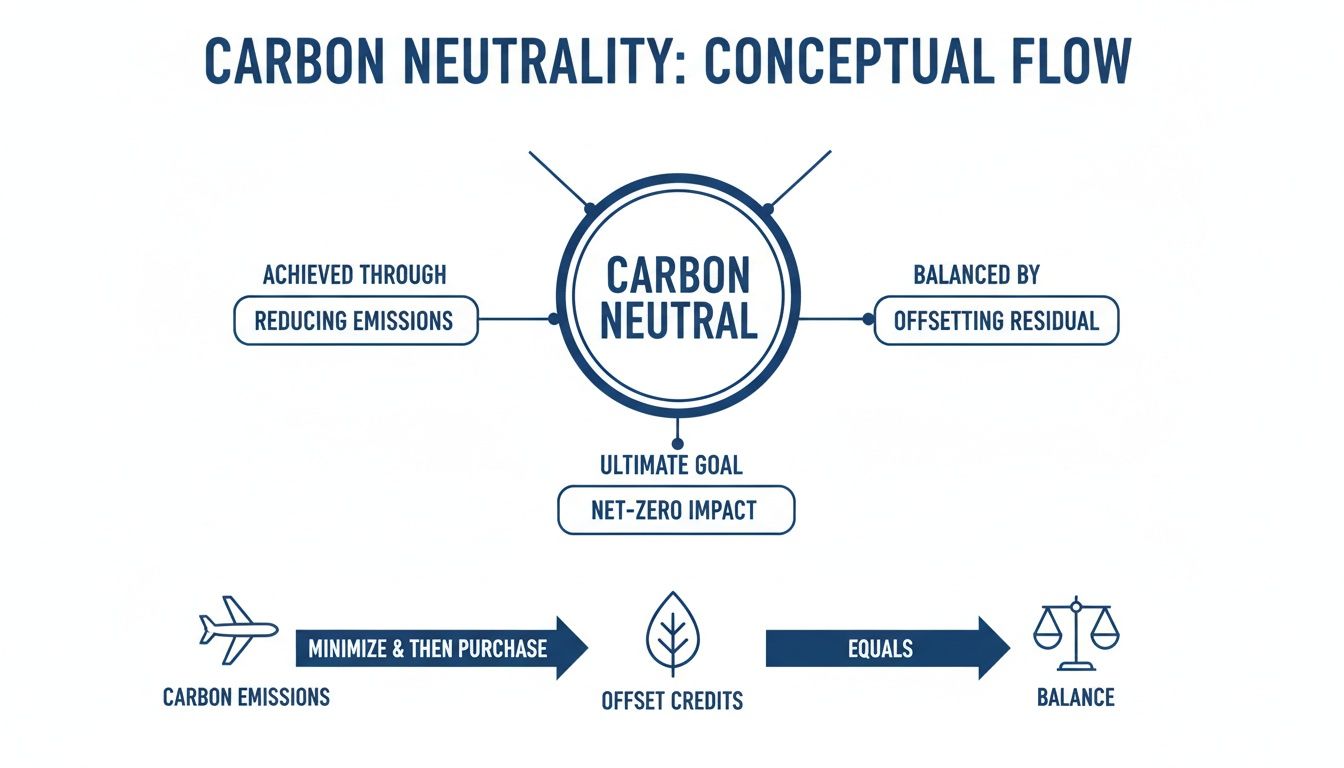
As you can see, the goal isn’t magic—it’s math. You’re simply aiming to create a net-zero impact by counteracting the emissions your activities produce.
Breaking Down Your Travel Emissions
Your total travel footprint comes from a few different places, which are often sorted into “scopes.” It’s a bit of jargon, but the idea is simple. Think of it this way:
Direct Emissions (Scope 1): These are emissions from sources you directly control. For a traveler, this is pretty rare, but the clearest example is driving a rental car. The fuel burning in the engine is a direct result of your activity.
Indirect Emissions (Scope 2 & 3): This is where almost all travel emissions live. A flight is the perfect example. You aren’t burning the jet fuel, but the airline is doing it on your behalf. The electricity your hotel or Airbnb uses to power your room also falls into this bucket.
Understanding this split helps clarify that your choices have a ripple effect that extends far beyond your immediate actions.
How Carbon Calculators Work
Carbon calculators are the tools that do the heavy lifting, turning your travel data into an emissions estimate. Most will ask for a few key details to give you a solid reading:
- Mode of Transport: Was it a flight, train, bus, or car? This is the single biggest factor.
- Distance Traveled: The longer the journey, the higher the emissions. Simple as that.
- Class of Travel (for flights): A seat in business or first class takes up more physical space on the plane, meaning your slice of the flight’s total emissions pie is bigger.
- Accommodation: Some of the more advanced calculators will also factor in the type of place you stayed and for how long.
A trip from Lisbon, Portugal, to Berlin, Germany, shows just how stark the difference can be. A flight might generate around 440 pounds (200 kg) of CO₂, while the same journey by train could produce less than 44 pounds (20 kg).
To help put that in perspective, here’s a quick comparison of a few popular routes.
Travel Emissions Quick Comparison Plane vs Train
This table shows the estimated CO2 emissions per passenger for popular travel routes, comparing air travel with high-speed rail to illustrate the environmental impact of your choice.
| Route | Flight CO2 Emissions (kg / lbs) | Train CO2 Emissions (kg / lbs) | Carbon Savings (%) |
|---|---|---|---|
| London to Paris | 55 kg / 121 lbs | 4 kg / 9 lbs | 93% |
| Amsterdam to Brussels | 38 kg / 84 lbs | 3 kg / 7 lbs | 92% |
| Madrid to Barcelona | 65 kg / 143 lbs | 10 kg / 22 lbs | 85% |
| Rome to Florence | 30 kg / 66 lbs | 5 kg / 11 lbs | 83% |
As you can see, choosing the train isn’t a small tweak—it’s a massive reduction. These individual choices feel even more urgent in a global context. Worldwide, fossil CO₂ emissions are projected to hit a record 42 billion US tons (38.1 billion metric tons) in 2025, a 1.1% increase from the previous year.
But there is good news. A recent study found that 35 countries, including the US and EU nations, have successfully cut their fossil CO₂ output over the last decade while still growing their economies. You can read more about these promising trends that show it’s possible to decouple growth from emissions.
Ready to get started? Once you have a clear picture of your impact, you can start making smarter choices. You can explore our own detailed guide and use our dedicated travel carbon footprint calculator to get a personalized estimate.
Applying the Reduction-First Approach to Carbon Neutral Travel
Working toward a carbon neutral lifestyle isn’t just about balancing the books after your trip is over. The single most powerful strategy is to shrink your emissions from the very beginning. This is the “reduction-first” approach—a mindset that prioritizes emitting less in the first place, making the final step of offsetting much smaller and more meaningful.
This philosophy completely changes how you plan your travels. Instead of seeing offsets as a free pass to fly without a second thought, you start looking for smarter ways to move and live on the road. It’s about making conscious choices that not only lower your impact but often lead to richer, more immersive experiences. Honestly, getting this part right is the most important step you can take.

Embrace Slow Travel and Rail-First Itineraries
For most travelers, the biggest culprit behind their carbon footprint is air travel. Period. It follows, then, that the most impactful change you can make is simply to fly less. This is where the beauty of slow travel and rail-first itineraries really shines.
Instead of hopping between cities on short-haul flights every few days, you can design a journey that connects destinations by train. Imagine swapping a stressful airport dash for a scenic ride through the countryside, watching the landscape change from your window. A multi-country rail pass can open up an entire continent, letting you stop in smaller towns you would have otherwise just flown over.
The emissions savings are staggering. As we’ve seen, train travel can be over 90% more efficient than flying the same route. You can explore a detailed breakdown of the numbers in our train vs plane emissions 2025 guide.
Slow travel also means spending more time in one place. By setting up a base for a few weeks or a month, you eliminate the constant emissions from transit and get to connect more deeply with a local community. Planning a trip like this is much easier with a reliable connection; getting an eSIM from a provider like Airalo ensures you have data from the moment you arrive.
Pack Light and Smart for Lower Fuel Consumption
Believe it or not, what you pack has a direct impact on your carbon footprint. Every extra pound of luggage adds to the total weight of a plane, train, or bus, which in turn increases fuel consumption. While your individual bag might seem insignificant, the cumulative effect of thousands of travelers packing lighter makes a real difference.
This is where minimalist packing becomes a powerful tool. A high-quality lightweight travel backpack is the foundation of any low-impact packing system. By using compression packing cubes, you can fit everything you need into a smaller space, often eliminating the need for checked baggage entirely. This doesn’t just save you money and hassle; it reduces your share of the vehicle’s emissions. I find a good carry on backpack forces you to be intentional about every item you bring.
Here are a few ways to lighten your load:
- Switch to Solids: A solid shampoo bar and biodegradable soap replace bulky, heavy liquids.
- Decant Everything: Use reusable toiletry bottles for essentials like lotion and conditioner instead of buying travel-sized disposables.
- Choose Multi-Functional Gear: Opt for items that serve more than one purpose, like a sarong that can be a towel, scarf, or beach cover-up.
- Embrace Laundry: Packing laundry detergent sheets allows you to wash clothes on the go, meaning you can pack far fewer outfits.
This mindful approach doesn’t just cut weight; it also reduces waste and simplifies your travel experience.
Choose Your Base Wisely: Regenerative Stays
Your choice of accommodation is the final piece of the reduction puzzle. Where you stay influences your daily transportation needs and your overall resource consumption. Look for what you might call a “regenerative stay”—one that actively benefits its local environment and community.
This often means looking for hotels and guesthouses with recognized eco-certifications, as these places usually have measures in place to conserve water and energy, source food locally, and minimize waste. More importantly, prioritize locations in walkable or transit-friendly neighborhoods.
By choosing a base city with excellent public transportation or pedestrian infrastructure, you drastically reduce your reliance on taxis and ride-shares for daily exploration. This simple choice can eliminate hundreds of pounds of CO₂ over a long-term stay.
When you’re browsing sites like Trip.com, use the map view to check for proximity to train stations, metro stops, and city centers. This little bit of research before you book can have a massive positive impact on your trip’s footprint, making your path to being carbon neutral that much easier.
Understanding Carbon Offsetting Done Right
Okay, so you’ve done the hard work of reducing your travel footprint. You’ve taken the train, packed light, and chosen eco-friendly stays. But there will almost always be some unavoidable emissions left over. This is where carbon offsetting comes in.
Think of it as the final step in balancing your environmental books to get your trip to carbon neutral. But let’s be clear: offsetting is a thoughtful last resort, not a free pass to ignore your impact.
How Does Carbon Offsetting Actually Work?
The whole process revolves around buying things called “carbon credits.” It’s simpler than it sounds. One carbon credit represents one metric ton (that’s about 2,205 pounds) of carbon dioxide that has been either removed from the atmosphere or prevented from entering it in the first place.
When you buy these credits, your money funds real-world climate projects. This could mean helping plant a forest that will soak up CO₂ for decades, financing a new wind farm to replace a dirty coal plant, or capturing methane gas from a landfill. Your purchase directly enables these positive actions, effectively neutralizing the emissions you couldn’t get rid of.

Not All Offsets Are Created Equal: How to Spot the Good Ones
Here’s the catch: the quality of offset projects varies wildly. To make sure your money is actually making a difference, you need to look for projects that are verified, permanent, and something called “additional.” It’s a complex world, so the smartest move is to stick with projects certified by trusted, independent organizations.
The two gold standards in this space are, fittingly, Gold Standard and Verra (which runs the Verified Carbon Standard, or VCS). These groups act like watchdogs, making sure every project delivers real, measurable, and lasting climate benefits. They do the heavy lifting so you can be confident your contribution matters.
The best projects also deliver “co-benefits” beyond just carbon reduction—things like creating fair-wage jobs, improving local health, or protecting biodiversity. This makes your investment even more powerful.
The Single Most Important Factor: Additionality
If you only learn one term in the world of offsetting, make it additionality. It’s a simple but crucial question: would this emissions reduction have happened anyway, without the money from carbon credits?
If the answer is yes, then the project is not additional, and your money isn’t creating new climate action. For instance, funding a solar farm that was already profitable and required by law would fail the additionality test. The climate benefit was already baked in.
A project with true additionality creates a direct link between your offset purchase and a positive outcome that absolutely would not have happened otherwise.
A good example? Funding the protection of a specific patch of rainforest that was slated for imminent clear-cutting. Your purchase directly prevents that deforestation.
To help you sort through the options, we’ve put together a checklist for evaluating projects. And if you want to see some vetted examples, check out our guide to the best carbon offsetting projects for travelers.
Before you invest in an offset, run it through this simple checklist. It’s a quick way to gauge the project’s quality and ensure your money will have a genuine, positive impact.
Evaluating Carbon Offset Projects: Key Criteria
| Criterion | What It Means | Why It Matters |
|---|---|---|
| Third-Party Verification | An independent body like Gold Standard or Verra has audited the project’s emission reductions. | This is your proof that the carbon savings are real, accurately measured, and haven’t been sold to someone else. |
| Additionality | The project would not have been financially or logistically possible without the revenue from carbon credits. | This guarantees your investment is creating new climate benefits, not just subsidizing business-as-usual. |
| Permanence | The carbon savings are long-term and protected from being easily reversed. A protected forest must have safeguards against future logging. | This ensures the climate benefits aren’t just a temporary fix. A planted tree that gets cut down in five years offers no real value. |
| No Leakage | The project doesn’t just shift the emissions-causing activity to another location. | For example, protecting one area of forest can’t lead to loggers just moving next door. The project must result in a true net reduction. |
| Community Co-Benefits | The project delivers social or economic benefits to the local community, like jobs, clean water, or better infrastructure. | This shows a holistic approach to sustainability, where climate action also supports human well-being. |
By using these criteria, you can confidently choose projects that turn your unavoidable travel emissions into a force for good, supporting both the planet and its people.
Editor’s Pick: The Gold Standard Marketplace
For travelers seeking a reliable way to become carbon neutral, the Gold Standard marketplace is our top recommendation. It’s not just a platform; it’s a rigorously vetted registry of high-impact climate projects. You can directly support initiatives like renewable energy in developing nations or reforestation efforts, all with the assurance that your contribution is verified, permanent, and creating change that wouldn’t have happened otherwise. Their focus on projects with community co-benefits—like creating jobs or improving public health—means your offset does more than just balance your carbon ledger.
Our Top Pick for Carbon Offsetting
Figuring out the world of carbon offsetting can feel like a maze. There are so many options, and it’s tough to know which ones are actually making a difference. After digging deep into transparency, project quality, and how easy they are to use, we’ve landed on a clear favorite for travelers: Gold Standard.
What we love about Gold Standard is that it’s not some vague platform where your money disappears into a black box. It’s a marketplace filled with projects that have been put through the wringer—every single one is certified to deliver real, measurable, and permanent climate benefits.
That last part is key. It means your contribution funds projects that genuinely wouldn’t have happened otherwise. You can browse through community-owned solar farms, reforestation efforts that bring ecosystems back to life, and other high-impact initiatives.
But what really sets them apart is their focus on “co-benefits.” It’s not just about pulling carbon out of the air. Their projects also create jobs, improve public health, and protect biodiversity in local communities. So, when you offset your travel, you’re making a much more holistic, positive impact.
How It Works: A Quick Example
Using the platform is refreshingly simple. Let’s imagine you’ve calculated that your month of slow travel through Southeast Asia generated about one metric ton (2,205 pounds) of CO₂.
- You head over to the Gold Standard marketplace.
- You can filter projects by type (like renewable energy or nature-based solutions) or by location.
- You find a project that connects with you—maybe one that provides clean cookstoves in Rwanda, which cuts emissions and reduces dangerous indoor air pollution.
- You purchase one carbon credit (which equals one ton of CO₂) for that project. A portable power bank makes sure your phone has enough juice to complete the purchase from wherever you are.
And that’s it. You get a certificate confirming your offset, effectively balancing your travel emissions for that trip.
Gold Standard provides a direct, transparent, and meaningful way to take that final step. For a closer look at other trustworthy options, check out our full guide to the best carbon offset programs for travelers in 2025.
Low-Impact Travel Tools (Worth It)
Also, if you’re planning a trip and want to keep things simple, these tools help you travel smoother while staying mindful about impact.
Get an eSIM for reliable data → Disclosure: Partner link. No extra cost to you.
Pre-book a transfer for easy arrivals → Disclosure: Partner link. No extra cost to you.
Your Questions About Carbon Neutral Travel, Answered
Thinking about how to travel in a more carbon-neutral way can bring up a lot of questions. That’s perfectly normal. I’ve pulled together some of the most common ones I hear from digital nomads and slow travelers to clear up any confusion and help you feel confident about your next steps.
Can an individual traveler really be carbon neutral?
Yes, absolutely. While large corporations and governments often discuss being “carbon neutral,” the core principle of balancing emissions is accessible to anyone. For a traveler, this means first calculating the carbon footprint of your journey, then actively reducing those emissions wherever possible. Finally, you can purchase verified carbon credits to offset the remaining, unavoidable impact, bringing your net emissions for that trip to zero. It’s a tangible way to take responsibility for your travel footprint.
Is carbon neutral the same as net zero?
They are similar concepts but have a key difference in scope. “Carbon neutral” specifically focuses on balancing carbon dioxide (CO₂) emissions. In contrast, “net zero” is a broader term that covers all greenhouse gases, including methane and nitrous oxide. Achieving net zero often requires deep, systemic reductions in emissions (around 90%) before using offsets for the last fraction. For an individual traveler, aiming to be carbon neutral is a more direct and achievable goal.
What’s the biggest mistake people make with offsetting?
The most common mistake is treating carbon offsetting as a license to travel without considering the impact. Offsetting should be the final step after you’ve already made efforts to reduce your footprint. The guiding principle is always to “reduce first, then offset the rest.” Using offsets to justify an unnecessary flight misses the point; they are meant to balance the emissions you couldn’t avoid through smarter travel choices, like taking a train instead.
How much does it cost to offset my travel?
The cost can vary significantly based on your travel activities and the specific offset project you choose. For instance, a round-trip flight from New York to London might generate about 1.6 tons of CO₂. The price for a high-quality, verified carbon credit typically ranges from $15 to $50 USD per ton. Therefore, offsetting that flight could cost between $24 and $80 USD. Projects with additional social benefits, like those that also improve community health, often cost a bit more.
Are flights the only thing I need to worry about?
No, flights are just one part of your travel footprint. While aviation is often the largest single source of emissions for travelers, a truly carbon neutral approach considers all aspects of your journey. This includes ground transport like taxis and rental cars, the energy consumed by your accommodations, and even your daily activities and food choices. A good universal travel adapter can help you power devices efficiently, but your choices on the ground matter just as much.
What if I can’t afford to offset my entire trip?
That is perfectly fine. The goal is progress, not immediate perfection. If offsetting your entire trip is not financially feasible, focus on the reduction side, which is free. Simple choices like packing light, opting for a collapsible water bottle to reduce plastic waste, using public transport, and choosing walkable destinations can significantly lower your impact. You can always start small by offsetting just one flight and build from there as your budget allows.
How can I be sure an offset project is legitimate?
To ensure your contribution makes a real difference, stick to projects verified by reputable third-party standards. The most trusted organizations in this space are Gold Standard and Verra. These bodies act as auditors, confirming that the emissions reductions are real, permanent, and “additional” (meaning they wouldn’t have happened without funding from carbon credits). Their certification is your assurance of a project’s legitimacy. A secure RFID blocking wallet is also a good idea when making any online purchases.
Does choosing a sustainable hotel really matter?
Yes, it makes a significant difference. A hotel committed to sustainability can drastically reduce the environmental impact of your stay through practices like using renewable energy, conserving water, sourcing local food, and minimizing waste. When you book with these establishments, you support their efforts and send a clear message to the tourism industry that sustainability is a priority for travelers. This encourages more businesses to adopt greener practices, creating a positive ripple effect. It’s an easy way to vote with your wallet.
Key Takeaways for Your Carbon Neutral Journey
Achieving carbon neutral travel is about making a series of conscious, informed decisions. It’s a practical approach that balances the joy of exploration with environmental responsibility. Here are the most important points to remember.
- Reduce First, Then Offset: The most effective strategy is to minimize your emissions from the start. Prioritize trains over planes, pack a single carry on backpack, and choose walkable base cities. Offsetting is the crucial final step to balance the unavoidable emissions that remain.
- Measure to Manage Your Impact: You cannot improve what you do not measure. Use a travel carbon footprint calculator to transform vague concerns into concrete data. Understanding the numbers behind your travel choices empowers you to make smarter, lower-impact decisions.
- Invest in High-Quality Offsets: When you do offset, ensure your money supports credible projects. Look for verification from standards like Gold Standard and Verra to guarantee that your contribution funds real, permanent, and additional climate action.
- Embrace Slower, Deeper Travel: Slow travel is not just a style; it’s a powerful sustainability practice. Longer stays in one place and overland journeys dramatically reduce transportation emissions while allowing for more meaningful cultural immersion.
- Support the Green Economy: Every travel purchase is a vote for the kind of tourism you want to see. By choosing eco-certified hotels, supporting local businesses, and booking with transparent companies, you help build a more sustainable travel industry.
- Stay Informed and Adapt: The world of sustainability is constantly evolving. Keep learning about new technologies and best practices. Your informed choices, combined with global progress in renewable energy, contribute to a powerful collective movement toward a more balanced planet.
Join the Sustainable Work Movement
Want more rail-first itineraries, low-impact packing systems, and walkable base-city ideas?
This article was fact-checked using sustainability data from the World Green Building Council, the Global Ecotourism Network, and peer-reviewed architecture studies. All partner links are vetted for compliance with sustainable business certifications.
