

Simply put, carbon offsetting projects are real-world initiatives that reduce or pull greenhouse gases out of the atmosphere. They’re designed to balance out emissions you can’t avoid—like the flight you need to take for your next trip. This guide to high-impact carbon offsetting projects will help you make informed decisions.
Think of it like a balance scale. On one side, you have your travel footprint. On the other, you have the positive climate impact from a project you’ve helped fund.

What Are Carbon Offsetting Projects?
As a sustainable traveler, getting to grips with carbon offsetting is a key part of taking responsibility for your environmental impact. Even after you’ve taken the train instead of a short flight, packed light, and stayed in eco-friendly spots, some emissions are just part of the deal.
Offsetting should be the final step in a thoughtful low-impact travel plan, not a free pass to emit more. It’s what you do after you’ve done everything you can to reduce your footprint first.
These projects generate something called carbon credits—measurable, verifiable units where one credit usually equals one metric ton (about 2,205 pounds) of CO2 equivalent (CO2e) removed or avoided. When you buy these credits, you’re directly funding the work that makes that reduction happen. You can see how this fits into a bigger picture in our complete guide to carbon-neutral travel.
The projects themselves are incredibly varied. They can be anything from planting native trees on degraded land to helping build a new wind farm that replaces a coal plant. And the interest is huge; in 2023, Europe dominated the global carbon offsets market with a massive 79.46% market share, valued at USD 846.15 billion. You can dig deeper into the expanding carbon offsets market for more on the numbers.
A Quick Look at Project Types
To give you a clearer picture of where your money can go, it helps to see the main project categories at a glance. Each type tackles climate change from a different angle, and many come with unique benefits that go beyond just carbon.
Quick Overview of Major Carbon Offsetting Project Types
This table breaks down the most common types of projects you’ll encounter, what they aim to do, and an example you might connect with as a traveler.
| Project Type | Primary Goal | Travel-Relevant Example |
|---|---|---|
| Reforestation & Afforestation | Remove CO2 from the atmosphere by planting new trees. | Funding a project that re-plants native trees in a region you visited. |
| Renewable Energy | Reduce future emissions by replacing fossil fuels. | Supporting a new solar or wind farm in a developing country. |
| Methane Capture | Prevent a potent greenhouse gas from entering the atmosphere. | Financing technology at a landfill or farm to capture and convert methane gas. |
| Community Projects | Reduce emissions while improving local livelihoods. | Providing clean, efficient cookstoves to communities that rely on burning wood. |
| Blue Carbon | Restore coastal ecosystems that are powerful carbon sinks. | Helping to rehabilitate a mangrove forest or seagrass meadow. |
These categories show the main ways your contribution can make a real difference on the ground. When it comes to choosing, it often comes down to what you value most—whether that’s restoring a specific ecosystem, supporting a community, or advancing clean technology.
Once you get the basic idea of carbon offsetting—balancing the scales of your travel footprint—the next logical step is to ask, “Where does my money actually go?”
Your contribution supports real-world carbon offsetting projects, and not all are created equal. They work in different ways, on different timelines, and often deliver powerful benefits that go far beyond just carbon math. Seeing how these projects work on the ground is what connects the dots between your trip and tangible, positive change.
Projects generally fall into two buckets. First, you have avoidance projects, which stop greenhouse gases from getting into the atmosphere in the first place. Think of building a wind farm to replace a coal-fired power plant. Then you have removal projects, which actively pull existing carbon dioxide out of the air. Planting trees is the classic example.
Understanding this difference is key. Both are vital for tackling climate change, but they approach the problem from different angles.
1. Reforestation and Afforestation Initiatives
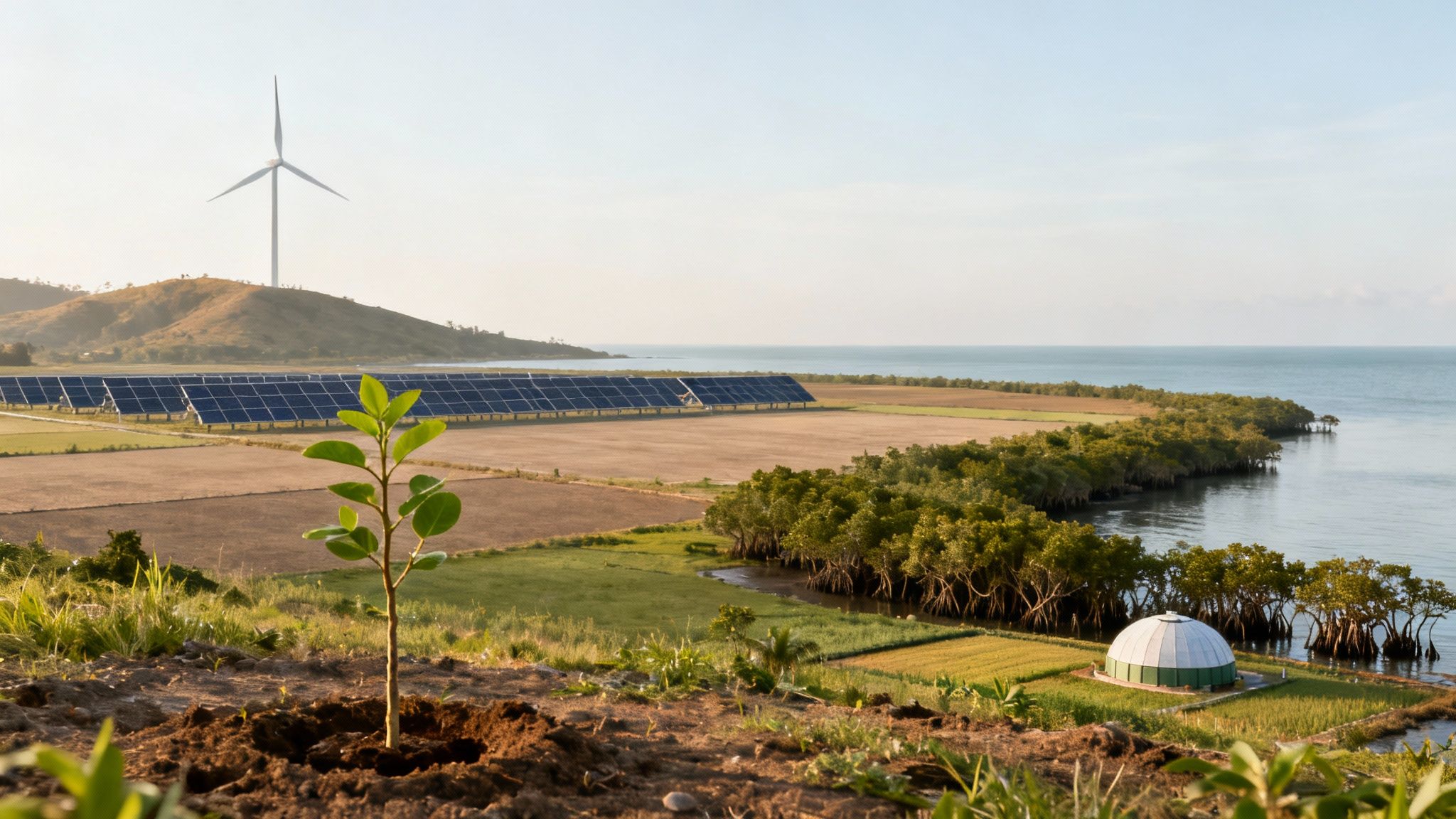
When most people think of carbon offsetting, planting trees is the first image that comes to mind. Reforestation means restoring forests where they’ve been cut down, while afforestation is about planting new forests where they haven’t historically grown. Both are powerful carbon removal strategies because trees are nature’s own carbon capture machines, absorbing CO2 through photosynthesis.
The timeline here is long-term; a sapling planted today won’t sequester a huge amount of carbon for years. But the co-benefits are massive and immediate. These projects restore critical wildlife habitats, prevent soil erosion, improve water quality, and can create sustainable jobs for local communities.
2. Renewable Energy Projects
Another huge category involves funding clean energy. These are avoidance projects through and through, focused on swapping our reliance on fossil fuels for wind, solar, or small-scale hydropower.
When you support one of these, you might be helping finance a new solar farm in India or a wind turbine project in Kenya. Your contribution helps add clean energy to the grid, displacing electricity that would have otherwise come from burning coal or natural gas. The impact is much faster than with forestry—emissions are avoided the moment the facility flips the switch. These projects also create green jobs and improve energy security for communities, contributing to a just transition away from fossil fuels.
3. Methane Capture and Avoidance
This one is less glamorous than planting trees but incredibly high-impact. Methane (CH4) is a greenhouse gas that’s over 80 times more potent than CO2 over a 20-year period, so stopping it from reaching the atmosphere is a huge win. These projects typically tackle methane from two main sources: landfills and agriculture.
- Landfill Gas Capture: As organic waste breaks down in landfills, it pumps out methane. These projects install systems to capture that gas. It can then be flared (turning it into less potent CO2) or, even better, used to generate clean electricity.
- Agricultural Methane Reduction: Think livestock manure. Projects can install “anaerobic digesters” that capture the methane produced by animal waste and convert it into biogas, providing a clean fuel source right on the farm.
These are highly effective avoidance projects that neutralize a powerful greenhouse gas before it can do any damage.
4. Community-Based Projects (Like Clean Cookstoves)
Some of the most compelling projects are those that weave climate action directly into the fabric of daily life. A perfect example is the distribution of efficient cookstoves in developing countries.
In many communities, families rely on open fires or rudimentary stoves that burn wood or charcoal. This contributes to deforestation and causes severe indoor air pollution, which is a major health crisis. By providing modern, efficient stoves, these projects slash fuel consumption, reducing carbon emissions and protecting local forests.
The health benefits are profound, especially for women and children who bear the brunt of indoor smoke. It’s a clear case of how climate solutions can directly improve lives. If this hands-on approach resonates with you, you might also be interested in the principles of regenerative travel and eco-volunteering.
5. Blue Carbon and Coastal Restoration
Finally, there’s the unsung hero of carbon sequestration: blue carbon. This term refers to the carbon captured and stored by the world’s ocean and coastal ecosystems. Think mangrove forests, salt marshes, and seagrass meadows.
These coastal habitats are absolute powerhouses, capable of storing up to ten times more carbon per acre than a terrestrial forest. Blue carbon projects focus on protecting and restoring these vital ecosystems.
Beyond their carbon storage abilities, these habitats provide critical storm protection for coastal communities, act as nurseries for countless fish species, and support incredible biodiversity. Supporting a blue carbon project is an investment in both climate resilience and the health of our oceans.
How to Identify High-Quality Carbon Offsetting Projects
Not all carbon offsetting projects are created equal. Far from it. As the market for offsets grows, it’s getting harder to tell the difference between projects that deliver real climate benefits and those that are little more than clever greenwashing. Making an informed choice is the only way to ensure your contribution genuinely supports a healthier planet.
So, how do you look past the marketing fluff? You need a basic checklist for climate integrity. Think of it as vetting a project to make sure it’s creating a real, measurable, and lasting impact—one that wouldn’t have happened otherwise.
It might sound complicated, but a few core principles will steer you toward the good stuff. These are the non-negotiables that separate a legitimate offset from an empty promise. Getting your head around them is the first step to becoming a savvy, impactful supporter of climate solutions.

Additionality: Is It Creating New Climate Action?
The single most important question to ask is about additionality. It’s a simple but powerful test: would this project’s climate benefit have happened anyway, even without the money from carbon credit sales?
If the answer is yes, the project is not additional. Buying its credits doesn’t create any new positive impact; you’re just paying for something that was already going to happen.
For example, funding a brand-new solar farm in a region hooked on coal is likely additional, especially if the project couldn’t turn a profit without carbon revenue. On the flip side, donating to protect a forest that’s already a legally protected national park is not additional. The trees were already safe.
A carbon project is additional if the emissions reductions or removals it produces would not have occurred without revenue from the sale of carbon credits. It’s the essential element that ensures your purchase is actually funding change, not just business as usual.
Permanence: Will the Carbon Stay Captured?
Another critical test is permanence. This is especially important for nature-based projects that pull carbon from the air, like reforestation. It’s all about making sure the captured carbon stays locked away for the long haul. A ton of CO₂ from your flight can hang around in the atmosphere for centuries, so the offset needs to be just as durable.
What happens if a newly planted forest burns down in a wildfire or gets illegally logged a decade later? The stored carbon goes straight back into the atmosphere, and the climate benefit vanishes. High-quality projects have to prove they have robust, long-term plans to manage these risks, like setting aside buffer pools of extra credits or using sustainable management practices to make the carbon storage effectively permanent.
Avoiding Leakage and Double-Counting
Next up, a quality project must prevent leakage. Leakage happens when a project’s activities just push the emissions somewhere else. Imagine protecting one patch of forest from logging, only for the loggers to move to the unprotected forest next door. No net climate benefit has been achieved; the problem just “leaked” from one area to another.
Similarly, double-counting is a huge red flag. This happens when two different parties try to claim the very same carbon credit. For instance, both the country hosting the project and the company that bought the credit might claim it toward their climate goals. Reputable registries have systems to prevent this, ensuring each credit is issued, tracked, and retired only once.
If you want to go deeper, our article exploring if carbon offsets are effective covers these issues in more detail.
Independent Verification: The Role of Standards
So, how can you, a traveler, possibly verify all of this? You don’t have to. That’s where third-party verification standards come in. Think of independent bodies like Gold Standard and Verra (Verified Carbon Standard) as the referees of the carbon market.
They develop rigorous rules, send auditors to check on projects, and run transparent public registries to track every single credit from its creation to its retirement.
Choosing a project certified by a reputable standard is your best guarantee that all these critical quality checks have been done. These organizations do the heavy lifting for you, confirming that projects are additional, permanent, and properly measured. It’s what gives you confidence that your investment is actually making a difference.
A Practical Guide to Offsetting Your Travel Footprint
Alright, you now know what separates a great carbon project from a questionable one. Let’s put that knowledge to work. Offsetting your travel footprint is a tangible way to take responsibility for the emissions you can’t avoid, but it can feel a little abstract at first.
The good news? It’s more straightforward than you might think. The whole process boils down to four simple steps: calculating your impact, finding a trusted partner, picking a project you believe in, and making your contribution.
The first step is non-negotiable: you have to accurately calculate your emissions. Guessing won’t do. Using a dedicated tool is the only way to get a realistic number to work with. You can find our simple tool right here: travel carbon footprint calculator guide.
A Step-by-Step Scenario
Let’s walk through a real-world example. Imagine you’ve just come back from a multi-city trip through Europe. You mostly took trains from Paris to Berlin to Prague, but you caught one short-haul flight from Prague back to London.
Here’s how you’d offset it:
- Calculate Your Footprint: You’d enter your train journeys and that one flight into the calculator. It spits out a total emissions figure—let’s say 0.55 metric tons of CO2e (or about 1,212 pounds).
- Find a Reputable Provider: Next, you’d head to a trusted offset provider or marketplace. The key is finding a platform that sells projects certified by Gold Standard or Verra.
- Choose a Project: This is the fun part. You get to browse their portfolio of carbon offsetting projects. Maybe a reforestation project in Peru catches your eye because you love hiking, or a clean cookstove project in Kenya resonates because of its direct health benefits for families.
- Complete the Purchase: You then buy credits equal to your footprint—0.55 tons in this case. The platform handles the transaction and officially “retires” the credits for you. This is crucial because it means they are permanently taken out of circulation and can’t be double-counted or sold again.
How Much Does Offsetting Cost?
This is one of the most common questions we get. The price of a carbon credit swings wildly, from as low as $5 USD to over $50 USD per metric ton of CO2e. The massive price gap comes down to the project type, its location, the certification standard, and any extra co-benefits it delivers.
As a general rule, high-quality projects with strong community and biodiversity benefits—the ones certified by standards like Gold Standard—tend to land in the $15 to $30 USD per ton range.
So for our European trip example (0.55 tons), you’d likely pay somewhere between $8 and $17 USD to fully offset your journey.
Editor’s Pick for Offset Providers
For travelers who want a user-friendly platform with a portfolio of high-integrity projects, we recommend Gold Standard’s Marketplace. It gives you direct access to projects that are not only rigorously vetted for climate impact but also deliver measurable benefits to local communities and ecosystems, aligning with the UN Sustainable Development Goals. Their transparent setup lets you choose exactly where your contribution goes, from renewable energy to reforestation.
It’s also worth seeing the bigger picture here. Corporate demand for carbon offsets hit a record high in 2023, with companies retiring 164 million credits. While this shows a serious commitment to climate action, it’s interesting to note that 91% of these credits came from avoidance projects (like renewable energy) and only 9% came from removal efforts like planting trees. To learn more, you can discover the full insights on 2023’s record-breaking carbon offset demand. This growing interest just reinforces why it’s so important for individuals to participate in credible offsetting, too.
Comparing the Major Carbon Offset Certifications
Once you’ve confirmed a project meets the big quality tests like additionality and permanence, the next step is to look for the logo. The world of carbon offsetting projects is kept in check by a handful of highly respected, independent certification bodies. These groups act as the referees, making sure the projects you support are legit, transparent, and actually delivering on their climate promises.
Think of these certifications like you would an organic or Fair Trade label, but for climate action. They provide the trust and verification we all need to navigate the market with confidence. While a few different standards exist, four key players dominate the high-quality end of the voluntary carbon market. Each one has a slightly different focus, which makes them better suited for certain types of projects.
Knowing these differences helps you move from being a passive buyer to an informed supporter. It lets you align your money with the impacts you care about most—whether that’s community development, protecting biodiversity, or backing pure technological innovation.
Gold Standard
Established in 2003, the Gold Standard is often seen as the high bar for projects that deliver strong sustainable development benefits alongside carbon reduction. It was created specifically to ensure projects didn’t just cut emissions but also made a positive, measurable difference for local communities and ecosystems.
The standard is known for its incredibly tough requirements. To get the Gold Standard stamp, a project must show it’s making a real impact on at least three of the UN Sustainable Development Goals (SDGs). This makes it a top choice for travelers who want their offset to support bigger goals, like providing clean water access or improving health through clean cookstove programs.
This flowchart breaks down the simple three-step process for offsetting your travel footprint.
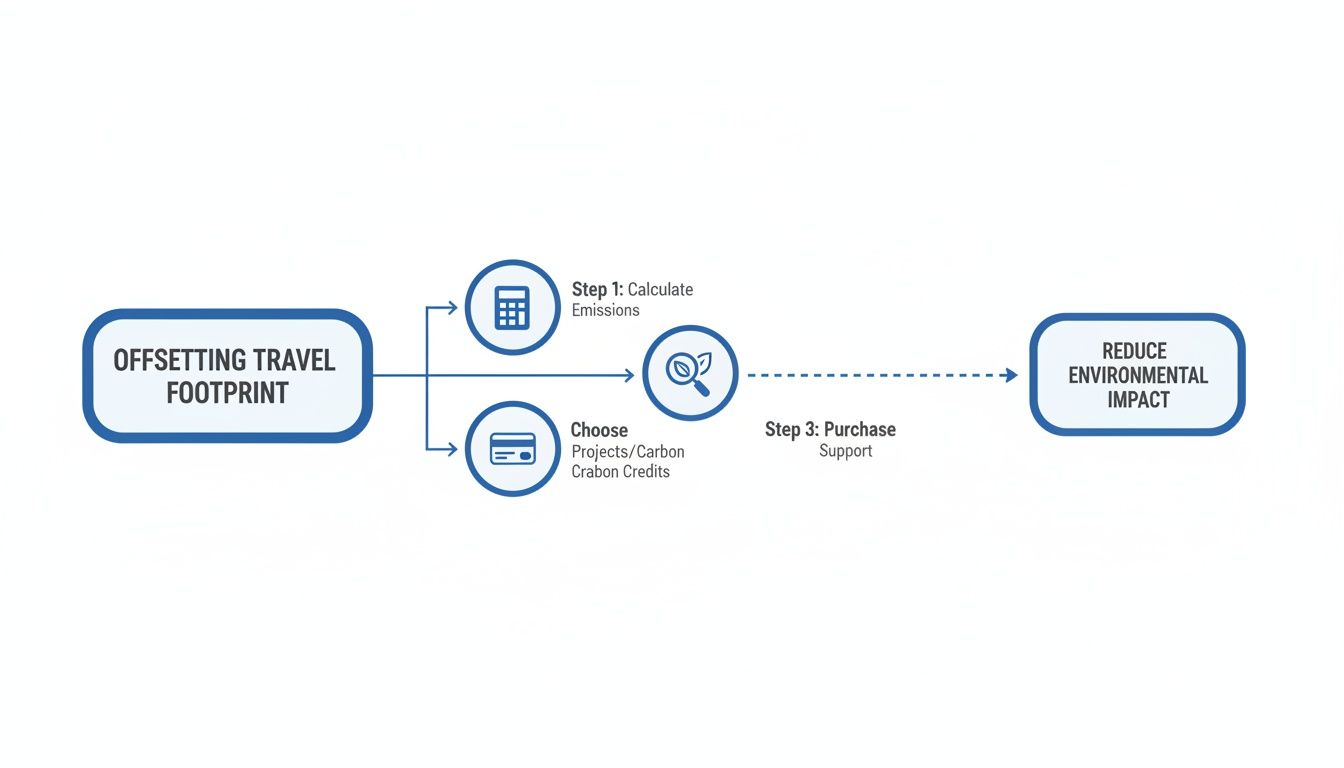
The visual flow from calculation to purchase shows just how straightforward the journey can be when you have the right tools and information.
Verra (Verified Carbon Standard)
Run by the non-profit Verra, the Verified Carbon Standard (VCS) is the largest and most widely used greenhouse gas crediting program in the world. Its main calling card is its massive scale, covering a huge range of project types from renewable energy and forestry to industrial waste management.
Where Gold Standard makes co-benefits a mandatory part of its process, Verra treats them as separate, add-on certifications. For example, projects can also earn Climate, Community & Biodiversity (CCB) Standards to prove these extra impacts. This flexibility makes Verra a popular choice for large-scale projects, including many of the big avoided deforestation (REDD+) initiatives.
American Carbon Registry (ACR)
As the world’s first private voluntary greenhouse gas registry, the American Carbon Registry (ACR) has a long history rooted in rigorous, science-based accounting. While it operates globally, it has a particularly strong presence in the United States, with deep expertise in forestry, agriculture, and industrial projects.
ACR is known for its technical precision and its role in pioneering new methodologies for measuring carbon reductions, especially in complex sectors like soil carbon and methane capture from mines or landfills.
Plan Vivo
The Plan Vivo standard is unique because it puts smallholders and rural communities at the heart of its model. It’s designed specifically for community-led projects that combine climate action with poverty reduction and ecosystem restoration.
You’ll often find Plan Vivo certifying agroforestry, small-scale reforestation, and ecosystem restoration projects where local people have direct control and receive a significant share of the benefits. It’s a powerful standard for travelers who want to ensure their contribution directly empowers the communities on the front lines of climate change.
Comparison of Top Carbon Offset Certification Standards
To make choosing a bit easier, this table breaks down the key features of these leading third-party standards at a glance. They all bring a high level of rigor to the market, but their different approaches mean you can find a project that aligns perfectly with your values.
| Standard | Primary Focus | Key Strengths | Common Project Types |
|---|---|---|---|
| Gold Standard | Climate action + Sustainable development | Mandatory SDG co-benefits, high rigor | Community-based energy, clean water, reforestation |
| Verra (VCS) | Broad-spectrum GHG reductions at scale | Largest registry by volume, wide project diversity | Renewable energy, REDD+, industrial efficiency |
| American Carbon Registry (ACR) | Science-based methodologies, U.S. focus | Longest-operating registry, technical expertise | Forestry, agriculture, methane capture |
| Plan Vivo | Community-led, nature-based solutions | Strong focus on empowering local livelihoods | Agroforestry, smallholder land use, ecosystem restoration |
Each of these standards plays a crucial role in maintaining trust and quality in the voluntary carbon market. For a deeper look at how they fit into a travel-centric plan, check out our guide to the best carbon offset programs for travelers.
Your Final Checklist for Choosing a Carbon Offset
Alright, you’ve learned the what and the why of carbon offsetting. Now comes the important part: choosing a project that actually makes a difference. Think of this as your simple, pre-purchase checklist to make sure your contribution counts.
The goal here isn’t just to pay a few dollars to feel better. It’s to consciously fund a real climate solution that reflects your values as a traveler. That means finding projects that are transparent, properly verified, and do more than just crunch carbon numbers.
Here are the essentials to lock in before you act:
Reduce First, Offset Last: This is the golden rule. Your first move should always be to shrink your travel footprint—taking the train instead of a short flight, packing lighter, or choosing an eco-lodge. Offsetting is for the emissions you can’t avoid.
Insist on Top-Tier Certification: Don’t even consider projects that aren’t verified by a leading standard like Gold Standard or Verra‘s Verified Carbon Standard (VCS). This is your single best protection against greenwashing and the only way to know a project meets strict rules for things like additionality and permanence.
Look for the Co-Benefits: The best projects have a ripple effect. They don’t just capture carbon; they support local communities, improve health outcomes by reducing indoor air pollution, or protect vital biodiversity. Nature-based projects are getting a lot more attention for this reason, with the issuance of removal credits growing by 7% in 2023. You can read the full report on the rise of nature-based solutions in the voluntary carbon market.
Use a Solid Calculator: Don’t just guess your footprint. A good calculator helps you quantify your emissions accurately, so you know exactly how many credits to buy. It turns an abstract idea into a concrete number.
Make Sure Your Credits Are Retired: This is the final, non-negotiable step. After you purchase credits, they must be permanently “retired” on a public registry. This is the official record that proves they’ve been used to offset your specific emissions and can never be sold or claimed again. It’s how you truly take accountability.
A Few Common Questions About Carbon Offsetting Projects
Diving into the world of carbon offsetting projects naturally brings up some fair questions and a bit of healthy skepticism. It’s a complex topic. To cut through the noise, we’ve put together straight answers to the questions we hear most from thoughtful travelers.
Is Carbon Offsetting Just an Excuse to Pollute?
This is the big one, and it’s a valid concern. When done wrong, yes, it can be misused. But legitimate carbon offsetting isn’t a free pass to pollute—it’s a climate finance tool that should always be the final step after you’ve already tried to reduce your emissions.
Think of it this way: you take the train instead of a short flight, you pack light, and you choose an eco-friendly stay. But some emissions from your trip are unavoidable. Offsetting is about taking responsibility for that leftover footprint by funding critical projects that wouldn’t get off the ground otherwise. It’s a complement to reduction, never a substitute for it.
What Is the Difference Between Carbon Neutral and Net-Zero?
These two get mixed up all the time, but they point to very different levels of ambition.
Carbon neutral usually means balancing out your current emissions by buying an equivalent amount of carbon offsets. For example, you use a calculator to figure out the footprint of your flight, and you buy enough credits to match that number.
Net-zero is a much bigger, longer-term goal. It means an organization (or even a country) commits to slashing its emissions by 90% or more. Only then do they use carbon removal projects—like large-scale reforestation—to pull that last, tiny slice of unavoidable emissions out of the atmosphere.
How Do I Know My Money Actually Helps a Project?
This is where third-party verification is non-negotiable. You should only support projects that are certified by a reputable, independent standard like Gold Standard or Verra’s VCS Program.
These organizations act like auditors. They send experts to the project site to make sure the work is real, the calculations are right, and the impact is what the developers claim it is. They also manage public registries where every single carbon credit is given a unique serial number and tracked.
When you buy an offset, make sure your provider “retires” the credit on your behalf. This permanently takes it off the market, so it can’t be double-counted or sold to someone else. It’s the final proof that your money funded a specific, verified climate action.
Can Individuals and Corporations Buy the Same Offsets?
Yes, you’re tapping into the same market. The voluntary carbon market is open to everyone, from a solo traveler offsetting a single flight to a multinational corporation working on its climate goals.
The best platforms and marketplaces sell credits from high-integrity carbon offsetting projects to both individuals and businesses. It means you can put your money directly toward the exact same high-quality solar, reforestation, or cookstove projects that big companies use to meet their commitments. In a way, it levels the playing field for taking climate action.
Key Takeaways
- Reduce First, Then Offset: Always prioritize cutting your travel emissions before you even think about offsetting what’s left.
- Use a Calculator: Measure your travel footprint with a reliable calculator to know exactly what number you need to offset.
- Look for Top Certifications: Stick to carbon offsetting projects verified by high-quality standards like Gold Standard or Verra to ensure their integrity.
- Consider Co-Benefits: Pick projects that deliver extra social and environmental benefits, like improving public health or protecting biodiversity.
- Check the Registry: After you buy credits, make sure they are “retired” in a public registry. This prevents them from ever being sold again.
This article was fact-checked using sustainability data from the World Green Building Council, the Global Ecotourism Network, and peer-reviewed architecture studies. All partner links are vetted for compliance with sustainable business certifications.
Join the Sustainable Work Movement
Want more rail-first itineraries, low-impact packing systems, and walkable base-city ideas?
Frequently Asked Questions About Carbon Offsetting Projects
Quick Answers for Travelers
1. What are carbon offsetting projects?
Carbon offsetting projects cut greenhouse gases or remove CO2 from the air, then issue carbon credits that match those verified results. When you buy credits, you help fund the project’s work.
2. Are carbon offsetting projects worth it for travelers?
Yes—when you reduce first and offset last. Offsets can help handle the emissions you can’t avoid, but they work best as a final step after smarter transport, lighter packing, and efficient stays.
3. What’s the difference between a carbon credit and an offset?
A carbon credit is the unit (usually 1 metric ton of CO2e). An “offset” is what you do with it: you buy and retire credits to balance your emissions.
4. How do I calculate how many credits I need for a trip?
Use a travel emissions calculator, enter your flight(s), rail, car, and lodging details, then buy the same number of credits as the calculator’s CO2e result. Don’t guess—measure.
5. What’s the difference between avoidance and removal projects?
Avoidance projects prevent emissions (like wind or solar replacing fossil power). Removal projects pull carbon from the air (like reforestation or certain blue carbon restoration).
Carbon Offset Quality Checklist: Additionality, Permanence, and Verification
6. What does “additionality” mean, and why does it matter?
Additionality means the project’s climate benefit wouldn’t happen without carbon credit funding. It matters because you want your purchase to create new impact, not pay for business as usual.
7. What does “permanence” mean for nature-based offsets?
Permanence means the stored carbon stays stored for the long term. High-quality projects manage risks like wildfire, disease, and illegal logging using monitoring plans and buffer reserves.
8. What is leakage in carbon offsetting?
Leakage happens when a project pushes emissions to another place instead of reducing them overall—like stopping logging in one area while logging increases nearby. Strong standards require plans to prevent or account for leakage.
9. What does it mean to “retire” a carbon credit?
Retirement permanently removes a credit from the market on a public registry. It prevents resale and double-claiming, and it proves the credit was used for your offset.
10. Which certifications should I look for?
Look for reputable third-party standards such as Gold Standard, Verra (VCS), American Carbon Registry (ACR), or Plan Vivo. These programs require auditing, monitoring, and registry tracking.
Gold Standard vs Verra: Which Carbon Offset Standard Should You Trust?
11. Gold Standard vs Verra—what’s the practical difference?
Gold Standard emphasizes verified community and sustainable-development benefits alongside carbon impact. Verra (VCS) covers a broad range of project types at large scale, often with optional co-benefit certifications.
12. Are tree-planting offsets always reliable?
No. Quality varies a lot. Favor projects with native species, long-term protection plans, transparent monitoring, and strong permanence safeguards over vague “plant a tree” promises.
13. What are blue carbon projects?
Blue carbon projects restore or protect coastal ecosystems like mangroves, seagrass, and salt marshes that store carbon in vegetation and sediments while also protecting shorelines and habitats.
14. Are clean cookstove projects legitimate carbon offsets?
They can be, when they use rigorous measurement and verification. Strong programs track adoption, sustained usage, and fuel savings—not just stove distribution.
15. How much does it cost to offset a trip?
Prices vary by project type and quality. Expect higher prices for high-integrity projects with robust verification and strong co-benefits, and lower prices for simpler avoidance credits.
Offset Your Whole Trip: Flights, Trains, Hotels, and Local Transport
16. Should I offset trains and hotels too, or only flights?
Offset your whole trip if you want a complete picture. Flights often dominate emissions, but ground transport and lodging can still matter, especially for long stays.
17. What comes first: reducing or offsetting?
Reduce first, offset last. Choose rail-first routes, fly less, pack lighter, and book efficient stays. Then offset what you can’t avoid.
18. How do I avoid greenwashing when buying offsets?
Check certification, verify the registry listing, confirm credit retirement, and read the project documentation for additionality, permanence, and monitoring. Avoid vague claims with no audit trail.
19. Do offsets make my travel “carbon neutral”?
Offsets can help you balance measured emissions when you retire the right number of verified credits. Still, treat “carbon neutral” as a practical accounting step, not a reason to stop reducing.
20. What’s the simplest way to start offsetting responsibly?
Calculate your trip, pick a certified project you understand, buy the exact number of credits you need, and confirm retirement on the registry. Then repeat the process as part of your travel planning routine.
Helpful references: Gold Standard • Verra (VCS)
