
Thinking about cheap travel in europe usually brings up images of sacrificing experience for savings. That’s a myth. The real secret is just about travelling smarter. It’s a simple, sustainable approach that focuses on value over flashy expenses, proving that a memorable European adventure can be both affordable and have a light footprint. This guide is your blueprint for making that happen.
So many travellers get stuck on the idea that a trip to Europe has to cost a fortune. It really doesn’t. By focusing on three core pillars—strategic seasonal planning, a ‘rail-first’ mindset for transport, and choosing high-value destinations—you can slash your costs while making the journey itself richer.
This approach isn’t just about saving money; it deepens your connection to the continent by encouraging you to slow down and travel more intentionally. Adopting these low-impact travel habits helps you see more for less. Instead of just rushing between crowded, expensive capitals in peak season, you get to explore charming, less-travelled cities that offer incredible value and a much more authentic feel.
Key Takeaways
- Prioritize Shoulder Seasons: Travel during April-May and September-October. You’ll find the best balance of good weather, fewer crowds, and lower prices on accommodation and transport.
- Embrace a Rail-First Mindset: Europe’s extensive train network is often cheaper, more scenic, and far more sustainable than flying. Use night trains to save on a night’s lodging, too.
- Look Beyond Western Europe: Destinations in Eastern and Southern Europe, like Poland, the Czech Republic, and Portugal, offer incredible experiences for a fraction of the cost.
- Pick Walkable Base Cities: Settle into an affordable, well-connected city like Prague or Lisbon for a week. From there, you can use regional trains for super cheap day trips.
- Pack Light and Smart: Travelling with only a carry-on avoids checked bag fees, makes train travel a breeze, and encourages a minimalist, low-waste approach.
- Stay Connected for Less: Use an eSIM from a provider like Airalo to avoid expensive data roaming fees and stay connected the moment you land.
Editor’s Pick: Best Tool For Finding Cheap Transport
For comparing travel options, a platform that aggregates train, bus, and flight data is indispensable. Using a comprehensive search tool like Trip.com pulls together prices in one search, making it simple to spot the cheapest and most efficient route. It saves a ton of time and makes sure you’re not overpaying for those point-to-point journeys.
This guide will give you practical, step-by-step advice for digital nomads, eco-conscious explorers, and anyone ready to see Europe on a sensible budget.
Crafting Your High-Value European Itinerary
The real secret to cheap travel in Europe isn’t about pinching every last penny. It’s about smart, high-value planning. And the single biggest decision you’ll make—the one that shapes your entire budget—is simply when and where you go.
Forget the summer chaos of July and August. Your sweet spot is the shoulder seasons: April-May and September-October.
During these months, you hit the jackpot. The weather is beautiful, the crowds have thinned out, and prices for both beds and train seats drop noticeably. Timing it this way lets you experience Europe’s best without the peak-season stress, making your money go so much further.
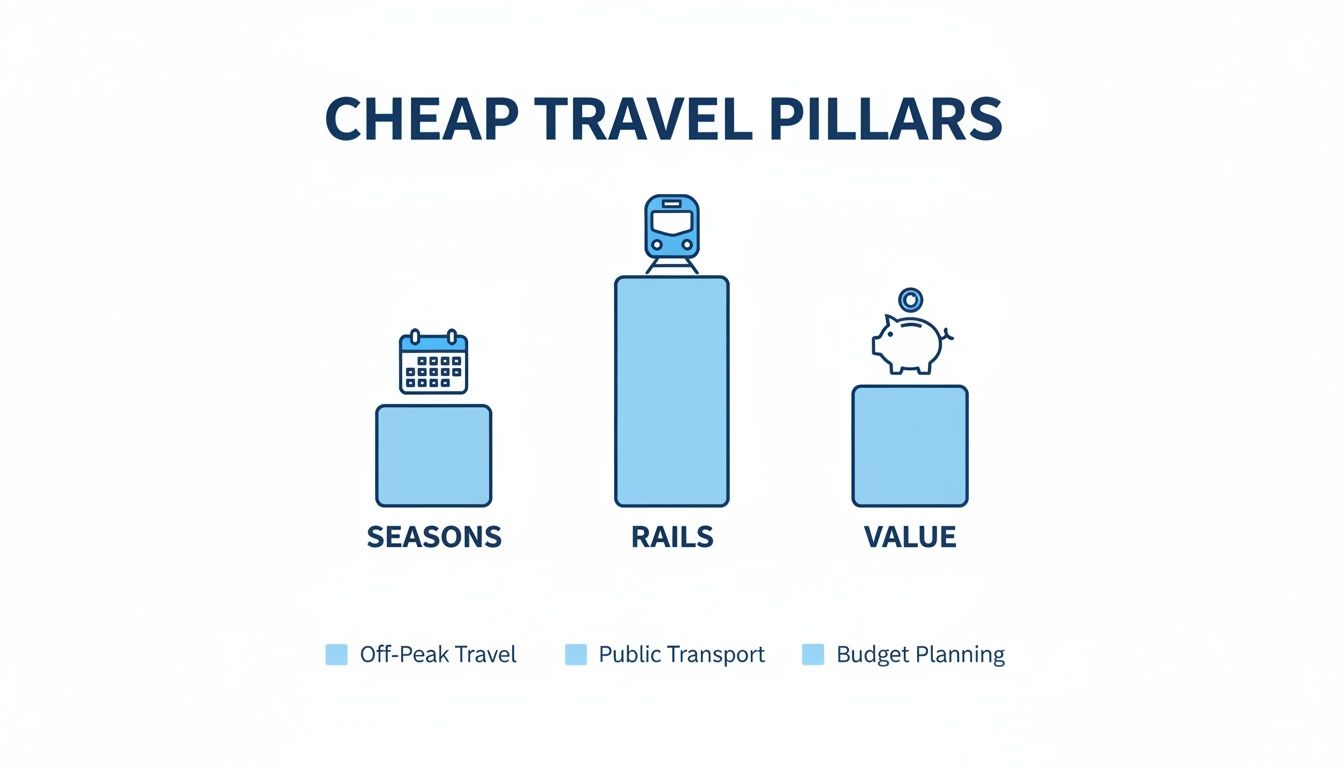
As the chart shows, getting these three pillars—timing, transport, and destination—to work together is what unlocks a truly affordable and meaningful trip.
Focus On High-Value Regions for Cheap Travel in Europe
While cities like Paris and London have their magic, they can burn through your budget in a heartbeat. For a proper adventure that won’t break the bank, turn your attention to the incredible value waiting in Eastern and Southern Europe. These regions offer world-class history, incredible food, and stunning landscapes for a fraction of the cost.
Budget-savvy travelers are discovering gems like Riga, Latvia, and Vilnius, Lithuania, where you can live well on just $55-$75 USD (€50-€70) a day. That kind of value makes a multi-week trip completely doable. In fact, Riga often tops lists as one of Europe’s cheapest cities, with daily costs for a solo traveler hovering around $70 USD (€65). Vilnius isn’t far behind at $73 USD (€68).
That’s a world away from Western capitals, where that same amount might barely cover your bed for the night.
To help you picture what this looks like on the ground, here’s a breakdown of daily costs in a few popular high-value cities.
Sample Daily Budgets In High-Value European Cities
| Expense Category | Prague, Czech Republic (USD/CZK) | Lisbon, Portugal (USD/EUR) | Riga, Latvia (USD/EUR) |
|---|---|---|---|
| Accommodation | $35 USD / 820 CZK (Hostel dorm) | $40 USD / €37 (Hostel dorm) | $30 USD / €28 (Hostel dorm) |
| Food & Drink | $25 USD / 585 CZK (Groceries/Street food) | $30 USD / €28 (Local cafes/Markets) | $28 USD / €26 (Markets/Local canteens) |
| Local Transport | $5 USD / 117 CZK (Walk/Single tickets) | $8 USD / €7.5 (Walk/Metro card) | $5 USD / €4.5 (Walk/Trams) |
| Activities/Sights | $10 USD / 234 CZK (Free walking tour/Museum) | $12 USD / €11 (Viewpoint/Historic site) | $10 USD / €9 (Museum/Free sights) |
| Total Daily Estimate | $75 USD / 1,756 CZK | $90 USD / €83.5 | $73 USD / €67.5 |
These numbers are just a starting point, of course, but they show how much breathing room you get by choosing your cities wisely.
Embrace Walkable Base Cities
One of my favorite strategies for saving money and having a richer experience is picking a “walkable base city.” Instead of hopping to a new city every two days—which piles on transport costs and kills your energy—settle into an affordable, well-connected hub for five to seven days.
Cities like Prague, Lisbon, or Budapest are perfect for this. They offer:
- Low daily costs: Your money for food, local transit, and fun goes a lot further.
- Walkability: You can see most of the city on foot, saving a ton on metro passes or taxis.
- Excellent rail connections: They act as gateways to incredible (and often even cheaper) day trips on regional trains.
From Prague, you can ride out to the historic town of Kutná Hora for less than $10 USD (€9). From Lisbon, a scenic train to the coastal town of Cascais costs just a few euros. This “hub-and-spoke” approach lets you go deeper and save a surprising amount of cash.
Point-to-Point Tickets vs. Rail Passes
This is the classic question for anyone planning a train-heavy trip: Do you buy a rail pass like Eurail, or book individual tickets? There’s no single right answer—it all comes down to your travel style.
- Point-to-Point Tickets are best for: Slow travelers. If you plan to stay put for several days and take shorter, regional trips, booking tickets in advance directly from national rail operators is almost always cheaper.
- A Rail Pass is best for: Fast-paced travelers covering long distances across multiple countries. If you’re moving every two or three days, the flexibility and bundled cost of a pass can be a fantastic deal.
To figure it out, sketch out your dream route. Then, use a rail planner to price out the individual legs and compare that total to the cost of a pass. That little bit of homework can easily save you hundreds. Mastering the art of linking these journeys together is a skill, and you can learn more in our detailed guide on effective trip-chaining for European rail adventures.
By building your itinerary around these ideas, you’re not just saving money. You’re creating a framework for a slower, more intentional journey that’s also kinder to the planet.
Mastering Europe’s Rails For Budget Travel
Forget the stress of budget airlines, remote airports, and rigid baggage rules. If you want to unlock affordable, sustainable, and genuinely enjoyable travel in Europe, the continent’s sprawling rail network is your single best tool. Mastering the rails lets you glide from one city center directly to another, turning travel days into part of the adventure itself.
With a little planning, the train becomes your secret weapon for cheap travel in Europe.
This isn’t just about saving money, though. Choosing the train over a short-haul flight dramatically shrinks your carbon footprint. It’s a conscious choice that lets you watch the stunning landscapes unfold between destinations instead of just flying over them.
[carbon_calculator_2025]
And the value? Often unbeatable. Train travel is making green exploration across Europe more accessible than ever, with plenty of point-to-point fares under $22 USD (€20) for journeys that take just a couple of hours. A perfect example is the scenic trip from Munich to Salzburg—it’s under two hours and can cost as little as $16-$22 USD (€15-€20), a fraction of the cost and hassle of a flight.
The Ultimate Budget Hack: Night Trains
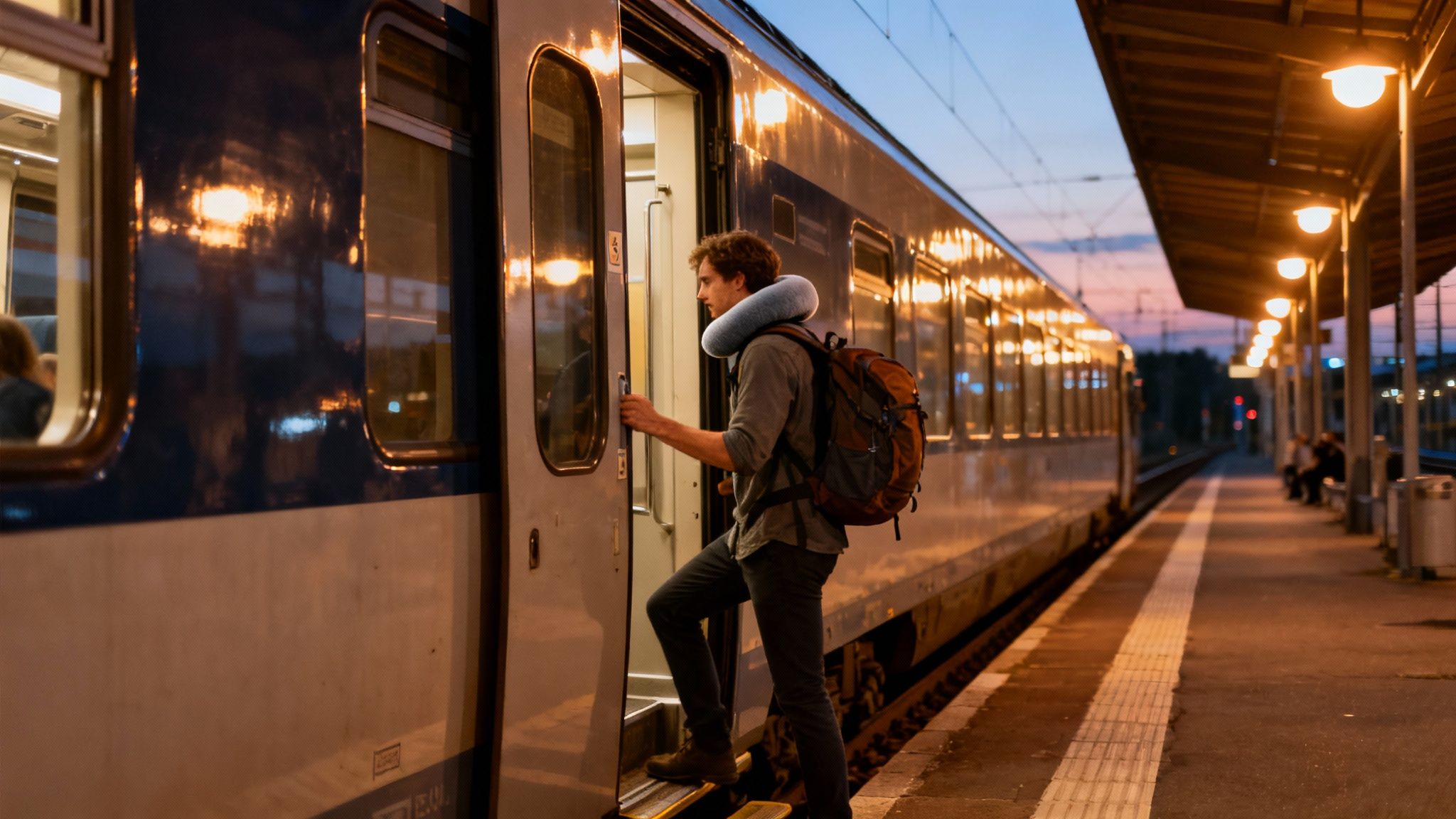
Night trains are the unsung heroes of budget European travel. The concept is brilliant: you board a train in the evening, sleep in a couchette or sleeper car, and wake up refreshed in a completely new city.
This one move solves two problems at once—it covers a long distance efficiently and completely eliminates the cost of a night’s accommodation.
Popular routes that are perfect for this include:
- Vienna to Rome
- Prague to Krakow
- Paris to Berlin
- Amsterdam to Zurich
Booking these requires some forward planning, as the cheapest couchettes sell out fast. Use national rail websites like Austria’s ÖBB Nightjet for the best direct prices. You’ll not only save money but also wake up ready to explore, having skipped an entire day of transit. You can find more detailed guidance in our comprehensive overview on how to travel Europe by train.
Finding Hidden Deals: When To Use Regional Trains
While high-speed trains are impressive, they come with a premium price tag. The real secret to deep savings lies with the slower, regional train networks. These trains stop at smaller towns, offering a charming and much more authentic glimpse into the countryside.
For journeys under four hours, a regional train is often not much slower than a high-speed one once you factor in the time to get to and from city-center stations. The cost savings, however, can be massive—sometimes 50% less than the faster alternative.
To find these deals, your best bet is to go directly to the source. National rail company websites (like Deutsche Bahn for Germany or SNCF for France) are the best places to find the lowest fares, as they don’t include the booking fees third-party sites sometimes add.
Book as early as possible, especially for popular cross-border routes, to lock in the cheapest advance-purchase tickets. By combining these simple rail strategies, you can navigate Europe efficiently, comfortably, and—most importantly—affordably.
How To Eat And Sleep Well For Less
Your two biggest daily expenses on the road are almost always food and a place to sleep. Get these two right, and you unlock the secret to affordable, long-term travel. The best part? Smart strategies for eating and sleeping don’t just save you a ton of money; they pull you deeper into the local culture, making your trip richer and more authentic.
To pull off cheap travel in Europe, you need to look beyond the obvious. That means thinking past crowded hostel dorms and overpriced tourist-trap restaurants. The goal is to live comfortably and eat well without torching your travel fund before you’ve even settled in.
This approach is a game-changer for slow travellers and remote workers who need a comfortable base without the high price tag. A few simple shifts in how you find a bed and a meal can easily save you hundreds over a multi-week trip.
Rethinking Your Accommodation Strategy
Hostels are the classic budget choice, but they aren’t your only move. In fact, for longer stays or if you need a quiet space to work, they often aren’t the best one. The real value is in finding places that offer more than just a cheap bed.
Apartments with kitchens are where it’s at. Renting a small flat for a week or more through a platform like Trip.com can often be cheaper per night than a private hostel room, especially in Eastern Europe. And the ability to cook your own meals unlocks massive savings that add up every single day.
Here are a few powerful alternatives to the standard hostel dorm:
- Eco-Certified Guesthouses: These small, often family-run places give you a real local connection and are typically more affordable than hotels. They also tend to have a lower environmental impact. You can learn how to spot truly sustainable stays and avoid greenwashing in our dedicated guide.
- Private Rooms in Shared Apartments: This gets you the privacy of your own room and access to a kitchen without the cost of renting an entire apartment. It’s a fantastic way to meet locals or other long-term travellers.
- House-Sitting: If you have a flexible schedule, house-sitting is the ultimate budget hack. You get free accommodation in exchange for looking after a home and maybe a pet or two. It’s perfect for slow travellers.
By prioritising a place with a kitchen, you take back control of your food budget. This single decision can slash your daily food expenses by more than 50%.
Eat Like A Local To Save A Fortune
Eating out for every meal is the fastest way to burn through your budget. The secret to eating well for less is simple: do what the locals do. That means hitting up local markets, cooking simple meals, and knowing how to spot a high-value meal when you see one.
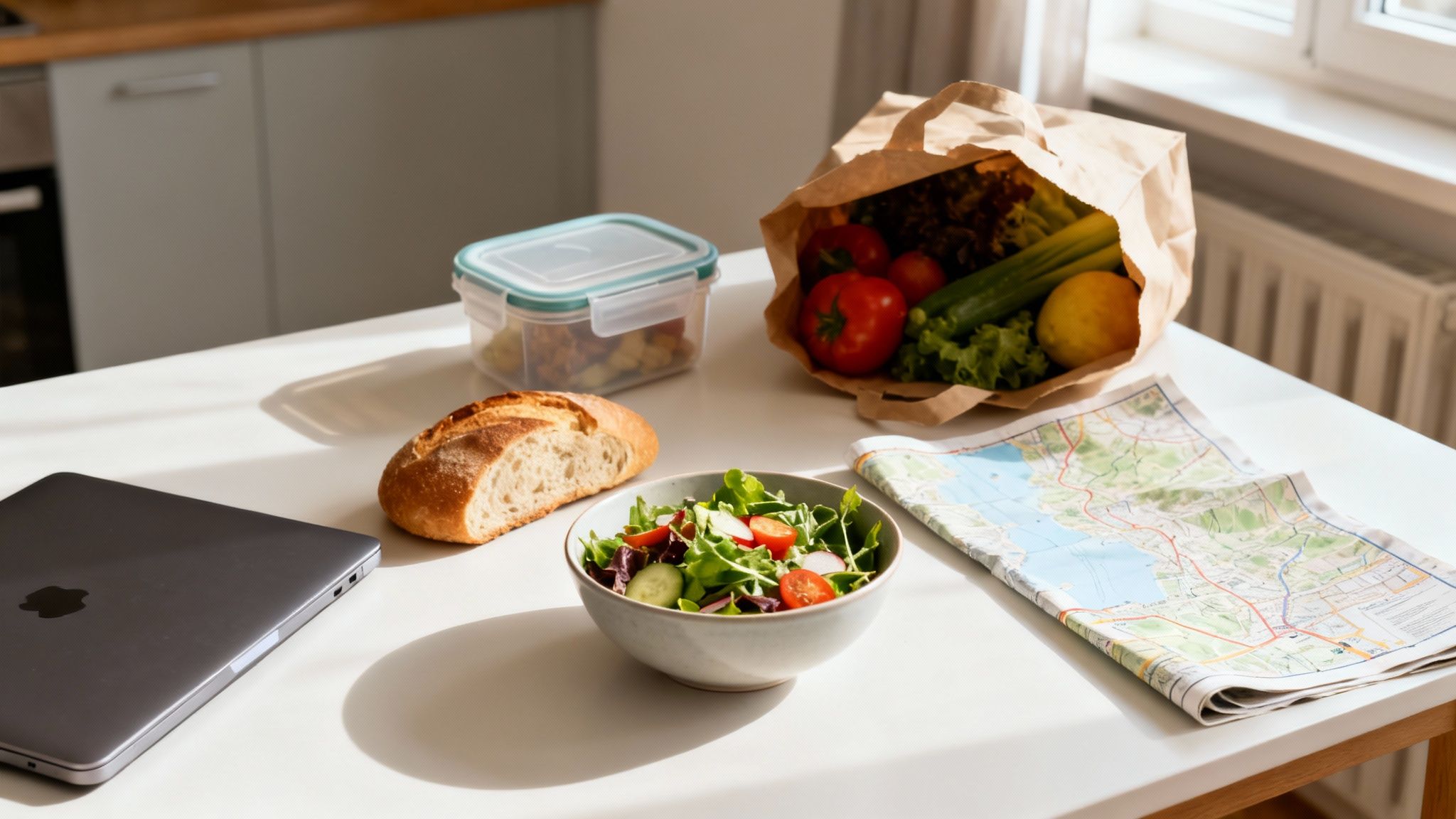
Start at the source: the local market. This is where you’ll find the freshest produce, amazing cheeses, and incredible bread at the lowest prices. It’s also a fantastic cultural experience in itself. Grab a fresh baguette, some local cheese, and a piece of fruit, and you’ve got a perfect picnic lunch for just a few euros.
Sample Daily Food Budget Strategy
Here’s what a typical day of eating well on a tight budget can look like.
| Meal | Strategy | Estimated Cost (USD/EUR) |
|---|---|---|
| Breakfast | Make it at your apartment (oats, yoghurt, coffee). | $2-3 USD / €1.80-2.70 |
| Lunch | Picnic with market finds or grab some local street food. | $5-8 USD / €4.50-7.30 |
| Dinner | Cook a simple pasta or rice dish with fresh market veggies. | $6-10 USD / €5.50-9.10 |
| Total | A full day of delicious, fresh food. | $13-21 USD / €11.80-19.10 |
This keeps your food spending incredibly low, freeing up your cash for actual experiences. And when you do decide to eat out, hunt for the cultural staples that offer great value. In Spain, for example, the ‘menu del día’ (menu of the day) gets you a three-course lunch with a drink for around $11-16 USD (€10-€15). It’s the main meal for many locals and an unbeatable deal.
By pairing smart accommodation with local eating habits, you can dramatically lower your daily costs. This lets you travel longer, go deeper, and do it all more sustainably.
Packing Light For Maximum Freedom And Savings
Overpacking is the silent budget killer of any European trip. It’s not just the surprise baggage fees, either. It’s the energy you waste wrestling a heavy suitcase on and off trains, and the freedom you lose when you’re weighed down instead of exploring. The real key to cheap travel in Europe is a minimalist, low-waste packing philosophy that puts mobility and simplicity first.
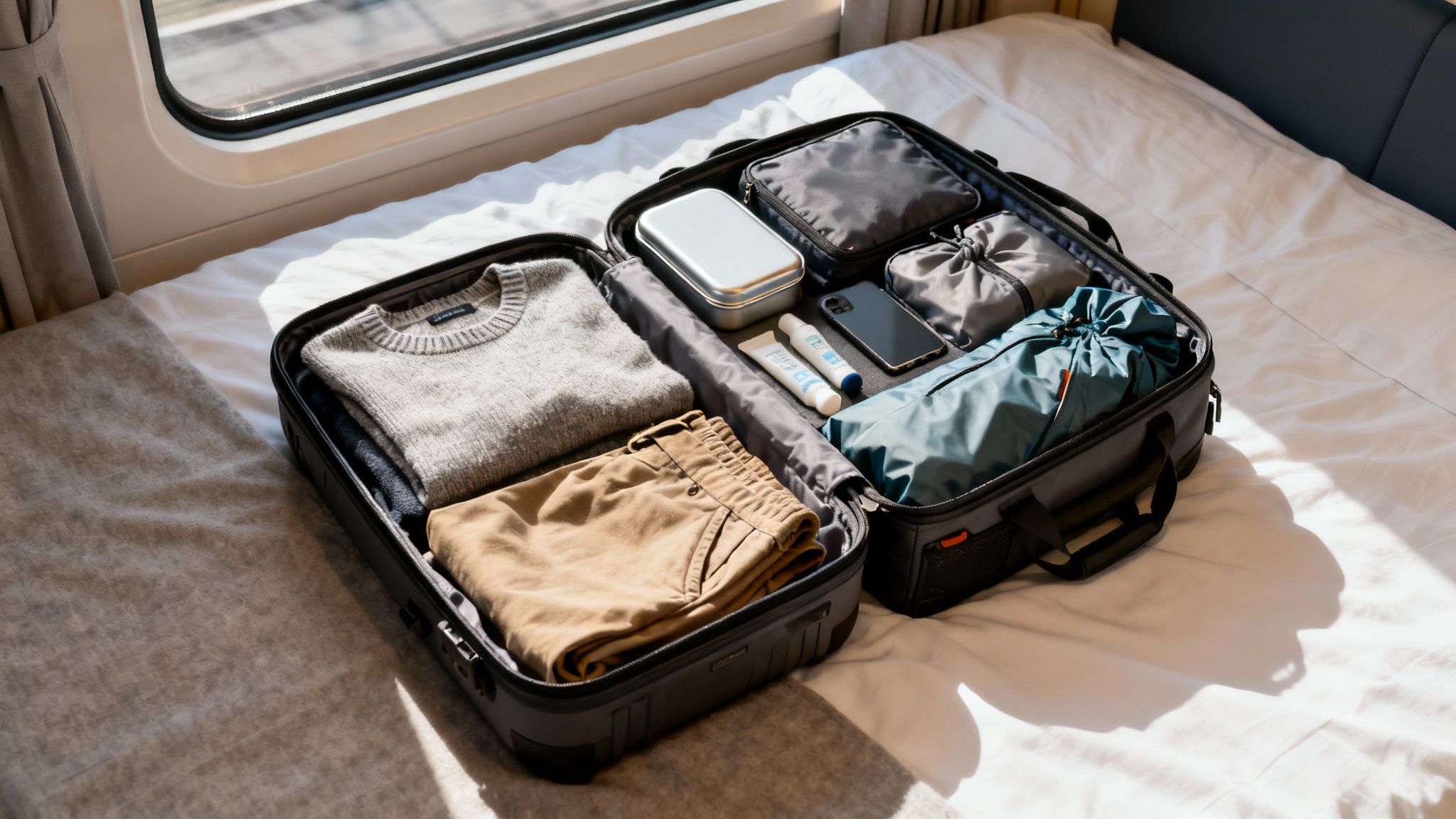
This approach is tailor-made for train travel, where you are your own porter. By building a capsule wardrobe from versatile, multi-purpose items, you can travel for weeks with just a carry-on-sized backpack. This move saves you from checked bag fees on the rare occasion you might need to fly, but more importantly, it makes navigating busy stations and narrow city streets an absolute breeze.
Affordability is reshaping how people explore the continent, with many now aiming for daily budgets of $110-$220 USD (€100-€200). According to recent industry analysis from Phocuswright, this budget-consciousness—which has seen a 14% increase—is driving more travelers toward shoulder-season train trips and Eastern European destinations. Smart packing is a huge piece of that puzzle.
Building Your Carry-On Capsule Wardrobe
The goal here is simple: pack items that can be mixed, matched, and layered. Think neutral colours with one or two accent pieces. Fabrics are everything; merino wool is a traveler’s best friend because it’s odor-resistant, temperature-regulating, and dries quickly. That means you can pack fewer things and wash them on the go.
Here’s a sample packing list to get you started:
- Tops: 3–4 merino wool or moisture-wicking t-shirts/tops.
- Bottoms: One pair of comfortable travel pants and one pair of versatile jeans or chinos.
- Layers: A lightweight fleece or merino wool sweater and a packable waterproof/windproof jacket.
- Footwear: One pair of comfortable, broken-in walking shoes and one pair of smarter shoes or sandals that can be dressed up or down.
- Essentials: 4–5 pairs of wool socks and underwear—enough to get you between laundry days.
This simple setup covers you for most situations, from city exploring to light hiking. For a deeper dive, check out our complete guide on how to pack for low-impact travel.
Essential Gear For The Modern Budget Traveler
Beyond your clothes, a few key pieces of gear will save you a world of money and hassle. Switching to solid toiletries—like shampoo bars, conditioner bars, and toothpaste tablets—is a game-changer. They don’t count toward your liquid allowance at airports, they can’t spill in your bag, and they dramatically cut down on plastic waste.
Staying connected is the other critical piece. Roaming charges can be astronomical, and nobody wants to hunt for a local SIM card after a long travel day. This is where an eSIM (embedded SIM) becomes invaluable.
An eSIM is a digital SIM that lets you activate a mobile plan without a physical card. You can buy and set it up before you even leave home. When you land, you just switch on the plan and you’ve got data immediately—perfect for navigating to your hostel or checking train schedules on the spot.
Editor’s Pick: Best Tool For Staying Connected Affordably
For reliable and affordable data across Europe, Airalo is my go-to. It offers regional eSIM packages that cover multiple countries, so you don’t have to worry about switching plans every time you cross a border.
You can check out Airalo’s Europe packages here to find a plan that fits your trip length and data needs. This one small investment in connectivity pays for itself in convenience and savings from the moment you arrive.
Your Top Questions About Cheap European Travel, Answered
Planning a budget-friendly trip through Europe always brings up a few practical questions. Getting the answers right can be the difference between a smooth, affordable adventure and one full of surprise costs. Here are the most common queries I see, with the straight-up advice you need to travel smarter.
What’s a Realistic Daily Budget for Eastern Europe?
For a solo traveler sticking to hostels and local eats in countries like Poland, Hungary, or the Czech Republic, a daily budget of $45–$65 USD (€40–€60) is perfectly realistic. This will comfortably cover a dorm bed in a good hostel, food from markets and cheap eateries, local transport, and a few low-cost activities.
If you prefer a private room or just want a bit more breathing room, aiming for $70–$90 USD per person is a solid target. It’s a world away from Western Europe, where a similar travel style can easily run you $90–$130 USD a day or more.
Is a Eurail Pass Actually Cheaper Than Buying Individual Tickets?
It honestly depends on your pace. If you’re planning to cover long distances and hop between countries every two or three days, a Eurail Pass often wins on cost and flexibility. It’s built for that kind of spontaneous, fast-moving travel.
However, for slower trips with shorter, regional journeys, buying point-to-point tickets in advance is almost always the cheaper way to go. Before you commit to a pass, map out your rough itinerary and compare the cost of individual tickets on a site like Trip.com against the price of the pass that fits your timeline.
How Do I Avoid Getting Stung by Currency Exchange Fees?
Whatever you do, steer clear of the currency exchange kiosks at the airport. They offer some of the worst rates you’ll find anywhere. The smartest move is to use a debit card with low or zero foreign transaction fees at a local bank’s ATM once you’ve arrived.
When the ATM asks if you want the transaction in your home currency or the local one, always, always choose the local currency (e.g., EUR, CZK). Choosing your home currency lets the ATM’s bank set a poor exchange rate for you through a process called dynamic currency conversion.
Are Budget Airlines Ever a Good Idea in Europe?
While a rail-first approach is better for the planet and often your sanity, budget airlines can sometimes be the most practical option. They really only make sense for covering huge distances where a train would take days or cost a fortune—think traveling from Lisbon all the way to Krakow. You can easily compare options on a site like Aviasales.
Just be sure to calculate the true cost before you book. Factor in the notoriously high baggage fees, the cost of getting to and from remote airports, and all the time you’ll lose in transit. More often than not, a comfortable overnight train offers far better value and a more memorable, sustainable experience.
This article was fact-checked using sustainability data from the World Green Building Council, the Global Ecotourism Network, and peer-reviewed architecture studies. All partner links are vetted for compliance with sustainable business certifications.
Join the Sustainable Work Movement
Want more rail-first itineraries, low-impact packing systems, and walkable base-city ideas?



Latest Sustainable Travel Guides
Explore Eco Nomad Travel
📚 Core Guides
🧭 Planning & Logistics
🗺️ Destinations & Seasons
Jeremy Jarvis — founder of Eco Nomad Travel, sustainable travel writer, and advocate for regenerative tourism. His work focuses on low-impact mobility, eco-friendly digital nomad life, and climate-positive travel.
Legal
Affiliate DisclaimerPrivacy Policy
Terms of Service
Image & Media Notice
Cookie Policy
Contact
Affiliate Disclosure: Some links on Eco Nomad Travel are affiliate links, meaning we may earn a small commission at no extra cost to you. This supports our mission to inspire responsible and low-impact travel worldwide.
Connect
✅ Trusted Official Sources
Plan smarter eco trips
Try our free Sustainable Travel Tools for Digital Nomads – carbon calculator, train vs plane comparator, and more.
Open Tools Hub