
Figuring out the cheapest way to travel to Europe always comes back to a simple, flexible rule: stay on the ground whenever you can. For most trips between European cities, long-distance buses are the undisputed budget champions. Trains offer a fantastic, sustainable alternative for mid-range journeys, and they’re often surprisingly affordable if you book ahead. As for flights? Mastering budget airlines is a game of dodging hidden fees that can easily wipe out any initial savings.
Crafting a European adventure that’s both cheap and sustainable is about more than just finding a good flight deal—it’s about smart, holistic planning from the start. For digital nomads and eco-conscious travelers, the real win is exploring the continent without constantly relying on carbon-heavy air travel. That means building an itinerary around slower, more immersive options, like using long-distance buses for regional hops and leaning on Europe’s incredible rail network for comfortable trips between major hubs.
This strategy does more than just cut your expenses; it immerses you in the landscape and shrinks your carbon footprint in a meaningful way.
Key Takeaways
- Long-distance buses are almost always the most budget-friendly choice for getting from point A to B within Europe.
- The train vs. plane debate really depends on distance. For journeys under 600 miles (about 1,000 km), trains are often cheaper, faster city-center to city-center, and far more sustainable.
- Mastering budget airlines means learning to sidestep extra fees for baggage and seat selection, which can easily double the final cost of your ticket.
- A smart itinerary focusing on geographically close countries during the shoulder season (April-May and September-October) will slash your costs dramatically.
- Using an e-SIM from a provider like Airalo or Yesim is a non-negotiable for avoiding outrageous data roaming charges while you’re on the move.
- Booking your transport in advance is crucial: 6-8 weeks for flights, 3-6 months for high-speed trains, and 1-4 weeks for buses.
Your Blueprint for Affordable European Travel
By mixing and matching different transport modes, you can build an itinerary that’s not just incredibly cheap but also much kinder to the environment. You can learn more about crafting a balanced trip in our detailed guide on the best way to travel in Europe.
European Travel Modes Cost and Impact at a Glance
This table provides a quick overview of the average cost, ideal use case, and sustainability impact for common European travel methods to help you make informed decisions.
| Travel Mode | Average Cost (Per 300 miles / 480 km) | Best For | Sustainability Profile |
|---|---|---|---|
| Long-Distance Bus | $15 – $30 USD | Ultimate budget travel, short to mid-range trips between cities. | Very Low Emissions |
| Regional/High-Speed Train | $40 – $120 USD | Comfortable city-center to city-center travel, scenic journeys. | Low Emissions |
| Budget Airline | $30 – $90 USD (base fare) | Long-distance cross-continental routes (over 600 miles / 965 km). | High Emissions |
| Ridesharing (e.g., BlaBlaCar) | $20 – $40 USD | Spontaneous, flexible travel and meeting locals. | Medium Emissions |
As you can see, what’s “cheapest” really depends on the situation. Buses win on pure price, but trains deliver an unmatched blend of comfort, speed, and low environmental impact for those mid-length trips.
Why European Buses Are the Undisputed Budget Champion
When your main goal is simply getting from A to B for the lowest possible price, Europe’s long-distance bus network is your answer. This isn’t about glamorous travel; it’s about smart, practical movement that keeps your budget intact for the experiences that actually matter.
Operators like FlixBus, RegioJet, and BlaBlaBus have woven a vast web of connections across the continent. They link major cities and smaller towns with fares that often seem too good to be true.
It’s completely normal to find tickets for just a few dollars, turning what could be a pricey train ride into a rounding error on your expense sheet. This makes buses the undisputed foundation of a truly low-cost European itinerary.
Key Takeaways for Bus Travel
- Rock-Bottom Fares: Buses are the most consistently cheap way to travel point-to-point, with international routes often costing less than $20 USD (€18.50).
- Ideal Booking Window: For the best deals, book your bus tickets 1 to 4 weeks in advance. This is the sweet spot before prices start to creep up.
- The Nomad Advantage: Long journeys can become productive work sessions for digital nomads, thanks to free Wi-Fi and power outlets on most modern coaches.
- The Trade-Off: The main compromise here is time. Bus journeys are significantly longer than train or plane trips, making them best for travelers with flexible schedules.
- Major Players: FlixBus is the biggest and best-known operator with a massive network and a solid app. RegioJet, on the other hand, is praised for its comfort in Central and Eastern Europe.
- Strategic Use: For an ultra-affordable travel plan, combine bus travel for shorter regional legs with trains or budget flights for longer cross-continental hops.
How to Maximize Savings with Bus Travel
Finding the best deals is straightforward. Using a platform like Trip.com is a great way to compare different operators and routes in one place, ensuring you see the lowest price available. The real key, though, is flexibility. If you can travel mid-week or at off-peak hours (think early mornings or late nights), you’ll unlock the absolute rock-bottom fares.
Long-distance buses and budget coaches are the single most consistently cheap option for point-to-point travel across Europe. Aggregated fare checks show median intra-European coach fares under €20 ($21.50 USD) for trips of 100–600 km (62-373 miles).
This screenshot from FlixBus shows a simple one-way search, highlighting just how low the prices can be and how extensive the network is.
The clear layout makes it easy to compare times and prices, showing just how accessible ultra-budget travel has become.
The Practical Side of Bus Journeys
For a digital nomad, a six-hour bus ride from Berlin to Prague for under $20 USD isn’t lost time—it’s a mobile office. Most modern coaches come equipped with complimentary Wi-Fi and power outlets at every seat, which means you can catch up on work, edit photos, or plan your next move while on the road.
Still, it’s important to manage your expectations. While some operators like RegioJet are known for enhanced comfort—including free hot drinks and seat-back entertainment—the standard experience is pretty basic. To make your journey more comfortable, a little preparation goes a long way:
- Pack Snacks and Water: Onboard food and drinks can be limited or overpriced.
- Bring a Neck Pillow and Eye Mask: These are essential for longer or overnight trips if you want to get any real rest.
- Download Entertainment: Don’t rely solely on the onboard Wi-Fi, which can be patchy at best. Have movies, podcasts, or music saved directly to your device.
By embracing a slow-travel mindset and using the journey productively, European buses become more than just the cheapest option. They become an efficient tool in your digital nomad arsenal.
Trains vs. Planes: The Real Cost and Carbon Footprint
The choice between a train and a plane is one of the biggest decisions you’ll make when planning a low-cost trip through Europe. While budget airlines flash unbelievably cheap fares, that first price is almost never what you actually pay. The real cost quickly adds up once you factor in airport transfers—often $20-$30 USD each way—checked bag fees, and the hours you lose in security lines and remote terminals.
[carbon_calculator_2025]
This breakdown offers a more honest, data-driven look to help you decide. A flight might look cheaper on paper, but a train often comes out ahead when you calculate the full door-to-door cost, especially on journeys under 600 miles (around 1,000 km).
And then there’s the night train, one of my favorite travel hacks. It rolls your transport and accommodation costs into a single ticket, saving you the price of a hotel room and dropping you right in the city center, ready to go the moment you arrive.
Cost Breakdown: The Real Price of a Ticket
To make a smart choice, you have to look past the sticker price. A $40 USD flight from Paris to Barcelona can easily become a $100+ USD expense after you add a $40 USD baggage fee and $30 USD for airport bus tickets.
In contrast, a $70 USD train ticket for the same route is usually all-inclusive. You arrive in the city center, so there are no expensive taxis from a remote airfield, and you can almost always bring more luggage at no extra charge. This simple math is fundamental to finding the cheapest way to travel in Europe.
The total cost of a journey—including transfers, baggage, and your time—is the only true measure of affordability. A cheap plane ticket is only cheap if you can dodge all the extra fees.
The Sustainability Factor
Beyond your budget, the environmental impact is a massive consideration for any conscious traveler. The carbon footprint of flying is dramatically higher than traveling by rail. Choosing a train over a plane for a mid-range journey is one of the most powerful decisions you can make to lower your travel emissions. For a detailed analysis, check out our guide to train vs. plane emissions.
A 2025 Europe-wide analysis of 142 routes showed that flying is still cheaper on a majority of cross-border corridors under 1,500 km (932 miles). The study, highlighted by Greenpeace research on European transport pricing, found flights were the cheaper option on 54% of the 109 cross-border routes looked at, while trains won on 39% of them. Still, that marks a 14% improvement for rail since 2023, driven largely by the welcome expansion of night train services.
This decision tree helps visualize the key trade-offs, balancing your budget with your practical needs.
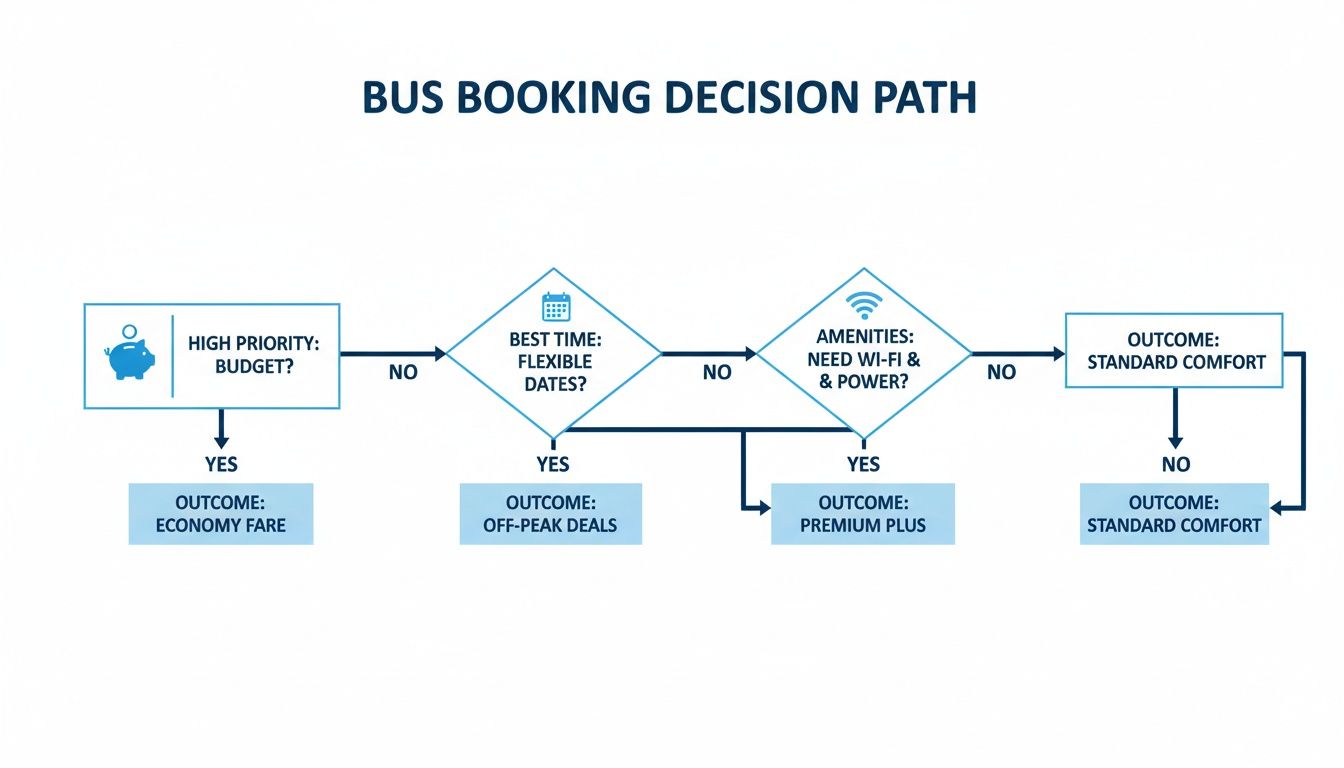
As the flowchart shows, when budget is your absolute top priority, buses are the undisputed winner. But your timing, flexibility, and desired comfort level all play a huge role in the final decision.
Making the Right Choice for Your Trip
So, when does flying still make sense? It’s generally the better call for long-distance routes over 600 miles (965 km) where a train journey would become impractically long. For almost everything else, the train offers a far better blend of cost, convenience, and sustainability.
- Choose the Train if: Your journey is under 600 miles (965 km), you want to arrive in the heart of the city, you have luggage, and you appreciate a relaxed, scenic ride.
- Choose the Plane if: You’re traveling over 600 miles (965 km), can pack light enough for just a carry-on, and you’ve found a fare that stays cheap even after adding the cost of getting to and from remote secondary airports.
Ultimately, by looking at the total cost and environmental impact, you can make an informed choice that lines up with both your wallet and your values.
Mastering Budget Airlines for the Cheapest Way to Travel to Europe
Budget carriers like Ryanair, Wizz Air, and EasyJet have completely changed the game for long-distance travel in Europe, making them a key part of finding the cheapest way to travel to Europe. But let’s be clear: their entire business model is built on luring you in with a rock-bottom fare and then making their profit on a minefield of extra fees.
Learning to navigate this system is a core skill for any budget traveler. The price you see advertised is almost never the price you’ll pay unless you’re incredibly disciplined. These airlines thrive on what they call “ancillary revenue”—money they make from everything except the basic seat. This includes checked bags, carry-on bags, seat selection, priority boarding, and even printing your boarding pass at the airport.
These add-ons aren’t just small charges; they can easily double or triple your final ticket price. A $30 USD flight from Lisbon to London can balloon into a $100+ USD ordeal if you aren’t careful, completely derailing your budget.
Key Takeaways for Budget Flights
- Baggage is the biggest trap. Budget airlines have painfully strict and tiny limits for their “free” personal item. Always measure your bag and expect to pay a premium for anything larger.
- Secondary airports hide extra costs. Many budget carriers fly into smaller, remote airports that require pricey and time-consuming bus or train transfers to get into the city.
- Packing light is non-negotiable. Your goal should be to travel with a single backpack that fits their “personal item” dimensions to dodge all baggage fees. Carry-on limits are often under 22 lbs (10 kg).
- Use the right tools to find real deals. Flight aggregators are essential for comparing prices across multiple carriers and uncovering genuine bargains.
- Pay for extras online, ahead of time. If you absolutely have to check a bag, do it when you book. Airport fees are always significantly higher.
- Check in online and print your pass. Airlines like Ryanair are famous for charging a massive fee (upwards of $60 USD / €55) if they have to print your boarding pass for you at the airport.
Editor’s Pick Best Tool for Finding Cheap Flights
For consistently finding the cheapest flights across multiple budget carriers, Aviasales is our top recommendation. Its flexible date search and transparent pricing help you quickly identify the best deals without hidden fees, making it an essential tool for any budget-conscious traveler in Europe.
The Hidden Cost of Secondary Airports
One of the sneakiest expenses is ground transit. A flight into London Stansted (STN) or Paris Beauvais (BVA) might look like a steal, but these airports are actually 50-60 miles (80-97 km) outside the city center.
The bus or train you’ll need to take can cost $20-$30 USD (€18-€28) each way and easily add two hours to your travel time. You have to factor this ground transportation cost and time into your comparison. Sometimes, a slightly more expensive flight into a main airport is actually the cheaper and more convenient choice. For those who prefer door-to-door service without wrestling with public transport, pre-booking with a service like Welcome Pickups can be a stress-saving alternative.
Always calculate the total door-to-door cost, not just the flight price. This includes airport transfers, baggage fees, and any other necessary add-ons.
How to Navigate Baggage Fees Like a Pro
Baggage is where budget airlines make a huge chunk of their money. The “free” allowance is usually just one small personal item that has to fit under the seat in front of you—think a small backpack or a large purse, nothing more.
- Measure and Weigh Everything: Before you even think about leaving for the airport, make sure your bag meets the airline’s specific size and weight rules. They are notoriously strict and will not hesitate to charge you.
- Wear Your Heaviest Items: Put on your hiking boots, your jacket, and that bulky sweater for the flight. This frees up precious space and weight in your bag.
- Consolidate and Minimize: Pack only what you truly need. Adopting a minimalist packing strategy is the single most effective way to beat the baggage fees.
If you understand the rules and plan ahead, you can use budget airlines for what they are: a tool for covering long distances on the cheap. They’re rarely as comfortable or convenient as a train, but for the right route, they can be an invaluable part of a budget-friendly European itinerary. If you’re looking for a more relaxed and sustainable alternative, our guide on how to travel Europe by train offers a great comparison.
How to Build the Cheapest European Itinerary
Finding the cheapest way to travel through Europe isn’t about snagging a single cheap flight or bus ticket. That’s just one piece of the puzzle. A genuinely affordable trip comes from a smart, holistic strategy that weaves together clever planning before you go with savvy tactics on the ground. This approach lets you mix and match different travel methods for a custom adventure that’s kind to both your wallet and the planet.
The absolute foundation of a low-cost itinerary is geography. It’s that simple. Instead of zigzagging across the continent chasing a checklist, focus on countries that are clustered together. This one decision dramatically slashes your travel time and costs, letting you swap long, expensive journeys for shorter, cheaper bus or regional train rides.
This strategy really sings when you pair it with destinations where your money just goes further. Eastern and Southern Europe consistently offer much lower daily costs for food, accommodation, and activities than their Western and Nordic neighbors. Our guide on the cheapest countries in Europe to visit breaks this down in detail to help you map out a route.

Key Takeaways for Building an Itinerary
- Go East and South: Prioritize regions like the Balkans, Poland, or Portugal. Your daily expenses for food and a place to sleep will be significantly lower.
- Travel in the Shoulder Season: Visiting during April-May or September-October hits the sweet spot. You get good weather with much lower prices for flights and accommodation.
- Cluster Your Countries: Design your route to minimize travel distances. A trip focused on Poland, Czechia, and Hungary will be far cheaper than one hopping from Spain to Greece to Sweden.
- Embrace Self-Catering: Staying in hostels or apartments with a kitchen can easily cut your food budget by more than half. Seriously.
- Stay Connected Smartly: Don’t get stung by crippling data roaming charges. Use an e-SIM from a provider like Airalo to stay online for cheap.
- Leverage Ridesharing: Services like BlaBlaCar offer a flexible and social way to cover distances that might be awkward or expensive on a bus or train.
Calculating a Realistic Daily Budget
Before you even think about booking, you need a realistic daily budget. For a bare-bones trip in Eastern Europe, you might scrape by on $40-$50 USD per day. In Western Europe, you’ll want to aim for $70-$85 USD as an absolute minimum.
Here’s a simple template to get you started:
- Accommodation (Hostel Dorm): $25 – $40 USD
- Food (Mostly Self-Catered): $15 – $25 USD
- Activities (Free Walking Tours, Museums): $5 – $10 USD
- Local Transport (City Pass/Walking): $5 – $10 USD
This gives you a baseline you can adjust depending on your destination and travel style. A day out in Lisbon will look very different from a day in Zurich.
Flexible Transport and Local Savings
Looking beyond the major bus and train routes can unlock serious savings and some unique experiences.
Ridesharing with BlaBlaCar is a fantastic tool, especially for spontaneous travelers. It’s a carpooling service that matches you with drivers already heading your way, and you just chip in for gas. It’s often cheaper than the bus and a great way to meet locals.
Once you arrive in a city, getting a handle on local transport is key. Many cities offer multi-day transit passes that give you unlimited rides on trams, buses, and metros. If you plan to explore beyond the old town center, these almost always offer better value than buying single tickets.
Staying Connected Without Overspending
One of the biggest budget traps for modern travelers is mobile data. Roaming charges from your home provider can be astronomical. The fix is an e-SIM—a digital SIM card you can install on your phone before you even leave home.
Companies like Airalo and Yesim offer regional European data packages for a fraction of what traditional roaming costs. For as little as $10-$20 USD, you can get enough data for a multi-week trip, letting you use maps, book tickets, and stay in touch without dreading your next phone bill.
By weaving these strategies together—choosing affordable regions, traveling in the shoulder season, budgeting your daily costs, and using smart tools for transport and connectivity—you build a strong framework for an incredibly affordable European adventure.
Common Questions on Budget European Travel
Sorting through the details is the final step in piecing together a smart European adventure. Here are a few common questions I get about finding the cheapest way to travel to Europe, helping you lock in your plans and move with confidence.
Is a Eurail Pass Actually the Cheapest Way to Travel by Train?
A Eurail Pass offers incredible freedom, but it’s rarely the flat-out cheapest option. It really shines for spontaneous travelers who plan on making lots of long-distance journeys in expensive countries like Germany or Switzerland, where last-minute tickets can be eye-wateringly high.
However, if you have a reasonably fixed itinerary, booking individual point-to-point tickets two to three months ahead is almost always cheaper. This is especially true on high-speed routes in France, Spain, or Italy.
The rule of thumb is simple: always compare the total cost of your planned tickets on a platform like Trip.com against the price of a Eurail Pass. The math will tell you which makes sense for your specific trip.
How Far Ahead Should I Book for the Best Prices?
Timing is everything. Booking windows vary a lot depending on how you’re moving, and hitting the sweet spot is key to locking in the lowest fares.
- Budget Airlines: The magic window is usually 6 to 8 weeks in advance.
- High-Speed & International Trains: Book as early as you possibly can—often 3 to 6 months ahead. The cheapest fare buckets disappear fast.
- Long-Distance Buses: You’ll generally find the best prices 1 to 4 weeks before your travel date.
- Regional Trains: Prices are often fixed, so there’s no real financial rush to book way in advance.
What Are Some Less Obvious Ways to Save Money in Europe?
Beyond your transport tickets, it’s the small, daily habits that make the biggest difference to your budget.
First, stay connected without the insane roaming fees. Using an e-SIM from a provider like Airalo or Yesim is a game-changer. This one simple move completely eliminates surprise data bills.
Next, get smart about food costs. Staying in places with kitchens allows you to cook some of your own meals, which cuts your daily spending dramatically.
Finally, lean into free activities. Join a free walking tour to get your bearings in a new city (just remember to tip your guide) and always carry a reusable water bottle. Tap water is safe and clean in most of Europe, saving you money while cutting down on plastic waste.
Final Thoughts and Practical Tools
Figuring out the cheapest way to travel Europe isn’t about finding a single magic bullet. It’s about making a series of smart, deliberate choices that add up. Prioritizing ground transport like buses and trains, aiming for the shoulder seasons, and keeping a close eye on those small, hidden costs—these are the habits that unlock affordable and sustainable travel across the continent.
True budget travel is really a mindset. It values experiences over luxury and slower, more thoughtful journeys over rushed flights. A well-planned itinerary finds the sweet spot between cost, time, and environmental impact, making your adventure both memorable and responsible.
If you want to dig deeper into the environmental side of your choices, our travel carbon emissions calculator is a great place to start. It helps you compare different routes and modes of transport, showing you the real-world impact of your decisions. It’s a simple tool for traveling not just cheaper, but with a lighter footprint.
This article was fact-checked using sustainability data from the World Green Building Council, the Global Ecotourism Network, and peer-reviewed architecture studies. All partner links are vetted for compliance with sustainable business certifications.
Join the Sustainable Work Movement
Want more rail-first itineraries, low-impact packing systems, and walkable base-city ideas?
Explore Eco Nomad Travel
📚 Core Guides
🧭 Planning & Logistics
🗺️ Destinations & Seasons
Jeremy Jarvis — founder of Eco Nomad Travel, sustainable travel writer, and advocate for regenerative tourism. His work focuses on low-impact mobility, eco-friendly digital nomad life, and climate-positive travel.
Legal
Affiliate DisclaimerPrivacy Policy
Terms of Service
Image & Media Notice
Cookie Policy
Contact
Affiliate Disclosure: Some links on Eco Nomad Travel are affiliate links, meaning we may earn a small commission at no extra cost to you. This supports our mission to inspire responsible and low-impact travel worldwide.
Connect
✅ Trusted Official Sources
Plan smarter eco trips
Try our free Sustainable Travel Tools for Digital Nomads – carbon calculator, train vs plane comparator, and more.
Open Tools Hub