
Seeing Europe on a budget isn’t about skipping the good stuff—it’s about traveling smarter. The cheapest way to visit Europe is to ditch the summer chaos and high prices for the shoulder season, then lean into the continent’s incredible train network. You fly into one major, well-connected hub in a month like April or October, and from there, the continent is yours to explore by rail.
It’s a blueprint that swaps pricey internal flights and crowded tourist traps for a more authentic, low-impact adventure. This approach is perfect for digital nomads, remote workers, or anyone who wants to soak up Europe’s diverse cultures without the luxury price tag. It’s about creating a better trip through slower, more mindful travel.
Your Blueprint for an Affordable European Adventure
You don’t need a massive bank account to have a rich European experience. It all comes down to planning with intention, focusing on when you go and how you get around. Think of this guide as your framework for a trip that prioritizes scenic train journeys and walkable home bases over expensive flights and rental cars.
Make a few deliberate choices upfront, and you can slash your costs for flights, accommodation, and day-to-day spending. This approach is perfect for digital nomads, remote workers, or anyone who wants to soak up Europe’s diverse cultures without the luxury price tag. It’s about creating a better trip through slower, more mindful travel.
Why a Rail-First Strategy Just Works
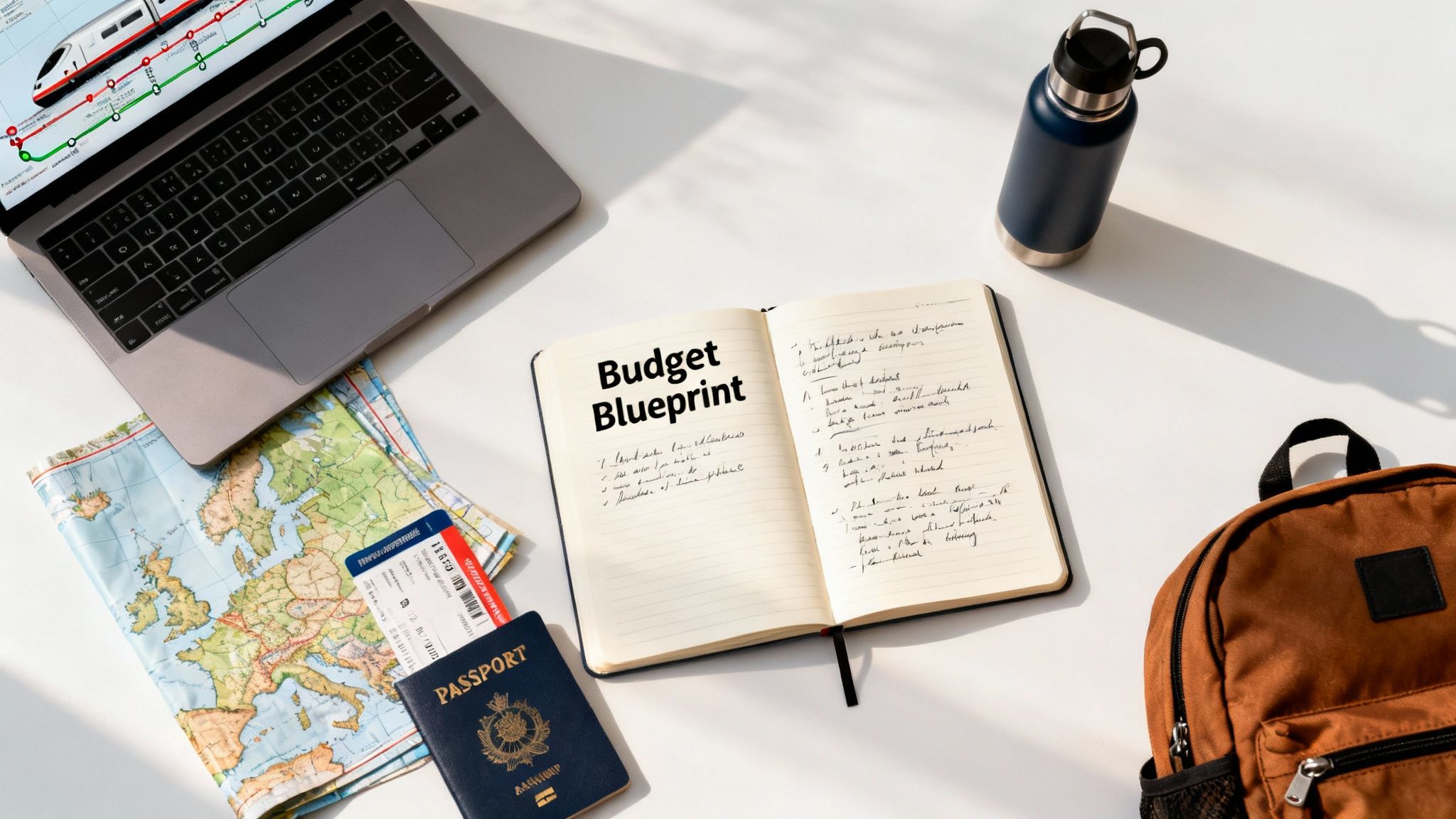
Adopting a rail-first mindset is the cornerstone of any cheap European trip. Unlike in North America, Europe’s train network is a masterpiece—it’s extensive, efficient, and surprisingly affordable, especially if you book ahead. Trains drop you right in the city center, which means you can forget about the time and money wasted on airport transfers. You just step off the platform and you’re there.
And the benefits go way beyond convenience:
- You save on accommodation. An overnight train ticket is your transport and a night’s lodging rolled into one. It’s a classic budget travel hack for a reason. Imagine falling asleep in Vienna and waking up fresh in Rome.
- The views are part of the journey. Many European train routes are destinations in themselves, offering breathtaking scenery of the Alps, coastlines, and countryside you’d completely miss from 30,000 feet (9,144 meters).
- Your environmental impact shrinks. Choosing the train over a plane massively cuts your carbon footprint, letting you align your adventure with more sustainable habits.
Embracing More Affordable Destinations
Sure, Paris and London are iconic, but they’ll drain your wallet fast. A truly budget-savvy trip often means exploring some of Europe’s more affordable gems. Countries in Central and Eastern Europe—think Poland, Hungary, and the Czech Republic—deliver incredible history, culture, and food for a fraction of the cost.
For some solid inspiration, check out our detailed guide on the cheapest countries in Europe to visit. Even within pricier countries like Italy or Spain, just heading south or exploring smaller towns can unlock dramatic savings. This blueprint will show you exactly how to connect these incredible, budget-friendly spots with ease.
Master the Calendar to Cut Your Costs
If there’s one secret to unlocking a cheaper trip to Europe, it’s timing. Seriously. Get your dates right, and you can slash your biggest expenses before you even book a single ticket. The core idea is simple: avoid the peak summer crush of June, July, and August, when demand—and prices—go through the roof.
Instead, aim for the “shoulder seasons.” These are the sweet spots, usually April to May and again from September to October. You get a fantastic blend of pleasant weather, cities you can actually walk through without battling crowds, and much friendlier prices on flights and accommodation. Just by shifting your travel window a few weeks, it’s common to see a 30-50% drop in your major costs.
This isn’t just about saving cash; it’s about a better, more sustainable way to travel. When you visit outside the absolute peak, you’re helping ease the strain of overtourism on local communities and infrastructure. You get to see the iconic sights without a wall of people in front of you, which makes the whole experience far more relaxed and enjoyable.
How Shoulder Season Savings Play Out in Real Life
Let’s ground this with a real-world example. Say you’re planning a week-long trip to Rome, a city that’s always in demand.
- A Week in August: A round-trip flight from a major hub like New York (JFK) can easily run you $1,200 USD or more. A decent, centrally located hotel or Airbnb will likely average $250 USD per night (approx. €230 EUR). Your bill for just flights and seven nights of lodging could hit $2,950 USD.
- A Week in October: Now, let’s look at the same trip just two months later. That flight could drop to $700 USD. The same room might now be available for $160 USD per night (approx. €147 EUR). Suddenly, your total for flights and lodging is around $1,820 USD—a saving of over $1,100 USD.
This isn’t a one-off fluke; it’s a predictable pattern you’ll find across Europe’s most beloved cities. The money you save by traveling in the shoulder season can be enough to fund a whole extra week, or you could put it toward experiences like cooking classes, museum tickets, or scenic train rides. For more ideas on stretching your transport budget, check out our guide on the best sleeper trains in Europe, which cleverly combines your travel and accommodation costs.
How to Pinpoint Your Perfect Travel Window
While the April-May and September-October rule of thumb is a solid starting point, a little extra digging can pay off. Before you lock anything in, do a quick search for major local holidays, city-wide festivals, or large conferences in your target destinations. Big events like Oktoberfest in Munich or national holidays can create temporary price spikes, even in the shoulder season.
European travel data backs this up. Recent trends show nearly one in three Europeans plan their own city or cultural breaks within the continent, with a huge focus on hubs like Barcelona, Berlin, and Paris. This domestic travel boom concentrates demand during predictable holiday periods. You can explore more on these European travel insights to get a feel for the patterns. By planning around these mini-peaks, you put yourself in the best position to find the real deals.
Ultimately, mastering your timeline is the foundational step. It costs nothing to be flexible, but it can save you thousands of dollars while leading to a more authentic and sustainable adventure.
Finding the Cheapest Way to Get Around Europe
Once your travel dates are set, figuring out how to move around Europe cheaply and efficiently is the next big piece of the puzzle. This is where a rail-first strategy really comes into its own, not just for its tiny environmental footprint but for its incredible value. The cheapest way to get around Europe is almost always by embracing its world-class train network.
Trains give you a mix of comfort, scenery, and practicality that budget airlines just can’t touch. They drop you right in the city center, saving you precious time and the extra cash for airport transfers, which can easily tack on $20-$50 USD (approx. €18-€46 EUR) at each end of a flight. Better yet, the journey itself becomes part of the adventure. You actually see the country you’re traveling through.
That said, the European travel landscape is always shifting. A deep-dive analysis by Greenpeace recently showed that while budget airlines are still cheaper on 54% of cross-border routes, the gap is closing fast. Since 2023, the share of routes where the train is the more affordable option has jumped from 25% to 39%.
The Ultimate Budget Hack: Overnight Trains
For long-haul travel, overnight trains are one of the smartest moves you can make. This one strategy rolls your transport and a night’s accommodation into a single ticket, saving you the cost of a hostel or hotel room. Imagine boarding a train in Vienna in the evening and waking up refreshed in the heart of Rome, ready to explore.
A few classic, cost-effective overnight routes include:
- Vienna to Rome: Connects two of Europe’s grandest historical capitals.
- Paris to Berlin: An efficient link between France and Germany.
- Zurich to Prague: A beautiful ride through the core of Central Europe.
By booking a couchette or sleeper car, you’re not just saving $80-$150 USD (approx. €74-€138 EUR) on a night’s stay—you’re also gaining an entire day for sightseeing. You can easily find and book these routes on platforms like Trip.com
Rail Passes vs. Point-to-Point Tickets
Here’s a question that trips up a lot of travelers: rail pass or individual tickets? It depends entirely on your travel style.
A rail pass, like a Eurail Pass, is all about flexibility. It’s perfect if your itinerary is packed with long-distance journeys in a short amount of time, letting you hop on and off trains across a region. This is often the cheapest way to visit Europe if you plan to move around a lot.
But for most trips—especially slower ones with fewer, shorter train rides—buying point-to-point tickets well in advance is almost always the cheaper way to go. To figure out the breakeven point for your specific trip, check out our complete guide on the best rail passes for Europe. Always do the math for your own itinerary.
When Buses and Budget Flights Make Sense
While we’re rail-first, we’re not rail-only. Sometimes, buses and even budget flights have their place in a smart, low-cost itinerary.
Intercity Buses: Services like FlixBus are unbeatable for certain routes, especially in regions with less-developed rail networks, like the Balkans. You can snag a ticket for as little as $5-$10 USD (approx. €4.60-€9.20 EUR), making them a fantastic tool for filling in the gaps.
Budget Flights: Every now and then, a flight is the only sensible option for covering massive distances, like getting from Lisbon to Warsaw. Use a search tool like Aviasales to hunt for deals, but always factor in the hidden costs: baggage fees, seat selection, and those expensive airport transfers.
The chart below shows just how much your travel season affects your total budget, which has a huge knock-on effect on what you can afford for transport.
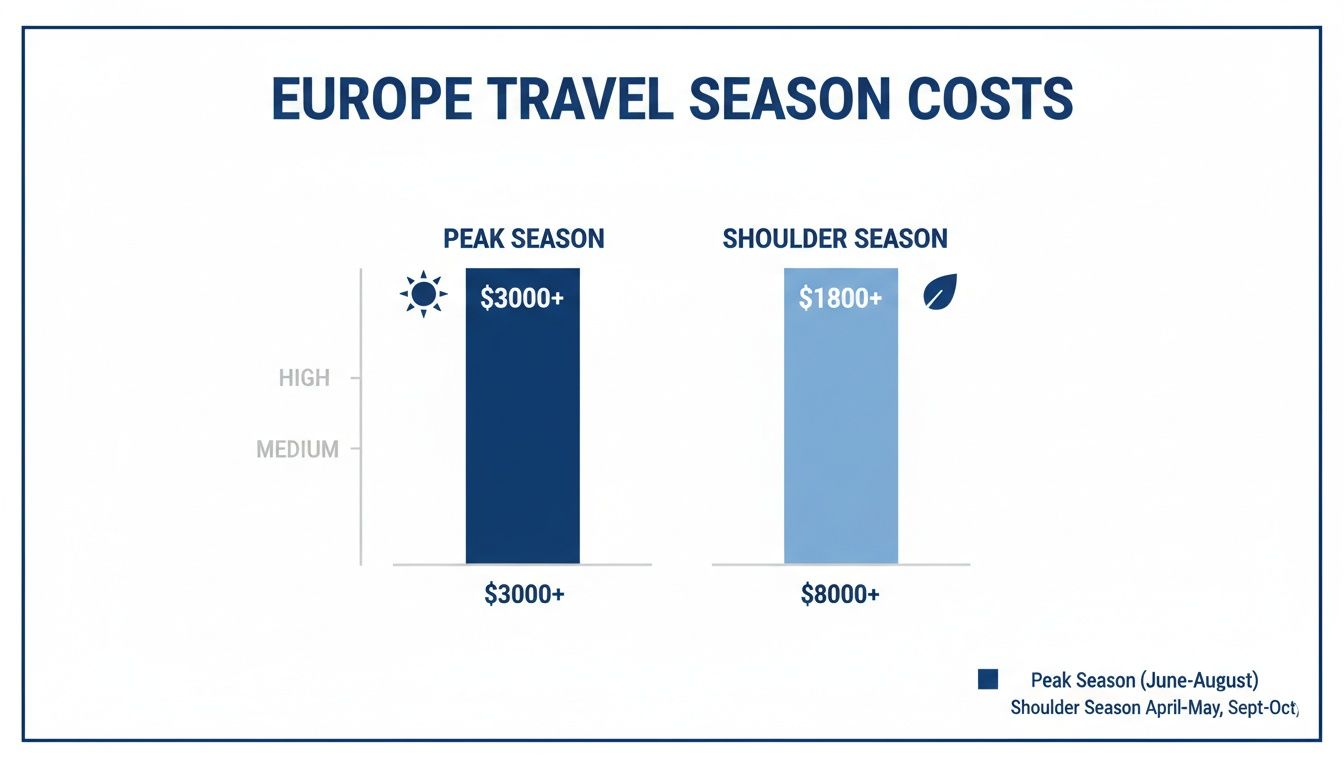
As you can see, simply shifting your trip to the shoulder season can save you over $1,000 USD. That frees up a lot of cash for train tickets and actual experiences.
A quick tip: to manage all this on the move, staying connected is a must. An eSIM from a provider like Airalo or Yesim lets you book tickets and navigate without getting hit by outrageous roaming fees. By building a flexible, multi-modal transport plan, you can craft the perfect low-cost European adventure.
H3 European Transport Cost and Impact Comparison
To put things in perspective, let’s compare the real-world trade-offs between different transport modes. This table breaks down the typical costs, times, and carbon impact for a sample 500-mile (approx. 800 km) journey in Europe.
| Transport Mode | Average Cost (USD) | Typical Travel Time | Carbon Footprint (Approx.) | Best For |
|---|---|---|---|---|
| Train | $60 – $150 | 5 – 8 hours | Low | City-center convenience, scenic routes, comfort, and low-stress travel. |
| Bus | $25 – $60 | 9 – 12 hours | Very Low | Ultra-budget travel, shorter routes, and regions with poor rail coverage. |
| Budget Flight | $40 – $120+ | 6 – 9 hours* | High | Very long distances where no practical rail alternative exists. |
*Travel time for flights includes getting to/from airports, security, and boarding.
As the comparison shows, trains consistently hit the sweet spot of cost, comfort, and efficiency. While buses are the cheapest, they come with a significant time penalty. And budget flights, once you add in all the extra time and fees, often end up being neither the fastest nor the cheapest option for all but the longest cross-continent hauls.
How to Find Affordable and Sustainable Stays
Your choice of accommodation can single-handedly make or break your travel budget. Honestly, figuring out the cheapest way to visit Europe often just comes down to where you sleep each night. While hostels are the classic backpacker go-to, thinking beyond the dorm room can unlock incredible value, way more comfort, and a more authentic feel for a place.
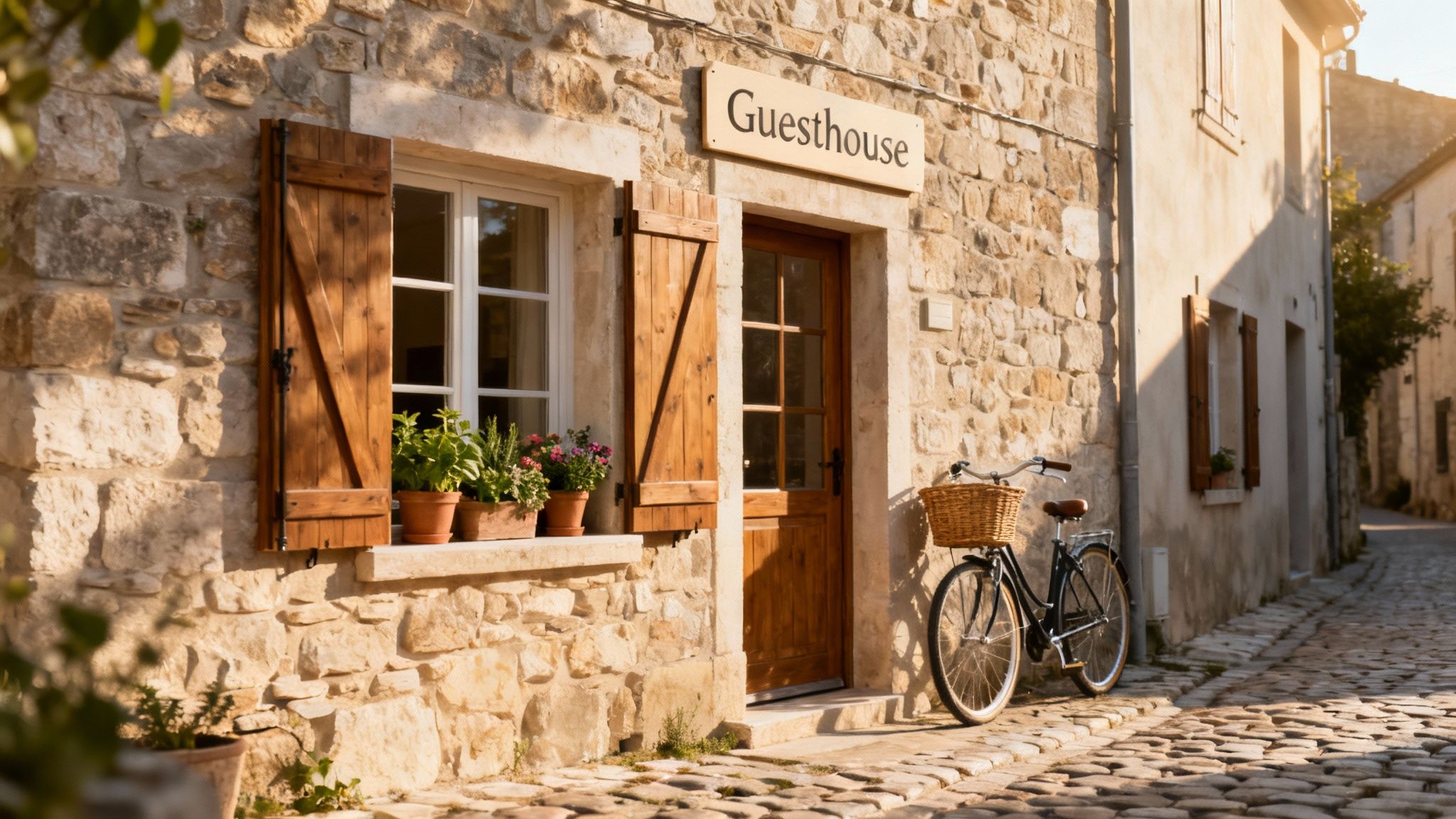
I’ve found that locally-owned guesthouses, longer-term apartment rentals, and rural ‘agriturismos’ (farm stays) almost always offer better bang for your buck. You get more space, private amenities, and the money you spend goes straight into the local economy, supporting the community you’re visiting. A private room in a Balkan guesthouse, for example, can be as little as $50 USD a night—a quiet, personal alternative to a packed city-center hostel. This is where a little strategic planning pays off big time.
Embrace the Walkable Base City Strategy
One of my favorite tricks for an affordable trip is to set up a “walkable base city.” Instead of hopping between expensive capitals every couple of days, you pick an affordable, well-connected hub and just settle in for a week or more. Think cities like Lisbon, Prague, or Budapest.
From your home base, you can take easy and cheap day trips to surrounding towns and attractions using regional rail. This approach has some serious advantages:
- Deeper Savings: You can often negotiate a better rate for a longer stay, especially with apartment rentals.
- Reduced Transit Stress: You unpack once. No more constant lugging of bags.
- Local Immersion: Staying longer means you discover the neighborhood cafes, the local markets, and the daily rhythms you’d completely miss otherwise.
It transforms your trip from a frantic checklist into a much more relaxed, immersive experience. You get to live somewhere for a bit, not just visit.
Why Staying Just Outside the Center Pays Off
It’s tempting to book a room right next to the main square, but that convenience always comes with a premium. I’ve found that by staying just one or two neighborhoods away from the tourist core, you can find prices that are 20-40% lower for comparable—or even better—accommodation.
Look for places in residential areas with great public transport links. Not only will you save a chunk of change, but you’ll also eat where the locals eat and get a much more genuine feel for the city. A 15-minute metro or tram ride can make a world of difference to your budget and your entire experience.
How to Find Genuinely Sustainable Stays
Beyond just cost, choosing your lodging is a chance to travel more responsibly. Supporting accommodations with credible green certifications ensures your money benefits the local community and environment. Look for certifications from recognized bodies, as these signal a real commitment to practices like energy efficiency, waste reduction, and fair labor.
Sustainable buildings can lead to significant operational cost savings. For instance, green building retrofits have been shown to generate an average of 15% in operational savings over five years, a benefit that can be passed on to guests through more competitive pricing.
To help with your search, we’ve put together a comprehensive guide on what to look for. You can learn more about finding and vetting eco-friendly lodging in our detailed article. This ensures your affordable trip is also a responsible one.
Editor’s Pick: Our Top Walkable Base City
For an unbeatable mix of affordability, amazing food, excellent rail connections, and stunning architecture, it’s hard to beat Lisbon, Portugal. Stay in a neighborhood like Graça or Alfama, just outside the main tourist drag, to find charming, budget-friendly apartments. From here, you can take easy day trips to Sintra, Cascais, and Évora, making it the perfect hub for exploring central Portugal without constantly changing hotels.
Smart Spending Habits for Daily Savings
Mastering your day-to-day spending is a huge part of pulling off the cheapest way to visit Europe. It’s not about pinching every penny until you can’t enjoy yourself. Instead, it’s about making small, smart choices on things like food, banking, and packing that free up cash for the experiences you actually care about.
These habits won’t make you feel like you’re missing out; they’ll actually connect you more deeply with local life.
One of the biggest budget killers is food, but it absolutely doesn’t have to be. Instead of defaulting to tourist-trap restaurants for every meal, you can eat incredibly well and save a ton by embracing the local rhythm. Start your day at a neighborhood market. The sights and sounds are an experience in themselves, and you can stock up on fresh bread, local cheese, and fruit for a fraction of what a café breakfast would cost.
For lunch, hunt down authentic street food. In places like the Balkans, a delicious burek (a savory pastry) or ćevapi (grilled meat) will only set you back a few dollars and gives you a true taste of the region. This simple habit of eating locally and affordably can easily save you $30-$50 USD per day.
Avoiding Hidden Fees and Unnecessary Costs
Beyond food, a few key preparations can shield your budget from those annoying surprise charges. Hidden fees from banks and airlines are common pitfalls for travelers, but with a bit of planning, they are entirely avoidable.
- Smarter Banking: Before you go, grab a travel-friendly bank card that has no foreign transaction fees and, ideally, reimburses ATM charges. Those fees can be $5 USD or more per withdrawal, which adds up fast.
- Stay Connected for Less: Ditch the expensive international roaming plans from your home carrier. Seriously. Use an eSIM from a provider like Airalo instead. You can get a regional data plan for Europe for as little as $5-$10 USD and stay connected for maps, bookings, and messaging.
- Travel Insurance: Never, ever travel without it. An unexpected medical issue or trip cancellation can be financially devastating. A reliable policy from a provider like VisitorsCoverage gives you essential protection for a small upfront cost. For more ideas, explore our other budget travel tips to safeguard your savings.
The Power of Packing Light
Packing light is more than a convenience; it’s a core budget strategy. Sticking to a single carry-on backpack forces you to be intentional about what you bring, cutting out the clutter and weight. This not only saves you from airline baggage fees but also makes navigating train stations and cobblestone streets infinitely easier.
Budget bus services have also transformed affordable European travel, with FlixBus leading the charge with fares as low as €5 EUR one-way. This has opened up overland travel for even the tightest budgets. For those on a rail-first journey, these buses are perfect for bridging gaps between train hubs, letting you create a cost-effective, multi-modal itinerary. You can discover more insights about budget European travel on happytowander.com.
The Short Version: Your Budget Europe Checklist
Think of this as the final check-in before you start booking anything. If you’re short on time, these are the core strategies that make the biggest difference in keeping your European trip affordable and low-impact.
These points distill everything we’ve covered into a simple, scannable list. They’re the habits that separate a stressful, overpriced trip from a relaxed, budget-friendly adventure.
Your Final Budget Travel Checklist
Go in the Shoulder Season: This is the single biggest money-saver. Plan your trip for April-May or September-October. You’ll find dramatically lower prices on flights and accommodation—often saving 30-50% compared to the summer peak—and enjoy the cities with fewer crowds.
Use Overnight Trains for Long Hauls: Sleeper trains are a game-changer for moving between major hubs. You’re combining your transport and a night’s accommodation into one ticket, which saves you both money and a full day of travel time.
Settle Into a Walkable Base City: Instead of constantly packing and moving, pick an affordable hub like Lisbon or Prague and stay for a week. Use cheap regional trains for day trips to explore the area. It’s less stressful and much cheaper than a series of one-night stays.
Eat Where the Locals Eat: Skip the tourist traps. Your daily food costs will drop dramatically if you shop at local markets, grab street food, and pack a lunch for your day trips. It’s the easiest budget win of the day.
Pack Light, Connect Smart: Stick to a single carry-on backpack. This lets you avoid expensive checked bag fees, especially on budget airlines. For your phone, grab an affordable eSIM from a provider like Airalo to dodge outrageous international roaming charges.
Your Top Questions About Budget Europe Travel, Answered
Alright, let’s wrap this up by tackling some of the questions that come up time and time again when planning a low-cost Europe trip. Think of this as the final checklist to iron out any lingering details.
Many travelers get stuck on what a realistic daily budget for Europe even looks like. The truth is, it’s all over the map—the continent has a massive range of price points.
What’s a Realistic Daily Budget for Europe?
Your money will stretch a whole lot further in some regions than others. Here’s a rough guide to help you get your bearings:
- Eastern & Central Europe (Poland, Hungary, Czech Republic): You can travel pretty comfortably on $50–$75 USD a day. That covers a dorm bed, local food, public transport, and a few activities without much stress.
- Western Europe (Spain, Portugal, Italy): Plan for about $75–$125 USD per day. You’re covering the same ground—accommodation, food, transit—but the higher cost of living in these countries just means your daily burn rate will be a bit higher.
Is a Eurail Pass Actually Cheaper?
This is a classic. A Eurail pass offers incredible freedom, but it’s not always the bargain it seems.
It really only pays off for travelers planning a whirlwind of long-distance, high-speed train journeys in a short amount of time. The breakeven point is usually around four to five long train rides.
For slower itineraries with shorter, more regional trips, buying individual point-to-point tickets well in advance is almost always the more affordable route. Always map out your ideal journey and compare the total cost of individual tickets against the price of a pass before you buy.
What Are the Best Apps for Budget Travel in Europe?
Having the right tools on your phone can save you a surprising amount of cash and headaches. Here are our go-to apps:
- Transport: Omio and Trainline are fantastic for comparing train and bus tickets in one place. The FlixBus app is a must for booking their ultra-cheap bus routes directly.
- Accommodation: Hostelworld is non-negotiable for finding budget dorms and private rooms. Booking.com can also be a goldmine for great deals on locally-owned guesthouses.
- Navigation: Citymapper gives you brilliant real-time public transit directions in major cities. And Maps.me is a lifesaver with its offline maps, letting you find your way around without burning through your mobile data.
How Can I Avoid High Currency Exchange Fees?
Bank and currency exchange fees can silently eat away at your travel fund. The single best way to sidestep them is by using a travel-friendly debit or credit card that charges zero foreign transaction fees.
Before you leave, look into opening an account with a bank known for good international terms.
Here’s another crucial tip: when you’re at an ATM, it will often offer to convert the currency for you. Always decline this offer. Let your own bank handle the conversion; you’ll get a much, much better rate. An airport transfer service like Welcome Pickups can also help you sidestep overpriced taxis right after you land.
Key Takeaways
- Travel in the Shoulder Season: The single most effective way to save is by traveling in April-May or September-October, which can cut flight and lodging costs by 30-50%.
- Prioritize a Rail-First Strategy: Use Europe’s efficient train network for city-center convenience, and book overnight trains for long distances to combine transport and accommodation costs.
- Adopt the Base City Method: Choose an affordable hub like Lisbon or Prague, stay for a week, and take day trips via regional rail to save money and reduce stress.
- Eat and Stay Local: Avoid tourist traps by eating at local markets and staying in guesthouses just outside the main city center to significantly lower daily expenses.
- Pack Light and Bank Smart: Stick to a carry-on to avoid baggage fees and use a travel-friendly bank card with no foreign transaction fees to prevent hidden costs.
- Stay Connected for Less: Use an eSIM from a provider like Airalo to get affordable data and avoid expensive international roaming charges.
This article was fact-checked using sustainability data from the World Green Building Council, the Global Ecotourism Network, and peer-reviewed architecture studies. All partner links are vetted for compliance with sustainable business certifications.
Your Top Questions About the Cheapest Way to Visit Europe
Organized answers to help you plan a budget-friendly, rail-first Europe trip with fewer fees, fewer crowds, and more real travel.
Planning and Timing (Where Big Savings Come From)
What is the cheapest way to visit Europe for the first time?
The cheapest way to visit Europe is to go in the shoulder season (April–May or September–October), fly into one well-connected hub, and move by train or bus. This lowers flight and lodging costs and prevents “moving too fast” expenses.
What month is the cheapest to visit Europe?
April and October are usually among the cheapest months because prices drop after peak summer, while weather stays comfortable for walking-heavy city travel.
What’s the cheapest way to visit Europe for 2 weeks?
Use the “base city” strategy. Pick 2–3 affordable hubs, stay longer in each, and use regional trains for day trips. Fewer hotel check-ins = fewer surprise costs.
Should I choose one base city or move around every few days?
Staying longer in one place is almost always cheaper. Weekly rates can be lower, and you avoid frequent transit days that quietly stack up costs.
What’s the biggest mistake that makes Europe more expensive?
Peak-summer travel + rushing through too many cities. Shoulder season, slower pacing, and rail-first routes are the simplest recipe for keeping your trip affordable.
Transport and Rail Strategy (How to Move Cheaply)
Is Europe cheaper if I travel by train instead of flying?
Often yes. Trains skip airport transfer costs, baggage fees, and wasted time. You also arrive in the city center, which saves money and lowers stress.
Are night trains really a budget hack for Europe?
Yes—night trains combine transport and a night of accommodation in one ticket. Booking ahead can replace a hostel or hotel night and give you an extra full day.
Is a Eurail pass actually cheaper than point-to-point tickets?
It depends on speed and distance. A Eurail pass can be worth it for several long-distance trips in a short time. For slower itineraries, advance point-to-point tickets often win.
How far in advance should I book trains to save money?
6–12 weeks ahead is the sweet spot for the best fares on popular routes. Sleeper trains and weekend travel sell out fastest.
Are buses cheaper than trains in Europe?
Usually yes. Buses can be the lowest-cost option, especially for shorter routes or areas with weaker rail coverage. The trade-off is longer travel time.
When do budget flights make sense in Europe?
For very long distances where rail is impractical. Always compare total cost after baggage fees and airport transfers before calling it “cheap.”
Budget Destinations and Daily Costs (Where Your Money Goes Further)
What are the cheapest countries in Europe to visit?
Central and Eastern Europe is often the best value—places like Poland, Hungary, and the Czech Republic deliver big experiences with lower daily costs.
How much money do I need per day for a budget Europe trip?
$50–$75/day can be realistic in Central/Eastern Europe. In many Western European spots, a comfortable budget is often $75–$125/day, depending on your lodging and food choices.
Accommodation (How to Sleep Cheap Without Sacrificing Comfort)
Is it cheaper to stay outside the city center in Europe?
Yes—staying 1–2 neighborhoods outside the tourist core can cut costs by 20–40%. Look for areas with strong metro or tram lines to keep it convenient.
What is the cheapest accommodation option in Europe?
Hostels, guesthouses, and budget apartments are usually best. Apartments can be the cheapest long-term option if you stay a week and cook a few meals.
Food and Everyday Spending (Daily Habits That Save the Most)
How can I eat cheap in Europe without missing out?
Markets + street food + simple lunches. You’ll eat like a local and avoid tourist pricing. One market run can cover breakfast and snacks for a full day.
How do I avoid foreign transaction fees and bad exchange rates?
Use a card with zero foreign transaction fees and decline dynamic currency conversion at ATMs. Let your bank do the conversion for a better rate.
Is packing carry-on only really worth it for Europe?
Yes. Carry-on travel avoids airline baggage fees and makes train stations and transfers easier—especially on fast-paced travel days.
Apps and Connectivity (Tools That Keep Your Budget on Track)
What are the best budget travel apps for Europe?
Trainline/Omio for routes, Hostelworld/Booking.com for stays, and Citymapper for transit. Offline maps help you navigate while saving data.
How can I stay connected in Europe without expensive roaming?
An eSIM plan is usually the cheapest option. It keeps you online for maps, bookings, and communication without roaming charges.
