
When you think of Costa Rica and ecotourism, it’s impossible to separate the two. This guide explores how this small country became a giant on the world stage. It figured out how to weave its jaw-dropping biodiversity into its national identity and economy. It’s the kind of place travelers seek out when they want their trip to mean something. Travelers can support real conservation and help communities thrive. This guide gets into the nuts and bolts of how to do just that.
Why Costa Rica Is a Model for Ecotourism
For decades, Costa Rica has essentially been a living laboratory for sustainable development. It has proven that you don’t have to choose between a healthy economy and a healthy planet. Moreover, this isn’t some recent marketing spin. It’s a core part of who they are, built on smart environmental policies and genuine cultural respect for nature. The national mantra, “Pura Vida” (pure life), isn’t just a catchy phrase. It’s a true reflection of the country’s commitment to its natural treasures.
And that commitment has paid off. Costa Rica once faced alarming deforestation rates from cattle ranching and agriculture. However, it managed to completely turn things around. Today, lush forests cover over 50% of its landmass. This is a powerful comeback story fueled by ambitious reforestation programs. It was a collective decision to protect its biological wealth.
From Policy to Paradise
Costa Rica’s success story wasn’t an accident. In fact, it’s the result of decades of deliberate, often bold, decisions. A few key moves paved the way:
- Abolishing its military in 1949: This radical step freed up massive amounts of public funds. These were redirected into education, healthcare, and, crucially, environmental conservation.
- Creating a robust National Park System: More than 25% of the entire country is now protected land. It is set aside in national parks, wildlife refuges, and biological reserves.
- Pioneering Payments for Environmental Services (PES): This brilliant program pays farmers and landowners to conserve and reforest their land. This turns conservation from a cost into a viable business.
This strategy has transformed Costa Rica’s natural assets into its economic gold. The country has built a nature-based tourism model that brings in an estimated $4.3 billion USD annually from international visitors. That money doesn’t just disappear. Instead, it directly supports wildlife protection, funds local communities, and creates a powerful feedback loop. Tourism helps preserve the very ecosystems travelers come to see. You can dig deeper into how indigenous startups are shaping the future of ecotourism in similar models.
The government’s role here is central. Agencies like SINAC (the National System of Conservation Areas) are the official stewards of the country’s protected wildlands.
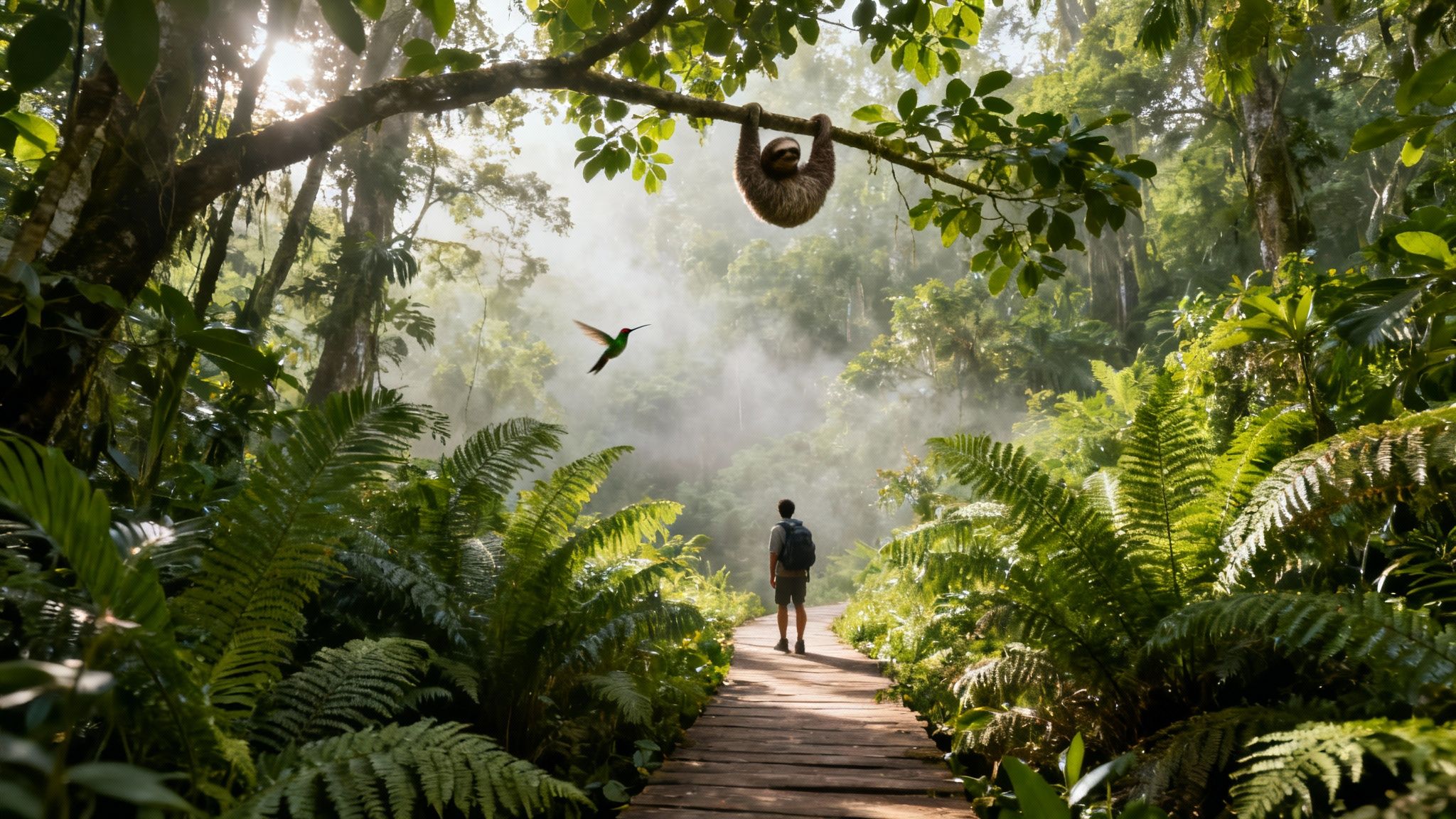
This government portal isn’t just a website. It’s a signal to visitors that their park entrance fees are part of a well-organized national effort. It shows a level of systematic, top-down commitment to conservation. You just don’t see this in many other places.
Understanding the Pura Vida Philosophy in Costa Rica and Ecotourism
To really get a handle on Costa Rica and ecotourism, you have to look past government policy. You must tap into the nation’s cultural soul. The guiding principle here is “Pura Vida,” a phrase you’ll hear everywhere. It translates to “pure life,” but it’s so much more than a greeting. It’s a deeply ingrained mindset of optimism, simplicity, and profound respect for nature.
This philosophy is the cultural bedrock on which the country built its entire green identity.
It wasn’t always this way. Back in the mid-20th century, Costa Rica was facing some of the highest deforestation rates in the world. Huge stretches of jungle were being cleared for cattle ranching and agriculture. This scarred the landscape at an alarming rate. But instead of continuing down that destructive path, the nation made a conscious pivot. It chose to see its biodiversity not as an obstacle to progress, but as its greatest asset.
This transformation started with a few bold, foundational decisions. Most famously, the country abolished its army in 1949. This move reallocated national funds toward education, healthcare, and, critically, environmental protection. Investing in its people and planet laid the groundwork for everything that followed. Consequently, it fostered a society that genuinely valued conservation.
From Philosophy to Actionable Policy
That Pura Vida mindset eventually grew into concrete, world-leading environmental strategies. In the 1970s, the government established its National Park System. This network has now expanded to protect over 25% of the country’s land. This was a clear declaration. Costa Rica’s natural heritage was priceless and worth preserving for generations to come.
Then came one of its most celebrated innovations: the Payments for Environmental Services (PES) program, launched in 1997.
This groundbreaking system pays farmers and landowners to protect and reforest their land. It effectively turns conservation into a profitable business, creating a powerful economic incentive for individuals to become stewards of the environment.
The program, funded in part by a tax on fossil fuels, directly links the economy to the health of the ecosystem. It’s been instrumental in helping Costa Rica double its forest cover in just a few decades. This is a truly remarkable environmental comeback story. As a traveler, your journey here supports this long-standing commitment. Ready to start planning? You can compare options and find the best flights for your trip.
The Economic Power of Green Thinking
The result of this cultural and political shift is a thriving ecotourism sector. It serves as a global model. By safeguarding its natural wonders, Costa Rica created a powerful draw for international visitors. Today, your decision to visit a national park or stay in an eco-lodge directly contributes to a system designed for sustainability.
It’s a win-win scenario. Tourism dollars fund the very conservation efforts that make the country so special.
Protecting your trip is just as important. Services like VisitorsCoverage travel insurance ensure you’re prepared for the unexpected. This allows you to focus on the incredible experiences ahead. Understanding this history is crucial because it shows that Costa Rican ecotourism isn’t some new trend. It’s the result of a genuine, decades-long national project. For a deeper look into the country’s green initiatives, you can learn more about Costa Rica’s sustainable tourism framework in our detailed guide.
Planning Your Sustainable Costa Rican Adventure
Turning the Pura Vida philosophy into a real travel plan is where the real work begins. This is what separates a genuinely sustainable trip from a standard one. Thoughtful planning ensures your visit actually supports the country’s deep conservation roots. Making conscious choices about how you get around, where you sleep, and what you do is central to experiencing Costa Rica and ecotourism authentically.
This means looking past the flashy brochures and digging into the details. For instance, instead of renting a private 4×4 for your entire trip, why not use Costa Rica’s excellent network of shared shuttles? It’s a small change that cuts emissions and often gives you a more relaxed way to see the country.
Staying connected is a modern travel reality, but you can do it responsibly. Ditch the plastic waste from physical SIM cards and opt for an eSIM. Companies like Airalo or Yesim let you download a digital data plan straight to your phone. This keeps you online without the extra trash.
Choosing Your Transportation
Getting around Costa Rica with a light footprint is one of the most impactful decisions you’ll make. The country’s wild terrain, from volcanic highlands to coastal plains, creates unique transport challenges—and opportunities.
Your best bets for lower-impact travel include:
- Shared Shuttles: These are a fantastic middle ground between public buses and private cars. They’re comfortable, reliable, and significantly reduce the number of vehicles on the road.
- Public Buses: For the budget-conscious and adventurous, the public bus system is extensive and cheap. It’s a great way to travel like a local and shrink your environmental impact.
- Pre-Booked Transfers: For airport runs, a service like Welcome Pickups offers a smooth, organized experience. Pre-booking ensures a reliable ride and helps manage traffic at busy hubs like San José (SJO) or Liberia (LIR).
Renting a 4×4 vehicle might feel essential. However, it’s often only needed for truly remote spots. For most popular routes, a mix of shuttles and local taxis is more than enough—and much greener.
This flowchart shows the critical fork in the road Costa Rica faced. It had to choose between continuing down a path of deforestation or pivoting toward a future built on conservation.
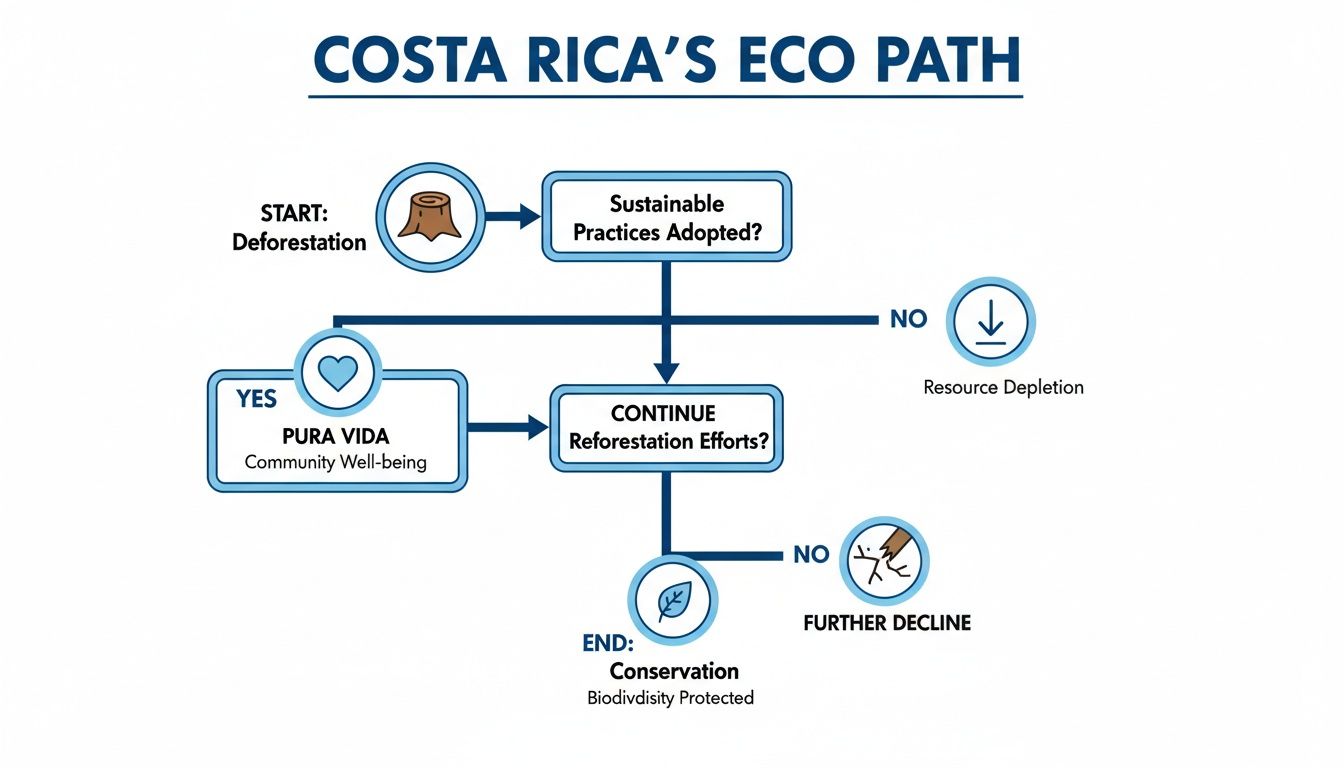
It’s clear how embracing the “Pura Vida” ethos was a conscious decision. This steered the nation toward its sustainable, conservation-first model.
Finding Genuinely Eco-Friendly Accommodations
In a country famous for its green credentials, the term “eco-lodge” gets thrown around a lot. To cut through the greenwashing, look for places certified by the Certification for Sustainable Tourism (CST). This is Costa Rica’s gold standard. It is a program from the Costa Rican Tourism Board that vets and grades businesses on their real-world sustainability practices.
The CST program evaluates businesses on a scale of 0 to 5 “leaves” across four key areas: physical-biological parameters, infrastructure and services, external clients, and socio-economic environment. A higher leaf rating signifies a deeper commitment to sustainability.
When you’re booking, don’t just fall for a pretty picture of a jungle bungalow. Dig a little deeper. Does the lodge’s website talk about its water conservation, waste management, or how it supports local employees? These details separate the truly committed from those just using a trendy label. You can learn more about what to look for in our guide on how to find truly eco-friendly lodging.
Here’s a quick breakdown to help you choose where to stay.
Choosing Your Sustainable Stay in Costa Rica
A comparison of different eco-friendly accommodation types, highlighting their typical features, price points, and ideal traveler profiles to help you make an informed choice.
| Accommodation Type | Key Features | Average Cost (USD per night) | Best For |
|---|---|---|---|
| ### Certified Eco-Lodge | CST certification, renewable energy, water conservation, community programs, guided nature tours. | $150 – $400+ | Travelers seeking deep immersion in nature with high comfort and proven sustainability practices. |
| ### Community Homestay | Living with a local family, shared meals, authentic cultural exchange, basic amenities. | $30 – $70 | Budget travelers and cultural explorers who want to directly support local families. |
| ### Boutique Eco-Hotel | Smaller scale, often locally owned, focus on sustainable design, farm-to-table dining. | $100 – $300 | Couples and digital nomads looking for style, comfort, and a lighter environmental footprint. |
| ### Glamping / Eco-Tents | Luxury tents, minimal land impact, close-to-nature feel with comfortable beds and private bathrooms. | $80 – $250 | Adventurous travelers who want to be close to the wild without sacrificing comfort. |
Each option offers a different way to experience Costa Rica’s green ethos. So, pick the one that best matches your travel style and budget.
Selecting Ethical and Impactful Activities
The final piece of your sustainable planning puzzle is choosing activities. These should honor Costa Rica’s wildlife and communities. The goal is to make sure your adventures give back to the local ecosystem and economy.
Here are a few ground rules for picking ethical tours:
- Prioritize Observation, Not Interaction: A reputable wildlife tour will never let you touch, feed, or hold wild animals. Good guides are experts at spotting wildlife from a respectful distance. They use tools like binoculars and spotting scopes.
- Support Community-Run Projects: Look for tours and activities run by local cooperatives or indigenous communities. This ensures your money directly supports the people who are the true stewards of the land.
- Ask About Guide Certification: In Costa Rica, official tour guides are certified by the ICT (Costa Rican Tourism Institute). Certified guides are trained in biology, conservation, and safety. This provides a much richer and more responsible experience.
By carefully considering your transport, lodging, and activities, you can build an itinerary. It will truly embrace the spirit of Costa Rica and ecotourism, leaving a positive mark long after you head home.
Embracing Regenerative Travel in Costa Rica
The whole idea of Costa Rica and ecotourism is getting a serious upgrade. For years, the goal was sustainability—basically, doing no harm. But a more ambitious idea is taking hold now: regenerative travel.
This isn’t just about preserving what’s already there. It’s about actively healing and improving local environments and communities. The new goal is to leave a place better than you found it.
Think of it as the next chapter in Costa Rica’s green story. It’s no longer enough to protect the rainforests. Instead, the focus is shifting to rebuilding them. For you, the traveler, this means your visit can be a direct force for good. You can put money and even your own time into projects that restore ecosystems for the long haul.
It’s a powerful economic model, too. More and more travelers are happy to pay for experiences that deliver a genuine, positive impact. This creates a whole new market for a different kind of luxury.
How Regenerative Travel Works in Practice
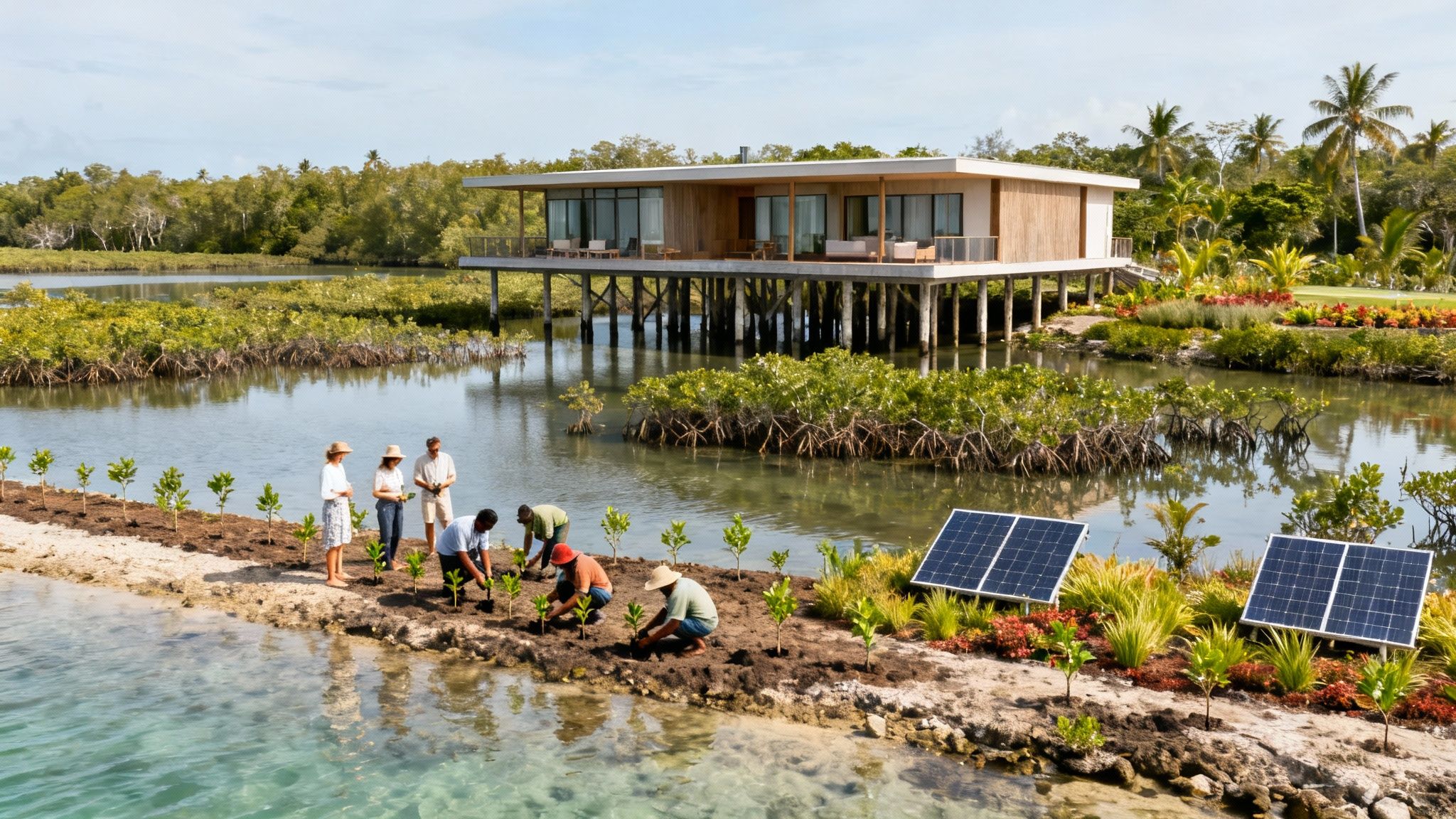
So, what does this actually look like on the ground? It’s about connecting your travel dollars to real, tangible results. Instead of just staying in a lodge that happens to use solar panels, you might stay at one that funnels its profits into funding a local scarlet macaw breeding program or a sea turtle hatchery.
These aren’t fuzzy concepts; they are specific, measurable actions. Many of the most forward-thinking lodges and tour operators now build these regenerative activities right into the guest experience. This way, you can see exactly where your money goes. Often, you can even get your hands dirty and help out.
The Rise of High-Impact Luxury Eco-Lodges
This hands-on model has sparked a unique form of luxury travel in Costa Rica. Top-tier eco-lodges in biodiversity hotspots like the Osa and Nicoya Peninsulas are pioneering a model. High-end hospitality directly funds vital conservation work. Some of these lodges, tucked away in UNESCO Biosphere Reserves, have average daily rates topping $1,200 USD.
But this isn’t just about expensive rooms; it’s about the value you get in return. Guests are paying for exclusive access and the knowledge that their stay is underwriting projects like coral reef restoration or reforestation. Data also shows that wellness-focused tourists, who are often drawn to these experiences, stay 2.4 days longer than the average visitor. This means their economic contribution is even greater. You can find more on this in reports about Costa Rica’s high-value tourism market.
Regenerative travel redefines luxury. It shifts the focus from passive consumption to active contribution, where the ultimate luxury is knowing your presence is helping to heal a place.
For digital nomads and slow travelers, this model is a perfect fit. Longer stays allow for a much deeper connection and a more meaningful contribution. When you spend weeks or months in one place, you’re not just a tourist passing through. You become a temporary part of the local ecosystem, supporting small businesses and conservation in a much more sustained way. You can learn more about the principles behind these trips in our guide to eco-volunteering and regenerative travel.
Editor’s Pick: Regenerative Stay
Lapa Rios Lodge: Nestled in a 1,000-acre (405-hectare) private reserve on the Osa Peninsula, Lapa Rios is a prime example of regenerative travel. It was built with locally harvested materials and directly supports the local community through employment and education. Guest experiences are centered on conservation, with proceeds funding reforestation, wildlife monitoring, and community projects, offering a stay that is both luxurious and deeply impactful.
By choosing this forward-thinking approach, you can ensure your trip adds to the ongoing story of Costa Rica and ecotourism, helping this green paradise become even greener.
Sample Low-Impact Costa Rica Itineraries
Putting the principles of Costa Rica and ecotourism into practice is easier with a clear plan. So, to help you picture what a low-impact journey really looks like, I’ve designed two distinct itineraries. They are for remote workers and slow travelers. Think of these less as rigid schedules and more as frameworks for making conscious choices. These choices support local families and keep your footprint light.
The goal here is to trade a typical fly-by-night vacation for a more immersive, respectful experience. Both itineraries are built around ground transportation, locally-owned stays, and activities that feed directly back into conservation. This shows you how to blend productive work days with genuine exploration.
This is how you become a temporary part of the community, not just a visitor passing through. By staying longer and spending your money with local businesses, your trip becomes a positive force. It benefits both the local economy and the environment.

Itinerary 1: The Cloud Forest Creative Retreat
This plan is built for a 14 to 30-day stay based in the Monteverde region. It’s perfect for deep work, creative projects, and settling into a slower rhythm. It’s a completely car-free plan that leans on Costa Rica’s excellent shared shuttle system and local taxis.
- Getting There: From San José (SJO) or Liberia (LIR) airport, book a shared shuttle straight to Santa Elena, Monteverde’s main town. It usually runs about $50–$60 USD (approximately ₡26,000–₡31,000 CRC) per person. It is a far lower-carbon choice than a private rental car.
- Where to Stay: Settle into a long-stay cabin or apartment at a certified eco-lodge. Look for places that offer weekly rates and, crucially, strong Wi-Fi. Booking platforms like Trip.com often have filters to help you find sustainable properties.
- Work-Friendly Spots: Many local cafes in Santa Elena, like Orchid Coffee Shop, have reliable internet. They also have a quiet vibe that’s perfect for a few hours of focused work.
- Low-Impact Activities: Spend your downtime exploring the Monteverde Cloud Forest Biological Reserve and the Santa Elena Cloud Forest Reserve. Both are easy to reach by local bus or a short taxi ride. You can also support local cooperatives by taking a guided night walk or visiting a sustainable coffee farm. For more trail ideas, check out our guide to the best hikes in Costa Rica.
Itinerary 2: The Caribbean Coast Conservation Journey
This 10 to 21-day itinerary is for anyone who wants to roll up their sleeves and actively join in conservation work. It’s centered on Tortuguero National Park. This is a remote area accessible only by boat and small plane, which makes car-free travel a built-in feature.
- Getting There: From San José, take a public bus or shared shuttle to La Pavona dock. From there, you’ll hop on a public boat for a beautiful 1.5-hour ride through the canals to Tortuguero village. This is the standard, most eco-friendly way to arrive.
- Where to Stay: Look for lodges directly involved in sea turtle conservation. Many offer volunteer packages that bundle accommodation and meals. They also include the chance to join night patrols during nesting season (July to October).
- Work & Connectivity: Be ready for limited connectivity. While some lodges offer Wi-Fi, it’s often slow. This is a trip designed for disconnecting and focusing on conservation, with just a few hours set aside for essential online tasks. An eSIM from Airalo can give you a reliable backup data connection.
- Impactful Activities: Your main activity here will be volunteering. This might mean monitoring turtle nests, cleaning beaches, or helping with biodiversity surveys. In your free time, take a guided canoe tour through the park’s canals. You can spot monkeys, caimans, and a wild number of bird species. Just make sure your tour operator is certified and follows strict rules to avoid disturbing the wildlife.
Both of these itineraries show that a real commitment to Costa Rica and ecotourism doesn’t just benefit the destination. It makes your own travel experience richer and more rewarding.
Navigating the Realities of Ecotourism in Costa Rica
While the story of Costa Rica and ecotourism is powerful, a thoughtful trip means looking honestly at the challenges. The country’s green reputation is so strong that it has attracted businesses happy to use eco-friendly marketing without doing the real work. This practice, known as greenwashing, can make it tough to tell which operators are genuinely committed.
The good news is that you, as a traveler, hold the power. Asking the right questions and looking for credible proof helps you cut through the noise. Does a lodge talk about its water recycling system? Or does it just have pictures of trees on its website? Do tour guides mention official certifications? These small details often reveal the truth.
This critical eye is more important than ever. The Costa Rican government’s National Tourism Strategy aims to boost visitor numbers. However, recent data shows international arrivals have been fluctuating. This creates a sweet spot for travelers, opening up better deals and less crowded experiences in the “shoulder seasons” (May–June and September–October). For more context, you can explore the latest trends reshaping Costa Rica’s tourism scene. This planned growth also signals future development, making it crucial for conscious travelers to stay aware of potential strain.
Spotting and Avoiding Greenwashing
Learning to recognize misleading claims is a core skill for any eco-minded traveler. Vague terms like “eco-friendly” or “green” without any proof are the biggest red flags. A truly sustainable business is proud of its efforts and is almost always transparent about them.
Here’s what to look for to ensure your money supports real conservation:
- Official Certifications: The gold standard in Costa Rica is the Certification for Sustainable Tourism (CST). Keep an eye out for the CST’s “leaf” rating on websites and marketing materials.
- Specific, Measurable Actions: Does a hotel detail its waste management program? Does a tour operator explain how it contributes to a local community project? Specifics matter far more than buzzwords.
- Local Employment: A core principle of ecotourism is supporting local communities. Ask if the staff—from guides all the way up to managers—are from the area.
By focusing on these markers of authenticity, you can confidently choose businesses that are part of the solution. If wildlife tours are on your list, our guide on responsible wildlife tourism offers more tips for selecting ethical operators.
Balancing Popularity with Preservation
The immense popularity of certain national parks, like Manuel Antonio, creates another challenge. Overcrowding and a heavy footprint can damage these areas. While these places are famous for a reason, their ecosystems are fragile. A high volume of visitors can disrupt wildlife, erode trails, and strain local resources like water and waste management.
This is where your travel choices can make a huge difference. Instead of only visiting the most famous hotspots, consider exploring lesser-known reserves and national parks. Places like Carara National Park or the Piedras Blancas National Park offer incredible biodiversity with a fraction of the crowds.
Visiting during the shoulder seasons also helps. Not only do you get a more peaceful experience, but you also help distribute the economic benefits of tourism more evenly throughout the year. Supporting these alternative destinations and travel times is a powerful way to help preserve the natural magic that defines Costa Rica and ecotourism.
Wrapping It Up: Your Ecotourism Checklist
If you want your trip to genuinely support Costa Rica’s ecotourism model, it helps to keep a few simple rules front of mind. Think of this as a quick checklist for making better choices on the ground.
Look for Certified Stays: Always prioritize hotels and lodges with the official Certification for Sustainable Tourism (CST). It’s the clearest way to sidestep greenwashing and back businesses that are truly walking the talk.
Travel Lighter on the Land: Opt for shared shuttles or public buses over a private rental car. This single choice dramatically shrinks your carbon footprint as you move between regions.
Practice Hands-Off Wildlife Viewing: Choose tour operators who maintain a strict no-contact policy with animals. They should also hire certified local guides. This ensures your awe doesn’t cause harm.
Stay Longer, Travel Slower: By slowing down and immersing yourself in one region, you cut down on travel emissions. You also contribute more meaningfully to the local economy. It’s a win-win.
Vote with Your Wallet: Whenever you can, spend your money at locally owned and operated tours, restaurants, and shops. It’s the most direct way to ensure your tourism dollars support Costa Rican communities.
Common Questions Answered
What’s the Best Time of Year for Ecotourism?
Honestly, the “best” time for Costa Rica and ecotourism comes down to what you’re looking for. The dry season, from December to April, gives you those classic sunny days. However, it also brings the biggest crowds.
If you want to see the landscape at its most vibrant and lush, with far fewer people on the trails, the “green season” from May to November is fantastic. Just be aware that September and October are the rainiest months. But they’re also the prime time to watch sea turtles nesting on the Caribbean coast.
How Much Should I Budget for an Eco-Friendly Trip?
An eco-friendly trip can fit almost any budget. For a comfortable mid-range experience, plan on $100–$150 USD (approx. ₡52,000–₡78,000 CRC) per person, per day. That’ll cover a certified eco-lodge, meals at local sodas and restaurants, shared shuttles, and national park fees.
If you’re looking for a truly special regenerative stay, luxury lodges can run over $500 USD a day. On the other end, budget travelers can absolutely get by on $40–$60 USD daily by staying in homestays, eating locally, and using the public bus system.
Is Public Transportation Safe and Reliable for Getting Around?
Yes, absolutely. Costa Rica’s public transport is generally safe and one of the most reliable ways to travel with a light footprint. The public bus network is surprisingly extensive and incredibly cheap.
For longer journeys between tourist hubs, shared shuttles are a great middle ground. They offer door-to-door service, are very safe and efficient. They are also a popular choice for travelers who want a bit more comfort than the public bus without renting a car.
Key Takeaways
- Move Beyond Sustainable: Aim for regenerative travel in Costa Rica. The goal isn’t just to preserve a place but to actively improve and heal local environments and communities.
- Vote with Your Wallet: Choose eco-lodges and tour operators that can show you exactly how they reinvest profits into tangible conservation projects like reforestation or wildlife protection.
- Embrace Longer Stays: As a digital nomad or slow traveler, your extended presence provides more consistent support for the local economy and allows for deeper engagement with community initiatives.
- Look for Hands-On Opportunities: Many regenerative lodges let guests participate in conservation activities, turning your vacation into a meaningful contribution.
- Redefine Luxury: Understand that the highest form of luxury is one that offers exclusivity while directly funding the protection of the pristine ecosystems you’ve come to enjoy.
- Use Certified Sources: This article was fact-checked using sustainability data from the World Green Building Council, the Global Ecotourism Network, and peer-reviewed architecture studies. All partner links are vetted for compliance with sustainable business certifications.
Join the Sustainable Work Movement
Want more rail-first itineraries, low-impact packing systems, and walkable base-city ideas?
Costa Rica and Ecotourism FAQs: Planning, Costs, Ethics, and Best Practices
Use these quick answers to plan a lower-impact trip, avoid greenwashing, and support real conservation and local communities.
Planning & Logistics for Costa Rica Ecotourism
1) What does “Costa Rica and ecotourism” actually mean in practice?
It means your trip is designed to protect biodiversity and strengthen local livelihoods. Practically, you choose certified stays (like CST-rated properties), ethical wildlife tours (hands-off, no feeding/handling), and spending that stays local—so your money helps conservation and communities thrive.
2) What’s the best time of year for Costa Rica ecotourism?
The dry season (Dec–Apr) is easiest for weather but busiest. The green season (May–Nov) is quieter and lush, often with better prices. Shoulder months (May–June, Sept–Oct) can be ideal if you’re flexible and prepared for rain.
3) Do I need a 4×4 for an eco-friendly Costa Rica trip?
Not usually. Many popular routes work well with shared shuttles and public buses, which are lower-impact than a private rental. A 4×4 is helpful mainly for remote areas with rough access roads—otherwise it’s often unnecessary.
4) Is public transportation safe and reliable for getting around?
Yes. Public buses are widely used and budget-friendly, and shared shuttles are a reliable comfort upgrade between regions. As with any destination, keep valuables secure and plan routes/times in daylight when possible.
5) How much should I budget for a sustainable trip in Costa Rica?
Budget travelers can often manage ~$40–$60/day using buses and simple stays. A comfortable mid-range plan is commonly ~$100–$150/day with shared shuttles, park fees, and certified eco-friendly lodging. High-end regenerative lodges can be $500+/day depending on the region and inclusions.
How long should you stay to keep your trip low-impact?
6) How long should I stay to keep my trip low-impact?
Longer stays typically lower your “transport footprint per day” and support local businesses more consistently. If you can, pick one region for 10–14+ days (or a full month for remote work), then move on slowly rather than hopping daily.
7) What are the most eco-friendly ways to get from the airport to my first base?
Shared shuttles are a great balance of comfort and footprint. Public buses are the lowest-cost and often lowest-impact option. For airport transfers, pre-booking can reduce chaos and help avoid last-minute high-emission choices like solo rides.
8) Do I need travel insurance for Costa Rica?
It’s strongly recommended—especially if you’ll do adventure activities (zip lines, hiking, water sports). Choose a plan that covers medical care, trip interruption, and activity coverage appropriate to your itinerary.
Eco-Lodges & Sustainable Stays in Costa Rica
9) How do I find a genuinely eco-friendly hotel or eco-lodge in Costa Rica?
Look for Costa Rica’s Certification for Sustainable Tourism (CST) and verify the property’s practices (water conservation, waste management, local employment, habitat protection). Real eco-stays describe specific actions, not just “green” buzzwords.
10) What CST “leaf rating” should I aim for?
Higher leaf ratings generally indicate deeper sustainability practices. Use CST as your baseline filter, then confirm the stay’s details: renewable energy, plastic reduction, local sourcing, and community programs.
11) Are boutique eco-hotels or homestays better for sustainability?
It depends on impact. Community homestays can direct money straight to local families and reduce leakage. Certified eco-hotels may have stronger infrastructure for water/energy management. The most sustainable choice is the one that’s transparent, locally rooted, and verifiably responsible.
12) How can I tell if an “eco-lodge” is greenwashing?
Red flags include vague claims (“eco,” “green,” “sustainable”) without proof, no certification, and no details on waste/water/energy. Ask: Where does the staff come from? How is wastewater handled? What happens to trash? How do they protect wildlife and habitat on-site?
13) What are simple ways to reduce waste while staying in Costa Rica?
Bring a refillable bottle, refuse single-use plastics, use reef-safe sunscreen near marine ecosystems, and choose stays that provide filtered water. Prefer eSIMs and digital tickets to reduce plastic and paper where possible.
Wildlife, Tours & Ethical Ecotourism Activities
14) What’s the #1 rule for ethical wildlife experiences in Costa Rica?
Observe—don’t interact. Avoid tours that allow touching, feeding, holding, or posing with animals. Ethical operators keep distance, minimize noise, and prioritize animal welfare over photos.
15) How do I choose an ethical tour operator or guide?
Choose certified local guides when possible, ask about group size limits, wildlife distance rules, and how the operator supports local communities. A good guide will educate you on ecosystems and behavior—without pushing animals into view.
16) Which activities are most aligned with Costa Rica and ecotourism?
National park hikes with certified guides, community-run cultural experiences, responsible snorkeling/diving (no touching coral), birding, and conservation-focused tours. Avoid attractions that depend on captive wildlife or staged interactions.
17) Is volunteering (eco-volunteering) always a good idea?
Only when it’s structured, locally led, and transparent about outcomes. The best programs have clear conservation goals, local governance, safety protocols, and measurable results—rather than “feel-good” experiences with unclear impact.
18) How can I help reduce overtourism in popular parks like Manuel Antonio?
Visit early, respect capacity rules, stay on trails, and travel in shoulder seasons. Consider rotating in lesser-visited parks and reserves so your spending supports a wider range of communities while easing pressure on hotspots.
Regenerative Travel in Costa Rica: Going Beyond “Do No Harm”
19) What’s the difference between sustainable and regenerative travel in Costa Rica?
Sustainable aims to reduce harm (lower emissions, less waste). Regenerative aims to leave a place better—funding habitat restoration, community projects, and long-term conservation outcomes that actively improve ecosystems and livelihoods.
20) How do I choose a regenerative stay or experience?
Look for proof of direct conservation investment (reforestation, wildlife monitoring, coral restoration), local hiring and training, and transparent reporting. The best operators can clearly explain where guest revenue goes and what it changes.
21) Do longer stays really help local communities more?
Usually, yes. Longer stays reduce constant transportation emissions and spread spending into daily life—local meals, services, guides, and small shops—rather than concentrating value in one-time tours or chain-style experiences.
22) What’s one simple itinerary rule to keep your footprint lighter?
Pick one base region, explore slowly, then move once. Fewer long transfers means fewer emissions, less stress, and a more immersive experience that aligns with Costa Rica and ecotourism principles.
