

Picture a travel pass that lets you legally live and work in another country for a year or more, all without being tied to a local company. That’s the simple idea behind a digital nomad visa, a special permit built for remote workers. This guide will walk you through everything you need to know about securing a digital nomad visa.
Think of it less like a restrictive work permit and more like a long-term guest pass to the global economy. It lets you earn your income from clients back home while you sink your teeth into a new culture.
The whole remote work shift has completely changed how we think about careers and travel. Dozens of countries have caught on and are now rolling out digital nomad visas to attract global talent.
What Is a Digital Nomad Visa and Why It Matters
This official authorization lets you stay in a country for an extended stretch—usually one to two years—while legally working for your own business or an employer based somewhere else. It neatly fills the gap between a short-term tourist visa (which strictly forbids work) and a traditional work permit (which demands a local job).
For anyone interested in sustainable, slow travel, this is a game-changer. By staying in one place longer, you slash your carbon footprint from frequent flights and get to properly immerse yourself in the local community. You contribute to the economy through your daily spending on housing, food, and activities, all while keeping your career on track. It’s a win-win: countries get skilled, higher-earning residents, and you get a legal way to live the dream.
How It Empowers Eco-Conscious Travelers
For those of us committed to low-impact travel, the digital nomad visa is more than just a piece of paper—it’s a ticket to a more intentional lifestyle. It gives you the freedom to set up a walkable home base, rely on public transport like Europe’s amazing rail networks, and support local, sustainable businesses.
Instead of sprinting through a checklist of sights, you have the time to build routines, learn a bit of the language, and connect with your new home on a much deeper level.
The real benefit of a digital nomad visa is legitimacy. It wipes out the stress of “visa runs” or the sketchy feeling of working on a tourist visa. You can just focus on your work and actually experience the place you’re in.
This shift gives you the power to make more thoughtful choices that align with your values. You can pick long-term apartments in eco-friendly buildings or prioritize destinations known for their green initiatives. For some great ideas on where to set up your next low-impact base, check out our guide on the top sustainable digital nomad destinations.
Top Countries with Digital Nomad Visas
Ready to see what’s out there? The world is opening up to remote workers faster than ever, and a digital nomad visa is no longer a rare exception. With so many countries now competing for your attention, you can afford to be picky and find a program that fits your finances and, just as importantly, your slower, low-impact travel style.
Let’s look at some of the best options, with a special eye on places that make rail-first, sustainable travel not just possible, but easy.
More than 40 countries have rolled out some version of a digital nomad visa, but Europe is without a doubt leading the pack. The latest [Digital Nomad Visa Index research](https://immigrantinvest.com/reports/digital- nomad-visa-index-2026/) puts Spain near the top of the list, mostly thanks to a low income requirement of €2,762 (about $2,950 USD) per month and a very friendly tax setup for new residents. It’s a solid, well-designed program for legally living and working from a beautiful, brilliantly connected country.
Portugal and Croatia are also strong contenders for anyone dreaming of a European base. Portugal’s popular D8 visa has a clear path to long-term residency, which is a huge plus for nomads tired of constant border hops. Meanwhile, Croatia’s one-year permit is perfect for exploring the stunning Adriatic coast at a relaxed pace. The trend is clear: countries are waking up to the value of location-independent talent.
European Hubs with Excellent Rail Access
For an eco-minded nomad, Europe is a natural fit. The train networks here are so extensive and efficient that you can genuinely explore dozens of countries without ever setting foot on a plane. A good base city makes all the difference.
Spain: A Top Choice for Sustainable Travel
Spain’s digital nomad visa really stands out for its blend of accessibility and lifestyle. It gives you a one-year stay to start, but you can renew it for up to five years, which feels much more stable than shorter-term permits.
The income threshold is quite reasonable at around $2,950 USD (€2,762) a month. But the real win is the ability to set up a home base in a walkable city like Valencia or Seville and use the high-speed AVE train system to explore the entire country. Imagine weekend trips to Madrid or Barcelona, all powered by clean, efficient rail.
Portugal: Your Gateway to Europe
Portugal’s D8 visa is another fantastic option, requiring a monthly income of about $3,540 USD (€3,280). The visa starts you with a four-month stay, during which you apply for a two-year residence permit.
This permit isn’t just for Portugal; it unlocks visa-free travel throughout the 27 countries of the Schengen Area. It’s an incredible launchpad for exploring the continent sustainably by train.
Croatia: Adriatic Beauty and Affordability
If you’re drawn to stunning coastlines and a more affordable cost of living, Croatia’s temporary residence permit for nomads is a great fit. You’ll need to show a monthly income of roughly $2,658 USD (€2,539.31) for a permit that lets you stay up to one year.
While Croatia isn’t yet part of the Schengen Area, it offers an incredible quality of life. Its location also makes it a perfect starting point for exploring the Balkans by bus and ferry. For a full breakdown of the paperwork, check out our detailed guide on where to apply for eco-nomad visas.
Comparing Top Digital Nomad Visas for Eco-Conscious Travel
To make sense of the options, it helps to see the details side-by-side. This table breaks down the key features of popular digital nomad visas, focusing on what matters most to sustainable remote workers, like income levels, visa length, and access to rail-based travel.
Visa Comparison Chart
| Country | Visa Name | Minimum Monthly Income (USD/Local) | Visa Duration & Renewal | Key Eco-Travel Perk |
|---|---|---|---|---|
| Spain | Digital Nomad Visa | $2,950 (€2,762) | 1 year, renewable up to 5 | Excellent high-speed AVE train network for national travel |
| Portugal | D8 Visa | $3,540 (€3,280) | 2-year permit, renewable | Schengen Area access for train travel across 27 countries |
| Croatia | Temporary Residence | $2,658 (€2,539) | 1 year, non-renewable | Great base for exploring the Balkans by bus and ferry |
| Japan | Digital Nomad Visa | ~$6,200 (¥10M/year) | 6 months, non-renewable | Unparalleled public transit, including the Shinkansen |
| Brazil | Digital Nomad Visa | $1,500 (or $18k savings) | 1 year, renewable for 1 | Extensive, affordable bus network for regional exploration |
As you can see, the requirements vary quite a bit, but each of these countries offers a unique advantage for nomads who prefer to travel overland and settle in for a while.
Exciting Options Beyond Europe
The digital nomad visa isn’t just a European phenomenon. Several countries across Asia and the Americas are also rolling out the welcome mat for remote workers with some really interesting programs.
Japan: A Blend of Tradition and Modernity
Japan finally launched its digital nomad visa in 2024, targeting professionals from 49 specific countries. It allows for a six-month stay but comes with a hefty income requirement of at least ¥10 million per year (around $6,200 USD).
If you meet the income bar, this visa is a dream for experiencing Japan’s incredible public transportation, rich culture, and amazing food scene. It’s a unique chance to live in one of the world’s most fascinating and efficient countries.
United Arab Emirates (Dubai): A Modern Metropolis
For anyone seeking a tax-free environment and a hyper-modern lifestyle, Dubai’s one-year renewable remote work visa is a strong contender. You’ll need to prove a monthly income of $3,500 USD.
Dubai is a major international air hub, but it’s also investing heavily in public transit, including its metro system. The visa grants you full residency and access to all local services, making for a very smooth transition. To get connected the moment you land, consider an eSIM from a provider like Airalo or Yesim.
Brazil: Vibrant Culture and Natural Wonders
Brazil offers a digital nomad visa that’s valid for one year and can be renewed for another. The income requirement is one of the most accessible out there, at just $1,500 USD per month or proof of $18,000 USD in savings.
This visa lets you truly immerse yourself in Brazil’s lively culture, from the beaches of Rio de Janeiro to the Amazon rainforest. While long-distance train travel isn’t common, the country has a fantastic and affordable bus network for exploring different regions. When booking your initial flight, a tool like Aviasales can help you find the best routes.
The Four Pillars of a Digital Nomad Visa Application
Staring at a pile of visa paperwork can feel pretty intimidating, right? Don’t worry. While every country has its own unique forms and quirks, almost every digital nomad visa application is built on the same four pillars. Once you understand these, gathering your documents becomes a much clearer, more confident process.
Think of this as your core checklist. Get these four categories of proof sorted, and you’ll be in great shape for almost any digital nomad visa you decide to go for. Let’s break down exactly what you’ll need.
Proving You Genuinely Work Remotely
First things first, you have to prove you’re actually a remote worker. This is the absolute non-negotiable part. Consulates need to see, in black and white, that your income is generated from sources outside their country.
To get this across, you’ll need some official paperwork. This could be:
- A signed employment contract that clearly states your role is remote.
- A formal letter from your employer on company letterhead, confirming your job, salary, and that you’re free to work from anywhere.
- A series of client contracts or recent invoices if you’re a freelancer, showing you have a steady pipeline of work.
- Official business registration documents if you’re the one running the show.
The goal here is simple: paint a clear and convincing picture of a stable, location-independent career.
Meeting the Minimum Income Threshold
Next up, you need to show you can support yourself without dipping into the local job market. This is where the minimum income threshold comes in. Every country sets a financial floor to make sure visa holders can contribute to the local economy and won’t become a financial strain.
These thresholds are all over the map, usually landing somewhere between $2,000 to $5,000 USD per month. Brazil, for instance, has a very manageable requirement of $1,500 a month, while Japan aims much higher at around $6,200 per month. You’ll need to hand over recent bank statements (typically the last three to six months) or tax returns to prove you consistently hit that mark. If you’re trying to find a program that fits your own numbers, our guide to eco-friendly bases for digital nomad visas in 2025 is a great place to compare your options.
Securing Proper Health and Travel Insurance
Comprehensive health coverage is another must-have. Countries need reassurance that you can handle any medical emergencies that come up during your stay, whether it’s a minor bug or a serious accident. Your standard, short-term travel insurance policy probably won’t cut it here.
You’ll need a policy that covers you in your destination country for the entire visa period. Plenty of specialized providers, like VisitorsCoverage, now offer plans specifically designed for nomads and long-term travelers. Make sure you have proof of this coverage ready to include with your application.
Providing a Clean Criminal Record
Finally, just about every country will ask for a clean criminal record check. This is a standard security step to ensure applicants don’t pose a safety risk. You’ll typically need to get an official background check from your home country, as well as any other country where you’ve lived for a significant amount of time (usually more than six months) in the last five or ten years.
This document needs to be fresh—often issued within the last three months—and might also require an official translation or an apostille to be considered valid, so be sure to check the fine print.
Navigating Taxes and Residency as a Global Citizen
Let’s be honest: figuring out taxes is one of the most tangled parts of the digital nomad life. It can feel overwhelming, but a little bit of knowledge here goes a long way in saving you from major headaches—and a lot of money. Get this right, and you can enjoy your travels without that nagging financial worry in the back of your mind.
The single most important concept to wrap your head around is tax residency. This is what determines which country gets to tax your income. It has nothing to do with your citizenship and everything to do with where you physically spend your time.
Most countries lean on the 183-day rule to figure this out. If you stay in one place for more than 183 days (that’s about six months) in a single year, you’ll likely be flagged as a tax resident. This could mean owing local income tax on your entire global earnings—a scenario most nomads work hard to avoid.

Understanding Your Tax Scenarios
The good news? You almost certainly won’t face double taxation, where two different countries tax you on the exact same income. Most nations have tax treaties in place that spell out exactly who gets taxing rights. Still, making sense of these agreements isn’t a DIY job; it calls for careful planning and, usually, some expert advice.
A growing number of countries are rolling out the red carpet with special tax deals to attract remote workers. The global digital nomad population has ballooned to over 40 million people, and these financial perks are a big reason why. While zero-tax spots like the UAE get a lot of attention, keep an eye on places like Spain. Their “Beckham Law” can potentially drop the tax on foreign income to 0% for five years for nomads who qualify.
Staying Compliant and Financially Savvy
Here’s the most crucial step you can take: talk to a tax professional who specializes in expat and digital nomad finances. They can give you advice that’s actually relevant to your citizenship, income, and travel plans. Trying to figure this out on your own is a recipe for expensive mistakes.
Beyond getting professional help, your best defense is meticulous record-keeping.
- Track Your Days: Keep a simple, running log of every single day you spend in each country. This is your proof you haven’t accidentally crossed the 183-day threshold.
- Organize Documents: Have a dedicated digital folder for your income statements, business expenses, and any letters or emails related to taxes.
- Understand Local Rules: Before you commit to a long stay, do a quick search on the specific tax rules for that country. Forewarned is forearmed.
Staying on top of your finances is what makes this lifestyle sustainable in the long run. For a deeper dive into financial planning and location ideas, check out our guide on the best countries for remote workers.
Your Step-by-Step Digital Nomad Visa Application Checklist
Applying for a digital nomad visa can feel like staring up at a mountain of paperwork. But like any big journey, you tackle it one step at a time. Breaking the process down into a clear timeline makes it feel far less intimidating and much more achievable.
The real key? Give yourself plenty of time. Rushing is a recipe for mistakes, missed deadlines, and a whole lot of unnecessary stress. A steady, well-paced approach means you’ll have every single document in perfect order, ready for its moment with the consulate.
Let’s walk through it, phase by phase, and turn this complex project into a straightforward plan.
Phase 1: The Foundation (3–6 Months Before Applying)
This early stage is all about research, planning, and getting your financial house in order. Think of it as laying the groundwork. These steps will set you up for a much smoother application process down the road.
Research and Select Your Country: This is the fun part. Dive deep into the visa programs that catch your eye. Compare the income requirements, how long the visa lasts, and the local cost of living. For a low-impact travel style, pay close attention to the public transport infrastructure—especially the rail networks.
Verify Your Eligibility: Before you get too invested, carefully read the specific requirements for your top-choice country. Make sure your nationality, profession, and income level are a good fit before you spend any more time or money.
Start a Savings Plan: Most digital nomad visas require you to show consistent monthly income and sometimes a specific amount in savings. Start putting money aside now to comfortably meet that financial threshold. You’ll almost always need to provide 3–6 months of bank statements.
Gather Core Documents: Begin collecting the easy-to-get documents that don’t have an expiration date. This includes your passport (check that it has at least 12-18 months of validity left), your birth certificate, and any proof of remote work, like an employment contract or business registration papers.
Phase 2: Document Preparation (1–2 Months Before Applying)
Now it’s time to get serious about the detailed paperwork. Many of these documents have short validity periods, so timing is everything.
Obtain a Criminal Record Check: You’ll need to request a federal or national background check from your home country. This document often needs to be issued within 90 days of your application, so don’t jump the gun and get it too early.
Get Documents Translated and Apostilled: Many non-English speaking countries require official, certified translations of your documents. Some also require an Apostille, which is a special seal that authenticates documents for international use. Research these requirements and find certified services.
Secure Health Insurance: Purchase a comprehensive health insurance policy that meets the host country’s minimum coverage and is valid for the entire length of your visa. You’ll need the policy certificate for your application. A reliable option for long-term travelers is VisitorsCoverage.
Book Your Consular Appointment: Visa appointments at embassies or consulates can get booked up weeks, or even months, in advance. As soon as you have a clear timeline for gathering your documents, book that appointment.
Phase 3: The Final Push (2–4 Weeks Before Applying)
You’re in the home stretch. This final phase is all about organization and triple-checking every last detail before you hit “submit” or walk into that appointment.
Finalize Your Application Form: Carefully fill out the official visa application form. Read every question twice and double-check every entry for accuracy and completeness.
Organize and Review Your Dossier: Assemble all your documents in the exact order specified by the consulate. It’s also a good idea to make photocopies or digital scans of everything for your own records.
Book Tentative Travel: Some applications require proof of flights and accommodation. To avoid losing money if your visa is delayed, use a service like Trip.com to book refundable or flexible options.
Attend Your Appointment and Submit: With your complete, organized package in hand, it’s time for your appointment. Be ready to answer questions about your work, your finances, and why you want to move there.
For more resources to help you plan, check out our detailed guide on the essential sustainable travel tools for digital nomads.
Final Reminders for Your Digital Nomad Journey
Thinking about digital nomad visas can feel overwhelming at first, but it really just boils down to a few core ideas. Think of this as your final checklist—the essential stuff to keep in mind as you start planning your move.
The whole process is a marathon, not a sprint. This flowchart lays out the typical path: careful research, followed by patient document gathering, and finally, the application itself.
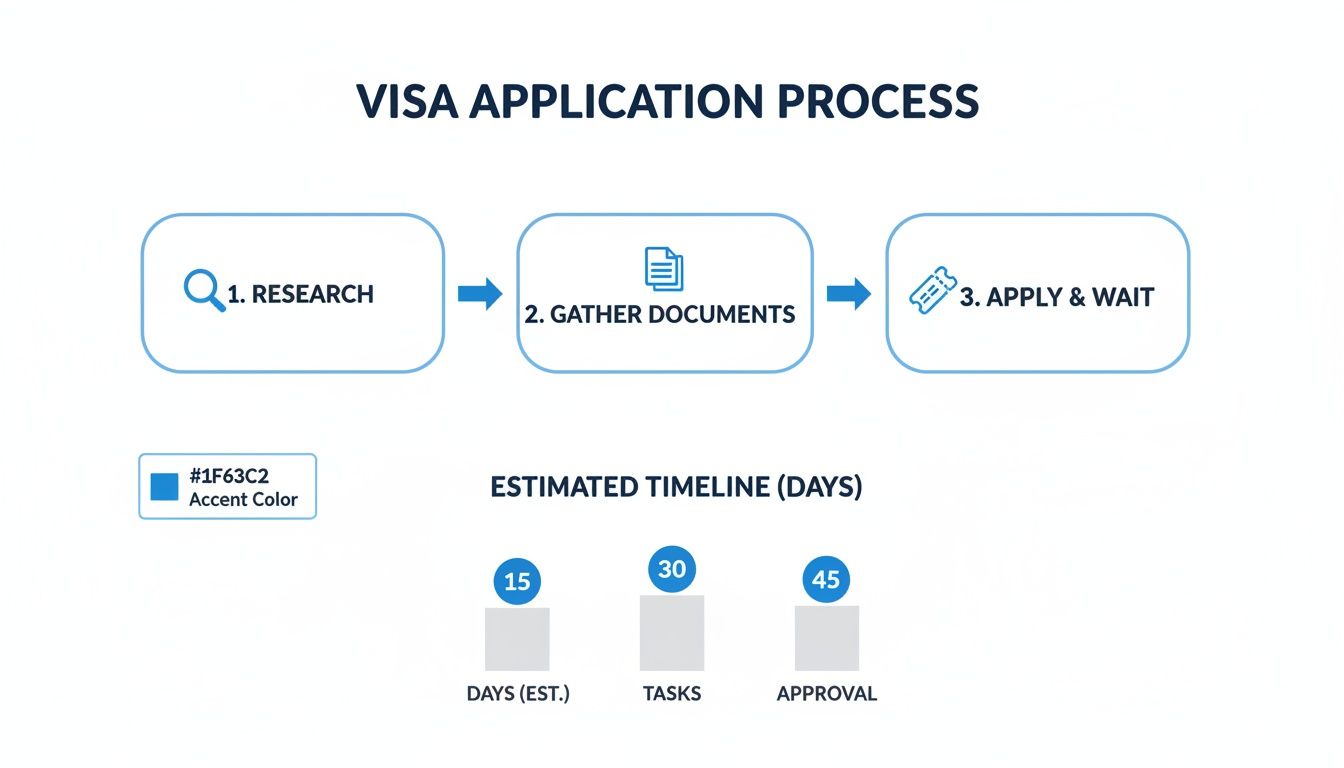
As you can see, getting this right is all about methodical prep work, not a last-minute scramble.
Here are the most important takeaways from this guide to lock in as you move forward:
Go the Legal Route: A digital nomad visa is your official green light to live and work remotely in another country. It’s the only way to avoid the stress and very real risks that come with trying to work on a tourist visa.
Proof of Income Is Everything: Every country with one of these visas has a minimum income requirement you have to meet. Be ready to show several months of bank statements or client contracts to prove you’re financially stable. This is non-negotiable.
Get Proper Health Insurance: Your standard travel insurance won’t cut it. You’ll need a comprehensive health policy that covers you fully in your new home base for the entire visa period. Long-term plans from providers like VisitorsCoverage are built for this.
Plan Your Taxes Carefully: Tax residency is usually determined by how long you stay in one place, often based on the 183-day rule. To avoid expensive surprises, talk to a tax professional who specializes in expat situations before you go.
Travel Sustainably: When choosing a base, prioritize places with great public transport, especially extensive rail networks. It’s a simple way to lower your carbon footprint and helps you connect with the country on a much deeper level.
Be Organized and Patient: This isn’t a quick process. You’ll need to be meticulous with your documents, and then you’ll have to wait. Start gathering everything early, keep it all organized, and follow the consulate’s instructions to the letter.
Common Questions About Digital Nomad Visas
The idea of a digital nomad visa is exciting, but the details can feel a little tangled. From application quirks to tax rules, it’s normal to have questions before you commit. Here, we’ll tackle the most common ones with straight, practical answers to help you plan with confidence.
Think of this as your go-to list for those “what if” moments. We’ll get into the specifics that often trip people up, giving you a much clearer picture of the journey ahead.
Can I Apply for a Visa While Already in the Country?
This comes up all the time, and the answer is: it completely depends on the country. Some nations, like Spain, are flexible and let you apply for your digital nomad visa after arriving on a tourist visa. This is a huge advantage, as it lets you get a real feel for a city before going all-in on the paperwork.
On the other hand, many countries are strict about it. They require you to apply from your home country or a place where you have legal residency. Mexico’s Temporary Resident Visa, for example, has to be secured at a consulate outside of Mexico. Always, always check the specific rules for your target destination, as this one detail can reshape your entire timeline and budget.
How Long Does the Visa Application Process Take?
Patience is a virtue, especially with visa applications. The processing time can vary wildly, from just a few weeks to several months. It’s not uncommon for applicants seeking European visas to wait three to four months for a decision.
Several things can affect this timeline: the country you’re applying to, the time of year, how busy your local consulate is, and whether your application is perfectly complete. The smartest move is to apply well ahead of when you hope to leave. And definitely hold off on booking non-refundable flights or housing until that visa is officially in your passport. Using a flexible booking site like Trip.com can give you a bit of a safety net here.
Do I Have to Pay Taxes in Two Countries?
This is the big financial question that keeps many nomads up at night. The short answer is usually no—you likely won’t be taxed on the same income twice. Most countries have what are called double taxation treaties specifically to prevent this from happening.
These agreements spell out which country gets the primary right to tax your income, which is usually determined by your tax residency status. But navigating these treaties is genuinely complex. It is strongly recommended that you talk to a tax advisor who specializes in expat and remote worker finances. They can make sure you stay compliant in both your home and host countries without any expensive surprises.
What Is the Best Travel Insurance for Digital Nomads?
Your standard travel insurance policy just won’t cut it. Those are designed for short holidays and often have clauses that void coverage if you’re working or staying long-term. For a digital nomad visa, you need something much more robust.
You should be looking for long-term international health insurance built for remote workers and expats. These plans give you proper medical coverage in your host country for the whole visa period. Companies like VisitorsCoverage offer policies that meet the strict requirements of most visa applications, covering everything from emergency care to routine check-ups. Make sure your chosen policy explicitly states it covers your destination for at least one full year.
Key Takeaways
- A Digital Nomad Visa is Your Legal Pass: This special permit allows you to legally live and work remotely in another country, avoiding the risks of working on a tourist visa.
- Income Requirements Vary Widely: Financial thresholds are a key part of every application, ranging from an accessible $1,500 USD per month in Brazil to over $6,200 USD per month in Japan.
- Europe Leads in Options: Countries like Spain and Portugal are top contenders due to reasonable requirements, excellent public transport, and access to the Schengen Area.
- Taxes Depend on Residency: Your tax obligations are typically determined by the 183-day rule. Professional tax advice is essential to avoid costly mistakes.
- Plan Ahead for Paperwork: The application process is detailed and can take months. Start early, stay organized, and always check the latest official requirements.
Editor’s Pick: Best Tool for Arrival
Navigating a new city after a long journey can be a real headache. For a seamless and reliable airport transfer, Welcome Pickups is a great service. You can pre-book a trained, English-speaking driver who meets you at the arrivals gate, helps with your bags, and offers a fixed-rate fare. It completely removes the stress of finding a taxi and ensures a calm, safe start to your long-term stay.
Join the Sustainable Work Movement
Want more rail-first itineraries, low-impact packing systems, and walkable base-city ideas?
This article was fact-checked using sustainability data from the World Green Building Council, the Global Ecotourism Network, and peer-reviewed architecture studies. All partner links are vetted for compliance with sustainable business certifications.
Digital Nomad Visa FAQ
Below are the most common questions readers ask when planning a digital nomad visa. Use these quick answers to clarify timelines, costs, taxes, and what to prepare before you apply.
Application & Eligibility
1) What is a digital nomad visa?
A digital nomad visa is a legal permit that lets you live in a country long-term while working remotely for clients or an employer based outside that country. It fills the gap between a tourist visa (no work allowed) and a local work permit (requires a local job).
2) Who qualifies for a digital nomad visa?
Most programs are designed for remote employees, freelancers, and business owners who earn income from outside the host country. You typically need proof of remote work, proof you meet the minimum income requirement, valid health insurance, and a clean criminal record.
3) Can I apply for a digital nomad visa while already in the country?
Sometimes. A few countries allow “in-country” applications after you arrive on a tourist status, while others require you to apply from your home country or where you have legal residency. Always check the rule for your destination before you book long stays.
4) How long does it take to get approved?
Processing time can range from a few weeks to a few months depending on the country, consulate workload, and whether your file is complete. If you’re aiming for a specific move date, build in a generous buffer and avoid non-refundable bookings until you’re approved.
5) What documents do I usually need?
Most digital nomad visa applications ask for: proof of remote work (employer letter/contract or client contracts/invoices), bank statements or tax returns showing stable income, health insurance covering the full stay, a background check, passport copies, photos, and the completed application form. Some countries also require certified translations and an apostille.
Money, Income Requirements & Proof
6) What is the minimum income requirement for a digital nomad visa?
It varies widely by country, but many programs fall in the $2,000–$5,000 USD per month range. Some are lower (Brazil is often cited as more accessible), while others are much higher (Japan’s requirement is notably steep). You’ll usually prove income with 3–6 months of bank statements, pay stubs, contracts, or tax returns.
7) Do I need savings as well as monthly income?
Some countries accept either steady income or
8) What counts as “proof of remote work”?
Common proof includes an employer letter on letterhead confirming you can work remotely, a signed contract stating the role is remote, recent payslips, client agreements and invoices (for freelancers), or business registration documents (for founders). The key is showing your work and income are sourced outside the host country.
Taxes, Residency & Compliance
9) Will I have to pay taxes in two countries?
Usually not on the same income twice, thanks to tax treaties and foreign tax credits. However, your real outcome depends on your citizenship, how long you stay, and the host country’s tax rules. A tax professional who works with expats can help you avoid expensive mistakes.
10) What is the 183-day rule and why does it matter?
Many countries use a version of the 183-day rule to determine tax residency. If you spend more than about six months in one country during a year, you may become a tax resident there. Track your days carefully and learn the local thresholds before you commit to long stays.
Insurance, Background Checks & Practicalities
11) What insurance do I need for a digital nomad visa?
Most countries require long-term international health insurance (not basic short-trip travel insurance) that covers you in the host country for the full visa period. The policy certificate must usually show coverage dates, territory, and minimum limits that meet the visa rules.
12) Do I need a background check or criminal record certificate?
Yes, in many cases. You’ll typically provide a recent criminal record check from your home country (and sometimes other countries you lived in). These documents often must be issued within a set window (commonly within 90 days) and may require an apostille and certified translation.
13) Can I bring my spouse or family on a digital nomad visa?
Many programs allow dependents, but requirements may increase (higher income threshold, extra insurance coverage, and additional documents). Confirm dependent rules before you apply so your financial proof and policies match the family structure.
Sustainable, Slow-Travel Planning
14) How does a digital nomad visa support low-impact travel?
It helps you stay longer in one place, which reduces the need for frequent flights and constant “visa runs.” With more time, you can choose walkable neighborhoods, rely on public transit, and spend locally in a way that’s better for communities and typically lower impact.
15) What’s the biggest mistake people make when applying?
The most common mistake is applying without a complete, well-organized document set—especially weak proof of remote work, unclear income evidence, or insurance that doesn’t meet the country’s exact requirements. Start early, follow the consulate checklist precisely, and keep copies of everything.
