


Finding genuine eco-friendly accommodations means looking far beyond a hotel’s polite request to reuse your towels. We’ve all seen those little cards. But a truly sustainable stay is a property designed, built, and operated from the ground up to minimize its environmental footprint.
It’s a holistic approach that weaves sustainability into every part of the business, from energy and water use to waste reduction and genuine community support. It’s about prioritizing the planet and local culture, not just making clever marketing claims.
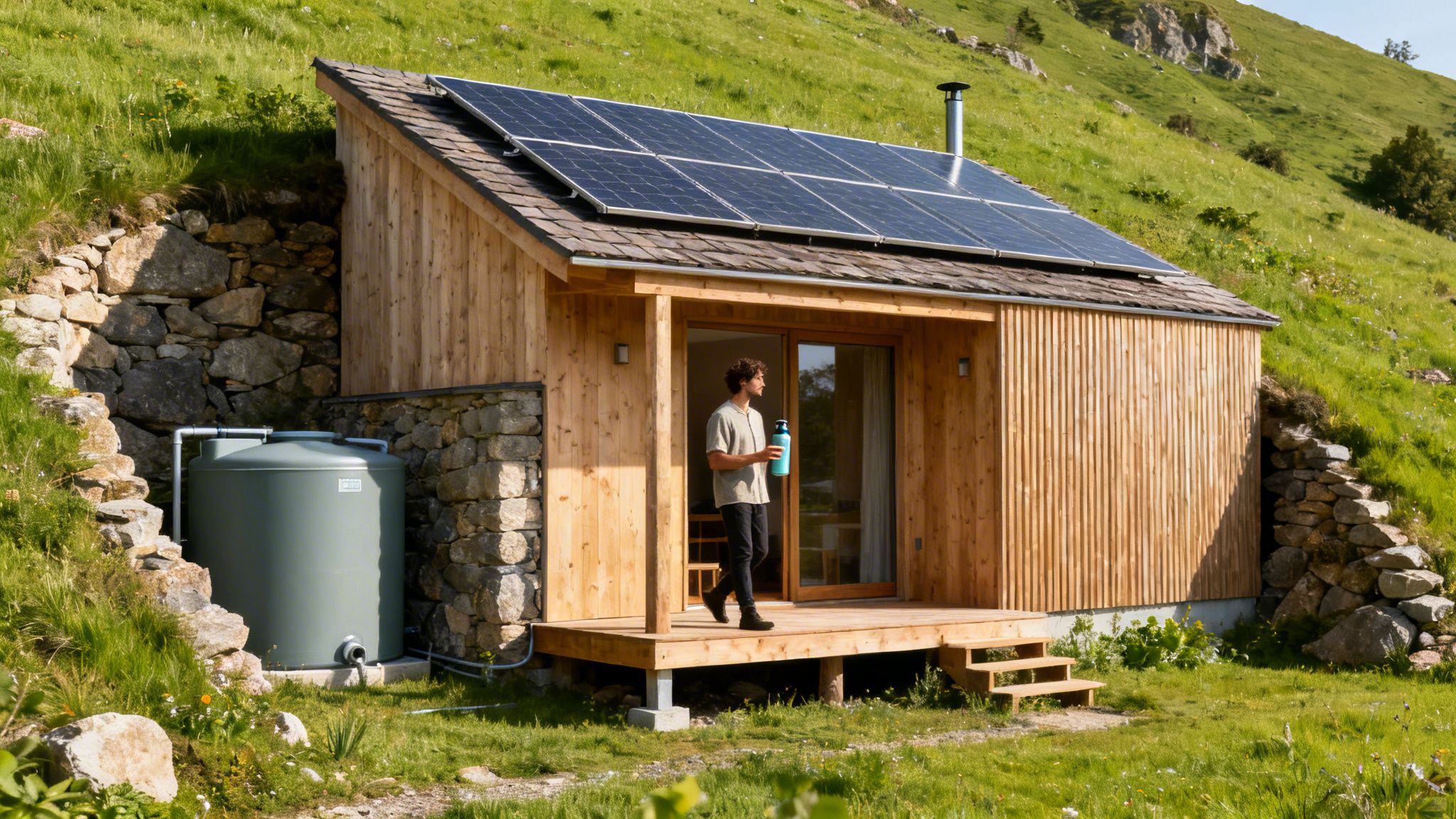
Decoding True Eco Friendly Accommodations
The term “eco-friendly” gets thrown around so much it’s almost lost its meaning. It’s often just a marketing buzzword, which makes it tough to tell the difference between places making a real effort and those just “greenwashing.”
But a truly sustainable property integrates these principles into its very DNA. It goes way beyond superficial gestures. You can see this commitment in their infrastructure, their day-to-day habits, and how they interact with the local community and environment.
This commitment often starts before the first guest ever checks in, right at the design stage. According to the World Green Building Council, buildings are responsible for a huge chunk of global energy use and carbon emissions. So, sustainable properties often use recycled materials, feature energy-efficient architecture, and are built to blend in with the landscape, not dominate it.
Of course, it doesn’t stop there. The daily operations are where a property’s true colors shine. This is everything from smart thermostats and low-flow fixtures to composting food scraps from an on-site restaurant. It’s about creating a closed-loop system where resources are conserved and the ecological footprint is as light as possible.
Core Pillars of Sustainable Lodging
To get a better handle on what sets these places apart, let’s break down the key areas they focus on. These pillars are the real foundation of a legitimately green stay.
Energy Efficiency: This one is huge. Look for properties running on renewable energy like solar or wind power. Other great signs are LED lighting, energy-efficient appliances, and smart room controls that power down the temperature and lights when you’re out.
Water Conservation: Sustainable spots get creative with water. This can be anything from rainwater harvesting systems for the gardens to advanced greywater recycling for things like flushing toilets. In your room, you’ll find low-flow toilets, faucets, and showerheads.
Waste Reduction and Management: A serious commitment to cutting down waste, especially single-use plastics, is a major indicator. This often means providing refillable water stations instead of plastic bottles and using bulk dispensers for shampoo and soap. Robust composting and recycling programs are also a must.
Beyond the Environment: Community and Conservation
True sustainability isn’t just about the planet; it’s also about people. Genuinely eco-friendly accommodations often play a vital role in their local communities.
They make it a priority to hire local staff, source food from nearby farms, and support local artisans. This makes sure the economic benefits of your stay are actually felt by the people who live there.
On top of that, many of these properties are actively involved in conservation. This could mean donating a portion of their profits to local wildlife projects, reforesting nearby land, or offering educational programs for guests about the local ecosystem. You can learn more about spotting these positive impacts in our guide to authentic environmentally friendly accommodation.
When you choose a stay like this, your travel dollars do more than just pay for a room—they directly support the protection and regeneration of the very place you’ve come to visit.
Why Sustainable Stays Are More Than Just a Trend
The rising interest in eco friendly accommodations isn’t just a passing phase; it’s a fundamental shift in how we think about travel. This isn’t about giving up comfort. It’s about finding more meaningful and responsible ways to see the world. As travelers, we’re becoming more aware of our footprint, and that awareness is reshaping the hospitality industry from the inside out.
The days of mindless consumption are fading. Today, people want to know their travel dollars are supporting businesses that reflect their values. That means choosing hotels and lodges that actively protect the environment and support local communities, creating a positive loop that benefits both the destination and the visitor.
For many of us, this shift is driven by a hunger for authenticity. A stay that gets its food from local farmers, hires local guides, and is built with sustainable materials offers a much deeper connection to a place. It turns a simple vacation into a richer, more memorable experience.
The Data Behind the Demand for Eco Friendly Accommodations
This isn’t just a feeling; the demand for sustainable options is backed by some powerful global trends. Consumer awareness is at an all-time high, with a staggering 83% of global travelers now saying that sustainable travel is important to them. That number has climbed steadily from just 62% in 2016, proving this is a consistent and growing movement.
And this desire is directly shaping booking decisions. Research shows that 70% of global travelers are more likely to book an accommodation if they know it has genuine eco-friendly credentials. It’s no longer a niche preference but a mainstream expectation that’s changing where people spend their money.
This shift isn’t just about good intentions. Over 40% of travelers are willing to pay more for sustainable stays, demonstrating that eco-friendly properties can build a strong business case while leading the way in responsible tourism.
Bridging the Gap Between Intent and Action
Despite this huge interest, a major challenge remains. Many travelers who want to book sustainably just aren’t sure how to find and verify real eco-friendly properties. The market is flooded with vague claims and “greenwashing,” making it tough to separate real commitment from clever marketing. This information gap is exactly why learning to spot authentic practices is so important.
The good news is that finding these stays is getting easier as travelers get smarter. Equipping yourself with the right knowledge empowers you to confidently choose accommodations that truly make a positive difference. It’s the same mindset behind packing mindfully; choosing a lightweight travel backpack, for instance, encourages a lower-impact style from the very start.
You can find more practical advice in our comprehensive guide to eco travel. This is how you turn your good intentions into real, impactful actions on your next trip.
How to Spot Real Eco Claims and Avoid Greenwashing
Navigating the world of eco friendly accommodations can feel tricky, especially with “greenwashing” on the rise. It’s a term for vague or misleading marketing designed to attract conscious travelers without any real substance behind the claims.
The good news? Becoming a savvy sustainable traveler is easier than you think. It all comes down to learning how to spot specific, verifiable proof instead of just accepting broad statements at face value.
Think of this as your field guide for cutting through the noise. By focusing on certifications, transparency, and the small operational details, you can confidently book stays that actually align with your values. Remember, the goal is progress, not perfection—every informed choice you make helps nudge the travel industry in a better direction.
Look for Reputable Certifications
Third-party certifications are your most reliable shortcut. These programs have strict criteria and require properties to go through rigorous audits to prove their sustainability claims. They do the heavy lifting for you, so you don’t have to.
Here are a few of the most respected global certifications to keep an eye out for:
- LEED (Leadership in Energy and Environmental Design): This is a huge deal in building design and construction. A LEED-certified hotel has been verified to save energy, conserve water, and provide a healthier space for guests and staff.
- Green Key Global: This standard evaluates a property’s environmental management and its corporate social responsibility. It’s a clear sign that a hotel is committed to continuous improvement.
- B Corp Certification: This one is a biggie. B Corp isn’t just for hotels; it measures a company’s entire social and environmental impact. It proves a business meets incredibly high standards of accountability and transparency across the board.
Spotting these logos on a hotel’s website is a very strong signal that you’re looking at a genuinely sustainable operation.
What to Look for on a Hotel Website
Beyond the official stamps of approval, a hotel’s own website can be a goldmine of information—if you know what to look for. A property that’s truly proud of its eco efforts will be transparent about them.
Start by looking for a dedicated “Sustainability” or “Our Impact” page. Vague language like “we love the planet” is an immediate red flag. What you want are specifics.
Do they publish a recent sustainability report with actual data? I always feel more confident when I see clear numbers on their energy and water use, waste diversion rates, or the percentage of food sourced from local producers.
This simple decision path can help guide your booking process.

It’s a straightforward gut check: if an accommodation gives you clear, convincing evidence of its eco-friendly practices, it’s a green light to book. If not, it might be time to reconsider.
Greenwashing Claims vs Genuine Sustainable Practices
To help you spot the difference on the fly, it’s useful to see common greenwashing tactics side-by-side with what legitimate eco friendly accommodations do instead. Distinguishing between them is one of the best ways to filter your options for a genuinely low-impact trip.
Greenwashing Claims vs Genuine Sustainable Practices
| Common Greenwashing Claim | What to Look for Instead (Genuine Practice) |
|---|---|
| Vague, Fluffy Statements Using phrases like “eco-friendly,” “green,” or “natural” with zero proof. | Specific, Measurable Data Sharing concrete results, like, “we reduced our water usage by 30% last year.” |
| Focusing on One Small Thing Making a big deal about a towel reuse program while ignoring massive energy and food waste. | A Holistic, Property-Wide Approach Showing sustainability across all operations—from energy and waste to community support and fair wages. |
| Misleading Nature Imagery Using stock photos of lush forests or pristine beaches that have no connection to the actual property. | Transparent Reporting & Certifications Publishing detailed sustainability reports and proudly displaying logos from third-party auditors like B Corp or LEED. |
Learning to recognize these patterns is a skill that will serve you well. By asking the right questions and looking for tangible evidence, you can ensure your travel choices make a real, positive impact.
You can find more strategies to identify authentic claims in our complete guide on how to avoid greenwashing in 2025.
Beyond the certifications and glossy website photos, the real proof of eco friendly accommodations is in how they run day-to-day. These are the tangible, on-the-ground features that separate a truly sustainable property from one that just talks a good game. Let’s pop the hood and look at the systems and habits that define a genuinely green stay.
Knowing what to look for doesn’t just help you choose better; it makes the experience richer. When you see these things in action, you know your stay is part of a bigger, more positive story. It turns you from a passive guest into a savvy, conscious traveler.
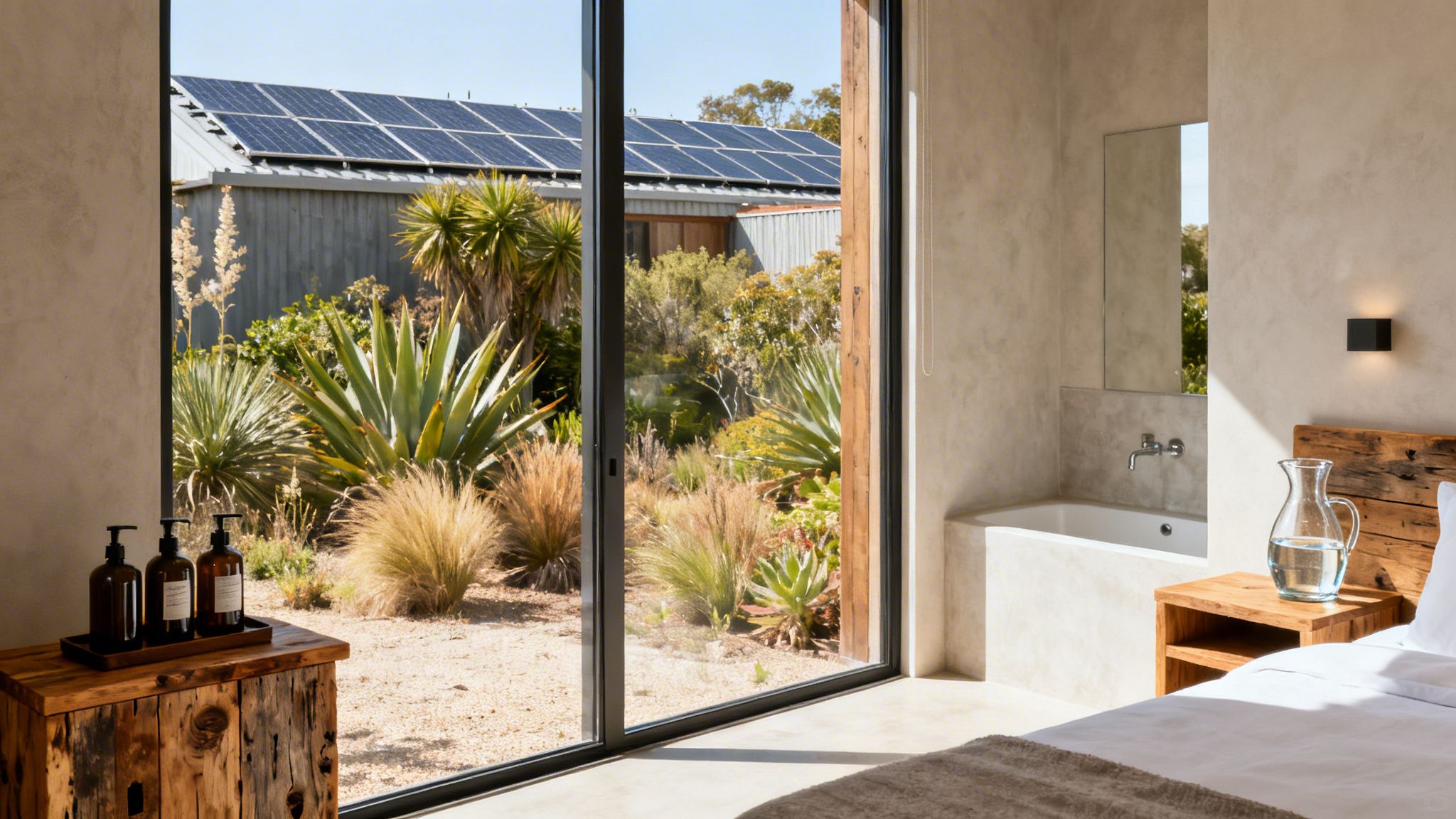
Efficient Energy and Water Systems
For any building, the biggest environmental dents come from energy and water. The best sustainable properties tackle this problem head-on with smart design and even smarter tech.
- Renewable Energy: On-site solar panels are the most obvious sign of commitment. Many top-tier properties generate a huge chunk of their own power this way, and some go even further with geothermal or small-scale wind turbines.
- Smart Consumption: Keep an eye out for things like keycard systems that automatically kill the lights when you leave, or smart thermostats that power down the AC in an empty room. LED lighting should be a given for any property that’s serious about efficiency.
- Water Conservation: This is about more than just a low-flow showerhead. The most advanced places use rainwater harvesting systems to water their gardens and even recycle “greywater” from sinks and showers to flush toilets.
These systems are the invisible workhorses that dramatically shrink a property’s footprint.
A Serious Approach to Waste Management
You can tell a lot about a hotel’s eco-commitment by looking at its trash. A truly sustainable property does way more than just stick a recycling bin in the corner of your room.
The real goal is a circular system—one that sends as little as possible to the landfill. This usually starts with a war on single-use plastics. You’ll see bulk dispensers for shampoo and soap instead of those tiny plastic bottles, and filtered water stations so you can refill your reusable water bottle.
Beyond that, a comprehensive composting program is non-negotiable. Kitchen scraps get turned into rich soil for the on-site gardens, closing the loop entirely. This isn’t just a nice-to-have; it’s a clear signal that the property walks the walk.
Conscious Sourcing and Community Support
True sustainability doesn’t stop at the property line; it weaves itself into the local community and economy. Where a hotel gets its food, its furniture, and even its bricks and mortar matters immensely.
Many of the best eco friendly accommodations have embraced farm-to-table dining, sourcing most of their ingredients from local farmers and producers. This slashes food miles and puts money directly into the pockets of the local community. The same goes for construction, with many properties prioritizing locally sourced, reclaimed, or recycled materials in their design. You can see how this all comes together in our deep dive on off-grid lodging for eco nomads.
The broader hospitality world is catching on. Major hotel chains are setting ambitious carbon-neutrality goals, while independent properties are pursuing LEED certifications and regenerative agriculture. Innovation is happening fast. Take the Whitepod in Switzerland, whose geodesic domes need 30% less energy than a normal building. It’s proof that sustainability isn’t just a niche—it’s a smart response to what travelers now expect.
How to Find and Book Your Next Sustainable Stay
Alright, you can now tell the difference between a genuinely green hotel and one that’s just painting its logo green. It’s time to put that skill to work. Finding and booking authentic eco friendly accommodations has gotten a whole lot easier, thanks to a new wave of specialized platforms and smarter filters on the big booking sites.
This is your roadmap to finding a stay that actually lines up with your values.
The trick is to combine dedicated eco-travel tools with a few clever search tactics. While some websites are built from the ground up for sustainability, others make you dig a little to find their eco-friendly options. Think of it like packing smart—just as you’d bring a universal travel adapter to be prepared, a little foresight in your booking process makes all the difference.
Knowing where to look is half the battle. If you start your search on the right platforms, you cut through the noise and can focus on properties that have already been vetted for their environmental and social standards. It saves you time and gives you confidence in your choice.

Using Booking Platforms with a Conscience
Some booking sites are designed specifically with conscious travelers in mind. These platforms do most of the heavy lifting for you, running the initial checks and making your search much more direct.
- Bookdifferent.com: This site is fantastic because it rates hotels on their carbon footprint and shows you which ones have earned legitimate sustainability certifications. It gives you a clear, data-driven snapshot of a property’s real-world impact.
- Trip.com: While it’s a massive mainstream platform, Trip.com has made some real progress with its sustainability filters. Just look for their “Sustainable” or “Eco-Friendly” tags when you search, and you can narrow down your options in seconds.
These tools are your first line of defense. And if you’re looking for properties deeply embedded in nature, our guide to finding the best eco-friendly lodges is the perfect next step.
Editor’s Pick: Proximity Hotel, Greensboro, NC (USA)
The Proximity Hotel is a brilliant example of how luxury and sustainability can go hand-in-hand. As one of the first LEED Platinum-certified hotels in the U.S., it uses **100 solar panels** to heat its water and generates a significant portion of its own electricity. Everything, from its recycled building materials to its hyper-efficient elevators, was designed for a minimal footprint. It’s a powerful reminder that you don’t have to trade comfort for a responsible stay.
Smart Search and Direct Questions
Sometimes, the most incredible places are hiding in plain sight, just not on the major booking engines. A simple, targeted web search can uncover gems that fly under the radar.
Try searching for specific terms like these:
- “B Corp certified hotel in [city]”
- “LEED certified accommodation [destination]”
- “Community-owned lodge near [national park]”
This approach helps you find properties that have cleared the high bar of specific, trustworthy certifications.
Finally, don’t be shy about reaching out directly. A property that is truly proud of its sustainable practices will be more than happy to talk about them. A quick, polite email asking about their initiatives in energy, water, waste, and community support can be incredibly revealing.
Their response—or the lack of one—will tell you everything you need to know.
Key Takeaways
- Look for Proof, Not Promises: Prioritize accommodations with verifiable third-party certifications like LEED, B Corp, or Green Key Global to avoid greenwashing.
- Sustainability is Holistic: A genuinely eco-friendly property integrates sustainable practices across all operations—from energy and water use to waste management and community support.
- Your Choices Drive Change: The growing demand from travelers for sustainable options is the primary force pushing the hospitality industry toward better practices.
- Tech is a Powerful Ally: Innovations in renewable energy, smart resource management, and transparent reporting are making it easier for accommodations to reduce their footprint.
- Pack Mindfully: You can contribute to a lower-impact stay by bringing items like a reusable water bottle, a quick dry travel towel, and solid toiletries to minimize waste on the road.
- Regeneration is the Next Step: The future of sustainable travel involves actively improving a destination, not just minimizing harm, through initiatives that restore local ecosystems and empower communities.
Low-Impact Travel Tools (Worth It)
Also, if you’re planning a trip and want to keep things simple, these tools help you travel smoother while staying mindful about impact.
Get an eSIM for reliable data → Disclosure: Partner link. No extra cost to you.
Pre-book a transfer for easy arrivals → Disclosure: Partner link. No extra cost to you.
Frequently Asked Questions About Eco Friendly Accommodations
Are eco-friendly accommodations more expensive?
Not always. While some luxury eco-resorts come with a premium price tag, many sustainable options are budget-friendly. Eco-friendly practices often lower a hotel’s operating costs (like energy and water bills in US dollars), and those savings can be passed on to guests. It’s best to compare properties based on their overall value, not just the nightly rate.
What is the difference between an eco-lodge and a green hotel?
An ‘eco-lodge’ is typically located in a natural environment and is designed around nature conservation, benefiting the local community, and offering educational experiences. A ‘green hotel,’ on the other hand, can be any type of hotel—often in a city—that has implemented significant environmental practices to reduce its impact. Both are excellent choices for eco friendly accommodations.
How can I be a more sustainable guest?
Simple actions make a huge difference. Conserve water and electricity, reuse your towels and linens, and avoid single-use plastics by bringing your own gear like a collapsible water bottle. Always support the local economy and follow the ‘Leave No Trace’ principles whenever you’re out exploring. Packing laundry detergent sheets can also help reduce plastic waste on longer trips.
Do I have to sacrifice comfort for sustainability?
Absolutely not. Modern eco friendly accommodations prove that sustainability and luxury can go hand-in-hand. From incredible design to premium, locally-sourced amenities, these properties often deliver a more unique and comfortable experience than their conventional counterparts.
What are the most recognized eco-certifications for hotels?
To verify real commitment, look for certifications like LEED (Leadership in Energy and Environmental Design), Green Key Global, B Corp, Green Globe, and EarthCheck. These third-party seals of approval confirm that a property is meeting high standards for both environmental and social responsibility.
Join the Sustainable Work Movement
Want more rail-first itineraries, low-impact packing systems, and walkable base-city ideas?
This article was fact-checked using sustainability data from the World Green Building Council, the Global Ecotourism Network, and peer-reviewed architecture studies. All partner links are vetted for compliance with sustainable business certifications.