
For digital nomads and thoughtful travelers, picking eco-friendly lodging is about more than just a place to sleep. It’s a conscious choice that directly shapes your environmental footprint, moving past simple towel-reuse signs to embrace a much deeper commitment to the planet and local communities. This article was fact-checked using sustainability data from the World Green Building Council, the Global Ecotourism Network, and peer-reviewed architecture studies. All partner links are vetted for compliance with sustainable business certifications.
Why Your Choice of Eco-Friendly Lodging Matters
Where you decide to stay is one of the biggest pieces of your travel footprint. The hospitality industry is incredibly resource-hungry, responsible for a huge chunk of tourism’s total energy and water use. But that story is starting to change, thanks to a growing movement of responsible hotels, guesthouses, and apartments.
By choosing these places, you’re not just getting a room; you’re directly supporting businesses that are actively working to lighten their impact.
This isn’t just about feeling good—it has a real, tangible effect. When you book a stay at a property running on renewable energy, conserving water, minimizing waste, and supporting its local economy, you’re voting with your wallet for a better model of tourism. This guide is here to help you cut through the marketing noise and find genuinely eco-friendly lodging that lines up with your values.
The Growing Demand for Sustainable Stays
Travelers are now actively looking for places that reflect their environmental values. It’s a huge shift. Recent data shows that a massive 83% of global travelers now say sustainable travel is important to them. This demand is pushing the entire industry forward, nudging more properties to adopt real green practices.
This trend is also proving that sustainability and great hospitality can absolutely go hand in hand. You can learn more about how our choices are shaping the industry in our guide to the future of sustainable tourism. Every conscious booking you make adds to this positive momentum.
As travelers, every booking we make sends a message. By choosing properties dedicated to genuine sustainability, we help build an industry that preserves destinations for future generations, rather than just consuming them.
Ultimately, opting for eco-friendly lodging transforms your journey from a simple visit into a positive contribution. It’s an opportunity to connect more deeply with a place, knowing your presence supports its long-term health and prosperity. The next sections will give you the tools to tell marketing fluff from meaningful action, so you can make informed decisions every time you travel.
Decoding Eco-Friendly Lodging Beyond the Buzzwords
The term “eco-friendly lodging” gets tossed around a lot, often losing its real meaning. True sustainability goes far beyond a polite request to reuse your towels. It’s a holistic approach that looks at how a property interacts with its environment and community across four key areas.
Thinking about a property’s sustainability is a bit like thinking about your personal carbon footprint. It’s not about one single action, but a combination of daily choices related to energy, water, waste, and community impact. A genuinely sustainable stay actively manages all four of these pillars.
This integrated approach is what separates authentic efforts from superficial marketing. As we dive into these pillars, you’ll learn how to spot the difference and make choices that truly matter, moving past the buzzwords to identify places that are part of the solution.
The Four Pillars of a Sustainable Stay
To really get what makes a place eco-friendly, we need to look at its operational DNA. This means digging into how it handles essential resources and its relationship with the local area. These four pillars give us a clear framework to work with.
This concept map shows how these pieces all fit together, with your stay right at the center.
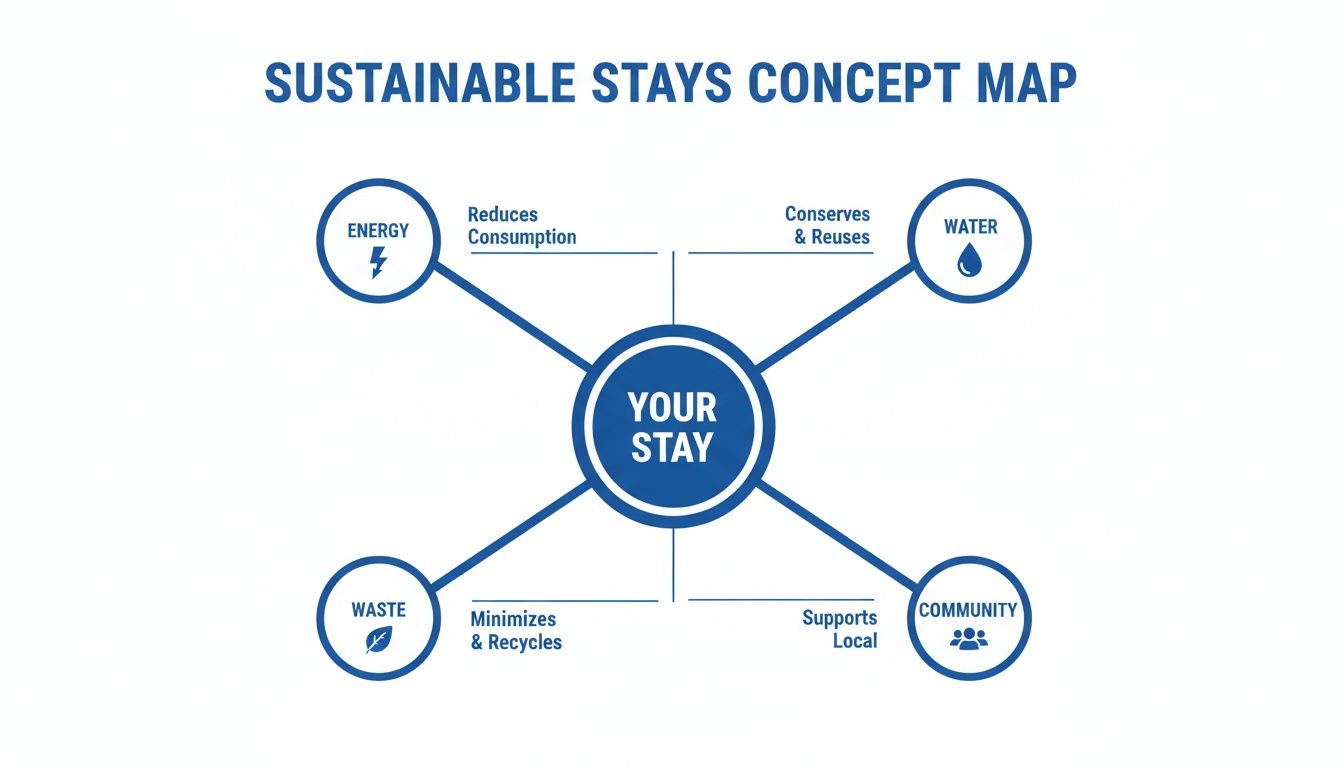
As the graphic shows, genuine sustainability isn’t an isolated feature. It’s a system where energy, water, waste, and community practices all work together to shrink a property’s overall impact.
1. Responsible Energy Use
A property’s energy consumption is a huge part of its environmental footprint. I always look for places that prioritize renewable energy, like solar panels for hot water or electricity.
Other great signs are energy-efficient appliances (look for Energy Star ratings), LED lighting, and smart thermostats that adjust the temperature when a room is empty. These features show a real commitment to cutting carbon emissions.
2. Smart Water Conservation
Water is a precious resource, especially in many of the places we love to travel. Sustainable properties get this and put smart water-saving measures in place.
This can include low-flow toilets and showerheads, rainwater harvesting systems for the garden, and landscaping with native, drought-resistant plants to cut down on irrigation. They treat water like the finite resource it is, not an endless utility.
3. Comprehensive Waste Management
How a property handles its trash speaks volumes. The first thing to look for is clear and accessible recycling and composting bins for guests.
A deeper commitment is obvious when a place actively works to reduce waste from the start. Think refillable toiletry dispensers instead of tiny plastic bottles, filtered water stations instead of bottled water, and sourcing food locally to reduce packaging.
4. Meaningful Community Integration
True sustainability goes beyond environmental practices to include social and economic responsibility. An eco-friendly property should be a positive force in its community.
This means hiring local staff and paying fair wages, sourcing food and supplies from nearby producers, and actively supporting local conservation or cultural heritage projects. When your stay benefits the local economy, your travel becomes a regenerative act.
Recognizing and Avoiding Greenwashing
Unfortunately, as conscious travel has grown, so has “greenwashing”—making misleading claims about environmental practices. Traveler demand for eco-friendly lodging is a powerful market force now. With roughly 83–84% of global travelers saying sustainable travel is important to them, some businesses are tempted to cut corners.
On the bright side, one analysis found sustainable accommodations were, on average, about 39% cheaper than their non-sustainable counterparts, proving that responsible travel can also be budget-friendly.
Spotting greenwashing is a critical skill for any traveler. Be wary of vague terms like “eco-friendly” or “green” without specific examples to back them up. A hotel that boasts about its towel reuse program but has no visible recycling or energy-saving measures is a classic red flag. For a deeper dive, our guide on how to identify and avoid greenwashing has you covered.
Real commitment is shown through transparent, measurable actions, not just marketing slogans.
To help you tell the difference on the fly, I’ve put together a quick comparison table. It’s a simple cheat sheet for separating the real deal from the marketing fluff.
Greenwashing Claims vs Real Eco Practices
| Common Greenwashing Tactic | What to Look for Instead (Genuine Practice) |
|---|---|
| Vague claims like “eco-friendly” or “green” with no proof. | Specific details: “We generate 30% of our power from solar panels.” |
| Focuses only on minor actions like reusing towels or linens. | A comprehensive approach covering energy, water, waste, and community support. |
| Using nature-themed imagery without actual sustainable policies. | Certifications from reputable bodies (like GSTC, Green Key) or a publicly available sustainability report. |
| Suggesting products are “natural” or “chemical-free” anachronistically. | Providing biodegradable cleaning products and refillable, locally sourced toiletries. |
| No transparency about their supply chain or staff policies. | Highlighting partnerships with local farmers, artisans, and paying staff a certified living wage. |
This table isn’t exhaustive, but it’s a solid starting point. The main takeaway is to always look for specifics. Genuine eco-lodges are proud of their work and are usually happy to share the details.
Verifying Sustainability With Eco Certifications
So, a property says it’s “green.” How can you be sure its claims are the real deal? While asking direct questions is a great starting point, third-party certifications are your most reliable tool for verifying eco-friendly lodging.
Think of them like the ‘Certified Organic’ or ‘Fair Trade’ labels you see at the grocery store. They’re a trusted seal of approval that cuts through the noise of potential greenwashing, signaling that an independent organization has audited the property against a strict set of environmental and social standards.
Recognizing these logos is a key skill for any conscious traveler. When you see one, it means the property has invested serious time and resources to prove its practices are up to par—from energy and water use to fair labor and community support.

Key Eco Certifications to Know
While dozens of regional labels exist, a few global heavyweights carry the most authority. Knowing these will help you quickly spot top-tier sustainable options anywhere in the world.
- Global Sustainable Tourism Council (GSTC): This is the gold standard. The GSTC doesn’t certify properties directly but accredits other certification bodies, ensuring their standards are rigorous. A GSTC-accredited certification is a powerful stamp of legitimacy.
- Green Globe: One of the most comprehensive out there, Green Globe assesses properties on over 40 criteria covering sustainable management, social/economic benefits, cultural heritage, and environmental protection.
- LEED (Leadership in Energy and Environmental Design): This one is all about the building’s hardware. A LEED-certified hotel has been designed and constructed from the ground up to be energy-efficient, water-wise, and built with sustainable materials.
- B Corp Certification: This goes way beyond just environmental practices. B Corps are legally required to consider the impact of their decisions on workers, customers, suppliers, the community, and the planet. It’s a holistic mark of a truly responsible company.
Eco‑friendly lodging has moved far beyond a niche market. The global ecotourism industry was valued at roughly $172.4 billion USD in 2022 and is set to grow significantly. Frontrunners like Costa Rica and New Zealand are actively championing sustainable lodging through robust certification programs.
How to Find and Verify These Labels
Finding certified properties is getting easier. Many major booking platforms now have sustainability filters, letting you narrow your search to places with recognized eco-labels. You can also look for these logos on a property’s official website, usually in the footer or on an “About Us” or “Sustainability” page.
A genuine certification is more than just an image on a website. Most certification bodies maintain a public database of their members. If you’re unsure, take a minute to cross-reference the property on the certifier’s official site.
This extra step is the single best way to confirm a claim is current and valid. By learning to spot and verify these key certifications, you can book your next stay with the assurance that you’re supporting one of the best eco-friendly lodges out there. A little bit of research empowers you to make choices that truly align with your values.
How to Find and Book Your Sustainable Stay
Alright, you’ve got a solid grasp of what makes a stay genuinely sustainable. Now it’s time to actually find one. The good news is that booking your ideal eco friendly lodging is getting easier, thanks to better search tools and a growing number of properties that are truly committed.
The secret is knowing where to look and, just as importantly, what to ask.
Major booking platforms are finally starting to listen to traveler demand. Sites like Booking.com now have a “Travel Sustainable” filter that flags properties with specific certifications or proven eco-friendly practices. This is a great starting point—it saves you a ton of time by clearing out the noise right away.
But don’t stop there. For a more hand-picked selection, it’s worth exploring niche eco-travel websites. These platforms do the heavy lifting for you, often featuring smaller, independent spots with incredible sustainability stories that you’d never find on the big sites.
Using Sustainability Filters and Niche Platforms
When you kick off a search, always hit that sustainability filter first. It’s a simple click, but it signals your priorities to the booking engines and gives more visibility to the properties making a real effort. Small action, big impact.
Once you have your initial results, it’s time to dig a bit deeper. Scan the property descriptions for mentions of specific certifications, like Green Globe or LEED. If a place just vaguely calls itself “green” without any third-party proof, that’s your cue to move on to the next step: a quick, direct conversation.
Your Vetting Checklist: Questions for Hosts
Not every fantastic eco-stay has a formal certificate, especially the smaller, family-run guesthouses where the cost and paperwork can be a real barrier. This is where you step in as the verifier. Reaching out with a few thoughtful questions shows you’re a serious guest and helps you gauge their real commitment.
Use this simple checklist to confidently contact hosts or property managers:
- Energy: “What are your main energy sources? Do you use any renewables like solar panels?”
- Water: “What kind of water conservation measures do you have in place, like low-flow fixtures or rainwater harvesting?”
- Waste: “How do you handle waste? Do you offer guest recycling and composting, and what are you doing to minimize single-use plastics?”
- Local Sourcing: “Do you source your food, toiletries, or other supplies from local businesses?”
- Community: “Are your staff members from the local area? Do you support any local conservation or community projects?”
Genuine hosts are almost always proud to talk about what they’re doing. Their response—or lack of one—will tell you everything you need to know. For anyone interested in fully self-sufficient options, our guide on finding the best off-grid lodging for digital nomads offers even more in-depth vetting strategies.
Inspiring Examples of Eco Friendly Lodging
Theory is one thing, but seeing how it all works in the real world is another. The best way to understand what eco friendly lodging really means is to look at places that are already getting it right. These properties prove that a deep commitment to the planet can create unforgettable travel experiences, not just tick a box.
Let’s spotlight a few inspiring spots in Europe and Asia that are setting a high bar. From a community-run guesthouse in Thailand powered by local traditions to a solar-powered agriturismo in Italy that grows its own food, these stays connect their daily practices directly back to the core principles we’ve covered.
This isn’t just about reducing your footprint; it’s about finding a more immersive and authentic way to travel. These stories show that choosing a sustainable stay means you don’t have to sacrifice comfort or a genuine connection to the place you’re visiting.
Farm-to-Table Living at an Italian Agriturismo
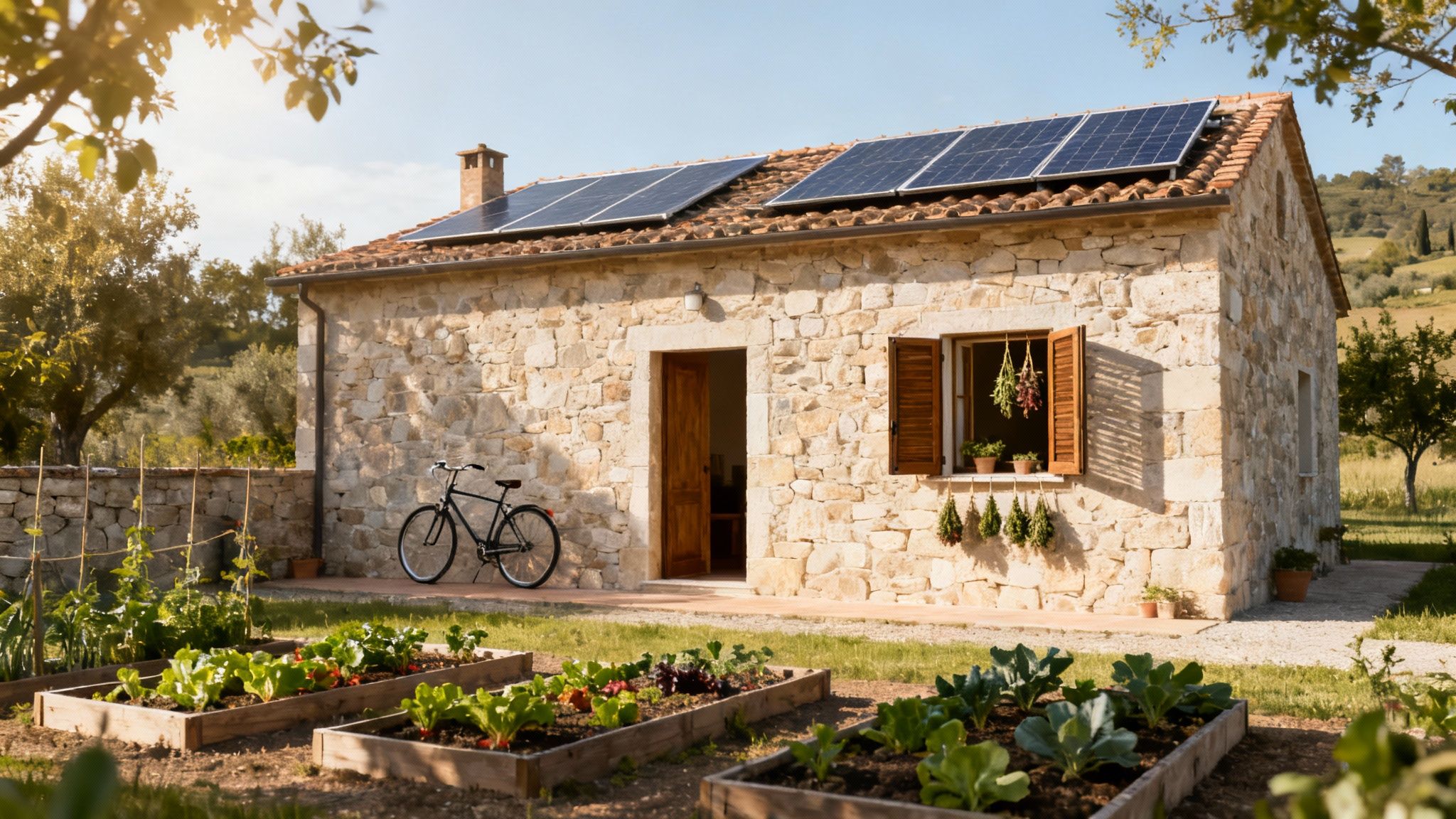
Imagine waking up in the rolling hills of Tuscany to the smell of fresh basil and tomatoes. This is the daily reality at many Italian agriturismos, farm-stays that perfectly blend hospitality with agriculture. One standout example near Florence takes this concept to the next level.
The entire property runs on solar power, and a sophisticated rainwater harvesting system irrigates the organic vegetable gardens that supply the on-site restaurant. Food waste is composted and returned to the soil, creating a closed-loop system that is both ancient and innovative. Guests are even invited to join cooking classes using ingredients picked just hours before.
This model does more than just lower the carbon footprint of each meal. It offers a powerful, tangible connection to the local landscape and food culture, turning a simple stay into a deeply educational experience.
Urban Sustainability at a Lisbon Zero-Waste Hostel
Proving that eco friendly lodging isn’t just for rural retreats, a hostel in Lisbon is redefining urban sustainability. Tucked inside a beautifully restored historic building, its mission is to operate with a near-zero-waste philosophy. This goes far beyond just providing recycling bins.
They’ve eliminated single-use plastics entirely, offering guests reusable containers and filtered water stations. Furniture is crafted from upcycled materials, and a rooftop garden supplies herbs for the communal kitchen. The hostel also partners with local social enterprises, making sure its economic impact benefits the surrounding community. Their transparency about their practices—from energy consumption metrics to waste diversion rates—sets a new standard for urban hospitality.
Behind the scenes, a fast-growing ecosystem of eco-friendly hotel products is turning these goals into reality. The market for items like biodegradable toiletries was valued at about $1.79 billion USD and is projected to reach roughly $5.27 billion USD by 2031. This growth is fueled by properties investing in LEED-certified buildings and smart energy management, making sustainable urban stays more accessible than ever.
Community-Led Heritage in a Thai Guesthouse
In a small village in northern Thailand, a community-run guesthouse offers an inspiring model of social and environmental synergy. Operated by local families, the entire experience is designed to preserve cultural heritage while creating sustainable livelihoods.
The guesthouses are built using traditional techniques and locally sourced bamboo and teak, minimizing construction impact. Meals feature ingredients from community gardens, and activities like weaving workshops and guided forest walks are led by village elders. This approach ensures that tourism revenue flows directly back into the community, funding local schools and conservation projects.
It’s a powerful reminder that some of the most profound sustainable practices are rooted in timeless local wisdom. For those seeking similar deep connections, our guide to remote eco-retreats for digital nomads offers more inspiration.
It’s Time to Book a Better Stay
Choosing a genuinely eco friendly lodging is one of the most direct ways a digital nomad can make a positive impact. It’s the difference between just passing through a place and actively helping it thrive. When you book with properties that care for their environment and community, you’re investing in a healthier, more resilient model of tourism.
You now have the tools to see past the vague “eco” marketing and find stays that are truly doing the work. You know how to check for real certifications and what questions to ask when there are none. Your next booking is a chance to travel with purpose.
Your Simple Eco Lodging Checklist
Think of your next booking as a quick, three-step investigation. Start with the sustainability filters on booking sites, then scan the property’s page for trusted certifications like GSTC or Green Globe.
If it’s a smaller, independent place, just ask them directly about their energy, water, waste, and community work. Honest hosts are usually proud of their efforts and happy to share the details.
This straightforward process means your travel budget supports businesses that share your values. Every time you book a thoughtful stay, you send a clear signal to the rest of the industry.
Editor’s Pick: A Tool to Simplify Your Search
Bookdifferent.com: This booking platform cuts through the greenwashing by focusing on verified eco friendly lodging. It calculates a ‘stay green’ score for properties based on their CO2 emissions, water use, and waste management—all cross-checked with GSTC-accredited certifications. It’s a transparent, data-driven tool that helps you compare options and book with confidence.
Your Eco-Stay Questions, Answered
Jumping into the world of sustainable travel can bring up a few questions. To help you book your next trip with confidence, here are some straightforward answers to the queries I hear most often from fellow travelers.
Is Eco-Friendly Lodging Always More Expensive?
Not at all. While you can certainly find luxury eco-lodges with a price tag to match, many of the most genuinely sustainable places are actually very budget-friendly. Think eco-hostels, locally-owned guesthouses, and simple apartments—they often have a smaller footprint and can be much more affordable than big, resource-hungry hotels.
It makes sense when you think about it. Properties built around energy efficiency and local sourcing often have lower running costs, and good owners will pass those savings on to you.
What if a Property Lacks an Official Certification?
A missing certificate isn’t a deal-breaker, especially for the small, independent spots where the cost of official programs can be a real barrier. In these cases, you just become the verifier yourself. Use the checklist from this guide and ask direct questions.
You could try something like, “Do you use any renewable energy, like solar panels?” or “How do you try to cut down on single-use plastics for guests?” Genuine eco-conscious hosts are usually proud of their efforts and happy to share the details. Their transparency is often the best sign of a real commitment.
What’s the Most Important Thing to Look For?
While true sustainability is a mix of many factors, a great place to start is with a property’s approach to energy and waste. Do they use renewables like solar? How do they handle food scraps and avoid single-use plastics? These two areas have a massive impact.
Another huge factor that’s easy to check is location. Choosing a central stay that lets you walk or use public transport instead of taxis is an inherently sustainable move. It dramatically cuts your trip’s carbon footprint by slashing your local travel emissions right from the start.
Key Takeaways
- Look Beyond Buzzwords: True sustainability involves energy, water, waste, and community support—not just reusing towels.
- Verify Certifications: Use labels like GSTC, Green Globe, and LEED to identify genuinely eco-friendly lodging, and don’t be afraid to check them on the certifier’s website.
- Ask Direct Questions: For uncertified properties, ask hosts about their specific practices regarding renewables, waste reduction, and local sourcing. Their answers reveal their true commitment.
- Use Booking Filters: Start your search on major platforms by using the “sustainable travel” filter to instantly narrow your options.
- Vote with Your Wallet: Every booking at a genuinely sustainable property supports a better model of tourism and encourages more businesses to adopt responsible practices.
- Location Matters: Choosing lodging with good walkability or access to public transit significantly reduces your travel footprint.
Join the Sustainable Work Movement
Want more rail-first itineraries, low-impact packing systems, and walkable base-city ideas?
Eco-Friendly Lodging FAQ
Quick answers to help you book a truly sustainable stay (without getting fooled by greenwashing).
Booking and Verification
1) What counts as eco-friendly lodging?
Eco-friendly lodging is a stay that actively reduces impact across energy, water, waste, and community outcomes (not just towel reuse). Look for renewable energy, serious waste reduction, water-saving fixtures, and transparent local sourcing.
2) What are the most trustworthy certifications to look for?
GSTC-accredited certifications are a strong signal of rigor. Other respected labels include Green Globe (operations + social criteria) and LEED (building efficiency). Always verify on the certifier’s official directory when possible.
3) How do I spot greenwashing fast?
Be cautious with vague claims (“green,” “eco”) that lack specifics. Real properties share measurable practices (solar %, refill stations, recycling/composting, supplier lists) and can answer direct questions about energy, water, and waste.
4) If a property has no certification, should I avoid it?
No. Many small, high-integrity stays skip certifications due to cost. Use a quick vetting message asking about renewables, water measures, waste systems, and local hiring/sourcing. Transparency matters more than perfect labels.
5) What questions should I ask before booking?
Ask: energy source (any solar/wind?), water savings (low-flow, rainwater), waste (recycling/composting, refill stations), single-use plastics policies, and local sourcing (food, staff, suppliers).
Energy, Water, and Waste Practices
6) Is solar power alone enough to make a stay sustainable?
Solar helps a lot, but sustainability is a system. A strong eco stay pairs renewables with insulation, efficient appliances, smart temperature control, and waste + water management so the total footprint drops meaningfully.
7) What water-saving features actually matter?
Low-flow showers/toilets, leak checks, towel/linen policies that don’t rely on guilt, rainwater harvesting for gardens, and drought-tolerant landscaping. Bonus: greywater reuse where it’s legal and well-managed.
8) What does good waste management look like in lodging?
Easy-to-find recycling and (ideally) compost bins for guests, refillable toiletries, filtered-water stations, bulk breakfast items (not single-serve plastic), and clear policies for reducing food waste.
9) Are refillable toiletries more hygienic than mini bottles?
When maintained properly, refillable dispensers can be safe and reduce plastic dramatically. A responsible property uses sealed cartridges or documented cleaning/refill routines rather than topping up old containers.
10) Do eco-friendly laundries and linens make a real difference?
Yes. Laundry is energy- and water-intensive. Look for efficient machines, low-temperature wash practices, eco-certified detergents, and linen changes only on request (with transparent policies, not guilt tactics).
Cost, Comfort, and Logistics
11) Is eco-friendly lodging always more expensive?
No. Eco-hostels, small guesthouses, and simple apartments can be very affordable. Efficiency and local sourcing often lower operating costs, and many sustainable stays price competitively.
12) Can I find sustainable stays on major booking sites?
Yes. Use sustainability filters as a starting point, then verify details on the property site (or by message). Filters help reduce noise, but your final check should be the property’s actual practices.
13) What’s better: eco-hotel, eco-hostel, or eco-apartment?
It depends on your trip. Hostels often reduce per-guest energy use; apartments can cut waste if you cook and avoid disposables; hotels can be excellent if they’re certified and run tight systems. Pick the option that supports your routines with the lowest added impact.
14) Does location matter as much as the building itself?
Often, yes. A central stay near transit and walkable essentials can reduce local transport emissions significantly. A “green” hotel that requires daily taxis can quietly erase many of its gains.
15) What amenities should I avoid if I want a lower-impact stay?
High-impact extras can include daily housekeeping by default, excessive single-serve breakfast packaging, heated private pools/hot tubs, and unlimited towel changes. Choose comfort that doesn’t force constant energy/water use.
Digital Nomads, Ethics, and Local Impact
16) What should digital nomads prioritize when booking eco friendly lodging?
Prioritize walkability + transit, stable internet, natural light/ventilation, and low-waste kitchen basics (kettle, dishes, reusable options). The best eco friendly lodging supports both your workflow and low-impact daily routines.
17) How can I tell if a property supports the local community?
Look for local staff in meaningful roles, fair-wage statements, partnerships with local farms/artisans, community-led tours, and transparent giving to conservation/cultural projects. Ask where food and services are sourced.
18) Are off-grid stays automatically more sustainable?
Not automatically. Off-grid can be great, but sustainability depends on water systems, waste handling, and energy generation. A poorly managed off-grid property can still create serious impacts.
19) What are the best ways to reduce plastic waste while staying in hotels?
Bring a reusable bottle, travel mug, and compact cutlery; use refill stations; refuse daily plastic water; and choose properties with bulk toiletries and strong recycling. Small daily choices add up fast over long stays.
20) What’s the single easiest “high-impact” action I can take as a guest?
Choose a transit-connected, walkable location and keep daily transport low. Then reinforce it by avoiding daily housekeeping, using refill stations, and supporting local businesses during your stay.
Explore Eco Nomad Travel
📚 Core Guides
🧭 Planning & Logistics
🗺️ Destinations & Seasons
Jeremy Jarvis — founder of Eco Nomad Travel, sustainable travel writer, and advocate for regenerative tourism. His work focuses on low-impact mobility, eco-friendly digital nomad life, and climate-positive travel.
Legal
Affiliate DisclaimerPrivacy Policy
Terms of Service
Image & Media Notice
Cookie Policy
Contact
Affiliate Disclosure: Some links on Eco Nomad Travel are affiliate links, meaning we may earn a small commission at no extra cost to you. This supports our mission to inspire responsible and low-impact travel worldwide.
Connect
✅ Trusted Official Sources
Plan smarter eco trips
Try our free Sustainable Travel Tools for Digital Nomads – carbon calculator, train vs plane comparator, and more.
Open Tools Hub