
Eco travel is all about making intentional choices that protect the environments, support local communities, and preserve the cultural heritage of the places you visit. It’s a way of thinking that turns your journey from a simple vacation into a positive force, enriching both your experience and the destination itself.
What Is Eco Travel and Why It Matters Now
At its core, eco travel is a mindset, not a sacrifice. It’s the understanding that every travel decision, no matter how small, has a ripple effect. This approach fits perfectly with the slower, more deliberate lifestyle that many digital nomads and thoughtful travelers are looking for.
Instead of just ticking off a checklist of crowded sights, you might choose a locally-run guesthouse. When you do, your money directly empowers a family and stays circulating within that community. It’s a simple switch with a real impact.
A Small Movement with Big Numbers
This shift is more than a trend; it’s a movement gaining serious momentum. The global ecotourism market was valued at around USD 219.81 billion and is projected to surge to as much as USD 945.34 billion by 2034.
What’s driving this? A powerful change in traveler awareness. An incredible 83% of travelers now see sustainable travel as essential. For remote workers, this boom means more choices for regenerative stays and walkable base cities, making a lower-carbon lifestyle smarter and more accessible than ever. You can discover more insights on the ecotourism market growth to see the full picture.

Small Choices, Big Impact
The beauty of eco travel lies in how accessible it is. You don’t need a huge budget or a drastic lifestyle change to make a difference. It starts with simple, practical swaps.
For example, packing a high-quality universal travel adapter means you won’t need to buy a new charger in every country, which helps reduce electronic waste over time. Similarly, bringing a reusable water bottle can eliminate dozens of single-use plastic bottles on a single trip. These small habits are central to the whole idea, and you can learn more about the broader concept of sustainable travel in our guide.
While these actions seem small on their own, they collectively create significant positive change. They contribute to cleaner destinations, stronger local economies, and a more authentic, grounded travel experience.
As we move through this guide, we’ll explore how to apply this mindset to every part of your journey, from planning train-first itineraries to choosing gear that’s built to last.
Understanding the Core Principles of Eco Travel
To really get what eco travel is all about, it helps to think of it as a mindset built on four simple but powerful pillars. These aren’t rigid rules you have to follow, but more like friendly guideposts to shape your decisions on any trip.
Keeping them in mind can turn a standard vacation into something more meaningful—an experience that benefits both you and the places you visit.
The best part? These ideas fit perfectly with a slower, more intentional travel style, which is exactly how many digital nomads and long-term explorers like to move through the world. Each pillar supports the others, creating a complete approach to seeing the world with a lighter touch.
Minimize Your Environmental Footprint
This is the one most people think of first, and for good reason. It’s all about shrinking the negative impact your journey has on the planet. The biggest lever here is transportation—choosing a train over a plane can slash your emissions by up to 90% for the same route. You can easily compare options on sites like Trip.com.
But it also comes down to the small, daily habits that add up.
- Reduce Waste: Packing a collapsible water bottle and a few laundry detergent sheets dramatically cuts down on single-use plastics and unnecessary packaging.
- Conserve Resources: Just be mindful of your water and electricity use wherever you’re staying, the same way you would at home.
- Pack Smart: Using compression packing cubes helps you fit more into a smaller bag, which can lighten the overall weight and fuel burn of whatever transport you’re on.
Support Local Economies Directly
This is one of the most rewarding parts of eco travel: making sure your money goes straight into the pockets of the people who call your destination home. Think of it as creating a positive economic ripple effect.
Choosing a family-run guesthouse over a multinational hotel chain is a perfect example. You’re not just booking a room; you’re investing in a neighborhood’s future, ensuring that tourism dollars support local families and their livelihoods. The same goes for eating at local restaurants, hiring local guides, and buying crafts directly from artisans.
Respect Cultural Heritage
Meaningful travel goes way beyond just seeing the sights. It’s about connecting with a place on a much deeper level. Respecting the local culture means taking a little time to learn about customs, traditions, and social norms before you even get there.
This could be as simple as knowing the right way to dress for a visit to a religious site or learning a few basic phrases in the local language. This thoughtful approach builds genuine connections and makes your presence a welcome and positive one. You shift from being a passive tourist to a respectful guest, which always leads to richer, more authentic experiences.
Conserve Biodiversity and Wildlife
The final pillar is all about protecting the natural world that makes these destinations so incredible in the first place. This means choosing tour operators who follow ethical wildlife viewing guidelines, which always means never disturbing animals in their natural homes and sticking to marked trails when you’re out hiking.
If your travels take you to the coast, using a quality reef safe sunscreen is a small but critical step in protecting fragile marine ecosystems from chemicals that can cause serious damage. By making these kinds of conscious choices, you help preserve the stunning biodiversity that makes these places so special for everyone, for years to come.
Explore our complete guide to green travel for more practical ways to put these principles into action.
How to Plan a Low-Impact Eco Travel Itinerary
This is where the idea of eco travel goes from a concept to a real, rewarding plan. Putting together a low-impact itinerary built around trains isn’t just about shrinking your carbon footprint; it’s often a more scenic, relaxed, and genuinely interesting way to see the world. We’ll walk through it step-by-step, making that first train-centric adventure feel completely doable.
The core idea is simple: pick destinations that are beautifully connected by rail and easy to explore once you’re there, no car needed. This one shift changes the entire rhythm of a trip, pushing you toward slower, more immersive experiences while slashing your travel emissions.
In fact, choosing trains over planes in Europe can cut your travel emissions by a staggering 80-90%. A typical flight across the continent pumps out around 10 times more CO2 per person than the same journey by high-speed train. That’s a huge win, and it’s a big reason why traveler priorities are shifting toward greener options, as highlighted in these ecotourism statistics.
Planning starts with looking at a rail map, not an airport map. Tools like Trip.com are brilliant for this, letting you see train and flight routes side-by-side so you can visualize the overland possibilities.
Train vs Plane Emissions: A Quick Comparison
To see just how massive the carbon savings are, let’s look at a few popular European routes. The numbers make it clear why a “rail-first” mindset is the single most powerful tool for low-impact travel.
| Route | Flight CO2 Emissions (per passenger) | Train CO2 Emissions (per passenger) | CO2 Savings |
|---|---|---|---|
| London to Paris | ~269 lbs (122 kg) CO₂ | ~8.8 lbs (4 kg) CO₂ | ~97% |
| Amsterdam to Berlin | ~320 lbs (145 kg) CO₂ | ~33 lbs (15 kg) CO₂ | ~90% |
| Rome to Milan | ~242 lbs (110 kg) CO₂ | ~24 lbs (11 kg) CO₂ | ~90% |
Choosing the train isn’t a small tweak; it’s a fundamental change that makes your journey vastly more sustainable before you’ve even packed your bag.
Choose Destinations with Great Public Transit
The best eco travel plans are built around cities and regions where a car is completely unnecessary. Think of places like Switzerland, Austria, or Japan, where the train network feels less like simple transport and more like part of the destination itself.
When you’re researching potential stops, ask yourself a few key questions:
- Is the city center walkable? Can you get to the main sights, cafes, and your accommodation on foot?
- How good is the local transit? Is there a solid system of trams, buses, or subways to get you around?
- What about day trips? How easy is it to hop on a regional train and explore nearby towns or natural spots?
A city that nails all three becomes the perfect “base camp.” You can settle in for a while, explore the wider region with a tiny environmental footprint, and travel much lighter. When you aren’t constantly on the move, a single carry on backpack is often all you need.
Embrace the Magic of Night Trains
Night trains are a true game-changer for low-impact travel, especially in Europe. They are brilliantly efficient, rolling your transportation and accommodation into one. You fall asleep in one city and wake up in the heart of another, saving a night’s accommodation cost and a full day of travel time.
Booking a sleeper cabin turns a long haul into a cozy, memorable part of the adventure. It’s a world away from the stress of a 4 AM alarm for an airport run. Plus, it’s one of the best ways to cover serious ground while keeping your carbon footprint incredibly low.
Select Walkable Cities as Your Home Base
The “walkable base city” strategy is a favorite for digital nomads and slow travelers. Instead of jumping to a new place every two days, you pick one well-connected city and make it your home for a week or more. From there, you can take easy day trips by rail to explore everything the region has to offer.
This approach lets you form a real connection with a place. You find your favorite local cafe, you shop at the neighborhood market, you fall into a comfortable rhythm. It also makes packing a breeze; using compression packing cubes keeps your carry on luggage organized, so you’re always ready for a spontaneous day trip without a full repack.
For a deeper dive into routing, passes, and booking, our full guide on how to travel Europe by train has you covered. It’s a strategy that makes your journey smoother, more affordable, and so much kinder to the planet.
Packing Light and Smart for Eco Travel
The art of eco travel doesn’t stop at the train station—it extends right into your suitcase. Packing with purpose is about more than just dodging excess baggage fees; it’s a core part of shrinking your travel footprint. A minimalist, low-waste kit is better for the planet, sure, but it also just makes travel better. Imagine navigating bustling stations and cobbled streets without being weighed down. That’s freedom.
It all starts with a mindset shift: away from disposable convenience and toward durable, multi-use essentials. Every single item in your bag should earn its place. When you pack light, your journey becomes simpler and more mobile. And on a practical level, lighter loads on any form of transport mean lower fuel consumption.
Our goal here isn’t to make you feel guilty about what you pack. It’s to help you build a travel kit that feels efficient and thoughtful, choosing a few high-quality items that serve multiple purposes over a suitcase stuffed with single-use plastics and “just in case” outfits you’ll never wear.
Building Your Low-Waste Travel Kit
Let’s be honest: the toiletry bag is usually the biggest offender when it comes to single-use plastic. The good news is that it’s also the easiest place to make a few smart swaps that reduce waste and free up a surprising amount of space.
- Ditch the Liquids: A solid shampoo bar and conditioner bar can last for months, have zero plastic packaging, and completely sidestep airport security liquid limits. Problem solved.
- Embrace Reusables: Instead of buying those tiny plastic travel-sized bottles every time, a good set of silicone reusable toiletry bottles lets you bring your favorite products from home, again and again.
- Simplify Your Soap: A single bar of biodegradable soap often works for body, hands, and even laundry in a pinch. That’s three plastic bottles you no longer need to pack.
This simple flow shows how packing fits into the bigger picture of a low-impact trip.
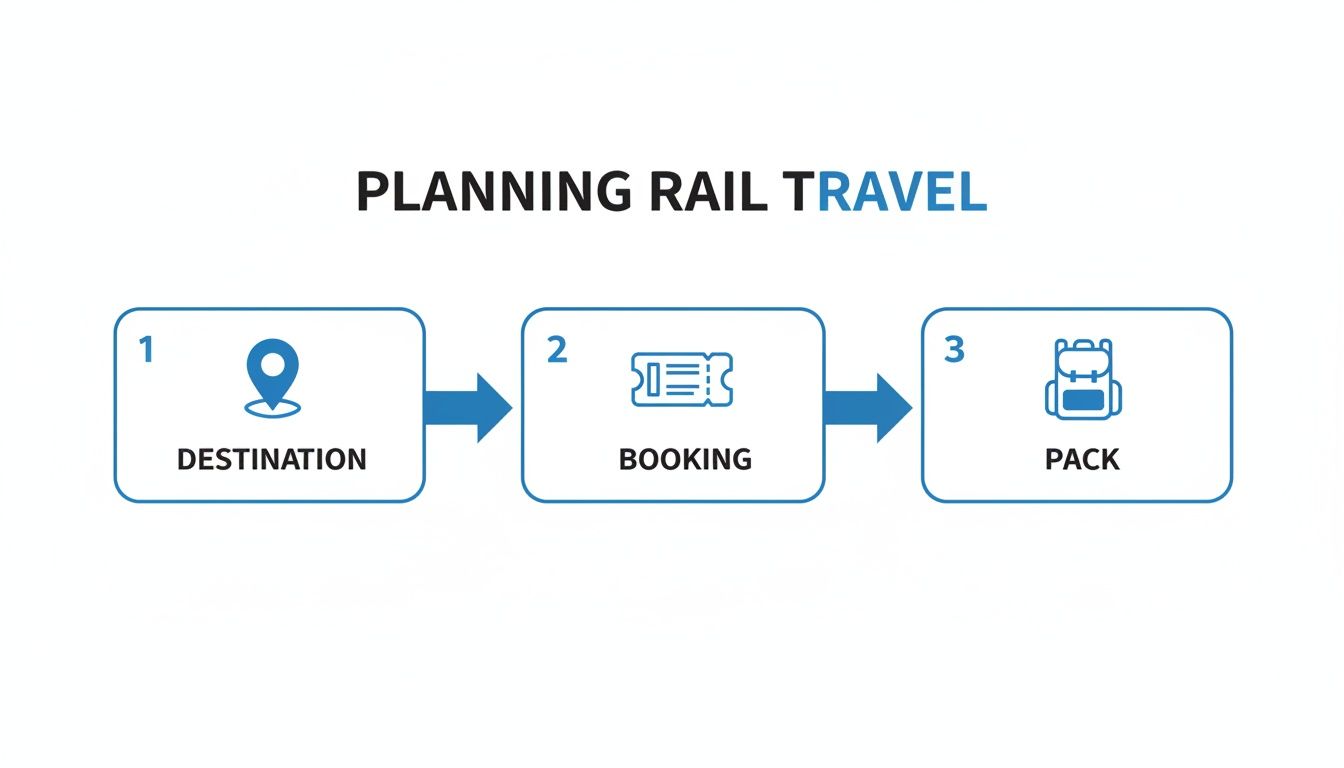
It’s the final, crucial step that pulls everything together after you’ve chosen a destination and booked your transport.
Curating a Minimalist Wardrobe
Packing light really begins with a versatile, capsule-style wardrobe. The secret is choosing items that mix and match to create multiple outfits from a handful of pieces. This lets you pack way less clothing without ever feeling like you have nothing to wear.
Focus on natural, durable fibers like merino wool or organic cotton—they’re breathable, surprisingly odor-resistant, and last for ages. Another game-changer is a high-quality quick-dry travel towel; it takes up a fraction of the space of a regular towel and dries so fast you can cut down on laundry. To keep it all organized, packing cubes are your best friend. They compress everything neatly inside your lightweight travel backpack, making it easy to find what you need without exploding your entire bag on the floor.
Essential Tech for the Modern Eco Traveler
For digital nomads and modern travelers, tech is non-negotiable. But it doesn’t have to be a tangled, heavy mess. The goal is to consolidate and minimize.
The most sustainable gear is the gear you already own. Before buying anything new, see what you have that can be repurposed for travel. That durable backpack or reliable charger you use every day is often the best choice.
Instead of carrying a brick of different chargers and adapters, invest in one quality USB-C charger with multiple ports. Paired with a single high-capacity portable power bank, you can keep all your devices—phone, laptop, and noise-canceling earbuds—charged and ready. A simple cable organizer travel case will prevent that familiar tangled mess and protect your gear, helping it last longer.
You can learn more about building your perfect minimalist kit in our complete guide on how to pack for low-impact travel. A little bit of planning here ensures you stay connected without being weighed down by gear you don’t truly need.
Choosing Stays That Support Local Communities
Your choice of accommodation is one of the most powerful tools you have in your eco travel toolkit. It’s where your money can have an immediate, positive impact. By choosing stays that actively support local communities and the environment, you move beyond being a tourist and become a partner in regenerative travel—the idea of leaving a place better than you found it.
This means looking for more than just a bed for the night. It’s about finding places woven into the fabric of their community. Think of a guesthouse that sources food from local farmers, hires staff from the village, and invests profits back into neighborhood projects. These choices turn your travel budget into a force for good.
Travelers are increasingly making these choices directly. The ecotourism market is booming, and direct bookings now command a 61% revenue share. This shift is huge—it means more of your money goes straight to independent eco-lodges and homestays, bypassing large booking platforms and directly supporting local families. With solo eco-travel also on the rise, the demand for authentic, low-impact stays is stronger than ever. You can explore the full ecotourism market research here.

How to Identify Genuinely Eco-Friendly Stays
It’s easy for a hotel to label itself “green,” but true sustainability runs much deeper. To avoid greenwashing, you need to look for tangible proof that a property is walking the talk.
Here’s a practical checklist to help you vet potential accommodations:
- Look for Certifications: Are they certified by respected third-party organizations? Look for logos from the Global Sustainable Tourism Council (GSTC), Green Key, or B Corp. These verify that a property meets high standards for environmental and social responsibility.
- Check Their Website: Do they have a dedicated sustainability page? Vague statements are a red flag. A genuinely committed place will proudly detail its practices, like its water recycling systems, use of renewable energy, or local hiring policies.
- Read Recent Reviews: Past guests often mention sustainability efforts. Look for comments about refillable water stations, plastic-free initiatives, or connections with local tour guides.
For more in-depth guidance, check out our guide on finding truly environmentally friendly accommodation.
Putting Your Money Where It Matters
Supporting the local community goes way beyond your hotel choice. It’s a mindset you can apply to your daily spending.
Instead of defaulting to familiar global chains, seek out family-run restaurants for a taste of authentic local cuisine. Hire guides who were born and raised in the area; their knowledge and stories will offer a much richer experience. When shopping for souvenirs, buy directly from the artisans who craft them.
Each of these small decisions helps ensure the economic benefits of tourism are distributed fairly. By being mindful of where your money goes, you contribute directly to the well-being and preservation of the destination.
Editor’s Pick: The Osprey Farpoint/Fairview 40 Backpack
For a versatile bag that excels in nearly every travel scenario, the Osprey Farpoint (or Fairview, the women’s specific fit) is a solid choice. It’s sized for carry-on, opens like a suitcase for easy packing, and has a comfortable suspension system that makes navigating train stations or city streets feel effortless. It’s not flashy, but its durable construction and thoughtful design make it a reliable partner for years of low-impact adventures. It’s a perfect example of buying one quality item that eliminates the need for multiple, lesser bags.
Low-Impact Travel Tools (Worth It)
Also, if you’re planning a trip and want to keep things simple, these tools help you travel smoother while staying mindful about impact.
Get an eSIM for reliable data → Disclosure: Partner link. No extra cost to you.
Pre-book a transfer for easy arrivals → Disclosure: Partner link. No extra cost to you.
Key Takeaways
- Prioritize Rail Travel: Choosing trains over planes is the single most effective way to reduce your travel emissions, often by up to 90%.
- Support Local Economies: Stay in locally-owned guesthouses, eat at family-run restaurants, and hire local guides to ensure your money directly benefits the community.
- Pack with Purpose: A minimalist approach with reusable items like a water bottle, solid toiletries, and packing cubes reduces waste and makes travel easier.
- Seek Authentic Stays: Look for accommodations with reputable certifications (like GSTC or B Corp) to avoid “greenwashing” and support genuinely sustainable businesses.
- Travel Slower: Choose a walkable base city for longer stays. This minimizes your transport footprint and allows for a deeper, more immersive travel experience.
FAQ: Your Eco Travel Questions Answered
Stepping into the world of eco travel often brings up a few questions. That’s perfectly normal. We’ve gathered some of the most common ones we hear and answered them in plain language, drawing from our own experiences on the road. The goal here is to cut through the noise, bust a few myths, and give you the confidence to plan a trip with a lighter footprint.
Is eco travel expensive?
Not necessarily. Many eco travel practices, like choosing trains over flights, staying in local guesthouses instead of large resorts, and eating at local markets, can actually save you money. Packing a reusable water bottle also cuts down on the daily cost of buying bottled water.
How can I spot a genuinely eco-friendly hotel?
Look for third-party certifications like GSTC, Green Key, or B Corp on their website. A truly sustainable hotel will also be transparent about its practices, detailing its water conservation, renewable energy use, and community support initiatives. It’s also smart to protect your trip with a policy from a provider like VisitorsCoverage.
What’s the biggest change I can make for a lower impact?
Your mode of transportation. Swapping just one short-haul flight for a train journey can reduce your carbon emissions for that leg of the trip by up to 90%. If you must fly, you can compare options on Aviasales.
How can I reduce plastic waste while traveling?
Start with a solid toiletry kit: a solid shampoo bar and biodegradable soap eliminate the need for mini plastic bottles. Always carry a reusable water bottle. And when you shop, bring your own packable tote bag to refuse single-use plastic bags.
Are carbon offsets a good solution?
Carbon offsets should be a last resort, not a first step. The primary focus should always be on reducing your emissions first—by choosing trains, packing light, and conserving energy. If you do choose to offset, ensure the project is verified by a reputable standard like Gold Standard or Verra.
How does eco travel benefit local communities?
By making conscious choices to spend your money at locally-owned businesses—from your accommodation to the guide you hire—you ensure that the economic benefits of tourism stay within the community. This supports local livelihoods and empowers residents directly.
What are some good destinations for a first-time eco traveler?
Costa Rica is a world leader in ecotourism and a fantastic choice. In Europe, countries with excellent rail networks and a strong green focus like Switzerland, Austria, and Slovenia are perfect for a train-first adventure.
How can I stay connected sustainably as a digital nomad?
Instead of buying a new plastic SIM card in every country, use an eSIM service like Airalo or Yesim. This reduces electronic waste and simplifies staying connected across borders. Also, a good laptop privacy screen is essential for working in public spaces.
Join the Sustainable Work Movement
Want more rail-first itineraries, low-impact packing systems, and walkable base-city ideas?
