
Choosing ecotourism in Costa Rica isn’t just about seeing a beautiful country. It’s about stepping into a story of conservation and community, one that you actively help write with every choice you make. For digital nomads and slow travelers, it’s a rare chance to weave work into a genuinely low-impact adventure that goes way beyond a standard vacation.
Why Costa Rica Is a Global Ecotourism Leader
Costa Rica’s deep green roots aren’t some recent marketing trend; they’re embedded in the national soul. The country made a series of incredibly forward-thinking moves decades ago, like abolishing its army in 1949. That single decision freed up enormous funds for education, healthcare, and environmental protection, nurturing a culture of conservation that makes real ecotourism possible today.
This commitment has paid off, both for the planet and the economy. Costa Rica’s tourism sector is valued at $4.35 billion USD in 2025 and is set to grow 8% each year through 2033, with ecotourism as the engine. As more travelers look for authentic eco-lodges and carbon-neutral experiences, the country’s green reputation directly fuels its growth. You can see the numbers in the Costa Rica tourism market report.
More Than Just Nature Walks
True ecotourism here is about getting your hands dirty, figuratively speaking. It means staying in a lodge that’s actively reforesting its land, hiring a tour operator who trains and employs local guides, and knowing that your travel dollars are funding tangible conservation work. It’s about learning, not just looking. You can dive deeper into these ideas in our guide on what ecotourism is.
This guide cuts through the buzzwords to give you a practical blueprint for a long-stay that is genuinely regenerative. We’ll cover the essentials:
- Identifying Vetted Stays: How to tell the difference between truly sustainable lodges and clever “greenwashing.”
- Low-Impact Travel: Navigating the country with shared shuttles and public transport to keep your footprint small.
- Meaningful Engagement: Finding community-based projects and tours that support local families and offer real cultural exchange.
The view below captures the kind of lush, protected landscape that this model of tourism helps sustain.
By the time you finish this guide, you’ll have a clear roadmap for an adventure that respects both the vibrant culture and the fragile ecosystems of this incredible country. From the misty cloud forests of Monteverde to the wild Osa Peninsula, your journey can be as impactful for Costa Rica as it is for you.
How to Spot Genuinely Sustainable Travel in Costa Rica
Ever feel like you need a decoder ring to figure out which hotels are actually eco-friendly and which are just good at marketing? It’s a real challenge. The term “green” gets thrown around so much that it can start to lose its meaning. This is where knowing what to look for saves you from accidentally supporting a greenwasher.
Thankfully, Costa Rica takes this stuff seriously. The country developed one of the most robust and respected national sustainability programs on the planet, designed to cut through the noise. Learning to spot its official certification is the single best way to ensure your money is going to businesses that walk the talk on conservation and community support.
The heart of the system is the Certification for Sustainable Tourism (CST) program. Think of it less like a simple eco-award and more like a rigorous, ongoing report card for tourism businesses.
Costa Rica’s Certification for Sustainable Tourism (CST)
Developed by the Costa Rican Tourism Board, the CST isn’t a simple pass/fail system. Instead, it scores businesses on a scale of 0 to 5 “leaves,” with five being the gold standard. This rating isn’t a one-and-done deal, either; businesses have to get re-evaluated regularly to prove they’re keeping up their standards.
It’s built on the three core pillars that define what real ecotourism is all about.
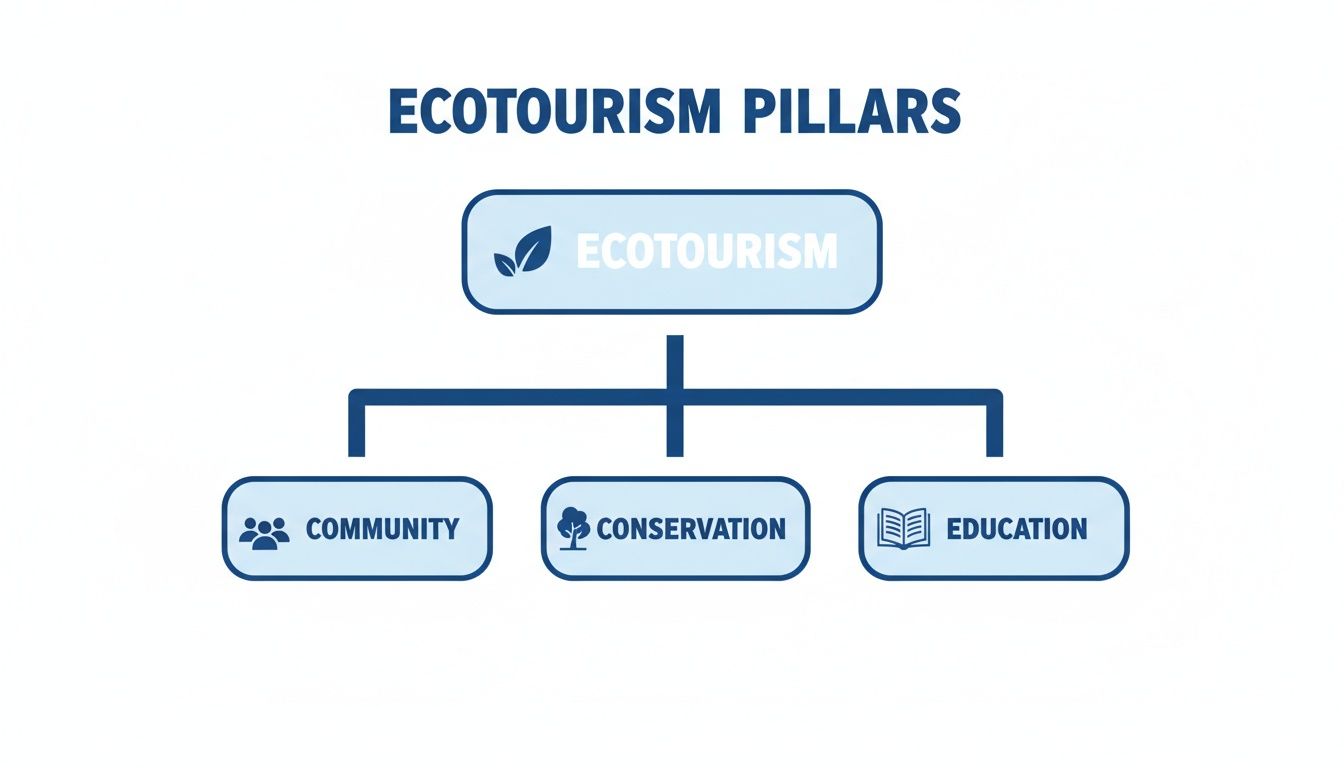
As you can see, it’s a balance. True sustainability needs to support the local community, actively contribute to conservation, and provide meaningful education for both staff and visitors. The CST is designed to measure exactly that.
The criteria are no joke. Auditors look at everything from water and energy use to waste management and how the business protects local plants and animals. Crucially, they also dig into the company’s relationship with its community—do they hire local guides? Do they buy produce from nearby farms? Do they support local culture?
Seeing a high CST leaf rating on a hotel’s website or at their front desk is a very strong signal that you’re looking at an operator who is genuinely invested.
Decoding Costa Rica’s CST Rating System
To make this even clearer, here’s a quick breakdown of what those “leaves” actually mean for you as a traveler. It helps you see beyond just the number and understand the level of commitment behind it.
CST Level (Leaf)
| CST Level (Leaf) | What It Means for the Business | What It Means for You as a Traveler |
|---|---|---|
| Levels 0–1 | Has just started the sustainability process. Basic policies might be in place but are not fully implemented or measured yet. | This is a starting point. The business shows intent, but its impact is still minimal. Better options are likely available. |
| Levels 2–3 | A good level of compliance. The business has solid sustainability programs running and can show measurable results in some areas. | A reliable choice. You can expect responsible practices like recycling, energy-saving measures, and some community involvement. |
| Levels 4–5 | Exemplary performance. The business is a leader, integrating sustainable practices across all operations and actively contributing to conservation. | The gold standard. Your stay directly supports a business that is a model for environmental and social responsibility in its region. |
Looking for businesses with 3 or more leaves is a great rule of thumb. It guarantees you’re supporting an operation that has moved well beyond basic good intentions and into proven, consistent action.
Global Standards and Good Questions
While the CST is your best friend in Costa Rica, it’s also helpful to recognize a few global players. The Global Sustainable Tourism Council (GSTC) sets the international baseline for what sustainability in tourism should look like. A hotel that is GSTC-recognized has met a rigorous global standard, offering another layer of trust.
But certifications aren’t everything. Sometimes, the best tool you have is your own curiosity. A truly committed operator is almost always proud to talk about their work.
Don’t be shy—ask direct questions. It’s one of the most powerful ways to vet a tour or a stay. For a deeper dive on this, check out our full guide on how to choose eco-friendly tour operators.
A few good questions to start with:
- How do you manage your waste and compost?
- Do you source your food and supplies locally?
- Are your guides from the local community? How are they trained?
- What specific conservation projects are you involved with?
A passionate, detailed answer is a fantastic sign. If they get excited telling you about their new water recycling system or the school they support, you know their commitment is real. Vague, generic replies? That’s your cue to keep looking.
Top Regions for Immersive Ecotourism Experiences
Costa Rica’s deep-rooted conservation ethos means you can find pockets of pristine nature almost anywhere. But a few key regions have become true global epicenters for ecotourism in Costa Rica, each a world-class example of how to protect a unique and fragile ecosystem. Picking the right one really comes down to what you hope to experience—misty highland forests, or wild, remote coastlines.
Think of this small nation, roughly the size of West Virginia, as a biological superhighway connecting two continents and two oceans. This geography cooks up hundreds of microclimates, from cool, damp cloud forests to humid mangrove swamps. It’s exactly why the country packs an incredible 5% of the world’s biodiversity, making every region a distinct universe to explore.
By focusing your trip on just one or two of these hotspots, you can seriously cut down on travel time and your carbon footprint. This slow-travel mindset is key. It allows for a much richer connection to the place, its wildlife, and the local communities working tirelessly to keep it wild.
Monteverde The Mystical Cloud Forest
High up in the Tilarán mountain range sits Monteverde, a name that immediately brings to mind mist-draped forests, elusive birds, and iconic hanging bridges. It’s more than a place; it’s an atmosphere. The constant moisture creates an ethereal world where every tree is cloaked in a thick blanket of orchids, mosses, and bromeliads.
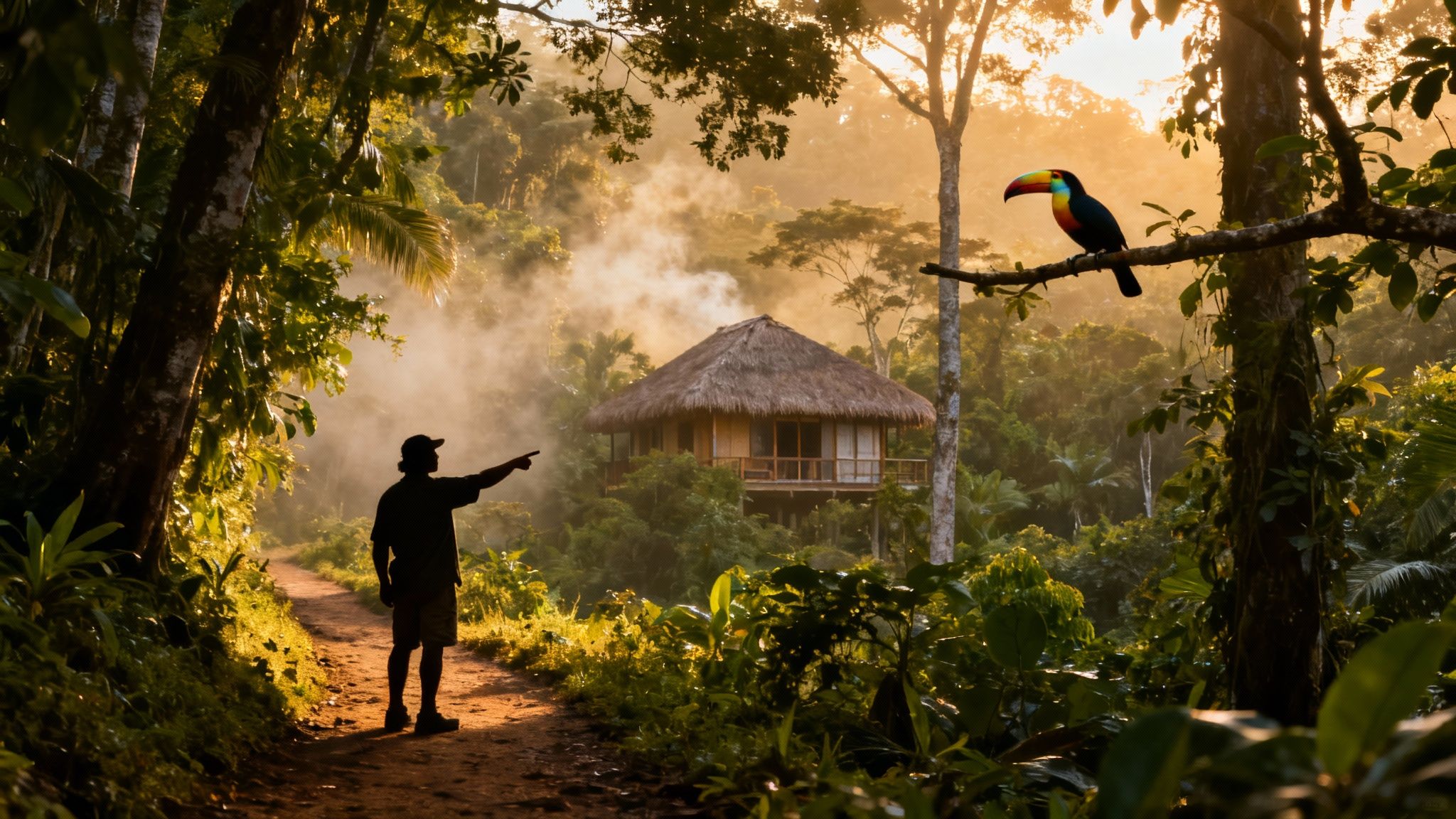
This region is a textbook case of community-led conservation. The Monteverde Cloud Forest Biological Reserve, for instance, wasn’t established by the government but by Quakers and local residents who saw how ecologically vital the area was and decided to protect it themselves.
Low-impact activities are the soul of the Monteverde experience:
- Guided Night Walks: Discover the forest’s hidden nocturnal life, from sleeping birds and glowing fungi to bizarre insects and glass frogs.
- Sustainable Coffee Tours: Visit a small, family-run farm to learn about shade-grown coffee, a practice that preserves critical habitats for migratory birds.
- Community Reserves: Explore smaller, community-managed reserves like the Santa Elena Cloud Forest Reserve, where your entrance fee goes directly toward supporting local schools.
For a truly immersive stay, look at an eco-lodge like Hotel Belmar, which holds a top-tier CST rating for its farm-to-table restaurant, on-site conservation projects, and deep community roots.
The Osa Peninsula A Biodiversity Hotspot
Often called “the most biologically intense place on Earth” by National Geographic, the Osa Peninsula is wild, raw, and completely unforgettable. This is where you’ll find Corcovado National Park, which shelters the last major tract of tropical rainforest in Pacific Mesoamerica. Getting here takes more effort, which is a good thing—it naturally keeps the crowds thin and the nature pristine.
This is the place for serious wildlife spotting. The peninsula is a stronghold for jaguars, Baird’s tapirs, and all four of Costa Rica’s monkey species. The regenerative lodges here aren’t just hotels; they’re active conservation hubs, often buying up and protecting surrounding land to create vital wildlife corridors. You can find excellent flights to get you closer to this incredible destination.
International visitor data reveals interesting shifts for sustainable travel. In 2025, Costa Rica logged 2.689 million air arrivals, a slight 1% increase from 2024. While North America remains the biggest market, visitors from South America jumped by 14.5%, showing a growing draw from new regions to these unique eco-destinations. You can dig into Costa Rica’s tourism market trends here.
Tortuguero A Sanctuary for Sea Turtles
Over on the Caribbean coast lies Tortuguero National Park, a labyrinth of freshwater creeks and lagoons accessible only by boat or small plane. This isolation has turned it into a sanctuary for countless species, but its main claim to fame is being the most important nesting ground for green sea turtles in the entire Western Hemisphere.
The whole community’s rhythm is built around turtle conservation. From July to October, you can join a guided, low-light night tour to watch female turtles haul themselves ashore to lay their eggs—a powerful experience governed by strict rules to prevent any disturbance.
The core principle in Tortuguero is observation without interference. Guides are trained to use special red-light torches and maintain a respectful distance, ensuring the turtles can complete their ancient nesting ritual undisturbed.
Beyond the turtles, exploring the canals by canoe or silent electric motorboat offers incredibly intimate encounters with monkeys, sloths, and a dizzying array of bird species. It’s a perfect model of an economy built from the ground up on the principles of ecotourism in Costa Rica.
Editor’s Pick: Our Top Regenerative Stay
For an unparalleled experience in the Osa Peninsula, we recommend Lapa Rios Lodge. This award-winning eco-lodge is set in a 1,000-acre (405 hectares) private reserve and serves as a model for regenerative tourism. They hire exclusively from the local community, fund the local primary school, and their guided tours directly contribute to wildlife monitoring and reforestation projects. It’s a stay that actively improves its environment.
Planning Your Low-Impact Itinerary
How you move through Costa Rica is just as important as where you sleep. For genuine ecotourism in Costa Rica, your itinerary isn’t just a list of places—it’s a plan for minimizing your footprint. It’s about slowing down and connecting with the country on a much deeper level.
This means consciously stepping away from the easy convenience of domestic flights and private car rentals. Yes, they’re fast, but their environmental price tag is high. Instead, you can embrace ground travel that’s lighter on the planet and, honestly, far richer in experience.
Simply grouping your destinations by region—say, spending a solid week exploring Monteverde before heading down to the Guanacaste coast—slashes your travel time and emissions. This slow-travel mindset isn’t just better for the environment; it saves you from travel burnout and lets you truly soak in each place. For getting to your accommodation from the airport, a service like Welcome Pickups can be a convenient and reliable option.
Shared Shuttles: Your Eco-Friendly Middle Ground
Shared shuttles are one of the best tools for the eco-conscious traveler in Costa Rica. These comfortable, air-conditioned vans connect all the major tourist hubs, striking a fantastic balance between convenience, cost, and a much lower environmental impact than going private.
Companies like Interbus or Caribe Shuttle run daily routes between hotspots like La Fortuna, Monteverde, and Manuel Antonio. Because you’re sharing the ride, the per-person carbon emissions drop significantly. A typical route, like the one from San José to La Fortuna, will run you about $55 USD (around ₡29,000 CRC).
Booking is simple and usually handled online, often with door-to-door service that saves you the hassle of getting to and from a central bus terminal.

The Public Bus: Authentic and Ultra-Low-Cost
For the more adventurous and budget-minded, Costa Rica’s public bus network is a fantastic, incredibly low-carbon way to get around. This is how locals travel, so it offers a real window into daily Tico life. It takes a bit more planning and flexibility, but the rewards are huge.
The network connects almost every town and village, though you might need to transfer in a hub like San José for longer trips. Fares are a bargain; a journey that costs $55 USD by shuttle could be as little as $10 USD (₡5,300 CRC) on a public bus. Just make sure you have small bills in Costa Rican Colones on hand.
Low-Carbon Transport Options in Costa Rica
Choosing how to get around involves trade-offs between your budget, your schedule, and your carbon footprint. This table breaks down the most common options to help you plan a lighter journey.
Transport Mode
| Transport Mode | Average Cost (USD) | Carbon Footprint | Best For |
|---|---|---|---|
| Public Bus | $5 – $15 | Very Low | Budget travelers, authentic experiences, and minimal environmental impact. |
| Shared Shuttle | $40 – $65 | Low | A comfortable, convenient balance for connecting major tourist destinations. |
| Electric Vehicle Rental | $60 – $90 per day | Low (with green grid) | Flexibility to explore remote areas, assuming access to charging stations. |
| Private Transfer/Taxi | $100 – $250+ | High | Speed and convenience for specific routes, but with a significant carbon cost. |
| Domestic Flight | $70 – $150 | Very High | Covering long distances quickly, but the least sustainable option by far. |
As you can see, sticking to ground transport like public buses and shared shuttles is the clearest path to lowering your travel emissions within the country.
Local Transport: Walkable Towns and E-Bikes
Once you’ve arrived in a new area, your focus shifts to local mobility. Choosing a base in a walkable town like Tamarindo or Santa Teresa lets you explore on foot, putting money directly into local shops and cafés as you wander.
For venturing a bit further, renting an e-bike is a brilliant, zero-emission way to see the surrounding countryside.
By weaving these methods together, you create an itinerary that’s both gentle on the earth and deeply fulfilling. If you’re curious about the numbers behind your choices, you can get a clearer picture with our travel carbon footprint calculator. This thoughtful approach ensures your adventure actively contributes to the conservation ethos that makes Costa Rica so special.
Living Sustainably as a Digital Nomad
True ecotourism in Costa Rica, especially when you’re staying for a while, isn’t just about the tours you book or the lodges you sleep in. It’s about weaving sustainability into your daily life. The real impact comes when your eco-conscious mindset extends from big travel choices right down to your everyday habits. This is what shifts your presence from a temporary visitor to someone who’s actually contributing to the local community and environment.
As a digital nomad, your daily routine sends ripples through the local system. Simple choices—where you buy your groceries, how you manage your waste—can either support local families or put a strain on local infrastructure. By consciously adopting lighter habits, you’re living in tune with the country’s Pura Vida ethos and making your remote work experience genuinely regenerative.
It’s all about creating a sustainable rhythm that benefits both you and the place you’ve decided to call your temporary home. The goal isn’t just to leave a small footprint, but a positive trace.
Embracing Zero-Waste Daily Practices
One of the most direct ways to lighten your impact is to tackle single-use plastics head-on. Costa Rica has made huge strides in this area, but as a traveler, you have the power to help push that progress forward. It all starts before you even leave home with a thoughtfully packed, zero-waste kit.
Here are a few non-negotiables:
- A reusable water bottle with a built-in filter. This is essential. It completely eliminates the need for plastic bottles and gives you access to safe drinking water pretty much anywhere.
- Solid toiletries. Shampoo bars, conditioner bars, and toothpaste tabs are game-changers. They save space, last for ages, and cut out plastic packaging entirely.
- A reusable shopping bag and some small produce bags. Perfect for trips to the local market; you’ll never need a plastic bag for your fruit and veg again.
- A portable cutlery set. Such a simple thing, but it lets you politely refuse disposable utensils when you’re grabbing a quick bite to eat.
Shopping Local at Ferias
If you want to live sustainably, shop where the locals do. Nearly every town has a weekly feria del agricultor, or farmers’ market. This is where you’ll find the freshest seasonal produce, local cheeses, and artisanal goods—all sold directly by the people who grew or made them.
Shopping at a feria accomplishes a few incredible things:
- It directly supports local farming families. Your money goes straight into the community, completely bypassing corporate supply chains.
- It drastically reduces food miles. The food travels a tiny distance from the farm to your bag, which massively lowers its carbon footprint.
- It connects you with the local culture. You get to practice your Spanish, learn about unfamiliar fruits and vegetables, and experience a genuinely vibrant part of daily Costa Rican life.
This is what that mindful, local-first workspace can look like.
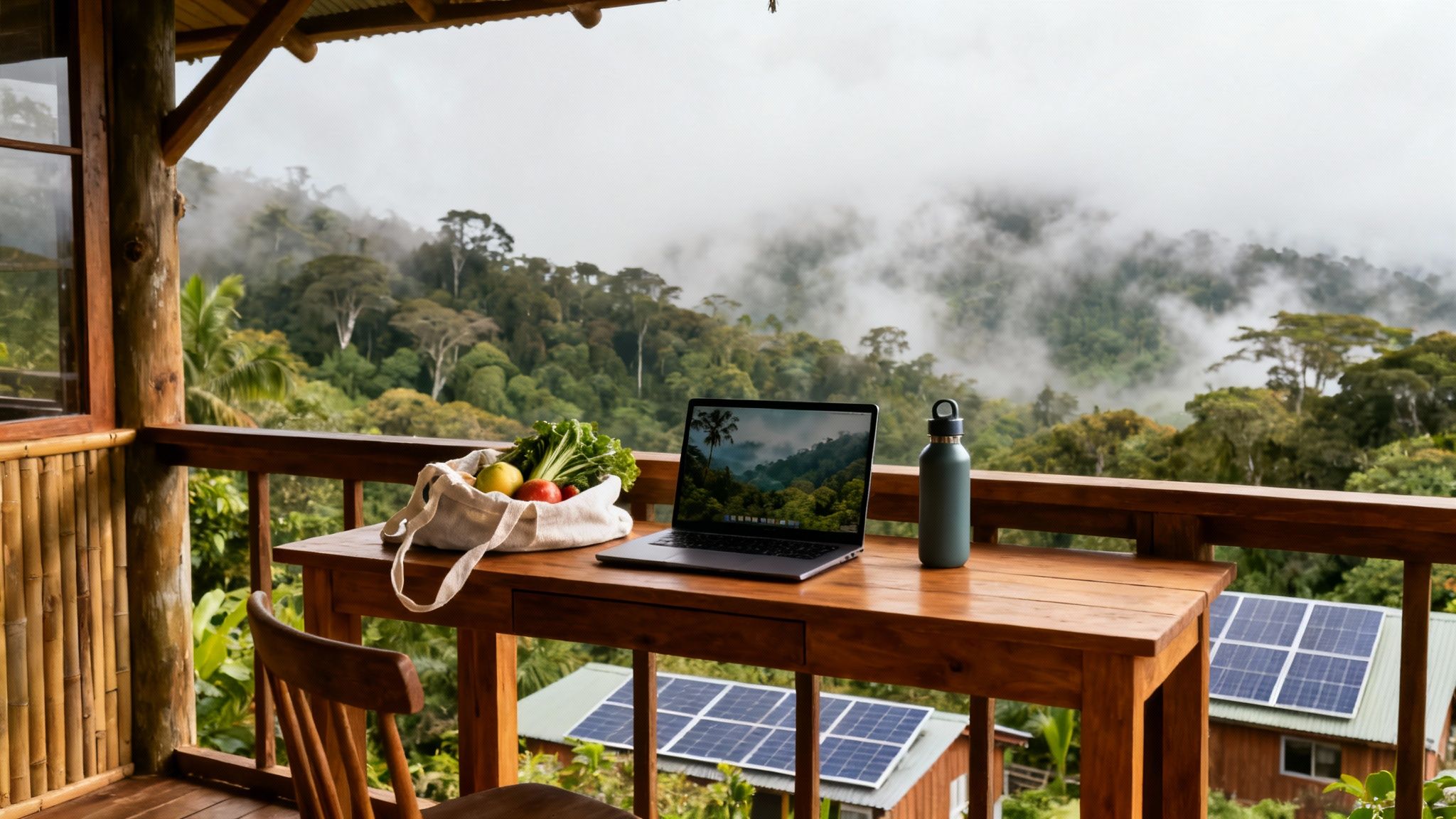
It’s about integrating fresh, locally sourced food and sustainable habits right into your daily work routine.
Wellness and Regenerative Living
The link between personal well-being and environmental health is becoming a huge part of modern travel. The opportunity for wellness-focused ecotourism in Costa Rica is growing fast, especially for long-stay travelers. In fact, wellness-minded visitors tend to stay 2.4 days longer than the average tourist, generating more income for local spas, organic restaurants, and nature guides. This trend is a perfect fit for digital nomads looking for a balanced, regenerative lifestyle. You can dig into Costa Rica’s tourism market trends here.
This means seeking out experiences that nourish both you and the local ecosystem. Think yoga retreats that source food from their on-site organic gardens or farm-to-table restaurants that build their menus around local ingredients. These choices not only provide a deeply restorative experience but also support sustainable agriculture.
Living sustainably also means keeping an eye on your digital footprint. Be mindful of your energy consumption while you work and try to use cloud services powered by renewable energy. For more ideas on blending work with responsible travel, you might find our guide on green travel for digital nomads useful. By weaving these practices into your life, you can make your stay in Costa Rica a true model of modern, mindful travel.
Putting It All Together: Your Costa Rica Ecotourism Plan
This is where theory meets the trail. You’ve learned how to spot genuine eco-lodges, why slow travel matters, and how to pack a lighter footprint. Now it’s time to weave those threads into a real itinerary.
The goal isn’t perfection. It’s about making a series of thoughtful choices that, together, create a trip that gives back more than it takes. Think of it less as a rigid checklist and more as a mindset—one that prioritizes the health of Costa Rica’s wild places and the prosperity of its communities.
To help you get there, we’ve boiled down the most important habits into a quick-reference list. Consider this your back-pocket guide to making sure your adventure is as regenerative as it is memorable.
Responsible travel is a skill you build over time, not a switch you flip once. This article was fact-checked using sustainability data from the World Green Building Council, the Global Ecotourism Network, and peer-reviewed architecture studies. All partner links are vetted for compliance with sustainable business certifications. By staying curious and asking good questions, you become part of that forward momentum.
Key Takeaways
- **Certifications First:** Make high-level CST (Certification for Sustainable Tourism) ratings or GSTC recognition your first filter. It’s the simplest way to back genuinely vetted businesses.
- **Travel Light on Carbon:** Ditch domestic flights and private cars. Shared shuttles and public buses dramatically shrink your carbon footprint as you move between regions.
- **Pack for Zero Waste:** Your packing list is your first line of defense. A reusable water bottle with a filter, solid toiletries, and a few tote bags will slash your reliance on single-use plastic.
- **Keep Your Money Local:** Eat at the family-run sodas, shop at the weekend ferias (farmers’ markets), and always hire local guides. This ensures your travel spending directly supports the community you’re visiting.
- **Be a Good Guest:** Learn a few Spanish phrases. Respect local customs. Follow wildlife viewing rules without exception. Your presence should feel positive and respectful, not disruptive.
- **Embrace Slow Travel:** Instead of rushing to see everything, pick one or two regions and go deep. You’ll cut down on travel emissions and forge a much stronger connection to the place and its people.
Join the Sustainable Work Movement
Want more rail-first itineraries, low-impact packing systems, and walkable base-city ideas?
Costa Rica Ecotourism FAQs
Planning a trip built around ecotourism in Costa Rica brings up a few practical questions—especially if you’re staying longer as a digital nomad. Use this section to make smarter bookings, avoid greenwashing, and keep your footprint as light as possible.
Trip Timing and Seasons
1) What’s the best time for ecotourism in Costa Rica?
The best time depends on what you want to prioritize.
- Dry season (Dec–Apr): Best for sun, beaches, and easier road conditions, but it’s also the busiest and most expensive.
- Green season (May–Nov): Fewer crowds, richer rainforest conditions, and often better prices. Afternoon rain is common, but mornings are frequently clear.
If you want a quieter, more “slow-travel” experience, the green season is usually the sweet spot.
2) Is the green season still good for wildlife and tours?
Yes—often better. Rain boosts forest activity, rivers run higher for boat routes, and many species are easier to spot.
Pack a light rain shell and plan outdoor adventures for mornings. Save indoor work blocks for afternoons.
3) When is sea turtle nesting season in Tortuguero?
Generally July to October is peak for green turtle nesting in Tortuguero, but exact timing can vary year to year.
Always book a licensed night tour and follow strict red-light rules so nesting turtles aren’t disturbed.
4) How long should I stay to do ecotourism in Costa Rica the “right” way?
For a truly low-impact trip, aim for 10–21 days or choose one region for a longer base stay.
Fewer long-distance transfers = lower emissions, less burnout, and deeper connection with the community.
Eco Certifications and Avoiding Greenwashing
5) What is the CST certification, and why does it matter?
CST (Certification for Sustainable Tourism) is Costa Rica’s respected national rating system that evaluates sustainability across operations.
- 0–1 leaves: early-stage efforts
- 2–3 leaves: solid measurable programs
- 4–5 leaves: industry-leading sustainability
A good rule of thumb is to prioritize businesses with 3+ leaves.
6) What are the biggest signs of greenwashing at a hotel or tour?
Look for specifics, not slogans. Red flags include:
- Vague claims like “eco-friendly” without certifications or data
- No explanation of waste, water, energy, or local hiring practices
- “Nature tours” that ignore visitor limits or wildlife distance rules
Ask direct questions. Proud, detailed answers are usually a good sign.
7) Is GSTC recognition important in Costa Rica?
It’s a helpful global benchmark. GSTC sets international standards, so a GSTC-recognized property or operator typically signals strong, verifiable practices.
In Costa Rica, CST is often the most locally relevant filter, but GSTC can add confidence.
8) What questions should I ask an eco-lodge before booking?
Use questions that reveal real practices:
- How do you manage waste and compost?
- What % of staff and guides are hired locally?
- Do you measure water and energy use?
- Which conservation projects do you fund or run?
Transport and Building a Low-Carbon Itinerary
9) What’s the most sustainable way to get around Costa Rica?
The lowest-impact options are:
- Public buses: very low emissions and the most budget-friendly
- Shared shuttles: convenient and still far lower impact than private transfers
- Walkable base towns + e-bikes: reduces daily transport emissions
Try to minimize domestic flights and long private transfers whenever possible.
10) Are shared shuttles actually eco-friendly?
They’re a strong “middle ground.” Sharing a single vehicle among multiple travelers significantly reduces per-person emissions compared to private transfers.
If your schedule is tight, shared shuttles often deliver a better footprint-to-convenience balance.
11) Should I rent a car for an ecotourism trip?
Only if your route genuinely requires it. If you do rent:
- Choose a single region to avoid long drives
- Carpool with other travelers when possible
- Consider an EV only if you have reliable charging access
For many classic routes (La Fortuna, Monteverde, Manuel Antonio), buses and shuttles work well.
12) What’s the best low-impact itinerary structure?
Cluster by region and slow down:
- Pick 1–2 hubs (e.g., Monteverde + Nicoya)
- Stay longer in each place (5–10 nights)
- Use ground transport between hubs
This reduces emissions and makes the trip feel calmer and more immersive.
Digital Nomad Practicalities
13) Is Costa Rica good for digital nomads—Wi-Fi, workspaces, and reliability?
Yes, especially in popular nomad zones and eco-lodges that cater to longer stays. Still, it varies by region.
- Ask for a recent speed test if you need video calls
- Have backup internet (hotspot or eSIM)
- Choose a base with coworking options if you need consistent bandwidth
14) What’s the simplest connectivity setup for a long stay?
Use a dual-layer plan:
- Primary: your accommodation’s Wi-Fi
- Backup: an international eSIM like Airalo
This keeps you covered during transfers, remote stays, and occasional outages.
15) Is Costa Rica safe for solo travelers and remote workers?
Costa Rica is widely considered one of the safer countries in the region, but common-sense precautions matter.
- Keep valuables secure in transit hubs and busy beaches
- Avoid isolated areas late at night
- Use reputable shuttles and licensed guides for remote parks
16) Do I need travel insurance for ecotourism activities?
Strongly recommended—especially if you’ll do hiking, boating, wildlife tours, or remote-region travel.
For coverage options, you can compare plans with Visitors Coverage.
Budget, Ethics, and Impact
17) How much should I budget for a sustainable trip in Costa Rica?
A realistic range for a sustainable, locally supportive trip is often $75–$150/day, depending on region and season.
Prioritize locally owned lodging, family-run sodas, and licensed guides for the best community impact.
18) How can I make sure my money supports local communities?
Use a simple “local-first” checklist:
- Stay at locally owned or community-rooted lodges
- Eat at sodas and shop at ferias
- Hire local, certified guides
- Choose tours that directly fund conservation
19) What are the most responsible wildlife-viewing rules?
Keep it simple and strict:
- No feeding wildlife
- Keep a respectful distance (follow your guide’s standards)
- No flash photography (especially at night)
- Stay on trails and follow park rules
In places like Tortuguero, these rules protect nesting behavior and survival rates.
20) What’s the single best “first step” to plan ecotourism in Costa Rica?
Choose your base region first, then filter stays by CST (3+ leaves) or credible sustainability proof.
Once your lodging is aligned, building a low-impact itinerary with shuttles/buses becomes much easier.
