

Picking an environmentally friendly accommodation is one of the biggest levers you can pull as a traveler. It’s about choosing a hotel, rental, or guesthouse that’s actively trying to shrink its footprint through smart design, resource conservation, and real community support. Consequently, this moves way beyond buzzwords to embrace genuine sustainable habits.
What Defines Environmentally Friendly Accommodation
At its heart, an environmentally friendly accommodation commits to operating in harmony with the local ecosystem and community. It’s a holistic approach that thinks about everything from where the building materials came from to how waste gets managed. This goes far deeper than just asking you to reuse your towels. In fact, it’s baked into the property’s identity and daily operations.
For digital nomads and slow travelers, this means finding a place that aligns with a low-impact lifestyle. Think of it this way: a conventional hotel is like a typical commuter car, just getting you from A to B. An eco-friendly stay, on the other hand, is like a well-designed electric bicycle—efficient, quiet, and deeply connected to its surroundings. It offers a more mindful and often more authentic experience.

Core Principles of Green Stays
So, what are the tangible things that make a property truly green? It usually boils down to a few key areas that work together to minimize their negative impact. These aren’t just ideals on a website; they’re put into practice every single day.
- Energy Conservation: This includes using renewable energy sources like solar panels, installing energy-efficient LED lighting, and using smart thermostats to cut down on power consumption. Many are even designed with passive heating and cooling in mind from the start.
- Water Stewardship: Green stays often use low-flow toilets and showerheads, which can slash water usage. Some even have advanced systems for rainwater harvesting and recycling greywater for things like garden irrigation.
- Waste Reduction: A huge focus is on minimizing what gets sent to the landfill. This means comprehensive recycling and composting programs, ditching single-use plastics, and sourcing products with minimal packaging.
- Community Support: True sustainability is also about people. This means hiring local staff, paying fair wages, and sourcing food and supplies from local farmers and artisans. It ensures that tourism money actually benefits the host community. You can learn more about this big-picture concept in our guide to sustainability in travel and tourism.
The Growing Demand for Sustainable Travel
This shift toward eco-consciousness isn’t just some niche trend; it’s becoming a mainstream expectation. Recent data shows that in 2025, a remarkable 93% of global travelers want to make more sustainable travel choices. This highlights a massive change in traveler priorities over the last decade.
Crucially, 53% of travelers are now also considering the impact of tourism on local communities, not just the environment. Simple habits, like turning off the air conditioning when leaving a room, have jumped from being practiced by 43% of travelers in 2020 to 67% in 2023, showing a real shift in everyday behavior. You can read the full research from Booking.com’s Sustainable Travel Report.
How to Find Environmentally Friendly Accommodation and Avoid Greenwashing
As more of us look for responsible travel options, we run into the tricky problem of “greenwashing”—when a property slaps an “eco-friendly” label on its website without doing the real work to back it up. Distinguishing a genuine commitment from clever marketing is the key to making sure your money supports places that actually care.
Vague claims like “eco-friendly” or “green” are basically meaningless without proof. True sustainability is something you can see and measure. It’s transparent. It’s about looking past the buzzwords for hard evidence of what a place is actually doing day-to-day to lower its impact.
The good news is, you don’t need to be a sustainability expert to figure this out. Once you know what to look for, you can quickly tell who’s walking the talk. It’s all about shifting your focus from marketing fluff to concrete actions.
Understanding Reputable Eco-Certifications
The most straightforward way to verify a property’s green claims is to look for third-party certifications. These labels aren’t just for show; they force hotels to meet strict, audited criteria covering everything from energy efficiency and water use to fair labor practices. They are your best defense against greenwashing.
Think of them like an organic food label—it’s an independent guarantee that specific standards have been met. For a deeper dive, you can explore our guide on how to avoid greenwashing in your travel choices.
When you’re booking your next stay, keep an eye out for these top-tier certifications. They’re a reliable shortcut to finding a truly environmentally friendly accommodation. Here’s a quick rundown of some of the most respected labels in the sustainable travel world.
Key Eco-Certifications at a Glance
This table helps you quickly identify and understand the most reputable certifications for environmentally friendly accommodation.
| Certification | Focus Area | What It Means for You |
|---|---|---|
| Green Key | Environmental management and sustainability education. | Indicates a commitment to strict environmental standards, often found in European hotels. |
| GSTC Certified | Social, environmental, cultural, and management principles. | The gold standard for sustainable tourism, ensuring a holistic approach to sustainability. |
| LEED | Green building design, construction, and operation. | Focuses on the physical building’s efficiency in energy, water, and materials. |
| EarthCheck | Scientific benchmarking and performance improvement. | Shows the property actively measures and manages its environmental impact over time. |
Seeing one of these logos is a great sign, but what if a place doesn’t have one?
Looking Beyond the Labels
While certifications are a fantastic starting point, not every small, independent eco-lodge can afford the lengthy and expensive certification process. That doesn’t mean they aren’t doing amazing work. You can still spot a genuinely green stay by digging a little deeper into their daily operations.
Look for specific, tangible details on their website or in recent guest reviews. Do they proudly mention that their electricity comes from solar panels? Do they talk about a rainwater harvesting system or greywater recycling? These aren’t marketing buzzwords; they’re real, functional systems.
A truly sustainable property will also be transparent about its waste policy. This means getting rid of single-use plastics, providing refillable toiletries, and running a serious recycling and composting program. Another excellent sign is a connection to the local food system, like sourcing from nearby farms or growing their own produce in an on-site organic garden. This shows a deep commitment to both the environment and the local community.
This shift in traveler demand is driving huge market growth, with the global ecotourism market projected to hit $279.41 billion by the end of 2025. That growth is powered by the 84% of travelers who now say sustainable travel is important to them. In Europe, countries like Sweden and Denmark are packed with Green Key certified properties, making them excellent, rail-accessible bases for a low-impact trip. You can find more details in the latest ecotourism statistics and research.
Inspiring Examples of Eco-Friendly Accommodation in Action
Reading about sustainability theory is one thing, but seeing it brought to life is what really sparks the imagination. It’s another thing entirely to see green practices woven into beautiful, innovative, and memorable travel experiences. All around the world, pioneering properties are proving that choosing an environmentally friendly accommodation doesn’t mean sacrificing comfort or style.
These places serve as powerful case studies, each with a unique story and approach. They showcase how a deep commitment to the planet can create exceptional stays, from geodesic domes nestled in the Swiss Alps to bamboo treehouses in a tropical jungle. Their success provides real, tangible inspiration for planning your own low-impact journey.
The global demand for these kinds of authentic experiences is growing fast. A recent Statista travel survey report found that by January 2025, 35% of British travelers were actively considering eco-friendly hotels to lessen their environmental impact. This lines up with a broader global sentiment where 83% of travelers now prioritize sustainable travel, pushing properties to adopt certifications like LEED and Green Key.
For digital nomads and rail-first travelers, this shift means a wider network of incredible eco-stays in walkable hubs and remote corners alike.
Leaders in Regenerative and Low-Impact Stays
Let’s look at a few remarkable examples that set the standard for what’s possible.
Whitepod in Switzerland: High in the Swiss Alps, these iconic geodesic domes are a masterclass in low-impact design. Their unique shape requires 30% less energy for heating compared to conventional buildings, and they’re minimally invasive to the landscape, preserving the pristine alpine environment. It’s an ideal stop on a European rail itinerary.
Bambu Indah in Bali, Indonesia: More than just a hotel, this is a living, breathing model of permaculture. The antique Javanese teak wood houses were carefully relocated and restored, and the property features natural swimming pools cleaned by plants. Their commitment extends to an on-site organic farm that supplies the kitchen, creating a closed-loop system you can taste and feel.
Saffire Freycinet in Tasmania, Australia: This luxury lodge demonstrates that high-end travel can be carbon-neutral. The property has invested heavily in restoring the local ecosystem, planting over 30,000 native species on-site. Their operations are powered efficiently, and they work closely with local conservation programs to protect the region’s unique biodiversity.
Azulik in Tulum, Mexico: For a truly immersive natural experience, Azulik offers handcrafted treehouses built from local wood that blend seamlessly into the jungle canopy. The villas are designed to operate without electricity or air conditioning, encouraging guests to reconnect with nature’s rhythms. It’s a compelling example of what you can find in our guide to off-grid lodging for eco-nomads.
The decision tree below offers a simple framework for spotting promising green stays during your own research.
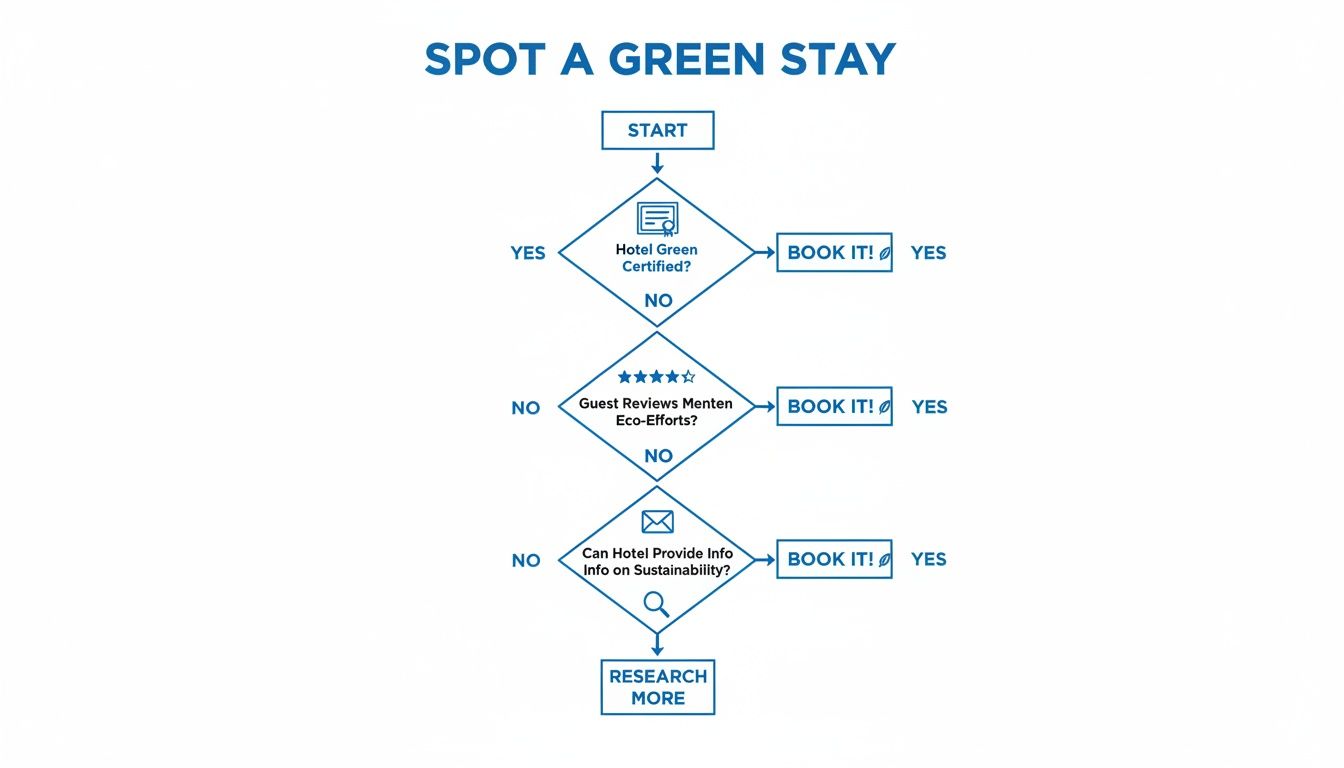
This visual guide breaks down a three-step process: check for official labels, read reviews for eco-mentions, and contact the hotel directly to verify its sustainability claims.
Editor’s Pick for an Environmentally Friendly Accommodation
For a stay that truly embodies regenerative principles, consider Bambu Indah in Bali, Indonesia. It’s more than just an eco-hotel; it’s a living example of sustainable design in action.
With structures built from locally sourced bamboo, natural river swimming pools, and an on-site permaculture farm that supplies its kitchen, it offers a deeply immersive experience. It’s an excellent choice for travelers who want to see sustainability not just as a policy but as a philosophy. It is easily accessible from Denpasar (DPS) airport, which can be reached via many international hubs. You can find affordable flights on Aviasales.
The Unexpected Benefits of Choosing Sustainable Stays
Choosing an environmentally friendly accommodation isn’t just about doing the right thing for the planet—it can seriously upgrade your entire trip. When you opt for a sustainable stay, you’re often stepping off the beaten tourist track and into a more authentic, memorable experience. It’s a choice that pays off for the destination and for you.
These places are often smaller, locally owned, and woven into the fabric of their surroundings. This opens the door for genuine connections you just won’t find in a massive, cookie-cutter hotel chain. You might get insider tips from a host who’s lived there their whole life or enjoy a meal made with ingredients grown a few steps from your room.
It’s about fostering a richer, more immersive way to travel. Instead of just looking at a culture from the outside, you get a small taste of what it’s like to be part of it. These deeper connections with people and nature are often the moments that stick with us long after we’ve unpacked. For more ideas on enhancing your journey, check out our complete green travel guide for 2025.
The Surprising Financial Perks
Let’s bust one of the biggest myths in travel: that going green always costs more. In reality, choosing an environmentally friendly stay can be a brilliant move for your wallet. Because these properties are designed from the ground up to be efficient, they save a ton of money on day-to-day operations.
Think about it: solar panels slash electricity bills, low-flow fixtures cut water costs, and sourcing food locally minimizes expensive transport. Those savings can be passed directly on to you. In fact, some studies show eco-friendly hotels can be up to 39% cheaper than their conventional counterparts, potentially saving you around $151 USD per night.
For digital nomads, slow travelers, and anyone on a budget, this is a game-changer. It proves that making a responsible choice doesn’t have to mean a bigger budget. Your decision supports a healthier planet and a healthier travel fund, letting you travel longer and more thoughtfully.
Better Health and Well-Being
Beyond the cultural and financial wins, sustainable stays often give your own well-being a boost. These properties typically put a high priority on creating a healthier indoor environment, and you can really feel the difference.
A key feature of many green accommodations is the use of non-toxic, natural cleaning products and building materials. This reduces your exposure to harsh chemicals, which is especially beneficial for those with allergies or sensitivities.
On top of that, many eco-lodges are designed to maximize natural light and fresh air, creating a more restorative atmosphere. From an organic, locally sourced breakfast to the simple quiet of a garden setting, these small details add up. You end up with a stay that isn’t just good for the environment, but genuinely good for you, too.
Practical Tips for Booking Your Next Green Getaway
Alright, you know what to look for—now it’s time to turn that knowledge into action. Finding and booking a genuinely environmentally friendly accommodation is easier than it used to be, thanks to better search tools and a growing number of properties walking the talk. With a few smart strategies, you can book a stay that really does align with your values.
The trick is to use a layered approach. Start broad with the sustainability filters on major booking sites, then get granular by digging into guest reviews. If you’re still not sure, a quick email directly to the property can clear things up. This method helps you cut through the marketing fluff and find places that are truly committed.

Master the Booking Platform Filters
Your first move should be to make the most of the tools already built into the big travel websites. Platforms like Trip.com have made it much simpler to find greener options with filters designed for this exact purpose.
- Look for ‘Travel Sustainable’ Badges: Most booking platforms now use a special badge or label for properties that meet their sustainability criteria. Make these your priority when you search.
- Use Keyword Searches: If a dedicated filter isn’t cutting it, try searching for terms like “eco-lodge,” “solar power,” “LEED certified,” or “plastic-free” alongside your destination.
- Filter by Property Type: Smaller, locally owned guesthouses and B&Bs often have a much lighter footprint than massive resorts. Try filtering for these kinds of stays to support local economies directly. For more ideas, check out our guide on finding unique eco-friendly lodges.
Read Reviews with a Green Lens
Guest reviews are your best source of on-the-ground intelligence. You just have to know what to look for. Go beyond the usual comments on cleanliness and dig for specific details about their eco-practices.
Scan recent reviews for mentions of sustainability in action. Do people mention the solar panels, the amazing farm-to-table breakfast, the refillable water stations, or the lack of single-use plastics? These are the real-world clues that a property’s commitment is more than just words on a website.
On the flip side, a total absence of these comments—or worse, complaints about excessive waste—can be a quiet red flag.
Smart Questions for Direct Outreach
Found a place that looks promising but still want to be sure? Don’t be afraid to reach out directly. A quick, friendly email with a couple of pointed questions will tell you everything you need to know.
- “Could you tell me a bit about your energy and water conservation measures?”
- “How do you work to reduce waste and move away from single-use plastics?”
- “In what ways does your property support the local community and economy?”
A genuinely sustainable host will be proud to share these details. If you get back vague, corporate-sounding answers (or no answer at all), it’s a good sign that sustainability isn’t their top priority.
For digital nomads, this is also the perfect time to ask about weekly or monthly rates for a longer, lower-impact stay. This approach helps ensure your travel is both responsible and practical, backed by simple tools like an Airalo eSIM for connectivity and a pre-booked Welcome Pickups transfer for a smooth, low-stress arrival.
Key Takeaways for Environmentally Friendly Accommodation
- Look for Proof: Prioritize properties with reputable third-party certifications like Green Key, GSTC, or LEED to avoid greenwashing.
- Use Booking Filters: Leverage the “Travel Sustainable” or similar filters on platforms like Trip.com to easily narrow down your search for vetted eco-stays.
- Check for Specifics: A truly green stay will be transparent about its practices, such as using renewable energy, implementing water-saving measures, and reducing single-use plastics.
- Read Reviews Carefully: Scan recent guest comments for mentions of tangible eco-features like refillable water stations, farm-to-table meals, or effective recycling programs.
- Understand the Benefits: Choosing sustainable accommodation often leads to more authentic cultural experiences, better personal well-being, and can even be more affordable.
- Ask Direct Questions: If in doubt, contact the property directly and ask about their sustainability initiatives. Their willingness to share details is a great indicator of their commitment.
Low-Impact Travel Tools (Worth It)
Also, if you’re planning a trip and want to keep things simple, these tools help you travel smoother while staying mindful about impact.
Get an eSIM for reliable data → Disclosure: Partner link. No extra cost to you.
Pre-book a transfer for easy arrivals → Disclosure: Partner link. No extra cost to you.
Frequently Asked Questions About Environmentally Friendly Accommodation
Even when you know what to look for, the world of eco-friendly stays can bring up a few tricky questions. I get it. To clear things up, here are answers to the most common queries I hear from travelers trying to book a better stay. From budgets to buzzwords, think of this as your quick-start guide to booking with confidence.
Is environmentally friendly accommodation always more expensive?
Not at all. This is probably the biggest myth out there. While you can definitely find high-end luxury eco-lodges, many sustainable options are surprisingly easy on the wallet. In fact, on average, they can be up to 39% cheaper than conventional hotels, saving travelers around $151 USD a night. How? It’s simple: lower operating costs. Properties that invest in energy efficiency, water conservation, and waste reduction just don’t have the same overheads. Hostels, locally-owned guesthouses, and homestays are perfect examples of places that are both affordable and genuinely lighter on the planet.
What is greenwashing and how can I avoid it?
Greenwashing is just a fancy term for deceptive marketing. It’s when a company spends more time and money telling you how green they are than actually doing the work. They use vague terms like “eco” or “natural” to attract travelers who care, without any real substance to back it up. To steer clear, you need to look for proof, not just promises. Look for real certifications like Green Key or GSTC, read recent reviews for mentions of actual practices, and ask direct questions. A genuinely sustainable place will be proud to tell you.
Does choosing an eco-friendly stay mean sacrificing comfort?
Absolutely not. Let’s put this myth to bed for good. Modern sustainable stays are expertly designed to be comfortable, stylish, and sometimes downright luxurious. Thanks to huge leaps in green building and sustainable design, you can expect great amenities. Think comfortable beds, fantastic water pressure from water-saving showerheads, and reliable Wi-Fi powered by renewable energy. Many travelers I know actually find these stays offer a higher-quality, more restorative experience.
Are eco-certifications reliable?
Yes, the reputable ones are the best tool we have. Labels from organizations like the Global Sustainable Tourism Council (GSTC), Green Key, and LEED (Leadership in Energy and Environmental Design) are the gold standard for a reason. These aren’t just marketing badges. To earn them, a property has to meet a long, strict list of criteria and pass regular, independent audits. They’re your most reliable shortcut to verifying a place’s claims and booking with real confidence.
How can I find environmentally friendly accommodation for a long-term stay?
For digital nomads or slow travelers settling in for a while, the approach is similar, just with a focus on long-stay practicalities. Look for co-living spaces or serviced apartments that make their sustainability practices a core part of their identity. When you’re searching on sites like Trip.com, use their ‘Travel Sustainable’ filter to do the heavy lifting for you. It’s also smart to contact properties directly. Ask about monthly rates and specific features like energy-efficient appliances, on-site recycling, or how close they are to public transport.
What is the difference between sustainable, eco-friendly, and regenerative?
These terms get thrown around a lot, often interchangeably, but they mean different things. Here’s a simple breakdown: Eco-friendly is the baseline, about doing less harm. Sustainable is broader, balancing environmental, social, and economic factors for long-term viability. Regenerative is the next step; it’s not just about doing less harm but about actively doing more good, leaving the local environment and community better than before.
Can a hotel in a big city truly be eco-friendly?
Yes, and some of the most innovative examples are in cities. Because their footprint is so large, urban hotels have a huge opportunity to lead the way with impressive green practices. Many are installing hyper-efficient LEED-certified heating and cooling systems, sourcing food from rooftop gardens or local urban farms, and completely eliminating single-use plastics. You’ll also find comprehensive recycling and composting programs and a switch to non-toxic, plant-based cleaning supplies.
What simple things can I do to be a more sustainable guest?
Your small habits add up to a huge collective impact. It’s not about being perfect; it’s about being mindful. The most impactful habits are often the simplest. Always turn off lights, heating, and air conditioning when you leave the room. Choose to reuse your towels and linens for several days to drastically cut down on water and energy consumption from laundry. Beyond that, carry your own reusable water bottle and coffee cup to avoid single-use plastics.
Do booking sites have good filters for finding these properties?
They’re getting much better. Most major booking platforms now recognize that travelers want these options. Sites like Trip.com have a dedicated ‘Sustainable’ or ‘Eco-Friendly’ filter that makes finding greener stays incredibly easy. Keep an eye out for properties with a ‘Travel Sustainable’ badge or a similar label. These are usually vetted against a checklist covering things like waste, energy, water, and community support, giving you a solid place to start your search.
How does choosing environmentally friendly accommodation support local communities?
A genuinely sustainable property sees the local community as a partner, not a backdrop for tourist photos. When you choose to stay with them, your money directly fuels that relationship. It means they prioritize hiring local staff and paying them fair, living wages. They make a point to source food from nearby farmers and feature art from local artisans. Many also invest a share of their profits into local conservation or social projects, ensuring your stay has a positive ripple effect long after you’ve checked out.
Join the Sustainable Work Movement
Want more rail-first itineraries, low-impact packing systems, and walkable base-city ideas?
*This article was fact-checked using sustainability data from the World Green Building Council, the Global Ecotourism Network, and peer-reviewed architecture studies. All partner links are vetted for compliance with sustainable business certifications.*
