

Last reviewed: 10 July 2026
Planning a rail-first trip? Use these France train travel tips to choose the right trains, buy TGV tickets at the best prices, and navigate big-city stations with less stress. This country guide focuses on practical steps, current rules, and links that help you book with confidence.
France train travel tips: quick answers
Here are the top points to save time and money before we dive deep.
- Buy long-distance tickets on the official SNCF Connect site or app. It shows TGV INOUI, OUIGO, Intercités, and TER in one place.
- Reservations are required on TGV INOUI, OUIGO, and most Intercités. TER regional trains usually have no reservations.
- Sales for many routes open about 3–4 months ahead, with seasonal batch releases. Prices tend to rise as trains fill.
- Eurostar links Paris/Lille to London and Brussels/Amsterdam; TGV Lyria links Paris to Geneva/Lausanne/Zurich.
- For rail passes (Eurail/Interrail), you still need paid seat reservations on high-speed and many Intercités.
- Big Paris stations serve different regions. Check the right station before you book hotels.
These France train travel tips cover tickets, stations, seat reservations, and route planning so you can pick the best option for each leg. Also, be flexible with daytime choices and check alternatives like TER if a high‑speed option sells out or gets pricey.
Free download: Eco Rail-First Trip Planner
A fast, practical checklist + templates for planning low-impact trips (without decision fatigue).
Moreover, always compare the total trip: a slower direct train with no station change can beat a fast train plus a long cross‑town transfer.

Train travel in France: what train types run?
France has a simple set of services. Each type has different speeds, prices, and reservation rules. The quick matrix below helps you choose; then you will find extra notes to decide between similar options.
| Service | Examples | Typical use | Reservation | Where to buy |
|---|---|---|---|---|
| TGV INOUI | Paris–Lyon, Paris–Bordeaux | Fast high-speed | Required | SNCF Connect, station |
| OUIGO | Paris–Lyon/Marseille (low-cost) | Cheapest fares, basic extras | Required | SNCF Connect, OUIGO |
| Intercités (day) | Toulouse–Marseille | Non–high-speed intercity | Usually required | SNCF Connect |
| Intercités de Nuit | Paris–Nice, Paris–Briançon | Night trains with berths | Required | SNCF Connect |
| TER | Regional (e.g., Lyon–Annecy) | Local/regional | Not required | SNCF Connect, station |
| Eurostar | Paris–London | International high-speed | Required | Eurostar.com |
| TGV Lyria | Paris–Geneva/Lausanne/Zurich | France–Switzerland | Required | SNCF Connect, TGV Lyria |
Sources: SNCF Connect; Eurostar; TGV Lyria.
In practice, TGV INOUI works best when you value comfort and schedule choice. You will usually find power sockets, quiet sections on some trains, and two classes. OUIGO, by contrast, is the low‑cost brand. It aims to keep fares low with tighter luggage rules, fewer extras, and simple pricing. Because of that, read the fine print on bags and any optional add‑ons before you buy.
Intercités lines are classic intercity routes that are not high‑speed. They can be a smart pick where no TGV exists, or when you prefer a direct train. On many routes, a seat is still required, but fares often remain simpler than TGV tiers.
TER regional trains cover short hops and local links. They are flexible: just buy a ticket and board within the rules shown on your ticket, with no seat assignment. Consequently, TER is ideal for spontaneous detours or day trips.
French train travel tips: how to buy TGV tickets
Follow these France train travel tips to buy official tickets at fair prices and avoid add-on fees.
- Search first on SNCF Connect. It has the full domestic inventory and most international partners.
- Compare with cross-border operators when relevant (for example, Eurostar or TGV Lyria).
- Choose refundable or exchangeable fares when plans are uncertain. Flexible tickets usually cost more up front, but they reduce risk.
- Match your Paris station. Different stations serve different directions, and a mismatch can add long metro transfers.
- Check the booking window. Long-distance sales often open about 3–4 months ahead and in seasonal batches.
Because cross-border trains may appear differently on national sites, it often helps to cross-check on the operator’s own site for the best selection or seat map.
SNCF Connect booking checklist
Step-by-step on SNCF Connect:
- Create a free account and add traveler names exactly as shown on IDs when tickets are name‑specific.
- Search your route and use filters: toggle “direct trains,†pick class, and set time windows (morning, afternoon, evening).
- Add any railcard you hold (for example, a national discount card). The app will reprice results where valid.
- Pick fare flexibility: non‑exchangeable for the lowest price, or exchangeable/refundable for fewer change fees. Read conditions before checkout.
- Choose seats when offered. On some trains you can select seat type (window/aisle, upper/lower deck where available).
- Pay with a major card or approved wallet. Then save the QR code ticket in the app and also download the PDF as a backup.
- Store tickets offline. Signal can drop in tunnels or on older station platforms.
OUIGO specifics to check before you pay: Some OUIGO departures use secondary Paris‑area stations (such as Marne‑la‑Vallée Chessy or Massy TGV). In addition, OUIGO often has luggage size limits and paid extras for larger items. Therefore, verify the exact origin and baggage rules on the checkout page so you do not face surprise fees or long transfers.
Changing or exchanging: If your fare allows changes, process them in the app or on the website before departure. Fees and fare differences can apply. When you change to a busier train, expect a higher price; when you switch to a quieter time, you may pay only a small fee, if any, depending on conditions.
Day‑of travel: Arrive with the QR code ready, plus ID if your ticket shows a name. Keep the PNR/booking code handy; it helps agents locate your file if anything goes wrong.
France rail travel: do I need a seat reservation?
Yes on high-speed and most long-distance services. TGV INOUI, OUIGO, Intercités (day and night), Eurostar, and TGV Lyria all require specific seats. TER regional trains are usually “turn up and go†with no reservation. If you hold a Eurail or Interrail Pass, you still need a paid reservation for TGV/Intercités and most international services. See Eurail’s France reservations guide.
These France train travel tips also apply if you are mixing tickets and passes: lock in reservations first for peak legs, then build the rest of your days around them. In busy seasons and on Friday evenings or Sunday afternoons, popular trains can sell out. In that case, consider earlier or later departures, or combine TER links with an off‑peak TGV.
| Train type | Reservation for ticket holders | Reservation for pass holders |
|---|---|---|
| TGV INOUI | Required (included in ticket) | Required, paid supplement |
| OUIGO | Required (included in ticket) | Not valid with passes |
| Intercités (day) | Usually required | Required or recommended, paid |
| Intercités de Nuit | Required (berth/couchette) | Required, paid |
| TER | No | No |
| Eurostar | Required | Pass holders need Passholder fare + seat |
| TGV Lyria | Required | Required, paid |
Source: Eurail (France seat reservations).
How to reserve with a pass: Try SNCF Connect for domestic legs. If you cannot reserve online, visit a staffed station counter in France, or use the reservation services linked from the Eurail site. Bring your pass details (or app) and a shortlist of train numbers you want.
Choosing seats: Direction of travel can change when the train reverses at a station. If that matters to you, pick a seat near the carriage middle to minimize motion, or choose seats that let your group sit together around a table.
Train travel in France: which Paris station should I use?
Paris has multiple mainline termini. Pick the right one for your route and lodging plans. With these France train travel tips, you can align routes, hotels, and transfers.
| Station | Main directions | Examples | Useful Métro/RER |
|---|---|---|---|
| Gare de Lyon | SE & Alps | Lyon, Avignon, Nice, Italy/Switzerland | M1, M14, RER A/D |
| Gare Montparnasse | SW & west | Bordeaux, Tours, Rennes | M4, M6, M12, M13 |
| Gare du Nord | N & UK/Benelux | Lille, Eurostar to London, Brussels | M4, M5, RER B/D/E |
| Gare Saint-Lazare | Normandy | Rouen, Le Havre | M3, M12, M13, M14 |
| Gare de l’Est | East/Alsace | Reims, Strasbourg, Germany | M4, M5, M7 |
| Gare d’Austerlitz | Centre/SW | Orléans, Intercités de Nuit | M5, M10 |
Transfer planning: Allow generous time for station changes across town, especially during rush hours. Use Métro lines for point‑to‑point or RER lines for longer hauls. If a cross‑city swap looks tight, consider a taxi or a later train to add buffer.
Left luggage and services: Major stations usually offer luggage storage options and clear signage to ticket halls (billetterie), platforms (voies), and restrooms. Follow the pictograms and overhead boards, and keep your valuables in sight at all times.
French train travel tips: booking windows, prices, and flexible tickets
For savings, these France train travel tips recommend booking popular high-speed routes when sales open and grabbing the cheapest fare tier you can accept.
- Sales timing: Long-distance releases generally open about 3–4 months out, often in two seasonal batches (winter and summer). Some cross-border partners have their own calendars.
- Prices rise as capacity sells: The cheapest fare buckets go first. If you see a good fare on a peak date, it rarely gets cheaper later.
- Flexible vs non‑flexible: Flex tickets cost more but let you change plans with fewer fees. Decide based on how fixed your route is.
Check current release notes on SNCF Connect and specific partner sites for precise calendars. Additionally, set a fare alert where available so you can act as soon as your dates open.
Smart timing tips: Midweek travel and midday departures can be cheaper. Before a long weekend, Friday evenings often sell out first. If you must travel then, book early. Otherwise, shift by a few hours to save.
One ticket vs separate tickets: When two legs appear on a single booking, the carrier can often assist if the first leg is late. Separate tickets give you less protection. Therefore, leave a bigger buffer if you split bookings.
France rail travel: passes vs point‑to‑point
Passes can be great for regional days with lots of TER hops. On TGV and Intercités, reservation fees add cost and reduce flexibility on peak days. In our France train travel tips, passes work best if you plan clusters of regional exploration with a few long-distance legs you pre‑book as point‑to‑point.
- Eurail/Interrail France One Country Pass: Good for regional touring and off‑peak flexibility.
- Global Pass: Useful if you are visiting several countries in one trip.
- Seat fees: Budget for reservation costs on TGV/Intercités; these can add up across a busy week.
See Eurail: Trains in France for pass details and reservation guidance.
Planning approach: Sketch your long‑distance “spine†first (for example, Paris → Lyon → Avignon → Nice). Buy those as point‑to‑point if the dates are fixed. Then use a pass day to roam TER lines in Provence or the Alps without reservations, as that is where a pass shines.
Train travel in France: TGV INOUI vs OUIGO
Both are high-speed. OUIGO is the low‑cost brand with tighter luggage rules and fewer extras. Our France train travel tips: choose OUIGO when price matters most and you can travel light; choose TGV INOUI when you want more comfort, power sockets, and flexible fares.
| Feature | TGV INOUI | OUIGO |
|---|---|---|
| Ticket type | Standard, Prem’s, flexible options | Low‑cost, limited flexibility |
| Seat & space | Standard/1st class, more room | Standard only, tighter space |
| Power/amenities | Widely available | Limited |
| Luggage | Generous; self‑carry | Stricter; extras may cost |
| Sales platform | SNCF Connect | SNCF Connect, OUIGO |
Boarding process: OUIGO often uses dedicated gates and a short check‑in window. Arrive earlier than you would for a typical TGV INOUI. For both, watch the live platform board; gates and tracks can change.
Seat choice: If you want quiet, avoid doors and staircase areas. On double‑deck TGVs, the upper deck offers wider views; the lower deck can be calmer with less sway.
Seat maps and choosing the best spots
France’s high-speed trains are comfortable across the board. However, seat choice can help a lot. Therefore, aim for layouts that match your travel style rather than chasing a specific carriage number.
- Solo travelers: Look for single seats in 1st class or two‑seat bays in 2nd to avoid the 4‑seat face‑to‑face layout if you want quiet.
- Families: A table for 4 works well for games and meals; bring snacks to avoid a dash to the café bar.
- Power and quiet: Seats near doors and stairwells get more foot traffic. Car middle sections are usually calmer.
- Window alignment: On some sets, windows may not align with every seat. Seat maps on operator sites can help.
- Direction of travel: Not guaranteed. If it matters, choose a reversible table bay or be ready to swap seats with a willing neighbor.
Upper vs lower deck on TGV Duplex: Upper has views and sunlight; lower can be easier for heavy bags and is closer to platform level. Pick what fits your needs.
France rail travel: station navigation and transfers
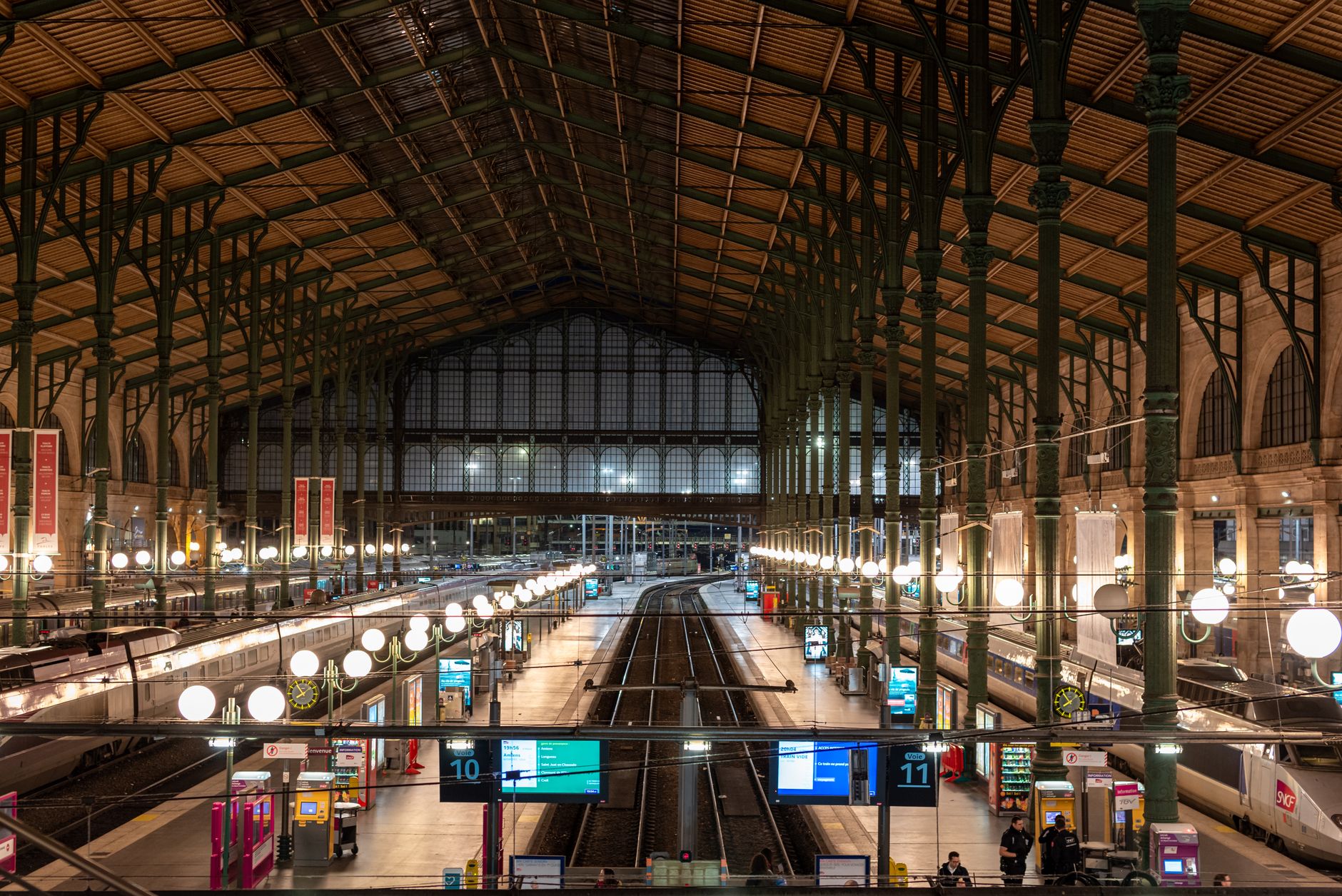
Station signs are clear, but big hubs can be busy. France train travel tips for smooth transfers include arriving 20–30 minutes early at major Paris stations, checking platform displays (voies) often, and following color‑coded Métro lines for transfers.
- Arrive early at Paris hubs (Gare de Lyon, Nord, Est, Montparnasse) to find the right hall and platform.
- Check the train number more than the destination, since many trains serve multiple stops.
- Mind the car numbering: Some sets board from the middle. Look for the coach composition screens.
- Keep your ticket/QR ready; random checks happen on some platforms and on board.
- Plan cross‑town station changes with the Métro/RER; allow buffer time during peaks.
Signs and terms you will see: “Voie†is the platform number; “Voiture†is your coach; “Salle d’attente†is a waiting room; “Sortie†is exit. If you have a paper regional ticket, “Compostage†refers to validation at yellow machines (TER only; not needed for QR e‑tickets).
Security and scams: Use official machines and counters only. Decline unsolicited help at ticket machines. Keep bags closed and in sight, and do not leave items unattended while you look at departure boards.
Train travel in France: luggage, bikes, and on‑board etiquette
Use these France train travel tips to pack smart and board faster.
- Luggage: You carry your own bags. Put small bags overhead and larger bags in end‑of‑car racks. Label luggage clearly. On busy trains, board early to find rack space.
- Bikes: On many TGVs you need a paid bike reservation and there are limited slots; TER is often easier for bikes. Folding bikes usually count as luggage when carried in a bag. See SNCF’s bike policy pages.
- Food: You can bring your own. Some TGVs have a café bar; OUIGO may not.
- Quiet: Keep calls short. Use headphones. Night trains expect low noise after lights‑out.
- Strollers and family gear: Fold strollers in vestibules or racks if space is tight. Keep aisles clear for boarding passengers.
Policies and options: see SNCF Connect: Bikes on trains and the operator’s onboard pages for luggage notes. If you are flying in on the same day, consider a later departure to allow time for baggage delays and airport transfers.
French train travel tips: delays, passenger rights, and refunds
France follows EU rail passenger rights, updated in Regulation (EU) 2021/782. Depending on the delay and carrier rules, you may be owed partial refunds or alternative transport. France train travel tips: claim promptly with your booking reference and keep receipts if you had extra costs due to disruptions.
| Arrival delay | Typical compensation baseline | Notes |
|---|---|---|
| 60–119 minutes | ≥25% of ticket price | Carrier procedures apply |
| 120+ minutes | ≥50% of ticket price | Carrier procedures apply |
| Missed connection | Assistance/alternative route | Subject to conditions |
See the official text at EUR‑Lex (EU 2021/782) and operator policies on SNCF Connect.
On the day: If a delay threatens a connection on a single booking, speak with staff early. They can advise on protected connections or alternative trains. For separate tickets, build bigger buffers and be ready to rebook if needed.
Strikes and disruptions: Check announcements in the app and on station boards. When services are reduced, earlier departures may be safer. Keep paper or digital receipts if you are advised to use other transport and later claim costs.
Train travel in France: night trains
Intercités de Nuit connect Paris with Nice, Briançon (for the Alps), and southwestern routes. You choose a berth (couchette) or, on some routes, a sleeper. Reservations are compulsory and sell out on weekends and holidays. For current routes and booking, use SNCF Connect and check SNCF’s night‑train pages.
Compartments and comfort: Couchettes are shared berths in a compartment. Pack light, bring a small lock for zippers, and keep essentials close. Lights dim after departure; keep noise to a minimum.
Timing strategy: Choose departures that reach your destination after sunrise when possible. That gives you time to store bags and get breakfast before hotel check‑in.
Accessibility and assistance
SNCF offers assistance services for travelers with reduced mobility, visual impairments, or other needs. Book help ahead of time so agents can arrange boarding ramps, seat guidance, or transfers at big hubs. Read policy and request tools on SNCF’s accessibility pages.
How to prepare: Specify the train number, station, and any equipment you use. Ideally, request assistance at least 48 hours before travel. Arrive early at the meeting point shown in your confirmation, and keep your ticket visible for staff.
Eco benefit: rail vs flying
Trains in France have a far lower average CO₂ per passenger‑kilometer than short‑haul flights. For typical route planning, rail is one of the most climate‑friendly options in Europe. See comparative data and methods at Our World in Data: Travel carbon footprint.
Besides emissions, rail offers city‑center arrivals and fewer security lines. Consequently, total door‑to‑door time on key corridors can compete with flying, especially when airports sit far from downtowns.
France rail travel: booking flow (at a glance)
Booking flow:
- Pick your routes and correct Paris station.
- Check sales window (aim for 3–4 months out).
- Compare TGV INOUI vs OUIGO vs Intercités.
- Decide ticket flexibility you need.
- Reserve seats (or passes + reservations).
- Plan station transfers and buffers.
- Pack to luggage rules; label bags.
Day‑of checklist: Screenshot QR codes, arrive early at big hubs, check the live board for the “Voie,†and stand near your coach letter. Keep snacks and water handy on longer rides.
Real‑world route examples and times
The following France train travel tips turn into sample routes you can copy. Always check current timetables before you book.
- From the capital to Lyon: Fast TGV in about 1h55 on many departures via Gare de Lyon.
- Heading west to Bordeaux: Around 2h05 on TGV from Montparnasse, with frequent services.
- Toward Strasbourg and Alsace: Roughly 1h50 by TGV from Gare de l’Est, with several daily options.
- Down to Avignon or Marseille: Typical times are about 2h40 to Avignon and around 3h05 to Marseille from Gare de Lyon.
- Across the border to Switzerland: Use TGV Lyria to Geneva, Lausanne, or Zurich; check exact timings and fares on TGV Lyria.
- Over the Channel to London: Eurostar runs about 2h15 from Gare du Nord; buy on Eurostar.
- Northern France to Lille: High‑speed links make this an easy hop, often under 1 hour from the capital.
Actual trip times vary by date, stopping pattern, and engineering works. Verify before purchase. If you need connections, pick combinations that keep transfers in the same station where possible.
France rail travel: money‑saving strategies
Here is how to protect your budget without adding stress.
- Book early for peak weekends and holidays; flexible days give you more cheap fare options.
- Compare OUIGO for simple trips with light luggage; read the baggage rules to avoid fees.
- Travel at off‑peak hours; midday or late evening trains can be cheaper.
- Look for railcards if you qualify (e.g., Carte Avantage). Check rules on SNCF’s railcard pages.
- Use TER for short hops; no reservations, fixed regional fares on many lines.
- Consider splitting: a short TER to a different TGV station can lower the long‑distance fare. Balance this against transfer time and comfort.
- Watch for promo periods. Seasonal sales appear in batches; act quickly when your dates open.
- Pack within luggage rules to avoid last‑minute add‑on fees on low‑cost services.
Sample 7‑day outline (no specific prices):
- Days 1–2: Capital city base; day trip by TER to a nearby town.
- Third day: High‑speed jump to a regional hub; pre‑book this long leg.
- Middle stretch: TER roaming in the region with a pass day or point‑to‑point.
- Sixth night: Optional night train to wake up in the south or the Alps.
- Final return: Mid‑day TGV for lower fares.
Ready to compare fares in one place?
Affiliate disclosure: Some links in this guide may be affiliate links. If you book or buy through them, Eco Nomad Travel may earn a commission at no extra cost to you.
To cross‑check options fast, you can also compare basics on Trip.com alongside operator sites. Use it to sanity‑check prices and schedules, then book the fare and flexibility you prefer.
French train travel tips: common mistakes to avoid
- Booking the wrong Paris station for your route. Always confirm the departure hub before you pick a hotel.
- Underestimating transfer time between Paris stations. Use the Métro/RER and allow a buffer.
- Skipping seat reservations on pass trips. TGV/Intercités require them and popular trains sell out.
- Overpacking. You carry your own bags and space can be tight in end‑of‑car racks.
- Ignoring France train travel tips about booking windows. Cheap fare buckets sell out early.
- Assuming direction of travel for a specific seat. Trains can reverse at intermediate stations.
Frequently asked questions
Do I need to validate tickets before boarding?
Paper TER tickets bought at stations may need validation in the yellow machines before boarding. E‑tickets and QR codes do not. Always follow the instructions on your ticket or app.
Can I board with just a QR code?
Yes. Show the QR code in the SNCF Connect app or your PDF. Keep an ID handy for name‑specific tickets.
How early should I arrive for TGV?
15–30 minutes at big stations is comfortable. Eurostar recommends more due to security and border checks.
Are children discounted?
Yes, but rules vary by operator and fare type. Check the children and family pages on SNCF Connect for current details before you buy.
Can I eat on board?
Yes, you can bring food. Many TGVs have a café bar. Pack out your trash and recycle at stations when possible.
What if my train is canceled?
Follow instructions from the operator for rebooking or refunds. EU passenger rights may apply. Keep receipts if you incur extra costs.
Our France train travel tips apply year‑round: check current schedules, lock in key reservations early, and leave buffers for big hubs.
More Europe train guides for planning your route
- Europe rail travel hub for route ideas
- Eurostar: London to Paris train guide
- Eurail & Interrail pass guide
- Night trains in Europe: how to book berths
How this guide stays current — We review operator pages and EU regulations for rule changes, add examples readers ask about, and update booking windows each season. Key sources in this guide include: SNCF Connect, Eurostar, TGV Lyria, Eurail: France reservations, and EU Rail Passenger Rights (2021/782).
