
So, how can we reduce our ecological footprint in a way that feels manageable? Let's start there. This guide breaks that big idea into smaller, practical pieces. We'll focus on areas where you can make a real difference: travel, daily consumption, and home energy.
Think of your ecological footprint as the total demand we place on the planet. It includes everything from the food on our plates to the way we get from A to B. It's about living within our planet's means. For most, the biggest slice of that footprint comes from carbon emissions.
In fact, our collective carbon footprint now accounts for a staggering 60% of humanity's total ecological footprint. This is why making conscious choices is so critical. Even small, consistent changes add up to a massive positive impact over time. This guide is a practical roadmap to help you start right where you are today.
Understanding Your Ecological Footprint: A Simple Guide
The whole concept of an "ecological footprint" can feel a bit abstract, I get it. But it's really just a way of measuring our impact. It calculates how much of the Earth's productive land and sea is needed to generate the resources we use and absorb the waste we create.
This guide isn’t about chasing perfection or feeling guilty. It's a practical roadmap, designed to give you the knowledge and real-world steps to make meaningful changes without feeling overwhelmed. The goal is to start right where you are today.
What Makes Up Your Footprint?
Your personal ecological footprint is shaped by a few key areas of your life. Once you see the components, it’s much easier to spot where you can make the most effective changes.
- Consumption: This is everything you buy and use, from food and clothes to single-use products. A diet heavy in meat and dairy, for instance, has a much larger footprint than a plant-forward one.
- Mobility: How you move around is a huge factor. Frequent flying sends your footprint soaring, while relying on public transport, cycling, or walking keeps it grounded.
- Shelter: The size of your home, your energy source (renewables vs. fossil fuels), and how efficiently you use electricity and water all play a part.
- Goods and Services: This covers everything from your phone and laptop to the services you subscribe to. The entire lifecycle of these products, from factory to landfill, has an environmental cost.
By looking at these areas, you can start to see where your biggest impacts are. It’s also useful to know the difference between the various types of footprints. If you're curious, you can learn more about the environmental footprint vs carbon footprint in our detailed guide. This background knowledge gives you a solid foundation for making smarter, more sustainable decisions—both at home and on the road.
Shrink Your Footprint with Smarter Travel Choices
When you’re trying to figure out how we can reduce our ecological footprint, transportation is the single biggest lever you can pull as a traveler. The way you choose to move from A to B often defines the entire environmental cost of your trip. Consequently, a simple “rail-first” mindset becomes incredibly powerful. It can shift your travel from a major source of emissions to a much lighter one.
Imagine you're planning a trip through Central Europe. The default for many is to string together a series of cheap, short-haul flights—Berlin to Prague, Prague to Vienna, Vienna to Budapest. While it seems quick, the carbon cost adds up fast.
Now, picture the alternative: a single Eurail pass covering the same route. You get scenic views rolling past your window and arrive right in the city center, ready to explore. More importantly, your carbon emissions plummet. Choosing the train over the plane in Europe can slash your travel emissions by up to 90%.
Just one transatlantic flight can pump out 1.5 to 2.5 tons of CO2 per passenger. That’s huge. By contrast, a remote worker basing themselves in walkable cities and using Europe’s high-speed rail network can prevent 2 to 4 tons of CO2 from hitting the atmosphere each year compared to someone hopping around on budget flights.
This visual breaks down the major parts of our ecological footprint, showing just how much our choices in travel, consumption, and energy really matter.
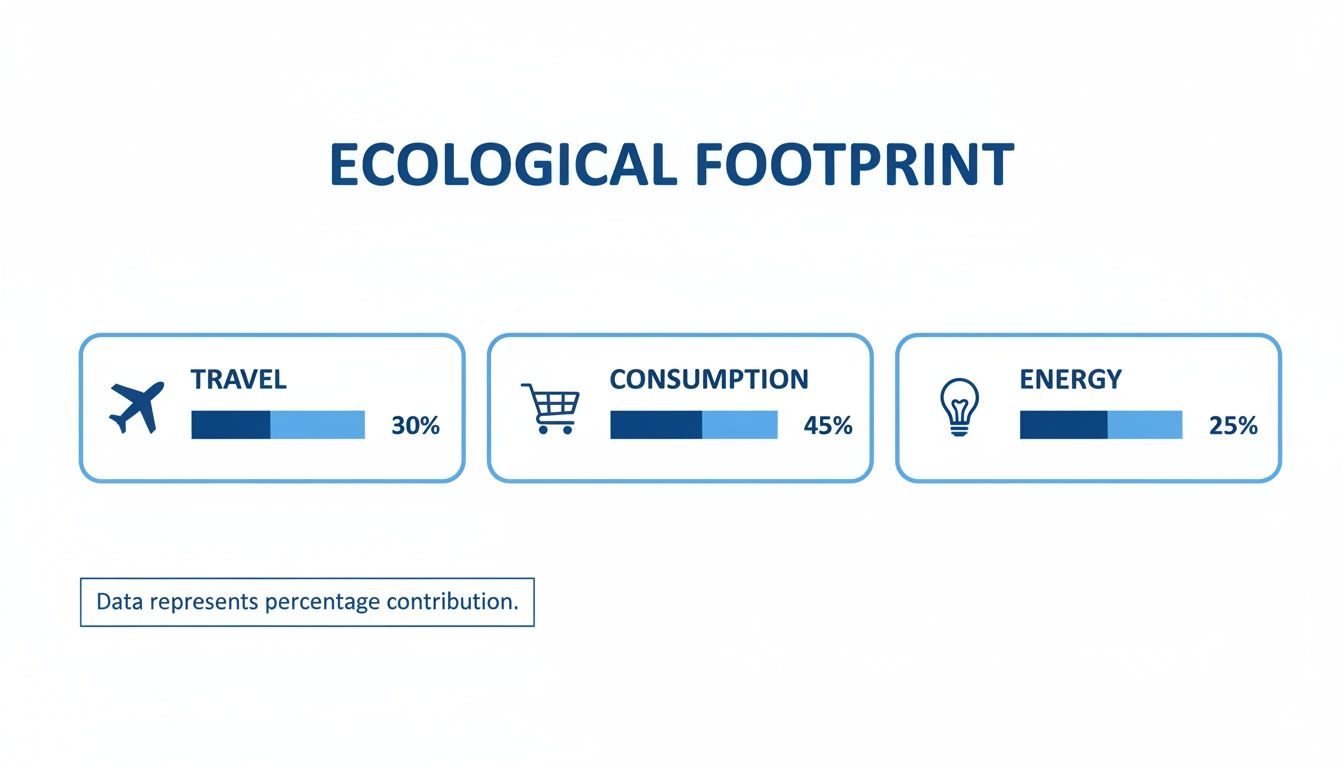
As the chart makes clear, travel is a heavy hitter. That’s exactly why focusing your energy on lower-impact transport gives you such a high return for your efforts.
Embrace the Rail-First Mentality
Making trains your go-to option requires a small shift in how you plan, but the rewards are massive. Night trains are a perfect example. Booking an overnight journey combines your travel and accommodation costs, saving you money and a full day of transit. You can fall asleep in one city and wake up refreshed in the heart of another.
To put this into practice, start your trip planning on platforms that let you easily compare different modes of transport. Using a site like Trip.com lets you see train, bus, and flight options side-by-side, making it obvious which choice is both eco-friendly and budget-conscious. If flying is truly unavoidable, a tool like Aviasales can help you find the most direct routes to minimize your impact.
Visualizing your impact is a powerful motivator. Use a travel carbon calculator before you book to see the tangible CO2 savings of choosing a train over a flight. Seeing that a single choice saves hundreds of pounds of CO2 makes the decision feel more meaningful.
To dive deeper into the numbers, check out our guide on train vs. plane emissions, which breaks down the data for popular routes.
Travel Mode Emissions A Quick Comparison
To really put the impact of your travel choices into perspective, the table below compares the carbon footprint of different travel modes for a typical 500-mile (approx. 800 km) journey. The numbers clearly show the significant savings that come from choosing the train.
| Travel Mode | Estimated CO2 Emissions per Passenger (lbs) | Key Benefit for Eco Travelers |
|---|---|---|
| Short-Haul Flight | ~440 lbs (200 kg) | Fastest for long distances |
| Gasoline Car (Solo Driver) | ~375 lbs (170 kg) | High flexibility |
| High-Speed Train | ~45 lbs (20 kg) | Drastically lower emissions, city-center arrivals |
| Intercity Bus/Coach | ~60 lbs (27 kg) | Often the most budget-friendly low-carbon option |
As you can see, the difference between flying and taking a high-speed train is dramatic. Making this one switch is one of the most effective actions you can take to lower your travel footprint.
Master Zero-Waste and Minimalist Packing
It might seem small, but how you pack also plays a role in your travel footprint. A lighter bag means less weight for planes, trains, and buses to carry, which translates directly to lower fuel consumption. This is where a zero-waste packing system really shines.
This approach isn’t just about minimalism; it’s about being intentional.
- Solid Toiletries: Swap liquid shampoos, conditioners, and soaps for solid bars. They last longer, have zero plastic packaging, and you’ll never worry about airport security liquid limits (typically 3.4 ounces or 100 milliliters).
- Reusable Essentials: A reusable water bottle, a coffee cup, and a set of bamboo cutlery are non-negotiable. This simple kit eliminates countless single-use plastics on the road.
- A Versatile Wardrobe: Choose clothing that can be layered and worn in multiple combinations. Merino wool is a traveler’s best friend—it resists odor, regulates temperature, and needs far less washing.
- Digital Organization: Keep your documents, tickets, and confirmations on your phone instead of printing everything out.
By packing only what you truly need and choosing reusable items, you simplify your journey and actively contribute to a lower-impact trip. Every pound of weight saved makes a small but cumulative difference.
Reducing Your Footprint Through Daily Consumption Habits
Beyond big moves like swapping planes for trains, understanding how we can reduce our ecological footprint is deeply woven into our daily lives. The choices we make at the grocery store and the products we bring home have a massive, cumulative impact on the planet. Therefore, it’s all about being more intentional with what we eat and buy.
The food on our plate is one of the most powerful places to start. You don’t need to go full vegan overnight to make a huge difference. Just shifting toward a more plant-forward way of eating can dramatically lower your personal footprint.
To put it in perspective, producing just 2.2 pounds (1 kilogram) of beef requires a staggering 4,000 gallons of water and generates a heavy carbon load. By contrast, the same weight of lentils uses a tiny fraction of that water and comes with a much smaller carbon price tag.
This isn’t about deprivation; it’s about smart, mindful substitutions. Swapping beef for beans in a chili or chicken for chickpeas in a curry are simple, delicious changes that really add up.

Tackle Food Waste in Your Kitchen
Just as important as what you eat is what you don’t. Globally, about one-third of all food produced gets wasted, creating an unnecessary strain on our land, water, and energy. For that reason, slashing food waste is a direct and incredibly effective way to shrink your footprint.
It starts with smart meal planning. Before you even head to the store, take a quick inventory of what you already have and plan a few meals around those ingredients. This simple habit prevents impulse buys and ensures you use up what’s on hand before it spoils.
Here are a few more strategies that work:
- Embrace Leftovers Creatively: Yesterday’s roasted vegetables can become today’s frittata or soup base. Leftover rice can be easily transformed into fried rice or tossed into a salad.
- Understand “Best By” vs. “Use By”: “Best by” dates are about peak quality, not safety. Many foods are perfectly good to eat long after this date. Trust your senses—if it looks and smells fine, it probably is.
- Store Food Properly: Learning the best ways to store different fruits and vegetables can dramatically prolong their freshness. For instance, always keep onions and potatoes separate in a cool, dark place.
Adopting these habits helps you get the most out of your food while cutting down on waste. It’s a core part of sustainable living and aligns perfectly with many other sustainable travel habits that center on resourcefulness.
Adopt Mindful Consumerism to Reduce Your Ecological Footprint
The “buy less, but better” philosophy is central to this whole effort. Our consumer culture often pushes us toward constant acquisition, especially with fast fashion and single-use items. These products carry a staggering environmental cost from production to disposal.
Mindful consumerism is the antidote. It’s about shifting your mindset from quantity to quality and from fleeting trends to lasting value.
Before making a non-essential purchase, try the 30-day rule. Wait 30 days. If you still truly need or want it after that time, then go ahead. This simple pause helps filter genuine needs from impulsive wants.
This approach invites you to find more fulfillment through conscious choices rather than just accumulating stuff. It’s about supporting local artisans, investing in durable goods that will last for years, and embracing a more minimalist outlook. Every time you choose a reusable item over a disposable one or repair something instead of replacing it, you’re actively casting a vote for a healthier planet.
Managing Energy and Resources with Conscious Choices
It’s easy to focus on what we eat and buy, but the “invisible” parts of our footprint—like home energy and the power grids we rely on—play a massive role. Every time you flick a switch or turn up the heat, you’re tapping into a system with a direct environmental impact. This is a huge piece of the puzzle when answering the question, how can we reduce our ecological footprint?
Simple actions at home really do add up. Energy-efficient appliances are a great start, as they’re built to do the same job with far less power, which directly cuts your emissions. Even just tweaking your thermostat by a few degrees, especially when you’re out or asleep, leads to some serious energy savings over a year.
And then there’s the “phantom load”—the sneaky energy that electronics pull even when they’re turned off. Unplugging devices when they’re not in use combats this. One charger might seem tiny, but the combined effect of every device in your home definitely makes a difference. It’s all about being more mindful of the resources we use every day.

Choosing Eco-Conscious Stays on the Road
For digital nomads and long-term travelers, this same mindset carries over to where you choose to stay. Your accommodation is your temporary home, and its energy habits become a part of your footprint.
When booking, I always try to actively look for places that put sustainability first. This might be a hotel running on solar panels, an apartment building with a clearly marked recycling program, or a guesthouse using rainwater harvesting. These aren’t just nice perks; they show a business is genuinely invested in reducing its environmental impact, which helps you reduce yours, too.
Choosing these kinds of stays connects your travel choices to the bigger picture of the global energy transition. It’s a way to support businesses that are actively trying to be part of the solution. You can see how these choices fit into the broader context in our guide to the travel carbon footprint.
Your Spending Power and How to Reduce Your Ecological Footprint
Every dollar you spend is a vote for the kind of world you want to live in. When you support businesses that invest in renewables, you’re helping drive market demand for cleaner energy. If hotels, restaurants, and tour operators see that their customers value sustainability, they are far more likely to adopt greener practices themselves.
Embracing renewables in your travel planning, like picking solar-powered stays or efficient electric rail, is a direct way to counter rising fossil fuel emissions. Europe’s rail network is already 70% renewable-powered and emits 90% less than planes, making the benefits crystal clear.
For a traveler, this means a train journey from London to Vienna produces around 110 lbs (50kg) of CO2. That’s a stark contrast to the 1100 lbs (500kg) generated by flying the same route, really showing how conscious choices can support a cleaner grid. You can find more insights on these renewable energy trends and their impact on emissions on Mongabay.
This principle isn’t just for travel, either. At home, you can often switch to a renewable energy provider or make a point to support local businesses that run on clean energy.
Editor’s Pick: Bookdifferent.com
Finding genuinely sustainable places to stay can feel like searching for a needle in a haystack. Bookdifferent.com makes this a whole lot easier. The platform rates hotels based on their carbon footprint and certified eco-labels, so you can quickly see which stays are truly committed to sustainability. It’s a straightforward, no-hype tool that helps you book accommodations that line up with your values, ensuring your travel money supports businesses making a positive impact.
By consciously directing your spending toward sustainable options, you contribute directly to the growth of a greener economy, both at home and on the road.
Your Action Plan for a Smaller Ecological Footprint
Alright, let’s turn good intentions into a real-world plan. Knowing how to shrink your footprint is one thing; actually doing it is another. This action plan breaks the whole process down into three manageable phases. Consequently, this gives you quick wins while building toward bigger, lasting changes.
The idea is to start small and build momentum. This way, you sidestep the overwhelm and make the journey feel both achievable and rewarding. Let’s dive into what you can do this week.
Quick Wins You Can Start This Week
Immediate actions are motivating. They give you that instant feedback that proves you’re on the right track. This isn’t about a massive life overhaul overnight; it’s about picking the low-hanging fruit to build confidence.
- Calculate Your Footprint: Get a baseline with an online calculator. Seeing the numbers in black and white is a powerful first step and instantly shows you where your biggest impacts are.
- Plan One Car-Free Day: Just one day this week, leave the car behind. Walk, cycle, or hop on public transport. It’s a simple experiment that often reveals practical alternatives you’d otherwise miss.
- Do a Fridge and Pantry Audit: Before you even think about your next grocery run, see what you already have. Plan a few meals around existing ingredients to stop food waste before it even starts.
- Unplug Phantom Loaders: Hunt down those electronics that sip power even when they’re “off”—think TVs, coffee makers, and game consoles. Unplug them or use a power strip so you can kill the power with one flick.
These small victories create the momentum you need to tackle the bigger stuff.
Building Habits for the Next Six Months
With a few wins under your belt, it’s time to build consistency. These medium-term goals are all about integrating more significant changes into your routine over the next few months. This is where you shift from one-off actions to a new default way of doing things.
Think about it this way: your travel choices and land use are deeply connected. Humanity currently burns through the equivalent of 1.8 Earths’ worth of resources each year—a staggering figure that underscores the urgency. When you choose regenerative stays or prioritize trains, you’re directly supporting regions with sustainable land management policies. Europe’s forest cover, for instance, has actually increased by 10% since 1990, partly thanks to this kind of forward-thinking.
For nomads, simple shifts like picking walkable cities and mastering zero-waste packing can shrink a personal footprint by 25-40%, helping preserve vital carbon sinks. You can see more data on our planet’s resource use at the Global Footprint Network’s website.
Other habits to build over the next six months:
- Adopt a Plant-Forward Diet: Start with something easy like “Meatless Mondays” and see where it goes. Gradually increasing your plant-based meals is one of the most effective changes you can make.
- Plan a Rail-First Itinerary: For your next trip, make the train your go-to. Use a tool like Trip.com to compare rail against flights and see the carbon savings for yourself. It’s often shocking.
- Switch to Solid Toiletries: Ditch the plastic bottles for good. Make the permanent switch to shampoo bars, conditioner bars, and solid soap for your bathroom and travel kit.
Lifestyle Shifts for Long-Term Impact
Finally, we have the big-picture changes. These long-term commitments are about fundamentally reshaping your relationship with consumption and resources. They might require more research or a bigger upfront investment, but they deliver the most profound, lasting impact.
These are the shifts that become part of who you are.
- Switch to a Renewable Energy Provider: This is a big one. Research green energy suppliers in your area. It’s one of the single most impactful changes you can make at home, directly divesting from fossil fuels.
- Invest in High-Quality, Durable Goods: Adopt a “buy it for life” mentality. Instead of chasing fast fashion or cheap gadgets, save for well-made items that will last for years. It reduces waste and saves you money in the long run.
- Become a Local Advocate: Your influence extends beyond your own habits. Get involved in local sustainability groups, support your farmers’ market, or advocate for better bike lanes and public transport in your community.
By phasing your actions like this, you create a sustainable path toward a lighter footprint. For more ideas on weaving these changes into a travel-heavy life, our carbon-neutral travel guide offers a much deeper dive.
Low-Impact Travel Tools (Worth It)
Also, if you’re planning a trip and want to keep things simple, these tools help you travel smoother while staying mindful about impact.
Get an eSIM for reliable data → Disclosure: Partner link. No extra cost to you.
Pre-book a transfer for easy arrivals → Disclosure: Partner link. No extra cost to you.

Key Takeaways
- Start with Transportation: Swapping a flight for a train is one of the most powerful moves you can make, often slashing travel emissions by up to 90%.
- Embrace a Plant-Forward Diet: Cutting back on meat and dairy significantly reduces your water and carbon footprint—no need to go fully vegan to make a huge difference.
- Reduce Consumption, Not Joy: Focus on a “buy less, but better” philosophy. Invest in durable goods and meaningful experiences over disposable stuff.
- Cut Energy and Food Waste: Simple habits like unplugging devices, planning meals, and actually eating your leftovers have a massive cumulative impact at home.
- Use Your Spending as a Vote: Every dollar is a choice. Support businesses that prioritize sustainability, from eco-conscious hotels to companies powered by renewable energy.
- Progress Over Perfection: Don’t let the scale of the problem paralyze you. Start with small, manageable changes and build from there. Momentum is everything.
Frequently Asked Questions on Lighter Footprints
As you start making changes, a lot of questions pop up. It’s totally normal. Here are some of the most common ones we hear, with straightforward answers to help you move forward with confidence.
What is the single most impactful change I can make?
For most of us, the answer is to fly less. Air travel has a massive carbon footprint compared to pretty much any other way of getting around. Swapping just one short-haul flight for a train trip can slash your emissions for that journey by up to 90%. After flying, the next biggest lever is usually reducing meat and dairy, especially red meat.
Do my small actions really make a difference?
Absolutely. While the big picture requires systemic change, our individual actions are what create the demand for it. It’s a ripple effect. When millions of us choose reusable bags, say no to plastic straws, or shift to a more plant-forward diet, it sends a powerful signal to the market. That collective behavior is what pushes companies to change their practices and builds the political will for better policies. Your choices matter because they’re part of a much bigger wave.
How can I reduce my ecological footprint without spending a ton of money?
Here’s the good news: many of the most effective actions actually save you money. Reducing food waste, for instance, literally means you’re not throwing cash in the bin. Choosing public transport over driving saves on gas, parking, and car maintenance. And embracing a “buy less, but better” mindset helps you avoid impulse buys and focus on quality items that last longer, saving you a lot in the long run.
I’m a digital nomad. How can I travel sustainably?
The digital nomad lifestyle is actually perfectly suited for this. The key is to prioritize slow travel—spend more time in fewer places to cut down on all that transit. Choose walkable cities as your base and get familiar with their public transport. Adopt a rail-first mindset for moving between countries, especially in well-connected places like Europe. Finally, pack light and carry a zero-waste kit with solid toiletries and reusables to minimize your impact wherever you are. For connectivity, consider an eSIM from providers like Airalo or Yesim to avoid plastic SIM cards.
Is it better to buy local or organic?
Both are great, but they solve different problems. Buying local cuts down on “food miles,” which are the emissions from shipping food across the country or the world. It also funnels your money directly into your local economy. Buying organic, on the other hand, is about farming practices that avoid synthetic pesticides and fertilizers, which is better for soil health and biodiversity. The ideal scenario? Do both. Buy local and organic from a farmer’s market. If you have to choose just one, buying local often has a bigger impact on your personal carbon footprint.
How do I stay motivated on this journey?
Motivation definitely comes and goes. The trick is to focus on progress, not perfection. Celebrate the small wins, like a week with zero food waste or planning a whole trip by train. Find a community of like-minded people, whether online or locally, to share ideas and encouragement. Most importantly, stay connected to nature. Spending time outdoors is a powerful reminder of what you’re working so hard to protect.
What’s the difference between a carbon footprint and an ecological footprint?
It helps to think of it like this: your carbon footprint is just one piece of the puzzle. It specifically measures the greenhouse gases (like CO2) your activities produce. Your ecological footprint is the whole picture. It measures your total demand on nature—the land needed for your food, the forests for timber, the seas for fish, plus the area required to absorb your carbon emissions. Right now, for most people in the developed world, the carbon footprint is the largest single part of their overall ecological footprint.
Can I just offset my carbon emissions?
You can, but it should always be the last resort, never the first step. The absolute priority is to reduce your emissions first. Once you’ve cut everything you reasonably can, like an unavoidable long-haul flight, you can purchase offsets from a reputable project. Make sure you look for projects certified by trusted standards like the Gold Standard or Verra to ensure they’re legitimate and actually making a difference.
How can I encourage my friends and family to join me?
The best way is to lead by example, not by lecturing. Share your delicious plant-based meals on Instagram. Talk about the amazing train journey you just took. Show them how much money you saved by cutting back on waste. People are far more likely to be inspired by your positive actions than by being told what they’re doing wrong. Focus on the benefits—better food, less stress, more meaningful travel—and you might just find them getting curious on their own.
How can we reduce our ecological footprint as a society?
This is the big one. Individual actions are the foundation, but they have to be paired with broader, systemic change. As a society, we need to transition our energy grids to renewable sources like solar and wind. We must invest in robust, affordable public transportation. We also need policies that hold corporations accountable for their environmental impact and push for circular economy models that design waste out of the system from the start. Supporting leaders and policies that champion these goals is one of the most vital things any of us can do.
Join the Sustainable Work Movement
Want more rail-first itineraries, low-impact packing systems, and walkable base-city ideas?
