
Figuring out how much is a trip to Japan always starts with one big question: how much is it really going to cost? You can pull off a 14-day trip for as little as $1,500 USD per person on a tight budget, but a more comfortable journey can easily top $7,000 USD, and that’s before you even book your flights. It all comes down to your travel style, the time of year you go, and how you decide to get around.
This guide will walk you through every expense, giving you a clear, realistic picture of your potential Japan trip cost. We’ll focus on a sustainable, rail-first approach—not just because it’s better for your carbon footprint, but because it immerses you in one of the world’s most scenic and mind-blowingly efficient transport systems. We’ll break down the numbers for accommodation, transport, food, and activities so you can build a budget that feels right for you.
Thanks to some recent economic shifts, Japan is more affordable for many travelers than it has been in years. Travel data shows that a budget-conscious traveler can get by on $70–$120 USD per day (¥10,500–¥18,000 JPY), making a two-week trip for under $1,600 USD (before airfare) entirely possible. The favorable exchange rate for the Japanese Yen against the US dollar helps your money stretch further, though flights remain the biggest up-front cost, usually landing somewhere between $600–$1,200 USD. You can see how these costs stack up globally in our analysis of travel expenses in different countries.
Key Takeaways
- Average 14-Day Cost: For a two-week trip, expect to spend around $1,500 (Budget), $4,500 (Mid-Range), or $7,000+ (Comfort) per person, not including international flights.
- Daily Budget Estimates: A good rule of thumb is to plan for a daily spend of $100–$125 USD for budget travel, $250–$350 USD for a mid-range trip, and $500+ USD for a comfortable experience.
- Biggest Cost Factors: The three things that will move the needle most on your total cost are your accommodation, whether you buy a Japan Rail Pass, and the season you travel in.
- Favorable Exchange Rate: The current weakness of the Japanese Yen (JPY) against the US Dollar (USD) makes Japan a more accessible destination for international travelers right now.
- Rail-First is Key: Japan’s incredible train network is the most sustainable and practical way to explore. Planning your itinerary around rail travel saves money, lowers your environmental impact, and is an experience in itself.
- Smart Savings: Simple strategies like eating at konbini (convenience stores), taking advantage of tax-free shopping, and traveling in the shoulder season can significantly reduce your total trip cost.
To give you a quick overview, here’s a simple breakdown of the estimated costs for a 14-day trip across different travel styles.
Estimated 14-Day Japan Trip Cost Per Person (Excluding Flights)
| Travel Style | Average Daily Cost (USD) | Total 14-Day Cost (USD) |
|---|---|---|
| Budget | $100 – $125 | ~$1,500 |
| Mid-Range | $250 – $350 | ~$4,500 |
| Comfort | $500+ | ~$7,000+ |
This table gives you a ballpark to start with as you begin to map out your own budget.
The chart below gives you a quick visual snapshot of how these numbers compare.
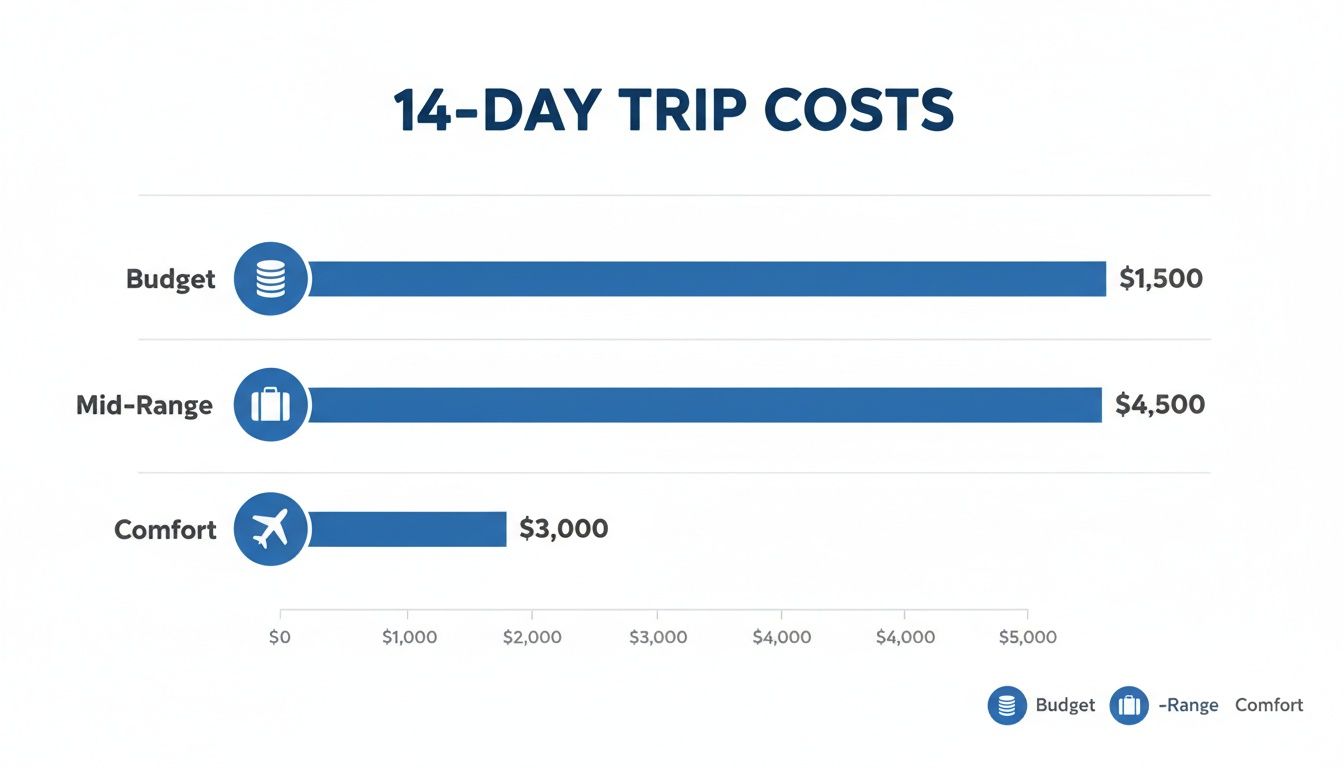
As you can see, the jump from a lean budget trip to a mid-range experience is significant—costing about three times as much. It really highlights how much your choices in accommodation and dining can shape your overall spending.
Planning Your Accommodation Budget
Your choice of where to stay will have the biggest impact on the final answer to “how much is a trip to Japan?” After flights, accommodation is almost always the single largest expense. But the good news is, Japan offers an incredible range of options, from ultra-affordable hostels to unforgettable traditional inns.
You’ll quickly notice that costs vary dramatically between major hubs and more rural spots. In bustling cities like Tokyo, Kyoto, or Osaka, you can expect to pay a premium. Even so, the market is so diverse that you can always find a place that fits your financial plan.
From iconic, space-efficient capsule hotels to welcoming family-run guesthouses (minshuku), your nightly lodging costs are well within your control. It all comes down to understanding the landscape of options and booking strategically.
Comparing Accommodation Costs Across Japan
To give you a clearer picture, let’s break down the average nightly costs. These prices are shown in both US Dollars (USD) and Japanese Yen (JPY) and reflect what you’d typically find outside of peak seasons like Cherry Blossom or Golden Week.
Average Nightly Accommodation Costs (Per Person):
- Budget (Hostels & Guesthouses): $25 – $50 USD (¥3,750 – ¥7,500 JPY). This is your go-to range for a dorm bed or a simple private room in a well-located hostel.
- Mid-Range (Business Hotels & Airbnb): $70 – $150 USD (¥10,500 – ¥22,500 JPY). Think reliable business hotel chains like APA or Toyoko Inn—clean, efficient, and almost always right near a train station.
- Comfort (Superior Hotels & Ryokans): $200+ USD (¥30,000+ JPY). This tier covers everything from upscale international hotel brands to traditional Japanese inns (ryokan), which often include exquisite multi-course meals (kaiseki) in the price.
A ryokan stay can feel like a splurge, but when you factor in the included breakfast and dinner, it often provides excellent value and a deeply authentic cultural experience. It’s a perfect choice for a special night or two.
Strategic Booking for Better Value
Timing and location are everything when booking your stays. For the best prices, aim to book two to three months in advance, especially if you’re traveling during popular periods. Last-minute deals are rare in Japan’s high-demand market.
One of the most effective strategies for a sustainable and budget-friendly trip is to choose accommodation near a major train or subway station. This simple choice makes car-free travel effortless, saving you both time and money on local transit. It also opens up a world of day trips, allowing you to explore surrounding areas without the hassle of moving your luggage.
When you’re searching, it’s always wise to read reviews carefully to understand exactly what you’re booking. You can explore a wide variety of vetted options on platforms like Trip.com for hotels and guesthouses across Japan. To make sure your choices align with your values, you can learn more about how to identify truly sustainable stays and avoid greenwashing in our detailed guide. This helps ensure your travel dollars support properties committed to genuine environmental and social responsibility.
How Much a Trip to Japan Costs for Transport
Getting around Japan is a highlight, not a hassle, but figuring out your transport is a huge part of your trip budget. The country’s rail network is legendary for a reason—it’s clean, hyper-efficient, and a genuinely scenic way to move between cities. From the iconic Shinkansen (bullet train) to local subways, getting the hang of the rails is your ticket to a smooth trip.
But for anyone planning a multi-city journey, that convenience comes with a big decision: the Japan Rail (JR) Pass. For years, the pass was an obvious choice for most visitors. After a recent and very significant price hike, the math has changed completely. Now, you really have to weigh its cost against your specific route.
The simple question is this: does the pass actually save you money compared to buying individual point-to-point tickets? The answer comes down to how far and how fast you plan to travel.
Is the Japan Rail Pass Worth It?
If you’re planning a whirlwind trip covering long distances, the JR Pass can still come out on top. A single round trip from Tokyo to Kyoto on the Shinkansen, for instance, already costs around $180 USD (¥27,000 JPY). Throw in another long leg, like a journey down to Hiroshima, and the pass starts looking much more attractive.
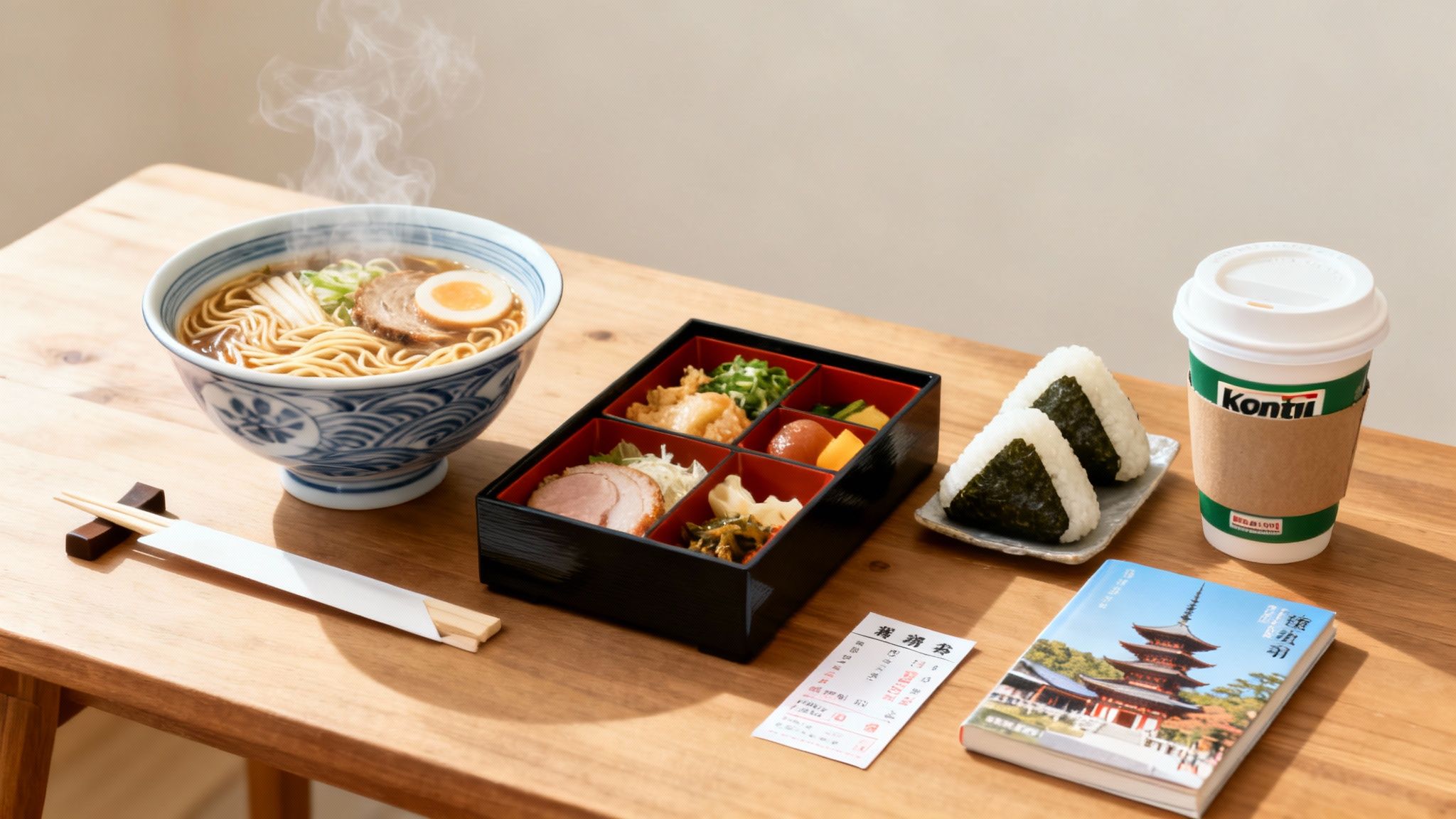
On the other hand, if your itinerary is slower or focuses on a single region, buying individual tickets is almost always the cheaper way to go. A 7-day pass runs about $335 USD (¥50,000 JPY), so you’d need to rack up more than that in long-distance train fares for it to make any sense.
To put it in perspective, let’s look at a classic “Golden Route” itinerary.
Japan Rail Pass vs Point-to-Point Tickets for a Classic Route
The table below breaks down the costs for a popular route connecting Japan’s main sights. It’s a great example of where the old “always buy the pass” advice no longer holds up.
| Route Leg | Point-to-Point Ticket Cost (USD/JPY) | Total Point-to-Point | 7-Day JR Pass Cost (USD/JPY) |
|---|---|---|---|
| Tokyo → Kyoto | ~$93 / ¥14,000 | ||
| Kyoto → Hiroshima | ~$73 / ¥11,000 | ||
| Hiroshima → Tokyo | ~$123 / ¥18,500 | ~$289 / ¥43,500 | ~$335 / ¥50,000 |
As you can see, for this specific trip, buying tickets as you go saves you around $46 USD. The JR Pass only starts to pay for itself if you add another significant journey, like a day trip from Kyoto to Kanazawa or a ride further south. You can easily book train tickets across Asia online, which lets you compare prices and lock in your seats ahead of time.
Local and Budget Transport Options
Beyond the bullet train, your daily transport budget will mostly be spent on getting around cities. In places like Tokyo and Osaka, the subway systems are incredibly good. A single ride usually costs between $1.30 and $2.70 USD (¥200 – ¥400 JPY). For days where you’re hopping around a lot, a 24-hour subway pass for about $5.40 USD (¥800 JPY) is a fantastic deal.
For anyone on a really tight budget, long-distance night buses are a game-changer. A ride from Tokyo to Kyoto can be as cheap as $30 USD, saving you the cost of a train ticket and a night’s accommodation. They’re much slower than the Shinkansen, of course, but it’s a smart way to make your yen go further.
Choosing rail over air for domestic travel in Japan is also a significant win for the environment. The carbon emissions from a train journey are a fraction of those from a flight over the same distance, aligning with a sustainable travel mindset without sacrificing convenience.
You can get a better sense of the numbers by checking out our detailed guide on train vs. plane emissions, which breaks down the real environmental impact of your travel choices. Sticking to Japan’s rail system isn’t just a great way to see the country; it also makes your trip significantly more eco-friendly.
Budgeting for Daily Food and Activities
From steaming bowls of ramen in a tiny shop to the quiet calm of a temple garden, your daily spending on food and activities plays a huge role in your total trip cost. The good news? Japan is brilliant at offering amazing experiences at every price point, so you can have a phenomenal time without draining your savings.
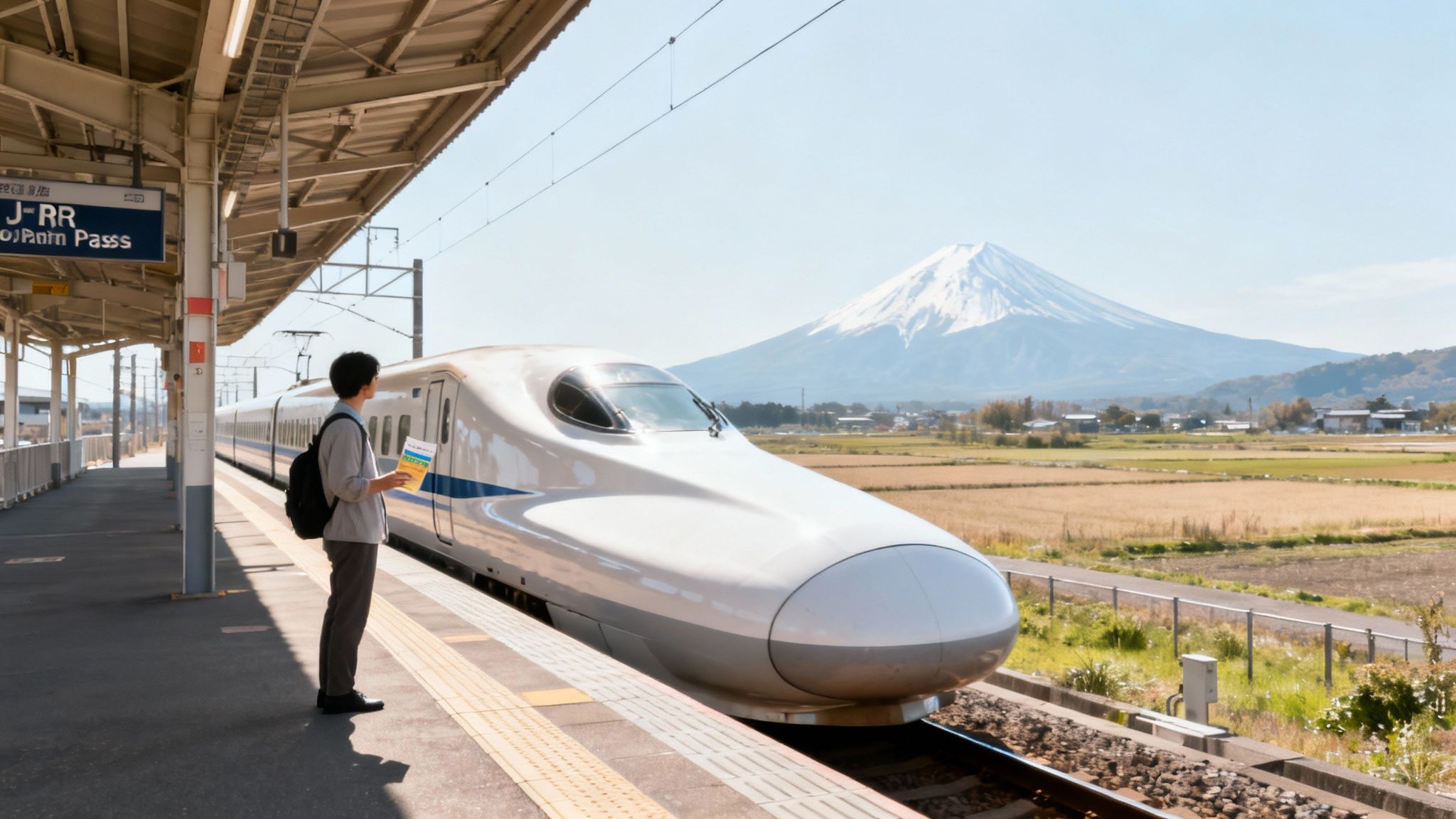
You can eat incredibly well for as little as $25–$40 USD per day (around ¥3,750–¥6,000 JPY). The secret is to lean into Japan’s incredible local food scene, from quick noodle joints to the absolute treasure troves that are convenience stores, or konbini. These aren’t your typical corner stores; they offer surprisingly high-quality meals like onigiri (rice balls), fresh sandwiches, and bento boxes perfect for a cheap and delicious lunch.
Eating this way not only keeps costs down but also pulls you deeper into the local rhythm. You end up eating where the locals eat, getting a much more authentic taste of Japan while keeping your budget firmly in check.
A Daily Food Budget for Every Travel Style
Your food costs can be as flexible as your itinerary. Whether you’re grabbing a quick bite between temples or settling in for a multi-course dinner, here’s a rough guide to what you can expect to spend.
- Budget Traveler ($25–$40 USD per day): Hit the konbini for breakfast and lunch, then find a local ramen or soba shop for dinner. A fantastic, filling bowl of noodles often costs less than $8 USD (¥1,200 JPY).
- Mid-Range Traveler ($50–$80 USD per day): Mix it up. You can still do budget-friendly meals but also weave in sit-down lunches and casual dinners at an izakaya (a Japanese pub), which is a great way to sample a ton of different dishes in a lively setting.
- Comfort Traveler ($100+ USD per day): This opens the door to the full spectrum of Japanese cuisine. Think high-end sushi restaurants, private rooms, and traditional multi-course kaiseki dinners. Just remember that reservations are often essential for these spots.
Japan’s food scene is a perfect example of how affordability and quality can go hand-in-hand. Unlike many places, a lower price tag rarely means a lesser experience, especially when it comes to local staples like ramen, udon, and curry.
Estimating Your Activity Costs
One of the best things about traveling in Japan is that so many of its most beautiful sights are completely free to enjoy. Wandering through historic neighborhoods like Gion in Kyoto, exploring vast public parks, and visiting the grounds of most Shinto shrines won’t cost you a single yen.
That said, for ticketed attractions, it’s smart to build a little room into your budget. The entrance fees are generally quite reasonable compared to what you’d pay in many Western countries.
- Temples and Shrines: While many are free, larger temple complexes like Senso-ji in Tokyo or Fushimi Inari in Kyoto might have specific paid areas inside. Expect fees from $3–$7 USD (¥450–¥1,050 JPY).
- Museums and Galleries: Major national museums will typically charge around $7–$15 USD (¥1,050–¥2,250 JPY). Special exhibitions might cost a bit more.
- Castles and Gardens: Famous spots like Himeji Castle or the Kenrokuen Garden in Kanazawa usually have entrance fees between $4–$10 USD (¥600–¥1,500 JPY).
A good rule of thumb is to budget an average of $15–$25 USD per day for activities. Some days you might spend nothing at all, while on others you might visit a couple of paid attractions. This daily average gives you a solid buffer. For more tips on stretching your funds, our guide to cheap travel in Europe has strategies that are surprisingly easy to adapt for Japan.
Managing Extra Costs and Smart Savings
A good travel budget is more than just flights and hotels. When you’re trying to figure out how much a trip to Japan will cost, it’s often the small, essential extras that sneak up on you. Things like travel insurance, staying connected, and bank fees need to be on your radar from the start to get a true picture of your spending.
Once those necessities are covered, there are tons of smart ways to make your money go further without cheapening your experience. Something as simple as visiting during the shoulder seasons—like autumn—can slash your costs. You get gorgeous scenery and pleasant weather while keeping your budget happy.
Even small habits add up. Grabbing a high-value lunch set (teishoku) or knowing the rules for tax-free shopping can lead to big savings over a few weeks. These are the practical tips that make managing your Japan trip cost a whole lot easier.
Essential Extras for Your Budget
Before you lock in your numbers, make sure these items are factored in. They’re small but absolutely crucial for a smooth trip.
- Travel Insurance: This one’s non-negotiable. Getting solid coverage for medical emergencies, trip cancellations, and lost luggage buys you invaluable peace of mind.
- Connectivity (eSIM or Pocket Wi-Fi): You’ll want data for maps and translation apps. An eSIM is usually the most convenient, low-waste option since you can activate it on your phone the moment you land. For a deeper dive, check out our guide on the best SIM card for international travel.
- Foreign Transaction Fees: Give your bank a call and ask about their fees for using your credit or debit card abroad. A card with no foreign transaction fees can save you a surprising amount of cash.
Editor’s Pick: Seamless Connectivity
For reliable and hassle-free data from the moment you land, an eSIM is the way to go. Airalo offers affordable, easy-to-install data packages specifically for Japan. It eliminates the need for physical SIM cards or bulky pocket Wi-Fi devices, making it a simple, sustainable choice for staying connected.
Smart Savings Tips for Japan
Japan can feel expensive, but it also offers incredible value if you know where to find it. The Japanese yen’s depreciation against currencies like the U.S. dollar has made the country much more affordable for visitors lately.
Here are a few tips to stretch your budget:
- Carry Some Cash: Cards are widely accepted, but many smaller restaurants, local shops, and rural temples are still cash-only. It’s always a good idea to have a reasonable amount of Japanese Yen (JPY) on you.
- Tax-Free Shopping: As a tourist, you can get a refund on the 10% consumption tax for purchases over ¥5,000 JPY (about $33 USD) at licensed stores. Just remember to have your passport handy when you’re shopping.
- Embrace Lunch Sets: So many restaurants offer teishoku (set lunch menus) for a fraction of what dinner costs. It’s a fantastic way to enjoy a high-quality, multi-course meal for around $10–$15 USD.
Your Top Questions About Japan Trip Costs, Answered
To wrap things up, let’s tackle the questions that come up most often when you’re trying to nail down a budget for Japan. Think of this as your quick-reference guide for all the practical details—the final pieces of the puzzle.
We’ll cover everything from the cheapest months to fly and whether Japan is really as expensive as people say, to how much cash you should have in your pocket and simple ways to travel more sustainably.
Each answer is short, sharp, and designed to give you the clarity you need to finish planning with confidence.
Japan Trip Cost FAQs
1) Is Japan an expensive country to visit?
Answer: It can be, but it doesn’t have to be. While accommodation and long-distance trains can be costly, daily expenses like food and local transport are often cheaper than in many Western countries. The current favorable exchange rate for the Japanese Yen (JPY) against the US Dollar (USD) can also make it more affordable for many international visitors.
2) What is a realistic daily budget for Japan?
A good starting point is $100–$125 USD for a budget trip, $250–$350 USD for a mid-range experience, and $500+ USD for a comfortable journey. This covers accommodation, food, activities, and local transport.
3) How much cash should I carry in Japan?
While credit cards are widely accepted in cities, it’s wise to carry about $50–$70 USD (roughly ¥7,500–¥10,500 JPY) in cash per day. Many smaller restaurants, local shops, and temples are still cash-only, especially in rural areas.
4) When is the cheapest time to fly to Japan?
The shoulder seasons of late autumn (October–November) and late spring (May) often have the best flight deals. Avoid peak times like cherry blossom season (late March–April) and Golden Week (late April–early May) when prices spike. You can compare fares on Aviasales.
5) Do I need a Japan Rail Pass?
Not necessarily. After recent price increases, the JR Pass is usually only cost-effective if you’re doing multiple long-distance Shinkansen (bullet train) trips in a short window. For many itineraries, point-to-point tickets are cheaper.
6) How many days do I need for a first-time trip to Japan?
10 to 14 days is ideal for a first visit. This gives you enough time to explore the classic “Golden Route” (Tokyo, Kyoto, and Hiroshima) without feeling too rushed.
7) What are some hidden costs I should budget for?
Budget for travel insurance, connectivity (an eSIM or pocket Wi-Fi), bank/ATM fees, and luggage storage or forwarding services if you’ll be moving between cities.
8) Is it easy to find vegetarian or vegan food in Japan?
It’s getting easier, especially in major cities like Tokyo and Kyoto. Just note that many traditional broths (dashi) are fish-based, so a simple translation card explaining your diet can help a lot.
9) Can I drink tap water in Japan?
Yes, Japan’s tap water is safe to drink nationwide. Bringing a reusable bottle is an easy way to save money and reduce plastic waste.
10) Do I need to speak Japanese to travel there?
No. In major cities, signage is often in English, and translation apps work well. Still, learning a few phrases like “Arigatou gozaimasu” (thank you very much) is appreciated.
11) Is tipping customary in Japan?
No—tipping isn’t part of the culture and can sometimes be considered awkward or rude. Great service is standard, and the listed price is typically what you pay.
12) What is the best way to get from the airport to the city?
Airport limousine buses and express trains (like the Narita Express for Tokyo) are usually the most efficient and cost-effective. A pre-booked transfer via Welcome Pickups can be a stress-free alternative.
13) Are taxis expensive in Japan?
Yes—taxis are generally expensive and best for short hops or late-night gaps when transit isn’t running. Trains and subways are usually the better option.
14) How much does a meal typically cost?
You can find a great bowl of ramen for around $8 USD. A casual restaurant or izakaya meal is often $15–$25 USD, while convenience stores offer surprisingly good meals for under $5 USD.
15) What’s the cheapest way to travel between cities?
Overnight highway buses are usually the most budget-friendly for long distances, often costing a fraction of a bullet train ticket—and they can save you a night of accommodation.
16) How can I travel more sustainably in Japan?
Prioritize trains over domestic flights, carry a reusable water bottle and shopping bag, and support local businesses. Staying in traditional ryokans or minshukus (family-run guesthouses) can also support local economies directly.
17) Are there eco-friendly accommodation options?
Yes. Many places follow low-impact practices even if they don’t market it heavily. Smaller, locally owned inns and ryokans often source food locally and use traditional methods that can be naturally lower impact.
18) Is waste and recycling a big deal in Japan?
Yes—sorting is taken seriously. You’ll see clearly labeled bins, but public trash cans can be rare, so plan to carry your waste until you find the right place to dispose of it.
19) What’s a low-impact way to see the cities?
Japan’s cities are very walkable. Pair walking with subways and buses for a minimal footprint. In places like Kyoto, renting a bicycle is also a great option.
20) Can I offset the carbon footprint of my flight to Japan?
Yes. Use a carbon footprint calculator to estimate your emissions, then choose offsets from certified projects (renewables or reforestation). Booking the most direct route you can also helps reduce emissions.
Join the Sustainable Work Movement
Want more rail-first itineraries, low-impact packing systems, and walkable base-city ideas?
Explore Eco Nomad Travel
📚 Core Guides
🧭 Planning & Logistics
🗺️ Destinations & Seasons
Jeremy Jarvis — founder of Eco Nomad Travel, sustainable travel writer, and advocate for regenerative tourism. His work focuses on low-impact mobility, eco-friendly digital nomad life, and climate-positive travel.
Legal
Affiliate DisclaimerPrivacy Policy
Terms of Service
Image & Media Notice
Cookie Policy
Contact
Affiliate Disclosure: Some links on Eco Nomad Travel are affiliate links, meaning we may earn a small commission at no extra cost to you. This supports our mission to inspire responsible and low-impact travel worldwide.
Connect
✅ Trusted Official Sources
Plan smarter eco trips
Try our free Sustainable Travel Tools for Digital Nomads – carbon calculator, train vs plane comparator, and more.
Open Tools Hub