

So, you’re wondering how much a trip to Ireland would cost? For a solid one-week trip, you can expect to spend anywhere from $1,200 to $3,000 USD per person. The final number really comes down to your travel style, where you choose to sleep, and how you get around the Emerald Isle.
Figuring out your budget is the first real step in planning an incredible Irish adventure. Costs can swing wildly, but getting a handle on the main expenses from the get-go helps you make smarter, more sustainable choices along the way.
This guide will give you a clear financial snapshot of everything from flights and lodging to food and activities. The goal is to help you plan a trip that fits both your wallet and your travel philosophy.
We’ll focus on how mindful decisions—like choosing a rail-first itinerary over a rental car—can seriously lower both your costs and your carbon footprint. It’s an approach that not only saves money but also offers a much more relaxing way to see Ireland’s stunning landscapes and walkable cities.
Understanding the Average Costs of a Trip to Ireland
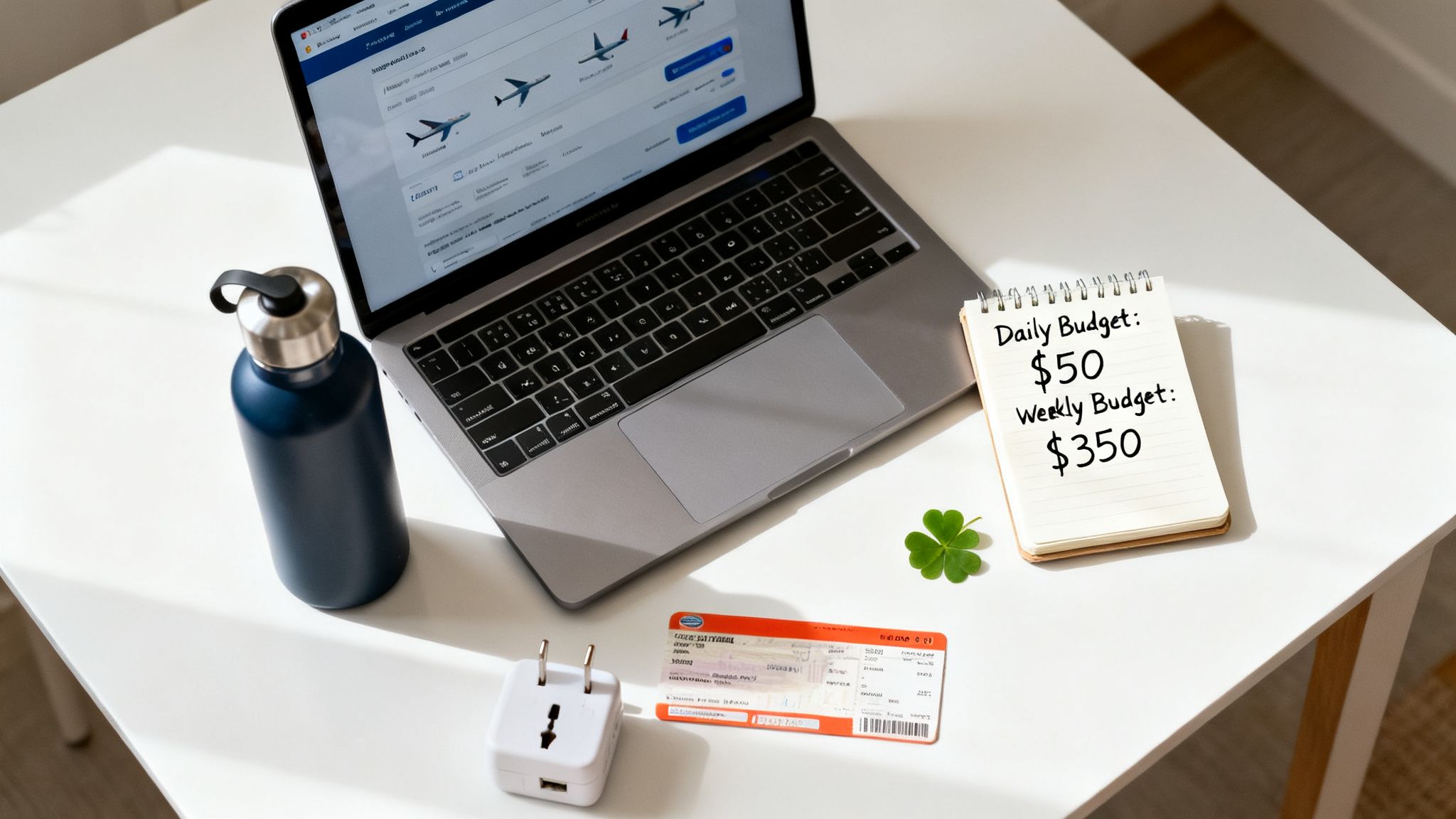
To give you a better idea of day-to-day spending, here’s a quick breakdown of what you can expect to pay per person in Ireland, depending on how you like to travel.
Average Daily Cost in Ireland per Person in USD and EUR
This table provides a quick overview of estimated daily expenses in Ireland, categorized by travel style. All costs are per person.
| Travel Style | Accommodation | Food and Drink | Activities and Transport | Total Estimated Daily Cost (USD/EUR) |
|---|---|---|---|---|
| Backpacker / Budget | $30–$50 / €28–€46 | $40–$60 / €37–€55 | $30–$50 / €28–€46 | $100–$160 / €92–€147 |
| Mid-Range / Eco-Conscious | $80–$150 / €74–€138 | $70–$100 / €64–€92 | $50–$80 / €46–€74 | $200–$330 / €184–€304 |
| Luxury / High-End | $250+ / €230+ | $150+ / €138+ | $100+ / €92+ | $500+ / €460+ |
As you can see, your travel style makes a huge difference. A budget-conscious traveler sticking to hostels and public transport can realistically keep costs in the $1,200 to $1,500 USD range for a week.
One thing that makes Ireland feel a bit pricey compared to other European spots is the higher cost of essentials. Things like meals out, fuel, and even mobile data can cost more than in neighboring countries. A simple but effective tip is to always carry a reusable water bottle—it saves you money and cuts down on single-use plastic waste.
Sustainable Travel and Your Budget
For digital nomads and eco-conscious travelers who want to skip the car rental, public transport is a great option. Local city transit usually costs around $11–$22 USD (€10–€20 EUR) daily. Meanwhile, longer train or bus journeys between cities will set you back $22–$44 USD (€20–€40 EUR).
Ireland’s tourism board is actively promoting “slow tourism,” encouraging visitors to spend more time in one area and use public transit. This approach lines up perfectly with a lower-carbon, lower-cost travel style.
It’s a strategy that not only cuts down on vacation expenses but also supports the sustainable travel model that rail-first itineraries are all about. This is ideal for remote workers planning to settle into a walkable city for a longer stay.
If you’re also thinking about a trip next door, you might find our guide on how much a trip to Scotland costs helpful.
Breaking Down Your Main Ireland Trip Expenses
To get a real handle on how much would a trip to Ireland cost, you have to look at each piece of the puzzle separately. Your total budget is built from a few key categories—flights, accommodation, transport, and food. Understanding them is the only way to put it all together without any last-minute surprises.
This breakdown will show you exactly where your money is likely to go. More importantly, it shows how making more sustainable choices can often lead to some pretty significant savings. We’ll cover everything from snagging a decent flight deal to getting around using Ireland’s fantastic public transit.
But first, a quick practical tip for your electronics: you’ll definitely want a good universal travel adapter in your bag. It’s a small, easy purchase that saves you a world of hassle when you need to keep your gear charged.
How Much to Budget for International Flights
For most people traveling from the United States, the flight is going to be one of the biggest upfront costs. The price tag can swing wildly depending on the season, how far ahead you book, and which city you’re flying out of.
As a general rule, you can find round-trip flights from major East Coast hubs like New York (JFK) or Boston (BOS) for around $500–$800 USD. That’s pretty typical if you book for the shoulder seasons (spring and autumn). If you’re planning a summer trip, expect those prices to climb into the $900–$1,200 USD range, or even higher.
To hunt down the best deals, we usually turn to flight comparison tools like Aviasales or Trip.com. Booking at least three to four months in advance is almost always the sweet spot for locking in a good fare.
Accommodation Costs Across Ireland
After your flight, where you lay your head each night will be your next biggest expense. The great thing about Ireland is that it has a huge range of options. Therefore, you can find something that fits your budget, from sociable hostels to cozy, family-run B&Bs.
Here’s a rough idea of what to expect per night:
- Hostels: A dorm bed is your most budget-friendly option, usually running $30–$50 USD (€28–€46 EUR). It’s also a brilliant way to meet other travelers.
- B&Bs and Guesthouses: For a more local feel, a room in a traditional Bed & Breakfast will typically set you back $80–$150 USD (€74–€138 EUR). Plus, you often get a massive Irish breakfast included.
- Hotels: Mid-range hotels generally cost $150–$250 USD (€138–€230 EUR) per night, while luxury stays can easily top $300 USD (€276 EUR).
If you’re interested in finding stays that align with a lower-impact travel style, have a look at our guide on choosing environmentally friendly accommodation.
Transportation: How Your Ireland Trip Cost Can Vary
How you choose to get around has a massive impact on both your budget and your overall experience. While renting a car gives you a ton of flexibility, a rail-first itinerary is often cheaper, far less stressful, and much more sustainable.
For a week-long solo trip from the US, using public transport can cost as little as $49 USD (€46 EUR). In contrast, car rentals can start around $100 USD a week in the low season. However, they can jump to over $300 USD in the summer—and that’s before you even factor in fuel, which is currently hovering near $7 USD per gallon.
To give you a clearer picture, city buses in Dublin cost just over $2 USD for a 90-minute fare. Plus, you can book long-distance trains from Dublin to Cork for as little as $16 USD if you reserve in advance. For an even more detailed cost comparison, this insightful article on Ireland trip expenses is a great resource.
Here’s a quick table to help you visualize the difference between a rail-first trip and renting a car for a week.
H3 Transportation Cost Comparison for a 7-Day Ireland Itinerary
Here is a comparison of the estimated weekly costs for traveling around Ireland using the public rail system versus renting a compact car.
| Expense Category | Rail-First Itinerary Estimated Cost | Car Rental Estimated Cost |
|---|---|---|
| Weekly Transport Pass/Tickets | $100 – $150 USD | N/A |
| Car Rental (Compact) | N/A | $200 – $350 USD (seasonal) |
| Fuel | N/A | $100 – $150 USD |
| Insurance & Fees | N/A | $70 – $120 USD |
| Parking | Minimal | $50 – $100 USD |
| Total Estimated Weekly Cost | $100 – $150 USD | $420 – $720 USD |
As you can see, opting for trains and buses isn’t just a greener choice—it can save you hundreds of dollars over a single week.
Food, Drink, and Activity Expenses
Finally, don’t forget to budget for your day-to-day spending. One of the easiest ways to save money—and plastic—is to pack a reusable water bottle and just refill it as you go.
- Food: You can get a hearty meal at an inexpensive pub for around $15–$20 USD. A three-course dinner at a mid-range restaurant will be closer to $50–$70 USD per person. To keep costs down, look for accommodation with a kitchen so you can make some of your own meals.
- Activities: The best part about Ireland is that many of its most stunning natural attractions, like its national parks, are completely free to enter. For major sites like the Cliffs of Moher or the Guinness Storehouse, expect to pay an entrance fee between $15 to $30 USD.
And a couple of final reminders: factor in travel insurance for peace of mind. You can get a quick quote from a provider like VisitorsCoverage to see what works for you. To stay connected without getting hit with huge roaming fees, an eSIM from a service like Airalo or Yesim is a game-changer.
Sample Budgets for Your Ireland Travel Style
Since every traveler’s style is different, a one-size-fits-all budget just doesn’t work for a trip to Ireland. To give you a much clearer idea of how much a trip to Ireland would cost based on how you like to travel, we’ve sketched out three very different sample budgets. Each one shows how your choices directly shape what you’ll spend.
Whether you’re seeing the Emerald Isle on a shoestring, putting comfort and sustainability first, or settling in for a longer slow-travel stay, there’s a way to make the numbers work. These examples are here to help you find the approach that feels right for your own journey.
One universal tip that works for any budget is to use packing cubes inside your carry on backpack. It’s a simple trick that keeps everything organized. This makes it a breeze to move between hostels, eco-lodges, or long-term rentals without the constant chaos of repacking.
The Backpacker on a Shoestring Budget
This one’s for the traveler who wants to see Ireland as affordably as humanly possible. The whole game here is stretching every euro to its limit while still soaking up the country’s incredible culture and landscapes.
- Daily Goal: $60–$80 USD / €55–€74 EUR
- Accommodation: You’ll be living the hostel life, mostly in dorms. A bunk will run you about $30–$50 USD a night.
- Food: Self-catering is your absolute best friend. Plan on cooking most of your meals at the hostel and packing lunches. Budget $20–$30 USD daily for groceries and the occasional pint or pub snack.
- Transport: Stick strictly to public buses and trains, and make sure you book them well in advance for the best prices. A weekly transport pass can be a great investment.
- Activities: Focus on all the amazing free stuff Ireland has to offer—hiking in the national parks, wandering through ancient city streets, and hitting up museums on their free-entry days.
For a full week, a backpacker can pull this off for around $500–$700 USD, plus flights. It’s definitely lean, but it’s a completely realistic way to experience the country.
The Mid-Range Eco-Explorer Budget
This budget is for the traveler who values comfort but also wants to make smart, sustainable choices along the way. You’re willing to spend a bit more for unique stays and greener options.
- Daily Goal: $200–$250 USD / €184–€230 EUR
- Accommodation: Think eco-lodges, family-run B&Bs, and green-certified guesthouses. Expect to pay $100–$150 USD per night.
- Food: You’ll enjoy a healthy mix of cooking for yourself and eating out at pubs or restaurants that source their ingredients locally. A daily food budget of $60–$80 USD feels about right.
- Transport: A rail-first itinerary is perfect for this style. Use Ireland’s excellent train network for the long hauls and local buses for shorter trips.
- Activities: Your budget has room for entrance fees to major sites like the Cliffs of Moher and Blaney Castle, plus a guided eco-tour or two to get a deeper look at the landscape.
A week-long trip for the mid-range eco-explorer will probably land somewhere between $1,500–$1,800 USD, not including flights.
This chart gives you a quick visual on how your transport choices can really shift your budget, comparing a rail-first plan against a standard car rental.
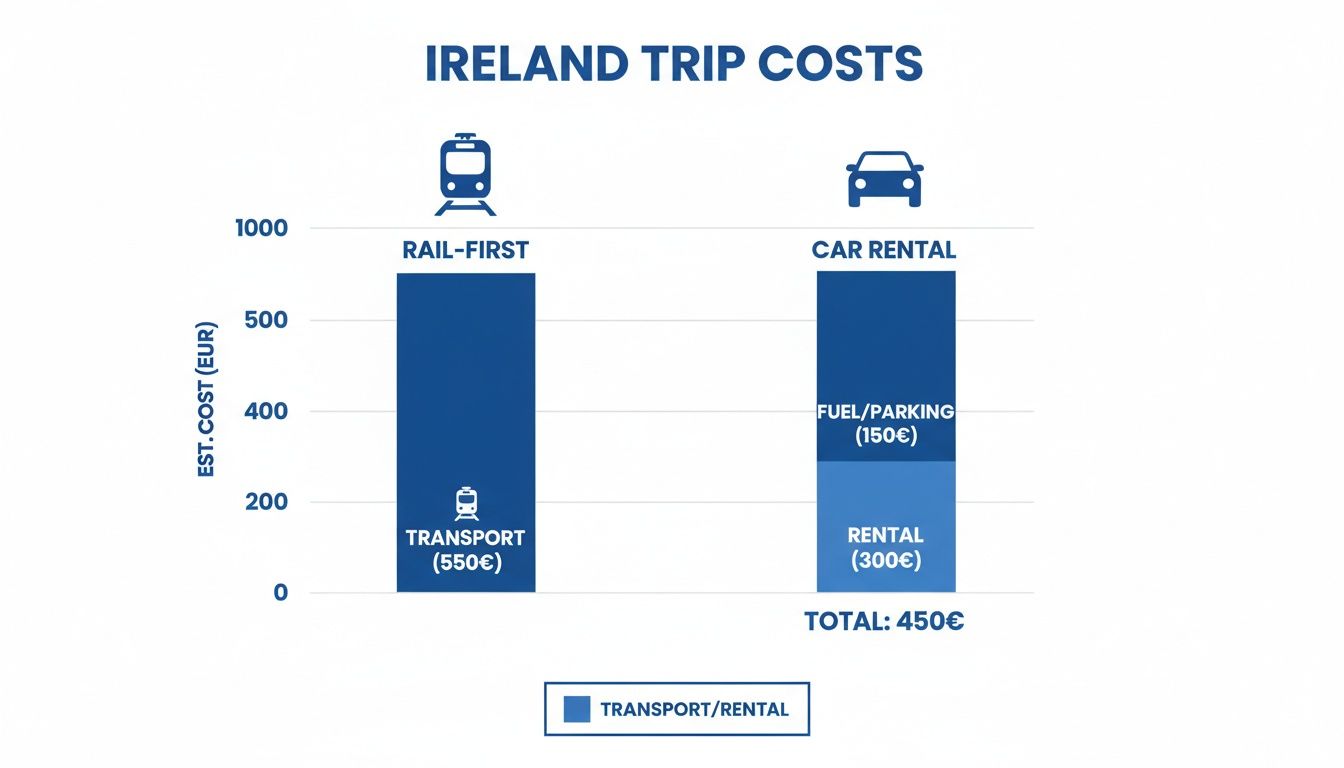
As you can see, sticking to trains and buses can free up a surprising amount of cash over the course of a week.
The Digital Nomad Slow Travel Budget
This budget is geared toward remote workers who are planning to settle into Ireland for a month or more. The beauty of slow travel is how it dramatically cuts your daily costs through longer-term rentals and living more like a local.
- Monthly Goal: $2,200–$2,800 USD / €2,025–€2,570 EUR
- Accommodation: Renting a room or a small apartment on a weekly or monthly basis is key. This can bring your lodging costs down to $1,000–$1,500 USD for the entire month.
- Food: With a real kitchen at your disposal, you’ll be cooking most of the time. A monthly grocery budget of $500–$600 USD is very realistic.
- Transport: Base yourself in a walkable city like Galway or Cork and rely on local transit. Keep a small budget aside for occasional weekend train trips to explore other parts of the island.
- Activities: Take your time. Really get to know your local area, seek out free community events, and find your favorite cafes to work from.
This approach gives you a much deeper, more immersive experience, and it’s surprisingly cost-effective. For more ideas on budgeting for longer stays, you might want to check out our guide on how much a trip to Japan costs, which also digs into different travel styles.
How a Rail-First Itinerary Slashes Your Ireland Trip Cost
When you’re trying to figure out how much would a trip to Ireland cost, your choice of transport is one of the biggest levers you can pull. Opting for trains and buses over a rental car isn’t just a nod to eco-conscious travel. In fact, it’s a game-changer for your budget that can easily save you hundreds of dollars.
Think about all the costs that sneak up on you with a rental car. You’ve got the daily fee, which can get pretty steep in high season. Then there’s fuel, hovering around $7 USD per gallon (€1.75 per liter). On top of that, you’re looking at hefty insurance, city parking fees, and surprise toll charges. It adds up, fast.
In contrast, Ireland’s train and bus network is efficient and surprisingly affordable, especially when you book your tickets a bit ahead of time. Going this route simply erases all those extra car-related expenses from your budget.
Ditching the Driving Stress for a Better Experience
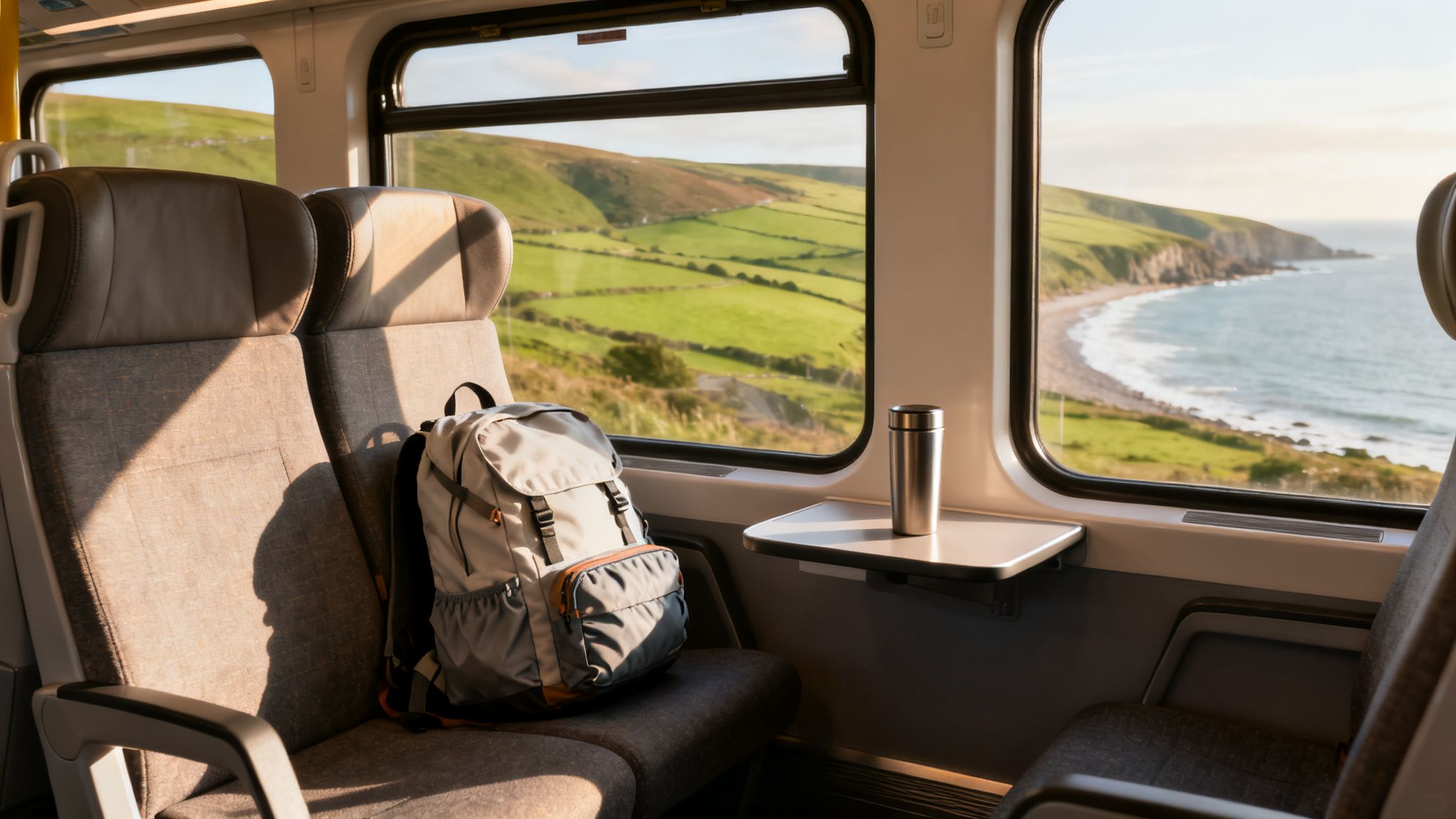
Beyond the clear financial perks, a rail-first approach just makes for a more relaxing and authentic trip. Instead of white-knuckling the steering wheel on narrow, winding country roads (on the left-hand side, no less), you can sit back and actually watch the stunning Irish countryside roll by your window.
This way, you can fully immerse yourself in walkable cities and towns without the headache of finding and paying for parking. You arrive at a central train station, often just a few minutes’ walk from where you’re staying. Packing smart with a versatile lightweight travel backpack makes these transitions even smoother. For your daily wanders, a packable daypack is perfect for carrying what you need without being weighed down.
Choosing trains connects you to the rhythm of the country, turning what could be a stressful travel day into one of the highlights of your trip. If you’re looking for more ways to travel affordably across the continent, you might like our guide on the cheapest way to visit Europe.
Practical Tips for Saving with Irish Rail and Bus
To really get the most value out of Ireland’s public transport, a little forward planning goes a long way.
- Book in Advance: Just like with flights, train and bus tickets are almost always cheaper when you buy them online a few weeks before you travel.
- Look for Transport Passes: Depending on your route, a multi-day or regional pass can offer fantastic value if you’re planning on making several journeys.
- Travel Off-Peak: If your schedule has some wiggle room, traveling during off-peak hours can often land you lower fares.
Adopting this mindset helps you see more of Ireland for less money, all while keeping your environmental footprint to a minimum.
Editor’s Pick: Iarnród Éireann (Irish Rail)
For a reliable and scenic way to explore Ireland, we recommend the national train network, Iarnród Éireann. It connects major cities and towns efficiently, offering a comfortable and low-stress alternative to driving. Booking tickets directly on their website is straightforward, and advance online fares provide the best value, significantly reducing your travel costs compared to renting a car. The journey itself becomes part of the experience, with large windows perfect for admiring the landscape.
Low-Impact Travel Tools (Worth It)
Also, if you’re planning a trip and want to keep things simple, these tools help you travel smoother while staying mindful about impact.
Get an eSIM for reliable data → Disclosure: Partner link. No extra cost to you.
Pre-book a transfer for easy arrivals → Disclosure: Partner link. No extra cost to you.
FAQ: Your Ireland Trip Budget Questions Answered
Here are answers to some of the most frequently asked questions about budgeting for a trip to Ireland.
What is the cheapest month to go to Ireland?
If rock-bottom prices are your main goal, the cheapest time to fly to Ireland is in the deep off-season from November through February. Just skip the Christmas and New Year’s holiday bubble. During these months, you’ll find the best deals on flights and hotels, but you’ll trade that for shorter daylight hours and properly chilly, damp weather.
For a much better balance of lower costs and genuinely pleasant weather, aim for the shoulder seasons: April, May, September, and October are fantastic alternatives.
Do I need cash in Ireland or is card widely accepted?
While your credit and debit cards will work almost everywhere in cities and larger towns, it’s always smart to have some euros on hand. I’d recommend keeping around $55–$110 USD (€50–€100 EUR) in your wallet for smaller, everyday moments.
You’ll be glad you have it for buying a coffee in a small village, browsing a local market, grabbing a pint in a rural pub, or leaving a well-deserved tip. For most of your spending, a card is fine. However, a bit of cash saves you from any awkward moments when you’re far off the beaten path. For extra peace of mind, an RFID blocking wallet is a simple way to keep your cards secure.
What is the average cost of a pint and a pub meal?
Ah, the important questions! The price of a pint of Guinness shifts depending on where you are. Generally, you can expect to pay somewhere between $6 to $8.25 USD (€5.50 and €7.50 EUR). Be prepared for prices to creep toward the higher end of that scale in tourist-heavy spots like Dublin’s Temple Bar.
A good, hearty pub meal—think classic fish and chips or a warming stew—will usually set you back $16 to $27 USD (€15 to €25 EUR).
What is the tipping etiquette in Ireland?
Tipping isn’t the deeply ingrained, obligatory culture it is in the United States, but it’s definitely appreciated for good service.
- In restaurants, a tip of 10-15% is a nice gesture, but always check the bill first to see if a service charge has already been added.
- For taxi drivers, most people just round up the fare to the nearest euro or two.
- Tipping bartenders isn’t expected, but if they’ve been great, you can “buy them one” by leaving a euro or two on the counter.
Is it possible to see Ireland without a car?
Absolutely. Not only is it possible, but it can also be a more relaxing way to experience the country. Ireland’s network of trains and buses is surprisingly efficient and connects all the major hubs you’ll want to see.
A rail-first trip makes it easy to move between cities like Dublin, Cork, and Galway. From there, you can use local buses or book day tours to explore iconic sights like the Cliffs of Moher or the Ring of Kerry. Traveling this way with a lightweight carry on backpack makes the transitions smooth and simple.
What are the best ways to save on accommodation?
To keep your lodging costs from eating up your budget, you should mix up your accommodation styles.
- Hostels are fantastic for affordable dorm beds and often have private rooms, too.
- B&Bs (Bed and Breakfasts) are a classic Irish experience and offer great value, since a massive “full Irish” breakfast is almost always included.
- For longer stays, look into self-catering apartments with kitchens. Cooking even a few of your own meals can save you a surprising amount of money.
- Whatever you choose, book well in advance, especially if you’re traveling during the summer peak season.
Are city passes like the Dublin Pass worth it?
A city pass can be a brilliant money-saver, but only if you’re a dedicated sightseer. The trick is to do the math before you buy.
Jot down the list of attractions you genuinely want to see, add up their individual entrance fees, and then compare that total to the price of the pass. If you plan to pack your days with museums and historic sites, it will almost certainly pay for itself. If you prefer a more laid-back pace, you’re probably better off just paying as you go.
Is travel insurance necessary for a trip to Ireland?
While it’s not a legal requirement to enter the country, I would never travel without it. Travel insurance is your safety net for all the things you hope won’t happen—trip cancellations, lost luggage, or unexpected medical issues.
Getting a policy from a provider like VisitorsCoverage offers serious peace of mind. It’s a small investment that ensures a minor hiccup doesn’t spiral into a major financial headache. This lets you enjoy your trip without worry.
Key Takeaways
- Financial Savings: A rail-first itinerary helps you avoid high car rental fees, expensive fuel (around $7/gallon), insurance, and parking costs, saving you hundreds of dollars.
- Reduced Stress: You can relax and enjoy the scenery instead of navigating unfamiliar, narrow roads and dealing with city traffic.
- Sustainability: Choosing trains and buses over a car significantly lowers your carbon footprint, making your trip more environmentally friendly.
- Deeper Immersion: Traveling by rail allows you to easily explore walkable cities and towns, offering a more authentic connection to local life.
- Advance Booking Benefits: Purchasing train and bus tickets online several weeks in advance almost always guarantees the lowest fares.
- Smarter Packing: Using a lightweight travel backpack and a packable daypack makes train travel seamless and easy.
Join the Sustainable Work Movement
Want more rail-first itineraries, low-impact packing systems, and walkable base-city ideas?
This article was fact-checked using sustainability data from the World Green Building Council, the Global Ecotourism Network, and peer-reviewed architecture studies. All partner links are vetted for compliance with sustainable business certifications.
