
Figuring out how to go from Seoul to Jeju Island usually comes down to two paths: a quick one-hour flight or a more thoughtful journey combining a high-speed train and an overnight ferry.
Flying is the default for most people, but this guide is written for the eco-minded traveler and digital nomad. It shifts the focus from pure speed to the quality of the travel experience and its real-world impact.
We’ll explore how a slower, more deliberate approach can turn a simple transit day into a memorable part of your South Korean adventure. By choosing the train and ferry, you’re not just moving between two points; you’re opting into a more grounded, scenic, and lower-carbon travel story. It’s a chance to connect with the journey itself—a philosophy that’s at the heart of sustainable travel.
Key Takeaways
- Two Main Routes: Your options are either flying directly from Seoul (Gimpo or Incheon) or taking the KTX train to a port city like Mokpo for a ferry connection.
- Most Sustainable Option: The train and ferry combo is the clear winner, slashing emissions by over 80% compared to flying. It’s the responsible choice for your trip from Seoul to Jeju.
- Best Time to Travel: Spring (April-June) and autumn (September-November) offer the best weather for exploring Jeju, with fewer crowds than in peak summer.
- Flight vs. Ferry: A flight is faster in the air (about 1 hour), but the ferry offers a unique, calming overnight journey that also saves you the cost of a night’s accommodation.
- Book in Advance: To get the best prices on the KTX and popular ferries, it’s smart to book at least 2–4 weeks ahead, especially for weekends.
- Car-Free is Easy: Jeju has an excellent public bus system, making it entirely feasible—and far more sustainable—to explore the island without a rental car.
Editor’s Pick: The KTX + Ferry Combo
For the best blend of comfort, scenery, and low environmental impact, we recommend the KTX high-speed train from Seoul to Mokpo, followed by an overnight ferry to Jeju. This route transforms a travel day into a genuinely relaxing experience, allowing you to wake up refreshed and ready to explore. It’s the most sustainable choice and a truly enjoyable part of the adventure.
The Eco-Conscious Journey: How to Go from Seoul to Jeju Island by Train and Ferry
If you’re looking for a more sustainable answer to how to go from Seoul to Jeju Island, the train and ferry combination is the way to go. This route is about so much more than just cutting your carbon footprint; it transforms a travel day into a genuinely scenic and relaxing experience. You get to trade the airport chaos for the quiet rhythm of the rails and the gentle roll of the sea.
The journey breaks down into two simple legs: a high-speed train from Seoul to a southern port city, and then a ferry across to Jeju Island. While a few other ports like Wando and Yeosu have ferry services, the most popular and straightforward route for travelers runs from Mokpo.
From Seoul, the KTX high-speed train gets you to Mokpo in about 2.5 to 3 hours, offering a comfortable and efficient overland journey. After that, a ferry from Mokpo takes you on the final stretch to Jeju, with both daytime and overnight options available. It’s a perfect fit for a slow travel mindset, letting you see much more of the Korean countryside along the way.
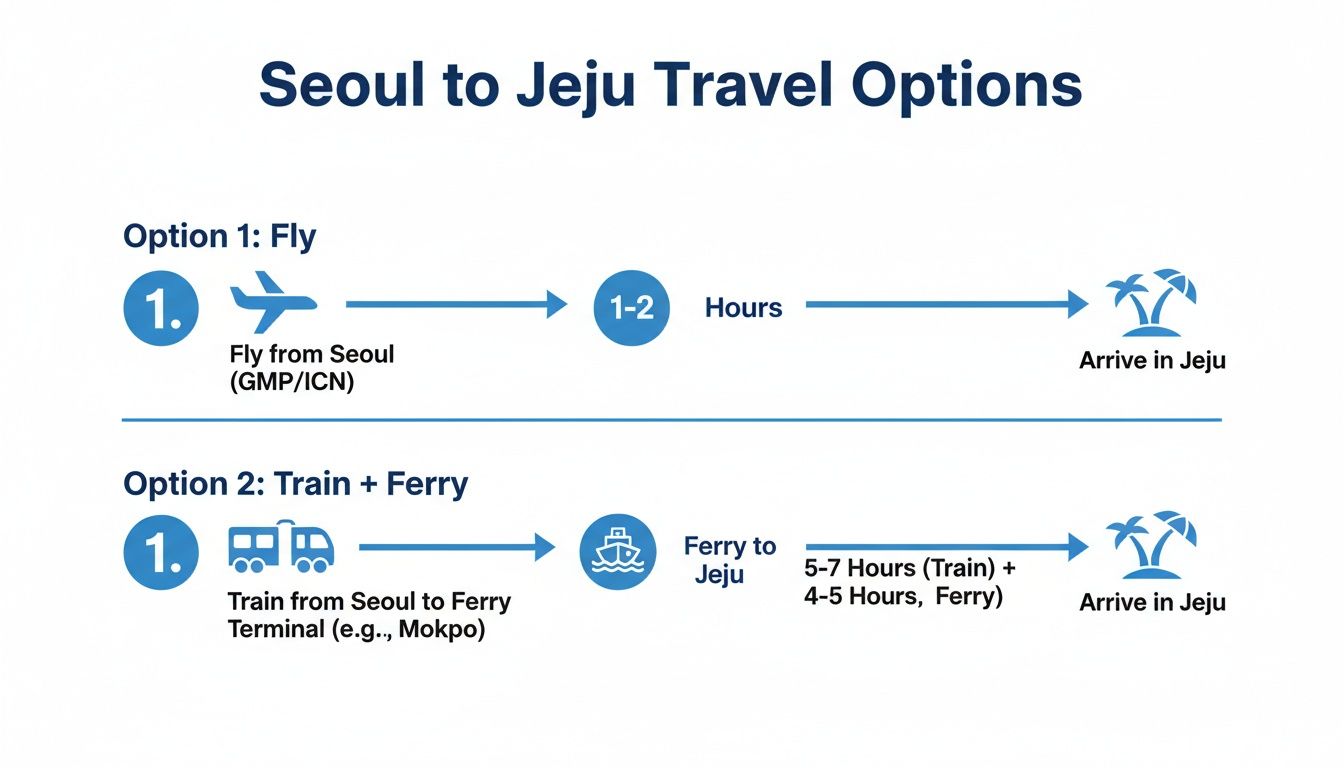
This route is a beautiful example of how choosing a lower-impact path can actually enrich your travel experience. Instead of a hurried flight, you get a story to tell—one that involves watching cities blend into farmland from a train window and feeling the sea breeze as you approach the island.
The real beauty of the train-ferry combo is its contribution to a more sustainable travel mindset. A round-trip flight from Seoul to Jeju can emit over 130 kg (about 287 lbs) of CO₂ per passenger. By choosing this route instead, you slash that footprint by as much as 80%. It’s a meaningful reduction.
The principles behind this style of travel are universal, whether you’re island-hopping in Korea or planning a trip closer to home. For more ideas, you might find our guide on low-impact island travel in the Mediterranean useful.
Step-by-Step Guide for the Mokpo Route
Your overland adventure starts at one of Seoul’s major train stations, usually Yongsan Station or Seoul Station, depending on the KTX line. Booking your ticket is easy. You can lock in your seats ahead of time using a platform like Trip.com for train tickets in Asia which has a reliable English interface and accepts international cards.
KTX trains are a pleasure to ride—they’re punctual, clean, and comfortable. You’ll find plenty of legroom, power outlets, and Wi-Fi. For luggage, each car has dedicated racks for larger suitcases plus overhead shelves for smaller bags and backpacks.
Once you arrive at Mokpo Station, you just need to get to the Mokpo Port International Passenger Terminal. It’s a short and simple transfer. A taxi from the station to the terminal takes about 10–15 minutes and costs around $5–$7 USD (₩6,000–₩9,000 KRW).
Here’s a quick breakdown of the logistics for this route.
Seoul to Jeju via Train and Ferry At a Glance
| Travel Leg | Mode | Departure/Arrival | Estimated Duration | Approximate Cost (USD/KRW) | Booking Link |
|---|---|---|---|---|---|
| Leg 1 | KTX Train | Seoul (Yongsan) → Mokpo Station | 2.5–3 hours | $45 / ₩60,000 | Trip.com |
| Transfer | Taxi | Mokpo Station → Mokpo Port | 10–15 minutes | $5–$7 / ₩6,000–₩9,000 | N/A (Pay driver) |
| Leg 2 | Ferry | Mokpo Port → Jeju Port | 4.5–5 hours | $30–$80 / ₩40,000–₩105,000 | Seastar Cruise |
This table gives you a clear snapshot of what to expect for each part of the journey. Planning ahead, especially for the train and ferry tickets, will make everything go smoothly.
Navigating the Ferry From Mokpo to Jeju
At the ferry terminal, you’ll check in for your sailing. It’s a good idea to book your ferry ticket in advance, particularly during peak season. The main operator here is Seastar Cruise, which runs the large, modern Queen Mary 2 and Queen Jenuvia vessels.
The overnight ferry is a brilliant choice for maximizing your time and budget. It usually departs around 1:00 AM and gets you into Jeju around 6:00 AM. This way, you travel while you sleep and save the cost of one night’s accommodation.
The ferries offer a few different cabin styles to fit your budget:
- Shared Rooms (Economy): These are large, open rooms with traditional Korean-style floor mats (yo) and blankets. It’s the most affordable option and a bit of a cultural experience.
- Bunk Beds: Some boats have shared cabins with bunk beds, which gives you a little more personal space.
- Private Cabins: For total privacy, you can book a private room for two to four people. These often come with an ensuite bathroom.
Onboard, you’ll usually find a convenience store, a small cafe or restaurant, and sometimes even a game room. Stepping out on the deck as the ship departs Mokpo or arrives in Jeju is a highlight.
When you dock at Jeju Port, you’re well-connected to the rest of the island. Taxis are waiting right outside, and several local bus routes stop near the terminal, ready to take you to Jeju City, Seogwipo, or wherever your adventure begins.
Flying to Jeju Island: The Faster Alternative
For most travelers, the simple answer to how to go from Seoul to Jeju Island is to hop on a plane. The Seoul-to-Jeju route is famously one of the busiest in the world, with what feels like an endless stream of flights departing every day. The time in the air is barely over an hour, making it the undeniable choice if you’re short on time.
But that speed comes at a price, especially for anyone trying to travel with a lighter footprint. The convenience of a quick flight hides a pretty significant environmental cost. Choosing to fly instead of taking the train and ferry dramatically inflates your carbon emissions—a tough trade-off to consider.
It’s not just about the carbon, either. The sheer volume of flights means the airports can feel chaotic and rushed, particularly during peak travel seasons. Flying gets you to Jeju faster, sure, but it completely misses the relaxed, scenic journey that makes the slower overland and sea route so rewarding.
Choosing Your Departure Airport: Gimpo vs. Incheon
When you’re flying out of Seoul, you have two airports to choose from: Gimpo International Airport (GMP) and Incheon International Airport (ICN). For a domestic hop to Jeju, Gimpo (GMP) is almost always the smarter choice.
Gimpo is much closer to central Seoul, making it cheaper and quicker to reach. You can jump on the AREX all-stop train or the subway and be there in as little as 20-30 minutes from neighborhoods like Hongdae. Getting to Incheon, on the other hand, can easily take over an hour and costs more.
Since Gimpo is primarily a domestic hub, it’s also smaller and way less hectic than the sprawling maze of Incheon. That means a much smoother, faster experience getting through check-in and security. Incheon (ICN) really only makes sense if you’re connecting directly from an international flight and want to bypass the trip into Seoul.

Navigating Budget Airlines and Booking Flights
The Seoul-Jeju route is dominated by a pack of low-cost carriers (LCCs). Airlines like Jeju Air, T’way Air, Jin Air, and Air Seoul are constantly competing, which keeps the base ticket prices impressively low. But you have to be savvy about the budget airline model.
That cheap price you see advertised is usually just for the seat. Expect to pay extra for almost everything else:
- Checked Luggage: Baggage allowances are tight, often just 15 kg (33 lbs). Go over, and the fees at the airport can be painfully steep.
- Seat Selection: Want to pick your spot? That’ll be an extra charge.
- Flexibility: The cheapest fares are typically non-refundable and come with hefty fees if you need to make any changes.
The best way to find a good deal is to use a flight aggregator. A site like Aviasales lets you compare all the airlines in one place, saving you the hassle of checking a half-dozen different websites. Just be sure to double-check the fine print on baggage before you book to avoid any nasty surprises.
The Environmental Impact of Flying
Here’s the biggest catch: the carbon footprint. A round-trip flight from Seoul to Jeju pumps out around 130 kg (about 287 lbs) of CO₂ per person. That number stands in stark contrast to the train and ferry option, which can slash your travel emissions by over 80%.
When you choose to fly, you’re making a direct trade: speed for sustainability. For a deeper dive into the numbers, our detailed analysis on train vs. plane emissions breaks down the data.
The sheer scale of air traffic on this single route magnifies the environmental problem. During peak summer travel, the Seoul-to-Jeju air corridor is staggering. Between July 25 and August 10, 2025, the Korea Airport Corporation projected passenger numbers to Jeju would hit 1.58 million, served by nearly 8,700 flights. You can find more details on this tourism data from The Chosun Ilbo.
Comparing Travel Options Seoul to Jeju
So, how do the two main options really stack up for an eco-conscious traveler? Here’s a quick head-to-head comparison that cuts through the noise.
| Factor | Fly (from Gimpo) | Train + Ferry (from Mokpo) | Recommendation |
|---|---|---|---|
| Total Travel Time | 3–4 hours (including transit) | 8–10 hours (including overnight) | Flying is faster, but the overnight ferry saves on a night’s accommodation. |
| Approximate Cost | $30–$100+ USD | $75–$130 USD | Flight prices swing wildly. The train and ferry offer much more stable and predictable pricing. |
| Carbon Footprint | High (~130 kg / 287 lbs CO₂) | Very Low (~25 kg / 55 lbs CO₂) | No contest. The train and ferry route is the clear winner for low-impact travel. |
| Travel Experience | Fast and convenient, but often stressful and generic. | Relaxing, scenic, and becomes part of the adventure itself. | For a memorable journey that connects you to the landscape, the train and ferry are superior. |
Ultimately, the choice comes down to what you value more on this particular trip: raw speed or a richer, more mindful travel experience with a tiny fraction of the environmental impact. Flying is an efficient tool, but the train and ferry route turns the journey into a destination in its own right.
Exploring Jeju Island Without a Car
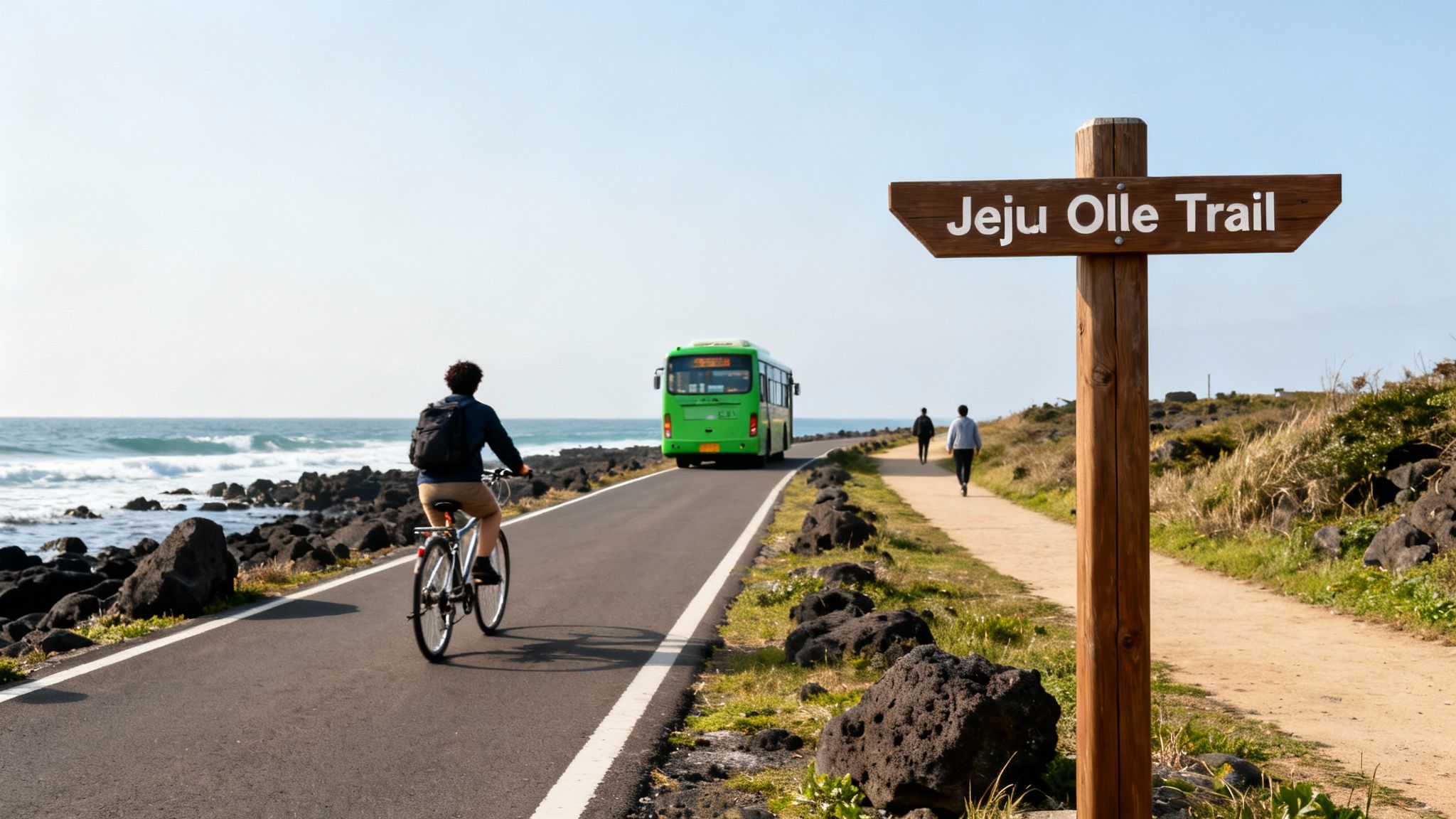
Your sustainable journey doesn’t have to stop once you step off the ferry. While most visitors reflexively book a rental car, getting around Jeju without one is not only doable—it’s a far richer experience that fosters a deeper connection to the island’s rhythm. Ditching the car is a powerful move that cuts your carbon footprint and eases the traffic choking the island’s beautiful roads.
This slower, more intentional approach to travel is gaining serious traction. In fact, Jeju saw a massive 17.5% jump in foreign tourists in 2025, a sign that international travelers are finally looking beyond Seoul for more authentic Korean experiences. You can read more about this fascinating trend on The Straits Times.
Choosing to explore Jeju car-free aligns perfectly with this mindset. It lets you see the island like a local, not just through a windshield.
Navigating with Public Buses
Jeju’s public bus network is modern, clean, and surprisingly comprehensive, connecting all the main towns, attractions, and Olle Trailheads. You can use the same T-Money card from Seoul to tap on and off, which makes everything seamless. Fares are incredibly cheap, usually between $1 to $3 USD (₩1,300–₩4,000 KRW) per trip.
One critical tip: Google Maps doesn’t really work for transit here. Before you go, download Naver Maps or Kakao Maps. These apps are essential, offering real-time bus tracking, accurate schedules, and walking directions that make the system feel intuitive, even if you don’t speak a word of Korean.
Taxis and Bicycles for Flexible Travel
For those moments when you need a more direct ride—say, from the ferry port to your guesthouse—taxis are easy to find. To skip any language barriers and get transparent pricing, booking ahead with a service like Kiwitaxi is a solid, stress-free option.
Another fantastic way to explore is by bike. Jeju is famous for its well-maintained coastal bike paths that serve up absolutely breathtaking ocean views. Renting a bike for the day gives you the freedom to cruise along scenic stretches at your own pace, discovering quiet beaches and tiny local cafes you’d fly right past in a car.
Hiking the Jeju Olle Trail
For the ultimate slow travel experience, nothing beats walking a section of the Jeju Olle Trail. This famous network of walking paths circles the entire island, broken down into over 26 distinct routes. Each trail immerses you in a different landscape, from dramatic coastal cliffs and volcanic cones (oreum) to peaceful forests and sleepy villages.
You don’t need to be a hardcore trekker to enjoy it, either. Just pick a route that speaks to you, walk for a few hours, and then hop on a local bus to get back to your base. It’s the perfect way to truly absorb Jeju’s tranquil beauty up close.
Exploring an island without a car can be a liberating experience, forcing you to slow down and engage more deeply with your surroundings. It’s a core principle of sustainable travel and a fantastic way to design a memorable workation. For more inspiration, check out our guide to the best workation cities you can explore without a car.
When to Visit and What to Pack for Your Trip
Timing your trip from Seoul down to Jeju is a huge part of the experience. While the island is technically a year-round destination, you’ll find the sweet spot in the shoulder seasons—spring and autumn. This is when you get the best mix of comfortable weather, smaller crowds, and more stable prices for the journey.
Spring (April–June): This is when the island really comes alive. Think vibrant cherry blossoms and endless fields of bright yellow canola flowers. The temperatures are mild, which is perfect for hiking a few sections of the Olle trails or cycling along the coast without overheating.
Autumn (September–November): My personal favorite. You get that crisp, clean air, clear blue skies, and incredible fall foliage. It’s cool enough for all-day exploring without the sticky humidity of a Korean summer.
It’s also smart to plan around major Korean national holidays like Chuseok (Korean Thanksgiving, usually in September or October). Domestic travel still has a massive impact on crowds and how quickly accommodation books up. That said, recent data hints at a slight dip in domestic visitors, which could mean more options and less congestion for international travelers, especially those planning a longer, slower stay. You can see more on Jeju’s tourism trends from the Seoul Economic Daily.
A Minimalist Packing List for the Eco-Nomad
Packing light isn’t just about convenience; it’s a core part of a low-impact journey. A minimalist wardrobe built around versatile, layerable pieces will serve you well in Jeju’s famously changeable coastal climate. Merino wool base layers, a lightweight waterproof jacket, and a single pair of comfortable, sturdy shoes for walking are a great foundation.
Beyond clothes, a few simple items will make your trip smoother and far more sustainable:
- Reusable Water Bottle: Tap water is safe to drink in South Korea. Bringing your own bottle means you can stay hydrated while completely sidestepping single-use plastic.
- Solid Toiletries: Shampoo bars, conditioner bars, and solid toothpaste are game-changers. They reduce plastic waste and eliminate the risk of messy spills in your bag.
- Universal Power Adapter: South Korea uses Type F plugs, so a universal adapter is a must-have for keeping your gear charged.
- Portable Power Bank: Absolutely essential. You’ll be out exploring all day, relying on your phone for navigation with Naver Maps, and you don’t want to get caught with a dead battery.
For a full rundown of what to bring (and what to leave at home), check out our complete guide on how to pack for low-impact travel.
Essential Tech for Staying Connected
For any digital nomad or modern traveler, solid internet is non-negotiable. You could rent a portable Wi-Fi egg at the airport, but a far easier option is an eSIM. It lets you activate a local data plan the moment you arrive, without having to hunt down a shop or fiddle with tiny physical SIM cards.
Providers like Airalo or Saily offer affordable and reliable data packages for South Korea. The best part? You can buy and install the eSIM before you even leave home, ensuring you have internet access from the second your journey begins.
Common Questions About Traveling From Seoul to Jeju
Planning this trip, especially the less-traveled ferry route, brings up a few common questions. Here are some straight answers based on my experience to help you finalize your plans with confidence.
Is the Ferry From Mokpo to Jeju Safe?
Absolutely. Passenger safety is a huge priority in South Korea’s maritime industry, and it shows.
The ferries on the Mokpo-Jeju route, like the Queen Mary 2 and Queen Jenuvia run by Seastar Cruise, are large, modern vessels. They’re equipped with the kind of advanced navigation and safety systems you’d expect, and they undergo regular, strict inspections to meet both national and international standards.
These aren’t little shuttle boats; they are substantial ships built for stability and comfort, even if the seas get a bit choppy. Onboard, you’ll find clear safety instructions, easy-to-find life-saving gear, and a professional crew trained for any scenario. Honestly, the whole experience feels more like a small, calm cruise than a simple ferry crossing.
Can I Bring a Car on the Ferry to Jeju?
Yes, the ferries have vehicle decks, so you can take a car. However, for most eco-minded travelers and digital nomads, I’d strongly recommend against it.
Jeju’s public bus system is excellent, and taxis and bicycle rentals are affordable and widely available. Getting around the island without a car is not only easy but also far more sustainable.
Plus, navigating and parking, especially in popular spots during peak season, can be a real headache. Ditching the car lowers your carbon footprint and nudges you into a slower, more immersive rhythm with the island.
What Is a Realistic Budget for the Seoul to Jeju Trip?
Your budget really comes down to which route you pick. Here’s a practical look at the one-way costs to help you decide.
Train + Ferry (The Sustainable Choice): This route has much more predictable pricing.
- KTX Train (Seoul to Mokpo): Usually around $45 USD (₩60,000 KRW).
- Ferry (Mokpo to Jeju): Between $30–$80 USD (₩40,000–₩105,000 KRW), depending on whether you go for a shared floor-mat room or a private cabin.
- Total Estimated Cost: $75–$125 USD per person.
Flying (The Faster Choice): Flight prices are all over the place, changing with the airline, booking time, and season.
- Flight (Gimpo to Jeju): Can be as low as $30 USD (₩40,000 KRW) if you snag a last-minute deal, or over $100 USD (₩135,000 KRW) if you book late.
- Baggage Fees: Don’t forget that budget airlines often tack on $20–$40 USD for a checked bag.
- Total Estimated Cost: $50–$140+ USD per person.
While a flight might look cheaper at first glance, the train and ferry option offers a more stable cost and a far more memorable travel experience.
How Far in Advance Should I Book Tickets?
Booking ahead is always a good move, particularly for the train and ferry route. The ideal window really depends on when you’re traveling.
- For the KTX Train: Seats can definitely sell out, especially on Friday and Sunday evenings. It’s best to book your tickets 2 to 4 weeks in advance to get the time you want. You can book KTX tickets online through platforms like Trip.com.
- For the Ferry: The overnight ferry is a local favorite. To guarantee a spot, and especially if you want a private cabin, I recommend booking at least 3 to 4 weeks ahead. This is crucial for weekend sailings or travel during the beautiful spring and autumn months.
- For Flights: To get the best deals on budget airlines, you need to book as far out as you can—ideally 1 to 2 months ahead. Last-minute fares can be surprisingly painful on the wallet.
A little planning not only saves you money but also makes for a much smoother, stress-free travel day.
This article was fact-checked using sustainability data from the World Green Building Council, the Global Ecotourism Network, and peer-reviewed architecture studies. All partner links are vetted for compliance with sustainable business certifications.
Join the Sustainable Work Movement
Want more rail-first itineraries, low-impact packing systems, and walkable base-city ideas?
Explore Eco Nomad Travel
📚 Core Guides
🧭 Planning & Logistics
🗺️ Destinations & Seasons
Jeremy Jarvis — founder of Eco Nomad Travel, sustainable travel writer, and advocate for regenerative tourism. His work focuses on low-impact mobility, eco-friendly digital nomad life, and climate-positive travel.
Legal
Affiliate DisclaimerPrivacy Policy
Terms of Service
Image & Media Notice
Cookie Policy
Contact
Affiliate Disclosure: Some links on Eco Nomad Travel are affiliate links, meaning we may earn a small commission at no extra cost to you. This supports our mission to inspire responsible and low-impact travel worldwide.
Connect
✅ Trusted Official Sources
Plan smarter eco trips
Try our free Sustainable Travel Tools for Digital Nomads – carbon calculator, train vs plane comparator, and more.
Open Tools Hub