

Last updated: June 19, 2026
For a related Eco Nomad guide, see europe train luggage rules.
If you’re wondering is it safe to travel by train in Europe, the practical answer is yes for most trips. The biggest risks for travelers are usually the same risks you’d manage in any busy city: crowds, distraction, and occasional petty theft at stations or around luggage racks. With a calm station routine, a simple luggage setup, and a few night-train habits, you can travel confidently.
Key takeaways on train safety in Europe
- Is it safe to travel by train in Europe? Yes—European rail is widely used and generally safe; most “problems” are avoidable hassles, not dangerous situations.
- Station safety matters most: crowds and last-minute platform changes are when people get distracted.
- Luggage theft is rare, but bag snatching happens: keep your main bag where you can see it and keep valuables on your body.
- Night train safety in Europe is about routines: lock the compartment when available and keep passports/phones within reach while you sleep.
- Use official advice when details change: security checks and arrival times vary by route (especially for Eurostar).
Is it safe to travel by train in Europe? The short answer
Yes. Trains are everyday transportation across Europe, and most rides are uneventful. If you want a “one-sentence” plan: arrive a little early, keep valuables on you, keep big luggage in sight, and stay alert when the train stops. That matches the real-world patterns described by major operators and station safety guidance.
For example, ÖBB (Austria’s national railway) recommends basics like keeping valuables in inner/front pockets, being extra cautious in crowds, never leaving luggage unattended, and locking compartments on night trains. ÖBB safety notes.
Avoid the biggest train-travel mistakes
Booking order + buffer rules + offline plan - free PDF.
What are the real train safety risks in Europe (and what is mostly hype)?
Most safety worries fall into three buckets:
- Station + crowd risk (distraction, jostling, opportunistic theft).
- Luggage risk (bags in racks near doors, or bags left unattended).
- Night-train comfort risk (sleeping lightly, protecting valuables, and choosing the right accommodation).
What’s usually not the problem? Violent crime on trains is not the typical traveler issue. Most people who say “train safety” actually mean “how do I avoid pickpockets, bag theft, and stressful mistakes.” Use the checklists below and you’ll cover the common failure points without turning your trip into a fear project.
Is it safe to travel by train in Europe for first-time visitors?
Yes—especially if you reduce “new system stress.” When you’re new to European rail, the biggest risk is rushing: sprinting to a platform, stepping onto the wrong train, leaving a phone on a seat while you lift a bag, or trusting a stranger who “helps” you at the ticket machine. The train itself is usually the calm part.
Think of safety as a simple equation:
- Less rush = fewer mistakes.
- Less distraction = fewer theft opportunities.
- More visibility (bags in sight, valuables on you) = less worry.
This is why the question “is it safe to travel by train in Europe?” is best answered with a routine, not a statistic. In practice, your “safety win” is arriving with time, knowing your platform, and keeping your essentials where you can’t forget or lose them.
Train station safety in Europe: a calm checklist you can repeat
Station time is where most travelers feel the most uncertainty—big terminals, language differences, platform changes, and crowds. Use this repeatable routine.
What should I do before I enter the station?
- Screenshot or save your ticket/QR code offline (and keep your passport in a secure, zipped place).
- Pack “quick access” items (water, snacks, charger) so you’re not digging through your main bag in a crowd.
- Set one simple rule: valuables stay on your body (phone, wallet, passport).
What should I do once I’m inside the station?
- Go straight to the main departure board (not random third‑party screens).
- Confirm: train number, destination, and platform—then confirm again at the platform.
- In crowds, carry your daypack in front and keep zippers closed.
- Ignore unsolicited “helpers,” especially around ticket machines and stairways.
| Moment | Do this | Why it helps |
|---|---|---|
| Platform changes | Follow the official board + platform displays; move early, not at the last minute | Reduces rush (and distraction) when boarding starts |
| Escalators + crowds | Keep one hand on your bag; pause if you’re being jostled | Prevents “bump and grab” style theft and simple falls |
| Someone offers help with bags | Decline and move toward staff or a staffed area | Reduces exposure to distraction-based scams |
| Waiting on the platform | Stand where other passengers are; keep distance from the platform edge | More eyes around you, less stress, safer boarding flow |
Berlin’s S‑Bahn safety guidance lists practical “tips against theft” and describes common tactics (like distractions and escalator tricks). It’s city‑specific, but the patterns translate well to big hubs across Europe. S‑Bahn Berlin: protection against theft. For another operator example, Switzerland’s SBB highlights paying extra attention to your valuables when people are getting on and off the train. SBB: stay alert against pickpockets.
Is it safe to travel by train in Europe with a big suitcase?
Yes—just plan for the two “suitcase moments” where people get distracted: stairs/escalators and boarding. If you’re wrestling a heavy bag onto a rack, your attention narrows and you’re easier to distract. The fix is simple: keep your phone, passport, and wallet in an inner pocket before you lift anything, and don’t accept unsolicited “help.”
Station safety red flags (move, pause, or change position)
Unexpected closeness: someone presses close behind you while you’re using your phone or wallet.
Distraction spike: a sudden commotion that tries to pull your eyes away from your bag.
Door-zone hovering: a person lingers near luggage racks close to train doors while the train is stopped.
Pressure to move: anyone insisting you follow them to an ATM, a “special” ticket machine, or a different exit.
If any of these happen, the safest move is usually boring: step toward a more populated area, get your back to a wall, and re-check your belongings. When you keep things calm, you keep control of the situation.
How to keep luggage safe on European trains (without overthinking it)
Luggage rules are usually relaxed compared to flying—but relaxed rules can tempt travelers to treat bags casually. Don’t. The safest approach is simple: big bag in sight, valuables on you.
Is luggage theft common on European trains?
It’s not “common” in the sense that most travelers experience it—but it’s plausible enough that you should plan for it. NS International describes how bag snatchers often take advantage of stops and crowds, including theft right as doors close. NS International: outsmart pickpockets and bag snatchers.
Luggage setup that works in 90 seconds
- Main suitcase/backpack: place it where you can see it from your seat (not in a rack behind you, if you can avoid it).
- Valuables pouch: phone + passport + wallet stay with you (belt bag, inner pocket, or a small crossbody worn front).
- Zippers: clip or tie zipper pulls together so casual opening is harder.
- Stops: when the train stops, do a quick “touch check” (phone, passport, wallet) and keep an eye on luggage racks near doors.
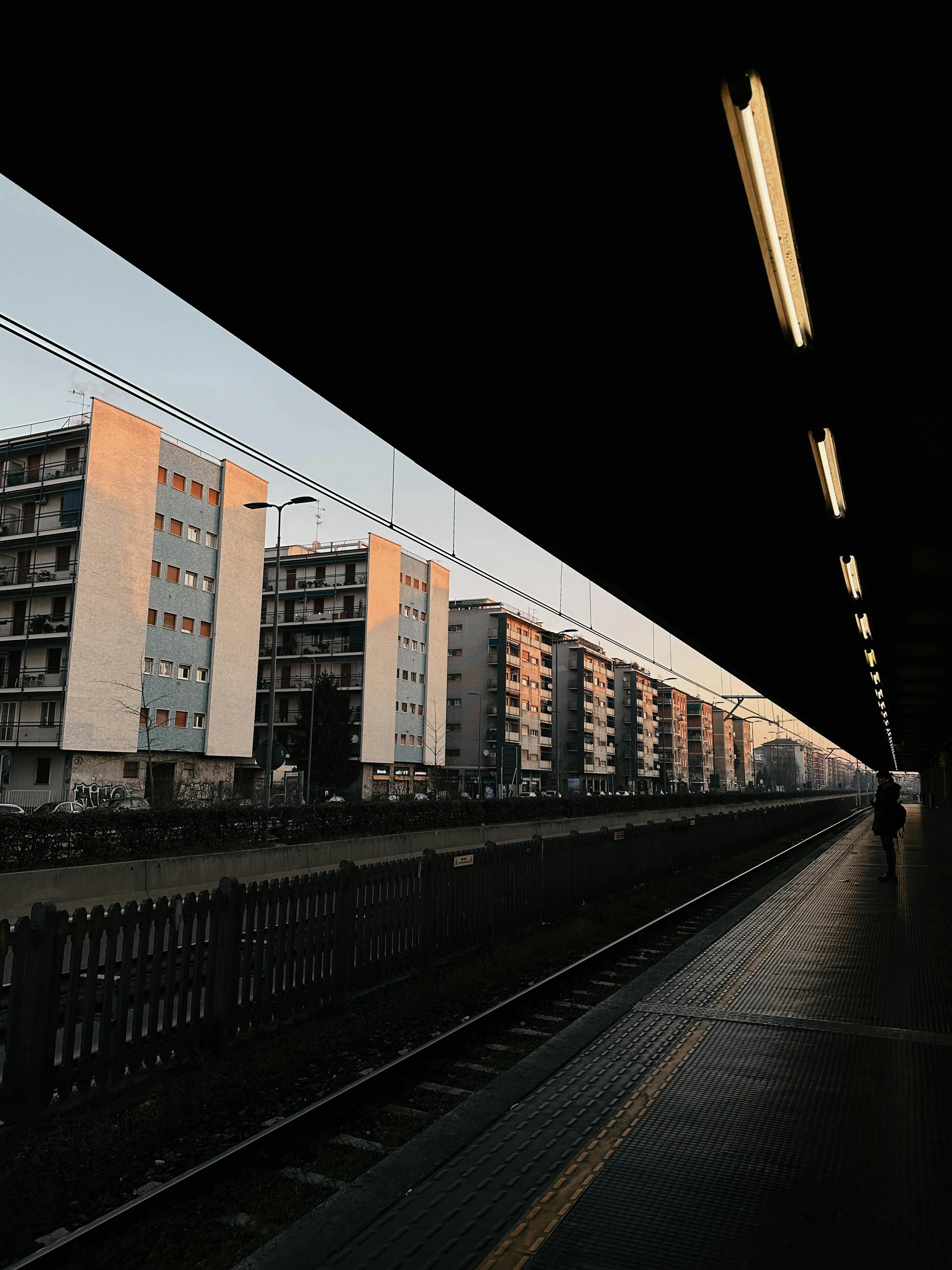
Where should I sit to keep luggage safe?
If you’re asking “is it safe to travel by train in Europe with luggage,” this is the most useful seat rule: choose a seat that keeps the luggage you care about in your line of sight. That usually means one of these:
- A seat with an overhead shelf directly above you (for smaller bags you can lift safely).
- A seat facing a luggage stack/rack where you can see your bag while seated.
- A seat where your bag can sit at your feet without blocking aisles (only if it fits and the train is not crowded).
Try to avoid placing your main bag on a rack behind you or in a vestibule rack right by the doors unless it’s the only option. If it is the only option, keep valuables on your body and be more alert when the train stops.
What should I do when the train stops?
Bag snatching often happens during stops because doors open, people move, and attention spreads out. NS International describes scenarios where theft occurs while the train is stationary or as staff begin departure procedures. NS International’s guidance is a helpful reminder to treat stops as the moment to re-check your setup.
Use this mini routine at every stop:
- Do a quick “touch check” for phone + passport + wallet.
- Glance at luggage racks near doors (especially if your bag is there).
- If someone is hovering near your bag without a clear reason, change position or put a hand on your bag.
Simple anti-theft upgrades that don’t slow you down
Light zipper clip: a small clip for your daypack discourages casual opening in crowds without adding any meaningful friction to your day.
Bright luggage strap: a simple strap or distinctive marker makes it easier to identify your bag quickly on racks and helps prevent mix-ups in busy aisles.
Minimal luggage tag: a name + email is often enough; avoid displaying full address details that you wouldn’t want visible in public.
Backup documents: keep photos of your passport and ticket confirmations stored securely so you can recover details fast if something goes missing.
None of this is about paranoia. It’s about reducing the chance that a tiny distraction becomes an expensive problem—and helping you enjoy how relaxing European rail can be.
Night train safety in Europe: how to sleep without worrying
Night trains can feel intimidating if you’ve never used them—but the “safety plan” is mostly comfort + routine.
Are night trains safe in Europe?
Generally, yes. Choose the right accommodation for your comfort level, and use a few habits that reduce the most common annoyances (noise, missing stops, and valuables management). ÖBB’s safety notes explicitly recommend locking the compartment on night trains and not keeping valuables right next to the door. ÖBB safety notes (night trains).
Couchette vs sleeper: which is “safer”?
Both are typically fine. The real difference is privacy and sleep quality:
- Sleeper: more privacy, fewer strangers, easier to keep your things organized and close.
- Couchette: more social, more people in the compartment, still safe with basic habits.
Night train routine (do this every time)
- Before bed: repack so passport, phone, and wallet are on your body or in an inside pocket you can’t accidentally leave behind.
- Lock the compartment if possible and follow the attendant’s instructions.
- Keep shoes and a small “grab bag” close so you can step off quickly at your stop.
- Set two alarms (phone + watch) if you’re anxious about missing the stop.
Night train comfort tips that also improve safety
If you’re still asking is it safe to travel by train in Europe on overnight routes, remember that “safe” often means “I can sleep without worrying.” These comfort steps help you sleep deeper and stay more aware when you need to be:
- Choose your berth strategically: many people sleep better in a top bunk (harder for someone to accidentally bump you) or in a lower bunk (easier to access your bag). Pick what makes you calmer.
- Keep essentials together: a single “night pouch” (passport, cards, phone, earplugs) prevents frantic searching at 6 a.m.
- Know the wake-up plan: look up your arrival time before bed and set alarms with enough buffer to pack calmly.
- Follow the operator’s rules: attendants can advise on door locks, station stops, and when to stay in the compartment.
Some operators offer options like smaller compartments or comfort‑oriented categories that simply make it easier to manage your belongings and sleep. If you’re anxious, paying a little more for better sleep can be the “safety upgrade” that matters most.
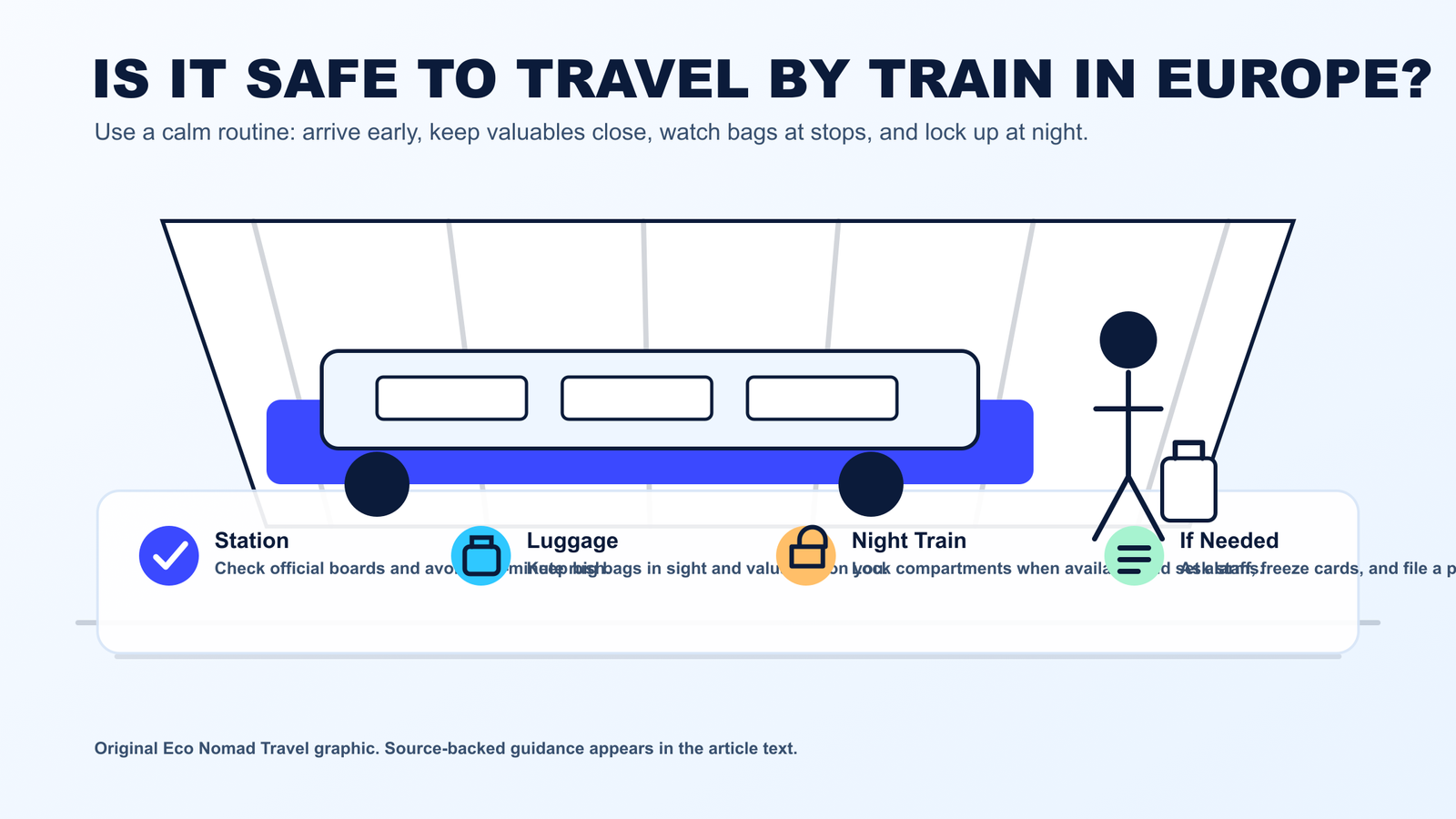
Visual guide: station-to-sleeper safety flow
If you want one routine to repeat on every route, use this flow from station hall to sleep.
Eurostar safety: why it feels more like an airport (and how to plan it)
Some international services (especially Eurostar to/from London) include security and border checks. That’s not “danger”—it’s logistics. Build in buffer time so you don’t feel rushed, because rush is when mistakes and distraction happen.
Eurostar’s own guidance notes that arrival time depends on route, and for London routes there are ticket, security, and border checks; ticket checks can close before departure. Eurostar: when to arrive at the station (official check-in guidance).
How to protect your phone and documents for European train safety
When travelers ask “is it safe to travel by train in Europe,” they’re often thinking about passports and phones. The goal is not to hide everything—it’s to make “grab and go” theft difficult and to make loss recoverable.
Phone safety on platforms and at doors
Use door zones carefully: when the train is stopped, keep your phone away from doorways and don’t stand right at the edge of the door cluster. Door areas are where people flow in and out—and where distraction spikes.
Step aside to check directions: if you’re using your phone for navigation or checking a platform number, step to the side and keep a hand on your bag so you’re not juggling phone + luggage at the same time.
Prevent drops: if you tend to drop your phone when lifting luggage, use a wrist strap or lanyard. A dropped phone can turn into a “grab and go” moment in a crowded station.
Passport + payment setup that reduces panic
Carry essentials inside your clothing: keep your passport and primary payment card in an inner pocket or a pouch worn under/inside your jacket—especially when moving through crowded platforms and station halls.
Separate backups: keep one backup payment option separate (a second card stored deep in your bag, not in your wallet). That way one loss doesn’t become a trip‑ending problem.
Make loss recoverable: store digital copies securely (for example, in a password manager or encrypted cloud vault). You’re not trying to “travel paranoid”—you’re making sure you can recover quickly if something goes missing.
Train safety in Europe by country: how to think about it
Europe is not one security environment. Big-picture: the day-to-day train experience is typically safe, but crowds and scams cluster in major tourist hubs and big interchanges. Your best planning move is to treat stations like city centers: stay aware, keep valuables close, and avoid late-night isolation.
If you’re planning a route that includes multiple capitals and large stations, this question gets more useful: “Where will I be rushed?” Tight connections, unfamiliar platforms, and night arrivals increase stress. Build buffers and you’ll feel safer without changing your itinerary.
Is it safe to travel by train in Europe as a solo traveler?
Yes—especially if you treat the trip like normal urban travel. Solo travel safety is mostly about avoiding isolation and avoiding distraction:
In large stations at night: stand near other passengers or near a staffed area.
On board: choose a seat where you can see your main bag (or keep it between you and the wall if it’s small enough).
When tired: don’t fall asleep with valuables on a table or loose on a seat.
If you’re traveling solo and still asking is it safe to travel by train in Europe, focus on two upgrades that make a big difference without changing your whole trip:
- Reduce late-night isolation: if you arrive very late, consider booking accommodation closer to the station or using a taxi/ride service for the final mile instead of walking unfamiliar streets with luggage.
- Buy calm: reserved seats, first class (when affordable), or a sleeper compartment can make it easier to keep luggage in sight and sleep better.
EUCPN’s prevention note on pickpocketing at stations highlights how crowded passenger areas create opportunities for distraction‑based theft. EUCPN: pickpocketing at railway stations and in trains.
Boarding and getting off safely: the 60-second drill
Most “train safety stories” happen during boarding and stops. The fix is not complicated—you just need a repeatable drill so you don’t improvise in a crowd.
- Before the train arrives: zip your daypack, move phone and wallet into inner pockets, and confirm the coach number on your ticket.
- When the doors open: let passengers off first and keep your bag close to your body.
- Once inside: move away from the door area quickly (door clusters are busy and make bag monitoring harder).
- At every stop: do the quick touch check (phone + passport + wallet), then glance at nearby racks.
Train station safety in Europe for families (kids, strollers, and groups)
Families are not less safe on trains—but they are easier to distract. If you’re traveling with kids, your goal is to reduce “splitting” and reduce last-minute decisions.
- Assign roles: one adult handles tickets/platforms; the other handles bags and kids.
- Pick a meeting point: if you get separated, reunite at the station info desk (not “somewhere near the platform”).
- Board early: if pre-boarding is available, use it so you can stow bags before the crowd compresses.
- Keep a small kid bag: snacks + wipes + toys so you aren’t opening the main luggage repeatedly.
These routines also answer the real question behind “is it safe to travel by train in Europe with children?”—yes, when you reduce rush and keep the group together.
What should I do if something goes wrong (lost item, theft, or harassment)?
Have a simple escalation ladder so you don’t freeze:
- Train staff first: conductor/attendant can help with the train number, next station, and reporting.
- Station staff next: info desks and security can direct you to the right local process.
- Lock down accounts: if wallet/phone is stolen, freeze cards and reset passwords quickly.
- Police report: you may need it for insurance.
A practical example: using train safety in Europe on travel day
Advice is most useful when you can picture it. Here’s what “safe” looks like on an average travel day from a major station—without adding stress or turning your trip into a security operation.
Start with the simple idea behind the big question: is it safe to travel by train in Europe? For most travelers, yes—when you remove rush and make your essentials hard to lose.
| Step | What you do | What it prevents |
|---|---|---|
| Before you leave your hotel | Put passport + wallet + phone in an inner pocket; save ticket offline | Panic-searching for essentials in the station |
| Inside the station | Confirm platform on official boards; ignore unsolicited helpers | Wrong-platform rush and distraction-based scams |
| On the train | Place big bag in sight; do a quick check at each stop | Bag snatching during stops or at door-closing moments |
If you do nothing else, do this: keep valuables on your body and keep your main bag in sight. That single habit fixes most of the situations that make people feel uneasy.
FAQ: train safety in Europe
Is it safe to travel by train in Europe at night?
Yes for most routes. Night travel feels different because you’re tired and stations can be quieter. Use the night-train routine (valuables on you, compartment locked when possible, alarms set) and you’ll reduce the most common issues.
How do I avoid pickpockets in European train stations?
Don’t give pickpockets “free minutes.” Keep your phone and wallet in a zipped inner pocket, carry your daypack in front in crowds, and avoid last-minute platform sprints. Distraction and jostling are the common setups.
Where should I put my suitcase on the train?
Put it where you can see it—ideally in a rack across from you or above you (not behind you). If the only large rack is near doors, keep valuables on you and be more alert when the train stops.
Should I lock my luggage on European trains?
A small lock or zipper clip is a reasonable deterrent, especially on crowded routes or night trains. It’s not about building a fortress—it’s about preventing easy, silent opening.
Do I need to arrive early for trains in Europe?
For most domestic trains, 15–30 minutes is plenty. For Eurostar and certain international routes, plan longer due to security/border steps. Always check operator guidance for your specific route.
Are night trains safer in a sleeper or couchette?
Neither is “unsafe,” but sleepers offer more privacy and can feel calmer. If you’re anxious, a sleeper (or a smaller compartment) can make it easier to manage valuables and sleep better.
More Europe train guides to plan your trip
Start with our hub: Train Travel in Europe: Eco-Friendly Planning Guide.
Then read: How to Book Train Travel in Europe.
If luggage is your biggest worry, use: Europe Train Luggage Rules (Bags, Bikes, Lockers, and Station Tips).
Compare the trip details before you book
Affiliate disclosure: Eco Nomad Travel may earn a commission if you book through qualifying links, at no extra cost to you. Use the link only when it genuinely helps your trip research.
Before you lock in dates for Is It Safe to Travel by Train in Europe Station, Luggage, and Night Train Tips, compare location, flexible cancellation, transfer timing, and total trip cost so the final plan fits your budget and pace.
