
Embarking on a journey of low impact travel isn’t about sacrificing adventure; it’s about making your adventures smarter and more intentional. It’s a way of exploring the world that focuses on minimizing your environmental, cultural, and economic footprint on a destination. This guide is designed to help you with any questions or concerns you might have about making your trips more sustainable.
This means making conscious choices—from the trains you take to the guesthouses you book—to ensure your travels contribute something positive instead of just taking away. For example, by choosing a lightweight travel backpack, you’re already starting your trip on the right foot, making train travel easier and reducing your load.
The whole process starts before you even lock your front door. It begins with packing with purpose, maybe choosing a durable carry on backpack that forces you to bring only what you truly need. By packing light, you’re already reducing weight on transport and making overland travel by train or bus far easier.
The Core Philosophy of Low Impact Travel

At its heart, low-impact travel is about becoming a thoughtful guest in someone else’s home. Instead of just consuming experiences and ticking off a checklist, you actively seek to preserve the places you visit. This shift often leads to a more authentic, rewarding, and connected way of seeing the world.
From there, every decision you make on the road builds on this foundation of mindfulness. The goal is to leave a place as good as, or even better than, you found it. This goes way beyond just picking up your trash; it’s about supporting local businesses, respecting cultural norms, and choosing operators who share your commitment to protecting the planet.
To see how this fits into the bigger picture, check out our guide on what sustainable travel means.
Practical Pillars of Low Impact Journeys
Adopting this mindset is simpler than it sounds. It really just breaks down into a few key areas where small changes can make a huge difference.
- Mindful Transportation: Prioritizing overland travel like trains and buses over flying whenever possible. This one move can dramatically slash your carbon emissions.
- Conscious Consumption: Reducing waste by carrying a reusable water bottle and packing essentials like a solid shampoo bar to ditch single-use plastics for good.
- Supporting Local Economies: Choosing locally owned guesthouses, restaurants, and tour operators so your money directly benefits the community you’re visiting, not a distant corporation.
- Cultural and Environmental Respect: Taking the time to learn about local customs, sticking to trail guidelines, and leaving natural sites completely undisturbed.
Ultimately, low-impact travel is about aligning your actions with your values. It’s an empowering way to explore that recognizes the privilege of travel and seeks to use it as a force for good. When you embrace this approach, you not only protect beautiful places for future generations but also enrich your own experiences in profound ways.
Why Your Travel Choices for Low Impact Travel Matter More Than Ever
Getting your head around low impact travel is one thing, but the real push comes from seeing just how critical it is right now. Every time we book a trip on a site like Trip.com, we’re casting a vote with our wallets, and those choices send powerful ripples across the planet and its communities.
Let’s be honest: conventional tourism, with its heavy reliance on cheap flights and mass consumption, puts an incredible strain on fragile ecosystems and local resources. From the jet fuel burned at 35,000 feet (10,668 meters) to the single-use plastics at all-inclusive resorts, the combined impact is staggering. This isn’t about guilt-tripping anyone over past holidays. It’s about realizing the collective power we have to nudge the industry in a better direction.
Making more conscious decisions protects the very places we love to explore. And as a bonus, this mindset often makes travel lighter and more flexible. A lightweight travel backpack, for example, is far easier to navigate through a packed train station or down a cobblestone street than bulky luggage, encouraging you to use public transit and your own two feet.
The Carbon Cost of Conventional Travel
Transportation is the big one. It’s by far the largest slice of a traveler’s carbon footprint, and aviation is the main culprit. The sheer convenience of flying comes at a steep environmental price, pumping greenhouse gases directly into the upper atmosphere where their warming effect is amplified.
To put it in perspective, a single round-trip flight from London to New York produces about 1.2 US tons (1.1 metric tons) of CO2 per passenger. That’s roughly what it takes to heat an average US home for an entire year. In contrast, choosing a train for a similar distance in Europe can slash those transport emissions by up to 90%. You can search for low-emission flight options on platforms like Aviasales.
That massive difference is why so many travelers are rediscovering the rails. It’s not just a quaint idea; in 2023, bookings for Europe’s night trains jumped by 50% year-over-year. People are catching on.
Beyond Emissions to Economic Empowerment
The impact of our travel choices goes way beyond carbon metrics; it directly shapes the economic and social fabric of the places we visit. Done right, tourism can be a powerful force for good, creating sustainable livelihoods and helping to preserve cultural heritage.
This is where regenerative travel comes in. It’s a core part of the low-impact approach, focusing on making sure our travel dollars directly benefit local people. Think choosing a locally-owned guesthouse over a multinational hotel chain, eating at a family-run restaurant, or hiring a guide who grew up in the area. This keeps money circulating where it’s needed most, fostering economic resilience and empowering residents to protect their own natural and cultural assets. (It also helps to have an RFID blocking wallet to keep your valuables secure so you can focus on these meaningful interactions.)
This approach helps stop “economic leakage,” a huge problem where tourist money gets siphoned out of the local economy and into the bank accounts of foreign corporations. You can dive deeper into how this works in our article on the future of sustainable tourism.
Protecting Biodiversity and Cultural Integrity
At its heart, low-impact travel is about respect for the place itself. We’ve all seen the effects of overtourism: eroded landscapes, strained water supplies, and mountains of waste. By traveling in smaller groups, visiting during the shoulder seasons, and sticking to marked trails, we can dramatically reduce our physical footprint.
Simple habits make a huge difference here. Using reef safe sunscreen, for instance, is a small but vital way to protect fragile marine ecosystems from chemical damage.
This respect extends to culture, too. Dressing appropriately, learning a few words of the local language, and asking permission before taking photos—these actions show that you see a destination as a living community, not just a backdrop for your Instagram feed. It’s a fundamental part of becoming a more conscious and responsible global citizen.
Mastering Low Impact Transportation
Transportation is almost always the single biggest chunk of your travel footprint. The good news? That makes it the single most powerful lever you have for making a real difference. Rethinking how you get from A to B doesn’t just cut your emissions—it opens up a world of scenic, affordable, and far more rewarding travel experiences.
It’s about trading the sterile airport terminal for a window seat with an ever-changing landscape.
Embracing this mindset means putting rail travel first. Trains aren’t just a nostalgic way to see the world; they’re a practical tool for slashing your environmental impact. Modern rail networks, especially across Europe and parts of Asia, are efficient, comfortable, and drop you right in the city center, saving you the time and money you’d otherwise spend on airport transfers. A pre-booked transfer from Welcome Pickups can make arrivals even smoother.
A long train journey is also an experience in itself—a rare chance to slow down, read, work, or just watch the world go by.
Build Your Itinerary Around the Rails
Adopting a “rail-first” planning process is a complete game-changer. Instead of booking flights and then trying to connect the dots, start by looking at a train map. This simple flip in perspective helps you discover logical, overland routes you might have otherwise missed entirely.
Night trains, in particular, are a brilliant tool for covering long distances. They save you the cost of a night’s accommodation and precious daylight hours, letting you fall asleep in one city and wake up refreshed in another. Imagine boarding a train in Vienna one evening and arriving in Rome the next morning, ready to explore.
For trips with multiple stops, regional rail passes offer incredible value and flexibility. Passes like the Eurail or Japan Rail Pass let you hop on and off trains within a country or region, encouraging spontaneous detours and deeper exploration without the hassle of buying individual tickets.
This simple visualization shows just how dramatic the difference is between flying and taking the train.
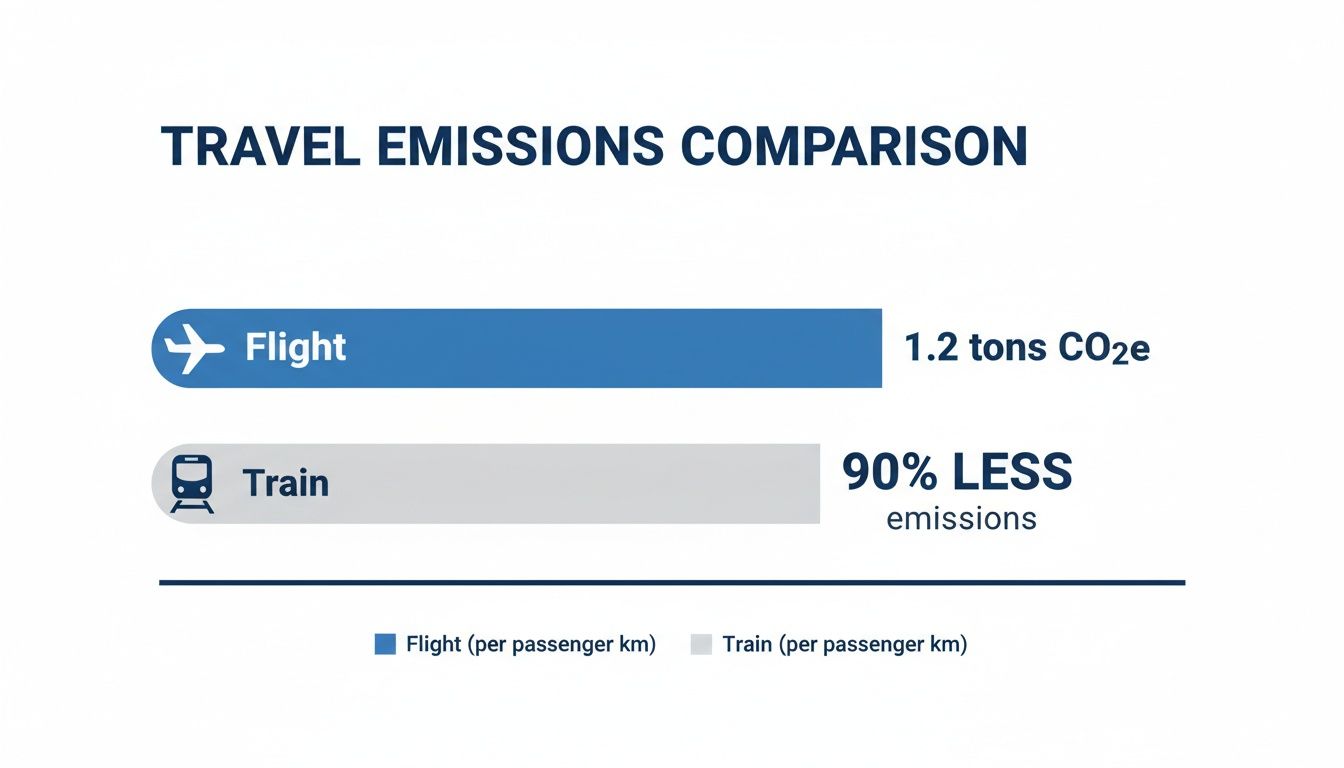
As the chart clearly shows, choosing the train over a plane for a similar distance can cut your transport emissions by a staggering amount. It’s often the single most effective choice for a low-impact journey. You can dive into the data behind these figures in our detailed guide comparing train vs. plane emissions.
To get a clearer picture of what this looks like in the real world, here’s a breakdown of CO2 emissions on a few popular routes.
Carbon Footprint Comparison Train Vs Plane on Popular Routes
This table shows the estimated CO2 emissions per passenger for a one-way trip on popular travel routes, comparing air travel with train travel to highlight the environmental benefits of choosing rail.
Paris to Amsterdam
| Route | Distance (Approx. Miles) | CO2 Emissions by Plane (kg) | CO2 Emissions by Train (kg) |
|---|---|---|---|
| Paris to Amsterdam | 267 | 115 (254 lbs) | 11 (24 lbs) |
London to Edinburgh
| Route | Distance (Approx. Miles) | CO2 Emissions by Plane (kg) | CO2 Emissions by Train (kg) |
|---|---|---|---|
| London to Edinburgh | 332 | 140 (309 lbs) | 18 (40 lbs) |
Rome to Florence
| Route | Distance (Approx. Miles) | CO2 Emissions by Plane (kg) | CO2 Emissions by Train (kg) |
|---|---|---|---|
| Rome to Florence | 144 | 85 (187 lbs) | 6 (13 lbs) |
Tokyo to Kyoto
| Route | Distance (Approx. Miles) | CO2 Emissions by Plane (kg) | CO2 Emissions by Train (kg) |
|---|---|---|---|
| Tokyo to Kyoto | 234 | 110 (243 lbs) | 10 (22 lbs) |
The numbers speak for themselves. On every single one of these routes, the train’s carbon footprint is just a tiny fraction of the plane’s, proving that you don’t have to sacrifice convenience to travel responsibly.
Low-Impact Transport Beyond the Train
While trains are the star player, they aren’t your only option. Modern intercity buses are another excellent, low-carbon choice, especially for shorter distances or on routes not well-served by rail. They are often the most budget-friendly option and have significantly expanded their networks in recent years.
Perhaps the most overlooked strategy is simply choosing a walkable base. By staying in a central location with great public transit, you can eliminate the need for daily taxi rides or a rental car. This approach not only shrinks your footprint but also immerses you more deeply in the local culture. You’ll discover the hidden cafes, quiet parks, and neighborhood markets you’d miss from inside a car.
Planning for More Complex Journeys
For digital nomads or anyone planning a multi-country itinerary, the puzzle can seem more complex. This is where a good carbon calculator becomes an invaluable tool. Before booking anything, you can map out different scenarios—comparing a series of flights against a combination of trains and buses—to see the real emissions data for each option. This allows you to make informed decisions that actually align with your sustainability goals.
Sure, flying from Lisbon to Bangkok is a high-carbon trip. But you could also plan an overland route through Europe and Asia that creates a fraction of the impact, turning the journey itself into the main adventure. It takes more time, but the experience is infinitely richer and aligns perfectly with the principles of slow, intentional travel.
The Art of Low Waste Packing and Mindful Consumption
Once you’ve nailed your low-carbon transport, the next big win in low impact travel is what you pack and how you spend your money on the road. Your packing list is more than just a checklist; it’s a statement about your travel philosophy. Packing light and with intention doesn’t just make hauling your bag onto a train easier—it dramatically cuts down your potential for waste.
This is where the principles of minimalism and sustainability really click. Instead of stuffing your bag for every imaginary “what if” scenario, focus on a versatile capsule wardrobe. A few high-quality, neutral pieces that you can layer and mix will create dozens of outfits. It’s a simple strategy that saves a surprising amount of space and weight.
For instance, a couple of merino wool shirts, one good pair of multi-purpose pants, and an adaptable jacket can handle a huge range of climates and social settings. This approach means everything fits into a smaller bag, making train and bus travel an absolute breeze.

Ditching Disposables for Good
One of the most powerful moves you can make is to systematically cut single-use plastics out of your travel routine. Hotels and convenience stores are infamous for churning out mountains of plastic waste, but with a little prep, you can sidestep them completely.
Let’s start with the basics: a reusable water bottle is non-negotiable. More and more airports and public spaces have refill stations, which saves you money while keeping countless plastic bottles out of landfills. A collapsible water bottle is a fantastic, space-saving option for longer hikes or day trips.
This mindset carries over to your toiletries. Ditch the tiny hotel bottles and invest in a set of toiletry bottles reusable for your favorite products. Even better, make the switch to solids. A solid shampoo bar and biodegradable soap last longer, weigh less, and come with zero plastic packaging. They are a traveler’s best friend. You can find more ideas in our complete guide to building a zero-waste packing list.
Organizing Your Gear for Efficiency
Smart organization is the secret to making a minimalist packing list actually work. It stops you from overpacking and makes finding what you need feel effortless. Using compression packing cubes is a brilliant technique to separate clothes and squeeze out extra air, making the most of every inch of your backpack.
A dedicated organizer can keep your electronics from becoming a tangled mess, while a small, lightweight packable daypack is perfect for daily excursions. It lets you leave your main luggage behind and explore with just the essentials. For even more efficiency, packing laundry detergent sheets means you can wash clothes on the go, which allows you to pack even less.
Mindful Consumption on the Road
Your commitment to low-impact principles doesn’t stop after you’ve unpacked. How you spend your money and time at your destination matters just as much. Mindful consumption is all about making deliberate choices that support the local community and minimize harm.
This means seeking out restaurants that prioritize locally sourced ingredients and skipping the tourist traps that generate enormous amounts of food and packaging waste. Instead of buying cheap, mass-produced souvenirs, look for handcrafted goods from local artisans. Your spending becomes a direct investment in preserving culture and supporting sustainable livelihoods.
By pairing low-waste packing with mindful consumption, you complete the circle of low impact travel, ensuring your presence is a positive one from start to finish.
Choosing Stays That Heal Not Harm
Your journey toward low-impact travel doesn’t stop when you step off the train. Where you choose to sleep each night has a huge effect on the local landscape and the community you’re visiting. The key is to move past vague “eco-friendly” labels and find places that are actively working to heal and restore their corner of the world.
This is the whole idea behind regenerative tourism. It’s a leap beyond sustainability, which is really about not making things worse. Regenerative stays aim to leave a destination better than it was before by putting energy back into ecological restoration and community well-being.
Picture a farm stay where your visit helps support local, organic agriculture. Or a city hotel built from certified green materials that harvests its own rainwater and runs on solar. These places aren’t just trying to do less harm—they’re creating a net positive, turning your stay into a force for good.
What Regenerative Stays Look Like in Practice
Finding these gems means looking for proof. Genuinely regenerative properties are open and honest about what they do. They don’t just talk about being green; they’ll show you the compost heap, the solar panels, and the local art on the walls.
You’re looking for tangible actions: robust recycling and composting systems, clear policies on water conservation, and a real commitment to hiring and training local staff at fair wages. It’s also about sourcing food from nearby farms and stocking the gift shop with work from local artisans, not mass-produced souvenirs.
The results are powerful. This model can boost local GDP by 15-25% through fair-wage jobs and circular waste systems. A 2024 study even found these initiatives restore 20-30% more habitat per visitor than standard ecotourism. In New Zealand alone, visitor-funded projects have planted over 10 million trees since 2020. You can read more about these game-changing 2025 travel trends.
How to Find and Vet Your Accommodations
Once you know what to look for, it’s much easier to find stays that match your values. Before you book your next trip, use this simple checklist. It’ll help you see past the greenwashing and find the places making a real difference.
- Check for Certifications: Look for credible, third-party seals of approval like B Corp, Green Globe, or LEED. These aren’t easy to get; they require businesses to meet tough environmental and social standards.
- Read Their Sustainability Page: A detailed page on their website is a great sign. It should lay out specific policies on energy, water, waste, and how they work with the community. Vague promises are a red flag.
- Ask About Local Sourcing: Where do they get their food and supplies? Places committed to regeneration will be proud to tell you about their partnerships with local farmers, producers, and makers.
- Verify Employment Practices: Do they hire from the local community for all roles, including management? Do they offer fair wages and chances to grow professionally?
Editor’s Pick for Regenerative Stays
For finding accommodations that truly give back, platforms like Bookdifferent.com are a great resource. It filters stays based on certified eco-labels and calculates the carbon footprint of your booking, making it easier to choose properties that actively support their environment and community. It helps take the guesswork out of finding a truly low-impact place to stay.
Taking a few extra minutes to research where you stay ensures your travel money supports businesses that are actively healing the planet. This one choice transforms your trip from a simple vacation into a meaningful contribution. It’s one of the most powerful decisions you can make.
Low Impact Travel for Digital Nomads
The whole idea of low impact travel lines up perfectly with the digital nomad lifestyle. Think about it: traditional tourism is often a frantic rush of short, frequent trips, each with a high carbon price tag. But as a location-independent worker, you have the freedom to embrace slow travel—the very heart of traveling with a lighter footprint.
By staying put in one place for weeks or even months at a time, you slash your transportation emissions. It’s that simple.
Instead of living out of a suitcase, you get to settle in, build real connections in the community, and properly get to know a place. This shifts travel from a checklist of sights to a more intentional way of living and working. Plus, you can actually unpack, which makes it far easier to stick to routines and stay productive.
Embracing the Slow Travel Mindset
Slow travel is all about depth over breadth. It means picking a home base and using it as a hub for exploring the surrounding region, mostly by train and public transit.
Honestly, choosing a walkable city with great rail links is the single most important decision you can make. It sets you up to live car-free, shrink your daily environmental impact, and just sink into the local rhythm of life.
This lifestyle isn’t a niche fantasy anymore. With 4.2 million remote workers worldwide now holding special visas in 34 countries, a powerful trend is taking shape. These eco-minded nomads are ditching short-haul flights for trains, cutting their per-trip emissions by a massive 70-90%.
An itinerary from Berlin to Barcelona, for instance, emits just 50-100kg (110-220 lbs) of CO2 by train. Flying that same route? You’re looking at over 500kg (1102 lbs). Visa has put together some fascinating global travel trends that highlight this exact shift.
Practical Tips for the Low-Impact Nomad
Living and working sustainably on the road comes down to a few key strategies. These simple habits can make a huge difference, especially over a longer stay.
- Choose Green Workspaces: When you’re picking a co-working space, look for one in a green-certified building or one that’s open about its sustainability policies. A lot of modern spaces are designed around natural light, energy efficiency, and waste reduction.
- Support the Local Economy: Your extended stay is a chance to be a real contributor, not just a consumer. Shop at local markets, eat at family-run restaurants, and become a regular at a neighborhood cafe. This ensures your money directly supports the community you’re living in.
- Pack for Productivity and Privacy: A laptop privacy screen is a non-negotiable for working in public spots like cafes or on trains. A good cable organizer travel case is another small thing that makes a big difference, keeping your mobile office tidy and protecting your gear. Getting a reliable eSIM from Airalo or Yesim also ensures you’re always connected without needing plastic SIM cards.
By folding these practices into your routine, you can build a life on the road that’s fulfilling, productive, and genuinely low-impact. For a deeper dive, check out our complete guide to green travel for digital nomads.
Key Takeaways
- Prioritize Overland Travel: Choose trains and buses over planes whenever possible to dramatically cut your carbon footprint. This is the single most effective action for low impact travel.
- Pack Light and Smart: Adopt a minimalist packing style using items like compression packing cubes and solid toiletries to reduce waste and make overland travel easier.
- Support Local Economies: Spend your money at locally-owned guesthouses, restaurants, and shops to ensure your visit directly benefits the community.
- Choose Regenerative Stays: Look for accommodations with verifiable sustainability certifications (like B Corp or Green Globe) that actively work to improve their local environment.
- Embrace Slow Travel: Stay in destinations for longer periods. This reduces transportation emissions and allows for a deeper, more meaningful connection with the local culture.
- Ditch Single-Use Plastics: Always carry a reusable water bottle and other reusables like a coffee cup and shopping bag to minimize your plastic waste.
Low-Impact Travel Tools (Worth It)
Also, if you’re planning a trip and want to keep things simple, these tools help you travel smoother while staying mindful about impact.
Get an eSIM for reliable data → Disclosure: Partner link. No extra cost to you.
Pre-book a transfer for easy arrivals → Disclosure: Partner link. No extra cost to you.
Frequently Asked Questions About Low Impact Travel
What is the main goal of low impact travel?
The main goal of low impact travel is to minimize your negative environmental, social, and economic footprint on a destination. Essentially, it means making conscious choices so your trip benefits the local community and helps preserve the natural and cultural heritage of the places you visit.
Is low impact travel more expensive?
Not always. While some certified eco-lodges can be pricey, many core principles of low impact travel actually save you money. For example, choosing trains over planes, staying in locally-owned guesthouses, and eating at local markets are often more budget-friendly than mainstream tourism options.
How can I reduce my carbon footprint when I have to fly?
If flying is your only option, you can still reduce its impact. First, choose direct flights, as takeoffs and landings consume the most fuel. Second, pack as light as possible—a lighter plane uses less fuel. Finally, you can select airlines that use more modern, fuel-efficient aircraft.
What’s the difference between ecotourism and low impact travel?
Ecotourism is a specific niche of travel focused on visiting natural areas responsibly, often with a conservation component. In contrast, low impact travel is a broader philosophy that you can apply to any type of trip, whether it’s to a bustling city, a quiet beach, or a remote wilderness area.
How does “slow travel” relate to this concept?
Slow travel is a key component of low impact travel. By staying in one place for a longer duration, you significantly reduce your transportation emissions. This approach also provides more opportunities to support the local economy and build deeper, more authentic connections with the community.
Low Impact Travel and Comfort: Can You Still Travel Well?
Can I still have a comfortable trip while traveling this way?
Absolutely. Low impact travel is not about sacrificing comfort; it’s about choosing smarter, often higher-quality, options. For instance, modern night trains, boutique eco-hotels, and farm-to-table restaurants can offer incredibly comfortable and memorable experiences that are far more authentic than their high-impact counterparts.
What is the most important first step to take?
The single most effective action you can take is to prioritize overland travel, especially trains, whenever possible. Reducing or eliminating flights from your itinerary will decrease your carbon footprint more significantly than any other single action. Using a portable power bank ensures all your devices stay charged during these longer journeys.
How can I avoid contributing to overtourism?
To avoid contributing to overtourism, travel during the shoulder seasons (the months just before and after peak season). Also, consider exploring less-famous “second cities” instead of popular hotspots. Finally, stay in neighborhoods outside the main tourist areas and use public transit to get around, which helps distribute your economic impact more evenly. Also, consider investing in travel insurance from a provider like VisitorsCoverage to be prepared for any unexpected changes.
Join the Sustainable Work Movement
Want more rail-first itineraries, low-impact packing systems, and walkable base-city ideas?
