
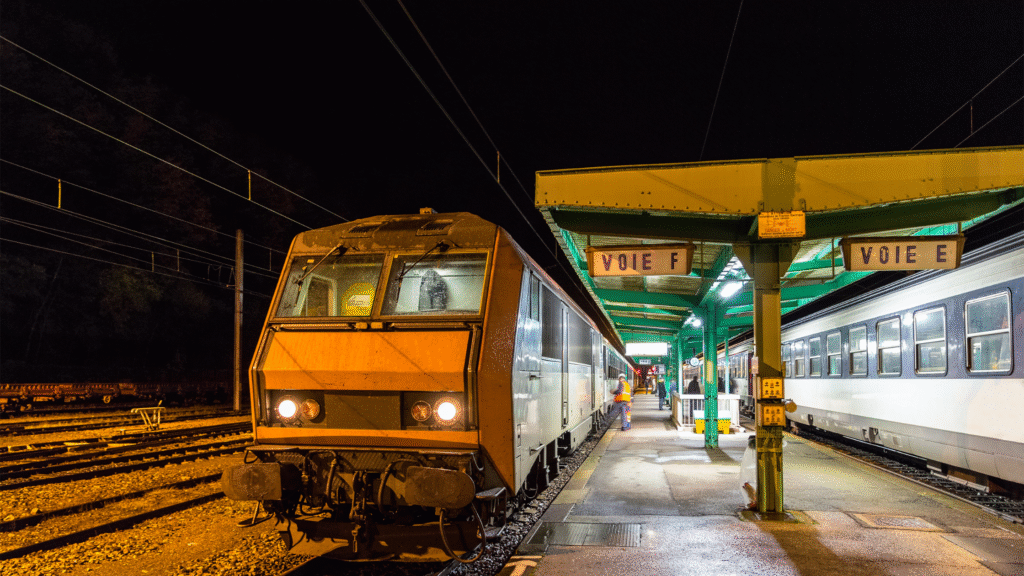
Night trains Europe 2025 are back in a big way. This guide shows eco nomads how to swap short-haul flights for sleeper trains, stitch together low-carbon routes, and still arrive rested for work the next morning.
Key takeaways: night trains Europe 2025
- Night trains cut emissions by up to 80–90% vs. flying on key European corridors.
- You “earn back” time by sleeping while you travel and arriving in city-centre stations.
- New routes in 2025 connect Berlin–Amsterdam, Paris–Barcelona, Zürich–Vienna, Copenhagen–Oslo and more.
- For eco nomads, night trains pair slow travel, deep focus, and car-free lifestyles.
- Book sleepers 2–6 months ahead, especially for weekends and summer.
Best all-round route for eco nomads
If you only ride one sleeper in 2025, make it the Berlin → Amsterdam night train. It links two thriving remote-work hubs, runs on largely electrified lines, and drops you into walkable, bike-friendly city centres.
Pair it with our guides: train vs plane emissions 2025 and how to book European sleeper trains.
Why night trains Europe 2025 matter for eco nomads
In just a few years, the revival of night trains in Europe has turned from a niche trend into a serious alternative to short-haul flights. As climate pressure rises, more travelers want low-carbon, rail-first itineraries that still work with remote jobs, deadlines, and calls.
Night trains Europe 2025 answer that tension. They let you cover long distances while you sleep, wake up in the centre of cities such as Berlin, Amsterdam, Paris, Barcelona, Vienna, and Copenhagen, and keep your footprint dramatically lower than if you flew. Instead of trading comfort for sustainability, you turn travel time into rest time.
Governments and operators from Austria, France, Germany, Switzerland, Sweden, and beyond are investing again in sleeper rolling stock, new routes, and better booking tools. This fits into the same movement you see in our night trains Europe eco-nomads guide, the carbon-neutral travel 2025 guide, and our sustainable travel handbook: slower, deeper, more grounded travel.
In this guide, you will see how modern European sleeper trains work, which routes are worth prioritising in 2025, and how eco-nomads can fold rail into a realistic work calendar without losing productive hours.
The rise of eco-nomad travel in Europe
Eco nomads combine location-independent work with low-impact habits. They travel light, stay longer in each city, and choose rail-first routes whenever possible. In practice, that means trading airport hops for night trains Europe 2025, walkable bases, and car-free lifestyles.
Minimalism sits at the core of this shift. By carrying only what they can comfortably roll or wear, eco nomads reduce transport emissions, avoid baggage fees, and make station transfers easier. This is the same mindset behind our zero-waste digital nomad packing guide and eco-friendly travel kit 2025.
Slow travel also matters. Instead of rushing through six countries in ten days, eco nomads use night trains to move between a handful of hubs, then stay a month or more in each. This gives time to build routines, learn transit networks, and tap into local coworking communities. For deeper context, pair this article with workation cities 2025 without a car and our sustainable digital nomad lifestyle guide.
Slow travel, deeper focus: why sleepers suit eco nomads
Night trains naturally enforce a slower rhythm. You board in the evening, settle into a cabin, and let the landscape roll by as you read, journal, or wind down. There are no security queues, no laptop-unfriendly middle seats, and no repeated airport transfers.
For knowledge workers, this often produces better mental health as well. You gain time in transit to process the day, plan the week, or simply rest. With the right route design, you can schedule calls for late afternoon in one city, board a sleeper, and arrive early enough the next morning to work from a new coworking space without missing a beat.
If you want to quantify the impact, compare a typical flight itinerary against rail in our train vs plane emissions 2025 explainer. You will see why night trains Europe 2025 are one of the strongest tools available for carbon-aware remote workers.
New and upgraded night train routes in Europe for 2025
Operators are adding and upgrading several key lines that matter for eco nomads. Below is a concise tour of the most useful night trains Europe 2025, with an eye on remote workers who prefer walkable, transit-rich hubs.
Berlin ↔ Amsterdam: remote-work corridor made easy
One of the headline additions for 2025 is the Berlin–Amsterdam sleeper. It links two major tech and creative hubs on mostly electrified lines. You can spend the day working near Berlin’s Ostbahnhof or Hauptbahnhof, board after dinner, and wake up close to Amsterdam Centraal, ready for a tram or bike ride to your coworking space.
Paris ↔ Barcelona: low-carbon alternative to the air bridge
Another key route connects Paris and Barcelona, offering a rail-first alternative to one of Europe’s busiest flight corridors. The line serves classic eco-nomad favourites: car-free life in central Paris and beach-plus-metro routines in Barcelona. Use our eco-travel places 2025 guide to bolt side trips onto this axis without reverting to flights.
Zürich ↔ Vienna: Alpine views while you sleep
The improved Zürich–Vienna service pairs two cities that already appear in our core night-train guide. You board in one compact, rail-centric city and wake up in another, with Alpine scenery as the backdrop. For eco nomads, this is a perfect “reset leg” between deep work sprints.
Copenhagen ↔ Oslo: unlocking Scandinavia by night
A sleeper between Copenhagen and Oslo opens up more Scandinavian car-free itineraries. Pair this route with Copenhagen’s cycle grid and Oslo’s harbourfront trams, and you can explore the region without renting a car. Check our eco-friendly travel tips to minimise your footprint further.
For step-by-step booking flows, see How to Book European Sleeper Trains (2025).
Comfort and amenities on modern European night trains
Modern night trains Europe 2025 look very different from older sleepers you may remember. Operators are adding better mattresses, quieter cabins, and flexible layouts that suit solo travelers, couples, and small teams.
Cabin types: seats, couchettes, and private sleepers
At the basic end, you still have reclining seats. These are cheap but rarely ideal for a proper night’s sleep. Couchettes offer bunks in shared compartments, while sleeper cabins provide real beds, doors that lock, and sometimes private toilets and showers. These cabins usually deliver the best balance of rest, privacy, and price for eco nomads who still need to work the next morning.
Food, drinks, and local sourcing onboard
Dining has improved as well. Many services now stock local, seasonal food, with vegetarian and plant-forward options. Some trains still run full dining cars; others use trolley or pre-order systems. Either way, you can top this up by bringing snacks in reusable containers as we outline in low-impact travel habits.
Connectivity, power, and quiet time for remote work
Not every sleeper has perfect Wi-Fi, but most newer sets offer power outlets and USB ports at each berth. Where connectivity is patchy, eco nomads treat the journey as offline time for planning, reading, or deep thinking, then catch up from coworking spaces the next morning.
Night trains vs flights and buses: emissions, time, and cost
To understand why night trains Europe 2025 matter, you need to compare them with flights and long-distance buses across three axes: emissions, door-to-door time, and total trip cost.
Emissions: rail wins on most European corridors
On electrified lines powered by increasingly clean grids, trains can emit up to 80–90% less CO₂ per passenger-kilometre than planes. That difference grows when you factor in airport transfers and short-haul inefficiencies. For more data, see train vs plane emissions 2025.
Door-to-door time: sleepers turn travel into sleep
Flights often look faster on paper, yet they hide check-in, security, boarding, de-planing, and transfers. With night trains you usually board once, sleep, and wake up downtown. You also replace one hotel night, which changes the cost calculus.
Cost and value: when sleepers make the most sense
Sleeper cabins can cost more than budget flights, especially on popular routes. However, when you factor in one saved hotel night, airport transfers, and luggage fees, the gap shrinks quickly. If you use Eurail or Interrail passes, you usually only pay a reservation or berth supplement.
Designing night-train itineraries for rail-first eco nomads in 2025
Once you understand the basics of night trains Europe 2025, the next step is to design practical itineraries that match your work rhythm, budget, and sustainability goals. Eco nomads are not on holiday full-time; they need reliable Wi-Fi during the day, quiet spaces for deep work, and transport that feels like a backbone rather than a disruption. A good night-train itinerary starts with a realistic map of where you actually want to do focused work, then connects those hubs with sleeper routes instead of short-haul flights.
How to choose car-free anchor cities for your night trains Europe 2025 itinerary
Begin by picking three to five anchor cities that align with your values: strong public transport, walkable neighbourhoods, and a healthy mix of nature and culture. Our guides to sustainable digital nomad destinations 2025, workation cities without a car, and the eco travel places 2025 guide are a good starting point. From there, layer in night trains in Europe as the long-distance links between these hubs, then fill the gaps with regional day trains, trams, and bikes instead of rental cars.
A classic eco-nomad loop for night trains Europe 2025 might look like this: start in Amsterdam for a few weeks of bike-first city life, ride the sleeper to Berlin to plug into its tech and creative scene, then take daytime rail down to Vienna via Prague. From Vienna, use a night train to reach Rome or Milan, then switch to fast rail for coastal hubs and smaller towns. At each step, you are replacing flights with sleeper trains while keeping your accommodation, coworking, and food habits steady. For more ideas, see our broader night trains Europe eco-nomads hub.
You can also design thematically focused routes. One month might prioritise climate-forward cities and rail innovation, building on insights from Carbon-Neutral Travel in 2025: The Complete Guide and our Green Travel Guide 2025. Another month could follow coastal and island hubs with strong ferry and rail links, using our sustainable travel guide to avoid greenwash when choosing stays. In both cases, night trains provide the long-distance legs, while day trains and walking fill in the local detail.
Plan your night trains Europe 2025 route with carbon data, smart packing, and low-impact habits
To keep your footprint visible and accountable, run each proposed leg through our Travel Carbon Footprint Calculator 2025 and compare it with a notional flight on the same route. Pair the results with habits from low-impact travel habits and eco-friendly travel tips. You will quickly see how a rail-first, sleeper-based itinerary lets you cut emissions dramatically without giving up comfort or productivity. This kind of quantified planning aligns well with official EU climate and transport targets, which increasingly encourage a modal shift from air to rail on short and medium distances.
Packing and logistics are the final layer. The lighter you travel, the easier it is to move confidently across stations, platforms, and night-train corridors. Use the frameworks in our zero-waste digital nomad packing guide, eco travel kit 2025, and zero-waste packing list to trim your load while staying comfortable in different climates. When your entire life fits into a single carry-on and day pack, switching from one night train in Europe to the next is a matter of minutes, not hours of repacking or checking bags.
When you step back, a well-designed night trains Europe 2025 itinerary looks less like a string of bucket-list stops and more like a coherent, low-carbon lifestyle experiment. You spend weeks at a time in cities that support car-free living, you move between them on sleepers instead of planes, and you anchor everything in routines that respect both your nervous system and the communities you visit. If you want to build this into a longer arc of travel, combine the ideas here with our sustainable digital nomad lifestyle guide and sustainable adventures guide. Together, they offer a blueprint for rail-first, climate-aware eco nomadism that still feels rich, curious, and fun.
Booking night trains Europe 2025: timing, tools, and strategy
Because demand is rising, you need a clear system for booking night trains in Europe. A little planning helps you secure sleeper cabins without over-spending.
Where to search and book
Always start with official operator sites and national rail portals, then cross-check with trusted platforms. For multi-country trips, tools we like include:
- Official operator portals for Nightjet, SNCF, SJ, and other national railways.
- Trip.com for multi-leg rail + hotel searches .
- Pass tools and timetable planners highlighted in our booking guide.
How early to book sleepers
For summer, weekends, and holiday periods, treat 2–6 months ahead as the sweet spot. Shoulder seasons give more flexibility, although new routes on the night trains Europe 2025 map can still sell out quickly in peak weeks.
Cabin selection for eco nomads
If you need to work the next morning, try to book a private sleeper or small shared couchette. Seats are fine for very short hops, but a lie-flat space will pay you back in energy, focus, and mood.
Onboard eco-habits: how to travel lighter by night train
Choosing night trains is a strong start. You can push emissions even lower by adopting basic eco-nomad routines on board.
Smart packing for rail-first Europe
Pack a lean, rail-friendly kit: one carry-on-sized bag, a small day pack, and a compact zero-waste toiletry setup. Our zero-waste packing guide and eco travel kit 2025 show examples. Lighter bags make station transfers easier and remove the temptation to rely on taxis.
Food, water, and waste
Bring a reusable bottle, cup, cutlery set, and snack box. Fill up at fountains in the station, or at your accommodation, and favour fresh food from markets over plastic-wrapped meals. Combine these steps with the advice in low-impact travel habits and eco-friendly travel tips.
Respecting local communities and rail staff
Eco-friendly travel is cultural as well as technical. Keep noise levels low at night, follow cabin etiquette, and treat rail staff with respect. In many countries, the revival of night trains Europe 2025 depends on ongoing public support and funding.
Community on the rails: real eco-nomad stories
Night trains are not just a transport mode; they are a moving community of rail-first travelers. A few snapshots illustrate how eco nomads experience these routes.
Berlin → Amsterdam: deep sleep, Dutch sunrise
Emma, a UX designer, booked a berth on the Berlin–Amsterdam night train rather than flying. She boarded after a coworking session, read for an hour, and fell asleep to the rhythm of the rails. In the morning, she woke to a Dutch sunrise and cycled from the station to her desk. The trip emitted a fraction of a flight and cost less than a hotel plus plane ticket.
Vienna → Rome: shared table, shared stories
On a sleeper from Vienna to Rome, Marco, a climate researcher, spent dinner in the dining car with other rail-first travelers. They traded tips on night trains Europe, favourite car-free cities, and how to build routes using the Eco Nomad night-train hub.
Family travel: adventure for kids, lower emissions for parents
For families, sleepers often feel like an adventure rather than a compromise. One reader, Sarah, told us how her children loved climbing into bunks on a Paris–Barcelona night train and waking up near the sea. The parents avoided airport stress and modelled low-carbon travel at the same time.
The future of night trains in Europe
Looking ahead, night trains Europe 2025 and beyond are likely to expand further. Political pressure to meet climate targets is pushing governments to support rail again, especially where it replaces short-haul flights that have strong alternatives.
Expect more cross-border cooperation, modern sleeper cars, and digital tools that make booking multi-country routes less painful. Energy-efficient locomotives, better insulation, and lighter rolling stock will cut emissions even more.
As these improvements land, eco nomads will be able to design almost entirely flight-free European seasons, connecting night trains with day trains, trams, and bikes. Combine this with our carbon-neutral travel guide and sustainable adventures guide, and you have the skeleton of a fully rail-based, low-impact lifestyle.
Rail tools and trip stack for night trains Europe 2025
Use this compact stack to plan and book night trains in Europe while keeping your footprint low and your routes realistic for remote work.
Affiliate links. If you book through these partners, Eco Nomad Travel may earn a commission at no extra cost to you.
FAQ: night trains Europe 2025
These questions cover the basics of night trains in Europe, from cabins and passes to safety, emissions, and car-free itinerary design. For even more detail, see our sleeper booking guide.
Basics of European night trains
Night trains in Europe are long-distance services that run overnight with reclining seats, couchettes, or sleeper cabins. They let you travel between major cities while you sleep instead of flying and staying in an extra hotel.
On electrified corridors, night trains Europe 2025 are usually far more eco-friendly than flights. Rail can emit up to 80–90% less CO₂ per passenger-kilometre. Compare routes in train vs plane emissions 2025 or with the [carbon_calculator_2025] tool.
Expect strengthened links among Berlin, Amsterdam, Paris, Barcelona, Zürich, Vienna, Copenhagen, and Oslo. Exact timetables change, so always confirm with official operator sites and our updated night-trains hub.
For popular night trains in Europe, book 2–6 months in advance. Summer, holidays, and big events sell out first. Shoulder seasons and mid-week dates often keep more berths open.
Cabins, comfort, and onboard experience
Most night trains offer reclining seats, couchettes, and sleeper cabins. Couchettes are shared bunk compartments; sleepers can be private or shared and may include private bathrooms on premium services.
Many night trains Europe 2025 have outlets at each seat or berth and partial Wi-Fi coverage. Coverage can drop in mountains or tunnels, so bring a power bank and download work or shows before boarding.
Several operators offer women-only couchettes or cabins. Availability depends on the route, so check the cabin selection screen or fare rules when booking.
Yes. Many families reserve a private couchette or sleeper so all beds are together. This often feels like a mini adventure for kids and replaces a hotel night.
Practicalities, pricing, and safety
Base fares can be higher than budget flights, yet night trains replace one hotel night and most luggage fees. When you add accommodation, transfers, and time, sleepers often represent strong value for eco nomads.
Most European night trains do not enforce strict baggage limits. However, cabins have finite space. Aim for one carry-on-sized bag plus a small day pack and follow our smart packing guide.
Generally yes. Modern night trains in Europe have staff on board and lockable compartments. As always, keep valuables on you, use small cable locks, and follow basic travel safety tips.
Yes. Most operators allow your own snacks and non-alcoholic drinks. Many eco nomads bring food in reusable containers to cut packaging and save money.
Passes, accessibility, emissions, and planning
Use official operator websites and national rail portals first, then cross-check with trusted aggregators. Our sleeper booking guide lists the most reliable sources for night trains Europe 2025.
Refund rules vary widely between railways and fare types. Flexible tickets cost more but give better cancellation options. Always read fare conditions before confirming your night train Europe 2025 booking.
Many services include accessible cabins and assistance services. Request support and accessible berths early, then confirm details with the operator a few days before departure.
Yes. Eurail and Interrail passes usually cover the base fare on night trains, but you still need a reservation and often pay a supplement for couchettes or sleepers.
Choose direct routes, daytime regional trains where practical, and second-class cabins to maximise occupancy. Then layer habits from our carbon-neutral travel guide.
Bring earplugs, an eye mask, light layers, a small cable lock, and a refillable bottle. For a full checklist, see our night-train packing guide.
Many European railways allow pets on night trains, usually with fees, carriers, or muzzle rules. Always check the specific operator policy before booking.
Use night trains as long-distance links, then rely on metro, trams, and walking in each city. Our guides to workation cities without a car and sustainable nomad hubs show practical examples.
Editor’s note & further reading
This guide on night trains Europe 2025 is part of Eco Nomad Travel’s rail-first series. It was fact-checked using emissions data from European rail operators, independent lifecycle assessments, and climate-aware travel resources.
For next steps, explore: our broader night-trains hub, Carbon-Neutral Travel 2025: The Complete Guide, and Sustainable Travel Guide 2025.



Recent Posts
Best Travel Towels
Quick picks for fast-drying, packable towels that actually work on the road.
Best Waterproof Backpack
What matters for rain, train platforms, and daily carry—without overpacking.
Cheapest Way to Travel to Europe
Budget routes, timing, and practical ways to cut costs without cutting comfort.
How to Travel Europe by Train
Planning tips, rail passes, and simple route strategies for smoother trips.
Best Night Trains in Europe
Top sleeper routes, what to book, and how to avoid common overnight mistakes.
SIM Card for International Travel
Simple guidance on SIM vs eSIM, coverage, and avoiding roaming surprises.
Explore Eco Nomad Travel
📚 Core Guides
🧭 Planning & Logistics
🗺️ Destinations & Seasons
Jeremy Jarvis — founder of Eco Nomad Travel, sustainable travel writer, and advocate for regenerative tourism. His work focuses on low-impact mobility, eco-friendly digital nomad life, and climate-positive travel.
Legal
Affiliate DisclaimerPrivacy Policy
Terms of Service
Image & Media Notice
Cookie Policy
Contact
Affiliate Disclosure: Some links on Eco Nomad Travel are affiliate links, meaning we may earn a small commission at no extra cost to you. This supports our mission to inspire responsible and low-impact travel worldwide.
Connect
✅ Trusted Official Sources
Plan smarter eco trips
Try our free Sustainable Travel Tools for Digital Nomads – carbon calculator, train vs plane comparator, and more.
Open Tools Hub