
Getting your European train trip right starts with picking the right digital tool. A solid rail journey planner Europe can turn a tangled mess of routes, timetables, and fares into a clean, simple itinerary. This guide unpacks the best ones out there, showing you how they work and which one fits the way you travel.
Choosing the right rail journey planner is the single most important first step you’ll take. It’s the key to unlocking a low-impact, scenic, and genuinely rewarding way to see the continent. Whether you’re a digital nomad scouting for your next walkable home base or just want a flight-free holiday, the right planner makes all the difference.
Train travel is having a serious comeback. It’s no longer just about getting from A to B; it’s becoming the way to explore. This isn’t just a vibe—the numbers back it up. EU rail travel recently hit 443 billion passenger-kilometers (approx. 275 billion passenger-miles), the highest it’s ever been. Consequently, Germany is at the heart of this revival, moving a staggering 2,904 million passengers.
This guide will help you sort through the options, from slick interfaces to easy mobile ticketing. With a bit of prep, you can stop worrying about the logistics. Therefore, you can focus on the journey itself—the landscapes rolling by, the quiet moments on board, and the cities waiting at each stop.
Why You Need a Digital Planner
A good rail planner does more than just show you departure times. In fact, it’s your control panel for the entire trip.
- Compare Fares: Instantly see prices across different train companies and ticket types, so you know you’re getting the best value.
- Simplify Bookings: Buy tickets for multi-leg, cross-border journeys in one go, without juggling multiple websites in different languages.
- Discover Routes: Uncover scenic local lines and smart connections you’d probably miss otherwise.
- Stay Organized: Keep all your tickets, seat reservations, and schedules in one app on your phone.
Before you go, remember that practical gear is just as important as a good plan. A reliable universal travel adapter is non-negotiable for keeping your phone charged across countries with different plug types. You need it to access your planner and tickets on the move.
For a deeper look at getting ready for the rails, check out our comprehensive guide on how to travel Europe by train. It’s packed with tips to make your journey smoother from start to finish.
Comparing the Top European Rail Journey Planners
With a dozen apps and websites all claiming to be the best rail journey planner for Europe, figuring out which one to actually trust can feel like a chore. Each platform offers a slightly different mix of features, geographic reach, and hidden costs. Here, we’ll cut through the noise and compare the heavy hitters—like Trainline, Omio, and DB Navigator—side-by-side.
My goal is to help you pick the right tool for your trip, focusing on what actually matters for nomads and eco-conscious travelers. We’ll look at their real-world coverage, how smoothly they handle rail passes like Interrail or Eurail, and what booking fees you can expect. For instance, some planners are brilliant for weaving together complex, multi-country routes, while others are better kept for simple domestic journeys.
Let’s match a planner to your travel style. Whether you’re guarding a tight budget, need seamless mobile ticketing, or crave the granular details of every connection, the right tool is out there.
Breaking Down the Top Contenders
Your choice of planner often boils down to two things: how complex your itinerary is and what kind of user experience you prefer. Let’s get to know the three most popular options.
Trainline: Often seen as the most user-friendly of the bunch, Trainline’s strength is its clean interface and massive coverage across 45 countries. It’s fantastic for booking simple point-to-point tickets. Plus, it has a knack for finding “split-ticketing” deals that can save you a surprising amount of cash. The only catch? Its booking fees can sometimes be a bit higher than the competition.
Omio (formerly GoEuro): Omio’s superpower is its multi-modal brain. It compares trains, buses, and even flights in a single search, which is perfect for travelers who want to see every possible option at a glance. Its coverage is solid, making it a reliable choice for piecing together journeys that mix different types of transport.
DB Navigator (Deutsche Bahn): As the official app of Germany’s national railway, DB Navigator offers unmatched detail for German routes and excellent coverage in neighboring countries. Bookings on its own network are generally fee-free, and its real-time updates are uncannily accurate. The interface can feel a bit clunky for first-timers, but once you learn its quirks, it’s an incredibly powerful tool.
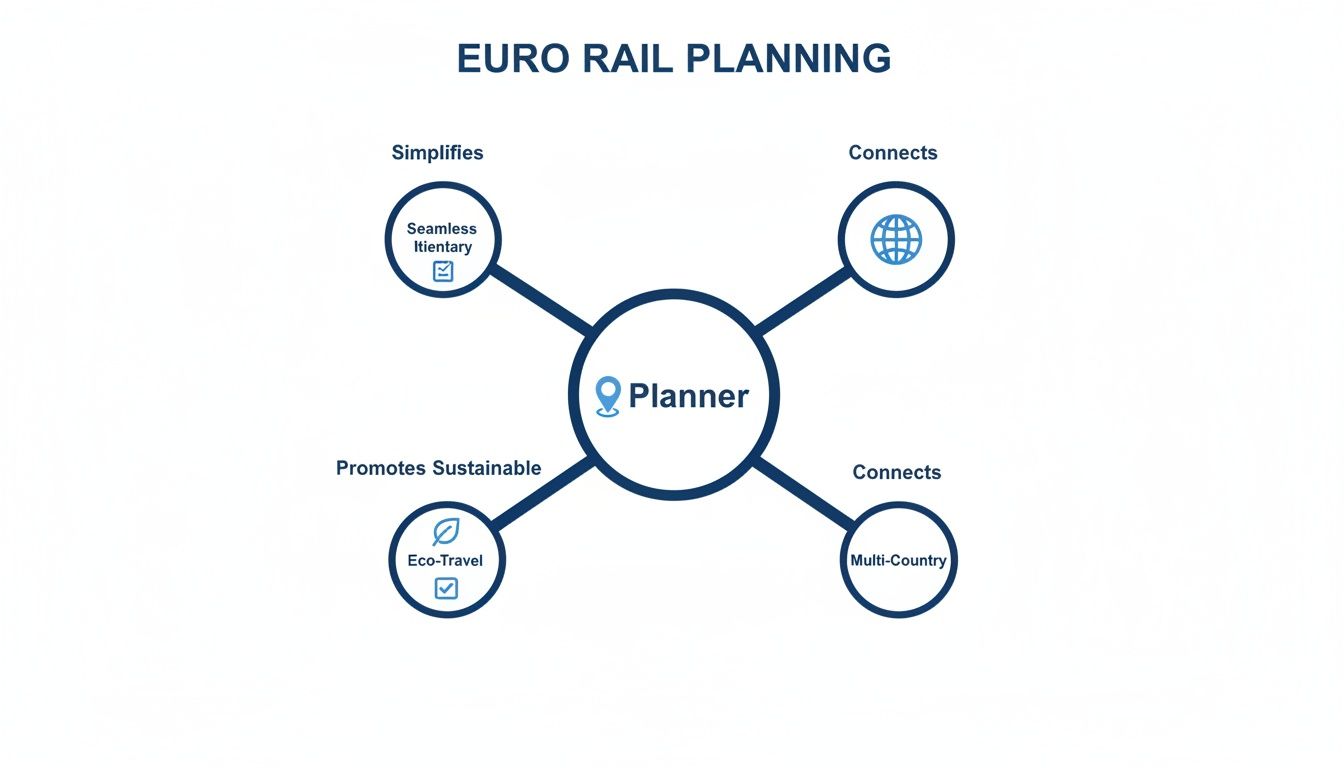
This diagram really nails the core benefits. A good planner doesn’t just show you timetables; it connects the dots, turning a series of individual train rides into a single, seamless, and sustainable journey across borders.
Rail Journey Planner Europe Feature Comparison
To help you decide at a glance, here’s how the most popular platforms stack up against each other on the features that matter most. Knowing these differences can save you a lot of time and a bit of money.
For a deeper look into building truly complex routes, our full guide on using a train travel route planner has more advanced tips.
| Planner | Best For | Geographic Coverage | Rail Pass Support | Booking Fees |
|---|---|---|---|---|
| Trainline | A clean interface and finding clever split-ticket savings. | Excellent (45 countries) | Good, but mainly for making seat reservations on a pass. | Varies; can be slightly higher than others. |
| Omio | Comparing trains, buses, and flights all in one search. | Extensive and multi-modal. | Limited; better for buying tickets directly. | Varies by the transport operator. |
| DB Navigator | In-depth details and fee-free booking for German trains. | Strongest in Central Europe. | Excellent for using passes within Germany. | Generally none for DB’s own trains. |
| Rail Europe | Aggregating major carriers and great pass integration. | Wide European network. | Very good support for Eurail/Interrail pass holders. | Moderate fees are usually built into the ticket price. |
Ultimately, there’s no single “best” planner for everyone. The right tool depends entirely on the shape of your trip and your personal travel habits.
Which Rail Journey Planner Should You Use?
So, what’s the verdict? For a straightforward trip between two or three countries with fixed dates, Trainline or Omio are fantastic. Their intuitive designs make booking a breeze, letting you get on with the more exciting parts of trip planning.
If your journey is heavily centered on Germany and its neighbors, DB Navigator is the undisputed champion for its accuracy and cost-effectiveness. And for anyone building an itinerary around a Eurail or Interrail pass, a platform like Rail Europe that specializes in pass-holder reservations will make your life much easier.
My advice? The best way to decide is to test-drive a few of them with your actual route. See which interface feels most natural and which one gives you the clearest pricing. It’s the only way to know for sure which planner works best for you.
Planning Your Trip with Sustainable Travel in Mind
A great rail journey planner for Europe does more than just hunt down the fastest or cheapest route—it’s a powerful tool for making more responsible travel choices. By learning to use their sustainability-focused features, you can design a trip that aligns with your values without sacrificing the adventure.
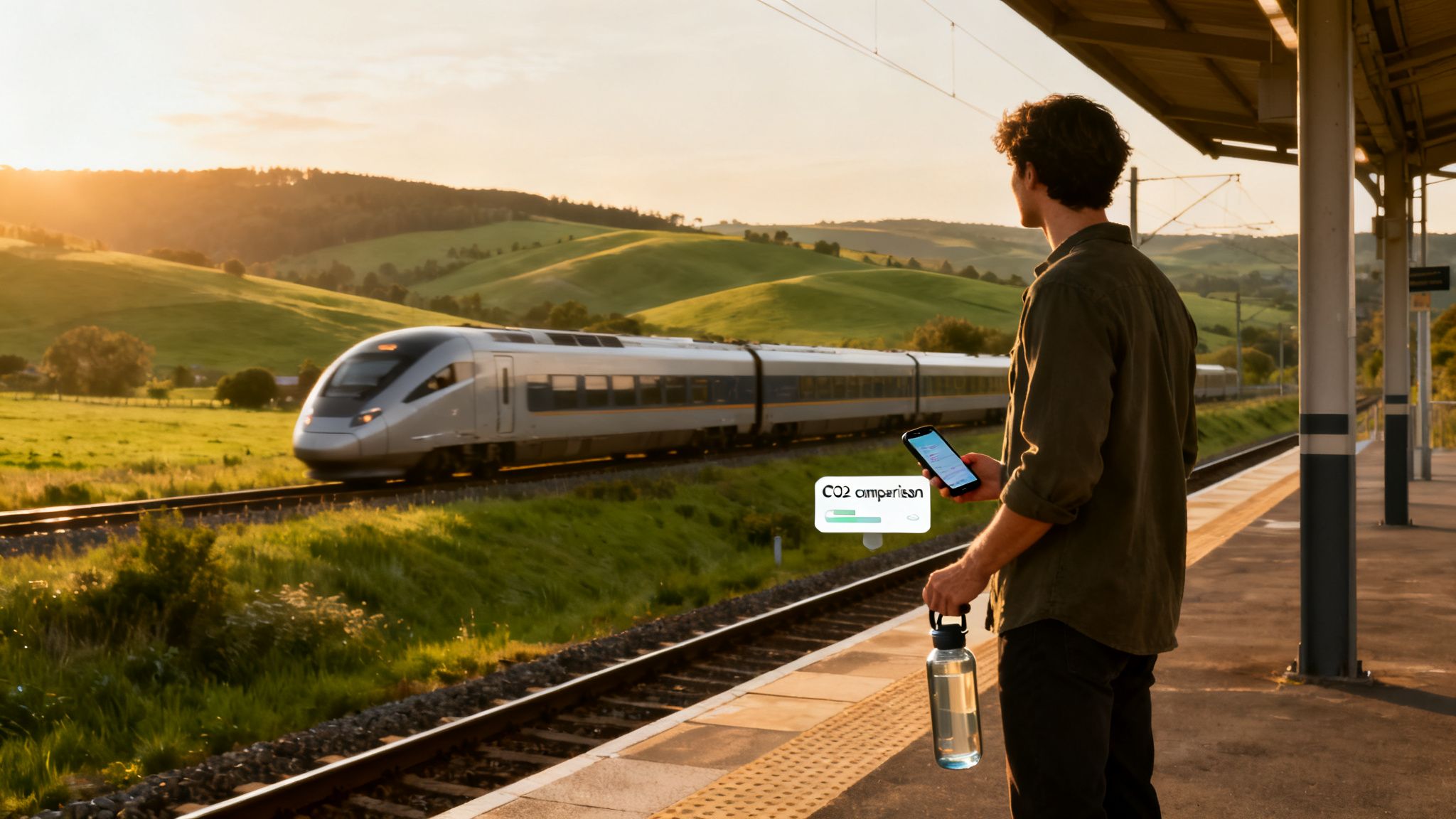
Many leading planners now show carbon emission estimates right in the search results. This lets you see the direct environmental impact of your train journey. Often, this is compared side-by-side with the much higher emissions of a flight for the same route. Seeing those numbers in black and white can be a powerful motivator to stick to the rails. You can learn more in our detailed guide comparing train vs plane emissions.
This shift toward greener travel isn’t just a niche trend; it’s a massive movement. Europe’s rail renaissance is being fueled by climate-aware travelers. A recent EU survey revealed that 3 out of 4 citizens would choose high-speed trains over planes if the connections were better. Moreover, that demand is pushing record growth in the rail sector. For more detail, you can explore the survey findings on European travel preferences.
Using Planner Features for a Lower Impact
Beyond just displaying emissions data, many planners offer filters and info that help you actively shrink your footprint. Knowing what to look for is key.
- Filter for Direct Routes: Opting for direct trains minimizes the energy burned during acceleration and deceleration. It’s a small change that adds up over a long trip.
- Choose Eco-Conscious Operators: Some planners highlight which train companies are committed to using renewable energy. Prioritizing these operators supports the transition to a greener rail network.
- Embrace Night Trains: Booking a sleeper train is a classic eco-nomad move. It combines your travel and accommodation into one, reducing your overall resource consumption and carbon footprint.
Packing smart plays a role, too. Tossing a simple reusable water bottle in your bag is an effortless way to cut down on single-use plastic waste while you explore.
Beyond the Booking Engine
Your sustainable choices don’t stop once you’ve booked your tickets. Think about how your rail journey connects to your wider itinerary.
A truly sustainable trip looks at the entire system. It’s about choosing a train over a plane, but it’s also about staying in walkable neighborhoods, supporting local businesses, and minimizing waste along the way. Your rail journey planner is the starting point for this mindful approach.
This means using your planner to find stations that are well-connected to public transport, letting you skip the taxi queue upon arrival. It also means packing light in a good carry on backpack so you can navigate cities on foot with ease. Making these conscious decisions at every stage transforms your trip from a simple vacation into a more positive and impactful experience.
Deciding: Point-to-Point Tickets vs. Rail Passes
This is one of the biggest forks in the road when you’re planning a European train adventure. Do you buy individual point-to-point tickets for each leg, or do you go all-in on a rail pass like Eurail or Interrail? The right call hinges entirely on your travel style, your budget, and how much freedom you want to build into your itinerary.
Getting this wrong can mean overspending or feeling boxed in by a rigid plan you regret later. A rail pass often feels like the ultimate ticket to freedom, but it isn’t always the most economical choice.
On the flip side, booking single tickets can save you a surprising amount of money. However, it demands more upfront planning and leaves less room for those spontaneous detours that make a trip memorable. Let’s break down how to decide.
When a Rail Pass Makes Sense
A rail pass is built for travelers who put a premium on flexibility, especially for longer, multi-country trips. If you love the idea of waking up and deciding your next move on a whim, or if you’re covering huge distances over several weeks, a pass often delivers unbeatable value.
Here are the scenarios where a rail pass really shines:
- Spontaneous Travel: You want to be able to just show up and hop on a train without having to pre-book every single journey weeks in advance.
- Multi-Country Trips: Your route involves crossing several borders, particularly in Western Europe where last-minute international tickets can get pricey.
- Long-Term Exploration: You’re traveling for three weeks or more and plan to live on the train network, using it almost daily.
- Youth Travelers: If you’re under 27, the discounts on Eurail and Interrail passes are significant, often tipping the scales and making them a financial no-brainer.
For a little extra security while navigating bustling train stations with all your gear, carrying a good anti theft backpack can give you valuable peace of mind.
When Point-to-Point Tickets Are Better
On the other hand, buying individual tickets is often the smarter financial move if your itinerary is mostly locked in. If you know exactly where you’re going and when, booking those tickets in advance can lead to huge savings, especially on high-speed routes.
Consider sticking to point-to-point tickets if:
- Your Itinerary is Fixed: You have a set schedule with just a few major train journeys, like hitting three or four cities over two weeks.
- You Can Book in Advance: Most European rail operators release tickets 90 to 180 days out, offering the best prices to early birds.
- You’re Traveling Within One Country: Domestic tickets are often far cheaper than international ones, making a country-specific pass an unnecessary expense.
- Your Route Involves Budget-Friendly Countries: In much of Central and Eastern Europe, train travel is so affordable that a pass rarely pays for itself.
The only way to know for sure is to do the math. Use your chosen rail journey planner for Europe to map out your dream itinerary and tally up the cost of the individual tickets. Then, compare that grand total to the price of a suitable rail pass. Our guide to the best rail passes for Europe can help you weigh the pros and cons in more detail.
Building Your Itinerary With Sample Routes
Alright, let’s put the theory into practice. The best way to really grasp what a rail journey planner for Europe can do is to see it in action with a few real-world routes. I’ve sketched out three distinct, train-first itineraries below—perfect for digital nomads and slow travelers who want to blend work with genuine exploration.
Each route has its own flavor, showing off a different region and travel style. We’ll look at a high-speed loop connecting major tech hubs, a slower coastal journey, and a deep dive into the grand capitals of Central Europe. Indeed, these are exactly the kinds of trips where a good planner becomes your best friend.
A quick pro-tip before we start: for any long trip where you need to stay productive, a solid portable power bank is non-negotiable. It’ll keep your laptop and phone alive, so you can work from your seat without hunting for an outlet.
Route 1: The Western European Tech Triangle
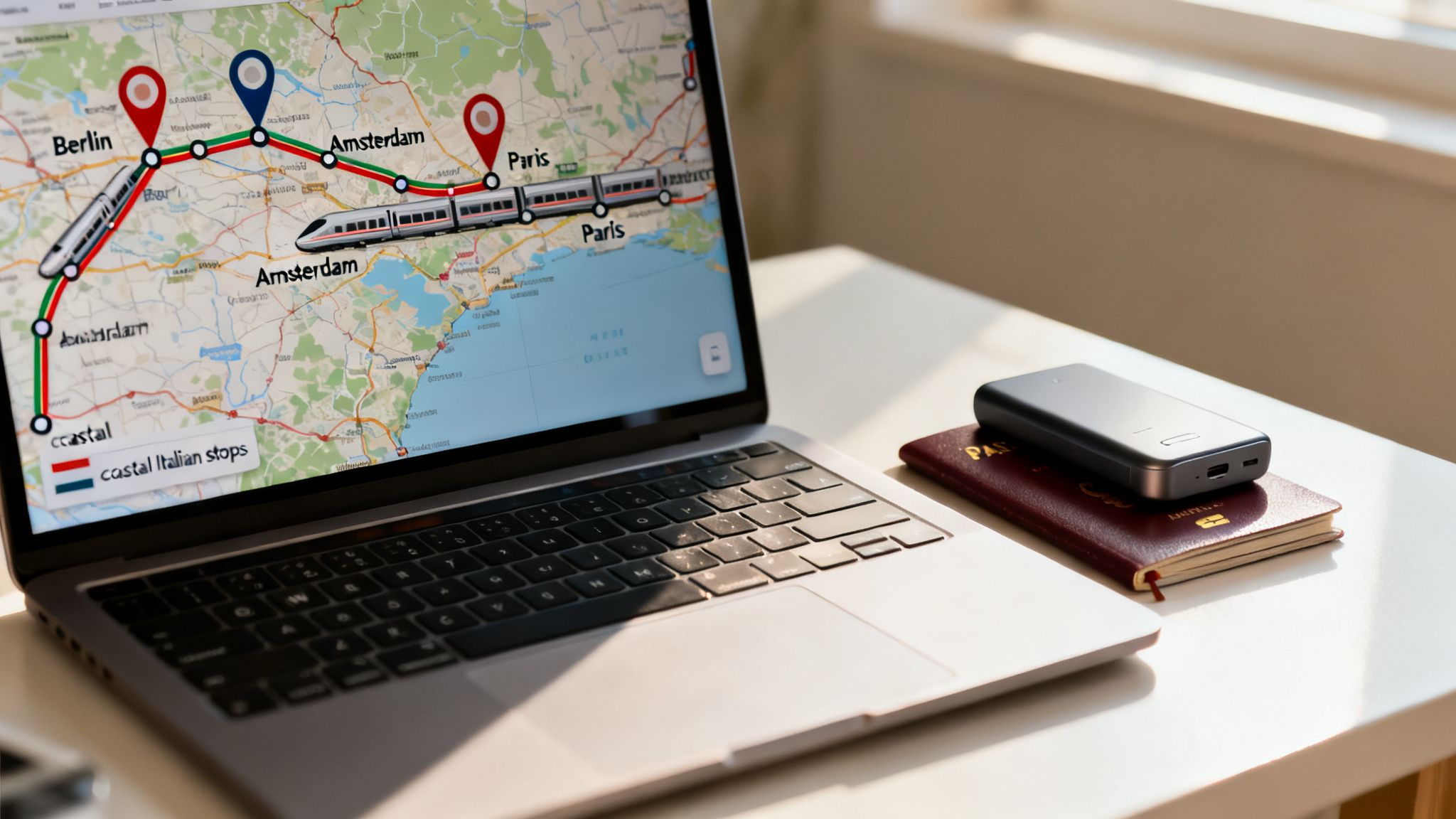
This high-speed itinerary is tailor-made for nomads who want to plug into major business centers while soaking up world-class culture. It connects three incredibly dynamic and walkable cities, all known for great infrastructure and thriving remote work scenes.
- Leg 1: Berlin to Amsterdam: Kick things off in Germany’s creative heart. The direct Deutsche Bahn ICE train gets you there in about 6 hours and 20 minutes. Give yourself 4-5 days to explore Berlin’s co-working spots and layered history before you head west.
- Leg 2: Amsterdam to Paris: After a few days enjoying Amsterdam’s canal-side charm, you’ll hop on the high-speed Thalys (now part of Eurostar). This leg is a zippy 3 hours and 20 minutes, making for a super easy morning journey.
- Leg 3: Paris to Berlin (Optional Night Train): To close the loop, think about taking the ÖBB Nightjet sleeper train back to Berlin. You save a night on accommodation and get to enjoy a genuinely cool, sustainable travel experience. You can find more ideas in our guide to the best sleeper trains in Europe.
This route is a perfect example of Europe’s booming rail traffic. The continent’s busiest stations, like Paris’s Gare du Nord, recently handled a mind-boggling 257 million travelers in a year. Consequently, they are incredible launchpads for adventures just like this one.
Route 2: Italy’s Coastal Connection
If you’re after a slower rhythm, this journey traces Italy’s magnificent west coast, mixing ancient cities with knockout sea views. It’s a comfortable and scenic trip using Trenitalia’s Frecciarossa and InterCity trains—ideal for anyone who wants to work with an inspiring view right outside their window.
- Start in Genoa: Settle into the historic port city for a couple of days.
- Travel to Cinque Terre: A regional train takes you there in about 1.5 hours. Use one of the five villages as your base for hiking and getting some work done.
- Continue to Rome: From La Spezia (the main station for Cinque Terre), the high-speed train to Rome takes around 4 hours.
- Finish in Naples: A final, quick high-speed leg of just over 1 hour drops you in the vibrant home of pizza.
Trust me on this: a good lightweight travel backpack will make your life so much easier here. Navigating Italy’s smaller stations and cobblestone streets is a breeze compared to wrestling with a rolling suitcase.
Route 3: The Imperial Capitals of Central Europe
This route takes you right into the heart of the old Austro-Hungarian Empire, linking three of Europe’s most beautiful and affordable capitals. It’s a trip steeped in history, art, and incredible cafe culture, all connected by efficient services like Austria’s Railjet trains.
- Vienna to Budapest: This comfortable ride takes just under 3 hours, whisking you between two architectural showstoppers.
- Budapest to Prague: The direct train is about 7 hours, giving you a full, relaxing day to watch the countryside roll by and catch up on work.
- Prague back to Vienna: You can complete the circle in about 4 hours, ready for whatever comes next.
Any of these itineraries can be tweaked, planned, and booked using a quality rail journey planner for Europe. They’re proof that you can build an inspiring, low-impact, and highly efficient trip entirely around the continent’s incredible train network.
Editor’s Pick for Route Planning
For putting together complex, multi-country trips like these, Trainline really shines. Its interface makes comparing fares across different rail companies incredibly simple, and its huge coverage across 45 countries means you can reliably plan and book in one place. It’s especially good at juggling the mix of high-speed and regional trains you’ll find on these kinds of routes.
Key Takeaways
- Choose the Right Tool: A user-friendly rail journey planner Europe like Trainline or Omio simplifies booking, while operator apps like DB Navigator offer detailed, fee-free options for specific regions.
- Book Early for Savings: For high-speed routes in Western Europe, book tickets 90-180 days in advance to secure the lowest fares. Prices can increase significantly closer to the travel date.
- Rail Pass vs. Single Tickets: A rail pass offers flexibility for long, multi-country trips, but point-to-point tickets are often cheaper for fixed itineraries booked in advance. Always do the math for your specific route.
- Embrace Sustainable Features: Use planner tools to compare carbon emissions, choose eco-friendly operators, and book direct or night trains to minimize your environmental impact.
- Pack Light and Smart: Train travel involves moving your own luggage. A lightweight carry on backpack and compression packing cubes make navigating stations and boarding trains much easier.
- Understand Seat Reservations: Many high-speed and night trains require a mandatory seat reservation in addition to your ticket or rail pass. Always check requirements in your planner to avoid issues.
Low-Impact Travel Tools (Worth It)
Also, if you’re planning a trip and want to keep things simple, these tools help you travel smoother while staying mindful about impact.
Get an eSIM for reliable data → Disclosure: Partner link. No extra cost to you.
Pre-book a transfer for easy arrivals → Disclosure: Partner link. No extra cost to you.
Frequently Asked Questions
When is the best time to book European train tickets for cheaper fares?
This is the golden question for anyone trying to keep their budget in check. For most high-speed and long-distance trains in Western Europe—think France’s TGV, Germany’s ICE, or Italy’s Frecciarossa—the answer is simple: book as early as you possibly can. Operators usually release tickets 90 to 180 days in advance, and that first batch is almost always the cheapest. Train fares work on a dynamic system, just like airlines. As seats fill up and the travel date gets closer, prices climb fast. A ticket that costs $35 (€32) three months out could easily shoot up to $120 (€110) or more if you try to buy it on the day. However, this isn’t a universal rule. For many regional trains or in parts of Central and Eastern Europe, prices are often fixed.
How do I make seat reservations with a rail pass?
This is a common hurdle for first-time Eurail and Interrail pass holders. While your pass covers the cost of the journey, it doesn’t automatically guarantee you a spot. On many high-speed trains, night trains, and popular cross-border routes, a separate seat reservation is mandatory. You can book these via the rail operator’s website (like Deutsche Bahn (DB)), a specialized service like Rail Europe, or at the station. Always check requirements in your planner app. I also keep my pass and cards safe in an RFID blocking wallet when navigating busy stations.
Are the real-time updates in planner apps reliable?
For the most part, yes. The top-tier planner apps like Trainline and DB Navigator get their data directly from the national rail networks. This means the information they show you—platform changes, delays, cancellations—is generally accurate and updated the moment it happens. These updates are a lifesaver, especially for a tight connection. That said, it’s always a good habit to glance at the main departure board at the station for final confirmation. I always have my noise canceling earbuds in busy stations to help me focus on app notifications and stay calm.
Which rail journey planner is best for night trains?
Booking sleeper trains is a bit more involved than a standard daytime trip. For this, the Austrian railway’s official website, ÖBB, is a fantastic resource, even for routes that don’t start or end in Austria. ÖBB operates the extensive Nightjet network, Europe’s leading sleeper train service, and their booking engine clearly shows all sleeper options. Trainline also handles night train bookings well. To make an overnight journey more comfortable, I always pack a quick dry travel towel and some biodegradable soap to freshen up in the morning.
What’s one practical tip for a first-time train traveler in Europe?
Pack light. Honestly, this is the single most important piece of advice. You’ll be lifting your bag on and off trains, stowing it in overhead racks, and navigating crowded platforms. Wrestling with a heavy, oversized suitcase is a miserable way to start a trip. Your goal should be to fit everything into a high-quality carry on backpack or a small roller bag. Compression packing cubes are a game-changer here; they organize your clothes and squeeze out extra air, creating a surprising amount of space.
Can I use my phone as my ticket for all journeys?
Mobile ticketing is now the norm across most of Europe, but it’s not quite universal yet. For major operators in Western and Central Europe, a digital ticket on your phone is perfectly fine. The conductor just scans the QR code. However, on some smaller regional lines or in certain Eastern European countries, you might still need a printed ticket. Your rail journey planner for Europe or confirmation email will state if a mobile ticket is valid. A good eSIM from a provider like Airalo ensures you have reliable data when you need it most.
Are there luggage restrictions on European trains?
Unlike airlines, European trains are famously generous with luggage. There are generally no strict weight limits, and you can bring far more than you could on a plane. The unwritten rule is simple: only bring what you can comfortably handle yourself. Most trains have overhead racks for smaller bags and dedicated luggage areas at the end of each carriage for larger suitcases. For a little extra security, a simple travel lock TSA approved on your main bag can provide some peace of mind.
How do I find the right platform at a large station?
Big European stations can feel overwhelming. The key is to focus on the main departure board (look for “Départ,” “Abfahrt,” or “Departures”). Find your train number and final destination. The platform number (“Voie,” “Gleis,” or “Platform”) is usually posted about 15-20 minutes before departure. Don’t panic if it’s not shown an hour ahead of time. Once it appears, just follow the signs. Most planner apps will also send a notification with the platform info, which is incredibly helpful.
Join the Sustainable Work Movement
Want more rail-first itineraries, low-impact packing systems, and walkable base-city ideas?
This article was fact-checked using sustainability data from the World Green Building Council, the Global Ecotourism Network, and peer-reviewed architecture studies. All partner links are vetted for compliance with sustainable business certifications.
