
Imagine leaving a beautiful place even better than you found it. That’s the real heart of regenerative travel—an idea that pushes past just ‘doing no harm’ and asks how we can actively make the places we visit healthier and more resilient. This guide explains how regenerative travel works. It feels like the next natural step in our journey as thoughtful travelers.
Why Regenerative Travel Matters Now
Think of it like this: sustainable travel is like carefully tending a garden to keep it healthy. Regenerative travel is like actively adding compost and nutrients to enrich the soil, making it more fertile for years to come. The goal is to be a positive force, to intentionally feed back into the local systems—both ecological and social—that make a place special. When we do this right, our presence becomes a force for good.
This shift in thinking is especially powerful for digital nomads and remote workers. Our tendency to stay longer in walkable base cities gives us the perfect opportunity to connect more deeply. Instead of just skimming the surface, we have time to build real relationships, consistently support small local businesses, and understand the unique fabric of a community.
Choosing a family-run guesthouse for a month-long stay, for example, provides stable income in a way an overnight hotel booking never could. Even a small habit, like always carrying a reliable reusable water bottle, cuts down on plastic waste and sends a clear signal that you’re a mindful visitor. This guide is all about making those kinds of impactful choices second nature, from planning rail-first itineraries to mastering zero-waste packing.
Shifting from Less Harm to More Good
The biggest change with regenerative travel is moving from a mindset of mitigation to one of genuine restoration. For years, the conversation around responsible tourism has been about shrinking our negative footprint—using less water, creating less waste, offsetting our carbon. Those things are still important, but they set the bar at zero.
Regenerative travel raises that bar. It asks a much bigger question: How can my journey actively help heal and strengthen a place’s social and ecological systems?
This isn’t just an abstract idea. It translates into real actions:
- Supporting Local Food Systems: Eating at restaurants that source ingredients from nearby farms. This directly pumps money into the local agricultural economy and slashes food miles.
- Participating in Restoration Projects: Staying at a lodge that funnels a portion of its revenue into local reforestation efforts or marine conservation projects. Your stay becomes direct funding.
- Cultural Preservation: Intentionally seeking out and fairly paying local artisans, storytellers, and guides. This helps keep cultural traditions alive and valued for generations to come.
What Does Regenerative Travel Actually Mean?
To really get behind regenerative travel, we have to move past fuzzy concepts and into a clear way of thinking. This isn’t about one single action, like picking up trash on a beach (though that’s great). It’s a complete mindset shift, guided by principles that turn good intentions into real, positive change on the ground.
At its core, regenerative travel is built on a powerful idea: our trips should actively leave the social, cultural, and environmental health of a place better than we found it. This means shifting from being a passive tourist to an active contributor. It’s about seeking out businesses and experiences that are deeply connected to their local roots.
For example, empowering local communities is a huge piece of this. It’s the difference between staying at a massive international hotel chain where profits are whisked away and choosing a locally-owned guesthouse where your money directly supports a family. It’s about making sure tourism dollars stay local, helping build resilience and self-reliance. For reliable connectivity, you can get an eSIM from providers like Airalo or Yesim.
More Than Just “Green”: Embracing Ecological Restoration
Another key idea is a serious focus on environmental restoration. This is a big step up from just “minimizing your footprint.” It means actively looking for and supporting projects that are healing and regenerating natural ecosystems.
A perfect example is staying at an eco-lodge that funnels a portion of your payment into local reforestation projects or the protection of a nearby watershed. Your stay becomes a direct investment in the long-term health of that specific environment. It’s a powerful feeling.
The chart below shows where regenerative travel fits into the bigger picture, placing it at the very top as the most positive and impactful way to explore.
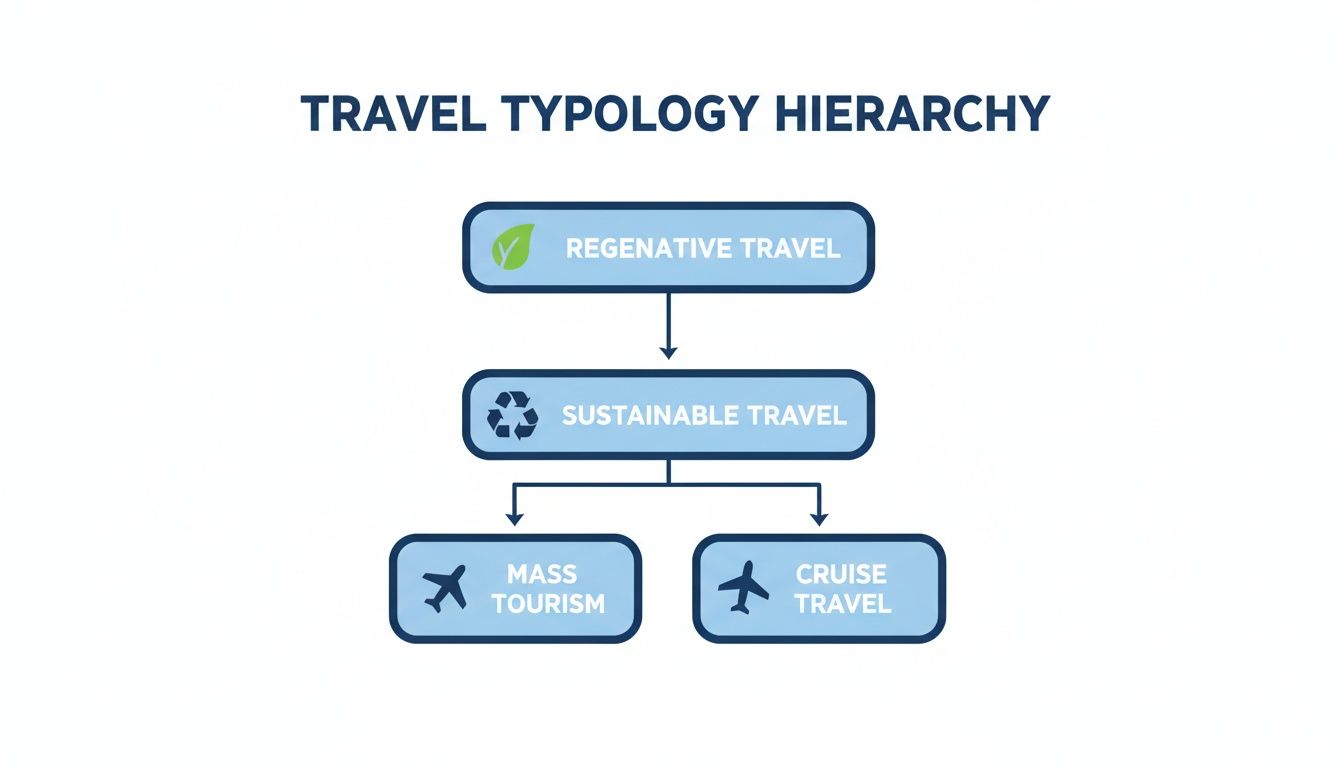
As you can see, it’s about actively improving a place—a clear evolution from the harm-reduction focus of sustainable travel.
Sustainable vs Regenerative Travel: A Quick Comparison
To clear up any confusion, it helps to see these approaches side-by-side. While they’re all part of the responsible travel family, their goals and mindsets are distinct.
| Travel Approach | Primary Goal | Example Action |
|---|---|---|
| Sustainable Travel | Do no harm; neutralize negative impacts. | Offsetting your flight’s carbon emissions. |
| Ecotourism | Conserve nature and improve local well-being. | Taking a guided wildlife tour that funds anti-poaching patrols. |
| Regenerative Travel | Actively improve the whole system (eco & social). | Staying at a farm that uses your fees to restore soil and fund a school program. |
The key takeaway? Sustainable travel aims for a neutral balance, while regenerative travel is about creating a net positive. It’s about giving back more than you take.
Thinking in Systems: How Everything is Connected
Finally, regenerative travel asks us to adopt a holistic, systems-based view. This means seeing a destination not just as a collection of sights, but as a complex, interconnected web of people, culture, economy, and nature. A decision in one area always creates ripples elsewhere.
This approach challenges us to think about the knock-on effects of our choices. When we buy produce from a local farmer’s market, we’re not just getting fresh food; we’re supporting small-scale agriculture, cutting down food miles, and pumping money directly into the local economy.
This interconnected thinking is everything. And it’s not just a niche idea anymore—the market is catching on. The regenerative travel hospitality market was valued at $2.9 billion USD and is expected to rocket to $9.4 billion USD by 2033. That’s an incredible 15.10% compound annual growth rate, proving that travelers and businesses are seeing tourism’s potential to heal ecosystems and lift up communities.
This systems mindset is what truly sets regenerative travel apart from other forms of responsible tourism. You can learn more about where these ideas come from in our deeper guide to what is sustainable travel.
How to Plan a Regenerative Travel Trip
Turning good intentions into real-world action is the best part of embracing regenerative travel. Planning your first trip is really about making a series of conscious choices before you even leave home. This is where you lay the foundation for a journey that genuinely gives back to the places you explore.
We can break this down into a few clear, manageable steps. First, we’ll look at choosing the right kind of destination. Then, we’ll cover how to find and properly vet your accommodations. Finally, we’ll touch on packing with purpose to shrink your footprint right from the start.
This planning stage sets the tone for everything that follows. When you think regeneratively from the beginning, you transform a simple vacation into a meaningful exchange that supports local communities and ecosystems.
Choosing a Regenerative Destination
Your first move is to pick a destination that already has a strong foundation for community-led tourism. You’re looking for regions where local ownership and cultural preservation are clearly valued, not just talked about. Train-accessible areas in Europe and Asia are fantastic starting points, as they naturally encourage slower, more immersive travel.
When you’re researching, try searching for terms like “community-based tourism,” “agritourism,” or “local co-op” along with your potential destination. These phrases will often lead you to places where tourism is designed to directly benefit residents, not outside corporations. Think smaller towns with thriving farmers’ markets or coastal areas with locally managed conservation projects.
Destinations that actively promote their natural and cultural heritage through local initiatives are prime candidates. For example, a region that highlights its network of small, family-owned farms and food producers is a great sign. It’s a clue that your tourist dollars will circulate locally, strengthening the community’s resilience.
Finding and Vetting Accommodations
Once you have a place in mind, finding the right stay is crucial. This means moving beyond the generic booking sites and digging a little deeper. The goal isn’t just to find an “eco-friendly” sticker, but to find accommodations that are actively contributing to their local environment and community.
A truly regenerative stay will be transparent about its impact. Look for these signs on their website:
- Detailed Impact Reports: Do they share specific data about conservation efforts, community partnerships, or local sourcing? Vague claims like “we’re green” aren’t enough.
- Community Integration: Do they hire local staff, pay fair wages, and support nearby artisans or schools?
- Local Sourcing: Do they highlight partnerships with nearby farms for their restaurant or guest amenities?
Don’t just rely on certifications, which can sometimes be misleading. Instead, look for authentic stories and measurable outcomes. A guesthouse that proudly showcases its support for a local school or its efforts to reforest a nearby hillside is demonstrating a real regenerative commitment. While you can explore options on booking platforms like Trip.com, always do your own vetting afterward.
How to Pack with Purpose
Your packing choices have a direct impact on your environmental footprint on the road. A minimalist, zero-waste mindset is a core part of regenerative travel, and every item you pack is an opportunity to reduce waste. A great starting point is our guide on achieving carbon-neutral travel.

Start with essentials that eliminate single-use plastics. A solid shampoo bar and biodegradable soap are lightweight, last for ages, and won’t create plastic bottle waste. Similarly, bringing a collapsible water bottle means you can stay hydrated without constantly buying bottled water.
Think about your tech needs, especially for long train journeys or stays in eco-lodges where outlets might be scarce. A reliable portable power bank is essential for keeping your devices charged without interruption. Packing light not only makes navigating train stations easier but also reduces the fuel consumption of your transport. While we always advocate for rail, if you must fly, you can compare flight emissions on a platform like Aviasales. Each item should have a purpose, helping you travel more lightly and mindfully on the planet.
Regenerative Travel in Action: Real-World Examples
The best way to really get your head around regenerative travel is to see it working in the wild. When you move past the theory, you start to see how simple travel choices can ripple out into real, positive change. Let’s look at two incredible examples—one from Europe and one from Asia—that bring this powerful idea to life.
These stories aren’t just hypotheticals. They show how regenerative principles are being put to work in completely different settings, proving that deeply rewarding, high-impact trips are totally within reach for slow travelers and digital nomads.
Case Study 1: Restoring Olive Groves in Rural Tuscany
Picture this: you step off a regional train and into the rolling hills of Tuscany, Italy. You’re headed for a community-owned agriturismo (farm stay), but this is more than just a place to sleep—it’s a living project. Instead of a standard hotel, you find a cooperative run by local families who are bringing ancient, abandoned olive groves back to life.

Your stay directly funds this vital work. A portion of every booking goes toward pruning neglected trees, rebuilding old stone terraces, and shifting back to organic farming methods. This isn’t just about restoring the landscape; it’s about reviving the local economy. Travelers are even invited to get involved, learning from local elders about traditional olive oil production or helping with the harvest in the fall.
The agriturismo itself is a brilliant model of circularity. Its restaurant serves food grown on-site or sourced from neighboring farms, slashing food miles to almost zero. Profits are then reinvested right back into the cooperative, supporting local artisans and funding educational programs for the community’s kids. By choosing a stay like this, your trip becomes a direct investment in cultural preservation and ecological healing. It’s a perfect fit if you’re exploring our guide to the top 10 ecotourism destinations for 2025.
Case Study 2: Healing Coral Reefs in Coastal Thailand
Now, let’s jump over to the warm waters of coastal Thailand, where a marine conservation project shows how tourism can actively heal fragile ecosystems. Here, a small, locally-owned dive center has completely flipped its business model from simple sightseeing to active reef restoration. Travelers are no longer passive observers; they’re citizen scientists.
When you book a dive or snorkeling trip, your money contributes directly to the project’s funding and its hands-on work. You can join workshops to learn how to clean and plant coral fragments onto artificial reef structures. Led by local marine biologists, these experiences forge a profound connection to the underwater world that a typical tour just can’t match.
This initiative is a powerful example of community-led conservation in action. The project hires local guides, many of them former fishermen, giving them sustainable livelihoods that depend on a healthy marine environment. Their deep, traditional knowledge is absolutely essential to the project’s success. This kind of approach is more critical than ever, especially when you consider that coastal and marine tourism generated an incredible $2.9 trillion USD in 2021, according to data from Earth-Changers.com. Projects like this one ensure that economic activity actually restores, rather than depletes, the natural resources it relies on. On a practical note, having a reliable universal travel adapter is a small but essential step to stay connected while supporting these remote, impactful projects.
Making a Positive Impact During Your Travels
Once you’ve sorted out your regenerative itinerary and landed in your new base, the real work begins. This is where your daily choices—from the cafe you pick to the way you explore a new neighborhood—start to shape the impact you leave behind. It’s the moment you shift from planning to doing, becoming a positive force in the community you’re temporarily calling home.
The idea is to move from being a passive tourist to an active, respectful participant. That means digging into the local culture with genuine curiosity, making sure your money flows directly into the local economy, and consciously lightening your footprint with every step.
Ultimately, your on-the-ground habits are what define a regenerative trip. It’s all about leaving a place and its people a little bit better than you found them.
Engage Respectfully with Local Culture
One of the most powerful ways to practice regenerative travel is to connect with the local culture on its own terms. This isn’t complicated; it just starts with genuine curiosity and a willingness to learn. Before you even arrive, spend ten minutes learning a few basic phrases. Simple greetings like “hello,” “please,” and “thank you” go a surprisingly long way.
This small gesture shows respect and opens doors to more authentic interactions. It signals that you see yourself as a guest, not just another customer, which helps build the mutual understanding that sits at the heart of any positive cultural exchange.
Support the Local Economy Directly
Where your money goes matters—a lot. To make sure your spending actually benefits the community you’re in, make a conscious effort to bypass the big international chains. Instead, seek out locally-owned businesses whenever you can.
Here are a few practical ways to do this:
- Eat at family-run restaurants: These spots are where you’ll find traditional recipes and ingredients sourced from nearby farms and markets.
- Shop at farmer’s markets: Buying directly from local producers supports small-scale agriculture and gives you a real taste of the region.
- Hire local guides: Their knowledge is invaluable, and your payment goes straight to their family. You can learn more about finding ethical operators in our guide on how to choose eco-friendly tour operators.
When you’re navigating bustling markets, a good anti theft backpack gives you peace of mind so you can focus on the experience itself. And if your trip involves a flight, pre-booking a trusted local driver through a service like Welcome Pickups ensures your money stays within the community from the second you land.
Mitigate Your On-the-Ground Footprint
Your daily habits add up, contributing significantly to your overall impact. This is where the idea of ‘impact accounting’ becomes practical. You can use a carbon calculator to get a rough idea of your activity footprint, then look for local initiatives to support as a way of giving back.
This could be as simple as donating to a local conservation group or joining a community clean-up if you’re staying a while. The goal is to balance your impact by actively contributing to local environmental and social projects.
Beyond that, small, consistent actions make a huge difference. Always carry your reusable water bottle. For minimalist packing at eco-lodges, a quick dry travel towel is a brilliant, space-saving choice. These simple habits cut down on waste and resource use, reinforcing your commitment to leaving a positive trace.
Why Regenerative Travel Is the Future of Tourism
Regenerative travel is quickly moving from a niche idea to a major force shaping the entire travel industry. This isn’t just a fleeting trend; it’s a direct answer to a growing global hunger for travel that feels more authentic, meaningful, and genuinely positive.
More and more, travelers are looking past simple sightseeing. They want to know their presence actually supports the places they visit, rather than straining them.
This shift is being driven by both conscious travelers and forward-thinking businesses. The global ecotourism market, which regenerative practices are a key part of, is currently valued at $244.2 billion USD. It’s projected to explode to an incredible $1,120.5 billion USD by 2035.
That explosive growth—a compound annual growth rate of 14.86%—signals a massive change in what the market values. You can dive deeper into the numbers in the full ecotourism market report.
This momentum means your choice to travel regeneratively is part of a much bigger, positive movement. As demand grows, so do the opportunities to find genuinely restorative options in markets across North America, Europe, and Asia.
Fogo Island Inn in Newfoundland, Canada, is a powerful example of regenerative travel in action. As a social business, 100% of its operating surpluses are funneled back into the community through the Shorefast Foundation. This model directly supports local economies and cultural preservation, making every stay a direct contribution to the island’s resilience. It proves that luxury and deep community benefit can absolutely go hand in hand.
Why This Growth Matters for You
This expanding market makes it easier than ever to plan journeys with real impact. You’ll find a growing number of tour operators, accommodations, and local experiences built from the ground up on restorative principles.
For anyone planning multi-stop rail journeys, organizing your gear with packing cubes makes navigating train travel so much smoother, letting you focus on the experience itself.
This growth also fuels more accountability. As businesses compete for conscious travelers, transparency about their real-world impact becomes a key way to stand out. This shift empowers you to make better-informed decisions, confidently choosing options that align with your values.
Before you head out, securing comprehensive travel insurance from a provider like VisitorsCoverage is a smart, practical step. By understanding these trends, you can see how the sustainable tourism future is already taking shape right now.
Low-Impact Travel Tools (Worth It)
Also, if you’re planning a trip and want to keep things simple, these tools help you travel smoother while staying mindful about impact.
Get an eSIM for reliable data → Disclosure: Partner link. No extra cost to you.
Pre-book a transfer for easy arrivals → Disclosure: Partner link. No extra cost to you.
Key Takeaways
- Go Beyond “Do No Harm.” Sustainable travel aims for neutrality. Regenerative travel aims to be a net positive by actively improving the social and ecological health of a place.
- Heal Ecosystems, Empower People. The core of regenerative travel is supporting locally-owned businesses that restore natural habitats and give communities a genuine stake in tourism’s future.
- Plan with Purpose. Look past marketing claims on booking sites. Search for accommodations and tour operators who are transparent about their impact with measurable outcomes.
- Your Daily Choices Add Up. Every decision—from shopping at a local market to respecting cultural sites—is part of the process. This shifts you from being a consumer to a contributor.
- It’s a Mindset, Not a Budget. Regenerative actions, like choosing local eateries or using public transit, are often more budget-friendly than conventional tourism.
Frequently Asked Questions About Regenerative Travel
Still have a few questions? Good. Regenerative travel is a big idea with a lot of moving parts, and it’s smart to dig into the details. Here are some straightforward answers to the questions we hear most often.
How Is Regenerative Travel Different from Ecotourism?
Think of it as an evolution. Ecotourism focuses on responsible travel to natural areas. The goal is to conserve the environment and support local well-being. Regenerative travel takes this a step further. It’s not just about doing less harm. It’s about actively trying to restore and improve the ecosystem and community, leaving a place better than you found it.
Can I Practice Regenerative Travel on a Budget?
Absolutely. Regenerative travel is a mindset, not a price tag. It’s about where your money goes and what your presence supports. Choosing to eat at a family-owned restaurant, using public transit instead of ride-shares, or volunteering your time are all regenerative actions that are often far more budget-friendly than conventional tourism.
How Can I Tell if a Hotel or Tour Is Truly Regenerative?
You have to look past the marketing slogans. A truly regenerative business is proud of its impact and isn’t shy about sharing the details. Check their website for a transparent impact report, look for specific information on their community partnerships or conservation projects, and see if they hold certifications from recognized bodies. A laptop privacy screen can be handy when you’re doing this kind of research in a busy café.
Does Regenerative Travel Mean I Have to Volunteer?
Not at all. While volunteering is a fantastic, direct way to contribute, it’s just one of many options. You can be a regenerative traveler by supporting local economies with your spending, choosing accommodations that fund restoration projects, or simply showing deep respect for cultural heritage. The goal is positive impact, and there are many paths to get there.
What’s the First Step to Becoming a Regenerative Traveler?
The easiest place to start is right at the beginning, during your planning. Before you book anything, just ask yourself one simple question: “How can this trip benefit the place I’m visiting?” That question alone will steer you toward more conscious choices for your stays, activities, and spending. And on a practical note, a good RFID blocking wallet is always a smart item to pack for peace of mind.
Is Regenerative Travel Only for Remote, Nature-Based Trips?
Not in the slightest. You can apply regenerative principles anywhere, even in the biggest cities. It might look like renting from a local host instead of a corporate chain, shopping at neighborhood markets, supporting independent artists, or mastering the local public transit system. Every destination, urban or rural, has a social and economic ecosystem you can contribute to.
How Does Slow Travel Relate to Regenerative Travel?
Slow travel and regenerative travel are natural partners. When you stay in one place for longer, you have more time and opportunity to invest in the local economy, build genuine connections with people, and actually understand the community’s needs. That deeper engagement makes it much easier to have a positive, lasting impact. A packable daypack is perfect for this style of travel, letting you head out for spontaneous local explorations.
Can a Single Traveler Really Make a Difference?
Yes, without a doubt. Every choice you make sends a signal to the travel industry about what travelers value. When you pick a regenerative stay or a community-led tour, you’re casting a vote with your wallet for a better kind of tourism. All those individual choices add up to create a powerful collective movement.
This article was fact-checked using sustainability data from the World Green Building Council, the Global Ecotourism Network, and peer-reviewed architecture studies. All partner links are vetted for compliance with sustainable business certifications.
Join the Sustainable Work Movement
Want more rail-first itineraries, low-impact packing systems, and walkable base-city ideas?
