
Responsible wildlife tourism is simple: it’s about watching animals in their natural homes in a way that helps, not harms. This approach to travel means your passion for nature becomes a real force for protecting it, and your travel choices directly support the ecosystems and communities you visit.
Think of it like an investment. You could chase a risky, high-return thrill that often ends in collapse—that’s exploitative tourism. Tiger petting, elephant rides, and intrusive boat tours that chase whales all fall into this category. The quick selfie comes at a huge cost to animal welfare.
Or, you could put your money into a stable, ethical fund that grows steadily and benefits everyone. That’s responsible wildlife tourism. It’s built on the long-term health of animal populations and their habitats. The payoff isn’t a cheap photo op, but the deep satisfaction of knowing your visit supports genuine conservation and empowers the local people who protect these wild places every day.
This isn’t a niche idea anymore. The wildlife tourism market was valued at an estimated USD $150–$165 billion in 2023, and it’s projected to nearly double to around USD $286–$316 billion by 2033. This growth is fueled by a massive shift in what travelers want. A recent sustainable travel report found that 76% of global travelers now plan to travel more sustainably, and this directly shapes their booking choices.
Moving Beyond Observation to Participation
True responsible wildlife tourism is a philosophy that overlaps with sustainable travel, but with a specific focus. While what is ecotourism covers the entire ecosystem—from your carbon footprint to cultural preservation—responsible wildlife tourism zooms in on the ethical treatment of animals.
The core principles are straightforward but powerful:
- Animal Welfare First: The physical and psychological health of the animals is non-negotiable. This means no direct contact, keeping a respectful distance, and never, ever baiting or altering their natural behavior for a better picture.
- Direct Conservation Contribution: Your money should flow back into protecting the species you came to see. This happens through park fees that fund anti-poaching patrols or by choosing operators who donate a share of their profits to local conservation projects.
- Community Empowerment: Ethical operators hire and train local guides, pay fair wages, and source supplies from nearby villages. This creates a real economic incentive for communities to protect wildlife, turning them into partners in conservation rather than seeing animals as a resource to exploit.
Once you get these fundamentals, you start to see how every decision—from the tour you book to how you act in the wild—becomes a meaningful action. You become a temporary steward of the places you visit, leaving them as healthy as you found them, or maybe even a little better.
Understanding Responsible Wildlife Tourism: The Three Pillars
To get wildlife tourism right, you have to look past the glossy brochures and ask what’s really happening on the ground. It all boils down to three core ideas that are tightly woven together: animal welfare, conservation, and community. Think of it like a three-legged stool—if one leg is wobbly, the whole thing comes crashing down.
The first and most important pillar is animal welfare. A truly ethical encounter puts the animal’s well-being first, always. This isn’t about getting close; it’s about observing wildlife in their natural habitat from a respectful distance, where they’re free to just be animals without human interference. Their health and freedom should never be traded for a photo op.
It’s a huge shift in mindset. Instead of asking, “What can this animal do for me?” the right question is, “What is my presence doing to this animal?” It’s about valuing wildness for its own sake, not for our entertainment.
How Your Trip Funds Real Conservation
The second pillar is conservation impact. This is where your wallet does the talking. When you choose a reputable tour operator, a portion of your fee goes directly toward protecting the very ecosystem you’ve come to see. This money is absolutely vital for funding everything from anti-poaching patrols and habitat restoration to the scientific research that shapes conservation strategies.
We saw this play out in stark reality during the pandemic. When travel stopped, many protected areas lost their main source of income almost overnight. Roughly 65% of destinations with wildlife sites were completely closed, and international tourist arrivals plunged by up to 30%. That funding gap led to a spike in poaching in some areas, proving that well-managed tourism isn’t just a nice-to-have—it’s a critical piece of the conservation puzzle.
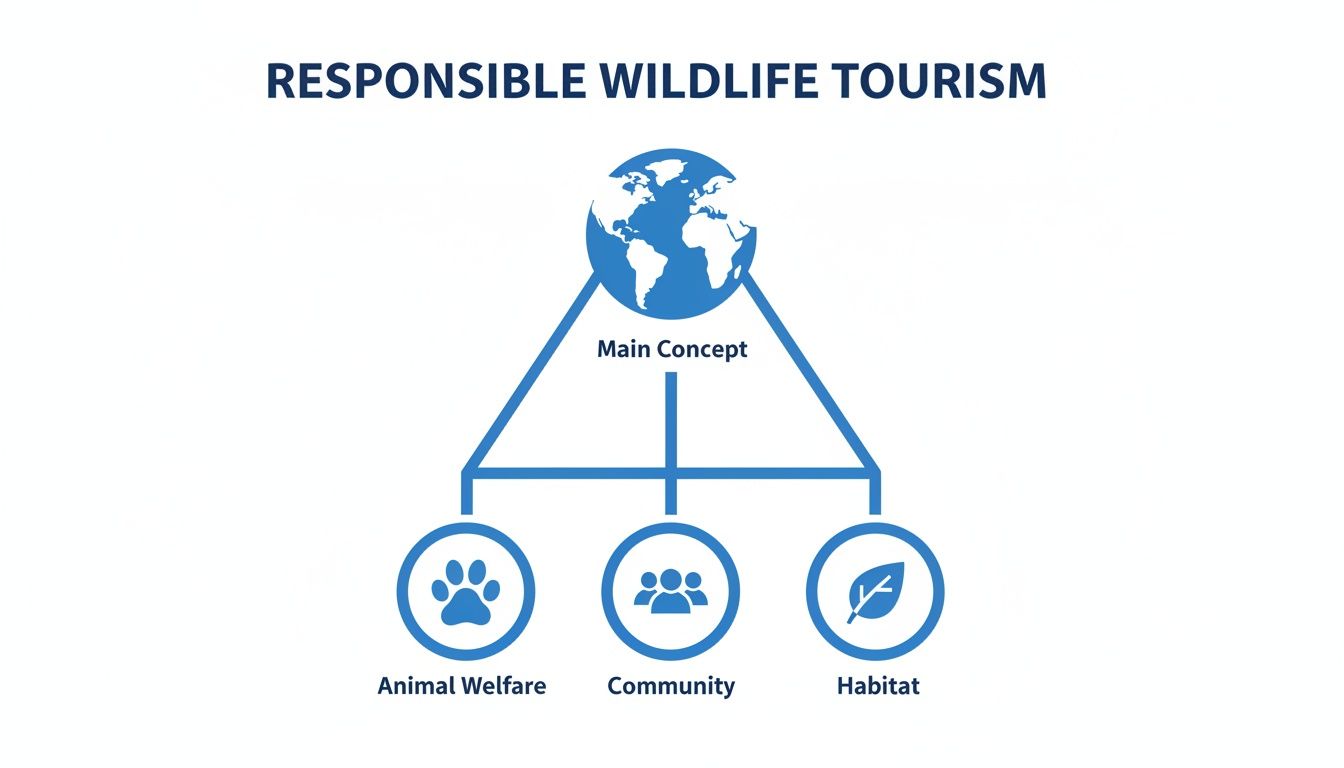
This diagram shows how these three pillars—animal welfare, community, and habitat—are the foundation of any responsible wildlife experience. It’s not just about the animals; it’s a balanced system where protecting nature and supporting local people go hand-in-hand.
Empowering Local Communities as Guardians
The final pillar is community empowerment. Ethical wildlife tourism gives local people a powerful reason to protect their natural heritage. When communities see real benefits from conservation—like fair-wage jobs as guides, lodge staff, or artisans—they become its most passionate defenders.
This creates a positive feedback loop. Your visit supports local families, who then become the frontline guardians of the ecosystem. It transforms wildlife from something to be potentially exploited into a sustainable asset worth protecting for generations. To see how this works in other travel contexts, check out our guide on the future of sustainable tourism.
“When local communities benefit from wildlife, they become its most passionate protectors. Their economic well-being becomes directly tied to the health of the ecosystem, creating the most effective conservation force there is.”
These three pillars are not separate goals; they reinforce each other. By keeping them in mind, you can be sure your journey is contributing to a future where both wildlife and the people who live alongside it can thrive. It makes the entire experience that much more meaningful.
How to Find Genuinely Ethical Tour Operators
Trying to find a truly ethical wildlife tour can feel like walking through a minefield of hollow claims. Too many operators splash words like “eco-friendly” and “green” across their websites with nothing to back them up—a classic case of greenwashing. To practice responsible wildlife tourism, you have to become a bit of a detective, able to see the difference between genuine conservation and clever marketing.
The good news is, travelers are getting much better at this. A recent global analysis showed that 61% of travelers now actively steer clear of attractions that keep wildlife in captivity. This is a huge shift, and it’s forcing the industry to adapt.
One industry snapshot revealed that in 2022, 68% of adventure tour operators were either certified or working on a sustainability certification. That’s a big jump from just 45% the year before. The momentum is real, and you can learn more about these trends over at Future Market Insights.
Your goal is to find the operators who are transparent, committed, and can actually prove their positive impact. This means digging deeper than their homepage and knowing the right questions to ask before you book.
Look for Reputable Certifications
Certifications are a solid starting point for vetting a tour company. No single label is a magic bullet, but they do show that an operator has gone through a rigorous third-party audit against a set of real sustainability criteria. It’s a strong signal of genuine commitment.
Some of the most respected global certifications include:
- Global Sustainable Tourism Council (GSTC): This is the gold standard. GSTC sets the global benchmarks for sustainable travel, so an accredited operator has met the highest social and environmental standards out there.
- Travelife for Tour Operators: This is a comprehensive, three-stage program that helps operators manage and improve their real-world social and environmental impacts.
- EarthCheck: Widely used across the tourism industry, EarthCheck uses scientific data for its benchmarking and certification, helping businesses make measurable improvements.
- B Corp Certification: While not specific to tourism, B Corp status is a big deal. It means a company meets incredibly high standards of social and environmental performance, accountability, and transparency.
These aren’t just badges for a website. They require operators to provide hard evidence of their practices, from waste management protocols to fair labor policies.
Master the Art of Asking Questions
Before you even think about booking, send an email or make a call. An ethical operator will welcome your questions and give you clear, specific answers. If they’re vague, evasive, or can’t provide any details, that’s a massive red flag.
Here’s a quick checklist of what to ask:
- What are your specific animal welfare policies? Get them to talk about viewing distances, group sizes, and how their guides are trained. Ask if they have a written policy they can share with you.
- How do you contribute to local conservation? Do they donate a percentage of profits? Do they fund a specific project or partner with a local conservation NGO? Ask for the name of the organization so you can look it up yourself.
- How do you support the local community? Dig into their hiring practices. Do they hire and train local guides? Where do they source their food and other supplies?
- What is your policy on wildlife interactions? The answer should be simple: there are none. Ethical operators never, ever allow touching, feeding, or baiting wild animals.
You’re looking for concrete examples here. An operator saying they “support conservation” is just noise. An operator who says they “donate 5% of every ticket to the Bornean Sun Bear Conservation Centre” is giving you something you can actually verify. For a deeper dive, check out our complete guide on how to choose eco-friendly tour operators.
Decode Online Reviews and Marketing Language
Look beyond the simple star ratings on review sites. You need to read the actual comments. Search for keywords like “distance,” “respect,” “local guide,” or “crowded.” Pay special attention to the negative reviews—they often reveal the exact problems an operator is trying to hide.
Also, be wary of marketing that’s all about guaranteed sightings or super close-up encounters. Wildlife is, by its nature, unpredictable. A responsible guide will never promise a specific outcome. Instead, they’ll focus the experience on the privilege of being in nature and the importance of respecting the animals’ space. True responsible wildlife tourism is built on patience and respect, not manufactured thrills.
Low-Impact Ways to Experience Wildlife
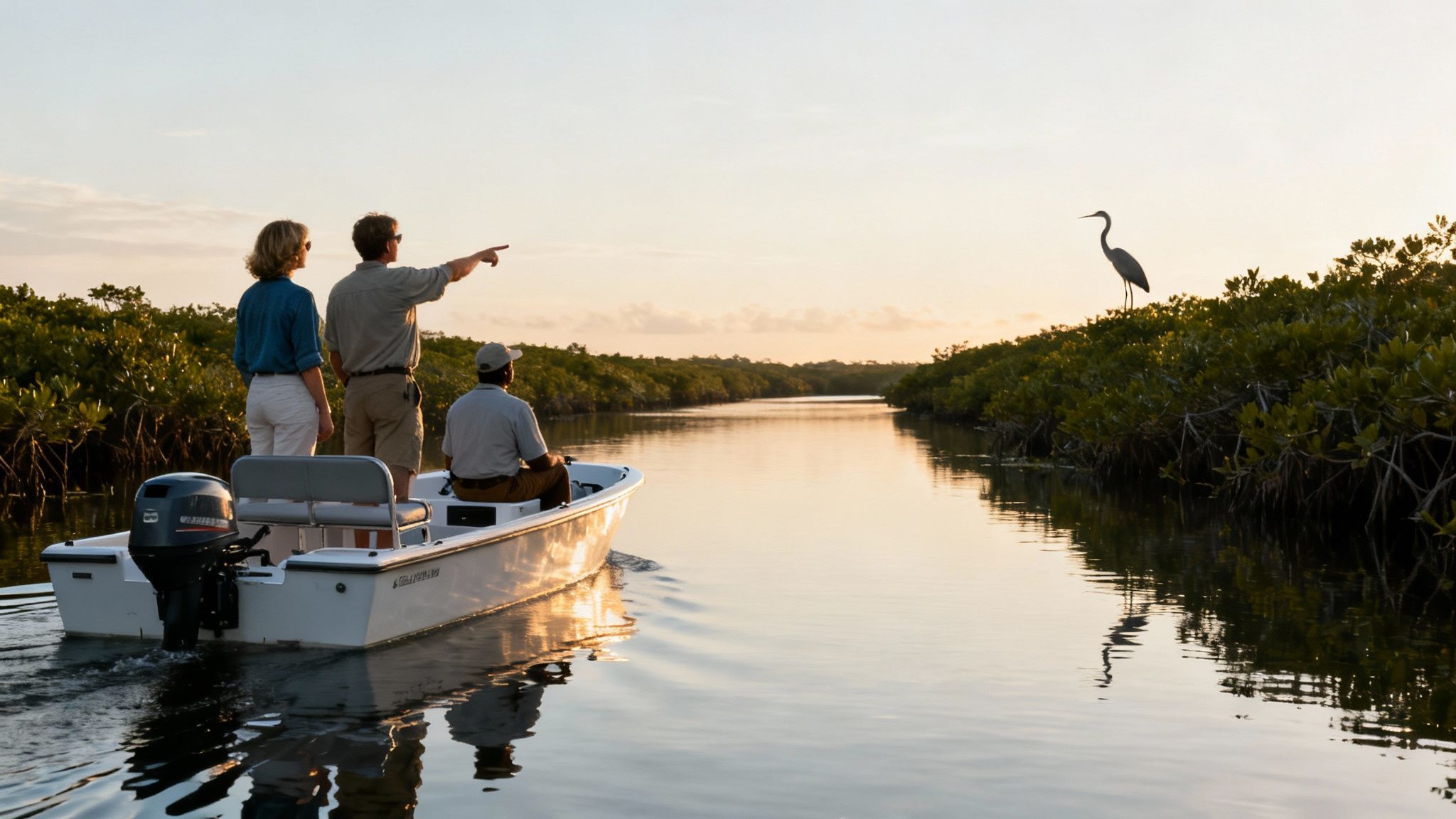
True responsible wildlife tourism often means looking past the classic jeep safari and finding slower, more intentional ways to connect with nature. These low-impact alternatives are all about minimizing our disturbance, letting us see animals behaving as they naturally would in their own homes. The whole mindset shifts from a high-speed chase to quiet, patient observation—which nearly always leads to a richer, more memorable encounter.
This is about quality over quantity. Instead of just ticking a species off a list, you’re becoming a temporary, respectful guest in a wild space.
This opens up a world of creative and meaningful experiences that mass tourism usually barrels right past. Not only are these alternatives better for the animals, but they also fit perfectly with a slow-travel philosophy, allowing for a much deeper connection to the places you visit.
Go Beyond Watching and Actively Contribute
One of the most powerful forms of low-impact tourism is getting involved in citizen science. These projects welcome travellers to contribute to real scientific research, whether it’s helping collect data on animal numbers, tracking migrations, or monitoring the health of a habitat.
Imagine spending your trip helping researchers protect sea turtle nests on a Costa Rican beach or recording bird sightings for a migratory study. Your presence isn’t just passive; you’re providing valuable data that conservationists need to protect vulnerable species. It gives your travels a unique sense of purpose—you leave knowing you made a tangible, positive difference.
Choose Stays That Restore and Regenerate
Where you sleep can be just as impactful as the tours you take. Keep an eye out for regenerative lodges and community-based ecotourism projects that go beyond just reducing their footprint. These forward-thinking places are actively involved in restoring the local ecosystem.
By choosing stays that actively reforest land, manage private nature reserves, or fund local conservation, your accommodation cost becomes a direct investment in the health of the habitat.
This model is a complete game-changer. For instance, some lodges use guest fees to fund massive reforestation projects, planting thousands of native trees. Others might manage their own wildlife corridors to ensure animals can move safely between larger protected areas. You can see brilliant examples of this in our guide to community ecotourism in Latin America, where local buy-in is the key to success.
Embrace Non-Invasive Observation Methods
Many low-impact activities are about using silence and human power to get closer to nature without causing stress. These methods make for intimate wildlife viewing while respecting the animal’s space and comfort.
Instead of a loud, crowded tour, consider these alternatives:
- Guided Nature Walks: A walking safari with a knowledgeable local guide lets you notice the small details of an ecosystem—the tracks, the sounds, the plant life—that you’d completely miss from a vehicle.
- Kayaking or Canoeing Tours: Paddling silently through mangroves or along a coastline is an incredible way to observe aquatic birds, manatees, or dolphins without the noise and pollution of a motorboat.
- Silent Electric Boat Trips: For larger bodies of water, electric boats offer a quiet, zero-emission alternative to traditional tours, minimizing disturbance to marine life.
- Visiting Accredited Rescue Centers: Support centers that are genuinely focused on rehabilitation and release. A legitimate sanctuary will never offer direct contact but will provide a powerful educational experience about its conservation work.
These experiences put the animal’s well-being first, making sure your presence doesn’t disrupt their natural feeding, resting, or breeding habits. It’s the ultimate sign of respect in the world of wildlife tourism.
Your On-the-Ground Code of Conduct
Okay, you’ve done the hard work of picking a genuinely ethical tour operator. Now the responsibility lands with you. How you act on the ground is just as important as the choice you made back home—this is the very heart of responsible wildlife tourism.
Think of it like this: you’re a guest in someone else’s home. Because that’s exactly what you are. Every decision, no matter how small, has a ripple effect on the ecosystem and the animals that live there.
This isn’t about a checklist of rigid rules. It’s about shifting your mindset to one of quiet respect and awareness. The whole point is to watch and appreciate wildlife without changing its natural behaviour. A single, seemingly harmless act can have unintended, damaging consequences for the very animals you traveled so far to see. Your presence should be a neutral, quiet one.
Maintain a Respectful Distance
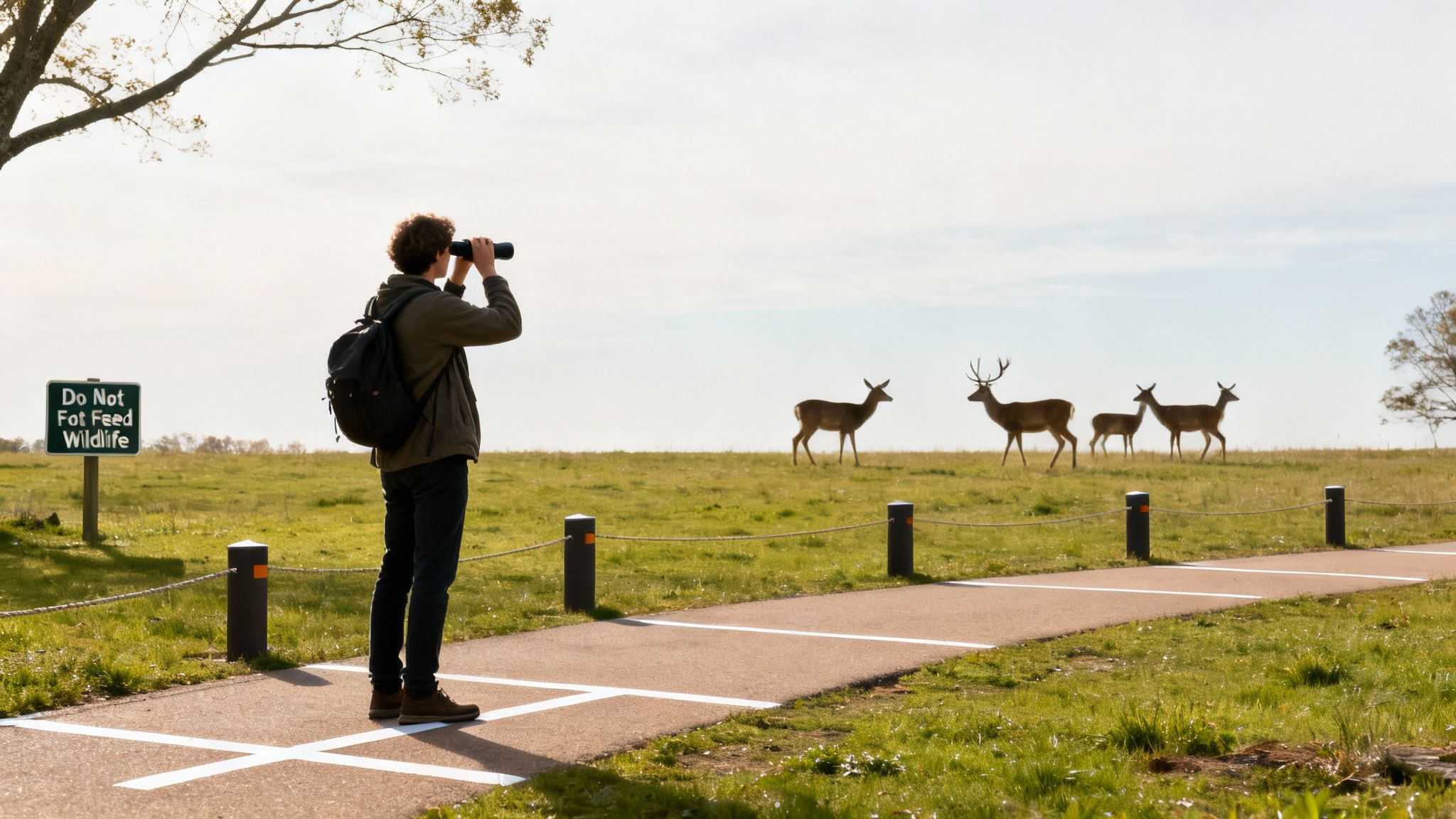
The golden rule of wildlife viewing is simple: keep your distance. Getting too close causes real stress, forcing an animal to flee, abandon its young, or stop vital activities like feeding. A good rule of thumb? If an animal changes its behavior because of you, you’re too close.
- Use Binoculars and Zoom Lenses: This is non-negotiable. Good optics let you get incredible, up-close views without ever encroaching on an animal’s space.
- Know the Local Guidelines: Parks and protected areas have specific viewing distances for a reason—they’re based on research. Follow them to the letter.
- Never Pursue Wildlife: If an animal moves away, let it go. Chasing it for a better photo is pure harassment and goes against every principle of ethical viewing.
Never Feed Wild Animals
It might feel like a kind thing to do, but feeding wildlife is one of the most dangerous and harmful acts you can commit. It teaches them to associate humans with food, a lesson that often leads to aggressive behaviour and conflict.
Human food is also junk food for wild animals, causing serious health issues and disrupting their natural ability to forage. It creates a dependency that can be a death sentence. The old saying is true: a fed bear is a dead bear. Once they lose their natural fear of humans, they become a threat and are often euthanized.
A wild animal’s survival depends on its ability to find its own food and remain wary of humans. Feeding them compromises both of these essential instincts, putting them in grave danger.
Follow the Principles of Leave No Trace
Your goal should be to leave the environment exactly as you found it. This means everything you bring in with you must come back out. And it goes beyond just obvious trash like plastic bottles.
- Pack It In, Pack It Out: This includes “biodegradable” stuff like fruit peels. In many environments, an orange peel can take years to decompose and can attract animals, altering their behaviour.
- Stay on Marked Trails: Sticking to the path prevents soil erosion, protects fragile plant life, and minimizes your disturbance to the habitats you’re there to appreciate.
- Keep Your Voice Down: Loud noises are jarring and unnatural in the wild. They can easily frighten animals, causing them to hide or flee. Speak in low tones and avoid sudden sounds.
By adopting this code of conduct, you shift from being just another tourist to an active guardian of the natural world. This is what puts the “eco” in ecotourism vs regular tourism and makes your experience truly meaningful.
Nikon Monarch M5 8×42 Binoculars: A quality pair of binoculars is the single most important tool for responsible wildlife watching. These strike a perfect balance between clear, bright optics and a wide field of view, so you can easily spot animals from a safe, respectful distance. They’re waterproof, fog-proof, and built for rugged travel without being too heavy (around 22.2 ounces / 630 grams). Good glass completely removes the temptation to get too close.
Your Pocket Guide to Ethical Wildlife Travel
Think of this as your final gut check before you head out. These are the simple, powerful actions that separate a truly respectful wildlife encounter from one that causes unintended harm. Run through this list before you book and while you’re on the ground.
Your choices matter more than you think. Every dollar you spend can either fuel genuine conservation and empower local guardians or, without meaning to, prop up practices that hurt the very animals you’ve traveled so far to see. Being a responsible wildlife tourist really just boils down to awareness and a deep-seated respect.
It’s about ditching the consumer mindset and stepping into the role of a temporary steward. This means doing your homework—vetting operators, understanding the local rules—and then acting with real intention once you’re there. By sticking to a few core principles, you ensure your presence is a positive one, leaving habitats and their inhabitants just as you found them: wild, undisturbed, and protected.
Your Questions Answered
Navigating the world of wildlife tourism can bring up some tricky questions. Here, we’ll tackle some of the most common ones to help you make clear, confident, and ethical choices on your next journey.
Are Wildlife Sanctuaries Always Ethical?
Unfortunately, no. The word “sanctuary” isn’t legally protected, so plenty of exploitative businesses use it as a friendly mask for what are really just roadside zoos or petting farms. A legitimate sanctuary is a world away from these tourist traps.
A real sanctuary’s mission is all about rescue, rehabilitation, and—whenever possible—release. They don’t breed animals in captivity, because that just adds to the problem of surplus animals with nowhere to go. Most importantly, they will never allow direct human contact like petting, holding, or taking selfies with the animals. These activities are incredibly stressful for wildlife and are a massive red flag.
To spot a genuine rescue center, look for:
- A strict no-contact policy: This is the clearest sign of an ethical operation.
- An educational focus: Their tours should be about the animals’ stories, conservation challenges, and natural behaviors, not just entertainment.
- Spacious, naturalistic enclosures: The habitats should prioritize the animals’ well-being, not the viewer’s convenience.
Does My Choice of Tour Operator Really Matter?
Yes, it matters profoundly. Every dollar you spend is a vote for the kind of world you want to see. When you choose a tour operator, your money follows a path with real-world consequences.
It can either flow to a responsible business that pays its local guides fair wages, invests in their training, and puts a portion of its profits directly into local conservation projects. This strengthens the entire conservation ecosystem, creating a positive loop where wildlife is more valuable alive than dead.
Or, that same money can fuel an unethical operator that underpays its staff, cuts corners on animal welfare, and contributes nothing to the long-term health of the habitat. Your choice directly determines which of these models thrives.
Can I Practice Responsible Wildlife Tourism on a Budget?
Absolutely. There’s a common myth that ethical travel has to be expensive, but that’s often not the case at all. In fact, some of the most authentic and low-impact experiences are also the most affordable.
Responsible wildlife tourism is about the how, not the price tag. Instead of a high-end, all-inclusive safari lodge, consider these budget-friendly alternatives:
- Staying in a community-owned guesthouse where your money directly supports local families.
- Hiring a local, independent guide for a walking tour in a national park.
- Opting for self-guided hikes on well-marked trails where it’s safe and appropriate.
- Visiting state or national parks with modest entrance fees that fund their own upkeep.
Often, the most ethical choice is the simplest one—the one that prioritizes local economies and minimizes infrastructure. Making a positive impact doesn’t require a five-star budget; it just requires a bit of conscious decision-making.
Key Takeaways
- Distance is Respect: Keep a safe distance. If an animal reacts to your presence, you’re too close. Use your zoom lens, not your feet.
- Never Feed Wildlife: Feeding animals messes with their diet and behaviour, leading to habituation and conflict. It does far more harm than good.
- Leave No Trace: Pack out everything you pack in—including organic waste. Stick to marked trails to protect fragile ecosystems.
- Listen to Your Guide: An ethical, trained guide knows best. Following their instructions is crucial for the safety of both you and the animals.
- Silence is Golden: Keep your voice low. You’ll minimize stress on the animals and have a much better chance of seeing their natural behaviour.
- No Selfies with Wildlife: Never try to take a selfie with a wild animal. It means getting dangerously close, putting both you and the animal at risk.
This article was fact-checked using sustainability data from the World Green Building Council, the Global Ecotourism Network, and peer-reviewed architecture studies. All partner links are vetted for compliance with sustainable business certifications.
Join the Sustainable Work Movement
Want more rail-first itineraries, low-impact packing systems, and walkable base-city ideas?
FAQ: Responsible Wildlife Tourism
These quick answers help you make ethical, low-impact choices before you book and while you’re in the field.
Booking & ethical operators
1What is responsible wildlife tourism?
Responsible wildlife tourism means observing animals in their natural habitat in ways that protect welfare, fund conservation, and benefit local communities—without changing animal behavior for entertainment.
2How do I spot greenwashing in wildlife tours?
Watch for vague claims (“eco-friendly,” “ethical”) with no proof, guaranteed sightings, or marketing focused on getting “close.” Ethical operators share written welfare rules, group-size limits, viewing distances, and specific conservation partners you can verify.
3Which certifications matter most for ethical wildlife travel?
Look for third-party, audited standards that address environment + labor + community impact (for example: GSTC-aligned programs, Travelife, EarthCheck, or B Corp for broader accountability). Treat certifications as a starting point—still read policies and reviews.
4What questions should I ask an operator before booking?
Ask about (1) written animal welfare policy (distance, no-contact, no-baiting), (2) guide training, (3) group size limits, (4) conservation contributions (exact % or partner org name), and (5) how they hire and pay local staff.
5Are wildlife sanctuaries always ethical?
No. A legitimate sanctuary prioritizes rescue, rehab, and (when possible) release. It avoids breeding, direct contact, and selfie sessions. The visitor experience should be educational and designed around the animal’s needs—not tourist access.
On-the-ground ethics
6How close is “too close” to wildlife?
If the animal changes behavior—stops feeding, turns toward you, moves away, vocalizes, or looks alert—you’re too close. Follow park rules, use binoculars/zoom lenses, and let wildlife control the distance.
7Why is feeding wildlife harmful even if it seems “nice”?
Feeding teaches animals to associate humans with food, which increases conflict and risk of injury or euthanasia. Human food also harms digestion and disrupts natural foraging, weakening survival skills.
8What’s the ethical approach to wildlife photography?
Use zoom instead of approaching, avoid flash (especially at night), don’t block movement paths, and never bait animals with food or sounds. The best wildlife photo is the one taken without altering behavior.
9Are boat-based wildlife tours ethical?
They can be—if the operator follows distance and speed rules, avoids chasing or crowding, limits engine noise (electric is best), and prioritizes animal well-being over “close encounters.” If multiple boats surround wildlife, it’s a warning sign.
Budget, impact, and planning
10Can I practice responsible wildlife tourism on a budget?
Yes. Focus on national parks, community-led guides, walking safaris where appropriate, self-guided trails with clear rules, and locally owned stays. Ethical choices are often simpler—not necessarily pricier.
11How does my tour fee actually support conservation?
In strong models, park fees fund rangers and habitat work, and ethical operators contribute a transparent share to conservation partners. Look for receipts: named programs, published impact reports, or verifiable local partnerships.
12What are low-impact alternatives to traditional jeep safaris?
Guided nature walks, kayaking/canoeing in mangroves, quiet electric boats, birding with local experts, and citizen-science trips. These often reduce disturbance and lead to more natural wildlife behavior.
13What’s one piece of gear that improves ethical wildlife viewing?
Quality binoculars. They remove the temptation to get closer and help you enjoy details from a safe distance. Pair them with patience and quiet observation for the best encounters.
14How can I make sure my trip benefits local communities?
Choose locally owned lodges, hire local guides, buy from local artisans, and prioritize operators that publish fair wage policies and local sourcing. The goal is for tourism income to stay in the community.
15What should I avoid no matter what?
Avoid any experience that relies on captivity for entertainment, direct contact (petting/holding), riding animals, drugging/declawing/training for shows, baiting for photos, or chasing wildlife for “guaranteed” sightings.
Quick gut-check
16If an operator says “no rules, we’re flexible,” is that good?
No. Ethical wildlife experiences are guided by clear rules to reduce stress and risk. “Flexible” often means cutting corners on distance, group size, or harassment guidelines.
17What’s the best way to handle a group member who breaks the rules?
Signal the guide privately and let them intervene. Don’t escalate in front of wildlife. Ethical guides are trained to enforce boundaries calmly and reset the group’s behavior.
18How do I know if wildlife is stressed?
Common signs include sudden stillness, alarm calls, repeated head turns, tail flicking, moving away, abandoning feeding/resting, or defensive postures. If you see these, increase distance immediately.
19Is it ethical to visit captive animals if the facility claims it’s “rescue”?
Only if the facility is transparent about rescue cases, has a no-contact policy, prioritizes rehabilitation over breeding, and has independent oversight. If selfies or feeding are offered, skip it.
20What’s the simplest definition of responsible wildlife tourism I can remember?
Responsible wildlife tourism is quiet observation, safe distance, no interference, and spending that supports conservation and local guardians.
Explore Eco Nomad Travel
📚 Core Guides
🧭 Planning & Logistics
🗺️ Destinations & Seasons
Jeremy Jarvis — founder of Eco Nomad Travel, sustainable travel writer, and advocate for regenerative tourism. His work focuses on low-impact mobility, eco-friendly digital nomad life, and climate-positive travel.
Legal
Affiliate DisclaimerPrivacy Policy
Terms of Service
Image & Media Notice
Cookie Policy
Contact
Affiliate Disclosure: Some links on Eco Nomad Travel are affiliate links, meaning we may earn a small commission at no extra cost to you. This supports our mission to inspire responsible and low-impact travel worldwide.
Connect
✅ Trusted Official Sources
Plan smarter eco trips
Try our free Sustainable Travel Tools for Digital Nomads – carbon calculator, train vs plane comparator, and more.
Open Tools Hub