

It might sound like a paradox, but sailing against the wind is the core skill that unlocks true freedom on the water. The secret isn’t about fighting the wind, but tricking it into pulling your boat forward—a beautiful bit of physics that lets you travel almost anywhere, no matter which way the breeze is blowing. Once you get the hang of this, you’re on your way to planning truly sustainable, low-carbon journeys.
How Sailing Against the Wind Actually Works
To picture how a sailboat can move into the breeze, think about squeezing a wet watermelon seed between your fingers. The pressure from both sides forces it to shoot forward. A sailboat does something similar.
The curved sail isn’t just a big sheet for the wind to push. It’s shaped more like an airplane wing, creating a low-pressure zone on one side and a high-pressure zone on the other. This difference generates a force called “lift,” which pulls the boat forward and sideways.
Then, the boat’s keel—a large fin under the hull—steps in to resist that sideways push. This is the crucial part. By stopping the boat from slipping sideways, the keel converts that energy into forward motion. This whole process of zig-zagging your way upwind is called ‘beating to windward,’ and each turn in that zig-zag is a simple maneuver called ‘tacking.’
Sailing Against the Wind in the Age of Sail: How 45° Limits Shaped Trade Routes and Exploration
Historically, this skill was a grueling test of endurance that shaped global trade. In the Age of Sail, square-rigged ships struggled to sail much closer than 45 degrees to the wind, forcing them onto long, inefficient routes that added weeks to their journeys. This simple limitation had a huge impact on exploration and trade, with a westward trip from Europe sometimes meaning you had to sail double the actual distance.
Understanding these dynamics is the first step toward planning smart, eco-friendly voyages. Once you grasp how to harness the wind’s power instead of just being pushed by it, you can design routes that rely almost entirely on nature’s energy. It’s a fundamental principle for anyone drawn to slow, sustainable travel by sea.
This synergy between sail and keel is the beautiful physics that makes upwind progress possible. It’s a skill that transforms your vessel from a passive object at the mercy of the wind into an active tool that can navigate with precision and grace. You can learn more about the intricate relationship between sailing and wind in our detailed guide.
Understanding the Points of Sail When Sailing Against the Wind
To really get the hang of sailing against the wind, you need a mental map of how your boat relates to it. The easiest way is to picture a clock face where the wind is always blowing from 12 o’clock. Your boat’s angle to that wind changes everything, and these different angles are what we call the Points of Sail.
Before we get into the angles, it’s worth remembering how this all works. Sailing isn’t just about the wind pushing you from behind. It’s a clever process where the sails act like an airplane wing, creating aerodynamic lift that pulls the boat forward.
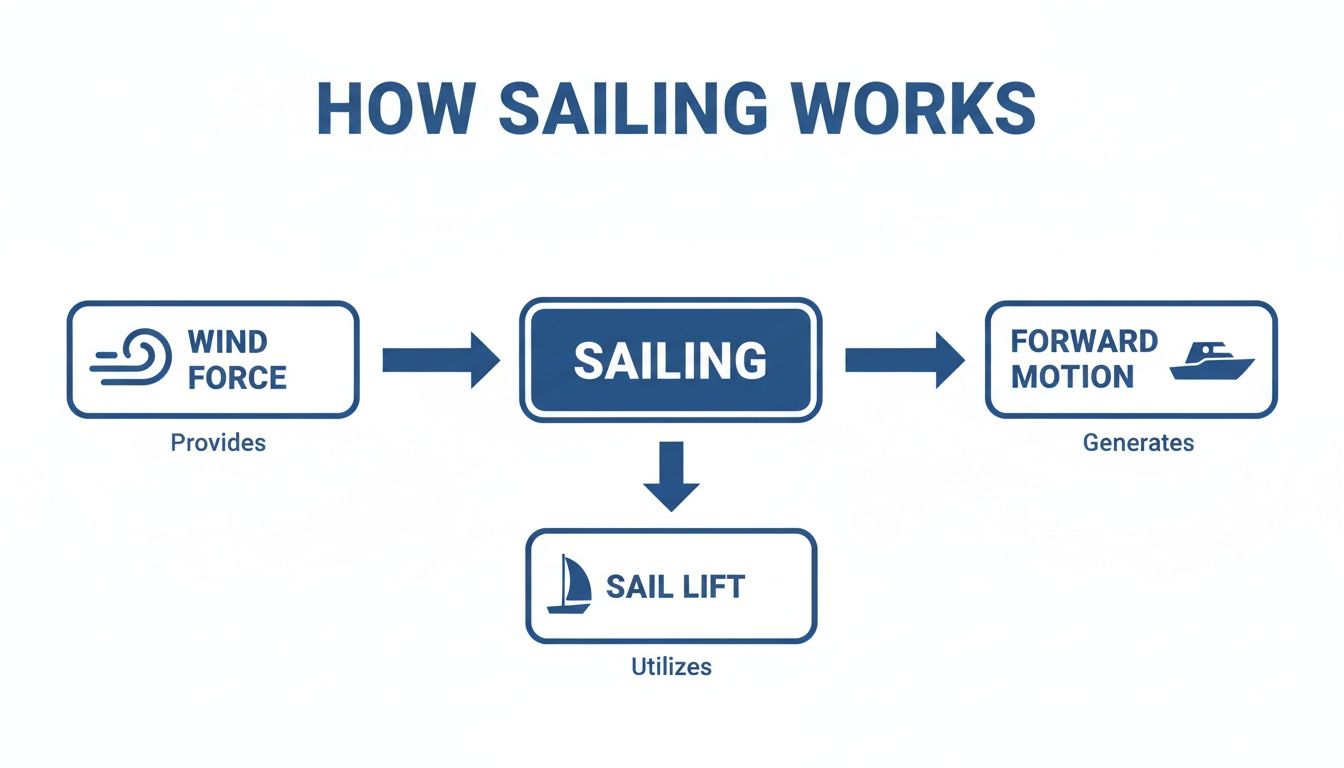
This idea—that you’re generating lift, not just being pushed—is the key to making progress upwind.
The No-Sail Zone
Straight ahead, from roughly 10 o’clock to 2 o’clock on our imaginary clock face, is the “No-Sail Zone.” If you point your boat’s bow directly into this area, the sails will just flap around uselessly, and you’ll stop dead in the water. This is the dead zone, where you can’t generate any lift.
So, instead of fighting it, you sail along its edges. This is called sailing “close-hauled,” and it’s the closest you can get to the wind while still moving forward. Every single tack you make is just the act of steering the boat’s nose through this No-Sail Zone to get onto the opposite upwind course.
Knowing when this is even possible has always been crucial. The Beaufort Scale, developed way back in 1805, was a huge leap forward in helping sailors quantify wind conditions. A Force 4 wind (11-16 knots or 13-18 mph) is generally where tacking becomes truly effective, letting a sailboat make about 6-7 knots at a 45-degree angle in waves of 3.3-5.5 feet (1-1.7 meters). Logs from the nineteenth century show that about 40% of North Sea crossings faced headwinds strong enough to slow schooners to a crawl, making just 3-5 knots of progress upwind. It’s a great reminder of how much performance depends on the wind. You can learn more about the history of the Beaufort Scale on sailing.
Charting Your Course
Getting familiar with each point of sail helps you trim your sails just right and know what to expect from your boat. For anyone planning long-distance, low-impact travel, understanding these angles is as vital as having a good chart and a fully charged portable power bank for your navigation gear.
The table below is a quick cheat sheet to all the main points of sail.
Points of Sail Explained
Point of Sail | Angle to Wind (Approx.) | Typical Use | Sail Trim Notes |
|---|---|---|---|
| In Irons / No-Sail Zone | 0-40° | Stalled / To be avoided | Sails will flap (luff); no forward power. |
| Close-Hauled | 45° | Sailing as close to the wind as possible. | Sails pulled in tight and flat. |
| Close Reach | 60° | Fast and efficient sailing. | Sails eased out slightly from close-hauled. |
| Beam Reach | 90° | Often the fastest and most comfortable point of sail. | Sails let out about halfway. |
| Broad Reach | 135° | Fast and stable downwind sailing. | Sails let out significantly. |
| Running | 180° | Sailing directly downwind. | Sails let all the way out; risk of accidental gybe. |
Think of this table as your guide. Whether you’re trying to make headway against a stiff breeze or enjoying a comfortable downwind run, knowing where you are on this spectrum is the foundation of good seamanship.
Mastering the Art of Tacking a Sailboat
If you want to sail against the wind, you need to tack. It’s the elegant zigzag that lets you work your way upwind, turning the boat’s nose through that tricky No-Sail Zone to switch from one angle to the other. Think of it less as a mechanical turn and more as a dance with the wind.
This section breaks down how to execute this core technique with confidence. A smooth tack doesn’t just save time and energy; it makes for a much more comfortable and efficient journey—a key part of a sustainable travel mindset. Whether you’re exploring the coastlines of sailing in Croatia or just navigating your local bay, a well-executed tack is a beautiful thing.

Step 1: Prepare Your Crew and Gear
Before you even think about turning the wheel, it’s all about communication. The skipper or helmsperson needs to make sure everyone on board knows a tack is coming and what their specific job is. This is also the moment to clear the cockpit of loose items—a reusable water bottle, books, anything that can slide—and check that your navigation gear is secure.
The classic call is direct and simple:
“Ready about?”
This is the heads-up for the crew to get ready. Once they have their lines in hand and are braced for the maneuver, they should respond with a clear “Ready!”
Step 2: Helm and Sail Coordination
Once everyone is set, the helmsperson announces, “Helms a-lee!” This signals the turn is officially starting. They will then turn the wheel or push the tiller smoothly and deliberately, guiding the boat’s bow up and through the wind.
As the boat turns, the headsail (your jib or genoa) will start to luff and flap. That’s the cue for the crew to release the sheet on the “old” side and start pulling in the sheet on the “new” side. The whole goal is to have the sail filled with wind on the new tack just as the boat settles onto its new close-hauled course.
Step 3: Avoid Getting Stuck “In Irons”
One of the most common hiccups for new sailors is turning too slowly. If you don’t carry enough momentum into the tack, the boat can stall with its nose pointing directly into the wind, stuck in the No-Sail Zone. This frustrating state is known as being “in irons.”
The fix is simple: make sure you have good boat speed before you start the tack. A confident, steady turn is far more effective than a slow, hesitant one. If you do get stuck, you might need to push the boom of the mainsail out by hand to “back” the sail, which uses the wind to help push the bow off onto your new course. Mastering this rhythm is what turns upwind sailing from a chore into an art.
Optimizing Sail Trim for Upwind Speed
Getting the most out of your boat when sailing against the wind is all about the little tweaks. You have to start thinking of your sails less like big sheets catching the breeze and more like powerful, efficient airfoils—just like an airplane’s wing. The art of proper sail trim is shaping them to generate maximum lift with the least amount of drag.
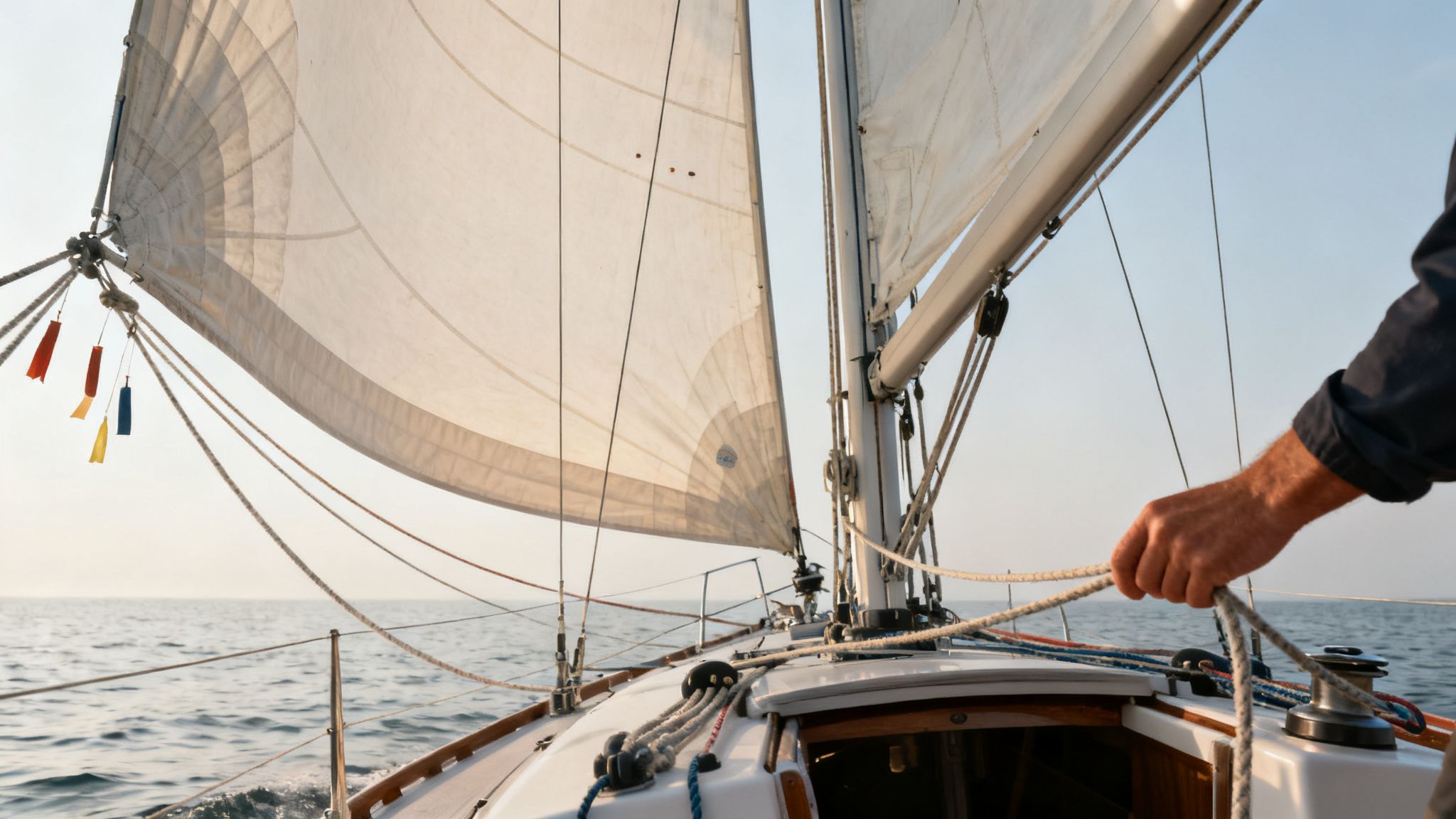
The secret is learning to read the airflow over their surface. This is where “telltales”—those little ribbons of yarn or cloth you see stuck to the sail—become your best friends. They are your visual guide to what the wind is doing, making an invisible force suddenly visible.
By keeping an eye on them, you can instantly see what’s wrong with your trim and fix it to get that perfect airfoil shape.
Using Telltales for Perfect Trim
When you’re sailing close-hauled (as close to the wind as you can), the goal is simple: get the telltales on both sides of the jib streaming straight back, horizontal and smooth. This is the sign that air is flowing cleanly over both surfaces of the sail, giving you optimal lift.
It’s a constant feedback loop.
- Windward (inside) telltale fluttering? You’re pointing too high into the wind, a state sailors call “pinching.” Steer the boat away from the wind just a little until it streams back smoothly.
- Leeward (outside) telltale fluttering? Your sail is too loose, and the wind isn’t attaching properly. You need to trim the jib sheet in tighter until it flies straight.
Adjusting Your Sails and Balancing the Boat
Beyond the jib, a few other controls let you power up or depower the sails depending on the wind. The mainsheet controls the angle of your boom, while the traveler moves the whole boom from side to side, which changes the sail’s twist. Tweaking these helps you manage power and heel—how much the boat is leaning over.
A little bit of heel is good; it actually helps the boat track straight through the water. But too much heel creates a ton of drag and something called “weather helm,” which makes the boat want to turn into the wind and becomes hard to steer. Managing that balance is absolutely crucial for both speed and comfort.
Even simple things, like keeping your gear tidy below deck with compression packing cubes, help manage the boat’s weight and balance. It all adds up.
Ultimately, this focus on efficiency is at the heart of a sustainable mindset. A well-trimmed boat slips through the water with less resistance, making the journey faster, more enjoyable, and lower-impact. It’s this constant dance with efficiency that makes wind-powered travel so deeply rewarding.
Planning Voyages With Wind Patterns in Mind
There’s an old saying among sailors: you don’t fight the weather, you work with it. Knowing the techniques for sailing against the wind is only half the battle. The other half is strategic planning that minimizes the time you spend doing it.
This is where the real art of passage-making comes in, blending historical wind data with modern forecasting to chart a smarter, lower-impact course.
Think of it like choosing a train over a plane for sustainable travel. On the water, smart routing means using weather models to pick a route—and a season—that gives you a tailwind. A classic example is the transatlantic crossing from Europe to the Caribbean. Sailors plan this for late autumn specifically to catch the powerful, consistent easterly trade winds, turning a potentially rough journey into a long, comfortable downwind slide. You can look for flight deals on sites like Aviasales to position yourself for such a journey.
Try to make that same passage in the opposite direction in the spring, and you’re looking at a completely different route, usually pushing much farther north to find the prevailing westerlies.
Choosing the right path isn’t just about comfort; it dramatically cuts down on passage time and fuel use if you have an engine. More importantly, it reduces the physical strain on both the crew and the boat itself. This strategic approach is what makes long-term, sail-based travel truly viable, especially if you’re a digital nomad.
A well-planned passage with favorable winds means more stability and less chaos on board. That creates productive downtime where you can actually open a laptop and work. This is when having a reliable USB C charger and a good power source becomes non-negotiable for keeping your gear charged, miles from the nearest shore power.
Minimizing the Beat
Ultimately, the goal is to let the wind do the heavy lifting for you. By studying historical wind charts (known as pilot charts) and using modern weather routing software, sailors can spot the ideal “weather windows” that make a passage smoother and faster.
This data-driven approach allows you to anticipate conditions days or even weeks in advance, transforming what could be a multi-day slog beating into rough seas into a far more pleasant and efficient journey. Consider grabbing a SIM card from Airalo to ensure you can download weather updates on the go.
This focus on working with nature is the very essence of what makes sailing a uniquely sustainable way to see the world. As you get more into passage planning, you’ll find that understanding large-scale wind sailing patterns is just as crucial as knowing how to trim your sails for a quick afternoon trip. It’s the key to unlocking smarter, slower, and far more rewarding journeys.
Editor’s Pick for Route Planning: PredictWind
For serious passage planning, PredictWind offers an excellent blend of weather routing, departure planning, and access to multiple forecast models. Its ability to compare routes based on historical wind data helps minimize time spent sailing against the wind, making it a valuable tool for planning efficient, low-impact voyages. It aligns perfectly with a data-driven approach to sustainable travel.
Key Takeaways
- Lift, Not Push: Sailing upwind relies on aerodynamic lift created by the sail’s airfoil shape, not the wind pushing from behind.
- Tacking is Essential: You cannot sail directly into the wind (the “No-Sail Zone”), so you must use a zigzag maneuver called tacking to make progress.
- Sail Trim is Critical: Use telltales to ensure smooth airflow over your sails. This allows you to point higher into the wind and maintain speed.
- Balance the Boat: Avoid excessive heeling (tilting), as it creates drag and makes steering difficult. A balanced boat is faster and more comfortable.
- Plan Your Route: Use weather forecasts and historical wind data to plan passages that minimize time spent beating into the wind.
- Mastery Unlocks Freedom: Proficiency in sailing against the wind is the fundamental skill for sustainable, wind-powered travel, opening up countless destinations.
Low-Impact Travel Tools (Worth It)
Also, if you’re planning a trip and want to keep things simple, these tools help you travel smoother while staying mindful about impact.
Get an eSIM for reliable data → Disclosure: Partner link. No extra cost to you.
Pre-book a transfer for easy arrivals → Disclosure: Partner link. No extra cost to you.
Frequently Asked Questions About Sailing Against the Wind
Getting your head around sailing upwind brings up a lot of questions. Here are some clear, straightforward answers to the things sailors ask most, designed to give you a better feel for what’s happening on the water.
How fast can you actually sail against the wind?
When you’re sailing against the wind—a point of sail we call “close-hauled”—you’re almost always moving slower than you would on other angles. A typical cruising sailboat might make 5-7 knots (that’s about 6-8 miles per hour) when pointed about 45 degrees away from where the wind is coming from. However, your real progress toward your destination, what sailors call Velocity Made Good (VMG), is even slower because you must sail a zigzag course. Your actual speed depends on everything from your boat’s design to the sea state and your sail trim skill.
Is it dangerous to sail directly into the wind?
Sailing directly into the wind isn’t dangerous, but it is impossible. If you point the bow of your boat into the “no-sail zone,” your sails will immediately start flapping uselessly (luffing). You’ll lose all forward motion, and the boat will get pushed backward by wind and waves. This is known as being “in irons.” While not a major issue in open water, it can become risky in a crowded channel or near hazards. The real challenge comes from the conditions, as beating into strong winds and big waves creates a bumpy, wet ride.
What is the difference between tacking and gybing?
Tacking and gybing are the two ways a sailboat changes direction, but they are polar opposites.
- Tacking is for turning when you’re sailing against the wind. You steer the bow (front) of the boat through the eye of the wind.
- Gybing (or jibing) is for turning when you’re sailing with the wind. You steer the stern (back) of the boat through the wind.
Tacking is generally a smooth, controlled maneuver. An unplanned gybe in strong winds can be violent, as the boom can slam across the boat with incredible force, posing a serious safety hazard. I always check that my critical gear is secure in my anti theft backpack before attempting either one.
Can all types of sailboats sail upwind?
Most modern sailboats with triangular, fore-and-aft sails are designed to sail upwind quite well, but performance varies. Boats with deep keels and efficient sails will point higher into the wind than older or heavier designs. Historically, square-rigged tall ships were notoriously bad at sailing against the wind. Even today, some boats like catamarans or those with shallow keels might not point as high as a deep-keel monohull, but they often compensate with greater speed on other points of sail.
What is the No-Sail Zone?
The “no-sail zone” is an area directly upwind, about 40-50 degrees on either side of the true wind direction. If you try to sail into this zone, you cannot generate lift. Your sails will just flap like flags, and the boat will stall. The entire strategy of sailing against the wind is built around avoiding this zone by tacking back and forth along its edges.
How do I know if my sails are trimmed correctly?
The easiest way is to watch the “telltales”—small ribbons attached to both sides of your headsail (jib). When sailing close-hauled, you want the telltales on both the inside (windward) and outside (leeward) to stream straight back smoothly.
- If the inside telltale flutters, you’re pointing too high into the wind (pinching).
- If the outside telltale flutters, your sail is too loose and needs to be pulled in.
It’s a constant dance of steering and trimming. Keeping supplies in a cable organizer travel case is a small trick that keeps things tidy onboard.
Does sailing upwind feel different?
Absolutely. It’s a completely different sensation. Sailing upwind is an active, energetic experience where you feel the full power of the wind and water. The boat heels over (tilts) and you feel it pounding as it punches through the waves head-on. Sailing downwind, by contrast, is usually much more relaxed. The boat is often upright with a gentle rolling motion as the waves push you along from behind.
How can I practice tacking safely?
The best place to learn is in an open area with light winds (4-16 knots or 5-18 mph) and calm water, far from other boats or hazards. Start with a small crew and communicate each step clearly. Walk through the motions slowly before you begin. As your confidence grows, you can gradually try it in stronger winds to feel how the boat responds with more power in the sails. The safest way to build these skills is by taking a certified sailing course.
Join the Sustainable Work Movement
Want more rail-first itineraries, low-impact packing systems, and walkable base-city ideas?
This article was fact-checked using sustainability data from the World Green Building Council, the Global Ecotourism Network, and peer-reviewed architecture studies. All partner links are vetted for compliance with sustainable business certifications.
