

Figuring out your Scotland trip cost is the first real step in planning. This guide helps you understand the expenses. You could scrape by on as little as $70 USD a day, or live it up for over $300 USD per person, per day. That’s before you even factor in flights.
For a week-long trip, a budget traveler might pull it off for around $500 USD. Meanwhile, someone looking for more comfort should probably set aside closer to $1,500 USD. Your travel style makes all the difference.
This article breaks down the expenses for different travel styles. We’ll cover everything from accommodation to activities. This will help you plan a trip that fits your budget perfectly. The real cost of a trip to Scotland depends on your choices.
A Realistic Scotland Trip Cost Breakdown
So, what will a trip to Scotland actually cost? It’s the big question, and the answer depends entirely on you. Your travel style, the time of year you go, and how you choose to get around will all shape your final budget.
This guide is here to break down the real-world costs for three different kinds of travelers: the savvy backpacker on a shoestring, the mid-range explorer who values comfort, and the eco-conscious nomad focused on low-impact choices.
By looking at daily estimates for a place to sleep, food, and activities, you can start to see where your money will go. You can also see how to tailor the trip to your own budget.
Average Daily Scotland Trip Cost Per Person (Excluding Flights)
To give you a clearer picture, this table breaks down the typical daily spend for each travel style. As you can see, your choice of accommodation makes the biggest dent in your wallet.
| Expense Category | Budget Traveler | Mid-Range Traveler | Eco-Conscious Traveler |
|---|---|---|---|
| Accommodation | $30 – $60 USD (Hostels, budget guesthouses) | $100 – $200 USD (B&Bs, 3-star hotels) | $70 – $150 USD (Eco-lodges, farm stays, campsites) |
| Food | $25 – $40 USD (Groceries, pub meals, takeaway) | $60 – $100 USD (Restaurants, cafes) | $40 – $70 USD (Local markets, farm-to-table cafes) |
| Transport | $15 – $30 USD (CityLink/MegaBus, local transit) | $50 – $80 USD (ScotRail, occasional taxi/Uber) | $30 – $50 USD (ScotRail passes, bike hire) |
| Activities | $10 – $25 USD (Free museums, hiking, walking tours) | $40 – $70 USD (Castle entries, guided tours, boat trips) | $25 – $50 USD (National Park entries, community tours) |
| Total Daily Estimate | ~$70 – $155 USD | ~$250 – $450 USD | ~$165 – $320 USD |
Ultimately, how much you spend is in your hands. A few smart choices—like booking train tickets in advance or focusing on free natural wonders—can make a huge difference.
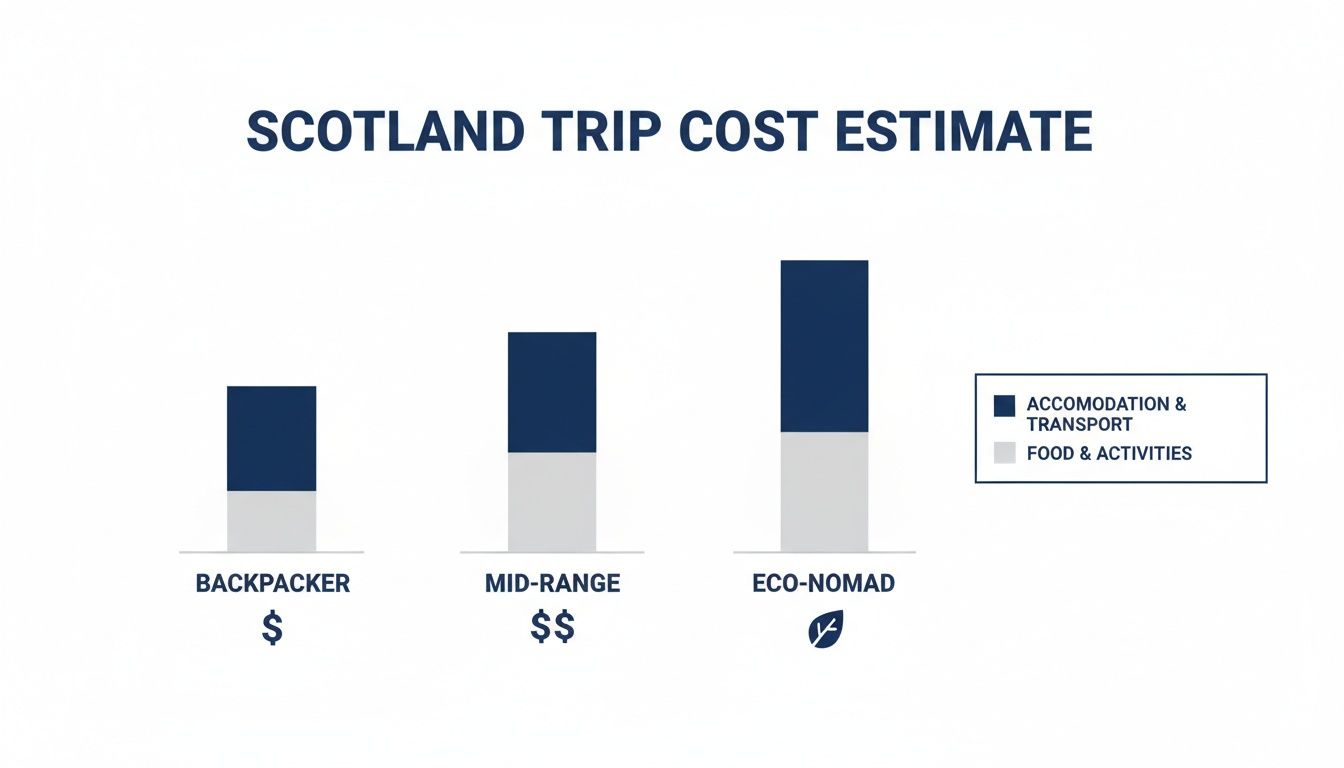
As the chart shows, accommodation is the biggest variable. Opting for hostels, preparing a few of your own meals, and prioritizing free attractions like hiking in the Highlands will keep your budget firmly in check. On the flip side, splurging on castle stays and fine dining will naturally push your costs up.
And if you’re wondering how these costs stack up against its Celtic neighbor, have a look at our guide on the cost of a trip to Ireland.
Budgeting for Accommodation From Hostels to Eco-Lodges
After your flights, where you choose to rest your head will be the single biggest factor in your final Scotland trip cost. The country offers a wonderful range of places to stay. These range from buzzing city-center hostels in Glasgow to charming, family-run B&Bs in the quiet Highlands. This diversity means there’s a good fit for nearly every budget and travel style.
Understanding the price differences is key to smart planning. A dorm bed in a well-regarded hostel might cost you between $35 to $60 USD (£28 to £48 GBP) per night. This is an excellent choice for solo travelers or anyone looking to connect with others. Mid-range travelers will find cozy guesthouses and 3-star hotels ranging from $120 to $250 USD (£95 to £200 GBP), offering more privacy and comfort.
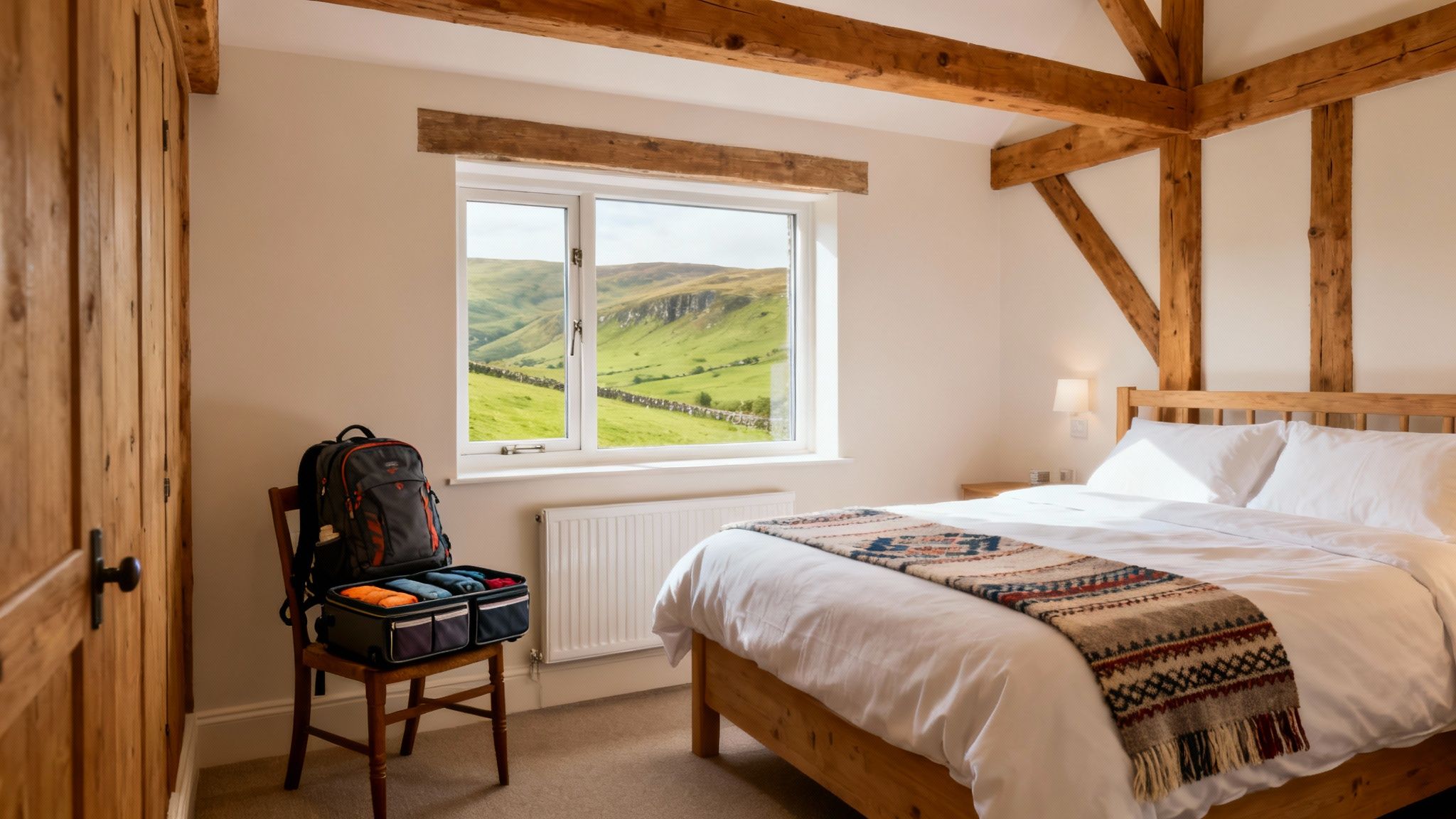
For those focused on sustainable travel, Scotland is home to many innovative eco-lodges and farm stays. These often cost between $90 and $180 USD (£70 to £145 GBP) per night. They provide a unique opportunity to connect with the landscape while supporting local, green-certified businesses. We have a detailed guide that can help you find amazing environmentally friendly accommodation options.
Seasonal and Regional Price Shifts
Timing your visit can lead to significant savings. Accommodation prices soar during the peak summer months of July and August. This is especially true in popular hubs like Edinburgh and the Isle of Skye. By traveling in the shoulder seasons—spring (April-May) and autumn (September-October)—you could see prices drop by a solid 20-40%.
Location plays a huge role, too. A hotel in central Edinburgh will naturally cost more than a comparable B&B in a smaller city like Dundee or a town in the Borders. Exploring less-trafficked regions not only lowers your expenses but also helps distribute tourism income more evenly across the country. This is a big win for responsible travel.
The Value of Slow Travel and Self-Catering
If your schedule allows, think about a longer stay in one location. Renting a self-catering apartment for a week or more can drastically reduce your per-night cost. It also lets you save a bundle on food by preparing some of your own meals—a perfect excuse to visit a local farmers’ market.
Staying in a locally-owned guesthouse or a certified eco-lodge doesn’t just offer an authentic experience; it ensures your tourism dollars directly support the community and sustainable practices. It’s a small choice that makes a big impact.
Whether you’re packing light with just a carry on backpack or need more space, choosing your lodging wisely is the best way to manage your budget. It frees up more of your funds for the experiences that make a trip to Scotland truly unforgettable. Just be sure to bring a good universal travel adapter to keep all your devices charged, no matter where you end up staying.
Getting Around Scotland: An Affordable and Sustainable Transport Cost Guide
How you choose to move between ancient cities and sweeping glens will be one of the biggest factors in your final Scotland trip cost—and your trip’s carbon footprint. For many, this is where the real adventure begins. Thankfully, Scotland’s excellent train network offers the perfect foundation for a low-impact, scenic, and surprisingly affordable itinerary.
Opting for rail travel over renting a car isn’t just a more sustainable choice; it’s often a much smarter financial one, too. With a carrier like ScotRail, booking tickets just a few weeks in advance can slash your fares dramatically compared to buying them on the day. This simple trick lets you experience iconic journeys, like the breathtaking West Highland Line, without the stress of navigating winding single-track roads or paying for expensive fuel in remote areas.
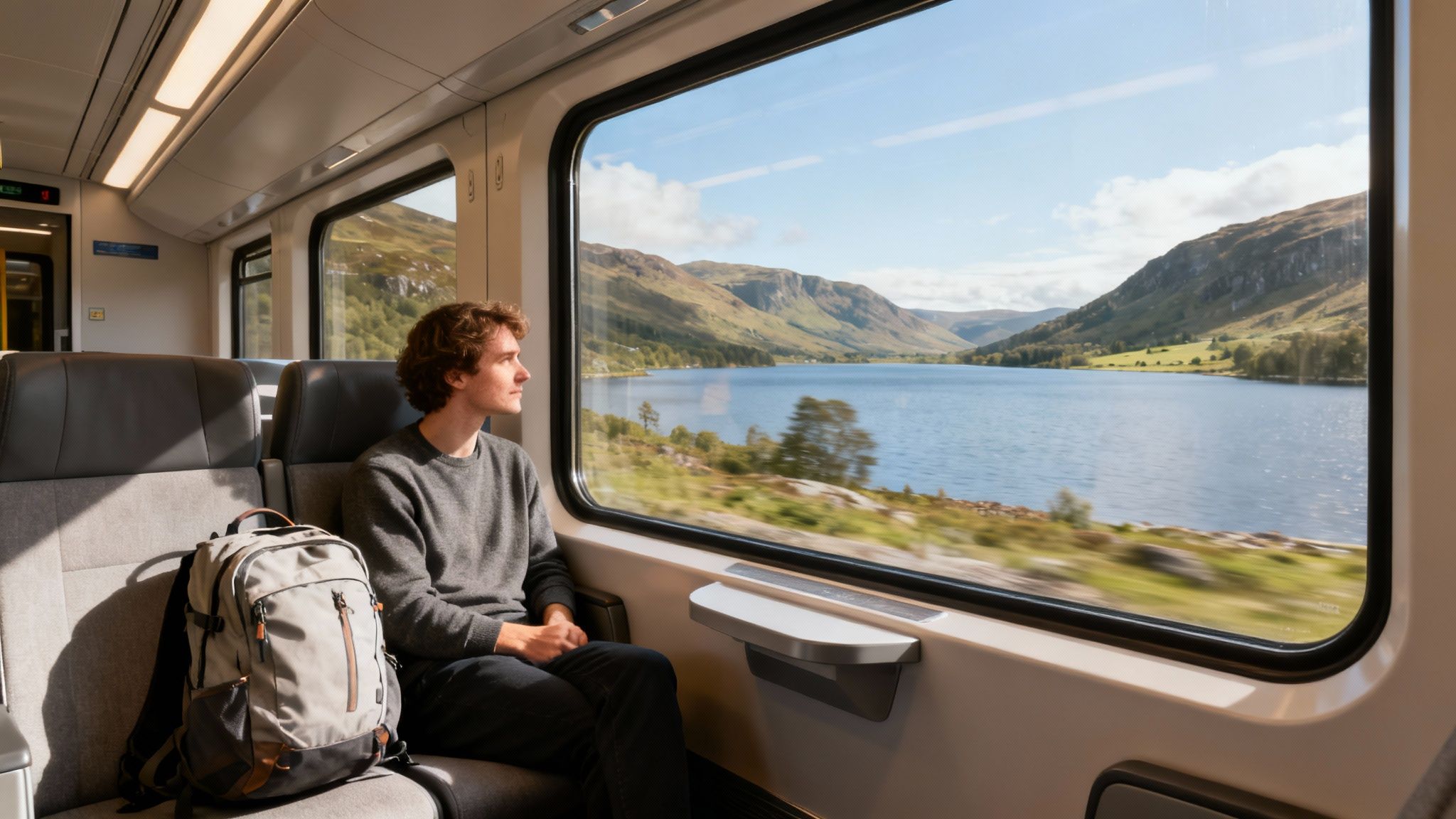
Beyond the savings, traveling by train immerses you in the landscape in a way that driving just can’t match. You get to sit back, relax, and watch the dramatic scenery unfold right outside your window. You’ll arrive in city centers refreshed and ready to explore. It’s a slower, more mindful way to travel that turns the journey itself into a highlight of your Scottish experience.
Comparing Rail Travel to Car Rental
While a rental car offers undeniable freedom, it comes with a bundle of costs that go way beyond the daily fee. You’ll need to budget for fuel (petrol), which can be 30-50% higher than in the USA. Prices climb even higher in the Highlands. Then you have to factor in parking fees at popular sites and in cities, plus potentially costly insurance. The numbers add up fast.
In contrast, the train system connects all major cities and many key towns efficiently. If you’re planning on island hopping to places like Skye or Mull, CalMac ferries integrate seamlessly with the rail and bus network. This makes a car-free island adventure not just possible, but genuinely enjoyable. For more on building a trip without a car, check out our complete guide on planning a trip to Scotland.
Popular ScotRail Routes Cost and Journey Comparison
To really see the value, it helps to put the numbers side-by-side. Remember, booking ahead is the single best way to bring your transport costs down. The “Standard Fare” below is what you might pay if you buy your ticket at the station just before you travel. The “Advance Fare” is what you can get by booking online a few weeks out.
H3: ScotRail Route Cost and Journey Comparison
| Route | Average Journey Time | Advance Fare (Approx. USD/GBP) | Standard Fare (Approx. USD/GBP) | Notes |
|---|---|---|---|---|
| Edinburgh to Glasgow | 50 minutes | $15 / £12 | $35 / £28 | A frequent, fast, and essential commuter route. |
| Glasgow to Fort William | 3 hours 45 minutes | $25 / £20 | $60 / £48 | Part of the stunning West Highland Line. |
| Edinburgh to Inverness | 3 hours 30 minutes | $30 / £24 | $75 / £60 | Connects the capital to the heart of the Highlands. |
| Inverness to Kyle of Lochalsh | 2 hours 40 minutes | $20 / £16 | $45 / £36 | Gateway to the Isle of Skye via a scenic route. |
As you can see, a little bit of planning can easily cut your train travel costs by more than half. This leaves more in your budget for experiences.
City Transport and Island Ferries
Once you’re in cities like Edinburgh or Glasgow, public transport is fantastic. Lothian Buses in Edinburgh offers day passes for around $6.50 USD (£5 GBP), giving you unlimited travel. For island adventures, a passenger ferry ticket with CalMac is surprisingly affordable. For example, the Mallaig to Armadale (Skye) route costs only about $4.80 USD (£3.85 GBP) for a foot passenger.
These smart transport choices let budget travelers make their funds go even further. With inter-city trains often available for under $25 USD (£20 GBP) with advance booking, you can cut costs by over 50% compared to last-minute fares. Comparing your options on a platform like Trip.com can help you find the best deals for your itinerary.
Editor’s Pick: The ScotRail Spirit of Scotland Pass
For travelers planning multiple long-distance train journeys, the Spirit of Scotland Pass offers exceptional value. It provides unlimited travel on ScotRail trains, major coach routes, and even some CalMac ferry routes for a set number of days. This simplifies planning and often proves much cheaper than buying individual peak-time tickets, making it a top choice for a comprehensive, low-impact exploration of the country.
Managing Daily Costs for Food, Drink, and Activities
Once you’ve sorted out flights and a place to stay, your day-to-day spending on food, drinks, and experiences is what will really shape your final Scotland trip cost. The good news is that Scotland’s incredible culture and landscapes are accessible no matter your budget. A little planning here goes a long way. It lets you soak it all in without worrying about your wallet.
From a hearty pub meal to exploring an ancient castle, it’s the daily choices that add up. Grabbing a pint of local ale in a historic pub will usually set you back $6 to $8 USD (£5 to £6.50 GBP). For a classic fish supper from a takeaway shop—a delicious and filling meal that’s easy on the budget—you can expect to pay around $10 to $14 USD (£8 to £11 GBP).
If you sit down for a main course at a mid-range restaurant, you’re often looking at $25 to $40 USD (£20 to £32 GBP) per person. The trick is to mix it up. Maybe a pub lunch one day, a picnic with local market finds the next. This way, you can keep your food budget in check while still getting a real taste of Scottish cuisine. A good set of reusable toiletry bottles can also save you money and reduce waste.
High-Value, Low-Cost Activities
One of the best things about Scotland is that many of its most breathtaking experiences are completely free. Thanks to Scotland’s “Right to Roam” laws, you have the freedom to explore vast areas of unenclosed land. This means you can hike through stunning national parks like the Cairngorms or Loch Lomond & The Trossachs without paying a single penny in entrance fees.
On top of that, many of Scotland’s best national museums and galleries, especially in Glasgow and Edinburgh, offer free admission. This is a fantastic way to dive into the country’s rich history and vibrant art scene without spending anything.
For a simple, sustainable touch, always carry a reusable water bottle. Scotland’s tap water is famously fresh and safe to drink. This saves you money while cutting down on single-use plastic. You can find more great ways to travel affordably in our guide to budget travel tips.
Budgeting for Major Attractions
While so much is free, you’ll definitely want to set aside some cash for a few of Scotland’s iconic paid attractions. Factoring these entrance fees into your plan is a key part of nailing down your total Scotland trip cost.
- Edinburgh Castle: A visit to this historic fortress is a must for many. Adult tickets typically start around $24 USD (£19.50 GBP) if you book online in advance.
- Stirling Castle: Another crucial historical site, entrance here is a bit less, at about $21 USD (£17 GBP) for an adult ticket.
- Loch Ness Cruises: If you’re hoping to spot Nessie, a one-hour boat tour on the famous loch usually costs between $25 to $35 USD (£20 to £28 GBP).
By researching these costs and booking tickets online beforehand, you can often lock in a lower price and skip the long queues. A small, packable daypack is perfect for carrying essentials like your water bottle, snacks, and a light rain jacket as you explore. Packing a solid shampoo bar is another great way to save space and reduce plastic waste on your trip.
Putting It All Together: Sample Itineraries & Cost Breakdowns
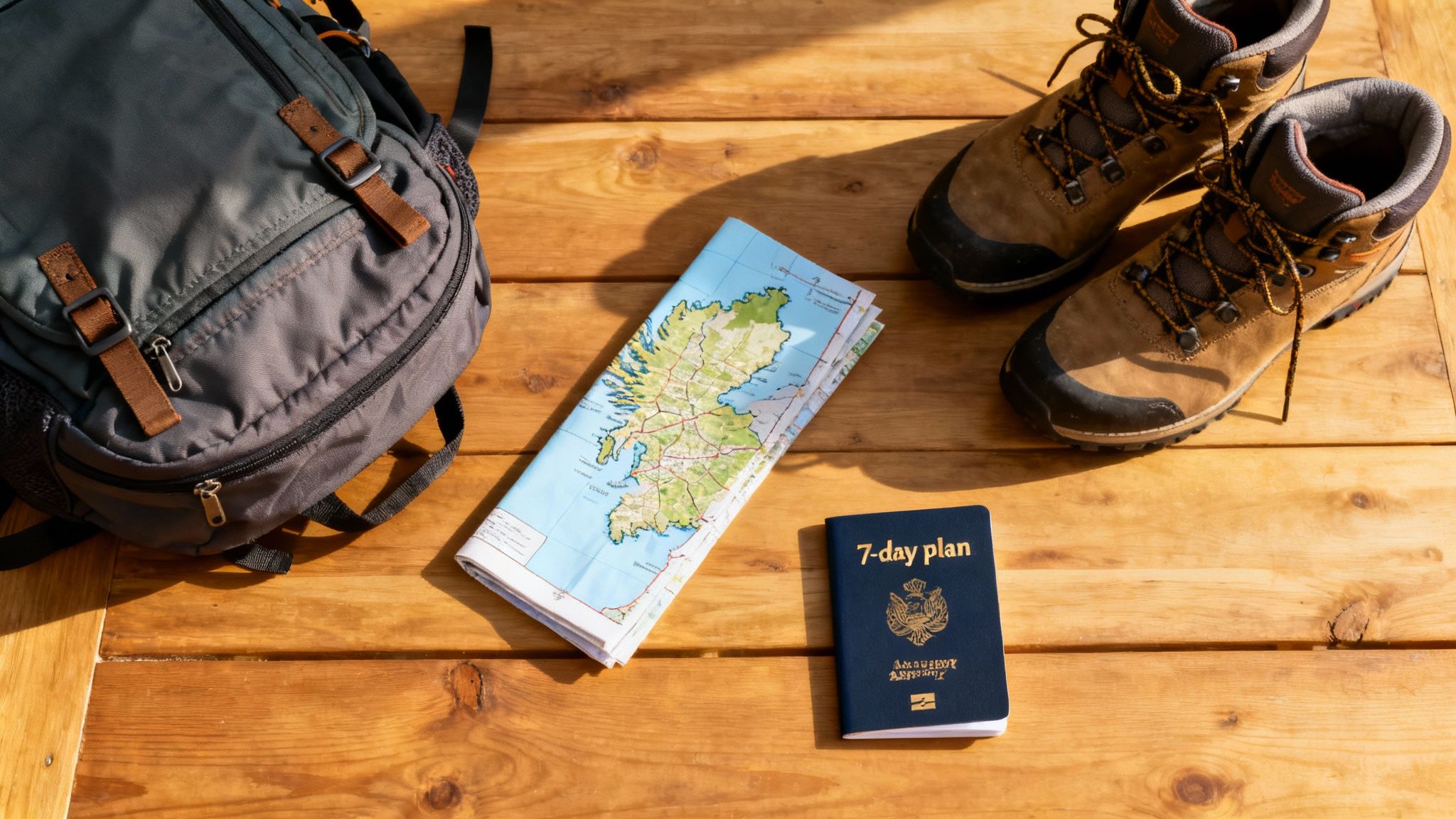
Theory is one thing, but seeing how the numbers play out in a real-world trip makes budgeting so much easier. Let’s walk through three distinct 7-day Scotland itineraries. Each is built for a different budget and travel style. Think of these as practical roadmaps you can adapt to fit your own adventure.
We’ll look at a shoestring backpacker’s tour of the Highlands, a comfortable journey through Scotland’s cultural hubs, and a rail-first eco-conscious adventure. Each plan breaks down the daily flow and gives you a final estimated cost. This provides a tangible goal to save for. Remember, these are just starting points—feel free to mix, match, and build your perfect trip from here.
Itinerary 1: The Budget Backpacker’s Highland Adventure
This plan is all about maximizing epic experiences while minimizing spend. It leans on hostels and public buses to get you deep into some of Scotland’s most dramatic landscapes without breaking the bank.
- Days 1-2: Glasgow. Arrive in Glasgow and dive into the city’s incredible free museums, like the Kelvingrove Art Gallery. Base yourself in a central hostel.
- Days 3-4: Glencoe & Fort William. Hop on a Citylink bus to Glencoe for some of the best free hiking you’ll find anywhere. You’ll stay in a Fort William hostel for two nights, using it as your adventure base.
- Days 5-6: Isle of Skye. Catch another bus over to Portree, the island’s famously colorful capital. From there, you can explore the mind-bending Trotternish Peninsula using local buses.
- Day 7: Return to Glasgow. Take the long, scenic bus route back to the city for your departure. A lightweight travel backpack is your best friend here, making it easy to hop on and off buses.
Total Estimated Cost: Roughly $750 – $900 USD (£600 – £720 GBP) per person for the week, not including flights. This covers your hostel stays, bus tickets, groceries for self-catering, and a few well-deserved pub meals.
Itinerary 2: Mid-Range Culture and Castles Tour
This itinerary is for those who want to blend city culture with iconic history. It uses a mix of pre-booked trains and comfortable B&Bs for a more relaxed pace. A good set of compression packing cubes will be a lifesaver for fitting everything into your carry on luggage.
- Days 1-3: Edinburgh. Settle into a charming B&B. Spend your days exploring the Royal Mile, visiting Edinburgh Castle (book tickets ahead!), and finding cozy meals in historic pubs.
- Day 4: Stirling. A short train ride takes you to Stirling. Here, you’ll visit the magnificent Stirling Castle and the iconic Wallace Monument.
- Day 5-6: Inverness & Loch Ness. Journey north by train into the Highland capital. From Inverness, you can take a day tour or a local bus to go monster-hunting at Loch Ness.
- Day 7: Return to Edinburgh. Enjoy one last proper Scottish breakfast before catching your train back to the airport.
Total Estimated Cost: Around $1,900 – $2,400 USD (£1,520 – £1,920 GBP) per person. This budget accounts for B&B or 3-star hotel stays, advance-purchase train tickets, entry fees for the main attractions, and daily restaurant meals.
Itinerary 3: The Car-Free Eco-Nomad’s Rail Journey
Designed for the sustainable traveler, this itinerary uses the fantastic ScotRail network to connect walkable cities with stunning natural areas. The focus is on low-impact activities and supporting local, green businesses. Keep your camera ready for all the scenic train views with a reliable portable power bank.
- Days 1-2: Glasgow. Arrive and check into a certified green guesthouse. Spend your time exploring the city’s unique architecture and vibrant food scene, all on foot.
- Days 3-4: Loch Lomond & The Trossachs. Take the train to Balloch, the gateway to the national park. Enjoy hikes along the shore and a boat trip on the loch, staying in a local eco-lodge.
- Days 5-6: Cairngorms National Park. Travel by train to Aviemore, in the heart of the Cairngorms. Explore the park through guided nature walks or by renting a bike.
- Day 7: Return via Perth. Take a final scenic train journey back towards Glasgow or Edinburgh, with a stop in the lovely city of Perth for a few hours to break up the trip.
Total Estimated Cost: Approximately $1,600 – $2,100 USD (£1,280 – £1,680 GBP) per person. This covers eco-friendly accommodations, a ScotRail pass, locally sourced food, and low-impact tours. A quick dry travel towel is perfect for any impromptu dips in a loch.
Don’t Get Blindsided: Scotland’s Hidden Fees and Extra Expenses
A solid budget is about more than just hotels and train tickets. It’s about anticipating those small, sneaky costs that can catch you out and throw your whole plan off track. Thinking about these “hidden” expenses ahead of time is the key to a realistic travel budget. It ensures your money goes toward incredible experiences, not last-minute emergencies.
For starters, many travelers don’t realize that some Scottish cities are rolling out new charges. A Visitor Levy, for instance, is coming to popular hubs like Edinburgh. It’s a small nightly fee added to your hotel bill to help fund local services. While it won’t break the bank, it definitely adds up over a week.
Another big one, especially if you’re renting a car, is the eye-watering cost of fuel in the Highlands. Pair that with parking fees at popular sites, and the value of a rail-first trip starts to look even better. And while you’re out and about, a simple RFID blocking wallet is a smart, low-cost way to keep your cards safe from digital pickpockets.
Common Overlooked Costs to Budget For
Beyond city taxes and fuel, a few other things can nibble away at your budget. ATM withdrawal fees can be surprisingly high, so it’s much smarter to take out larger amounts of cash less often. And please, don’t forget to factor in comprehensive travel insurance from a provider like VisitorsCoverage; it’s an absolute non-negotiable for any trip.
You might also notice groceries costing a bit more in a remote glen or on the islands. This makes sense when you think about the cost of getting them there. These little details matter. Research shows that things like parking can tack on $18-$30 USD (£15-£25 GBP) per night, even at hotels. UK fuel prices can be 30-50% higher than in North America. To really get prepared, check out this deep dive into often-overlooked Scottish travel expenses.
Staying Ahead of Surprise Expenses
The best defense is a good offense. Before you go, check the visitor levy policies for the cities on your itinerary. If you’re island hopping, book your ferries well in advance, because prices can swing wildly and spots disappear fast in summer. A little foresight here prevents a lot of stress (and expense) later.
Thinking ahead about your packing can also save you a surprising amount of cash. Knowing how to pack light can help you avoid checked bag fees altogether. If you need some strategies, our guide on how to pack carry-on only is a great place to start. It not only saves you money but makes navigating train stations and cobbled streets a whole lot easier. You can get everything you need into a great carry on backpack.
Key Takeaways
- Factor in Visitor Levies: Be aware that cities like Edinburgh are introducing small nightly tourist taxes that add to your accommodation bill.
- Anticipate High Rural Costs: Budget for more expensive fuel, parking fees at attractions, and slightly higher grocery prices in remote areas like the Highlands and Islands.
- Book Ferries in Advance: Island ferry prices fluctuate significantly and sell out during peak season. Booking ahead secures your spot and often your price.
- Don’t Forget the Basics: Remember to include costs for ATM fees and comprehensive travel insurance in your final budget calculations.
- Embrace Rail Travel: Choosing trains over a rental car is one of the most effective ways to avoid the high costs of fuel and parking.
- Protect Your Finances: Using simple tools like an RFID blocking wallet helps safeguard your cards from digital theft while you’re on the move.
Low-Impact Travel Tools (Worth It)
Also, if you’re planning a trip and want to keep things simple, these tools help you travel smoother while staying mindful about impact.
Get an eSIM for reliable data → Disclosure: Partner link. No extra cost to you.
Pre-book a transfer for easy arrivals → Disclosure: Partner link. No extra cost to you.
Frequently Asked Questions About Scotland Travel Costs
How much does a 7-day trip to Scotland cost?
For a 7-day trip, a budget traveler can expect to spend around $700-$1,000 USD per person, not including flights. A mid-range traveler might budget $1,800-$2,500 USD, while a luxury trip could easily top $4,000 USD. These figures cover accommodation, food, transport, and activities.
What is the cheapest month to go to Scotland?
The cheapest months are typically the off-season, from November to March (but skipping the Christmas and New Year holidays). You’ll find lower prices on flights and accommodation, plus the huge bonus of having popular attractions all to yourself.
Is Scotland more expensive than England?
Generally, Scotland can be a bit easier on the wallet than England, especially once you leave Edinburgh. Costs in major cities are pretty comparable to English cities (outside of London, of course). However, you’ll often find better value on accommodation, food, and transport in Scotland’s smaller towns and rural areas.
How much money should I bring to Scotland for a week?
It’s always best to have a mix of cash and cards. For a week, having around £150-£200 in cash (about $190-$250 USD) is a good safety net for smaller purchases. This is especially true in rural pubs or shops that might not take cards. For everything else, cards are widely accepted.
Is food expensive in Scotland?
Food costs can be all over the map. You can eat really affordably by shopping at supermarkets like Tesco or Lidl and grabbing pub meals. A main course often costs $15-$20 USD (£12-£16 GBP). A meal at a mid-range restaurant will be more, with entrees typically running $25-$40 USD (£20-£32 GBP).
Do you need to tip in Scotland?
Tipping isn’t a mandatory part of the culture like it is in the US, but it’s always appreciated for good service. In restaurants, 10% is standard if a service charge isn’t already included on the bill. For taxis, most people just round up the fare.
Is it better to use cash or card in Scotland?
Using a card is the most convenient option for hotels, restaurants, and shops across Scotland. That said, it’s always a good idea to carry some cash. This is particularly true when you head to more remote areas or visit smaller independent businesses like a local pub or market stall.
How can I save money on transportation in Scotland?
The train is your best friend for saving money. Book your ScotRail tickets well in advance to get huge discounts on “Advance” fares. Use a platform like AviaSales to find deals. For bus travel, companies like Citylink and Megabus offer cheap fares between major cities. If you’re planning a lot of journeys, a railcard or travel pass can offer fantastic value.
Join the Sustainable Work Movement
Want more rail-first itineraries, low-impact packing systems, and walkable base-city ideas?
This article was fact-checked using sustainability data from the World Green Building Council, the Global Ecotourism Network, and peer-reviewed architecture studies. All partner links are vetted for compliance with sustainable business certifications.