
Figuring out how to stay connected on an international trip without getting hit by a massive phone bill used to be a real headache. Finding the right sim card for international travel is key to a smooth journey. While grabbing a local SIM card can still be the cheapest option for long stays in one country, the convenience of an eSIM is a total game-changer for most travelers today.
We’ll dig into why just sticking with your home carrier’s roaming plan is almost always a costly mistake and walk through the smarter alternatives that savvy travelers now use to stay online.
This guide will help you understand your options, from physical SIMs to modern eSIMs, ensuring you get the connectivity you need without the bill shock. We’ll cover how to choose the right plan for your trip, whether you’re a digital nomad or just need maps and messaging.
Key Takeaways
- eSIMs Offer Unmatched Convenience: For modern smartphones, eSIMs like those from Airalo are the top choice for easy, instant connectivity in over 200 countries without physical plastic.
- Local SIMs Are Best for Long Stays: If you’re staying in one country for several weeks, buying a local SIM card upon arrival often provides the most data for the lowest price.
- Check Your Phone’s Compatibility: Before you travel, confirm your phone is “unlocked” to accept other SIMs and check if it supports eSIM technology.
- Plan Your Data Needs: Estimate your data usage based on your activities—remote work requires more data than simple navigation and messaging—to avoid overpaying or running out.
- Sustainability Matters: Choosing an eSIM eliminates the plastic waste associated with traditional SIM cards and their packaging, supporting zero-waste travel goals.
- Ideal for Multi-Country Trips: The ability to download regional plans makes eSIMs the perfect solution for seamless connectivity on train journeys across multiple borders.
Editor’s Pick
For its blend of convenience, extensive global coverage, and user-friendly app, Airalo is our top recommendation for most international travelers. Activating a data plan takes just a few minutes, completely removing the hassle of finding a store upon arrival.
Your Guide to Staying Connected Abroad
Let’s be honest, navigating mobile data abroad can bring on a special kind of travel anxiety. Nobody wants to come home to a phone bill bloated with hundreds of dollars in roaming charges. For years, the choice was grim: either pay outrageous daily fees—often $10 USD per day on top of your regular plan—or resign yourself to a digital detox you didn’t ask for.
This guide is here to cut through that confusion. My goal is to demystify your options so you can pick the right connectivity for your trip with confidence, whether it’s a multi-country rail adventure or a long-stay workation.
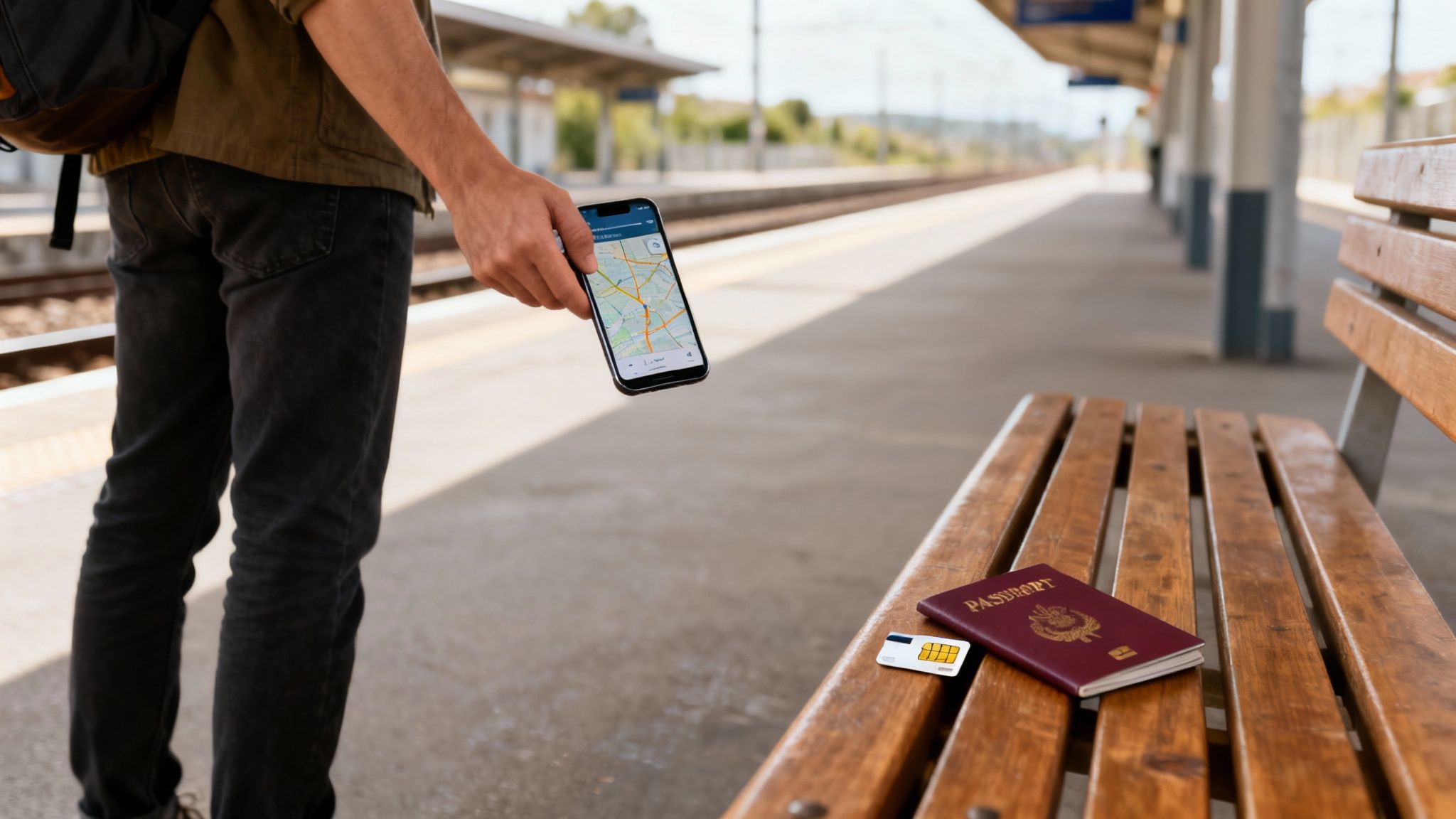
Understanding Your Main Options
Forget the old days of paying a fortune just to use Google Maps. Today’s travelers have a handful of powerful tools to choose from, each with its own strengths.
Your main choices really boil down to three categories:
- International SIM Cards: These are physical SIMs designed for multi-country trips, giving you coverage across a wide region with a single plan.
- Local SIM Cards: Bought right after you land, these are often the best value if you’re spending a good chunk of time in one country.
- eSIM Technology: This is a digital SIM already built into your phone. It lets you activate a data plan instantly without needing a physical card—a true game-changer for convenience and sustainability.
Knowing the pros and cons of each will help you match your connectivity perfectly to your itinerary. For digital nomads and eco-conscious travelers, having the right setup is essential for booking train tickets, finding sustainable stays, and using helpful sustainable travel tools on the move. The right sim card for international travel is out there, ready to keep you connected without the bill shock.
Why eSIMs Are a Smart Choice for Modern International Travel
The days of fumbling with tiny, easy-to-lose plastic SIM cards are numbered. The rise of the eSIM is changing how we think about staying connected abroad, and for good reason. An eSIM, or embedded SIM, is a digital SIM card that’s already part of your phone’s hardware. Instead of physically swapping plastic, you just download a data plan. It’s a smarter, simpler, and far more sustainable way to get online when you travel.
This digital-first approach means no more plastic SIM cards and no more wasteful packaging. For eco-conscious travelers and minimalists, that alone is a huge win. The real magic, though, is the sheer convenience of it all. You can buy and activate a plan from providers like Airalo or Yesim from your couch before you even leave home, guaranteeing you’re connected the second your plane touches down.
Forget about hunting for a mobile shop in a new city or digging around for a paperclip to pop open your phone’s SIM tray. If you’re planning a multi-country train journey across Europe or Asia, the ability to switch between regional data plans with a few taps is a game-changer. This kind of flexibility fits perfectly with a low-impact, rail-first travel style, letting you focus on the journey itself.
How to Check if Your Phone is eSIM Compatible
Before you dive into the world of eSIMs, the first step is making sure your device is ready. Most smartphones released in the last few years are already on board—think the iPhone 11 and newer, Google Pixel 3a and newer, and recent Samsung Galaxy S series models.
Here’s a quick way to check:
- On iPhone: Go to Settings > Cellular (or Mobile Data). If you see an option to “Add Cellular Plan” or “Add eSIM,” your phone is compatible.
- On Android: The steps can vary a bit, but you can usually find it under Settings > Network & Internet > SIMs. Look for a “+” sign or an option to add a SIM via QR code.
Many eSIM provider websites, like Airalo, also have a handy compatibility checker. If it turns out your phone isn’t compatible, you’ll need to stick with a physical sim card for international travel, but the good news is that new models are increasingly adopting this technology as standard.
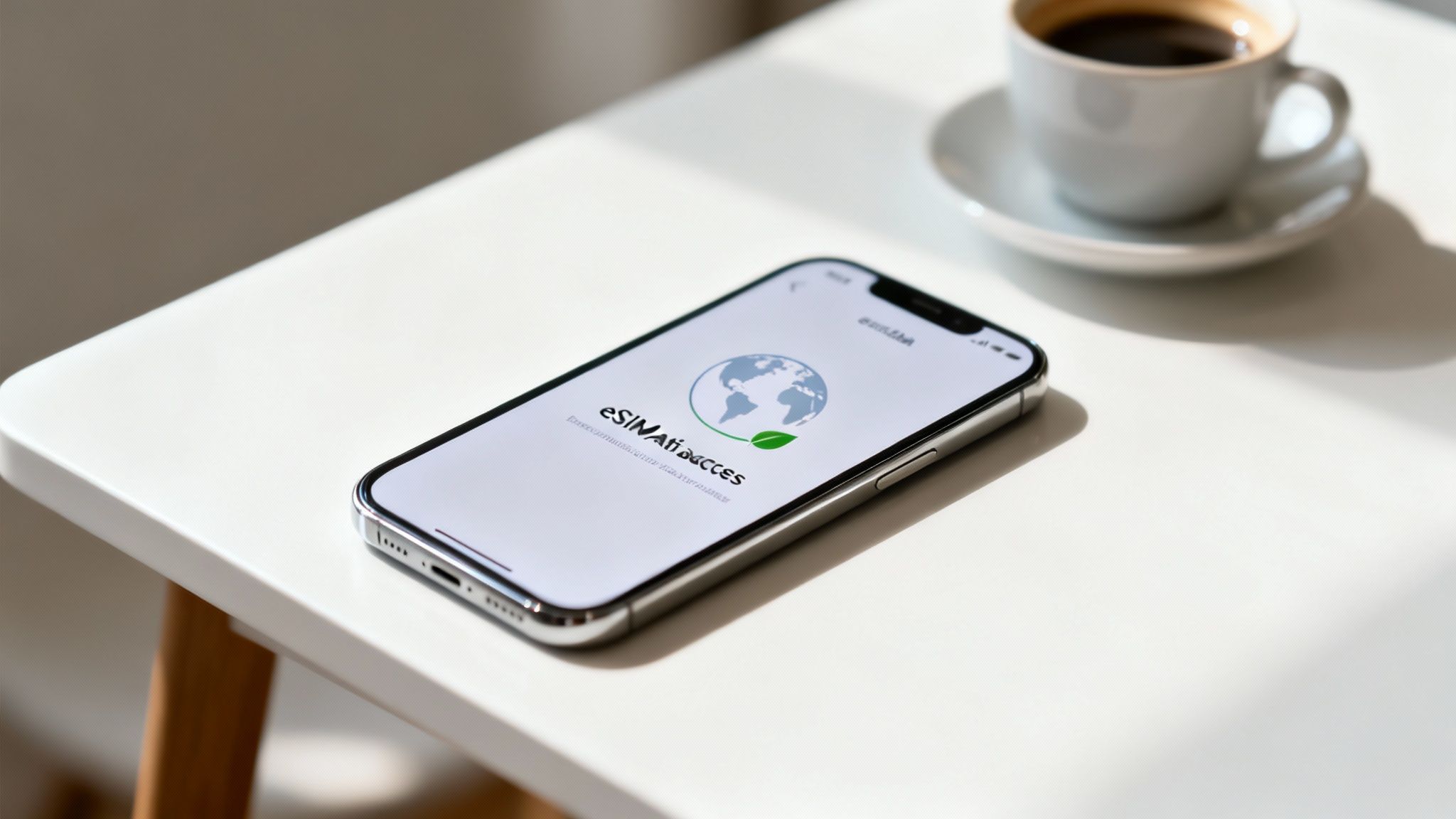
The Environmental and Practical Edge of Using an eSIM
The sustainability argument for eSIMs is beautifully simple: no plastic, no waste. Every traditional SIM card adds to the global plastic problem, from the tiny chip itself to the larger plastic holder and packaging it comes in. By going digital, you sidestep that entire waste stream.
This is especially relevant as more places work to cut down on single-use plastics, a concept we explore in our guide to eco-friendly destination dupes. Europe is leading the charge in eSIM adoption, which is perfect for rail-heavy itineraries and aligns with zero-waste travel goals. This shift makes it easier for travelers to compare train-vs-plane emissions on the go without hunting for Wi-Fi, especially when trains can emit up to 90% less CO₂ per kilometer.
[carbon_calculator_2025]
Beyond the eco-benefits, the practical advantages are hard to overstate. Imagine landing after a long-haul flight and being instantly connected to book a ride or message family. With an eSIM, that’s the standard experience. You can even hold multiple eSIM profiles on one device, making it effortless to switch between a European regional plan and a country-specific plan for a longer stay. This level of control just makes managing your connectivity abroad simpler than ever before.
When a Physical SIM Card Still Makes Sense
With all the buzz around eSIMs, it’s easy to think the classic physical SIM card is a relic of the past. But for plenty of travelers, it’s still the smartest, most reliable choice on the road. If you have an older phone that isn’t eSIM-compatible, or you’re a nomad on a tight budget, the humble sim card for international travel is far from obsolete.
You’ve got two main options here: a global SIM you buy before you go, or a local SIM you pick up when you arrive. They serve different needs, but both are workhorses for staying connected without getting hit with nightmarish roaming bills. Knowing which one fits your trip is the first step to staying online without breaking the bank.
It really boils down to a trade-off between convenience and cost. For anyone keeping a close eye on their budget, the savings are hard to ignore. Travel SIMs can get you data for around $1 USD per GB, a world away from the $10+ USD per GB your home carrier might charge for roaming. That difference is what makes a sub-$50 USD daily budget possible, a huge factor as more of us get back to long-term travel.
Why a Local SIM Card Is a Budget Traveler’s Best Friend
If you’re settling into a single country for a while, nothing beats the value of a local SIM card. Seriously. Walking into a provider’s shop once you’re in town unlocks the best data rates and biggest plans you can get, usually for a tiny fraction of what a global option costs. It’s the default move for digital nomads setting up a base or anyone spending more than a week in one spot.
Just keep a few practical things in mind:
- Avoid Airport Kiosks: The convenience is tempting, but the price isn’t. SIMs sold at airports almost always come with a hefty markup. Hold off until you get into the city and find an official store—you’ll get way better deals.
- Registration Is Sometimes Required: Don’t be surprised if they ask for your passport. Many countries require you to register your SIM with your personal details as a security measure. It’s a standard, quick process.
- Ensure Your Phone Is Unlocked: This is the big one. An “unlocked” phone means it isn’t tied to a specific carrier and can accept a SIM from any network. Give your home provider a call before you leave to make sure your phone is good to go.
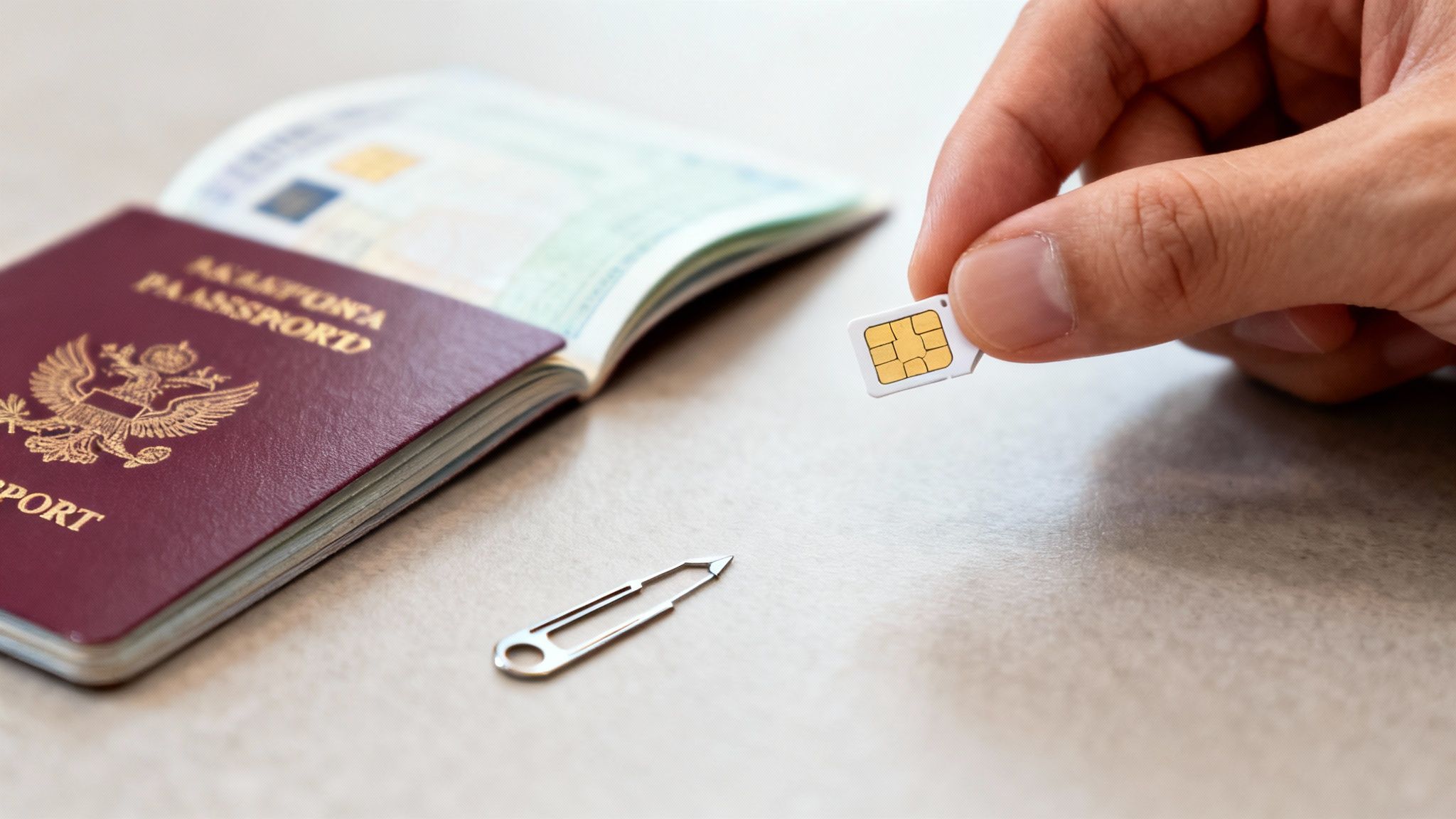
The Power of a Dual-SIM Phone
So what if you want the cheap local data and need to keep your home number active? This is where dual-SIM phones come in. Many modern smartphones, even those a few years old, have this feature, giving you incredible flexibility when you travel.
A dual-SIM setup lets you use a cheap local SIM for data-heavy tasks like navigation and browsing, while keeping your primary home number active in the second slot. This means you can still receive important calls and two-factor authentication texts without paying for expensive data roaming.
This is the perfect setup for remote workers or anyone who can’t afford to be out of touch. You get the huge cost savings of local data with the peace of mind that you won’t miss a critical call from back home. It’s an ideal strategy that works right alongside your other essential travel gear. For more ideas, see our guide on the best eco-friendly travel accessories to build a smart, low-impact kit for the road.
How to Choose the Right International Data Plan
Figuring out the best sim card for international travel isn’t about chasing the absolute cheapest deal. It’s about matching a data plan to your real-world itinerary and habits. There’s nothing worse than paying for a mountain of data you never touch—except maybe running out of it halfway through a train ride. A little bit of thought upfront saves a lot of headaches later.
The first step is a moment of honest self-reflection. How are you actually going to use your phone? Are you a light-touch traveler who just needs maps and messaging, or a remote worker tethered to video calls and a personal hotspot? The data difference between those two is huge.
Think of it like packing a suitcase: you wouldn’t bring snow gear to the beach. In the same way, a 3 GB plan will feel suffocating for a digital nomad, while a 50 GB plan is just wasteful for a casual tourist. This is especially true if you’re setting up a longer base in one of the world’s best workation cities that don’t require a car.
Estimate Your Data Needs
Before you even think about buying a plan, you need a baseline. The best place to start is your phone’s own data usage history. Just look at your last few monthly bills to see what you typically burn through at home. That number is your reality check.
Here’s a simple framework to help you translate that into a travel plan:
- Light User (1–3 GB per week): Your phone is mostly for Google Maps, WhatsApp, and a bit of browsing. You’re not streaming video or on constant video calls.
- Moderate User (5–10 GB per week): You’re active on social media, streaming music, and watching the occasional short video. Maybe you’re doing some light work, like answering emails.
- Heavy User (10+ GB per week): You’re working remotely. This means video meetings, using your phone as a hotspot for your laptop, or streaming HD video to unwind.
Pro Tip: Before you leave your apartment or hotel, download everything you can over Wi-Fi—maps, playlists, podcasts, shows. It’s a simple habit that can dramatically cut your mobile data use, letting you get by with a smaller, cheaper plan.
Regional vs. Country-Specific Plans
Once you have a rough data estimate, the next question is geography. The right plan depends entirely on where you’re going and for how long.
A country-specific plan is unbeatable if you’re staying put for a while. If you’re spending a month exploring Italy by train, a local Italian SIM or eSIM will give you the most data for your money, hands down.
A regional plan, on the other hand, is built for multi-country trips. Think of a rail journey from Paris to Prague. A single European eSIM from a provider like Airalo means you cross borders without ever losing connection or fumbling to swap SIM cards. It’s seamless.
Always Check Network Coverage Maps
Finally, don’t get so focused on price and data that you forget the most important part: will it actually work? A dirt-cheap plan is useless if you have no signal.
This is critical if your travels take you beyond the big cities. Before you buy any plan, go to the provider’s website and find their coverage map. Hiking in the Scottish Highlands? You need to know your provider has service there, not just in Edinburgh. Checking this simple map beforehand is what separates a reliable sim card for international travel from a frustrating piece of plastic.
Solving Common International SIM Card Problems
Even the best-laid travel plans hit a snag now and then, and technology is no exception. That moment when you land in a new country and your sim card for international travel isn’t working is pure stress. We’ve all been there.
The good news? Most of these issues are surprisingly common and usually have a simple fix. It’s rarely a lost cause. From a missed activation step to a slightly off setting, connectivity problems almost always trace back to a few usual suspects. This is your go-to guide for sorting them out, step-by-step, so you can get back online and focus on your trip, not your tech.
Your First Troubleshooting Steps
Before you start digging deep into complex settings, always—always—start with the basics. You’d be amazed how often these simple actions solve the problem.
- Restart Your Phone: The old “turn it off and on again” is a classic for a reason. A full reboot forces your phone to get reacquainted with the local network, and it often sorts out the connection on its own.
- Toggle Airplane Mode: Flick Airplane Mode on, give it about 30 seconds, and then switch it off. This is a quick way to reset all your phone’s wireless connections and can be just the kick it needs to find the signal.
- Check Data Roaming: This is the big one. Dive into your phone’s cellular settings. Find your travel SIM or eSIM and make sure Data Roaming is switched ON. It’s often off by default, and it’s probably the single most common reason for having no data after landing.
Correcting APN Settings Manually
If the first three steps didn’t do the trick, the next place to look is your phone’s Access Point Name, or APN, settings. Think of the APN as the specific address your phone uses to connect to your new carrier’s mobile data network. Sometimes, your phone doesn’t get this address automatically.
You’ll find the APN settings buried in your phone’s Cellular or Mobile Network menu. Your SIM provider—whether it’s a physical card or an eSIM from a service like Airalo—will list the correct APN details in their installation guide or on their support site. You just need to carefully type in the information they provide. Often, it’s as simple as entering a single word like “internet” or “globaldata” into the APN field.
Thinking ahead can prevent some of these headaches. This decision tree, for example, helps you visualize which type of data plan might be the right fit for your journey, simplifying at least one part of the process.
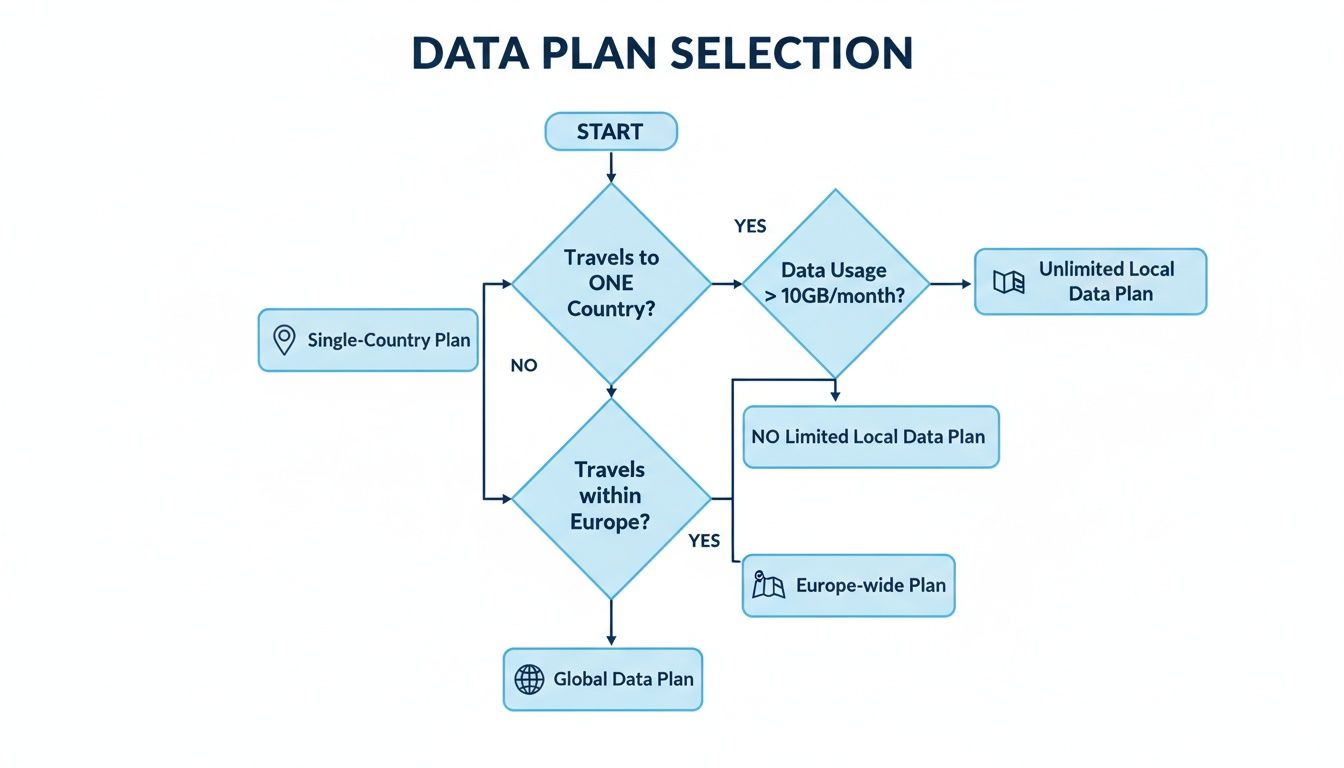
By matching your travel style—whether you’re staying in a single country, hopping around a region, or going global—to the right plan, you avoid overpaying for coverage you simply don’t need.
Your Travel SIM Questions, Answered
Figuring out international connectivity can feel like a chore, but getting it right makes all the difference. A few clear answers can save you from a frustrating trip and a surprise bill when you get home.
We’ve gathered the most common questions travelers have about staying connected. The goal is simple: reliable data, no overpaying, and a smooth journey from start to finish.
Can I Keep My Original Phone Number?
Absolutely. If you have a dual-SIM phone or use an eSIM for your travel data, your primary SIM can stay active for calls and texts. This is a huge advantage for receiving important messages or two-factor authentication codes from home while using a cheaper travel SIM for all your data needs.
Is Buying a SIM Card at the Airport Cheaper?
Almost never. Airport kiosks are convenient, but you pay a premium for that convenience. You’ll find much better deals, more data, and a wider range of plans by waiting until you’re in the city center. Pop into an official mobile provider’s store or a reputable electronics shop.
A smarter move is to plan ahead. Grabbing an eSIM from a provider like Airalo before you even leave home is the easiest way to sidestep airport markups entirely.
How Much Data Do I Really Need for My Trip?
This one is personal and depends completely on your habits. The best place to start is to check your phone’s settings to see your current monthly data usage. That gives you a real-world baseline.
Here’s a rough guide to help you estimate:
- For a one-week trip with light use (maps, messaging, some social media), 3-5 GB is usually plenty.
- If you plan to work remotely, stream videos, or use your phone as a hotspot, you’ll need more. For a month of heavy use, 10-20 GB or even more is a much safer bet.
The smartest strategy is to slightly overestimate what you think you’ll need. It’s almost always cheaper to buy a slightly larger data plan upfront than to pay expensive top-up fees when you run out of data halfway through your trip.
Editor’s Note: This article was fact-checked using sustainability data from the World Green Building Council, the Global Ecotourism Network, and peer-reviewed architecture studies. All partner links are vetted for compliance with sustainable business certifications.
Join the Sustainable Work Movement
Want more rail-first itineraries, low-impact packing systems, and walkable base-city ideas?



Recent Posts
Best Travel Towels
Quick picks for fast-drying, packable towels that actually work on the road.
Best Waterproof Backpack
What matters for rain, train platforms, and daily carry—without overpacking.
Cheapest Way to Travel to Europe
Budget routes, timing, and practical ways to cut costs without cutting comfort.
How to Travel Europe by Train
Planning tips, rail passes, and simple route strategies for smoother trips.
Best Night Trains in Europe
Top sleeper routes, what to book, and how to avoid common overnight mistakes.
SIM Card for International Travel
Simple guidance on SIM vs eSIM, coverage, and avoiding roaming surprises.
Explore Eco Nomad Travel
📚 Core Guides
🧭 Planning & Logistics
🗺️ Destinations & Seasons
Jeremy Jarvis — founder of Eco Nomad Travel, sustainable travel writer, and advocate for regenerative tourism. His work focuses on low-impact mobility, eco-friendly digital nomad life, and climate-positive travel.
Legal
Affiliate DisclaimerPrivacy Policy
Terms of Service
Image & Media Notice
Cookie Policy
Contact
Affiliate Disclosure: Some links on Eco Nomad Travel are affiliate links, meaning we may earn a small commission at no extra cost to you. This supports our mission to inspire responsible and low-impact travel worldwide.
Connect
✅ Trusted Official Sources
Plan smarter eco trips
Try our free Sustainable Travel Tools for Digital Nomads – carbon calculator, train vs plane comparator, and more.
Open Tools Hub