
Slow travel is less about taking a longer vacation and more about a complete mindset shift—choosing connection over checklists. Instead of sprinting through five cities in a week, you settle into one place. You learn its rhythms, absorb its culture, and become part of the community, even for just a little while. This meaningful approach to slow travel is the difference between tourist burnout and a truly memorable experience.
What Slow Travel Really Means and Why It Matters Now
At its heart, slow travel is the art of experiencing a place, not just seeing it. It’s about swapping a jam-packed itinerary for the joy of spontaneous discovery—finding a favorite local café, spending a whole afternoon in a park, or learning a few words of the language from a friendly shopkeeper. It’s an intentional approach that allows for a much deeper, more authentic connection.
And this philosophy is catching on. A recent Hilton trends report, which surveyed 13,000 travelers, found that for 2025, 1 in 4 leisure travelers are actively choosing a slower pace. They’re booking longer stays to live more like locals, trading frantic sightseeing for genuine cultural immersion.
The Benefits of a Slower Pace
Choosing to travel more slowly brings some powerful advantages that fit perfectly with a more mindful and sustainable lifestyle. It’s not just about feeling less rushed; it’s about making your journey better while making your impact smaller. If this sounds like your style, our guide on what is sustainable travel is a great next step.
Here’s what you gain when you adopt a slow travel mindset:
- A Lighter Environmental Footprint: When you minimize flights and opt for ground transport like trains, your carbon footprint drops dramatically. Staying put means fewer high-emission journeys. Simple.
- Deeper Cultural Immersion: Lingering in one place lets you move past surface-level tourism. You can actually build relationships, understand local customs, and directly support the small, community-owned businesses that make a place unique.
- It’s Often More Affordable: Longer stays can unlock big discounts on accommodations, like weekly or monthly rental rates. Plus, having a kitchen means you can shop at local markets and cook your own meals, which saves a ton of money.
- Genuine Well-Being: A slower pace gets rid of the stress and exhaustion that come with “fast” travel. It creates space for rest, spontaneity, and real discovery, so you don’t come home feeling like you need a vacation from your vacation.
The Environmental Benefits of a Slower Travel Pace
Choosing to travel slower has a powerful, positive ripple effect on the planet, and the single biggest win comes from rethinking how we get from A to B. By prioritizing ground travel like trains over short-haul flights, you can slash your carbon footprint without sacrificing the adventure. It’s one of the simplest and most effective changes you can make.
The difference in emissions isn’t just a small tweak; it’s staggering. Flying is fast, but it’s incredibly carbon-intensive. A single short flight can pump out more emissions than many people generate in several months. Trains, on the other hand—especially modern electric ones—are vastly more efficient per passenger.
This is a true game-changer for sustainable travel. Aviation is responsible for around 2.5% of global CO2 emissions and is on track to triple by 2050 if we don’t shift our habits. But here’s the good news: the European Environment Agency found that switching from a plane to a train for the same route can cut your personal travel emissions by up to 90%. You can learn more about the future of travel emissions and explore additional data on this topic.
Affiliate disclosure: This post may contain affiliate links. If you buy through them, Eco Nomad Travel may earn a small commission at no extra cost to you.
Comparing Carbon Your Footprint By Train And Plane
To make this feel real, let’s look at some numbers for popular European routes. The data makes it obvious: a few extra hours on a train translates into a massive environmental saving. It’s a cornerstone of responsible slow travel. And remember, while flight times look shorter on paper, they never include the time spent getting to and from airports, going through security, and waiting at the gate.
Carbon Footprint Comparison: Train vs. Plane
This table compares the estimated CO2 emissions per passenger for popular European routes, highlighting the significant environmental benefits of choosing rail travel over air travel. All measurements are based on United States standards.
| Route | Travel Mode | Estimated CO2 Emissions (per person) | Travel Time |
|---|---|---|---|
| Paris to Amsterdam | High-Speed Train | 9.9 lbs (4.5 kg) | 3.5 hours |
| Paris to Amsterdam | Airplane | 150 lbs (68 kg) | 1.2 hours (flight only) |
| Berlin to Prague | Train | 13.2 lbs (6 kg) | 4.5 hours |
| Berlin to Prague | Airplane | 242 lbs (110 kg) | 1 hour (flight only) |
| Rome to Florence | High-Speed Train | 6.6 lbs (3 kg) | 1.5 hours |
| Rome to Florence | Airplane | Not a typical flight route, showing rail’s advantage | N/A |
As you can see, choosing the train for a trip from Berlin to Prague saves over 220 pounds (about 100 kg) of CO2 per person. For a couple, that’s a huge reduction that makes a tangible difference. When flying is truly unavoidable, you can check out flight options with lower emissions on Aviasales.
Beyond Transportation The Broader Ecological Wins
The environmental benefits of slow travel go far beyond just swapping planes for trains. When you stay in one place for longer, you help reduce the strain caused by over-tourism—a phenomenon that overwhelms local infrastructure, damages fragile ecosystems, and displaces residents in popular destinations.
Slow travel flips the script.
- Supporting Local Economies: You spend your money at neighborhood markets, family-run restaurants, and local artisan shops. This ensures your travel dollars directly benefit the community, not a distant corporate headquarters.
- Easing Environmental Pressure: Fewer arrivals and departures mean less strain on local water, waste, and energy systems. It gives the destination breathing room.
- Promoting Regenerative Stays: You have more time to find and support accommodations that actively give back. Think farm stays that practice reforestation or guesthouses powered by renewable energy. This approach helps heal and restore local environments, leaving them better than you found them.
Ultimately, this mindful approach transforms you from a consumer of a destination into a temporary, respectful resident who contributes to its well-being. By slowing down, you not only enrich your own experience but also become a crucial part of the solution for a more sustainable travel future.
How to Plan Your First Slow Travel Journey
Ready to plan your own low-impact trip? Moving from the idea of slow travel to the reality of it is simpler than you might think. This guide breaks down the planning process into clear, practical steps, helping you design a meaningful journey with confidence. It all starts with choosing quality over quantity.
Instead of trying to tick off a long list of countries, focus on a single region. This simple shift is the foundation of a great slow travel itinerary. It lets you minimize travel days and maximize your time for genuine immersion, cutting both your stress levels and your carbon footprint.
The goal is to trade frantic transit for rich, local experiences. Recent travel outlooks show this mindset is gaining serious momentum. A survey from IPX1031 revealed that 92% of Americans plan to travel in 2025, with trends like staycations (54%) and workcations (41%) on the rise. And as travel budgets grow—with many travelers planning to spend more than $10,000—so does the desire for deeper, more intentional trips. You can read the full 2025 travel report for more on these shifts.
This visualization shows just how dramatic the emissions difference is between flying and taking the train for the exact same route.
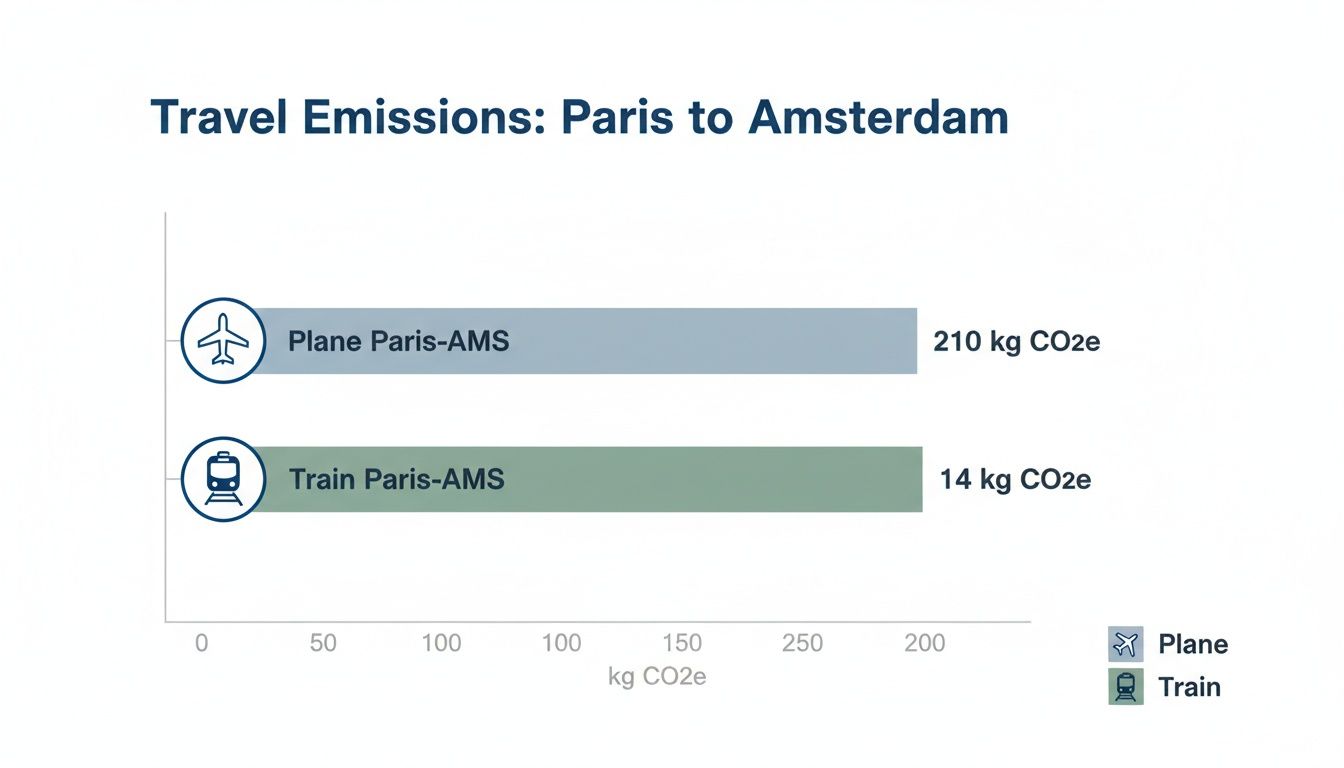
As the chart makes clear, choosing the train for a journey like Paris to Amsterdam cuts your carbon footprint by over 90%. This is a core principle of sustainable slow travel in action.
Finding Your Perfect Walkable Base City
Once you’ve picked a region, the next step is selecting a "base city." This will be your home for a while, so it needs to be more than just a place to sleep. A great base city is highly walkable, with excellent public transport that connects you to the whole surrounding area.
Look for cities with:
- Pedestrian-friendly neighborhoods that invite you to explore on foot.
- Reliable and extensive public transit (trams, buses, metro) for easy day trips.
- Vibrant local markets where you can shop for fresh food and connect with the community.
- Accessible green spaces like parks and gardens for daily walks and relaxation.
Cities like Ljubljana, Slovenia, or Lyon, France, are perfect examples. They offer a high quality of life, are easy to get around without a car, and serve as fantastic hubs for exploring their regions by train. For more inspiration, check out our collection of flight-free travel itineraries for 2025.
Mastering Train Travel and Packing Light
Overland travel is the heart of the slow travel experience, and night trains are a brilliant strategy. They act as both your transport and your accommodation, saving you time and money. You can fall asleep in one city and wake up refreshed in a new one—all while producing a tiny fraction of a flight's emissions.
Booking is straightforward these days. Platforms like Trip.com offer comprehensive options for booking trains across Europe and Asia. For seamless arrivals, especially late at night, you might consider pre-booking a reliable transfer with a service like Welcome Pickups to get to your accommodation safely.
To make train travel a breeze, packing light is non-negotiable. A minimalist, zero-waste bag not only makes navigating stations easier but also aligns perfectly with a low-impact mindset.
Focus on packing:
- Versatile clothing that can be layered and worn in multiple combinations.
- Solid toiletries like shampoo bars and toothpaste tablets to avoid liquids and reduce plastic.
- A reusable water bottle and coffee cup.
- A sturdy, comfortable backpack that's easy to carry on and off trains.
This approach makes you more mobile and less burdened, freeing you up to fully enjoy the journey itself.
Budgeting for Slow Travel Without Sacrificing Quality
One of the biggest myths about slow travel is that longer trips have to come with a massive price tag. In reality, the opposite is often true. When you shift your mindset from a frantic tourist sprint to a more deliberate, immersive journey, you unlock some surprising savings that make your travel budget stretch further than you ever thought possible.
The real secret is in slashing your per-day expenses. Staying in one place for a few weeks or a month means you can stop paying expensive nightly hotel rates and instead lock in big discounts on weekly or monthly apartment rentals. This one simple change can cut your accommodation costs—often the biggest chunk of any travel budget—by 50% or more.
This approach also completely changes how you eat. With your own kitchen, you can shop at vibrant local markets for fresh, seasonal produce instead of eating out for every single meal. Not only does this save a huge amount of money, but it connects you to the local food culture in a much more real and authentic way.
Editor’s Pick: Trainline for Seamless Journeys
For navigating Europe’s extensive rail network, Trainline is our go-to tool. It simplifies booking across different countries and operators into one easy-to-use app. Instead of juggling multiple websites, you can plan, book, and store all your tickets in one place. It’s a practical, stress-free way to make train travel your default, which is a cornerstone of any great slow travel itinerary.
The Financial Advantage of Going Slow
The economic perks of slow travel become crystal clear when you put a typical whirlwind tour side-by-side with an immersive stay. A rushed 14-day, four-city trip is just packed with costly expenses: multiple flights or high-speed train tickets, four different accommodation check-ins, and a heavy reliance on tourist-priced restaurants.
In contrast, a 30-day slow travel experience in just two base cities wipes out a huge portion of those costs. You'll only have one major transportation expense between your two hubs. You'll have time to master the local public transit system, which is always far cheaper than taxis or ride-shares. Plus, you’ll have the time to discover all the affordable, high-quality neighborhood spots that locals actually love.
For more ideas on stretching your funds, check out our comprehensive guide to budget travel tips.
Sample Budget: A Tale of Two Trips
Let's break down the numbers to see how this works in the real world. This comparison shows how a longer trip can, paradoxically, be much more affordable on a daily basis.
| Expense Category | 14-Day Fast Trip (4 Cities) | 30-Day Slow Trip (2 Cities) |
|---|---|---|
| Accommodation | 14 nights @ $150/night = $2,100 | 30 nights @ $60/night (monthly rate) = $1,800 |
| Transportation | 3 flights/trains @ $150 each = $450 | 1 train ticket between cities = $75 |
| Food & Drink | 14 days @ $80/day (mostly restaurants) = $1,120 | 30 days @ $40/day (mix of cooking & dining) = $1,200 |
| Activities | Museums & tours = $300 | Museums & local events = $250 |
| Daily Average Cost | $283 per day | $110 per day |
| Total Trip Cost | $3,970 | $3,325 |
As you can see, the 30-day trip not only costs less overall but also drops the average daily expense by over 60%. It’s proof that thoughtful slow travel planning is a powerful tool for making your adventures more sustainable—both for the planet and for your wallet. For longer journeys, ensuring you have reliable travel insurance from a provider like VisitorsCoverage is also a smart budgeting move for ultimate peace of mind.
Choosing Your Home Base: Regenerative Stays and Walkable Cities
Where you decide to stay is the heart and soul of any slow travel trip. It’s so much more than just a place to sleep—it’s the anchor for your whole journey. Picking the right apartment or guesthouse in a city that aligns with slower, more sustainable principles is what turns a good trip into a deeply memorable one.
This is where the idea of regenerative stays comes into play. It’s a concept that goes a step beyond the standard eco-hotel. While an eco-friendly spot focuses on doing less harm, regenerative accommodations actively work to make the local environment and community better.
Think of it as the difference between not littering and actually joining a park cleanup. A regenerative stay gives back. It might be a farm stay that uses its profits for reforestation, a guesthouse sourcing 100% of its food from nearby organic farms, or an apartment in a building with a green roof that boosts urban biodiversity.
Affiliate disclosure: This post may contain affiliate links. If you buy through them, Eco Nomad Travel may earn a small commission at no extra cost to you.
Identifying the Perfect Walkable Base City
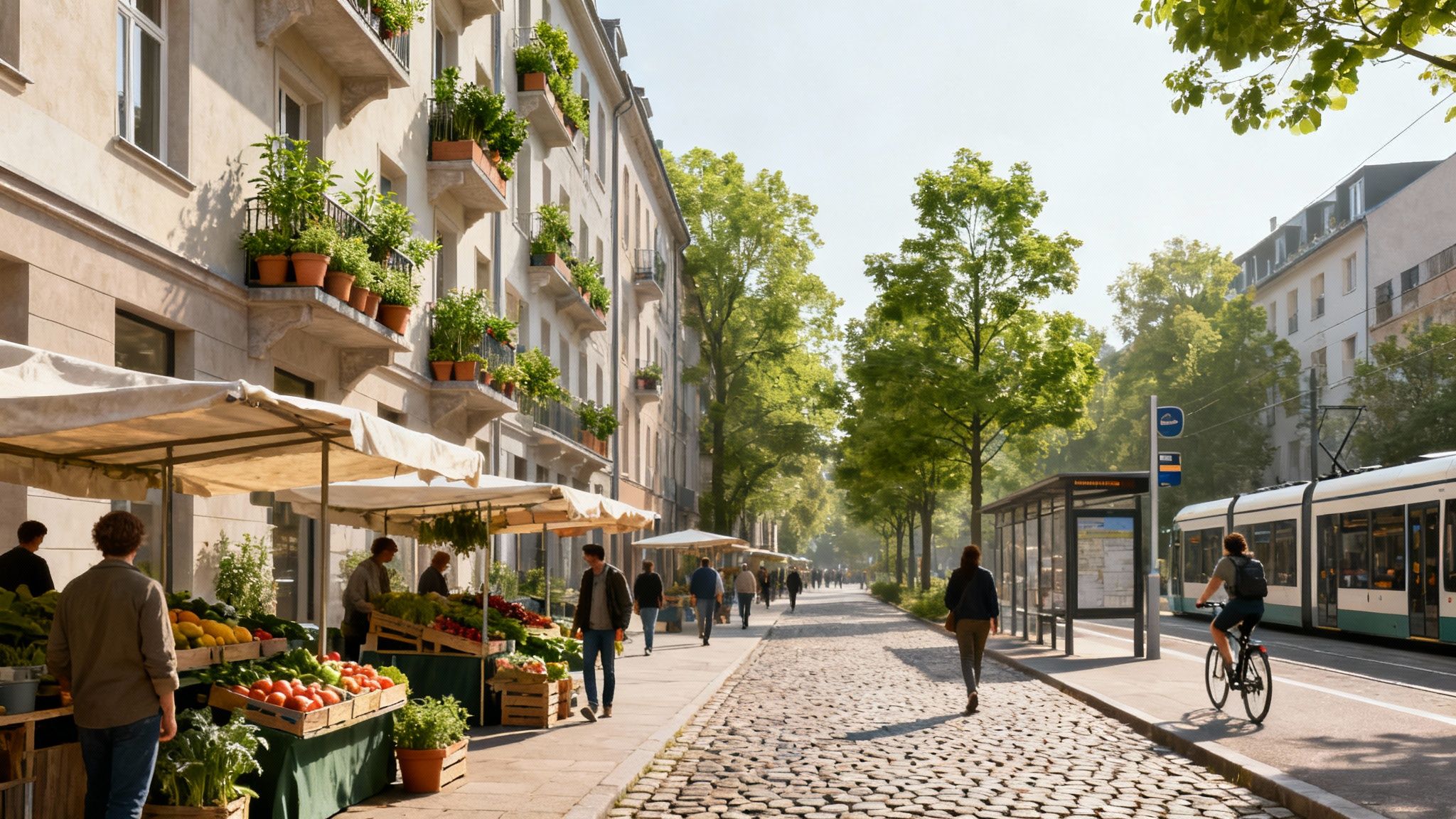
Your home base is the launchpad for all your slow adventures. A truly great one makes it easy—and genuinely enjoyable—to live like a local, mostly on your own two feet or with a simple transit pass. Forget the stress of rental cars; the ideal city lets you sink in effortlessly.
Here’s a practical checklist to help you find that perfect hub:
- Excellent Public Transportation: You’re looking for a solid network of trams, buses, or a metro that’s frequent, affordable, and easy to figure out. This is your ticket to seamless day trips and exploring the surrounding region.
- Pedestrian-Friendly Core: The city center should practically invite you to get lost on foot. Think wide sidewalks, car-free zones, and public squares that encourage you to just wander without a plan.
- Vibrant Local Markets: Access to a daily or weekly market is the hallmark of a great base city. It’s where you can buy fresh, local food, try out a few words of the language, and just watch the rhythm of daily life unfold.
- Accessible Green Spaces: Parks, riverside paths, and botanical gardens are essential. They offer a free, beautiful place to relax, read a book, and recharge after a day of exploring.
Case Study Cities: Ljubljana and Kyoto
To see how all this works in the real world, let’s look at two cities that absolutely nail the walkable, slow travel approach.
Ljubljana, Slovenia: Often called Europe’s “Green Capital,” Ljubljana is a dream for slow travelers. Its entire city center is a pedestrian-only zone, crisscrossed by charming bridges over the Ljubljanica River. With a massive central market, a castle perched above the old town, and an efficient public transit system, it’s an incredibly livable home base for exploring Slovenia’s stunning mountains and lakes.
Kyoto, Japan: While Kyoto is a big city, it feels more like a collection of intimate, walkable villages. Every neighborhood has its own unique character, from the historic geisha district of Gion to the quiet magic of the Arashiyama Bamboo Grove. The city’s superb bus and subway network makes getting around simple, and its deep cultural roots invite you to slow down and notice the details—a hidden temple, a traditional tea house, or a peaceful garden.
Both are brilliant choices, but for more ideas, check out our guide to the best cities for digital nomads.
Low-Impact Travel Tools (Worth It)
Also, if you’re planning a trip and want to keep things simple, these tools help you travel smoother while staying mindful about impact.
Get an eSIM for reliable data → Disclosure: Partner link. No extra cost to you.
Pre-book a transfer for easy arrivals → Disclosure: Partner link. No extra cost to you.
Frequently Asked Questions About Slow Travel
Got questions? You’re not alone. Here are some of the most common things people ask when they’re thinking about shifting to a slower, more intentional style of travel. We’ll clear up a few myths and give you some straight answers to help you plan your next trip.
Is slow travel only for long-term travelers or digital nomads?
Not at all. While the slow travel mindset is a perfect match for digital nomads, you can apply its ideas to any trip, no matter how short. Even on a one or two-week vacation, it’s about choosing to go deep in one city or region instead of racing through a checklist of different places. It’s a shift in focus: connection over coverage.
How do I find authentic local experiences?
The secret is to step just a little way off the main tourist trail. Wander through a local market, sign up for a cooking class, or just learn a few basic phrases in the local language. Using public transport and asking for a recommendation from the person who makes your morning coffee can open up some of the best, most genuine moments of a trip. Staying in a residential neighborhood instead of the central hotel district is another great way to feel the real rhythm of a place.
Is traveling by train in Europe or Asia difficult to navigate?
It’s surprisingly easy—and often far more efficient than flying. Most countries have fantastic, well-connected rail networks with clear signs, many of which are in English. Planning tools like Trip.com make it simple to map out routes and book tickets before you even leave home. Best of all, major train stations are almost always right in the city center, saving you the time and money you’d otherwise spend getting to and from a distant airport.
What is the biggest benefit of slow travel?
The single biggest win is a deeper, more meaningful connection to the place you’re visiting. This approach helps you avoid travel burnout, leaves room for spontaneous discoveries, and is significantly kinder to the environment. It can even be easier on your wallet, as longer stays often come with discounts and you’re spending less on hopping between cities.
How can I stay connected with data while traveling slowly?
Using an eSIM is the easiest and often cheapest way to stay connected, especially if you’re crossing borders. Services like Airalo or Yesim let you buy regional data plans and install them on your phone digitally. That means you have reliable internet the second you arrive, without having to hunt for a shop and swap out physical SIM cards.
What is zero-waste packing?
Zero-waste packing is all about minimizing single-use items to shrink your environmental footprint. This means swapping liquids for solids (like shampoo bars and toothpaste tablets), always carrying a reusable water bottle (ideally with a filter), and packing a tote bag for shopping. It also encourages a minimalist wardrobe with versatile pieces, which usually means lighter, easier-to-manage luggage.
How much should I budget per day for a slow travel trip in Europe?
This can vary a lot by country, but a good mid-range estimate for Western Europe is around $70-$100 USD per day. You can hit this by booking longer-term apartment rentals, cooking some of your own meals, and relying on public transport. In Eastern Europe, you can often travel comfortably for much less, sometimes around $40-$60 USD per day.
Can I travel slowly with a family?
Absolutely. In fact, slow travel is fantastic for families because it cuts down on the stress of constantly packing up and moving. Renting an apartment gives you a comfortable home base with a kitchen, and the slower pace allows for more relaxed days, random park visits, and the downtime that kids (and adults) really need.
What is a regenerative stay?
A regenerative stay goes a step beyond just being “eco-friendly.” It’s an accommodation that actively works to improve its local environment and community. Think of a hotel that runs a local conservation project, a guesthouse that sources 100% of its food from nearby organic farms, or a business that invests its profits back into community development. It’s about leaving a place better than you found it.
How far in advance should I book trains for a European trip?
For the major high-speed routes, booking 2-3 months ahead usually gets you the best prices. For regional trains, though, you can often buy tickets just a few days in advance or even on the day of travel. If you want maximum flexibility, a rail pass lets you decide your travel days as you go, but just remember you might still need to make seat reservations on the most popular high-speed lines.
Key Takeaways for Embracing Slow Travel
If you’re ready to trade frantic sight-seeing for something more meaningful, these are the core ideas of slow travel. Think of them as simple reminders for planning your next trip with less rush and more reward.
Prioritize Depth Over Distance: Forget the tourist checklist. Instead of racing through multiple cities, choose one region and really get to know it. This shift from skimming surfaces to genuine immersion is what makes a trip unforgettable.
Embrace Overland Travel: This is the single biggest environmental win you can make. Swapping just one flight for a train journey can slash your travel emissions by up to 90%. It’s a powerful choice that reshapes your entire itinerary for the better.
Stay Longer to Save More: Slow travel is surprisingly budget-friendly. Booking a single apartment for a few weeks often unlocks big weekly or monthly discounts. With your own kitchen, you can shop at local markets and cook for yourself, saving a small fortune on meals.
Select a Walkable Home Base: Choose a city with great public transit and neighborhoods made for walking. This lets you live more like a local, discover hidden gems on foot, and dramatically reduce your reliance on cars or taxis.
Support Local and Regenerative Economies: When you stay longer, your money has more power. You can consciously choose to spend at small, family-owned shops, eat at neighborhood restaurants, and support regenerative stays that actively benefit the local community and environment.
This article was fact-checked using sustainability data from the World Green Building Council, the Global Ecotourism Network, and peer-reviewed architecture studies. All partner links are vetted for compliance with sustainable business certifications.
Join the Sustainable Work Movement
Want more rail-first itineraries, low-impact packing systems, and walkable base-city ideas?
