

Sustainable tourism isn’t just about putting your recycling in the right bin at the hotel. It’s a bigger, more thoughtful way of moving through the world—one that aims to benefit local communities, protect cultural heritage, and preserve the environment all at once. This guide to sustainable tourism will give you practical tips for responsible travel.
Think of it as the difference between being a guest and being a customer. Instead of contributing to the extractive, often damaging, nature of mass tourism, this approach is about creating a positive cycle where your presence actually helps a place thrive.
The Heart of Sustainable Tourism
At its core, sustainable tourism is more of a philosophy than a checklist. It’s built on the simple idea that our adventures should enrich both us and the destination. Instead of just taking memories and photos, we’re encouraged to leave a place a little better than we found it.
This is especially true for digital nomads and slow travelers. When you stay in one place for weeks or months, your impact—for good or for bad—gets magnified. Your daily choices about where you eat, shop, and live become part of the local fabric.
The whole concept rests on three interconnected pillars. Imagine a three-legged stool: if one leg is weak, the whole thing wobbles. Each pillar has to work with the others to support a destination’s long-term health.
The Three Foundational Pillars
These pillars give us a framework for making better, more informed choices on the road. They ensure a balanced, holistic approach that goes far beyond just “green” travel.
- The Environmental Pillar: This is the one most people know. It’s all about conserving natural resources by minimizing your carbon footprint, cutting down on waste, and protecting biodiversity. Choosing a cross-country train journey instead of a short-haul flight is a perfect example of this pillar in action.
- The Social Pillar: This one is all about people and culture. It means respecting local traditions, supporting human rights, and making sure tourism actually benefits the host community. It can be as simple as learning a few phrases in the local language or hiring a local guide who can share authentic stories about their home.
- The Economic Pillar: This pillar is designed to keep the money you spend circulating within the local economy. It’s about consciously choosing to support locally-owned businesses—from family-run guesthouses to artisan craft shops—instead of huge, foreign-owned chains. This helps create stable jobs and gives communities the power to shape their own future.
To make this clearer, here’s how the three pillars look side-by-side.
The Three Pillars of Sustainable Tourism at a Glance
This table breaks down the three core components of sustainable tourism, providing clear examples for each pillar to help travelers understand the concept in practical terms.
| Pillar | Core Principle | Actionable Example for Travelers |
|---|---|---|
| Environmental | Conserve natural resources and protect ecosystems. | Choosing a night train over a short-haul flight to reduce your carbon footprint. |
| Social | Respect local culture and ensure benefits reach the community. | Hiring a guide from the local community for an authentic, respectful cultural tour. |
| Economic | Support local businesses to keep money within the destination. | Staying at a family-owned guesthouse instead of a large international hotel chain. |
Thinking in terms of these pillars helps turn an abstract idea into a series of clear, repeatable actions you can take on any trip.
This isn’t just a niche idea anymore; it’s rapidly becoming a major force in the travel industry. The sustainable tourism market is projected to grow from $3.11 billion in 2025 to an incredible $10.50 billion by 2032.
That kind of explosive growth signals a fundamental shift in how we explore the world. With nearly 70% of travelers planning to prioritize minimizing their environmental impact, the demand for truly sustainable options is reshaping the entire sector. You can explore more data on the future of sustainable tourism to see just how quickly these trends are moving.
Putting the Three Pillars of Sustainable Tourism into Practice
Knowing the three pillars is one thing, but the real magic happens when you start applying them to your own travel habits. This is where big ideas become small, concrete actions that completely change how you see the world. It’s about making a series of intentional choices that add up to a real, positive impact on the places you visit.
This isn’t about giving up the joy of travel. Far from it. It’s about making your journey richer by connecting more deeply with a place and its people. Every decision—from the train ticket you book to the souvenir you bring home—is a chance to build a healthier, more fair travel ecosystem. When you consciously think about each pillar, you stop being a passive tourist and become an active partner in preserving the world’s beauty and culture.
This concept map helps visualize how the environmental, social, and economic branches all work together, holding up the core idea of sustainable tourism.
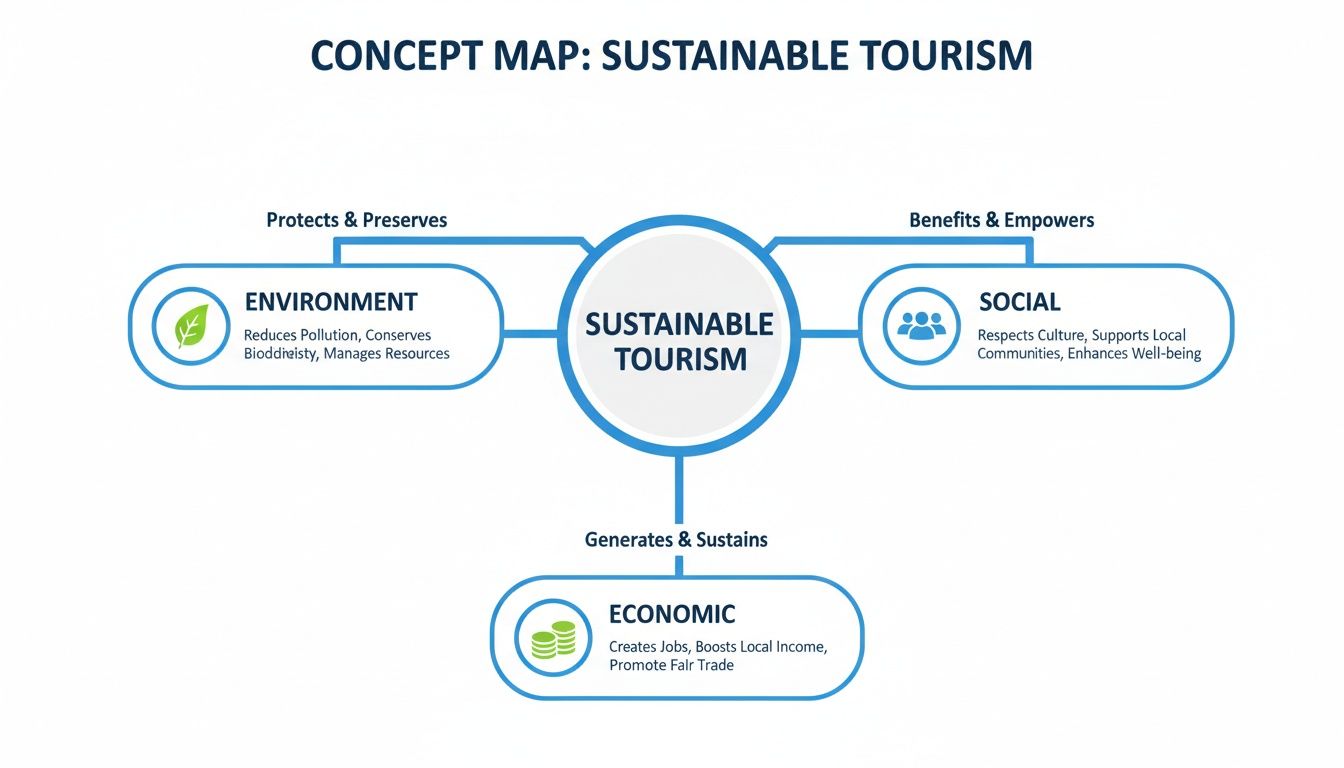
As you can see, a truly sustainable approach is a balancing act. You can’t just focus on one area and ignore the others; they are completely interconnected.
The Environmental Pillar in Action
Shrinking your environmental footprint often begins before you’ve even packed your bags. This pillar is probably the most tangible of the three, giving you clear, immediate ways to reduce your impact.
One of the most powerful moves you can make is choosing low-impact transport. Simply opting for a train instead of a short-haul flight slashes your carbon emissions. A flight from London to Paris, for example, pumps out around 14 times more CO2 per passenger than the same journey by rail. You can find efficient train options on platforms like Trip.com for countless routes.
Beyond getting there, a few simple habits make a huge difference:
- Pack for zero-waste: Tossing a reusable water bottle, coffee cup, and a few solid toiletries into your bag is a tiny change that prevents a mountain of single-use plastic waste.
- Be mindful of resources: Treat water and energy at your accommodation like they’re your own. Flip off the lights and AC when you head out, and keep showers reasonably short.
- Leave no trace: When you’re out hiking or exploring natural parks, stick to the marked trails and pack out everything you packed in. The goal is to leave wild places exactly as you found them.
The Social Pillar in Action
The social pillar is all about people, culture, and basic human respect. It’s about making sure your visit is a positive two-way exchange that honors local traditions and empowers the community you’re visiting. Authentic engagement is everything here.
Start small by learning a few words in the local language—”hello,” “thank you,” and “please” go a long way. It’s a simple gesture of respect that often opens the door to more genuine interactions. And, of course, always ask permission before you take someone’s picture.
Supporting locally-owned businesses is another cornerstone of this pillar. When you eat at a family-run restaurant or stay in a local guesthouse, your money stays in the community, helping it thrive. When you’re looking for things to do, find out what makes a tour truly sustainable by finding guides who are actually from the area and can share real, lived-in stories.
The Economic Pillar in Action
Finally, the economic pillar is about making sure your travel budget directly benefits the people whose home you’re visiting. Think of your spending as a tool for good.
By consciously directing your money toward local enterprises, you help build a resilient local economy that isn’t dependent on foreign corporations. This fosters economic stability and empowers residents to preserve their cultural and natural heritage.
Here’s how to put your money where it really counts:
- Hire local guides: They provide priceless knowledge, and your fee goes directly to supporting their family and community.
- Buy from artisans: Purchase souvenirs and crafts straight from the people who made them, not from shops selling mass-produced trinkets.
- Dine at local restaurants: Seek out places that proudly source their ingredients from nearby farms and producers. Your meal supports an entire local supply chain.
How to Plan Your Low-Impact Itinerary
Putting sustainable principles into practice really starts with your itinerary. This is where the big ideas turn into real-world choices that add up, shaping your trip from the ground up to be as rewarding for you as it is gentle on the planet.
Think of it this way: every decision, from the train you book to the neighborhood you use as your base, is a building block. Crafting a low-impact itinerary isn’t about ticking boxes or sacrificing adventure; it’s about being deliberate and discovering a smarter, more connected way to travel.
And the single biggest piece of that puzzle? How you get from A to B. This one choice can easily be the largest chunk of your trip’s carbon footprint, making it the perfect place to start.

Prioritizing Rail and Low-Carbon Transport
Transportation is the heavyweight champion of your carbon footprint. While long-haul flights are sometimes the only practical way to cross continents, overland travel is almost always the cleaner choice for regional journeys.
It’s not even close. A train journey, for instance, just blows flying out of the water on emissions. A flight between two major European cities can pump out up to 14 times more CO2 than the same trip on a high-speed train. For digital nomads and anyone practicing slow travel, embracing the rails is one of the most powerful moves you can make.
Think beyond the flight booking engine:
- High-Speed and Regional Trains: These are your best friends for zipping between cities and diving deep into a region. Platforms like Trip.com are great for mapping out and booking routes across Europe and Asia.
- Night Trains: My personal favorite. You cover huge distances while you sleep, save a night on accommodation, and wake up fresh in a new city. It’s efficient, comfortable, and seriously low-carbon.
- Ferries and Buses: On certain routes, these are solid, lower-carbon alternatives to quick, polluting short-haul flights.
When a flight is truly unavoidable, you can still be smart about it. Use a flight tool like Aviasales, which often shows emission estimates and helps you find direct routes. Remember, takeoffs and landings burn the most fuel, so fewer connections mean fewer emissions.
For some serious ground-first inspiration, check out these flight-free travel itineraries.
Choosing Accommodations for Sustainable Tourism
Where you sleep is the next big piece of the puzzle. The hospitality industry has a massive environmental footprint—think energy, water, and mountains of waste. The good news is that more hotels and guesthouses are finally starting to clean up their act.
The catch? “Greenwashing” is everywhere. It’s easy to slap a green leaf icon on a website without doing any of the hard work. To find places that are genuinely walking the walk, look for real, third-party certifications.
Certifications like Green Globe, EarthCheck, and B Corp aren’t just marketing fluff. They require businesses to pass rigorous, audited checks on their environmental and social impact. They’re a reliable shortcut to finding the good guys.
When you’re browsing, look for properties that are open about what they do. Do they hire local staff? Source food from nearby farms? Have real programs to conserve water and energy? These are the details that signal a true commitment to sustainable tourism.
Designing Your Trip Around Walkable Base Cities
Your choice of a “base city” can quietly slash your daily carbon footprint. Picking a walkable city with great public transit means you can ditch the rental car and endless rideshare trips, which cause both emissions and soul-crushing traffic jams.
By settling into a central, walkable neighborhood, you can explore on foot, by bike, or on the local tram. This isn’t just better for the planet—it’s a better way to travel. You make spontaneous discoveries, find hidden gems, and build a real connection with the place.
Before you book anything, pull up a map. Check an area’s walkability and how close it is to a metro or bus stop. A well-chosen base makes sustainable travel feel completely natural and effortless.
One final tech tip: to stay connected without creating plastic waste, use an eSIM from a provider like Airalo for your data. It’s a small, smart choice that fits perfectly into a low-impact travel philosophy. When you pull all these threads together, you create a journey that’s sustainable from start to finish.
Understanding the Challenges of Modern Travel
To really get why sustainable tourism matters, it helps to first look at the problems it’s trying to solve. The freedom to explore our world is an incredible gift, but the sheer scale of modern travel is creating serious headaches for the very destinations we love. It’s a classic case of too much of a good thing.
When a popular spot gets swamped with visitors—a phenomenon we now call overtourism—the results can be corrosive. Local infrastructure like public transport, water systems, and waste management gets pushed to the brink. This strain doesn’t just harm the environment; it wears down the quality of life for the people who actually call that place home.
The paradox is that while more of us want to be responsible travelers, the total volume of travel just keeps climbing. Our collective footprint gets bigger even as our individual intentions get better.
The Growing Impact of Tourist Footprints
The numbers tell a pretty stark story. International tourism arrivals hit 1.1 billion tourists from January to September 2025 alone, blowing past pre-pandemic levels. At the same time, there’s been a positive shift in mindset, with 69% of travelers now aiming to ‘leave places better than they found them’.
But good intentions are struggling to keep up with the overwhelming volume. Without a serious change of course, tourist-generated waste is projected to hit 205 million tonnes annually by 2034. Right now, tourists generate about 3.5 pounds (1.6 kg) of waste per person daily—roughly double the global average. You can read more on how the industry is responding to this challenge and see why making sustainable choices is so vital.
This data highlights a critical disconnect. We want to do better, but our collective habits are creating unsustainable pressure. Every plastic bottle left behind and every long, wasteful shower adds up when multiplied by millions.
Resource Strain and Cultural Erosion
Beyond just waste, mass tourism puts a heavy load on essential resources. In many sunny, dry destinations, the tourism industry’s thirst for water—for swimming pools, golf courses, and daily hotel operations—can create shortages for the local community. Energy consumption also tends to spike hard during peak seasons.
This is where the principles of sustainable tourism become so crucial. It’s not just about offsetting your flight emissions, which is a complex topic all on its own (you can learn more in our guide on whether carbon offsets are truly effective). It’s about making conscious choices that reduce this direct strain on the ground.
When you travel with this awareness, you become part of the solution. You help ensure the beauty, culture, and resources that draw you to a place will still be there for future generations to enjoy. Even small, responsible steps in your planning phase, like using reliable services like Welcome Pickups for efficient airport transfers or securing VisitorsCoverage for travel insurance, contribute to a smoother, less impactful journey. These choices connect your actions directly to the preservation of the destinations you explore.
Essential Gear and Tech for the Responsible Traveler
How you pack is where sustainable tourism stops being an idea and becomes a real-world habit. The gear in your bag directly shapes your footprint, influencing everything from the plastic you leave behind to the resources you use on the ground. A few smart choices can dramatically cut waste, lighten your load, and make your travel feel more intentional.
This isn’t about running out to buy a bunch of expensive new gadgets. It’s about shifting your mindset toward minimalism and resourcefulness. Swapping a few everyday items makes a massive difference. Think solid toiletries—shampoo bars, conditioner bars, and toothpaste tablets are absolute game-changers. They eliminate plastic bottles and make sailing through airport security liquid checks a breeze. In the same way, carrying a reusable water bottle and coffee cup stops a mountain of single-use plastic from ever being created.

Building Your Zero-Waste Packing System
Putting together a zero-waste packing system is far simpler than it sounds. The whole idea revolves around choosing durable, multi-purpose items that will survive years of travel, not just one or two trips.
- Solid Toiletries: Shampoo, conditioner, and soap bars last much longer than their liquid counterparts, weigh less, and generate zero plastic waste.
- Reusable Containers: A high-quality water bottle is a must. Add a collapsible coffee cup and a compact set of reusable cutlery to sidestep single-use plastics when you’re eating on the move.
- Durable, Minimalist Gear: Invest in well-made equipment that you won’t have to replace every year. A versatile travel backpack made from recycled materials is a perfect example. You can find more ideas in our complete guide to eco-friendly gear for digital nomads.
Editor’s Pick Sustainable Travel Backpack
For a backpack that balances durability, thoughtful design, and a low environmental impact, we recommend the Osprey Sojourn Porter 46L. Made with bluesign®-approved recycled fabrics and a PFC-free water-repellent coating, it’s built to handle serious travel without relying on harmful chemicals. Its versatile carry options and practical organization make it a solid choice for minimalist, long-term travelers who need gear that lasts.
Essential Tech for Smarter Sustainable Tourism
Technology also has a big part to play in cutting waste and traveling more efficiently. One of the easiest and most impactful tech swaps you can make is to ditch physical SIM cards, which are just tiny pieces of plastic that quickly become e-waste.
Using an eSIM (or embedded SIM) lets you download a data plan straight to your phone. Services like Airalo or Yesim offer affordable plans in hundreds of countries, completely removing the plastic waste and the annoying hunt for a local SIM card shop the moment you land. This small digital shift aligns perfectly with the principles of sustainable tourism by cutting out unnecessary physical production and waste.
Winding Up Your Sustainable Tourism Journey
Think of sustainable tourism less as a strict set of rules and more as a rewarding way to see the world. It’s about shifting your mindset from being a passive visitor to an active partner in keeping the places you love healthy and whole. When you balance the environmental, social, and economic sides of a trip, you’re not just on vacation—you’re a positive force.
This whole journey is built on small, deliberate choices that add up. It’s the decision to take the train instead of a short flight, to pack a reusable water bottle, or to eat at a family-run konoba instead of a global chain. Each choice sends a clear signal: your visit supports local families, protects delicate ecosystems, and respects living cultures.
Your choices are powerful. They feed into a global movement that helps ensure the world’s wonders are still here for generations of travelers to come.
Key Takeaways to Remember
- Prioritize Low-Impact Transport: Whenever you can, choose trains over planes for regional travel. It’s one of the single biggest ways to shrink your carbon footprint.
- Support Local Economies Directly: Spend your money at locally owned guesthouses, restaurants, and artisan shops. This ensures your funds actually stay in the community.
- Pack for Zero Waste: Simple gear like solid toiletries and a reusable water bottle makes a huge difference in cutting down single-use plastic.
- Verify Sustainability Claims: Don’t just take a hotel’s word for it. Look for credible third-party certifications like Green Globe or EarthCheck to sidestep greenwashing.
- Engage with Respect: Learning a few words of the local language and observing cultural norms isn’t just polite—it creates a genuine, two-way exchange.
A Few Common Questions About Sustainable Travel
Even with a clear framework, a few practical questions always pop up. Here are some quick answers to the things travelers often ask when trying to put these ideas into practice.
What’s the Difference Between Ecotourism and Sustainable Tourism?
It’s easy to mix these two up, but the difference is simple when you think of it visually. Sustainable tourism is the big-picture idea—the entire umbrella that covers the environment, local communities, and the economy.
Ecotourism is just one specific spoke under that umbrella. It zooms in on travel to natural areas, focusing almost entirely on conservation and the well-being of people who live near those wild places. So, while all true ecotourism is sustainable by definition, not all sustainable travel is ecotourism (a trip to a walkable, transit-rich city like Copenhagen, for instance).
Can I Travel Responsibly Without a Big Budget?
Yes, absolutely. In fact, a lot of sustainable travel habits are naturally budget-friendly. It’s a common myth that you have to spend more to be a responsible traveler.
Think about it: choosing a night train over a flight doesn’t just cut emissions; it saves you the cost of a hotel room for one night. Eating at a small, family-run restaurant is almost always cheaper than a tourist-trap chain, and the money stays right there in the community. The same goes for staying in a locally-owned guesthouse instead of a huge international hotel. It’s more about making mindful choices than shelling out more cash.
How Can I Tell if a Hotel Is Genuinely Eco-Friendly?
This is a real challenge, especially with so much “greenwashing” out there. Any business can call itself “green,” but the proof is in the details. The most reliable shortcut is to look for a legitimate, third-party certification.
Seals of approval from organizations like Green Globe, EarthCheck, or B Corp aren’t just marketing fluff. To get them, a business has to go through a tough, audited assessment of its real-world environmental and social practices. Seeing one of those logos is a strong signal that a hotel is walking the walk, not just talking the talk.
This article was fact-checked using sustainability data from the World Green Building Council, the Global Ecotourism Network, and peer-reviewed architecture studies. All partner links are vetted for compliance with sustainable business certifications.
Join the Sustainable Work Movement
Want more rail-first itineraries, low-impact packing systems, and walkable base-city ideas?
FAQ: Sustainable Tourism Questions (Answered Simply)
Quick answers to the most common questions about sustainable tourism, responsible travel, and how to reduce your impact without sacrificing the fun.
What is sustainable tourism in simple terms?
Sustainable tourism means traveling in a way that protects nature, respects local culture, and supports local jobs. The goal is to enjoy a destination without harming it, while helping communities benefit from tourism long-term.
What are the 3 pillars of sustainable tourism?
The three pillars are environmental (reduce waste and emissions), social (respect culture and people), and economic (support local businesses so money stays in the community).
What’s the difference between ecotourism and sustainable tourism?
Sustainable tourism is the big umbrella—any trip can be sustainable if it protects the environment and benefits locals. Ecotourism is a narrower category focused on natural areas and conservation-based experiences.
Can I travel responsibly on a budget?
Yes. Responsible travel is often cheaper because it leans into public transit, local food, slow travel, and fewer “tourist trap” add-ons. Night trains can also replace a hotel night while cutting emissions.
What is the most impactful change I can make for sustainable tourism?
If you can do only one thing: choose lower-carbon transport whenever possible. Trains, buses, and shared transit typically have a much smaller footprint than short-haul flights.
Most Impactful Sustainable Tourism Change: Choose Low-Carbon Transport First
How do I avoid greenwashing when booking hotels?
Look for third-party certifications and transparent details, not vague slogans. Helpful signs include real reporting on energy/water use, local staffing, refill stations, and credible badges like Green Globe, EarthCheck, or B Corp.
What are easy sustainable tourism habits I can do every day?
Start with simple defaults: carry a reusable bottle, pack solid toiletries, refuse single-use plastics, use public transit, and be mindful with energy and water in your accommodation.
How do I support local communities while traveling?
Prioritize locally owned stays, restaurants, markets, and tours. Hiring a local guide and buying from artisans keeps your spending in the local economy and supports cultural preservation.
Is carbon offsetting enough to make travel sustainable?
Offsets can help, but they’re not a “free pass.” The strongest approach is reduce first (train over plane, lighter packing, fewer trips), then offset the unavoidable emissions with reputable programs.
How can digital nomads practice sustainable tourism long-term?
Slow down and choose walkable base cities. Stay longer, use local transit, shop local, and respect neighborhood norms. Longer stays reduce frequent transport emissions and create more meaningful community impact.