
Sustainable travel and tourism is all about exploring the world in a way that leaves a positive mark on the environment, culture, and economy of the places you visit. This guide to sustainable travel and tourism goes way beyond just carrying a reusable water bottle—it’s about making conscious choices that directly benefit local communities and help preserve natural beauty for everyone who comes after us.
When people hear “sustainable travel,” many picture expensive eco-lodges or giving up all comfort. But the real idea is much simpler and more accessible than that. It’s about creating a better travel experience—for you and for the destination you’re visiting.
This whole approach is built on a simple truth: every decision we make when we travel, from the train ticket we book to the souvenir we buy, has a ripple effect.

This mindset isn’t a niche interest anymore. It is a powerful movement shaping how we explore the globe. The global sustainable tourism market is currently valued at USD $3.56 trillion and is on track to hit an incredible USD $11.39 trillion by 2034.
What’s driving this? A massive shift in traveler values. A full 84% of travelers now say that sustainability is a key factor when they plan their trips. You can explore more on the incredible growth in the sustainable tourism market. This article was fact-checked using sustainability data from the World Green Building Council, the Global Ecotourism Network, and peer-reviewed architecture studies. All partner links are vetted for compliance with sustainable business certifications.
Beyond the Buzzword: What is Sustainable Travel and Tourism?
Shifting from Extractive to Regenerative Travel
For a long time, tourism could be extractive, taking more from a place than it gave back. This often leads to overcrowded landmarks, strained local resources, and money that never actually reaches the people who live there. Sustainable travel and tourism flips that model on its head, aiming for something regenerative instead.
A regenerative approach focuses on leaving a place better than you found it. This can mean:
- Supporting local economies: Choosing a family-run guesthouse over a multinational hotel chain makes sure your money stays in the community.
- Protecting natural environments: Opting for a train instead of a short-haul flight dramatically slashes your carbon emissions.
- Honoring cultural heritage: Hiring local guides and buying from artisans fosters respect and helps keep traditions alive.
This guide will break down these ideas into simple, actionable steps. We believe that truly understanding the core principles of sustainability in travel and tourism is the first step toward planning more meaningful journeys.
By making small, informed choices, you contribute to a healthier planet and a more equitable world—all while making your own adventures richer. It’s a win-win that can completely change how we see and connect with the places we visit.
Understanding the Three Pillars of Sustainability
True sustainable travel and tourism rests on a sturdy, three-legged stool—not just a single plank. It’s easy to focus on the environmental side of things. However, for travel to be genuinely sustainable, it has to balance ecological health with social fairness and economic viability.
This balanced approach is what turns a simple trip into a positive force for the destination.

Think of these three pillars—Environmental, Social, and Economic—as interconnected gears. When one turns, the others move with it. A decision that benefits the local economy but harms the environment isn’t sustainable in the long run. Likewise, an eco-friendly project that displaces local people fails the social test.
Global frameworks from organizations like the Global Sustainable Tourism Council (GSTC) are built on this very principle of interdependence.
The Environmental Pillar: Protecting Our Planet
This is the pillar most of us picture when we hear “sustainability,” and for good reason. It’s all about minimizing our negative impact on the natural world. This means reducing pollution, conserving resources, and protecting biodiversity in the places we visit. Ultimately, it’s about being a good guest in nature’s home.
Making environmentally conscious choices is more straightforward than you might think. For example:
- Choosing low-carbon transport: Opting for a train instead of a short-haul flight can slash your travel emissions by up to 90%.
- Reducing waste: Carrying a reusable water bottle and coffee cup drastically cuts down on single-use plastics.
- Conserving resources: Being mindful of water and electricity use in your accommodation helps lessen the strain on local infrastructure.
These actions directly shrink your travel footprint. To get a clearer picture of your impact, it helps to understand the difference between your broader environmental footprint vs carbon footprint, as carbon is just one piece of the puzzle.
The Social Pillar: Championing People and Culture
The social pillar shifts the focus to the well-being of local communities. It’s about ensuring that tourism respects local traditions, supports human rights, and contributes positively to the social fabric of a destination. After all, a place is defined by its people, not just its landmarks.
This involves engaging with local culture in a way that is respectful and authentic, not exploitative. It’s about seeing communities as partners in your travel experience, not as a backdrop. You can support this pillar by:
- Hiring local guides: They offer invaluable insights and your money directly supports their livelihood.
- Learning basic phrases: A simple “hello” or “thank you” in the local language shows genuine respect.
- Asking permission before taking photos: This small gesture acknowledges people’s privacy and dignity.
This approach ensures cultural exchange is mutual and respectful, enriching both you and the host community. When you need a ride from the airport, a service like Welcome Pickups often works with local drivers, starting your trip on the right foot.
The Economic Pillar: Supporting Local Livelihoods
Finally, the economic pillar makes sure the financial benefits of tourism flow directly into the local economy. When your travel spending supports local businesses, it creates stable jobs and funds community projects. It also gives residents a tangible reason to protect their natural and cultural heritage.
Instead of your money being funneled to distant corporate headquarters, it stays where it can make a real difference. This is where your choices as a traveler have immense power. Here’s how you can make your spending count:
- Stay at locally-owned guesthouses: Choose small, independent accommodations over large international chains. You can often find great options on sites like Trip.com with no follow.
- Eat at local restaurants: Savoring authentic cuisine at a family-run cafe supports local suppliers and entrepreneurs.
- Buy from local artisans: Purchase souvenirs directly from the people who made them.
By making these simple shifts, you transform your vacation budget into a powerful tool for community development, completing the circle of sustainable travel.
How to Choose Your Transportation
Of all the choices you make when planning a trip, how you get from A to B is one of the most powerful. Your transportation can easily become the biggest part of your carbon footprint, so this decision really counts.
When we dig into the numbers, a clear picture forms—especially in the classic train versus plane debate. Tourism-related transport is responsible for 5% of worldwide carbon dioxide emissions. A single flight across Europe can easily pump out 1-2 tons (about 900-1800 kilograms) of CO2 per passenger. High-speed rail? Often just 10-30 grams per kilometer. With over 83% of global travelers saying sustainable travel is important to them, these numbers are hard to ignore.
But this is about more than just emissions. It’s about making the journey itself better.
Why Rail Travel Is a Game Changer for Sustainable Journeys
Let’s be clear: choosing the train isn’t a sacrifice. It’s an upgrade. Forget the familiar shuffle through airport security and the long waits at the gate. Train travel offers a slower, more connected way to see the world. It lets you glide through scenic countrysides while the landscape unfolds from a comfortable seat.
Better yet, trains usually deliver you right into the heart of a city. This simple fact cuts out the need for expensive and time-consuming airport transfers, saving you both money and hassle. You just step off the platform and you’re there, immediately immersed in your destination.
Europe’s expanding night train network adds another brilliant layer. You can board a sleeper in one capital and wake up refreshed in another. This effectively combines your travel and accommodation costs into one efficient, low-carbon journey. It’s a genuinely smart way to maximize your time and shrink your impact.
Comparing Your Options: A Data-Driven Look
To make a truly informed choice, it helps to see the numbers side-by-side. Let’s compare a popular European route—Paris to Barcelona—by both high-speed train and plane. Understanding the trade-offs in time, cost, and emissions is key to planning a trip that aligns with your values.
The chart below shows how progress on the three pillars of sustainability—environmental, social, and economic—is measured in the travel industry.
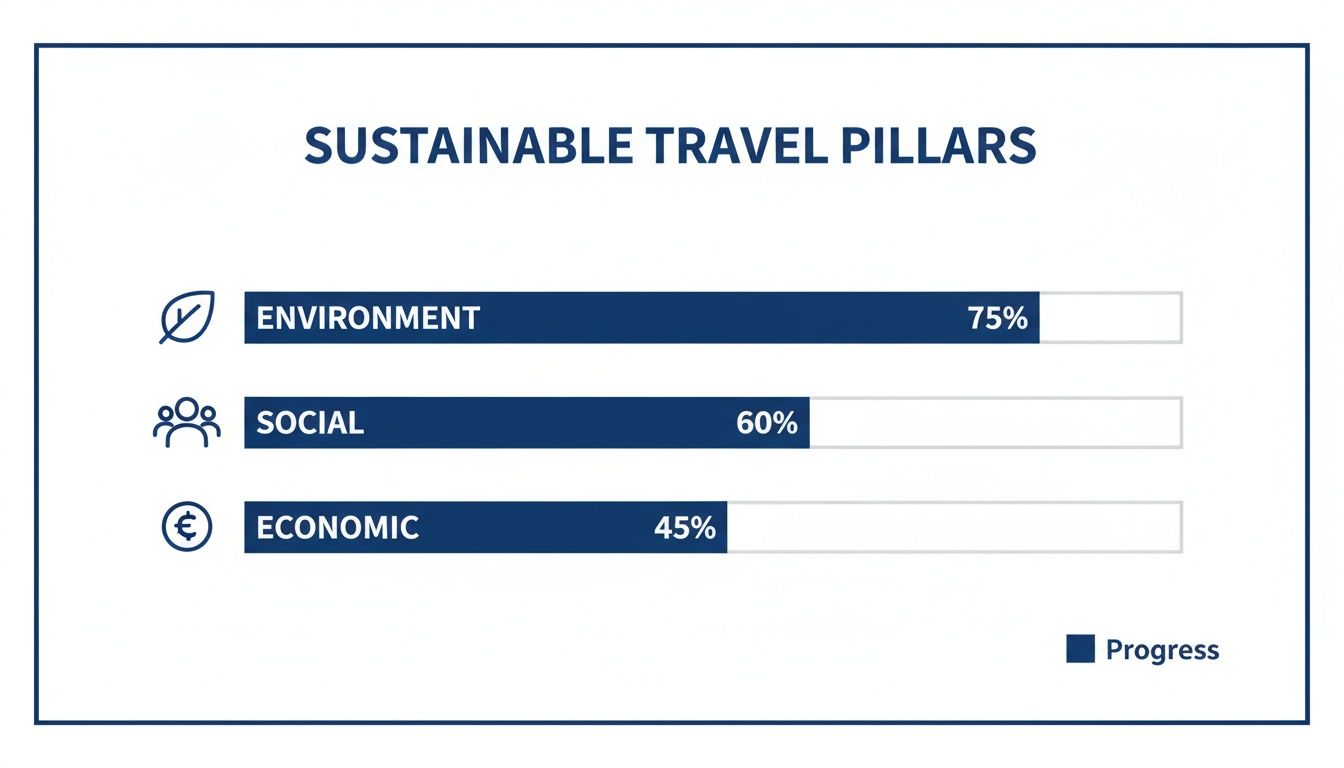
This visual reminds us that while environmental factors get a lot of attention, we still have work to do on the social and economic fronts to achieve a truly balanced approach.
Travel Mode Comparison Paris to Barcelona (One-Way)
Here’s a practical comparison of taking the high-speed train versus a plane for this popular European route. This breaks down the key metrics for sustainability and convenience.
| Metric | High-Speed Train (TGV) | Airplane (Economy Class) |
|---|---|---|
| Average CO2 Emissions per Passenger | ||
| Total Travel Time (City Center to City Center) | Approx. 7 hours | Approx. 5.5 hours (incl. airport transit, security) |
| Average Cost (Standard Ticket) | USD $80 – $180 | USD $60 – $200 (plus baggage fees) |
| Baggage Allowance | Generally more generous, less restrictive | Often includes extra fees for checked bags |
| Experience | Scenic views, spacious seating, city center arrival | Airport queues, cramped seating, travel to/from airport |
As the table makes clear, the train emits roughly 90% less CO2 than the plane for this journey. And while the total travel time might look longer on paper, that gap shrinks dramatically once you factor in getting to and from airports and navigating security lines.
For a precise look at your own itinerary’s impact, you can use a dedicated travel carbon emissions calculator for 2025 to compare different modes of transport. This makes it much easier to plan a trip that is both memorable and mindful.
How to Plan a Low-Impact Itinerary
Putting the ideas of sustainable travel and tourism into practice really starts with the plan. Thinking through a low-impact itinerary isn’t about restriction. It’s about making smarter, more meaningful choices from the moment you start dreaming about your next trip.
This practical roadmap will guide you through the key steps. We’ll cover everything from picking places to stay that actively help their environment to packing light and smart to cut down on waste along the way.
The goal here is to build an adventure that’s not just incredible for you but is genuinely good for the places you explore. It’s a journey of intention, where every choice, big or small, adds up to a more positive trip for everyone.
Choose Regenerative Stays
Your choice of accommodation has a massive ripple effect. Instead of large, international chains, seek out regenerative stays. These are places that actively work to leave their environment and community better than they found it.
This could be an eco-lodge powered by solar panels or a family-run guesthouse that sources all its food from local farmers. These spots usually have smaller footprints, and your money goes directly into supporting the local economy. When you’re booking, use filters to search for properties with recognized eco-certifications.
Looking for vetted options can be time-consuming. Platforms like Trip.com with no follow are getting better at highlighting properties with sustainability practices, making it easier to find a stay that aligns with your values. And remember to always have travel insurance, like the options from VisitorsCoverage, for peace of mind.

Master Zero-Waste Packing
Packing with purpose is a cornerstone of any low-impact itinerary. The less you bring, the lighter your footprint. More importantly, what you pack can drastically reduce the single-use junk you create at your destination.
Start with the basics of a zero-waste travel kit:
- Solid Toiletries: Shampoo bars, conditioner bars, and solid soap get rid of the need for tiny plastic bottles.
- Reusable Water Bottle: This one is non-negotiable for cutting out endless plastic water bottle purchases.
- Reusable Cutlery & Straw: A simple bamboo or metal set helps you say no to disposable plastics at food stalls and cafes.
- Tote Bag: A foldable cloth bag is perfect for groceries and souvenirs, helping you avoid plastic bags.
This minimalist approach doesn’t just help the environment—it also simplifies your journey. Consequently, it makes navigating cities and train stations a whole lot easier.
Engage Respectfully with Local Communities
At its heart, sustainable travel is about people. Engaging with local communities in a respectful and supportive way enriches your experience and ensures tourism is a positive force.
One of the best ways to do this is by hiring local guides. Their firsthand knowledge offers a depth of understanding you’ll never get from a guidebook, and your payment directly supports their family. Similarly, when shopping for souvenirs, buy authentic crafts directly from artisans rather than mass-produced trinkets. This helps preserve cultural heritage and provides a fair wage. For easy connectivity to find local guides or businesses, an eSIM from Airalo with no follow or Yesim with no follow can be incredibly helpful.
By investing in local guides, artisans, and businesses, you’re not just a tourist; you’re a temporary participant in the local economy, contributing to its resilience and vitality.
Understand and Offset Your Footprint
Even with the most careful planning, some carbon emissions are unavoidable. The first step is to get a handle on your impact. Use a simple carbon calculator to estimate the emissions from your transportation and activities.
Once you have a number, you can offset these emissions by investing in certified projects that reduce greenhouse gases elsewhere, like reforestation or renewable energy initiatives. Offsetting isn’t a perfect solution, but it is a responsible final step in taking accountability for your travel footprint. This approach, combined with prioritizing low-carbon options like rail, forms a powerful strategy. For more ideas, explore our guide to flight-free travel itineraries for 2025.
For digital nomads and remote workers, choosing walkable base cities is a powerful move. By settling into a neighborhood where daily needs are met on foot, you minimize your transport emissions and integrate more naturally into the local rhythm of life.
For finding accommodations that align with sustainable values, we recommend using booking platforms that allow filtering for properties with sustainability certifications. Look for eco-labels like Green Key or GSTC-Certified. These properties have been verified to meet high standards in energy efficiency, waste management, and community support, making it easier to book a truly regenerative stay.
Tackling the Challenge of Tourist Waste
Beyond how we get there and where we stay, one of the biggest—and most overlooked—parts of sustainable travel and tourism is the trail of waste we leave behind. The beautiful places we travel to see are often put under incredible strain by the sheer volume of tourist trash. This problem hits fragile coastal and island communities especially hard.
Thinking about waste isn’t just about what you toss in a bin. It’s about the small choices you make all day long. A traveler can generate nearly double the amount of waste as a local resident. This can quickly overwhelm infrastructure that was never built to handle that kind of surge. It’s a direct threat to the very natural beauty that drew us there in the first place.
The scale of the issue is pretty startling. A recent report found that the average tourist generates a staggering 3.5 pounds (1.6 kilograms) of waste per person, per day. If we don’t change our habits, that could swell to 205 million tonnes of waste every year by 2034. The full World Economic Forum report gives a much deeper look at this challenge.
Practical Strategies to Minimize Your Footprint
The good news is that cutting down on your waste is one of the most direct and empowering ways to travel more sustainably. It all starts with a simple shift in mindset, backed up by the zero-waste packing principles we’ve covered. Every single-use item you turn down is a small win for the place you’re visiting.

This proactive approach ties directly into what you pack. Carrying just a few key reusables can eliminate hundreds of pieces of plastic from a single trip. For a complete list of essentials, have a look at our detailed guide to building an eco-friendly travel kit for 2025.
Simple Swaps for a Big Impact
You don’t have to be a zero-waste expert to make a real difference. Adopting a few simple habits can dramatically slash your waste output. These small actions, when multiplied by millions of travelers, create a powerful collective shift.
Here are a few easy strategies to start with:
- Carry a Reusable Cutlery Set: A compact bamboo or metal set lets you politely refuse plastic forks and spoons at street food stalls and casual eateries.
- Refuse Plastic Straws: This one is simple. If you don’t need one, just say “no straw, please” when you order a drink.
- Choose Restaurants That Source Locally: Dining at places that prioritize local ingredients cuts down on packaging and transport waste from imported goods. It also puts money directly into the local agricultural economy.
Addressing Food Waste on the Road
It’s not just about plastic; food waste is another huge issue in the tourism industry. Buffets, in particular, can lead to enormous amounts of perfectly good food being thrown away. Just be mindful of your appetite and take only what you know you can eat.
When you can, opt for à la carte dining or visit local markets where you can buy fresh produce in smaller amounts. This approach not only reduces waste but also delivers a far more authentic culinary experience. By being a mindful consumer, you become part of the solution. You help to ensure these destinations stay beautiful for years to come.
What to Remember on Your Next Trip
Sorting through the world of sustainable travel and tourism really just boils down to a few key decisions. To keep things simple, I’ve pulled the most important ideas from this guide into a quick summary. Think of it as a mental checklist for planning your next trip with a lighter touch.
These are the habits that make the biggest difference, from how you get from A to B to where your money ends up. The goal isn’t perfection, but to build a trip that’s better for the planet and local communities—and honestly, more memorable for you.
Here’s your quick-reference guide for a more conscious journey:
- Take the Train, Not the Plane: Switching to rail can slash your transport emissions by up to 90%. It’s also a far more scenic and comfortable way to see a country.
- Spend Money Locally: The simplest way to have a positive impact is to support locally-owned hotels, restaurants, and shops. This ensures your travel dollars actually stay in the community you’re visiting.
- Pack to Reduce Waste: A zero-waste mindset goes a long way. Simple swaps like a reusable water bottle, coffee cup, and solid toiletries can massively cut down your environmental footprint.
- Look for Certified Stays: Keep an eye out for hotels and guesthouses with real sustainability certifications (like Green Key or GSTC). It’s a good sign that your stay aligns with responsible practices.
- Travel Slower, See More: Instead of rushing, try spending more time in fewer places. This naturally cuts down on transit emissions and opens the door for a much deeper, more authentic connection to the local culture.
Sustainable Travel FAQs
The world of sustainable travel and tourism can feel a bit tangled at first. You hear terms like “greenwashing” and “carbon footprint,” and it’s easy to wonder if you’re making the right choices.
Let’s untangle some of the most common questions. From budgets to booking, here are straightforward answers to help you plan your next trip with a clearer, more confident mindset.
Does Sustainable Travel Have to Be More Expensive?
Not at all—in fact, it’s often cheaper. While there are certainly high-end eco-lodges with matching price tags, the core habits of sustainable travel can actually save you a lot of money.
Think about it: choosing trains over planes for regional trips cuts down on one of your biggest expenses. You can run a quick price check on a site like Aviasales with no follow to see the difference for yourself. Likewise, staying in locally-owned guesthouses and eating at vibrant neighborhood markets are almost always more affordable than international chains. Plus, they give you a far more authentic feel for a place. It’s about being conscious, not just spending more.
How Can I Spot a Genuinely Sustainable Hotel?
“Greenwashing”—when a company makes fuzzy or fake claims about its environmental credentials—is a real problem. The best way to cut through the marketing noise is to look for proof from a credible third party.
Keep an eye out for recognized eco-labels like Green Key, EarthCheck, or GSTC-Certified. These aren’t just stickers; they’re backed by rigorous audits that verify a hotel’s commitment. Beyond certifications, look for transparency. A truly sustainable hotel will have a detailed policy on its website explaining its work on water conservation, waste reduction, energy efficiency, and how it supports the local community. Real commitment is rarely quiet.
Does One Person’s Choice Really Make a Difference?
Absolutely. It’s easy to feel like your decision is just a drop in the ocean, but the entire tourism industry is built on our collective demand. Every single time you book a train journey, choose an eco-certified hotel, or buy a souvenir directly from a local maker, you’re casting a vote for a better way to travel.
Collectively, these individual choices create a powerful economic signal. They encourage more businesses to adopt sustainable practices, push tour operators to offer more responsible options, and ultimately help protect fragile destinations for future generations to enjoy. Your choices have power.
What’s the Single Most Impactful Thing I Can Do?
For most travelers, the single biggest move you can make is to reduce or eliminate air travel whenever you can. Transportation makes up the lion’s share of a trip’s carbon footprint, and flying is by far the most carbon-intensive way to get around. A single long-haul flight can generate more emissions than many people produce in their home countries over several months.
By adopting a rail-first mindset for overland journeys, you slash your emissions dramatically. This one shift is the cornerstone of low-impact travel and makes the biggest dent in your environmental footprint. And for any trip, smart preparation like having good travel insurance from a provider like VisitorsCoverage is always a good idea.
* **Prioritize Rail Over Air:** Choose trains whenever possible to cut transportation emissions by up to 90%, which is better for the planet.
* **Support Local Economies:** Spend your money at locally-owned hotels, restaurants, and shops to ensure your funds directly benefit the community.
* **Pack to Reduce Waste:** A zero-waste mindset with reusable items like water bottles and solid toiletries minimizes your environmental impact.
* **Choose Certified Accommodations:** Look for eco-labels like Green Key or GSTC to ensure your stay meets high sustainability standards.
* **Travel Slower and More Mindfully:** Spend more time in fewer locations to reduce transit emissions and foster deeper cultural connections.
* **Engage with Respect:** Hire local guides and buy directly from artisans to ensure your travel benefits the community in a respectful manner.
Join the Sustainable Work Movement
Want more rail-first itineraries, low-impact packing systems, and walkable base-city ideas?
Sustainable Travel and Tourism FAQs
Basics of sustainable travel and tourism
1) What does sustainable travel and tourism actually mean?
Sustainable travel and tourism means traveling in ways that reduce environmental harm, respect local culture, and keep more economic benefits in the destination—so the place stays healthy and livable for residents and future visitors.
2) What’s the difference between sustainable travel and ecotourism?
Ecotourism is usually nature-based travel with conservation and education at the center. Sustainable travel and tourism is broader: it applies to cities, beaches, business trips, and everything in between—transport, lodging, food, and spending choices.
3) Does sustainable travel have to be expensive?
No. Rail-first routes, traveling slower, eating locally, and staying in small guesthouses often costs less than short flights, chain hotels, and tourist traps—while delivering a more authentic experience.
4) What are the three pillars of sustainability in tourism?
The pillars are environmental (emissions, waste, biodiversity), social (community well-being, culture, labor), and economic (local livelihoods, fair distribution of tourism revenue). Sustainable choices balance all three.
Low-carbon transportation
5) What’s the most impactful change I can make for sustainable travel and tourism?
For most trips, it’s reducing flights and choosing rail, bus, or shared ground transport where possible. Transportation is often the biggest slice of a trip’s footprint.
6) Is train travel always more sustainable than flying?
In most short-to-medium routes, yes. High-speed rail typically has far lower emissions per passenger than flying. If rail isn’t available, consider direct flights, pack light, and avoid unnecessary connections.
7) If I have to fly, what are the best ways to reduce impact?
Choose direct flights, fly economy, pack light, and stay longer in fewer places. Pair the flight with low-carbon choices on the ground: walkable neighborhoods, transit, and local spending.
8) Are electric cars a “sustainable travel” solution?
They can help, especially when powered by cleaner grids, but they’re not always the lowest-impact option. In many places, public transit and rail still win. Use EVs when you truly need a car (rural routes, accessibility, family logistics).
Hotels, stays, and greenwashing
9) How can I spot greenwashing in travel and tourism?
Be cautious of vague claims like “eco-friendly” with no details. Look for specific actions (energy, water, waste, labor practices) and credible third-party certifications or transparent annual reporting.
10) What certifications matter most for sustainable hotels?
Prioritize recognized, audited programs (often aligned with GSTC criteria) and properties that show clear, measurable practices: renewable energy use, waste reduction, water management, and local sourcing. When in doubt, choose smaller locally owned stays with transparent policies.
11) Is staying in an eco-lodge always the best option?
Not automatically. The best option is the one that’s low-impact and community-benefiting in that location. Sometimes a simple guesthouse in a walkable area (with good transit access) is more sustainable than a remote lodge that requires extra driving.
12) What should I look for when booking a “regenerative” stay?
Look for proof that the property actively improves local outcomes: habitat restoration, community partnerships, local hiring, local food supply chains, and reinvestment in conservation or community infrastructure.
Waste, water, and everyday habits
13) What’s the best zero-waste travel kit to start with?
Start simple: a reusable bottle, solid toiletries, a tote bag, and reusable cutlery. Those four swaps cut a surprising amount of single-use plastic on a typical trip.
14) How can I reduce plastic waste when traveling?
Refill water where safe, buy in bulk at markets, refuse straws/cutlery, and choose restaurants using reusable serviceware. Staying longer in one place also reduces packaging-heavy “on-the-go” purchases.
15) How do I travel responsibly in places with water scarcity?
Limit long showers, reuse towels, report leaks, avoid daily laundry, and choose stays with water-saving systems. In water-stressed destinations, your hotel’s water demand can directly affect local access.
16) Are reef-safe sunscreens and eco products worth it?
They’re a smart upgrade when you’re swimming, snorkeling, or spending time in sensitive coastal ecosystems. Pair them with behavior changes that matter even more: avoid touching wildlife, follow local rules, and reduce waste.
Community, money, and ethics
17) How can I ensure my travel spending helps local people?
Prioritize locally owned stays, restaurants, and tours. Hire local guides, buy from artisans directly, and choose community-based experiences where residents control and benefit from tourism.
18) What’s the most respectful way to engage with local culture?
Learn basic phrases, ask permission for photos, dress appropriately for cultural sites, and follow local norms. Treat communities as partners in your experience—not scenery.
19) Is volunteering while traveling sustainable and ethical?
It depends. Avoid programs that replace local jobs or involve unethical practices. Choose vetted, community-led initiatives with transparency, long-term impact, and appropriate skill matching.
20) Do carbon offsets make travel “sustainable”?
Offsets can be a responsible final step, but they’re not a substitute for reducing emissions. The strongest approach is: reduce first (rail, fewer flights, longer stays), then offset what remains with credible projects.
Note: For the best results, match your actions to the destination—transport choices, local spending, and waste reduction usually deliver the biggest impact fastest.
