
For digital nomads and remote workers, choosing the right destination is about more than just Wi-Fi speeds and living costs. It’s about finding sustainable tourism spots that align with a slower, more mindful way of exploring the world. This guide moves beyond typical fly-in, fly-out destinations to highlight regenerative, rail-first hubs across Europe and Asia. We’ll focus on places where you can live, work, and travel with a minimal carbon footprint, all while supporting local communities. These aren’t just vacation spots; they are blueprints for a more sustainable nomadic lifestyle.
From the car-free coastal villages of Italy to the electric-powered mountain railways of Switzerland, the destinations on this list are curated for their commitment to eco-conscious infrastructure. We’ll dive into practical details like rail connectivity, walkable base cities, and low-impact activities. This ensures you can plan a meaningful long-term stay without relying on cars or short-haul flights. Consequently, the goal is to make low-carbon travel accessible, comfortable, and deeply rewarding.
As you explore these options, consider how each one could fit into a broader, multi-country itinerary connected entirely by land. We’ll provide insights grounded in sustainability data from the World Green Building Council and the Global Ecotourism Network. This article was fact-checked using sustainability data from the World Green Building Council, the Global Ecotourism Network, and peer-reviewed architecture studies. All partner links are vetted for compliance with sustainable business certifications, helping you make informed choices for your next journey.
1. Cinque Terre, Italy – Coastal Rail-Connected Villages
Cinque Terre stands out as one of Europe’s premier sustainable tourism spots, offering a blueprint for car-free coastal living. This UNESCO World Heritage site is a string of five historic villages-Monterosso, Vernazza, Corniglia, Manarola, and Riomaggiore-etched into seaside cliffs. What makes it exceptional for eco-conscious travelers is its complete reliance on rail transport. The Cinque Terre Express train connects all five villages in minutes, rendering rental cars entirely unnecessary and significantly lowering your travel footprint.

This destination is ideal for digital nomads who value walkability and nature. For instance, Monterosso and Manarola offer the most reliable internet and services for remote work. Base yourself in one of these and use the efficient train system for daily excursions to the other villages. For the best deals on your stay, you can check out platforms like Trip.com.
Sustainable Itinerary & Impact
- Rail Access: Frequent regional trains connect La Spezia to the villages. From major hubs like Florence or Milan, the journey is straightforward and scenic.
- Ideal Stay Length: 1 to 2 weeks allows for a relaxed pace, combining work with exploration.
- Low-Impact Activities: Hike the famous Sentiero Azzurro (Blue Trail) connecting the villages, enjoy locally sourced seafood, and explore the terraced vineyards. For a deeper dive into regional travel, you can learn more about the best way to travel Italy by train.
- Carbon Note: Choosing the train from Milan to La Spezia over a flight saves approximately 105 kilograms (231 pounds) of CO2 per person.
A multi-day Cinque Terre Card provides unlimited train access and entry to hiking paths, promoting a slow, immersive travel style. To further reduce impact and avoid crowds, plan your visit during the shoulder seasons of April-May or September-October.
2. Transalpine Night Train Route – Basel to Milan via Gotthard
The Transalpine night train route from Basel to Milan offers a unique and sustainable way to traverse the heart of the Swiss Alps. This journey is one of the most remarkable tourism spots for eco-conscious travelers and digital nomads. It combines productivity with breathtaking scenery, allowing you to work during the day and travel overnight. This eliminates the need for a flight and an extra night’s accommodation. The route features the engineering marvel of the Gotthard Base Tunnel, the world’s longest railway tunnel at 57 kilometers (35 miles).
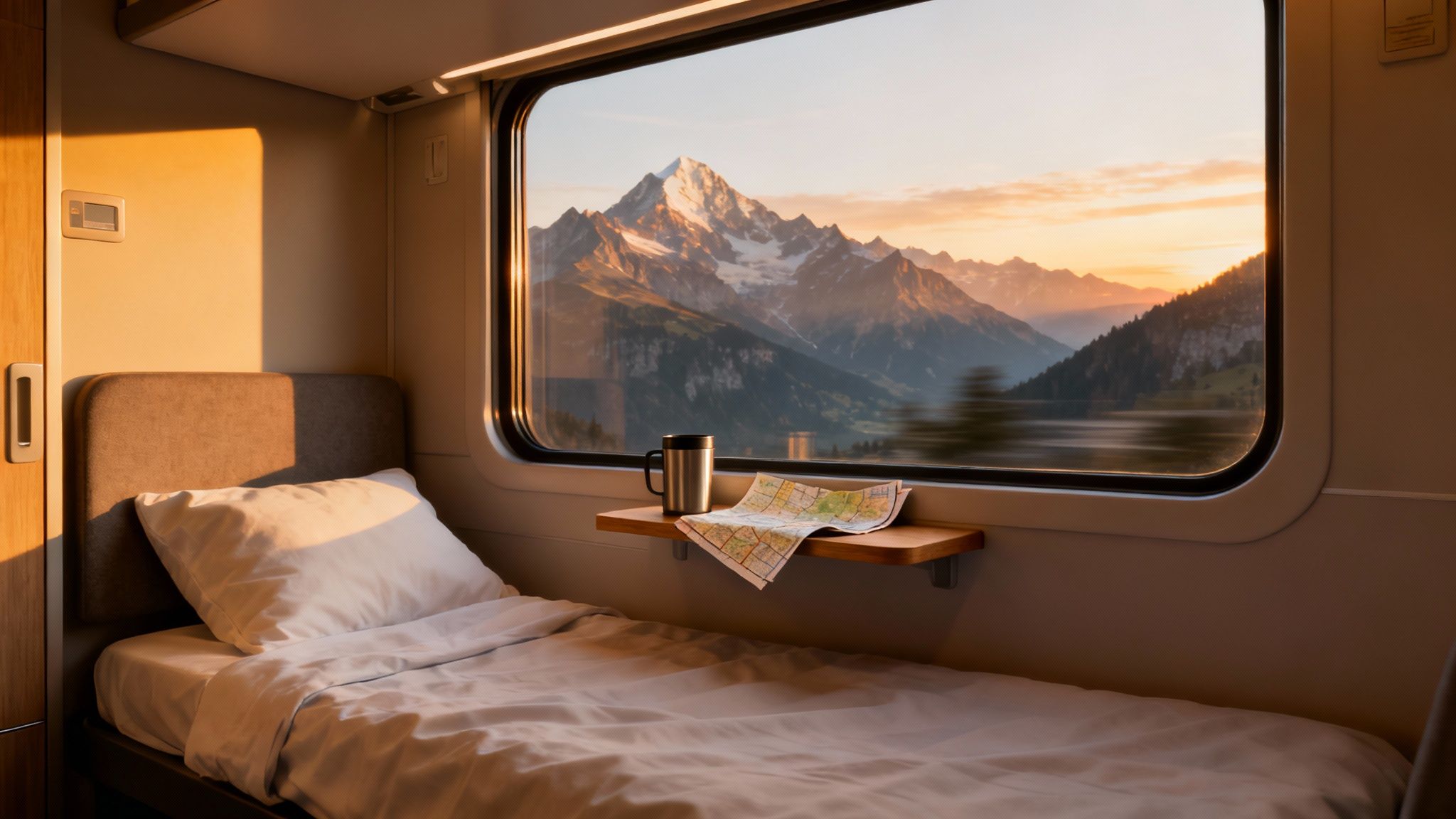
This travel method is perfect for remote workers connecting Central Europe with Northern Italy. Imagine a monthly circuit where you work from a base in Basel, take an overnight train to Milan for a week, and then explore Lugano before returning. The efficiency of the sleeper train maximizes your time, turning a travel day into a restful night.
Sustainable Itinerary & Impact
- Rail Access: The route is easily booked via SBB or Eurail. Book 4-6 weeks ahead for the best fares, especially for Comfort or Single cabins which are more suitable for a restful journey.
- Ideal Stay Length: Combine the 9-hour overnight journey with 5 to 7-day stays in base cities like Milan, Lugano, or Interlaken to make the most of the trip.
- Low-Impact Activities: Use your base cities for hiking in the Swiss Alps, exploring Lake Como from Milan, or enjoying the local food scene in Lugano. Packing only carry-on luggage and using station lockers for larger bags simplifies logistics. You can discover more about the best sleeper trains in Europe to plan similar adventures.
- Carbon Note: Choosing the night train from Basel to Milan instead of a one-hour flight saves approximately 110 kilograms (242 pounds) of CO2 emissions per traveler.
3. Amsterdam, Netherlands – Car-Free Base City
Amsterdam has solidified its reputation as one of Europe’s premier sustainable tourism spots by prioritizing people over cars. As a capital city that is both pedestrian and bike-centric, it offers a blueprint for urban mobility. With over 500 kilometers (310 miles) of protected cycle paths and a seamless tram network, the city makes car-free living effortless. This infrastructure makes Amsterdam an ideal long-stay base for digital nomads seeking a high quality of life with minimal environmental impact.
The city serves as an outstanding central hub for remote work, with world-class coworking spaces and reliable high-speed internet. For example, neighborhoods like De Pijp and Oud-West offer a vibrant local atmosphere, perfect for a 1 to 3-month stay. From Amsterdam Centraal station, high-speed trains connect you to Brussels, Paris, and Berlin, making weekend excursions across Europe simple and low-carbon.
Sustainable Itinerary & Impact
- Rail Access: High-speed Thalys and Eurostar trains connect Amsterdam directly to major European hubs. Regional trains also provide easy access to Dutch cities like Haarlem and Utrecht.
- Ideal Stay Length: 1 to 3 months allows you to settle in, establish a routine, and explore the Netherlands and neighboring countries without rushing.
- Low-Impact Activities: Purchase a used bike for daily transit, explore local markets like Albert Cuyp Market, and take day trips by train. For more ideas on car-free destinations, you can learn more about the most walkable cities in Europe.
- Carbon Note: Choosing the train from Amsterdam to Brussels over a flight saves approximately 78 kilograms (172 pounds) of CO2 per person, a significant reduction for a short journey.
For ultimate mobility, purchase a personal OV-chipkaart to easily tap on and off all public transport. To truly live like a local, buy a second-hand bicycle upon arrival. It is the most cost-effective and authentic way to experience one of the world’s best tourism spots.
4. Rila Monastery & Sofia, Bulgaria – Regenerative Mountain Base
Bulgaria offers one of Europe’s most underrated tourism spots for regenerative travel, blending urban digital nomad infrastructure with profound natural retreats. The Rila Monastery, a UNESCO World Heritage site, is nestled high in the Rila Mountains and exemplifies community-focused, low-impact tourism. The journey itself is sustainable, relying on budget-friendly regional trains and buses from Sofia, Bulgaria’s walkable and affordable capital.

Sofia serves as an excellent base for a 2-4 week stay, with living costs around $650-$975 USD (€600-€900 EUR) per month. Its direct rail connections to Thessaloniki, Belgrade, and Bucharest make it a strategic hub for extended Balkan exploration. This setup is perfect for remote workers seeking a balance of productive work weeks in the city and rejuvenating weekend escapes to the mountains for hiking, meditation, and connecting with local culture.
Sustainable Itinerary & Impact
- Rail Access: From Sofia, take a scenic train to Dupnitsa, then a connecting bus to the monastery. For longer trips, consider the Sofia-Bansko rail line to explore more of the region.
- Ideal Stay Length: 3 to 4 weeks allows you to settle into Sofia for work and plan several multi-day retreats to the Rila Mountains.
- Low-Impact Activities: Base yourself in Sofia for work, using coworking spaces like Betahaus Sofia. Book weekend or week-long stays at the monastery’s guesthouses for immersive wellness sprints. Hike the pristine mountain trails and support local organic farms by purchasing provisions in the villages.
- Carbon Note: Choosing the train from Sofia to Dupnitsa and a bus to Rila instead of renting a car for the 240-kilometer (150-mile) round trip saves approximately 22 kilograms (48.5 pounds) of CO2 per person.
For a deeper experience, book your monastery guesthouse stay several weeks in advance via email, as spots are limited. To support the local economy directly, stay in Sofia’s quieter, residential neighborhoods like Novy Iskar or Dragalevtsi, which offer a more authentic and affordable living experience.
5. Krakow, Poland – Affordable Historic Base with Regional Rail Hub
Krakow offers a compelling model for sustainable slow travel, blending deep history with modern digital nomad infrastructure. As a key Central European rail hub, this UNESCO World Heritage city provides a walkable, affordable base for regional exploration. Its completely car-free Old Town and highly walkable neighborhoods like Kazimierz and Nowy Świat allow you to live and work with a minimal carbon footprint. Direct overnight trains connect Krakow to Prague, Vienna, and Budapest, making it an exceptional base for multi-country, flight-free itineraries.
This destination is perfect for remote workers seeking a cost-effective European experience without sacrificing culture or connectivity. With living costs around $950–$1,275 USD per month, you can base yourself here for 2 to 6 weeks, combining focused work sprints with weekend rail excursions to nearby attractions like the Wieliczka Salt Mine or the Tatra Mountains. The city’s efficient public transit and extensive bike paths further reduce the need for private transport.
Sustainable Itinerary & Impact
- Rail Access: Krakow Główny (main station) is a central hub. Direct overnight trains to Prague (7.5 hrs), Vienna (8 hrs), and Budapest (9 hrs) are easily booked.
- Ideal Stay Length: 2 to 6 weeks provides ample time to settle in, work, and take several regional train trips.
- Low-Impact Activities: Explore the historic Old Town on foot, rent a bike to cycle along the Vistula River, and use regional trains for day trips. A 7-day PKP regional pass for about $33 USD (€31 EUR) covers access to Wieliczka and Tatra mountain towns.
- Carbon Note: Choosing the overnight train from Krakow to Prague instead of a flight saves approximately 115 kilograms (254 pounds) of CO2 emissions per person.
For a truly immersive stay, live in Kazimierz (the historic Jewish quarter) for its vibrant atmosphere and walkability. Booking night trains 3–4 weeks in advance, often through operators like ÖBB, can secure better prices than last-minute purchases. This approach supports a more regenerative form of tourism, benefiting local economies while keeping your environmental impact low.
6. Slovenia’s Green Capital Route – Ljubljana, Lake Bled & Alpine Villages
Slovenia offers a masterclass in regenerative tourism, making it one of Europe’s top tourism spots for eco-conscious travelers. As the continent’s most forested country, it pairs its lush landscapes with progressive green policies, especially in its car-free capital, Ljubljana. The nation’s compact size allows for an extensive, car-free itinerary connecting the urban hub with alpine wonders like Lake Bled and the Bohinj Valley, all accessible via a reliable network of regional trains and buses.

This destination is perfect for digital nomads seeking a long-stay base with strong infrastructure and a deep connection to nature. Base yourself in Ljubljana for two to three weeks, enjoying its walkable neighborhoods and co-working spaces, while using the efficient public transport for weekend trips to the Julian Alps or even the Croatian coast.
Sustainable Itinerary & Impact
- Rail & Bus Access: From regional hubs like Vienna or Zagreb, direct trains and buses service Ljubljana. Once there, the local rail and bus system makes reaching Lake Bled (1 hour), Postojna Caves (1.5 hours), and the coast (2 hours) simple and affordable.
- Ideal Stay Length: 2 to 3 weeks provides ample time to settle into Ljubljana and take multiple day or weekend trips without rushing.
- Low-Impact Activities: Explore Ljubljana’s car-free city center, hike the trails around Lake Bled and Bohinj, and stay at eco-farms for an immersive local experience. For longer trips, regional buses are often greener and more cost-effective than trains.
- Carbon Note: Opting for the bus from Ljubljana to Postojna Caves instead of driving a rental car saves approximately 9 kilograms (20 pounds) of CO2 per person for the round trip.
To maximize your low-impact journey, purchase an Urbana transit pass for seamless travel within Ljubljana and use regional bus operators for intercity routes. Staying in walkable neighborhoods like Kolezija or Trnovo offers a more local, affordable experience than the central tourist district. Plan your visit during the shoulder seasons of April-May or September-October to avoid crowds and benefit from lower prices.
7. Swiss Jungfrau Region – Mountain Base via Interlaken
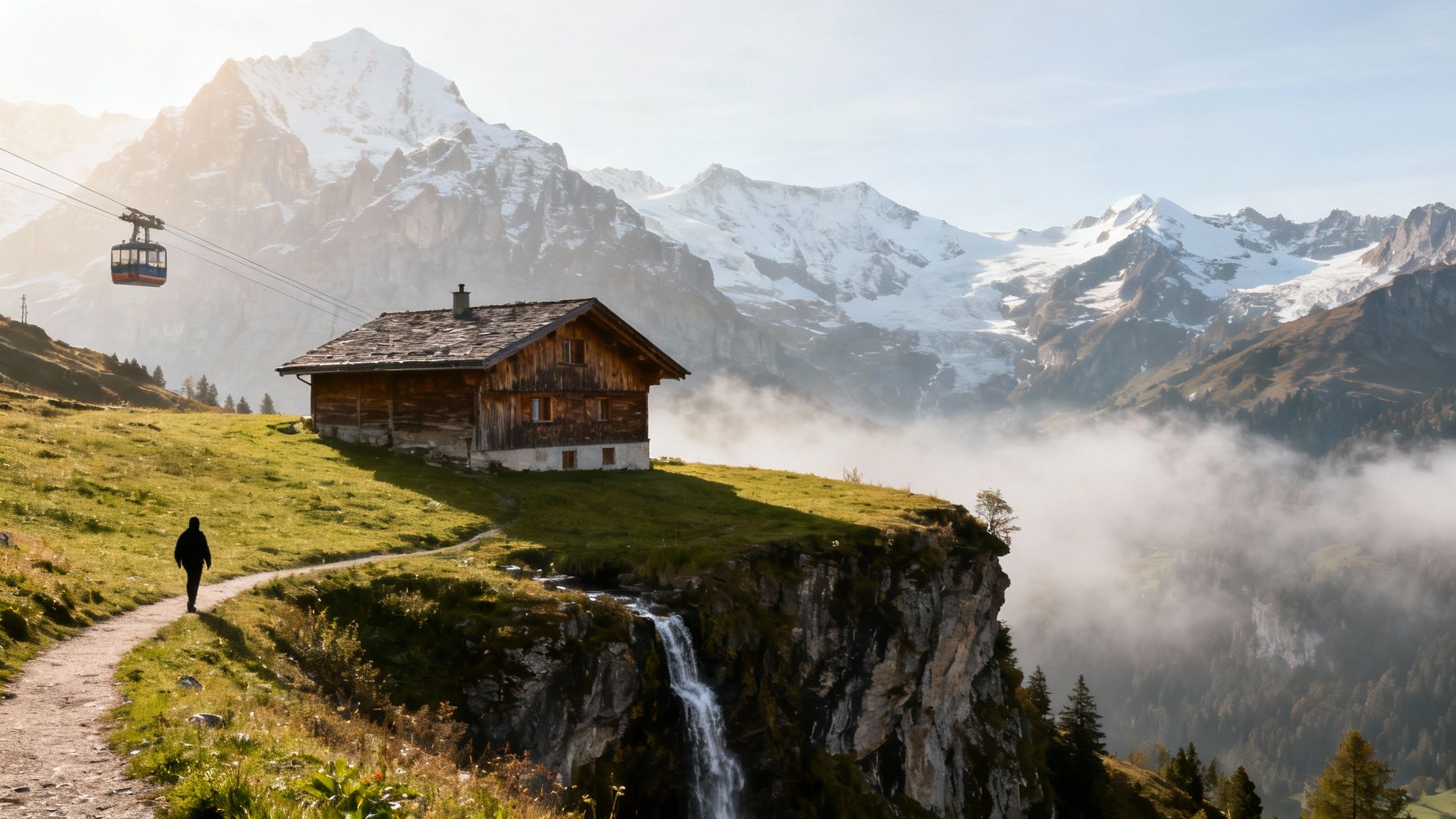
The UNESCO World Heritage Jungfrau region is one of the premier tourism spots for car-free Alpine immersion. Accessible via the central rail hub of Interlaken, it offers unparalleled access to mountain villages and hiking trails. The entire network of rack railways is 100% electric, making it a model for sustainable mountain tourism. By basing yourself in Interlaken or one of the car-free villages like Wengen or Mürren, you can completely eliminate the need for a vehicle while exploring the high Alps.
This destination is perfect for digital nomads who prioritize wellness, epic scenery, and a low-carbon lifestyle. Though it comes at a higher cost, the trade-off is a seamless, regenerative travel experience. Direct trains connect Interlaken to major cities like Zurich, Bern, and Milan, integrating this mountain retreat into a wider European rail itinerary.
Sustainable Itinerary & Impact
- Rail Access: Interlaken is the main gateway, with direct connections from Zurich Airport, Geneva, and Bern. From Interlaken, local trains take you into the valleys and up the mountains.
- Ideal Stay Length: 2 to 4 weeks allows you to balance work with extensive hiking. A popular routine involves basing in Interlaken for coworking and weekend trips to mountain huts.
- Low-Impact Activities: Hike the vast network of trails, explore the car-free villages of Wengen and Mürren, and take the historic Jungfrau Railway to the “Top of Europe.” Focus on locally owned guesthouses and restaurants.
- Carbon Note: The regional transport system runs on hydroelectric power. Choosing the train from Zurich to Interlaken instead of a comparable short-haul flight saves roughly 100 kilograms (220 pounds) of CO2 per passenger.
For stays longer than three weeks, investing in a Swiss Travel Pass can be cost-effective, covering trains, buses, boats, and most mountain railways. To manage luggage between bases, use the SBB Luggage Forward service, which allows for minimalist, carry-on-only travel up to the mountain villages.
8. Croatia’s Dalmatian Coast – Car-Free Island & Coastal Towns
Croatia’s Dalmatian Coast presents one of the most idyllic tourism spots for a car-free, island-hopping adventure. The network of historic towns like Split and Dubrovnik, connected to islands such as Hvar, Korčula, and Vis, relies on an efficient ferry system. This model drastically reduces the need for rental cars, promoting a slower, more sustainable travel rhythm. Using ferries for inter-island travel emits approximately 60% less CO₂ than short-haul flights, making it a powerful choice for the eco-conscious traveler.
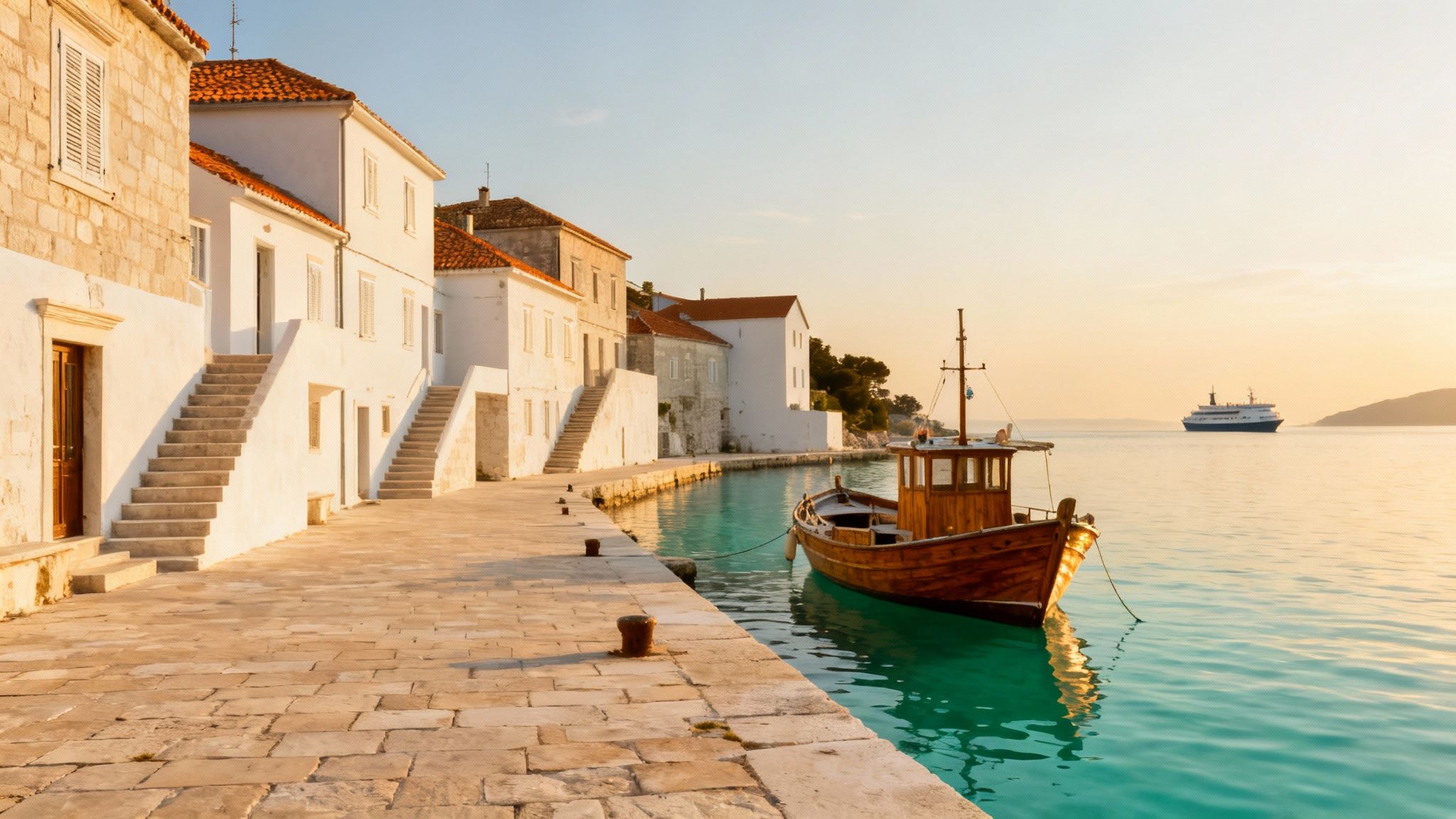
This region is perfect for digital nomads seeking warm weather and strong communities. Split and Hvar offer reliable internet and growing remote work scenes. Affordable long-term guesthouses and apartments, especially in the shoulder seasons, make it viable for extended stays. You can establish a base in a walkable coastal city and take ferry excursions to explore quieter, more remote islands for weeks at a time.
Sustainable Itinerary & Impact
- Rail & Ferry Access: Arrive in Split via the scenic Zagreb-Split train line. From there, an extensive network of Jadrolinija and Kapetan Luka ferries connects you to all major islands.
- Ideal Stay Length: 3 to 6 weeks allows for a true island-hopping experience, blending work with deep exploration of multiple islands.
- Low-Impact Activities: Explore the car-free old towns of Dubrovnik and Korčula, cycle through vineyards on Hvar, and kayak in the quiet coves of Vis. You can discover more tips for a low-impact journey along the Adriatic coastline.
- Carbon Note: Choosing a 4-hour ferry from Split to Hvar instead of a private water taxi or chartered flight saves a significant amount of fuel and reduces your carbon footprint for the journey to nearly zero.
To maximize savings and flexibility, consider a Jadrolinija multi-journey pass, which can reduce ticket costs by 15-20%. For a more authentic experience away from the crowds, prioritize stays on secondary islands like Vis or Korčula, especially during the peak summer months.
9. Portugal’s Iberian Rail Route – Lisbon, Porto & Douro Valley
Portugal presents a near-perfect circuit for rail-first digital nomads, combining vibrant, walkable cities with serene, regenerative countryside. This route connects Lisbon and Porto, two major hubs, with the stunning UNESCO-listed Douro Valley wine region. Portugal’s commitment to renewable energy and its efficient regional train network make it one of Europe’s top sustainable tourism spots. The core Lisbon to Porto journey takes just three hours, allowing for easy, low-carbon travel between these distinct cultural centers.
This itinerary is excellent for remote workers seeking longer stays. You can establish a base in Lisbon’s Príncipe Real or Porto’s Cedofeita neighborhoods for excellent walkability and local charm. From there, plan extended work sprints combined with weekend rail trips. The route also connects seamlessly with overnight trains to Spain and France, integrating it into a wider European slow-travel plan.
Sustainable Itinerary & Impact
- Rail Access: The Alfa Pendular high-speed train connects Lisbon and Porto. Regional trains operated by CP (Comboios de Portugal) provide scenic access to the Douro Valley.
- Ideal Stay Length: 4 to 8 weeks allows for deep immersion, with time for work and extensive exploration of all three regions.
- Low-Impact Activities: Explore Lisbon and Porto using their bike-share systems (Gira and Ciclo Porto), hike in the Douro Valley, and support regenerative agriculture by staying at a local wine farm (quinta). You can explore similar scenic journeys by checking out some of the best train routes in Europe.
- Carbon Note: Choosing the train from Lisbon to Porto instead of a domestic flight saves approximately 65 kilograms (143 pounds) of CO2 emissions per traveler.
10. Trans-Siberian Railway Segment – Moscow to Lake Baikal via Regional Trains
The legendary Trans-Siberian Railway offers one of the world’s most epic overland tourism spots, charting a course across Asia. For digital nomads seeking a truly low-impact adventure, the segment from Moscow to Lake Baikal exemplifies slow, sustainable travel. This 9-day, 3,170-mile (5,100-kilometer) journey prioritizes regional trains over tourist-focused services, significantly reducing both cost and carbon intensity. This route is a masterclass in ultra-low-emission, long-distance exploration.
This journey is best suited for adventurous remote workers with flexible schedules. The slower pace and multiple stops allow for authentic cultural immersion in smaller towns often missed by express routes. While current political and visa conditions can present challenges for accessibility, the model of using local rail networks for vast distances remains a powerful blueprint for sustainable overland travel.
Sustainable Itinerary & Impact
- Rail Access: The journey starts in Moscow, using regional “platzkart” trains (3-berth compartments) toward Irkutsk, the gateway to Lake Baikal.
- Ideal Stay Length: 2 to 3 weeks are recommended to fully embrace the journey and spend adequate time exploring Lake Baikal.
- Low-Impact Activities: Disembark in towns like Yekaterinburg or Novosibirsk for a day, explore the shores of Lake Baikal on foot, and engage with local communities at train stops.
- Carbon Note: Traveling this 3,170-mile (5,100-kilometer) segment by train emits just 0.05 kilograms of CO₂ per kilometer, showcasing the immense carbon savings of overland rail compared to air travel.
Choosing third-class regional trains, priced around $215-$375 USD (€200–€350 EUR), not only makes the trip affordable but also supports the local transit system. This approach transforms the journey itself into the destination, offering a profound connection to the vast landscapes and diverse cultures of the region.
10 Tourist Destinations: Access & Highlights Comparison
Cinque Terre, Italy – Coastal Rail-Connected Villages
| Complexity 🔄 | Resources ⚡ | Expected outcomes 📊 | Ideal use cases ⭐ | Key advantages & tips 💡 |
| Low — established regional trains & pedestrian-only villages; booking needed in peak | Moderate — regional train pass (€16.40/day); daily €35–60; Wi‑Fi good in larger villages only | High scenic/hiking value; near‑zero local emissions; limited modern amenities and capacity | Short stays, coastal hiking loops, digital nomads wanting walkable Mediterranean base | UNESCO site, car‑free; book Monterosso/Manarola, travel Apr–May or Sep–Oct, pack light |
Transalpine Night Train – Basel ↔ Milan via Gotthard
| Complexity 🔄 | Resources ⚡ | Expected outcomes 📊 | Ideal use cases ⭐ | Key advantages & tips 💡 |
| Moderate — sleeper reservations & fixed night schedules; advance booking (2–4 wks) recommended | Low–Moderate — berths €80–150; limited luggage; Wi‑Fi variable | High connectivity; saves daytime productivity; extremely low emissions vs flights | Long-distance transfers maximizing work time; nomads linking Central Europe and Italy | Sleep while you travel; book via SBB/Eurail early; choose Comfort cabins for longer legs |
Amsterdam, Netherlands – Car-Free Base City
| Complexity 🔄 | Resources ⚡ | Expected outcomes 📊 | Ideal use cases ⭐ | Key advantages & tips 💡 |
| Low — mature bike/tram network; easy urban integration | High — monthly €1,400–1,800; 1 Gbps internet; many coworking options | Very high QoL for nomads: cycling, reliable connectivity, strong community | 1–3 month urban bases focused on coworking and cycling lifestyle | Extensive cycling infrastructure; live in De Pijp/Oud‑West; buy/register a used bike |
Rila Monastery & Sofia, Bulgaria – Regenerative Mountain Base
| Complexity 🔄 | Resources ⚡ | Expected outcomes 📊 | Ideal use cases ⭐ | Key advantages & tips 💡 |
| Low–Moderate — regional trains + buses; monastery stays require advance booking | Low — weekly €120–180; Sofia internet 20–50 Mbps; basic mountain facilities | High cultural/wellness immersion, regenerative tourism, very low costs; limited rural services | Wellness retreats, short nomad stints combining city work and mountain retreats | UNESCO monastery + organic farms; base in Sofia neighborhoods; book monastery 2–3 wks ahead |
Krakow, Poland – Affordable Historic Base with Regional Rail Hub
| Complexity 🔄 | Resources ⚡ | Expected outcomes 📊 | Ideal use cases ⭐ | Key advantages & tips 💡 |
| Low — strong rail connectivity and established nomad infrastructure | Low — monthly €950–1,250; affordable coworking and living costs | High value for money; good weekend rail reach; occasional rail delays | 2–6 week affordable historic base with frequent regional excursions | UNESCO Old Town, cheap night trains; live in Kazimierz, vet landlords via nomad platforms |
Slovenia’s Green Capital Route – Ljubljana, Bled & Alpine Villages
| Complexity 🔄 | Resources ⚡ | Expected outcomes 📊 | Ideal use cases ⭐ | Key advantages & tips 💡 |
| Low — compact transit; some mountain routes slower | Moderate — monthly €950–1,300; Urbana card; fewer coworkings than major cities | High sustainability impact; compact low‑emission itinerary; smaller nomad community | 2–3 week eco-focused stays combining city base and nature day trips | Green Capital credentials; base in Trnovo/Kolezija; book eco-lodges and visit shoulder seasons |
Swiss Jungfrau Region – Mountain Base via Interlaken
| Complexity 🔄 | Resources ⚡ | Expected outcomes 📊 | Ideal use cases ⭐ | Key advantages & tips 💡 |
| Moderate — transfers to car‑free villages, cable/cog rail logistics | High — monthly €2,200–2,800; Swiss Travel Pass recommended; luggage forwarding common | Very high wellness + zero‑car immersion; premium cost and tourist density | Multi-week mountain immersion for nomads prioritizing nature and wellness | 100% electric transport; invest in Swiss Travel Pass; pack carry‑on or use luggage services |
Croatia’s Dalmatian Coast – Car-Free Islands & Coastal Towns
| Complexity 🔄 | Resources ⚡ | Expected outcomes 📊 | Ideal use cases ⭐ | Key advantages & tips 💡 |
| Moderate — ferry schedules seasonal and weather‑dependent; island logistics | Moderate — monthly €1,100–1,500; ferries €15–40 per leg; internet variable on islands | High Mediterranean experience, low CO₂ vs flights; summer crowding risk | 3–6 week island‑hopping or warm‑weather nomad bases (Hvar, Split) | Strong ferry network; book ferries in summer, use lesser islands (Vis/Korčula) for authenticity |
Portugal’s Iberian Rail Route – Lisbon, Porto & Douro Valley
Complexity 🔄 | Resources ⚡ | Expected outcomes 📊 | Ideal use cases ⭐ | Key advantages & tips 💡 |
| Low — direct regional trains; Douro access requires planning | Moderate — monthly €1,100–1,400; growing coworking; strong renewable energy mix | High mix of city work and rural wine‑region experiences; seasonal crowding in Lisbon | 4–8 week coastal + wine‑region stays combining coworking and farm‑stays | Affordable, renewable leader; base in Príncipe Real/Cedofeita; book Douro farm stays early |
Trans‑Siberian Railway Segment – Moscow → Lake Baikal
| Complexity 🔄 | Resources ⚡ | Expected outcomes 📊 | Ideal use cases ⭐ | Key advantages & tips 💡 |
| High — very long journey (9 days), visa & political constraints; limited services | Low–Moderate — segment fares €200–350; basic sleeper berths; slow travel | High adventure and cultural immersion with low emissions per km; accessibility limited | Long overland explorers seeking ultra‑low‑emission, multi‑week expeditions | World’s longest rail route; verify visas/entry rules, prepare for basic onboard conditions |
Your Next Move: Integrating Sustainability into Your Travel DNA
Choosing sustainable tourism spots is a powerful way to align your travels with your values. As we’ve explored, prioritizing extensive rail networks, highly walkable cities, and regenerative local economies does not mean sacrificing comfort or adventure. In fact, this approach often leads to more authentic and memorable experiences that foster a deeper connection to a place. Whether you’re basing yourself in a budget-friendly hub like Krakow to explore regional gems or investing in a zero-carbon Alpine retreat in the stunning Swiss Jungfrau region, the key is intentional, mindful planning.
By embracing a slower pace and making conscious choices about how you move, stay, and spend, you directly contribute to a healthier planet and more resilient local communities. The destinations in this guide, from Italy’s coastal villages to Slovenia’s green capital, prove that low-impact travel is accessible, enriching, and deeply rewarding. It shifts the focus from a checklist of sights to a holistic experience of a destination’s culture, nature, and daily rhythm. This mindset is the foundation of modern, responsible exploration.
Let these examples serve as your blueprint. Begin to dig into the train schedules for a route that sparks your interest, research the local eco-lodges that support community initiatives, and start building an itinerary that reflects a genuine commitment to low-impact living. The future of travel is not about seeing everything in a frantic rush, but about experiencing places in a way that ensures they thrive for generations to come. Your journey is part of that positive change.
Low-Impact Travel Tools (Worth It)
Also, if you’re planning a trip and want to keep things simple, these tools help you travel smoother while staying mindful about impact.
Get an eSIM for reliable data → Disclosure: Partner link. No extra cost to you.
Pre-book a transfer for easy arrivals → Disclosure: Partner link. No extra cost to you.
Frequently Asked Questions
1. Why is train travel better for the environment?
Train travel is significantly more energy-efficient than flying, especially for short to medium distances. It produces far fewer greenhouse gas emissions per passenger, helping to reduce your carbon footprint and combat climate change. Many modern rail networks in Europe even run on renewable electricity.
2. What makes a city a good “walkable base” for digital nomads?
A good walkable base city features a compact, pedestrian-friendly city center, reliable public transportation, extensive bike lanes, and essential amenities (cafes, grocery stores, coworking spaces) within a short walk or bike ride. This eliminates the need for a car, reducing costs and environmental impact while improving quality of life.
3. How can I find affordable, long-term accommodation in these tourism spots?
Look for “apart-hotels,” local guesthouses, or rental platforms that cater to longer stays. Booking during the shoulder seasons (spring and autumn) can significantly reduce prices. Also, consider staying in residential neighborhoods just outside the main tourist core for better rates and a more authentic experience.
4. Are these destinations suitable for someone who has never traveled by train in Europe?
Absolutely. The destinations listed, especially those in Western and Central Europe like Cinque Terre, Amsterdam, and Switzerland, have incredibly user-friendly and efficient rail systems. Signage is typically multilingual, and apps like Trainline or Omio make booking simple.
5. What is an eSIM and why is it recommended for sustainable travel?
An eSIM (embedded SIM) is a digital SIM card that allows you to activate a cellular plan without a physical card. For travelers, services like Airalo or Yesim let you download a local data plan upon arrival. This reduces plastic waste from physical SIM cards and is often more convenient and affordable than international roaming.
6. How do I manage luggage on long rail journeys?
Pack light and use a carry-on-sized backpack or roller bag. For longer trips with multiple stops, many major train stations have luggage storage lockers. In countries like Switzerland, you can use luggage forwarding services to send your bags ahead to your next destination.
7. Is it necessary to book train tickets far in advance?
For high-speed, long-distance, or overnight trains, booking 4-8 weeks in advance is highly recommended to secure the best prices and your preferred seat or cabin. For regional and local trains, you can often buy tickets on the day of travel with little price difference.
8. How can I ensure my travel spending supports the local community?
Prioritize staying in locally-owned guesthouses over international hotel chains. Eat at family-run restaurants, shop at local markets, and hire local guides. This ensures your money directly benefits the people who live in the destination.
9. What are the best tools for planning a rail-first trip?
Websites like Aviasales can help compare flight and train options to find the most sustainable route. For booking, national rail websites (like SBB for Switzerland or DB for Germany) are great, while apps like Omio or Trainline aggregate options from multiple operators. For ground transportation, Welcome Pickups is a reliable service.
10. Do I need travel insurance for these destinations?
Yes, comprehensive travel insurance is always recommended. It protects you from unforeseen events like medical emergencies, trip cancellations, or lost luggage. Services like VisitorsCoverage offer plans tailored to international travelers and digital nomads.
Editor’s Pick: Slovenia’s Green Capital Route
For its exceptional blend of accessibility, affordability, and deep commitment to sustainability, Slovenia stands out. The ease of connecting Ljubljana, Lake Bled, and the Alpine villages by an efficient rail and bus system makes it a model for car-free travel. Ljubljana’s award as a European Green Capital is well-earned, with its pedestrian-only city center and tangible eco-initiatives, providing a perfect base for any remote worker or slow traveler.
Key Takeaways
- Rail-First is Realistic: Prioritizing train travel across Europe and parts of Asia is a viable and often superior way to travel, drastically reducing your carbon footprint compared to flights.
- Walkability Defines Your Base: Choosing a walkable base city like Amsterdam, Ljubljana, or Krakow is the single most effective way to minimize local transport impact and enrich your daily experience.
- Longer Stays, Deeper Impact: Slowing down and extending your stay in one region allows you to support the local economy more meaningfully and reduces the environmental cost of frequent transit.
- Sustainability is Diverse: Eco-conscious travel isn’t a single formula. It can mean staying in a family-run guesthouse in Bulgaria, supporting a zero-waste cafe in Portugal, or choosing a B-Corp certified tour operator.
- Your Choices Compound: Every decision, from packing light to choosing a reusable water bottle and offsetting your journey’s emissions, adds up to a significantly lower-impact trip.
- Plan Ahead for Savings: Booking train tickets, especially for overnight or high-speed routes, well in advance can lead to significant cost savings and better availability.
Ready to plan your next sustainable journey? For more detailed rail-first itineraries, low-impact travel guides, and walkable base city reviews, explore the resources at Eco Nomad Travel. We provide the practical tools and inspiration you need to discover incredible tourism spots responsibly.
Join the Sustainable Work Movement
Want more rail-first itineraries, low-impact packing systems, and walkable base-city ideas?
