
Planning a multi-city rail trip can feel like trying to solve a giant puzzle, but a good train travel route planner makes the whole process click into place. These digital tools can turn what seems like an overwhelming task into a genuinely creative and exciting part of your trip, helping you build an itinerary that’s both efficient and rewarding. We’re talking about more than just booking tickets; the right planner helps you map out the entire experience from start to finish.
A truly great rail-first journey is more than just a list of stops; it’s a story you design. Whether you’re a digital nomad looking for walkable base cities or a couple planning a slow-travel escape, a route planner helps you match your specific goals with the practical realities of train schedules and connections. This is also a huge win for sustainable travel, as it sets you up to compare emissions, costs, and travel times with real clarity.
This strategic approach is catching on. Surveys from sources like the Global Business Travel Association show that while six in ten travelers expect to keep their rail travel habits steady, a significant 18% predict they’ll travel by train more often, driven by sustainability concerns and the ability to work on board.
Key Takeaways
- Define Your Goals First: A route planner works best when you know what you want from your trip—whether that’s speed, scenery, or sustainability.
- Visualize the Journey: These tools let you see your entire route on a map, which makes it easy to spot inefficient backtracking and discover logical travel corridors.
- Compare More Than Price: Modern planners allow you to weigh cost against travel time and, increasingly, the carbon footprint of your journey.
- Simplify Complex Bookings: Planning multi-country trips with different rail operators becomes much more manageable with a central tool.
- Unlock Hidden Options: You’ll often find alternative routes, including scenic local lines or efficient night trains, that you might have otherwise missed.
Why a Route Planner Is Your Most Powerful Travel Tool
A train travel route planner is essential because it transforms an abstract idea into a concrete, actionable itinerary. Instead of guessing at connections, you can see the most direct “backbone” routes that link your main destinations, which are often high-speed lines. From there, you can start layering in regional trains for side trips and unique local experiences.
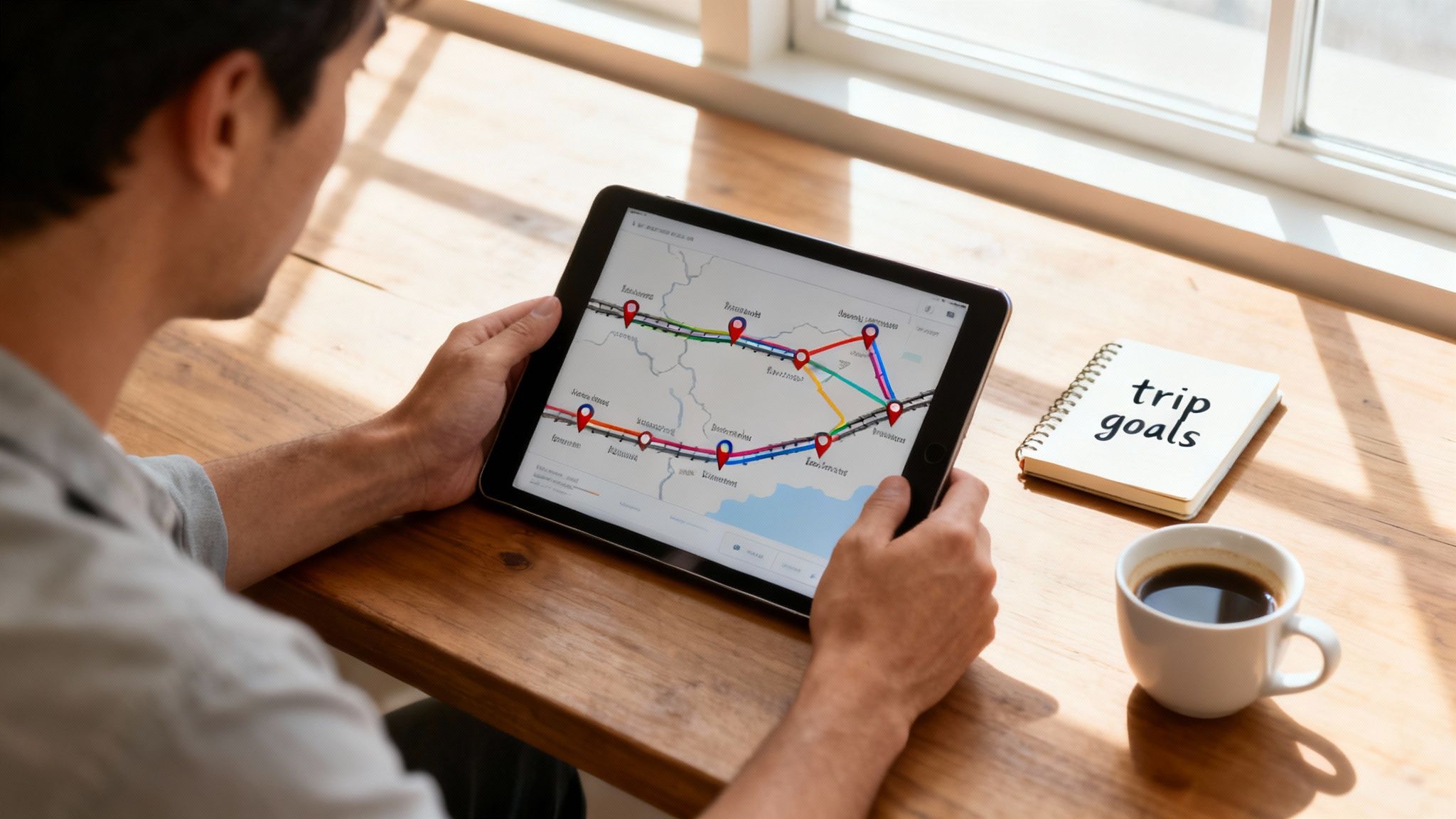
In Europe and Asia-Pacific, 66% of travelers are already choosing trains over planes for comparable journeys—a simple switch that can slash your carbon footprint by up to 95%. This shift highlights why getting comfortable with a train travel route planner is so important. You’re not just saving time; you’re making a conscious choice for lower-impact travel.
[carbon_calculator_2025]
Editor’s Pick
Best All-Around Route Planner: Omio
For its broad coverage across Europe and intuitive interface, Omio is an excellent starting point. It simplifies comparing train, bus, and flight options in one search, making it easy to see why rail is often the most balanced choice for time, cost, and environmental impact.
Using a planner effectively means thinking a bit like a cartographer. You can identify hub cities that serve as excellent bases for exploring a whole region, which minimizes hotel changes and long, tiring travel days. This mindset transforms your trip from a simple straight line into a dynamic network of possibilities.
Choosing The Best Train Route Planner For Your Trip
Finding the right train travel route planner is a lot like picking the right pair of shoes; the best one depends entirely on the journey you have planned. Not all digital tools are created equal. Their strengths, user experience, and regional coverage vary wildly, so the goal is to find the platform that clicks with your travel style—whether that’s a sprawling month-long Eurail adventure or a series of precise high-speed hops across Japan.
Some planners are aggregators, pulling data from dozens of operators to give you a bird’s-eye view of your options. Others are the dedicated apps of national rail companies, which often provide the most detailed and real-time information for their own network.
The key is knowing which tool to use and when. For multi-country European trips, aggregators are almost always the best place to start. They excel at untangling complex, multi-leg journeys that cross several borders and involve different rail companies. This is where you can easily compare the value of a rail pass against individual tickets, a calculation that can save you a serious amount of money and hassle.
Comparing The Top Digital Tools
The market for route planners is crowded, but a few key players stand out for their comprehensive features and user-friendly design. Platforms like Trainline and Omio have become the go-to resources for travelers because they simplify the headache of searching and booking across multiple countries. They integrate schedules from various operators, allowing you to see a complete journey in one search, even if it involves switching trains from different companies.
On the other hand, national carrier apps like Germany’s DB Navigator or Switzerland’s SBB Mobile are incredibly powerful for domestic travel. They often have superior real-time data, including platform information, delay notifications, and even how full a specific carriage is. For a trip focused heavily within one country, using the local app is a no-brainer.
Many seasoned travelers use a hybrid approach: they use an aggregator for the initial high-level planning and price comparison, then switch to the national app for final bookings and on-the-ground travel. For more on digital planning, explore our complete list of sustainable travel tools for digital nomads.
Here’s a quick overview of how the main options stack up. This table compares the key features of popular train travel planning platforms to help you choose the best one for your itinerary.
Comparison of Top Train Route Planner Tools
| Planner Tool | Best For | Regional Coverage | Pass Integration | Mobile App Experience |
|---|---|---|---|---|
| Trainline | Multi-country European booking, UK travel | Strong in Europe, especially UK, France, Italy | Yes, with clear passholder seat reservations | Clean, intuitive, and reliable |
| Omio | Integrated train, bus, and flight searches | Excellent across Europe, with strong bus network data | Yes, helps compare pass vs. point-to-point | Very good, great for multi-modal trips |
| DB Navigator | In-depth German travel, real-time data | Germany-focused but has strong pan-European routing | Excellent, a must-have for German Rail Pass users | Gold standard for features and reliability |
| SBB Mobile | Swiss travel precision, timetables, and ticketing | Switzerland, with good data for neighboring countries | Yes, integrates Swiss Travel Pass seamlessly | Top-tier, known for its accuracy |
Choosing the right tool ultimately comes down to your itinerary’s specific needs. Aggregators offer breadth, while national apps provide depth and real-time accuracy.
Which Route Planner Is Right For You?
To pick the best tool, start by defining your trip’s main characteristics.
- For Multi-Country European Tours: An aggregator like Omio or Trainline is indispensable. They handle currency conversions, compare different operators seamlessly, and are often the easiest way to assess the value of a Eurail or Interrail pass.
- For Deep Dives into a Single Country: Download the national rail app. Planning a trip through Italy? Trenitalia is your best friend. Exploring the Swiss Alps? SBB Mobile is non-negotiable for its precision and reliability.
- For Complex, Multi-Modal Journeys: If your trip involves mixing trains with buses to reach smaller towns, Omio is particularly strong. It excels at showing integrated bus connections that other train-focused planners might miss, solving that critical final-mile challenge.
- For Visual Planners and Scenic Routes: Some travelers prefer to see their route unfold on a map. Tools like All Aboard or even Google Maps’ transit layer can be useful for visualizing distances and discovering scenic detours that might not be obvious in a list-based search result.
In the end, you don’t have to commit to just one train travel route planner. Most seasoned rail travelers have a handful of apps on their phone, using each for its specific strengths to build a truly customized and seamless itinerary.
How To Map A Sustainable Itinerary
This is where the real art of planning a rail-first trip begins. Using a train travel route planner isn’t just about finding the quickest connection—it’s about crafting a low-impact journey that feels intentional, not rushed.
The process always starts with your “trip anchors.” These are the non-negotiable cities, regions, or experiences that form the skeleton of your journey. Get those clear first.
Once you have your anchors, you can build logical travel corridors between them. This is a simple but critical step for avoiding the kind of costly and time-sucking backtracking that can drain a trip’s energy. A well-designed route just flows, maximizing your time on the ground and cutting out exhausting travel days.
Think of it as connecting the dots on a map. A good route planner helps you see the major high-speed lines that act as the main arteries of your trip. From there, you can layer on the smaller, scenic regional lines for side trips and deeper exploration. The result is a journey that’s both efficient and rich with experience.
Defining Your Trip Anchors And Travel Corridors
Let’s walk through a real-world scenario. Imagine you want to plan a rail-first trip from Amsterdam to Copenhagen. Your primary anchors are these two fantastic capital cities. The puzzle is connecting them in a way that’s sustainable, enjoyable, and makes sense on the ground.
Instead of just booking the fastest, most direct train, you can use your route planner to explore the corridor between them. You might discover that a logical stop in Hamburg, Germany, breaks up the journey perfectly. It becomes a secondary anchor, turning a single long travel day into two manageable legs and giving you the chance to explore a third city.
This is the power of smart sequencing. By adding Hamburg, you create a natural flow: Amsterdam → Hamburg → Copenhagen. This simple tweak helps you avoid a punishing 11-hour single journey and opens up a whole new set of experiences along the way.
Comparing Impact With Your Train Travel Route Planner
A huge part of mapping a sustainable itinerary is actually understanding the environmental cost of your choices. Many modern train route planners now provide carbon emission estimates, letting you directly compare different rail options against flying. The difference is almost always staggering.
For example, a flight from Amsterdam to Copenhagen generates roughly 150 kg (330 lbs) of CO₂ per passenger. The train journey? Around 25 kg (55 lbs) of CO₂. That’s an 83% reduction in your carbon footprint for that leg alone. Tools that show you this data make the sustainable choice incredibly clear. To get a better feel for these numbers, you can explore how different transport modes affect your footprint with our detailed travel carbon emissions calculator.
This is where planning becomes a powerful act of conscious travel. You’re not just choosing a route; you’re actively shrinking your environmental impact. It’s this growing awareness that’s fueling a massive global shift back to rail.
The flowchart below shows how to think through selecting the right planning tools based on your travel style, region, and what you need the tool to do.
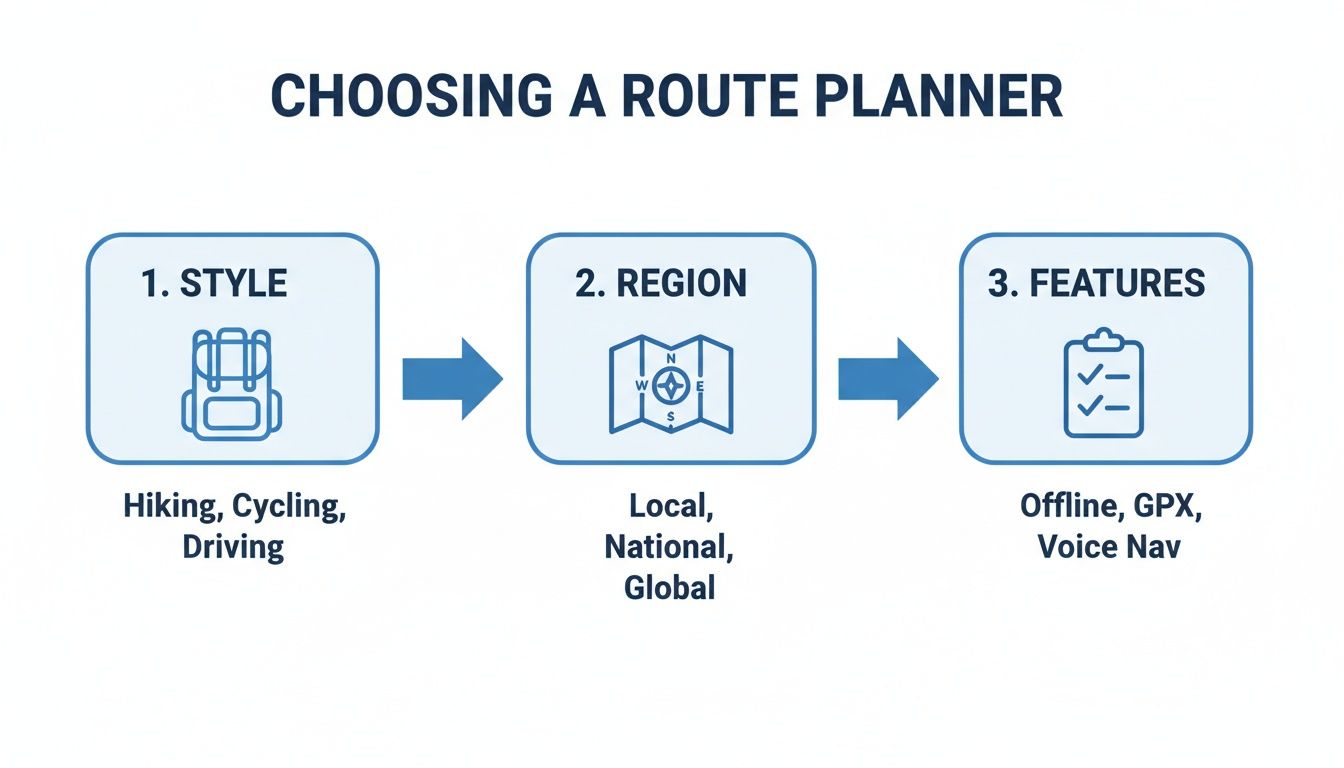
It really just highlights that a successful itinerary starts with understanding your own needs before you even open an app.
A Real-World Scenario: Amsterdam to Copenhagen
Let’s flesh out our Amsterdam-to-Copenhagen example with a few practical steps:
- High-Speed Backbone: Use a planner like Omio to find the main route. It will likely show a high-speed ICE train from Amsterdam to Hamburg as the core of the journey.
- Night Train Option: For the Hamburg-to-Copenhagen leg, check for a night train. This saves you a travel day and the cost of a hotel, and you’ll arrive in Copenhagen refreshed and ready to explore.
- Incorporate Regenerative Stays: When booking your accommodation, look for properties with solid sustainability credentials. In Copenhagen, a place like Zoku Copenhagen is a fantastic base with a focus on community and smart, sustainable design, which aligns perfectly with a low-impact travel ethos.
A well-planned train journey is more than just transit; it becomes an integral part of the travel experience itself. The views from the window, the conversations in the dining car, and the simple rhythm of the rails are often as memorable as the destination.
This intentional approach to travel is backed by a booming rail market. In 2025, the global train market revenue is projected to hit USD $77.4 billion, with passenger trains making up USD $47.21 billion of that. This growth is heavily concentrated in Europe and Asia, where dense networks and eco-conscious travelers are driving demand.
By combining efficient routing with thoughtful choices in where you stay, you transform a simple trip into a cohesive, sustainable adventure.
Smart Booking Strategies For Passes And Night Trains
Once your ideal path is mapped out with a train travel route planner, the next puzzle is booking it all without blowing your budget. The world of train tickets can feel like a maze of multi-country passes, deeply discounted advance fares, and last-minute deals.
Figuring out this puzzle is where you turn a good plan into a great, affordable journey.
The big question for most multi-stop trips is whether to get a rail pass, like Eurail or Interrail, or just buy individual point-to-point tickets. There’s no single right answer here—the best choice depends entirely on your trip’s length, how flexible you want to be, and the kinds of trains you’ll be using.
A rail pass often delivers incredible value and freedom for long, spontaneous trips with lots of stops, letting you hop on and off regional trains whenever you like. But for a shorter trip with just a few high-speed legs booked far in advance, buying separate tickets is almost always cheaper. This is where your route plan becomes a critical budgeting tool.
The Great Debate: Rail Pass or Individual Tickets?
To make the right call, start by pricing out your main “anchor” journeys as individual tickets. Use a tool like Trip.com to get a feel for the cost, paying close attention to the high-speed routes, as those will be your biggest expense. Tally up the total for these essential legs.
Next, compare that number to the price of a rail pass that covers your trip’s duration and countries. Don’t forget to factor in the hidden costs of a pass: mandatory seat reservation fees. These can range from a few dollars (or euros) on regional trains to over $30 USD for popular high-speed services, and they add up fast.
A good rule of thumb: If you’re planning more than four or five long-distance train journeys, a pass often starts to make financial sense. For anything less, point-to-point tickets usually win.
The Strategic Advantage of Night Trains
For any eco-minded traveler, night trains are a total game-changer. These rolling hotels are one of the most efficient ways to cover serious ground. You board in one city center in the evening, fall asleep to the gentle rhythm of the rails, and wake up right in the heart of another.
It’s an incredible way to save both time and money.
Benefits of Night Trains:
- Accommodation Savings: Your ticket includes your bed for the night, wiping out the cost of a hotel room.
- Time Maximization: You don’t lose a precious day of your trip to travel. You cover hundreds of miles while you’re asleep.
- Unique Experience: There’s a certain romance to train travel at night that you just don’t get on a budget airline.
When you book, you’ll usually choose between a private “sleeper” cabin (with 1-3 beds, often with a small sink) or a more social “couchette” (with 4-6 bunks). Learning how to book European sleeper trains is a skill that pays you back in both savings and amazing experiences. Most route planners let you filter for overnight journeys, making them easy to spot.
Advanced Booking Tactics
Beyond the pass-versus-ticket debate, a few other habits can help you lock in the best fares. Booking high-speed and international trains 90-120 days in advance can often slash the price by 50% or more.
Also, think about traveling during the shoulder seasons—April to early June and September to October. Fares are lower, trains are less crowded, and the weather is often just as lovely as in the peak summer months.
Finally, if you find yourself traveling a lot within one country, it’s worth signing up for the national railway’s loyalty program. It can lead to exclusive discounts and offers down the line.
Mastering The Logistics Of Modern Rail Travel
A perfectly mapped route is a beautiful thing, but a trip’s success often hangs on the small, practical details. Mastering the logistics of modern rail travel—from luggage to what happens when you step off the train—is what turns a good plan into a seamless, stress-free experience. A smart approach here means your focus stays on the adventure, not on wrestling a heavy suitcase or hunting for a power outlet.
Beyond just the route, a great journey is about thinking through what happens on the train and in the station. This is where you can really lean into the benefits of rail; it’s a mode of transport designed for human comfort, offering a far more relaxing and productive environment than flying.
This renewed appreciation for a comfortable journey is part of a much bigger trend. From 2019 to 2024, global spending on cross-border rail tours shot up by an incredible 59%, blowing past the 18% growth seen in total cross-border tourism. This renaissance is especially strong among travelers seeking comfortable, scenic routes and night trains, with European hotspots like Switzerland and Italy leading the way.
The Art Of Packing For The Rails
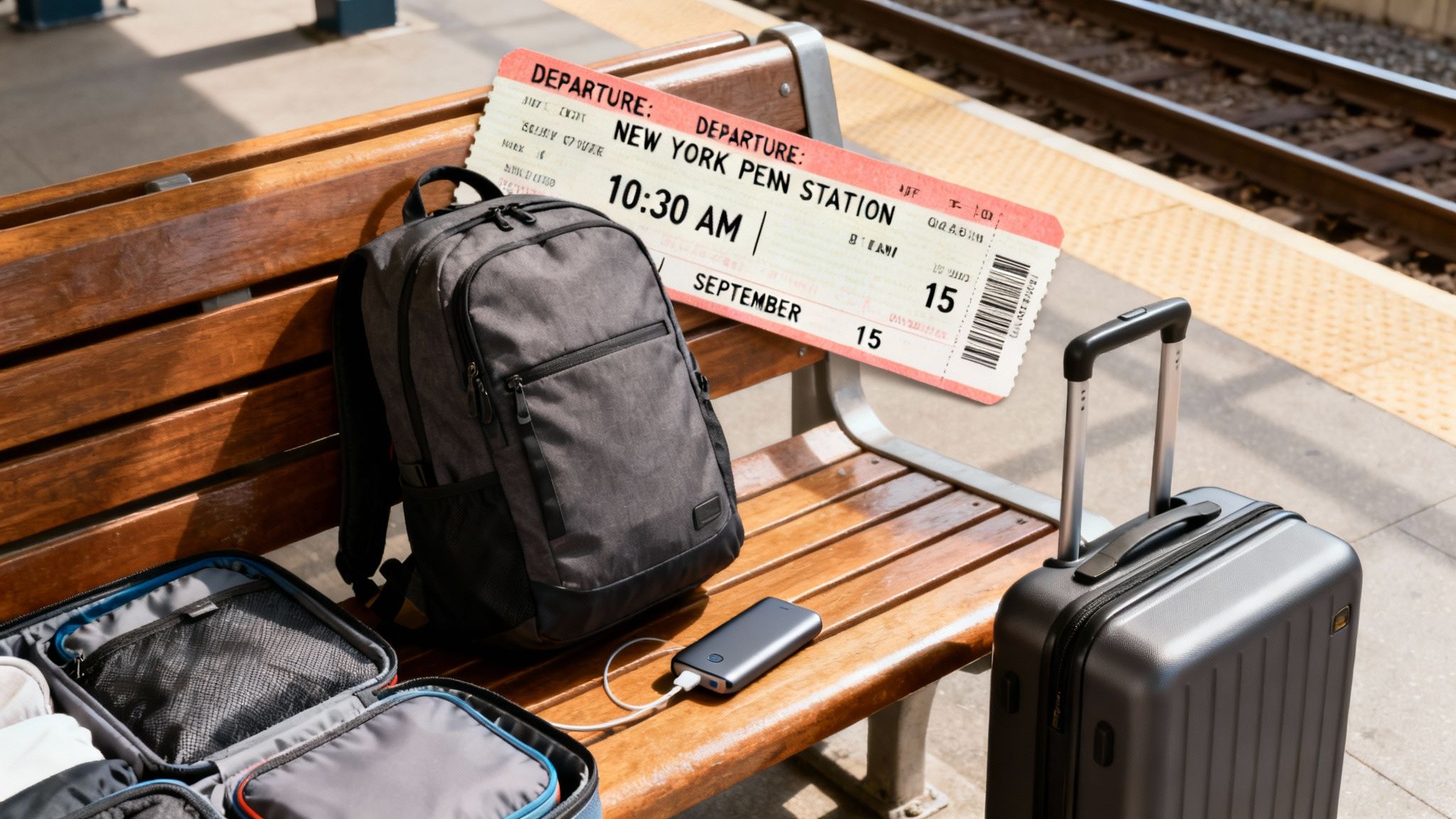
Luggage is the single biggest logistical challenge of train travel. Unlike flying, there are no baggage handlers to whisk your bags from check-in to your destination. You are responsible for carrying, lifting, and stowing every single thing you bring. This is why a minimalist approach isn’t just a preference; it’s a necessity.
Your goal should be a single carry-on-sized suitcase or a travel backpack. This makes navigating crowded station platforms, narrow train corridors, and steep stairs infinitely easier. If you’re on a longer journey, check out our strategies for trip chaining rail adventures to make minimalist packing work for you.
For layovers, look for luggage storage services (“left luggage” or lockers) in major stations. They’re a game-changer, freeing you up for a few hours of unburdened exploration.
Navigating The Onboard Experience
The onboard experience is where train travel really shines. Most modern long-distance trains in Europe and Asia come equipped with amenities designed for comfort and productivity.
- Connectivity: Wi-Fi is often available, but it can be spotty, especially when crossing borders or passing through tunnels. For a reliable connection, an eSIM from a provider like Airalo is a fantastic backup. It lets you stay online without hunting for a signal.
- Power: Power outlets are usually available at seats in both first and second class on intercity trains, but it’s not always a guarantee on older or regional services. A portable power bank is an absolute must-have.
- Food and Drink: Most high-speed trains have a cafe or restaurant car serving snacks, meals, and drinks. But you’re always welcome to bring your own food and beverages onboard—a great way to save money and enjoy a picnic with a view.
Seamless Station Connections
Your journey doesn’t end when the train pulls into the station. That final leg—getting to your accommodation—can be the most stressful part, especially in a new city late at night.
Services like Welcome Pickups let you pre-book a reliable, English-speaking driver who will meet you right at the platform. It’s a small investment for a huge amount of peace of mind. By thinking through these final-mile logistics, you ensure your rail journey ends just as smoothly as it began.
Editor’s Pick
Essential Logistics Tool: Airalo eSIM
For seamless connectivity across multiple countries without swapping SIM cards, Airalo is invaluable. It ensures you can access your train travel route planner, book a ride, or navigate to your hotel the moment you step off the train, removing a major point of travel friction.
Your Top Questions About Planning a Train Trip, Answered
Even with the best train travel route planner on your side, a few questions always pop up. It’s only natural. Planning a solid rail journey means juggling quite a few moving parts, from when to book your tickets to what to do with your bags.
This is your final pre-trip checklist. Think of it as the practical advice you’d get from a friend who’s done this dozens of times. We’ll sort out booking windows, rail passes, luggage, and staying connected on the move.
How Far in Advance Should I Book Train Tickets?
This is probably the most critical question for anyone trying to stick to a budget, and the answer really depends on the train.
High-Speed and International Trains: Think of these like plane tickets. Fares for slick services like France’s TGV or the cross-border Eurostar are dynamic. The closer you get to your departure date, the higher they climb. To lock in the best prices, aim to book 90 to 120 days in advance.
Regional Trains: This is where you get your flexibility back. Fares on local or regional trains are usually fixed. You can often buy these on the day of travel with no price penalty, which is perfect for those spontaneous side trips.
Are Rail Passes Worth the Money?
A rail pass—like a Eurail or Interrail pass—can be a brilliant deal, but it’s not a one-size-fits-all solution.
A pass is probably worth it if your trip is long (say, three weeks or more), has a lot of stops, and you want the freedom to be spontaneous. It lets you hop on most regional trains without a second thought.
But if your itinerary is shorter and built around a few major cities connected by high-speed rail, booking individual advance tickets is almost always cheaper. Always do the math: price out your main journeys one by one and compare that total to the cost of a pass. Don’t forget to factor in any mandatory seat reservation fees, which are extra.
What’s the Best Way to Handle Luggage on a Train?
The golden rule of train travel is simple: pack light. You are your own porter. You’ll be the one lifting your bag onto overhead racks, navigating stairs, and squeezing down narrow aisles. Try to stick to one main bag you can carry comfortably.
Most major stations have luggage storage lockers (“left luggage”), which are a game-changer for exploring a city during a long layover without dragging your bags around. And for that transfer from the station to your hotel, pre-booking a car service like Welcome Pickups can be a real lifesaver, especially if you’re wrangling bulkier items.
How Do I Stay Connected While Traveling by Train?
Most modern intercity trains offer free Wi-Fi, but let’s be honest—it can be patchy, especially in rural areas or when you’re crossing a border.
For a connection you can actually count on, an eSIM is your best bet. A global eSIM from a provider like Airalo lets you tap into local data networks across multiple countries without ever needing to swap a physical SIM card. It’s the easiest way to make sure your train travel route planner, maps, and tickets are always accessible right when you need them.
This article was fact-checked using sustainability data from the World Green Building Council, the Global Ecotourism Network, and peer-reviewed architecture studies. All partner links are vetted for compliance with sustainable business certifications.
Join the Sustainable Work Movement
Want more rail-first itineraries, low-impact packing systems, and walkable base-city ideas?



Recent Posts
Best Travel Towels
Quick picks for fast-drying, packable towels that actually work on the road.
Best Waterproof Backpack
What matters for rain, train platforms, and daily carry—without overpacking.
Cheapest Way to Travel to Europe
Budget routes, timing, and practical ways to cut costs without cutting comfort.
How to Travel Europe by Train
Planning tips, rail passes, and simple route strategies for smoother trips.
Best Night Trains in Europe
Top sleeper routes, what to book, and how to avoid common overnight mistakes.
SIM Card for International Travel
Simple guidance on SIM vs eSIM, coverage, and avoiding roaming surprises.

Explore Eco Nomad Travel
📚 Core Guides
🧭 Planning & Logistics
🗺️ Destinations & Seasons
Jeremy Jarvis — founder of Eco Nomad Travel, sustainable travel writer, and advocate for regenerative tourism. His work focuses on low-impact mobility, eco-friendly digital nomad life, and climate-positive travel.
Legal
Affiliate DisclaimerPrivacy Policy
Terms of Service
Image & Media Notice
Cookie Policy
Contact
Affiliate Disclosure: Some links on Eco Nomad Travel are affiliate links, meaning we may earn a small commission at no extra cost to you. This supports our mission to inspire responsible and low-impact travel worldwide.
Connect
✅ Trusted Official Sources
Plan smarter eco trips
Try our free Sustainable Travel Tools for Digital Nomads – carbon calculator, train vs plane comparator, and more.
Open Tools Hub