
How much your trip to Italy costs is a classic “how long is a piece of string?” question. It all comes down to your travel style. A backpacker bouncing between hostels and grabbing street food might get by on as little as $75 USD (€70) per day. On the flip side, if you’re picturing boutique hotels, private tours, and long dinners, you could easily spend over $400 USD (€375) daily.
Your total trip cost really boils down to three big things: where you sleep, how you get around, and your daily spending on food and fun. Making small, smart choices in each of these areas can completely change your final budget.
For instance, taking a scenic regional train instead of the high-speed Frecciarossa doesn’t just save you a surprising amount of cash; it shows you a whole different side of the Italian countryside. Same goes for accommodation—swapping a city-center hotel for a charming agriturismo (a working farm stay) often cuts costs while giving you a far more authentic experience.
Good planning is your best friend here. If you can, travel during the shoulder seasons—that’s April to May and September to October. You’ll usually find better prices on flights and lodging, and you won’t have to battle the peak summer crowds.
This guide will dig into all these costs, helping you build an incredible Italian adventure that’s not only affordable but also a little kinder to the planet.
This chart gives you a quick visual of how daily costs stack up across different travel styles.
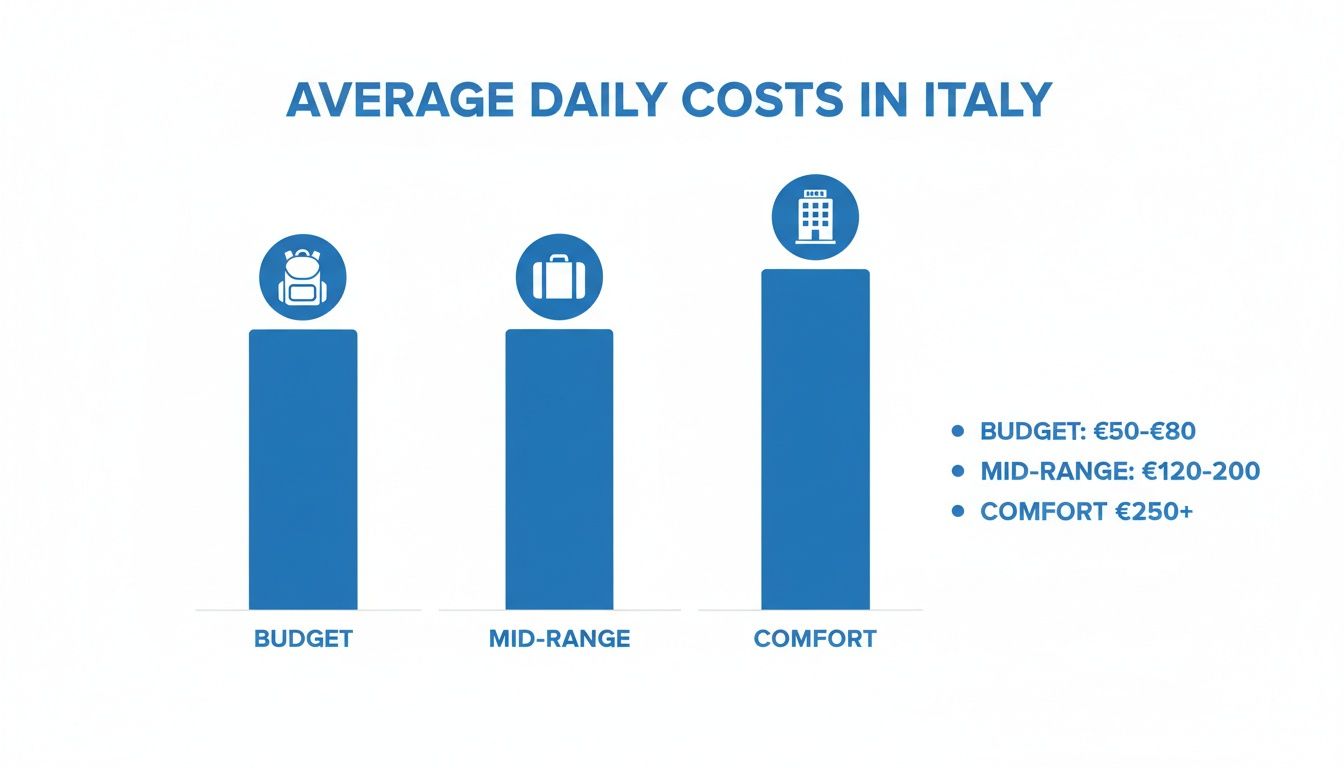
As you can see, jumping from a budget to a mid-range approach nearly doubles your daily spend. It really shows how much your choices in lodging and dining shape the final numbers.
Breaking Down Your Daily Italy Budget
To get a handle on your own budget, it helps to understand what each of these travel styles really means in practice. Let’s take a look.
To give you a clearer picture, here’s a simple table breaking down the estimated daily costs for a solo traveler. This should help you start mapping out your own budget, whether you’re planning in USD or Euros.
Average Daily Trip to Italy Cost Per Person (USD/EUR)
| Expense Category | Budget Traveler | Mid-Range Traveler | Comfort Traveler |
|---|---|---|---|
| Accommodation | $30–$60 (€28–€56) | $80–$150 (€75–€140) | $250+ (€235+) |
| Food | $25–$40 (€23–€37) | $50–$90 (€47–€84) | $120+ (€112+) |
| Activities | $10–$20 (€9–€19) | $30–$60 (€28–€56) | $80+ (€75+) |
| Transportation | $10–$25 (€9–€23) | $20–$50 (€19–€47) | $50+ (€47+) |
| TOTAL (USD) | $75–$145 | $180–$350 | $500+ |
| TOTAL (EUR) | €70–€135 | €168–€327 | €468+ |
This breakdown makes it obvious: a budget traveler is all about free activities, cooking some meals in a hostel kitchen, and mastering public transport. A mid-range traveler might mix in sit-down dinners at a local trattoria, visit a few major museums, and stay in comfortable B&Bs. The comfort traveler is looking at private transfers, fine dining, and premium hotels.
By figuring out your own priorities, you can decide where to save and where to splurge. Maybe you save on lunch by grabbing amazing street food so you can splash out on a guided tour of the Colosseum or a really special dinner. It’s your trip, and your budget should reflect what matters most to you.
For a different perspective on planning for a major international trip, you might find our guide on how much a trip to Japan costs useful for comparison.
Saving on Sustainable Transport and its Effect on Your Trip to Italy Cost
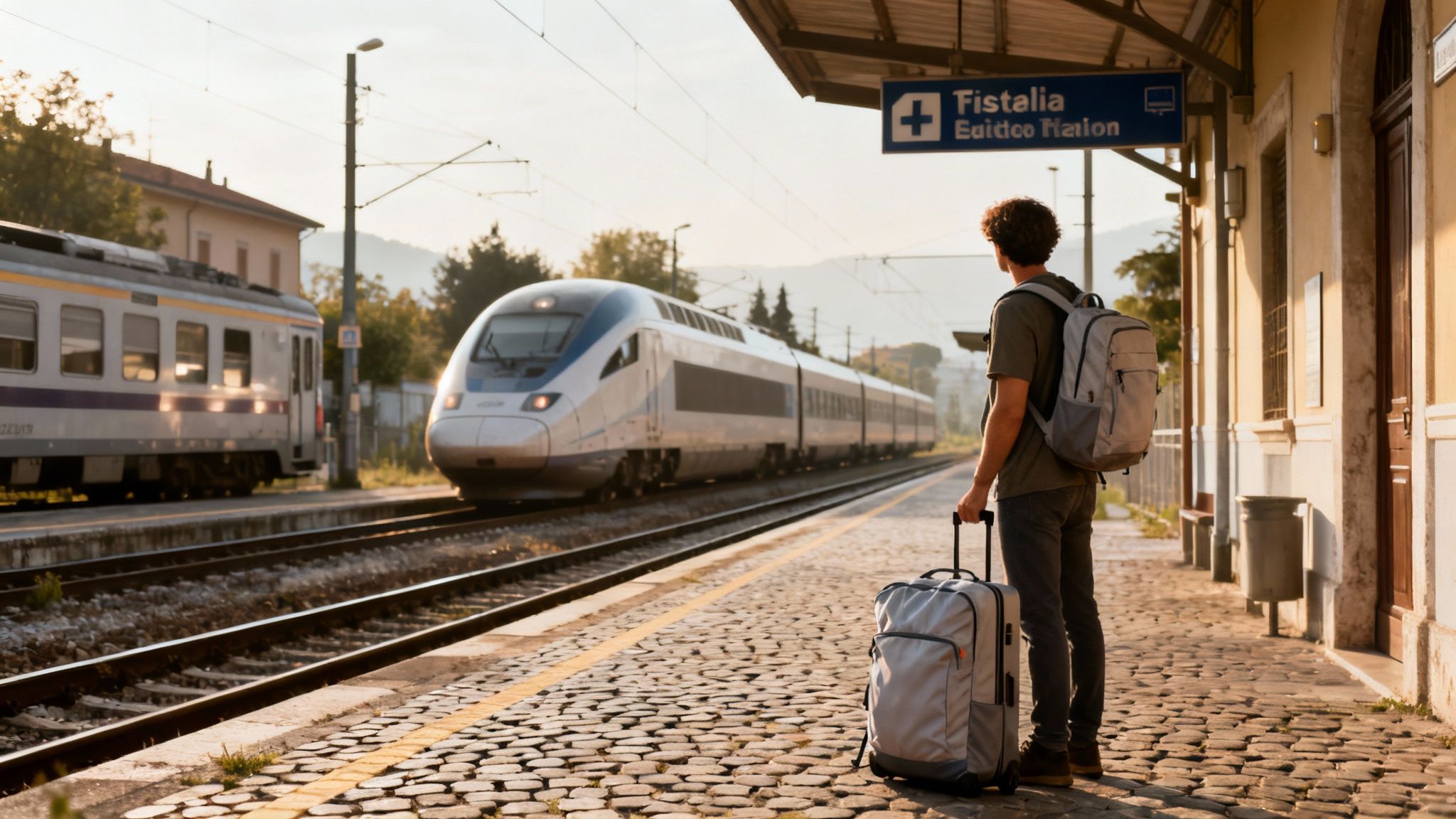
Getting around Italy doesn’t have to chew through your budget or your carbon allowance—in fact, it’s a huge piece of your total trip cost. Going with a rail-first strategy is usually the most affordable, beautiful, and sustainable way to see the country. It also frees you up to travel light, making a simple carry on backpack the only thing you need to navigate train stations and those classic cobblestone streets.
This approach lets you actually see the country, watching the landscapes shift from your window, from the rolling hills of Tuscany to the dramatic Amalfi Coast. Instead of killing time in airport security, you’re gliding directly from one city center to the next. It’s a slower, more intentional way to travel that makes the journey itself part of the adventure.
Plus, train travel is just incredibly practical here. Italy’s major cities are linked by a fast and far-reaching rail network, so planning a multi-city trip without ever touching a car is refreshingly simple. All you need is a smaller packable daypack for daily wanderings, which is perfect for stashing your essentials while you explore ancient ruins or buzz through local markets.
Comparing High-Speed and Regional Trains
In Italy, you’ll find two main types of trains, and knowing when to use each one is a game-changer for your budget. High-speed trains, known as Le Frecce (like Frecciarossa) and Italo, are brilliant for covering long distances between hubs like Rome, Florence, Milan, and Venice. They’re comfortable, seriously fast, and have all the modern comforts you’d expect.
On the other side are the regional trains, or Regionale. These are slower, make more stops, and connect all the smaller towns and villages the fast trains skip. They are significantly cheaper and give you a much more local-feeling experience. For shorter hops or diving deep into one region like Puglia or Sicily, these trains are an unbeatable low-cost choice.
The secret to making high-speed rail affordable? Book ahead. Seriously, planning is the single best way to slash this part of your trip cost.
Booking in Advance for the Best Fares
Nabbing your high-speed train tickets 60 to 90 days in advance can save you over 50% compared to buying them on the day. For example, a Frecciarossa or Italo ticket between major cities can cost as little as $16-$32 USD (€15-€30) per leg when you book early. Regional trains, on the other hand, cost just $5-$27 USD (€5-€25) for shorter trips, and you don’t need to book them ahead of time.
Choosing the train also comes with a massive environmental upside. Research shows that trains can emit up to 90% less CO2 than planes per passenger kilometer. You can get a better sense of how these costs stack up across Italy to help you map things out.
A great way to stay on top of this is by using a platform like Trip.com to compare schedules and prices across both Trenitalia and Italo. It makes spotting the best deals for your route way easier.
Budget-Friendly Buses and City Passes
While trains are the star of Italian transport, don’t overlook long-distance buses. Companies like FlixBus or Itabus can sometimes offer even cheaper fares, especially if you’re on a really tight budget. They take longer, sure, but for certain routes, the savings can be huge. Just be sure to pack some noise canceling earbuds to make the ride more comfortable.
Once you’re in a city, public transport is your best friend. In hubs like Rome, Florence, or Milan, grabbing a multi-day transport pass for the metro, trams, and buses is far more economical than buying single tickets every time you move. These passes usually cost around $26-$38 USD (€24-€35) for a 72-hour period and give you unlimited travel, letting you explore freely without constantly fumbling for change.
For a full breakdown of the different ways to get around, check out our guide on the best way to travel Italy. It will help you piece together a seamless and affordable journey.
Finding Affordable and Eco-Friendly Accommodation
Where you sleep each night is one of the biggest factors shaping your total trip to Italy cost. While hotels have their place, Italy is brimming with unique, sustainable, and often more affordable options that can completely change your travel experience for the better.
If you look beyond the usual choices, you’ll find lodging that not only saves you money but also plugs you directly into Italian culture and landscapes. This is where options like rural farm stays and city apartments really shine, offering a chance to live more like a local, even if just for a week.
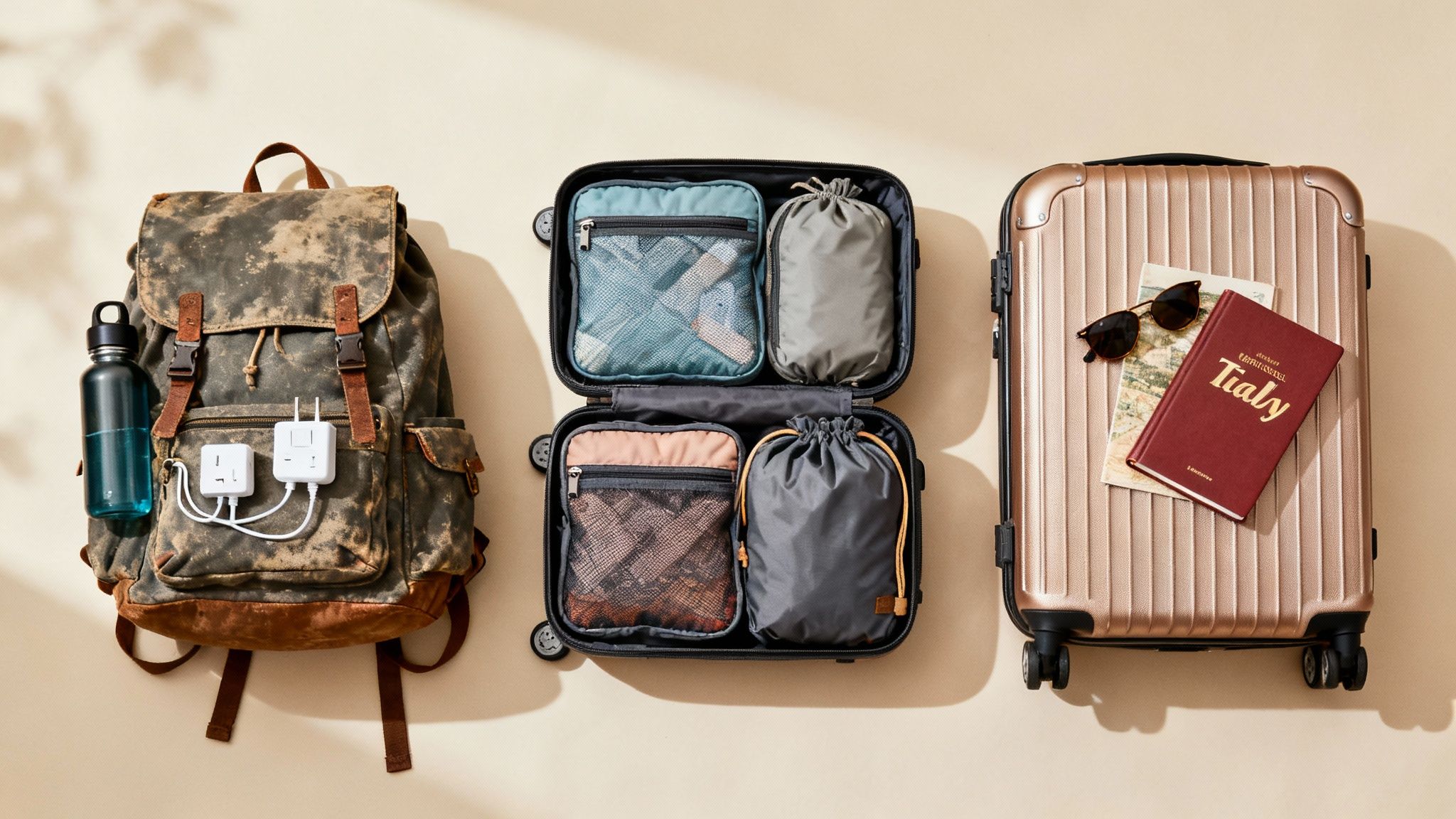
This approach is especially rewarding if you’re traveling light. Tucking your gear into packing cubes makes moving between a rustic farmhouse and a city flat feel completely seamless.
Discovering Agriturismi Farm Stays
One of the most authentic and eco-friendly lodging choices in Italy is the agriturismo. These are independently-owned working farms that offer rooms or apartments to guests, giving you a direct line to the Italian countryside.
Many are leaders in sustainable practices, using homegrown ingredients for incredible farm-to-table meals.
Staying at an agriturismo can be way cheaper than a city hotel. Prices often fall between $75–$150 USD (€70-€140) per night for a comfortable double room with breakfast. You get a peaceful setting, home-cooked food, and a genuine cultural exchange—all while your money directly supports a local family.
The Value of Apartments and Longer Stays
For trips lasting a week or more in one city, renting an apartment is a brilliant way to manage your trip to Italy cost. Having a kitchen means you can cook some of your own meals with fresh finds from local markets, which drastically cuts down on food expenses.
This option gives you more space and a feeling of home, perfect for slow travelers or digital nomads. It also encourages a more mindful, relaxed pace. For a deeper look at finding places that fit this style, our guide on choosing sustainable stays and avoiding greenwashing is a huge help. Having a good carry on luggage piece makes settling into your temporary home base easy and stress-free.
Boutique Hostels and Budget-Friendly Guesthouses
Hostels in Italy have come a long way from just basic dorm rooms. Many now offer private rooms that rival budget hotels in comfort but at a much lower price point—often $30–$60 USD (€28-€56) for a dorm bed or $70–$120 USD (€65-€112) for a private room. They’re also fantastic social hubs for solo travelers.
When staying in hostels or eco-lodges, a few key items make a big difference.
- A quick dry travel towel is a must-have, as many budget spots don’t provide them or charge extra.
- A portable door lock can add an extra layer of security and peace of mind in shared spaces.
- Bringing your own solid shampoo bar also cuts down on plastic waste and saves precious space in your bag.
The Impact of Seasonality on Accommodation Costs
The time of year you visit has a massive impact on lodging prices. Traveling during the shoulder seasons—April-May and September-October—can save you 30-50% on accommodation compared to the peak summer months.
The weather is still beautiful, the crowds are thinner, and your overall trip to Italy cost will be much, much lower. It’s a win all around.
How to Handle Daily Costs for Food and Fun
This is where your budget really comes to life. Your daily choices on food, activities, and little extras are what truly shape your total trip to Italy cost. From that first morning espresso to museum tickets and the evening aperitivo, these smaller expenses add up—but the good news is, Italy makes it incredibly easy to eat well and explore deeply without emptying your wallet.
The secret is to live like a local. Instead of hitting the tourist-trap restaurants on the main piazza, just wander a block or two deeper into the neighborhood to find a family-run trattoria. You’ll almost always find better food, a more genuine vibe, and much friendlier prices. Same goes for lunch—hitting a local market for fresh bread, cheese, and fruit makes for a memorable and seriously affordable meal.
This is also where a few smart pieces of gear can make a big difference. An RFID blocking wallet gives you peace of mind when you’re navigating crowded markets or hopping on public transport. And since your phone is your map, camera, and translator all in one, a solid portable power bank is non-negotiable. There’s nothing worse than finding the perfect photo spot only to see your battery die.
Eat Like an Italian and Keep Your Budget Happy
Italian food culture has plenty of built-in ways to save money. For breakfast, do as the Romans do: grab a cornetto (croissant) and an espresso while standing at the bar. It’ll cost you around $2.60–$4.30 USD (€2.50–€4), but be warned—sitting down at a table will often double the price.
For lunch, you can’t go wrong with a massive slice of pizza al taglio (pizza by the slice) or a freshly made panini, which will only run you about $4.30–$7.50 USD (€4–€7).
But the real game-changer for budget travelers is the aperitivo. In the early evening, bars all over Italy offer a pre-dinner drink that comes with a surprisingly generous spread of free snacks. We’re not just talking chips and olives; you’ll often find small pasta dishes, cured meats, and little sandwiches. For the price of a single cocktail ($8.60–$13 USD / €8–€12), you can easily make a light dinner out of it.
Come dinnertime, keep an eye out for restaurants offering a menu fisso or menu turistico (a fixed-price menu). This usually gets you a couple of courses, sometimes with wine and water included, for a set price, typically around $21–$38 USD (€20–€35).
A Realistic Look at Food Costs
The affordability of everyday life is a huge part of Italy’s charm. For one person, monthly living costs (without rent) average out to about $935 USD (€874). That breaks down into totally manageable daily food expenses.
A simple takeout panini is about $5.30 USD (€5), a proper pizza dinner can be had for $21–$27 USD (€20–€25), and a casual meal at a trattoria with wine often lands between $32–$48 USD (€30–€45). With these prices, it’s completely realistic to keep your daily food spending under $43 USD (€40). You can get a deeper dive into the numbers from this breakdown of living costs in Italy on Profee.com.
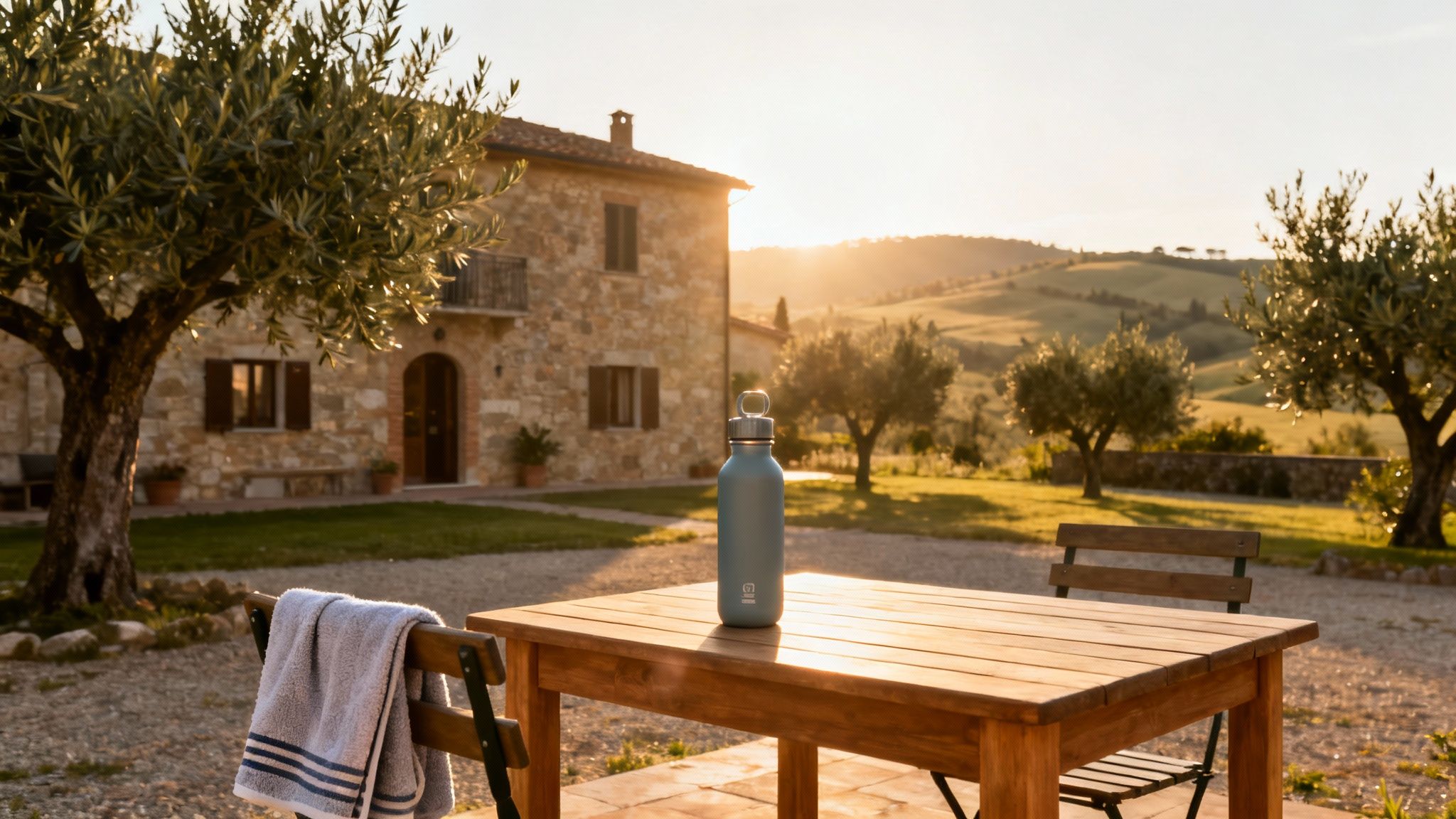
Pro Tip: At restaurants, always ask for acqua dal rubinetto (tap water). It’s perfectly safe to drink, it’s free, and it cuts down on plastic waste. Bringing a reusable water bottle is also a great idea for refilling at the public drinking fountains (nasoni) you’ll find all over cities like Rome.
Budgeting for Sightseeing and Activities
Activity costs can swing wildly, but there are plenty of ways to keep this part of your trip to Italy cost under control. Big-ticket attractions like the Colosseum or the Uffizi Gallery will have entrance fees anywhere from $17–$27 USD (€16–€25). The key here is to always book your tickets online, well in advance. You’ll save a ton of time by skipping the notoriously long lines.
Plus, many of Italy’s most incredible experiences are completely free:
- Get lost wandering through Rome’s historic center.
- Explore the stunning public gardens in Florence.
- Visit St. Peter’s Basilica in Vatican City (you only pay if you want to climb the dome).
- Go off the beaten path and discover some of the true hidden gems of Italy.
Keep an eye out for free museum days, too. On the first Sunday of most months, state-run museums and archaeological sites across the country throw their doors open for free admission. Finally, if you’re planning on hitting multiple paid sites in one city, look into a city pass. Options like the Roma Pass or the Firenze Card can be a great value, as they bundle entrance fees and public transport into one price.
Practical Money-Saving Tips for Your Italian Trip
Beyond just picking trains over planes, a few smart habits can seriously slash the cost of your trip to Italy. The single biggest lever you can pull? Timing.
If you visit during the shoulder seasons—think April-May or September-October—you’ll sidestep the peak summer crowds and prices. Flights and accommodation are often much cheaper, and the weather is usually gorgeous.
Another key is to simply act local. This means ditching the tourist traps around the main squares and hunting for authentic, affordable food. A short walk into a residential neighborhood almost always reveals family-run trattorias where the quality is higher and the prices are lower. For peace of mind in busy cities, keeping your essentials in a good anti theft backpack is always a smart move.
Booking your inter-city trains well in advance is also a game-changer. Aim to book 60-90 days out to lock in the best fares on the high-speed routes. Finally, get comfortable with local public transport. A multi-day bus or metro pass in cities like Rome or Florence will save you a ton compared to single tickets or taxis.
Travel Like a Local to Save More
Adopting a local mindset is your most powerful budgeting tool. Italians are savvy travelers in their own country, and you can learn a lot from how they move.
For example, average domestic travel spending is about $1,484 USD (€1,387) per person, but that number drops in certain regions. Italians in Sicily ($1,238 USD / €1,157) and Calabria ($1,280 USD / €1,195) are masters of the thrifty homeland trip. By mimicking this focus on regional discoveries, you could save 20-30% compared to a pre-packaged holiday. You can dig into these Italian travel spending habits on unicaradio.it.
This approach trickles down to simple daily choices. Always carry a collapsible water bottle to refill at the free public fountains (nasoni) you’ll find all over Italy. This tiny habit saves you a few euros a day and cuts down on a massive amount of plastic waste. For more ways to travel smart, check out our complete guide to budget travel tips.
Editor’s Pick: Agriturismo Farm Stays
For an authentic and often more affordable stay, consider booking an agriturismo. These working farms offer lodging that connects you directly with the Italian countryside. You get a peaceful setting, incredible home-cooked meals, and a genuine cultural exchange, all while supporting local families. They’re a fantastic alternative to city-center hotels for a more memorable experience.
Essential Gear for a Smarter Trip
Packing a few key items can also help you manage costs and make your trip smoother.
- A universal travel adapter is a non-negotiable for keeping your devices charged without any drama.
- Bringing along laundry detergent sheets is a brilliant hack for longer trips. You can do a quick wash in your apartment or hotel sink, saving you a small fortune on expensive laundry services.
It’s these small, conscious choices that add up, making your journey more sustainable and a lot more affordable.
To pull all this together, let’s zoom out. If you keep just a few core ideas in mind, you can manage your trip to Italy cost without feeling like you’re constantly crunching numbers. Think of these as the foundational habits for a smarter, lower-impact trip.
Low-Impact Travel Tools (Worth It)
Also, if you’re planning a trip and want to keep things simple, these tools help you travel smoother while staying mindful about impact.
Get an eSIM for reliable data → Disclosure: Partner link. No extra cost to you.
Pre-book a transfer for easy arrivals → Disclosure: Partner link. No extra cost to you.
Frequently Asked Questions
How much money should I bring to Italy for a week?
For a 7-day trip, a mid-range traveler should plan on spending somewhere between $1,260 to $2,450 USD (€1,176 to €2,289), and that’s before you factor in your flights. If you’re traveling on a tighter budget, you could definitely pull it off for $525 to $1,015 USD (€490 to €945). This covers your accommodation, food, local trains or buses, and a few key activities. It’s always a good idea to have a mix of cash (Euros) and cards on you.
Is Italy an expensive country to visit?
Italy can be as affordable or as expensive as you want it to be. Compared to other Western European countries like Switzerland or the UK, it’s generally much friendlier on the wallet. You can dramatically lower your trip to Italy cost by eating at local trattorias instead of tourist-trap restaurants, using public transport, and traveling in the shoulder seasons. Just know that major hubs like Venice and the Amalfi Coast will always hit your budget harder than less-visited regions.
What is the cheapest month to travel to Italy?
If you’re hunting for the absolute lowest prices, the cheapest months are usually from November to February, skipping the Christmas and New Year’s holidays. This is when you’ll find the best deals on flights and places to stay. The trade-off is colder weather, and some attractions might have shorter hours. For a nice balance of good weather and lower prices, the shoulder seasons of April–May and September–October are pretty much perfect.
Can you use US dollars in Italy?
No, you cannot use US dollars for your day-to-day purchases in Italy. The official currency is the Euro (€). You’ll need to either exchange your money before you go or, much more conveniently, just withdraw Euros from ATMs when you arrive. Credit cards are accepted almost everywhere, but it’s essential to have some cash on hand for smaller cafes, local markets, and tiny shops.
How much does a 10-day trip to Italy cost?
For a 10-day trip, a mid-range traveler can expect to spend between $1,800 and $3,500 USD (€1,680 and €3,270), not including international flights. A budget-conscious traveler could get by on something closer to $750 to $1,450 USD (€700 to €1,350). This budget gives you enough room for a comfortable journey through two or three cities, especially if you stick to a rail-first approach.
Is it cheaper to go to Italy or Greece?
Generally speaking, Greece often ends up being slightly cheaper than Italy. This is especially true for accommodation and dining out on the less touristy islands. That said, the costs can be very similar depending on your travel style and where you go. Both countries offer fantastic value for travelers who plan ahead and travel smart.
How much cash should I carry daily in Italy?
Having about $50 to $100 USD (€50 to €95) in cash per person, per day is a good rule of thumb. It’s plenty for small purchases like your morning coffee, a scoop of gelato, lunch from a local market, or bus tickets, so you’re not pulling out a credit card for every little thing. For bigger expenses like a nice dinner or museum tickets, using a card is usually easier and safer.
What is a realistic food budget for Italy?
A realistic daily food budget for a mid-range traveler is about $50 to $90 USD (€47 to €84). This lets you have a standing coffee and pastry for breakfast, a simple panini or slice of pizza for lunch, and a proper sit-down dinner at a trattoria with a glass of house wine. Budget travelers can eat incredibly well for $25 to $40 USD (€23 to €37) a day by hitting up local markets, making the most of aperitivo, and grabbing delicious street food.
Key Takeaways
- Travel During the Shoulder Season: Planning your visit for April-May or September-October is the single biggest money-saver, potentially cutting flight and accommodation costs by 30-50%.
- Embrace Train Travel: Italy’s rail network is your best friend. Book high-speed Frecciarossa tickets 60-90 days out to save over 50% on major routes, and use cheap regional trains for shorter hops.
- Eat Smart and Local: Avoid tourist-trap restaurants. Stand at the bar for coffee, enjoy the aperitivo happy hour for a light dinner, and wander a few streets away to find better, more affordable food.
- Choose Sustainable Accommodation: Look beyond hotels. An agriturismo (farm stay), a city apartment for longer visits, or a modern hostel will often offer better value and a more authentic experience.
- Book Major Attractions in Advance: For sites like the Colosseum or Uffizi Gallery, always buy your tickets online beforehand to skip long lines and sometimes secure a better price.
- Stay Connected Smartly: Instead of expensive roaming, get an eSIM from a provider like Airalo for affordable data as soon as you land.
This article was fact-checked using sustainability data from the World Green Building Council, the Global Ecotourism Network, and peer-reviewed architecture studies. All partner links are vetted for compliance with sustainable business certifications.
Join the Sustainable Work Movement
Want more rail-first itineraries, low-impact packing systems, and walkable base-city ideas?
