
So, you see the term “carbon neutral” on a travel booking site or a product label. Understanding what does carbon neutral mean is the first step toward making more responsible travel choices.
Think of it like a perfectly balanced scale. On one side, you put all the carbon dioxide (CO2) emissions an activity creates—say, from a long-haul flight. On the other side, you add actions that remove or prevent an equal amount of CO2 from entering the atmosphere.
When the scale is perfectly level, the net impact is zero. That’s carbon neutral.
Affiliate disclosure: This post may contain affiliate links. If you buy through them, Eco Nomad Travel may earn a small commission at no extra cost to you.
The Core Idea Behind Carbon Neutrality
At its heart, going carbon neutral is a way of taking responsibility for the greenhouse gas emissions we can’t avoid creating.
The balance is usually achieved by purchasing carbon offsets—investments in projects designed to reduce emissions somewhere else in the world. For a traveler, that might mean calculating the emissions from a 3,860-mile (6,212 km) flight from New York to London and then funding a project that plants enough trees to absorb that exact amount of CO2 over their lifetime.
The goal is to neutralize your footprint, effectively making it as if your emissions never happened. This isn’t just a vague concept; it was formally defined by the PAS 2060 standard back in 2010 to give companies a clear, verifiable process for demonstrating carbon neutrality.

This idea is especially powerful for eco-conscious digital nomads. By making sustainable choices first—like taking night trains across Europe instead of flying—you shrink the initial emissions that even need offsetting. It’s a continuous loop: measure, reduce, and then offset what’s left.
Why It Matters for Travelers
For anyone planning a trip, understanding carbon neutrality is a foundational step toward more responsible exploration. It offers a tangible way to counteract the environmental cost of travel, especially for high-impact activities like flying.
But here’s the crucial part: it should always be seen as a starting point, not a free pass.
While balancing the scale is a great step, the best approach is always to reduce the weight on the emissions side first. This is a core principle in the broader world of what is sustainable travel, which prioritizes lowering your impact from the get-go. Carbon neutrality is a powerful tool, but it’s just one piece of a much larger puzzle aimed at protecting the planet we love to explore.
What Does Carbon Neutral Mean vs Net Zero
While “carbon neutral” is a good start, net zero is the real gold standard for climate action. Getting the difference is key for any traveler who wants to back genuinely sustainable businesses. This isn’t just jargon; it reveals how deep a company’s commitment to the environment actually goes.
Think of it like this: carbon neutrality is like going on a diet to balance out a week of indulging. It’s about compensating for your impact after the fact—like buying offsets to plant trees after taking a flight. It’s a valid way to address your immediate emissions.
But net zero is a fundamental lifestyle change focused on healthy habits first. This approach demands deep, foundational changes to stop the “indulgence” from happening in the first place. For a company, this means slashing its own emissions as much as possible before even thinking about offsets.
What This Means for Your Travel Choices
This difference has a direct impact on the choices you make on the road. A hotel that calls itself “carbon neutral” might just be buying carbon credits to balance out its energy use. While that’s better than doing nothing, it doesn’t mean the hotel has made any real changes to reduce its own footprint.
On the other hand, a hotel working toward net zero has probably made serious investments to cut its own emissions first. This could mean installing solar panels, upgrading to energy-efficient appliances, or sourcing food from local farms to slash transport emissions. They’re tackling the root cause, not just the symptom.
The critical distinction is that carbon neutrality lets a company balance its CO₂ using offsets without requiring deep internal cuts. Net zero, however, demands they slash their own emissions by 90% or more across all operations before using carbon removals for the tiny bit that’s left.
You can learn more about how different sustainability terms stack up by reading about the differences between an environmental and carbon footprint.
A Glance at Carbon Neutral vs Net Zero
To make it even clearer, let’s break down the key differences. This table helps you see at a glance why net zero is a far more ambitious and impactful goal.
| Feature | Carbon Neutral | Net Zero |
|---|---|---|
| Primary Focus | Balancing emissions, mainly through offsetting. | Drastically reducing emissions first, then removing the small remainder. |
| Emissions Scope | Often focuses only on carbon dioxide (CO₂). | Covers all greenhouse gases (GHGs), including methane and nitrous oxide. |
| Reduction Target | No universal reduction target is required before offsetting. | Requires deep decarbonization, typically a 90-95% reduction in emissions. |
| Offsetting Role | Can be the main tool used to achieve the goal. | Used only as a last resort for the final, unavoidable 5-10% of emissions. |
| Travel Example | A tour company offsets the carbon from its flights. | A tour company switches to electric vehicles, sources local food, and then offsets the tiny remaining emissions. |
Knowing this helps you look past the marketing slogans. It empowers you to understand the real commitment behind a brand’s green claims, so you can support the businesses that are truly leading the way in sustainable travel. When you see a company talking about its net zero pathway, you know it’s on a much more rigorous and meaningful journey.
How Carbon Emissions Are Actually Measured
To really get what carbon neutral means, you have to look at how the math is done. Companies and organizations don’t just guess their impact; they follow a structured system to count their greenhouse gas emissions. The whole thing is broken down into three categories, known as “scopes.”
Let’s use a simple travel analogy to see how it works. Imagine you’re staying at an eco-lodge. The way it measures its carbon footprint will fall into these three distinct buckets.
Scope 1: Direct Emissions
Scope 1 covers direct emissions from sources that a company owns or controls. These are the most straightforward to measure because they happen right on-site.
For our eco-lodge, this would be the natural gas burned in its furnaces to provide heat and hot water. It also includes the fuel used in the hotel’s own shuttle van that picks you up from the train station. It’s the carbon coming directly from their property and equipment.
Scope 2: Indirect Emissions from Purchased Energy
Scope 2 includes indirect emissions from the generation of purchased energy. This means the electricity, steam, heating, and cooling that the company buys from a utility provider.
Back at the eco-lodge, this is the electricity powering your room’s lights, the air conditioning, and the Wi-Fi router. The emissions don’t happen at the lodge itself but at the power plant that generates the electricity. But because the lodge uses that energy, it’s responsible for the emissions tied to it.
Scope 3: All Other Indirect Emissions
Scope 3 is the big one, and it’s where things get complicated. It covers all other indirect emissions that happen anywhere in a company’s value chain. This includes everything from the production of goods they buy to the business travel of their employees.
For our eco-lodge, this is massive. It includes the emissions from:
- The farms that grew the food served in the restaurant.
- The factory that manufactured the bed linens and furniture.
- The waste generated by guests, which is then sent to a landfill.
- Your flight or train journey to get to the destination.
This is a critical, but often overlooked, part of the puzzle. Some companies only report on Scopes 1 and 2, which gives you a very incomplete picture of their real impact. A truly transparent business will measure and work to reduce emissions across all three scopes.
This is where you can start to see how different climate commitments stack up, with carbon neutrality acting as a foundational step and net zero as the ultimate goal.
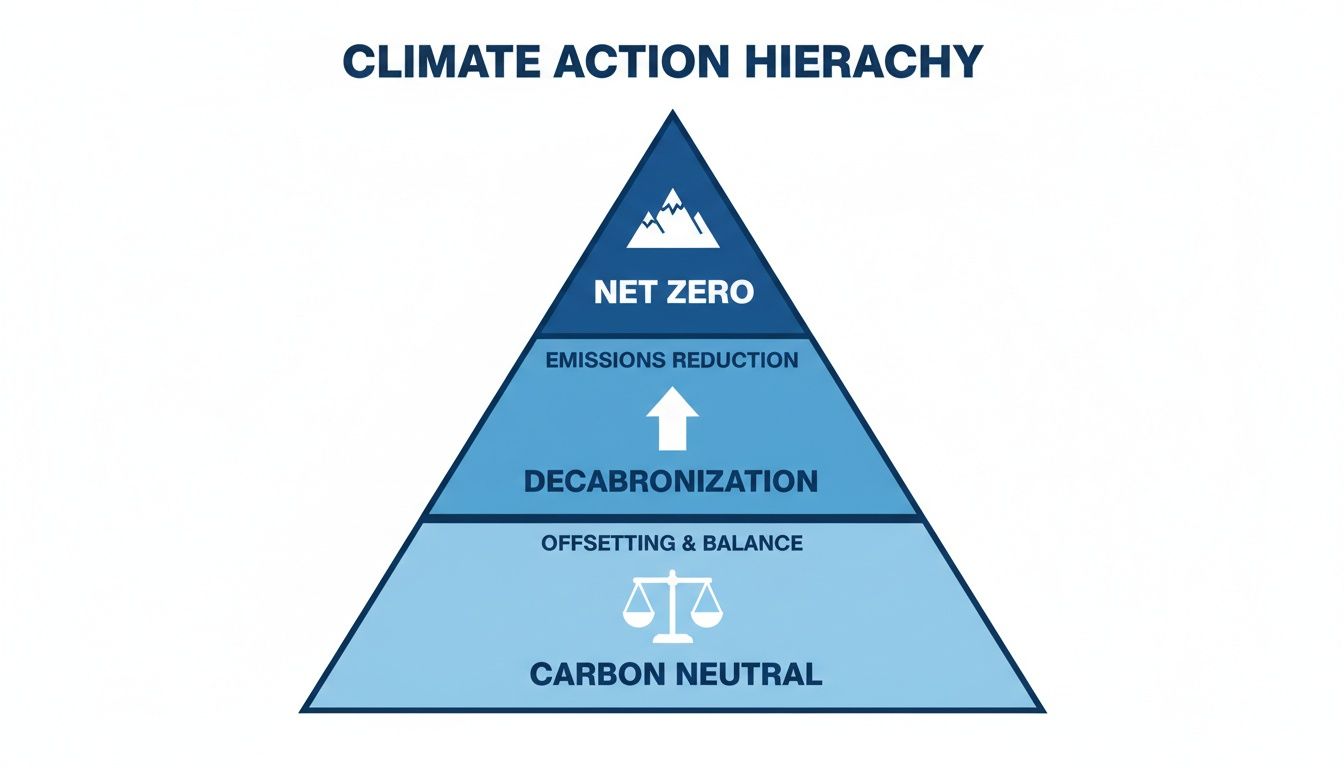
The pyramid shows that hitting net zero is a much tougher journey, demanding deep emission cuts before anything else. Understanding these scopes helps you ask smarter questions and see why small choices, like bringing your own reusable water bottle or a solid shampoo bar, are so powerful. These simple actions reduce the Scope 3 emissions tied to manufacturing, shipping, and disposing of single-use products associated with your trip.
Want to see how your own travel choices add up? Dive deeper with our travel carbon footprint calculator to get a clearer picture.
Your Guide to Carbon Neutral Travel
Knowing the theory is one thing, but actually putting it into practice on the road is what counts. Let’s translate all these ideas into a simple, actionable plan for your next trip, helping you travel more thoughtfully. The first and most important step is always to reduce your emissions before you even think about offsetting.
This “reduce first” mindset changes everything about how you plan. It means choosing a scenic train journey over a quick flight. It means packing smarter to cut down on weight and waste. Using gear like compression packing cubes helps you fit everything into a smaller carry-on backpack, shrinking your footprint from the very start.
For the emissions you just can’t avoid—like that necessary long-haul flight—the next step is to balance the scales responsibly. This is where offsetting comes in, but it’s vital to choose high-quality projects that make a genuine difference.

How to Offset the Rest Responsibly
Once you’ve done everything you can to minimize your travel footprint, it’s time to deal with what’s left. Responsible offsetting isn’t about paying to erase guilt; it’s an investment in real, measurable climate solutions. The trick is finding projects that are verified by internationally recognized standards.
Keep an eye out for certifications from organizations like Gold Standard and Verra (Verified Carbon Standard). These third-party auditors act as referees, making sure that carbon offset projects are real, measurable, and permanent. They confirm that the emission reductions genuinely wouldn’t have happened without the project’s existence.
The best projects often deliver powerful “co-benefits” that go beyond just carbon reduction. Think new jobs, protected biodiversity, or better public health for local communities. To get a better handle on this, check out our detailed guide on choosing effective carbon offsetting projects.
Aligning Your Travel with Global Climate Goals
Making these conscious choices brings your travel style in line with critical global climate targets. The big one is the Paris Agreement’s goal to limit global warming to 1.5°C, which means the world needs to hit net-zero CO2 emissions by around 2050.
This deadline is exactly why prioritizing walkable cities and rail travel matters so much. Trains emit just 0.04 kg of CO2e per passenger-kilometer, while aviation is way up at 0.15 kg.
For a digital nomad, this could mean a 6,213-mile (10,000 km) rail journey across Europe might generate as little as 88 lbs (40 kg) of CO2e. That’s a tiny fraction of the emissions from stringing together a bunch of short flights.
Editor’s Pick: The Gold Standard Marketplace
For travelers looking for a trusted and transparent way to offset their journey’s emissions, the Gold Standard Marketplace is our top recommendation. It lets you directly support high-impact, certified projects around the world. You can filter by project type (like reforestation or renewable energy) and see exactly how your contribution supports both climate action and sustainable development goals. It’s a straightforward way to ensure your offsets are making a genuine positive impact.
How to Spot Greenwashing and Verify Claims
In a world drowning in “eco-friendly” and “green” labels, it can be tough to know which claims are real. This is where you need to get smart about greenwashing—when companies make misleading claims about their environmental practices to look better than they are. Learning to see past the marketing hype is a critical skill for any responsible traveler.
Greenwashing often leans on vague buzzwords without any proof. A hotel might shout about its biodegradable soap while conveniently ignoring the massive carbon footprint from flying in food from halfway across the world. It’s a classic move: shine a spotlight on one small, positive action to distract from a much larger negative impact.
Look for Credible Third-Party Certifications
The most reliable way to check a company’s story is to look for credible, third-party certifications. These organizations have tough standards and transparent auditing processes, taking the guesswork out of your decision-making. They act as an independent stamp of approval.
Some of the most respected certifications in the travel and business world include:
- B Corp Certification: This is the big one. It assesses a company’s entire social and environmental performance, from supply chain to employee benefits, making it a holistic measure of a business doing good.
- Green Globe: This is a premier certification program built specifically for the travel and tourism industry, evaluating sustainability across environmental, social, and economic metrics.
- EarthCheck: Another leading scientific benchmarking and certification program for the travel sector, helping businesses measure and manage their environmental footprint with real data.
Here is an example from B Lab, the nonprofit network behind B Corp Certification, showing how they frame their mission to use business as a force for good.
The key insight here is that certifications like B Corp go beyond a single product. They audit a company’s entire operational DNA.
Questions to Ask Before You Book
Beyond certifications, you can become your own sustainability detective. Arm yourself with a few sharp questions to cut through the noise and see if a business is truly walking the talk. Before you book a tour, stay, or flight, consider asking:
- Do you have a public sustainability report? Legitimate companies are open about their goals, their progress, and even where they fall short. Transparency is a huge green flag.
- What specific actions are you taking to reduce your Scope 1, 2, and 3 emissions? This question shows you know your stuff and that they understand their full impact, not just the easy bits.
- Are your carbon offsets verified by a recognized standard like Gold Standard or Verra? This confirms the quality of their offsetting. For a deeper dive, check out our guide on whether carbon offsets are effective.
- How do you support the local community and economy? True sustainability is about people and place, not just carbon math.
By asking these questions, you empower yourself to support businesses that are genuinely invested in a better future. It’s how you make your travels more meaningful and impactful. Packing your own quick-dry travel towel or using reusable toiletry bottles is great, but choosing businesses with integrity is what scales that positive impact.
Key Takeaways
- Carbon Neutral is a Balance: It means balancing out the carbon emissions you produce by funding projects that remove an equal amount.
- Net Zero is the Ultimate Goal: This is a much higher standard that requires cutting emissions by 90% or more first, then offsetting the small remainder.
- Reduce First, Offset Last: The most impactful action is always to lower your emissions from the start (e.g., take trains instead of planes). Offsetting is for the unavoidable emissions.
- Verify Claims: Greenwashing is common. Look for credible third-party certifications like B Corp or Green Globe to ensure a company’s claims are legitimate.
- Quality Offsets Matter: Not all offsets are equal. Always choose projects verified by standards like Gold Standard or Verra to ensure your money makes a real impact.
Low-Impact Travel Tools (Worth It)
Also, if you’re planning a trip and want to keep things simple, these tools help you travel smoother while staying mindful about impact.
Get an eSIM for reliable data → Disclosure: Partner link. No extra cost to you.
Pre-book a transfer for easy arrivals → Disclosure: Partner link. No extra cost to you.
Frequently Asked Questions
The world of sustainable travel can feel like a maze of new terms and ideas. Here, we’ve tackled some of the most common questions travelers ask about carbon neutrality, offsets, and making smarter choices on the road.
What Is the Main Difference Between Carbon Neutral and Net Zero?
The real difference comes down to the game plan. Carbon neutral is all about balancing the scales for your carbon dioxide (CO₂) emissions, mostly by buying carbon offsets. Think of it as a one-for-one exchange: you create an emission, you pay to cancel it out somewhere else.
Net zero, on the other hand, is a much tougher and more ambitious goal. It demands that a company or country first slash its emissions by at least 90% across its entire operation (Scopes 1, 2, and 3). Only when those deep cuts are made can the last unavoidable slice of emissions be neutralized with carbon removal projects.
In short, net zero is about deep reduction first, while carbon neutral is about balancing what you emit today.
Can an Individual Traveler Truly Be Carbon Neutral?
Yes, absolutely. An individual can achieve carbon neutrality for their travels. It’s a two-step process: first, figure out the carbon footprint of your trip with a tool like our travel carbon footprint calculator. Second, you buy high-quality carbon offsets from a verified source to match the emissions you calculated.
But—and this is a big but—this should always be the final step after you’ve already done everything you can to shrink your footprint from the start. Prioritizing train travel, packing light with a lightweight travel backpack, and choosing eco-certified hotels are always the more powerful first moves.
Why Is Reducing Emissions Better Than Just Offsetting?
Reducing your emissions is always the top priority because it tackles the problem at its source: pumping excess greenhouse gases into the atmosphere in the first place. Offsetting is a critical tool for dealing with the emissions we can’t avoid right now, but it doesn’t stop them from happening.
Think of it like a leaky faucet. You can stick a bucket underneath to catch the drips (that’s offsetting), but the best solution is to fix the leak itself (that’s reduction). Focusing on reduction is what drives real, long-term change, pushing innovation in clean energy, better transport, and smarter technology.
How Much Does It Cost to Offset a Flight?
The price tag for offsetting a flight varies a lot depending on the distance, the type of project you support, and its certification. A short domestic flight might only cost a few dollars (USD) to offset. Meanwhile, a long-haul international flight could run anywhere from $25 to $100 USD or more.
For example, a round-trip flight from New York to London (roughly 7,000 miles or 11,265 km) produces about 1.6 tons of CO₂ per passenger. Offsetting that could cost between $16 and $80 USD, depending on the project. Projects with strong community co-benefits, like those certified by Gold Standard, often cost more but deliver a much bigger positive impact.
Before you book, you can compare flight prices on platforms like Aviasales and then calculate what the offset cost would be.
Are All Carbon Offsets Created Equal?
Not even close. The quality and integrity of carbon offset projects are all over the map. High-quality offsets come from projects that are proven to be additional (meaning the emission reduction wouldn’t have happened without the funding), permanent, and verified by a credible third-party standard like Gold Standard or Verra.
Low-quality offsets might fund things that were going to happen anyway, or they might fail to deliver the carbon reductions they promised. This is why it’s so important to do your homework and choose certified projects. You want to be sure your money is actually making a difference. If you’re not sure where to begin, the Gold Standard Marketplace is a great place to find reputable projects.
What Is Climate Neutral and How Is It Different?
Climate neutral is a bigger, more comprehensive term than carbon neutral. While carbon neutral focuses specifically on balancing out carbon dioxide (CO₂), climate neutral tackles all greenhouse gases (GHGs). This includes heavy hitters like methane (CH₄) and nitrous oxide (N₂O).
Because those other gases have a much more powerful warming effect than CO₂, aiming for climate neutrality is a more holistic and impactful goal. A company claiming to be climate neutral is taking responsibility for its full climate impact, not just its CO₂ footprint.
How Can I Reduce My Travel Footprint Besides Flying Less?
While flying less is the single most effective action you can take, plenty of other choices add up to make a huge difference. Here are a few practical steps:
- Pack Light and Smart: Use gear like packing cubes and a packable daypack. This helps you avoid checked bags, which reduces the aircraft’s fuel burn.
- Choose Sustainable Stays: Book accommodations certified by programs like Green Globe or EarthCheck. You can find them on sites like Trip.com by using their sustainability filters.
- Embrace Slow Travel: Stay in one place longer. You’ll cut down on transport emissions and support the local economy in a more meaningful way.
- Use Public Transport: Once you arrive, get around using trains, buses, and your own two feet instead of taxis or rental cars. Pre-booking a service like Welcome Pickups can help you get from the airport to a central spot where public transit is easy to navigate.
- Reduce Waste: Carry a collapsible water bottle and use laundry detergent sheets to slash your single-use plastic consumption.
Does Using AI for Trip Planning Have a Big Carbon Footprint?
This is a great question, especially as more travelers turn to AI tools. The data so far suggests that the carbon footprint of a single query on an AI chatbot is surprisingly tiny. A 2025 Google report estimated that a median text query on its Gemini model generates just 0.03 grams of CO₂e.
While that number is incredibly low for individual use, it’s worth remembering that the collective energy consumption of data centers is massive. For now, the impact of using AI for your personal trip planning is likely a tiny fraction of your overall travel footprint. Your choice of transportation will always have a much, much bigger effect.
Join the Sustainable Work Movement
Want more rail-first itineraries, low-impact packing systems, and walkable base-city ideas?
This article was fact-checked using sustainability data from the World Green Building Council, the Global Ecotourism Network, and peer-reviewed architecture studies. All partner links are vetted for compliance with sustainable business certifications.
