
To really get your head around what a greenway is, picture a kind of ‘nature highway’ built just for people, not cars. It’s a protected strip of open space, designed for walking, cycling, and just connecting with the outdoors, safely away from traffic. For anyone serious about low-impact travel, these pathways are essential.

A greenway is so much more than just a path; it’s a deliberate link between places, people, and the natural world. Think of greenways as the green arteries of a city or an entire region.
They weave together parks, neighborhoods, cultural landmarks, and even whole cities, creating a network that makes car-free movement a real, enjoyable option. For travelers, especially those of us building rail-first itineraries, these corridors are gold. They often provide a scenic, healthy, and surprisingly direct route from a train station to your accommodation or a local point of interest.
The idea really started to gain traction in the early 1990s, when experts began defining them as linear open spaces that follow natural corridors like rivers or repurposed routes like old railway lines. In Europe, the concept was formalized to mean routes built exclusively for non-motorized journeys.
Why Greenways Matter for Eco-Conscious Travelers
Using greenways fits perfectly with a sustainable travel mindset. When you choose to walk or cycle along these routes, you’re actively shrinking your carbon footprint. Consequently, that simple choice, when made by many, has a massive collective impact on a destination’s environmental health.
But it goes deeper than that. Hopping on a greenway encourages a slower, more immersive way of seeing a place. Instead of blurring past the landscape in a vehicle, you get to observe the local ecosystem up close, stumble upon hidden gems, and engage with the community on a much more personal level.
Connecting to a Larger Movement
These green corridors are a cornerstone of a green travel guide. They represent a real, tangible shift toward prioritizing ecological well-being and human-centric design in our towns and cities.
They aren’t just recreational perks; they are vital parts of a resilient, sustainable transportation system that benefits both locals and visitors. This approach helps create cities that are more livable, walkable, and enjoyable for everyone—the backbone of a travel style that is both regenerative and personally rewarding.
What is a greenway composed of? Different types explained
Not all greenways are created equal. Knowing the different kinds helps you figure out what to expect on your travels, from the terrain under your feet to the scenery you’ll be soaking in. Once you can spot the difference, planning your low-impact adventures gets a whole lot easier.
This diagram breaks down the core idea—these are corridors designed to connect us with nature, communities, and each other.
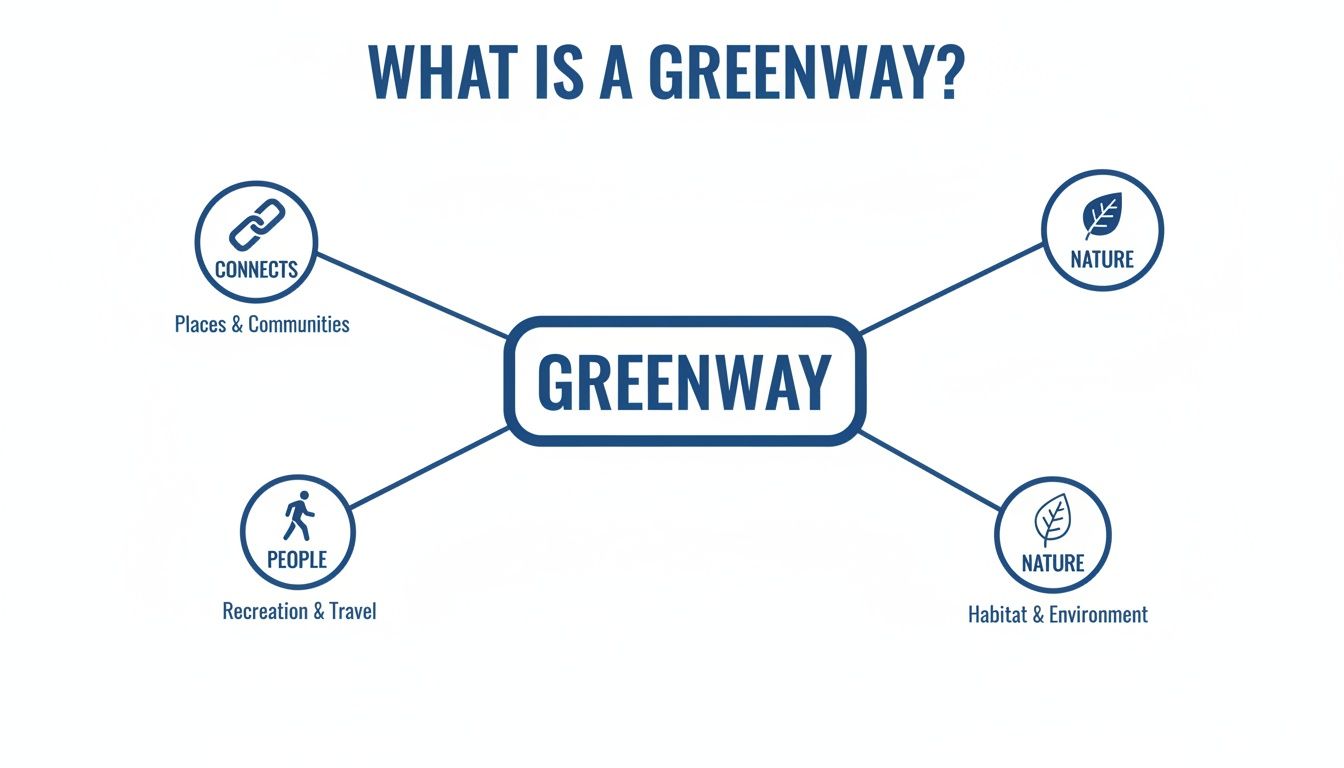
It’s a simple concept with a few common variations you’ll find out on the road. Let’s break down the main categories.
Urban Linear Parks
Think of these as green lifelines threading through the heart of a city. Urban linear parks often trace natural features like rivers or give new life to old infrastructure, offering a welcome break from the concrete jungle. They are almost always paved and easy to access, perfect for a morning run or a quiet walk between city sights.
A brilliant example is Seoul’s Cheonggyecheon Stream, where an old elevated highway was torn down and reborn as a beautiful waterfront park. It’s now a beloved public space that connects major districts, used by locals and travelers alike.
Rail-Trails
For cyclists and long-distance walkers, rail-trails are a dream come true. These paths are built on former railway lines, which means they are wonderfully flat with gentle grades—no brutal hills to climb. They slice through beautiful rural landscapes that were once only visible from a train window, making them ideal for multi-day trips.
The Vennbahn, a 78-mile (125-kilometer) trail crossing through Germany, Belgium, and Luxembourg, is a perfect example of how these routes can connect not just towns, but entire countries. You can learn more about similar treks in our guide to inn-to-inn hiking in the USA.
Blueways and Waterfronts
Just as the name suggests, blueways are scenic corridors that follow rivers, canals, coastlines, and other waterways. They offer a unique way to experience a destination, mixing outdoor activity with calming water views. These paths are perfect for anyone who loves being near the water and often link coastal towns or riverside communities.
A classic example is the Danube Cycle Path, one of Europe’s most famous cycling routes. It follows the river through ten countries, offering an epic journey from Germany’s Black Forest all the way to the Black Sea while connecting countless cities and villages along its banks. For these kinds of excursions, a small packable daypack is perfect for carrying water and snacks.
To make it even clearer, here’s a quick comparison of the greenway types you’re most likely to encounter on your travels.
Greenway Types at a Glance
Urban Linear Park
- Primary Feature: Paved, accessible path in a city
- Common Location: Follows rivers, repurposed infrastructure
- Example: Cheonggyecheon Stream (Seoul)
Rail-Trail
- Primary Feature: Flat, gentle grade on old railway lines
- Common Location: Rural and suburban areas, connecting towns
- Example: Vennbahn (Germany, Belgium, Lux.)
Blueway/Waterfront
- Primary Feature: Follows a body of water
- Common Location: Coastlines, rivers, canals
- Example: Danube Cycle Path (Europe)
Each type offers a different flavor of low-impact travel, but they all share the same goal: to create car-free spaces for recreation, nature, and connection.
How Greenways Benefit Communities and the Planet
Greenways are far more than just pleasant paths for a weekend stroll. They’re powerful engines for positive change, connecting the simple act of taking a walk to the bigger principles of low-impact travel. Every cyclist who chooses a greenway over a road is one less car on the street, directly cutting carbon emissions and improving local air quality.
These corridors also pull double duty as vital channels for biodiversity. By preserving natural landscapes within cities and suburbs, they protect precious habitats for plants and wildlife, making them essential tools for building more resilient ecosystems.
Boosting Local Well-Being
The advantages of greenways ripple deep into the community. It’s been proven time and again that easy access to safe, green spaces boosts both physical and mental health, offering a straightforward way to get exercise and relieve stress. They naturally become social hubs where neighbors meet and connect, strengthening the local fabric.
Economically, the investment pays off handsomely. One systematic review found that the societal benefits of greenways far exceed their costs, with an average cost-benefit ratio of 3.12 to 1. This value comes from real-world impacts like reduced healthcare costs, cleaner air, and increased property values. For travelers, this all adds up to more vibrant, healthier destinations to explore.
A Path to Regenerative Travel
This is where the whole concept of a greenway aligns perfectly with regenerative tourism. When you choose to explore a place through its greenway network, you’re not just a passive observer; you’re actively contributing to its well-being. Your travel becomes a positive force, supporting a system that benefits local ecology and public health.
Instead of just passing through, you’re participating in a local solution. Every mile you cover on foot or by bike is a small vote for sustainable infrastructure.
By using greenways, travelers don’t just see a place; they become part of its sustainable ecosystem. It’s an active way to ensure your visit improves the destination, leaving it better for future generations of locals and visitors.
Choosing these paths is a key part of any thoughtful travel strategy. It’s a simple action that reflects a deeper commitment to exploring the world responsibly, and you can find more ideas like this in our comprehensive green travel guide. Greenways are a real-world example of how smart infrastructure can make sustainable choices the easiest and most enjoyable ones.
How to Plan Your Travels Around Greenways
It’s surprisingly simple to weave greenways into your travels. With the right tools and a bit of forward thinking, these quiet corridors can become more than just a scenic detour—they can be the very backbone of your itinerary.
The trick is to stop seeing them as an afterthought and start treating them as your primary ‘last-mile’ connectors. Think of them as the natural link between a train station and your final stop for the day.
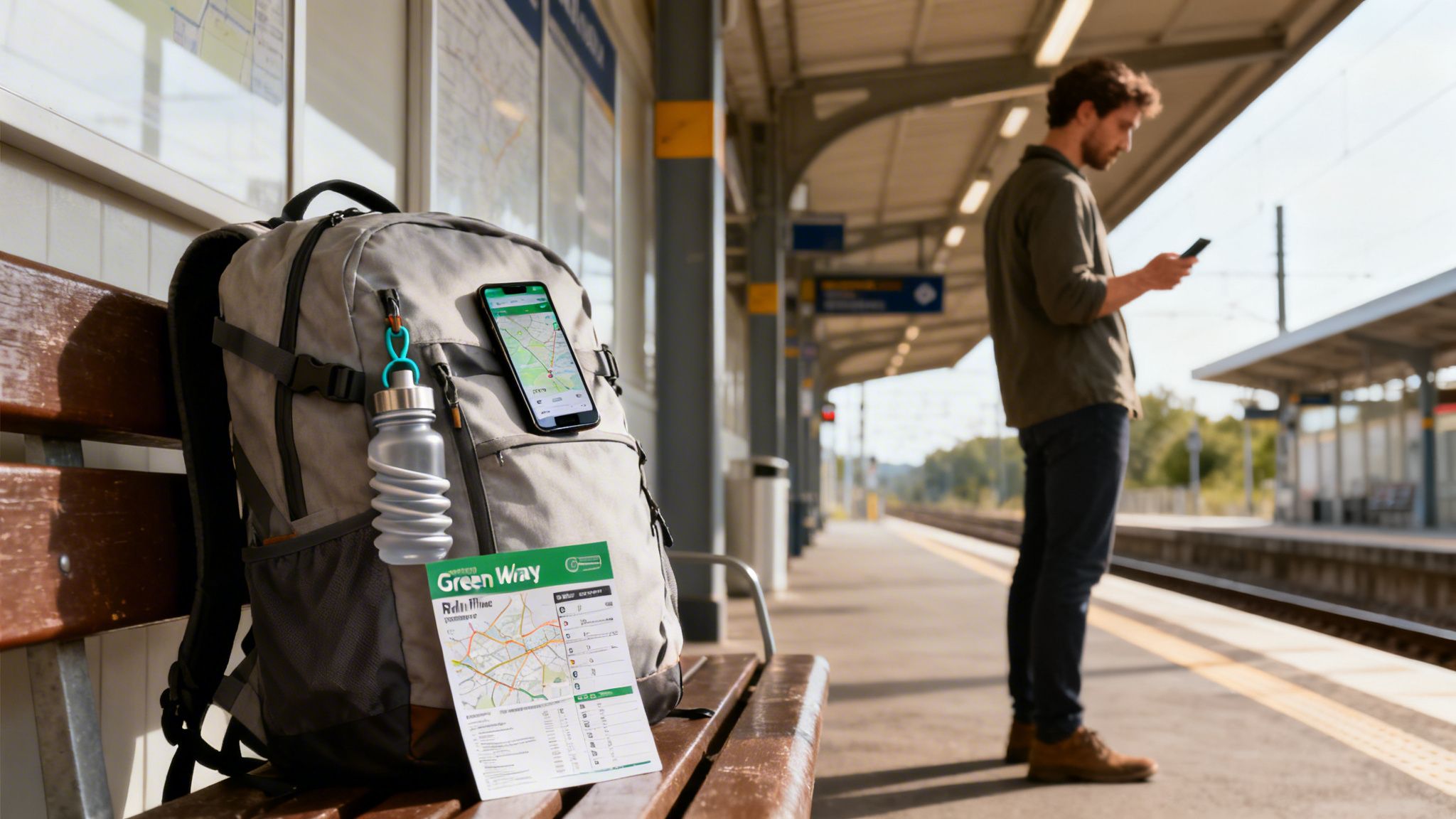
Picture this: you step off a train, and instead of jumping into a taxi, you hop on a bike and follow a tree-lined path straight to your hotel. This is the whole idea behind building a rail-first itinerary around greenways, a concept we dig into in our guide to the best train travel route planners. It’s about making the journey itself just as memorable and low-impact as the destination.
Finding and Mapping Your Route
First thing’s first: you need to find these networks. Luckily, there are some excellent resources out there to help you scout them.
- Regional Associations: For big-picture planning, sites like the European Greenways Association are fantastic. They have extensive maps and details on long-distance routes that can take you clear across a country.
- Navigation Apps: When you’re on the ground, apps like AllTrails and Komoot are your best friends. They offer detailed trail maps, tell you what the path surface is like, and have user reviews so you know exactly what to expect.
- Local Tourism Sites: Don’t forget to check the local city or regional tourism board’s website. They almost always have a section dedicated to cycling and walking paths, often with downloadable maps and notes on where to access the trails.
Using these tools, you can easily spot the greenways that connect key points of interest, from train and bus stations to parks, museums, and your accommodation.
Packing and Safety for Greenway Adventures
When you’re heading out on a greenway, thinking minimalist and zero-waste is the way to go. Pack light, but pack smart. A durable collapsible water bottle is a must-have; it keeps you hydrated without the plastic waste and saves a ton of space in your bag once it’s empty.
Safety is also important. While most greenways are well-maintained and feel perfectly safe, it’s always smart to be aware of your surroundings, especially on more isolated stretches. Let someone know your route and when you expect to be back.
Finally, take a quick look at the local rules. Some paths have speed limits for cyclists or have designated lanes for walkers and riders. A little prep goes a long way, letting you enjoy these incredible green corridors with complete confidence on your next trip.
Inspiring Greenway Routes in Europe and Asia
To really bring the idea of a greenway to life, let’s move from theory to the real world. These routes show just how central these corridors can be to a low-impact travel plan, serving as destinations in their own right. They are living proof that you can explore entire regions without ever touching a car.
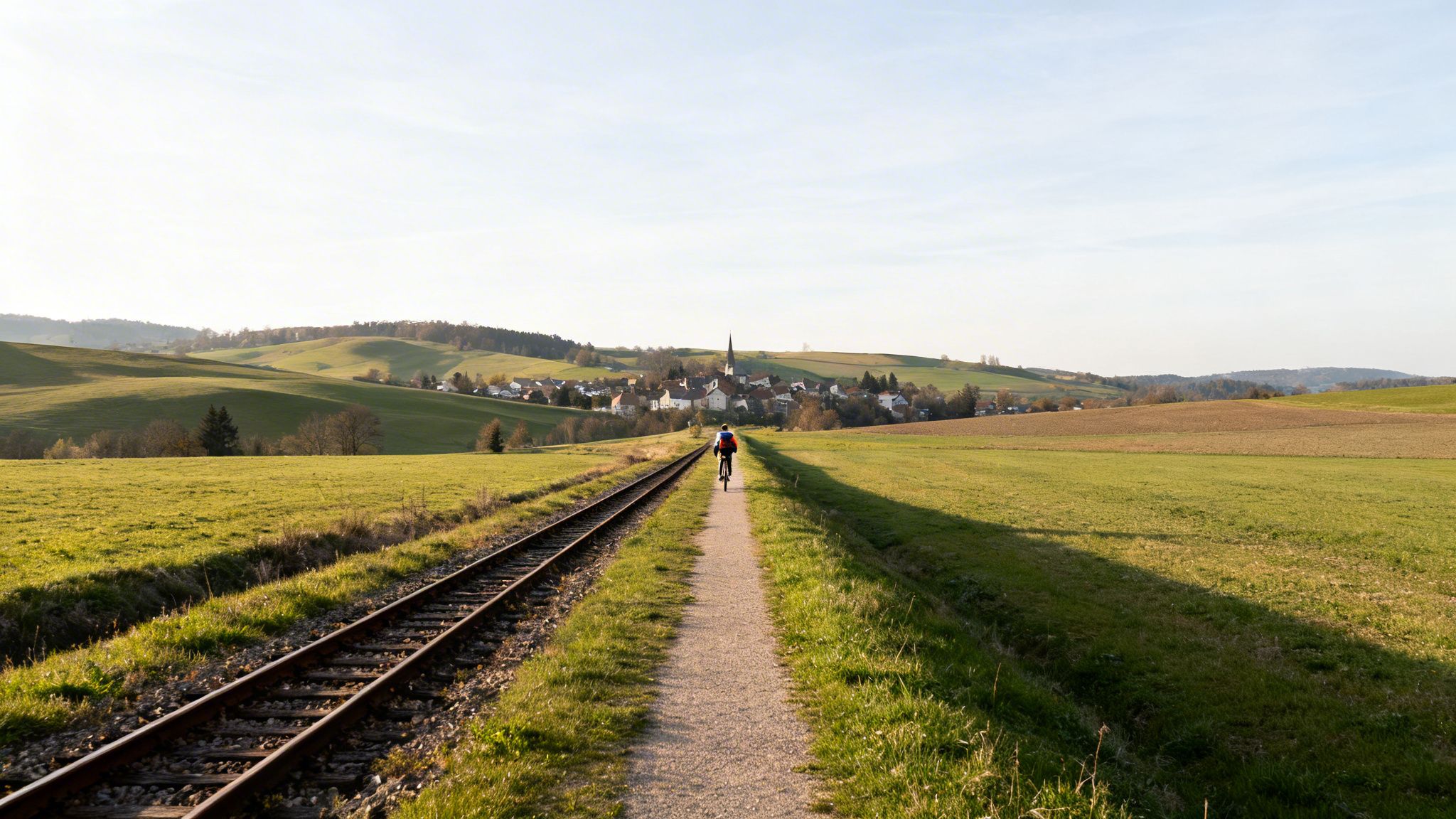
European Greenway Highlights
Europe is absolutely crisscrossed with incredible greenways, and the best part is that so many of them are easy to reach by train. Here are a couple of standouts that capture the spirit of slow, rail-adjacent travel.
- The Vennbahn: This epic 78-mile (125 km) rail-trail is a masterclass in cross-border collaboration. It follows a former railway line snaking through Germany, Belgium, and Luxembourg, offering a beautifully flat and scenic ride through the High Fens nature park. You can easily hop on and off at different sections via train stations in towns like Aachen, Germany, or Troisvierges, Luxembourg.
- Spain’s Vías Verdes: Spain has gone all-in on this concept, transforming over 2,050 miles (3,300 km) of disused railway lines into more than 130 “Vías Verdes” or “Green Ways.” These routes are perfect for all skill levels and guide you through some of a country’s most stunning and diverse landscapes, offering a unique window into rural Spanish life far from the usual tourist crowds.
These paths are perfect for multi-day trips. After a long day on the saddle, a reliable universal travel adapter is a non-negotiable for recharging your phone and other devices. To get a feel for planning trips in this part of the world, check out our guide to exploring Croatia.
Asian Greenway Networks
Asia is also embracing the greenway movement, using these corridors to inject nature and calm into some of its most dense urban centers.
- Singapore’s Park Connector Network (PCN): Singapore has created a truly astonishing island-wide network of green corridors that link up parks and nature reserves. With 186 miles (300 km) of trails, it’s possible to walk or cycle from one end of the city-state to the other, almost entirely through green space. The network is a world-class example of smart urban planning.
- China’s Guangdong Greenway: This is one of the most ambitious greenway projects on the planet, spanning thousands of miles in the Pearl River Delta. It connects major cities like Guangzhou and Shenzhen with rural villages and scenic areas, promoting both eco-tourism and healthier lifestyles for millions of residents.
These examples show what a greenway is in practice: a path to slower, more connected, and sustainable exploration.
Editor’s Pick: Our Top Greenway Planning Tool
When it comes to mapping out a greenway adventure, Komoot is an indispensable tool. It excels at multi-day planning and provides detailed surface-type information, so you know exactly what to expect. This helps you choose the right gear and plan your pace accordingly. The app’s ability to create custom routes that snap to known trails and paths makes it easy to link train stations to accommodations via scenic, car-free corridors. For a small one-time fee, you unlock offline maps for entire regions, which is incredibly useful in areas with spotty cell service.
Key Takeaways
- Greenways are People-First: A greenway is essentially a ‘nature highway’—a protected corridor of open space exclusively for non-motorized use like walking and cycling.
- They Connect Places: Unlike isolated parks, the primary purpose of a greenway is to connect parks, neighborhoods, cultural sites, and even entire cities.
- Multiple Types Exist: Common types include urban linear parks, flat rail-trails on former railway lines, and scenic blueways that follow rivers or coastlines.
- Eco and Health Benefits: They reduce carbon emissions by promoting car-free travel, protect biodiversity, and improve the physical and mental health of communities.
- Easy to Plan With: Modern apps like Komoot and AllTrails make it simple to find greenways and integrate them into your travel itinerary as “last-mile” connectors from transit hubs.
- Global Movement: From Spain’s Vías Verdes to Singapore’s Park Connector Network, greenways are a growing global solution for creating more livable and sustainable destinations.
Low-Impact Travel Tools (Worth It)
Also, if you’re planning a trip and want to keep things simple, these tools help you travel smoother while staying mindful about impact.
Get an eSIM for reliable data → Disclosure: Partner link. No extra cost to you.
Pre-book a transfer for easy arrivals → Disclosure: Partner link. No extra cost to you.
Frequently Asked Questions About Greenways
To wrap things up, here are answers to a few common questions that pop up around greenways. This should clear up any lingering details and get you ready to start exploring these amazing corridors.
How is a greenway different from a regular park or trail?
The biggest difference comes down to one word: connection. A regular park is usually a self-contained island of green space, designed for recreation in a single spot. A greenway, on the other hand, is a linear corridor built specifically to connect different places. Think of it as a “green highway.” It’s designed to link other parks, neighborhoods, commercial hubs, and even transit stations. While a simple trail can absolutely be part of a greenway, the term “greenway” itself always implies a bigger, connective purpose that blends recreation with conservation and transportation.
Are all greenways paved and accessible?
Not always, and that’s a really important detail to check when you’re planning. The surface and overall accessibility of a greenway can vary quite a bit depending on its location and main purpose. Many urban greenways and most rail-trails will be paved with asphalt or have a smooth, compacted gravel surface, making them perfect for wheelchairs, strollers, and road bikes. But more rural or nature-focused greenways might just be unpaved dirt paths. It’s always a good idea to check a local parks website or an app like AllTrails beforehand to confirm the path’s condition and make sure it works for you.
What is the best way to find greenways when traveling?
Finding greenways is easier than you might think. A quick search for “[City Name] greenway” is a great place to start, as it will usually point you toward official local government or parks and recreation websites. These are your most reliable sources for maps and access points. For on-the-ground navigation and discovering new routes, apps like Komoot and AllTrails are invaluable. And for bigger-picture, regional planning, don’t forget resources like the European Greenways Association or the Rails-to-Trails Conservancy in the U.S., which have extensive maps of long-distance networks.
Are there any safety concerns I should know about?
Greenways are generally very safe, but it’s always smart to follow standard safety practices, just like you would anywhere else. Be aware of your surroundings, especially in more isolated sections, and it’s a good habit to let someone know your planned route. Always follow posted rules, which might include speed limits for cyclists or yielding to pedestrians. In city settings, be extra cautious at road crossings where the greenway intersects with traffic. For extra peace of mind when carrying your passport and electronics, using an anti theft backpack is a practical move.
Can I use a greenway for commuting?
Absolutely! In fact, many greenways are designed with exactly that in mind. They offer a safe, scenic, and often stress-free alternative to driving or sitting on crowded public transit. These routes frequently connect residential areas with business districts, train stations, and city centers. Using a greenway for your daily commute is a fantastic way to build physical activity into your routine while cutting your personal carbon footprint. It’s a win for your health and the planet.
This article was fact-checked using sustainability data from the World Green Building Council, the Global Ecotourism Network, and peer-reviewed architecture studies. All partner links are vetted for compliance with sustainable business certifications.
Join the Sustainable Work Movement
Want more rail-first itineraries, low-impact packing systems, and walkable base-city ideas?
