
So, what is sustainable travel, really? At its heart, it’s a way of exploring the world that aims to leave the places you visit a little better than you found them. This means making choices that support local communities, protect cultural traditions, and preserve the environment—all without giving up the joy of the journey itself.
Understanding sustainable travel is much more than just a buzzword; it’s a real shift in how we think about our relationship with the world. Don’t think of it as a list of rules. Instead, see it as a framework for having more authentic and meaningful experiences. Instead of just passing through a destination, you become a partner in its future.
This entire philosophy rests on three core pillars that guide every decision, from how you get there to where you eat.
Key Takeaways
- It’s a Mindset: Sustainable travel is a conscious approach focused on positive environmental, social, and economic impacts.
- Three Pillars: It’s built on environmental protection, social and cultural respect, and economic benefits for local communities.
- Beyond Green: It goes further than just being eco-friendly, weaving ethical and cultural awareness into your journey.
- Action-Oriented: Your choices in transport, stays, and activities directly shape a destination’s well-being.
- Authentic Experiences: This approach often leads to more memorable travel by connecting you directly with local life.
Airalo eSIM for Low-Impact Connectivity
Switching to an Airalo eSIM is a simple yet impactful sustainable choice. It eliminates the plastic waste from physical SIM cards and their packaging, reducing your travel footprint before you even land. It’s a practical tool for staying connected responsibly.
Picture taking a scenic train through the Swiss Alps instead of a short flight, or staying in a family-run jungle lodge in Costa Rica that actively funds local conservation. These kinds of choices don’t just reduce your footprint; they enrich your trip, giving you deeper connections and better stories to bring home. It’s all about creating a positive exchange between you and the destination.
What Sustainable Travel Is Not
It’s also important to know what sustainable travel isn’t. While it shares goals with ecotourism, its scope is much broader.
Ecotourism is specifically about travel to natural areas to conserve the environment and support local people. Sustainable travel, on the other hand, applies these principles to any destination—from a massive city to a tiny village. You can dive deeper into the specifics in our guide on what ecotourism truly means.
“We need to continue to travel in order to experience the beauty of this world that we need to protect. It should be clear that traveling is a privilege. Having access to this privilege entails the responsibility to travel consciously and sustainably.”
Ultimately, this way of thinking is about making sure the beautiful places we love to visit will still be here for future generations to enjoy. It empowers you to become a steward of the world, turning every single journey into a chance to make a positive contribution.
The Three Pillars of What Is Sustainable Travel
To get a real handle on sustainable travel, I find it helps to think of it as a sturdy, three-legged stool. If you kick out any one of the legs—environmental, social, or economic—the whole thing wobbles and falls. Every conscious travel decision we make rests on keeping these three in balance.
When these elements work together, they turn a simple trip into something genuinely positive. It’s never about chasing perfection. It’s about making mindful choices that consider the planet, its people, and their prosperity all at once. This way, tourism becomes a benefit, not a burden, to the places we’re so lucky to visit.
And this isn’t just a niche idea anymore; it’s becoming mainstream. A recent study shows that for 2025, a massive 84% of global travelers now see sustainability as a top priority when they plan their trips. That’s a huge jump from just 42% in 2016. For the first time, over half (53%) are now thinking about a trip’s impact on local communities, right alongside the usual environmental concerns.
The chart below breaks down how these three pillars connect, showing how each one contributes to a more balanced and respectful way of exploring the world.
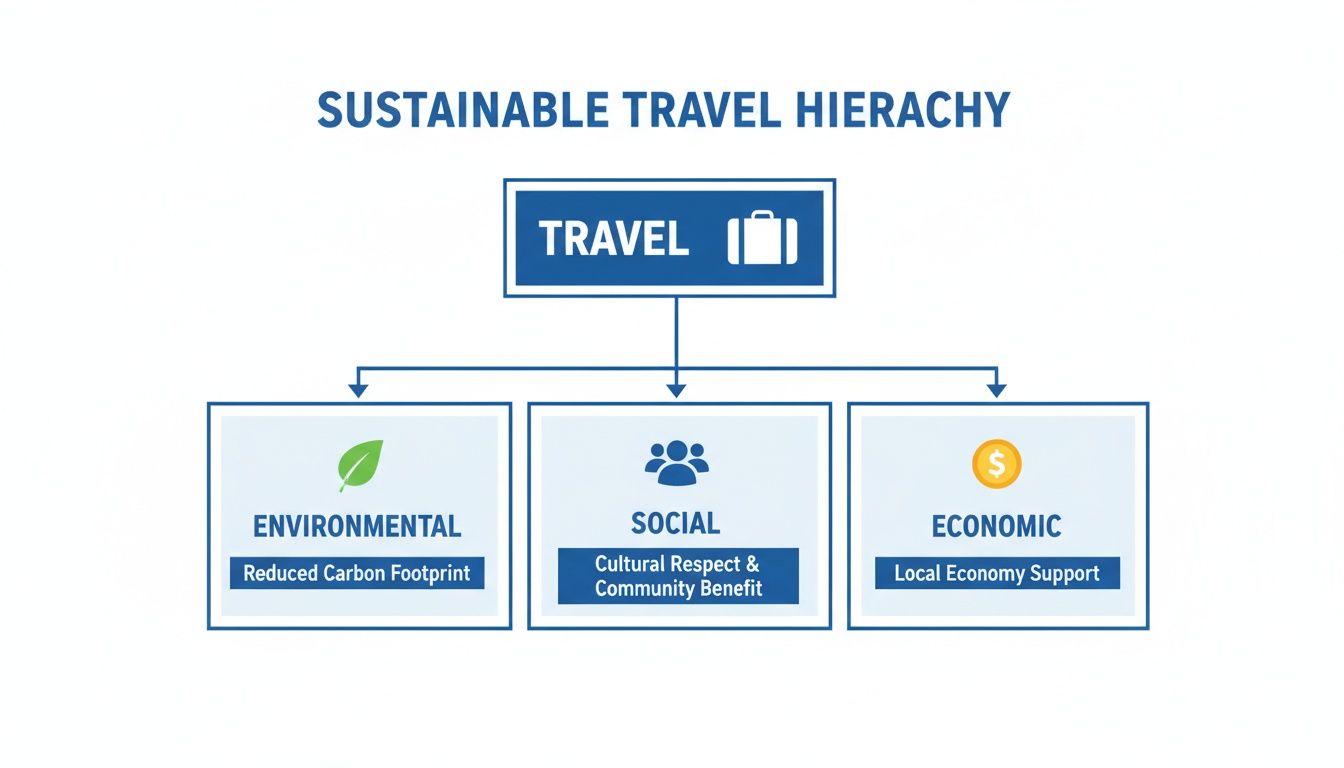
As the visual shows, true sustainability isn’t just about recycling your hotel towels. It demands a holistic approach that weaves together environmental care, community respect, and local economic support.
H3 Environmental Responsibility
The environmental pillar is what most people think of first, and for good reason. It’s all about shrinking your negative impact—your “footprint”—on the natural world. This covers everything from how you get there to what you put in your bag.
Opting for a train over a plane for shorter distances, for example, is a game-changer for cutting carbon emissions. Packing a reusable water bottle and coffee cup helps fight the plague of single-use plastic that’s choking our landfills and oceans.
Simple actions, when repeated, make a huge difference:
- Conserving Resources: Choosing stays that run on renewable energy, conserve water, and have proper recycling.
- Protecting Wildlife: Seeking out ethical wildlife encounters where animals are in their natural habitat, not exploited for a photo op.
- Respecting Nature: Sticking to “Leave No Trace” principles. That means packing out everything you pack in, staying on marked trails, and leaving landscapes just as you found them.
H3 Social And Cultural Responsibility
The second pillar is all about people. Sustainable travel means engaging with local communities in a way that’s respectful, ethical, and actually benefits them. At its heart, it’s about remembering you’re a guest in someone else’s home.
This means doing your homework—taking a little time to learn about local customs and etiquette before you arrive. It’s asking permission before you take someone’s picture and showing reverence for sacred sites.
A huge part of this is choosing experiences that empower, not exploit. Instead of grabbing a generic, mass-produced souvenir, seek out a local artisan and buy one of their unique crafts directly. You get a far more authentic memento, and the artist earns a fair wage for their skill. To learn more about spotting ethical operators, check out our guide on what makes a tour truly sustainable.
H3 Economic Responsibility
Finally, the economic pillar ensures your travel money directly supports the local economy. When your spending stays within the community you’re visiting, it helps fund schools, improve infrastructure, and create stable, dignified jobs.
A key principle here is stopping “leakage”—where your tourism dollars flow straight out of the local economy and into the pockets of large, foreign-owned corporations. The goal is to keep the benefits right where they belong.
This is where your choices have real power.
- Stay Local: Choose locally-owned guesthouses, boutique hotels, or family-run B&Bs over international chains.
- Eat Local: Dine at independent restaurants and cafés that source ingredients from nearby farms.
- Hire Local: Book tours and activities with local guides who offer an invaluable window into their culture and home.
By directing your dollars this way, you become an active partner in the community’s well-being. Your trip transforms into an investment, helping to preserve the very culture and environment you came to experience.
To make these pillars more concrete, here’s a quick-reference table that contrasts conventional travel habits with their more sustainable alternatives.
Sustainable Travel Choices At a Glance
| Pillar | Conventional Choice | Sustainable Alternative |
|---|---|---|
| Environmental | Short-haul flights for regional travel | Taking a scenic train or coach instead |
| Environmental | Buying single-use plastic water bottles | Packing a reusable bottle with a filter |
| Social | Visiting a popular site without context | Hiring a local guide to learn the real story |
| Social | Buying mass-produced souvenirs | Purchasing unique crafts directly from artisans |
| Economic | Staying at an all-inclusive international resort | Choosing a family-owned guesthouse or B&B |
| Economic | Eating at a familiar global fast-food chain | Dining at independent, locally-sourced restaurants |
This table isn’t about guilt; it’s about seeing the small pivots you can make. Each sustainable choice, no matter how minor it seems, reinforces the three pillars and helps build a healthier, more equitable future for travel.
How to Measure Your Sustainable Travel Footprint
So far, we’ve talked about the big ideas. But to make sustainable travel real, we have to get comfortable with the numbers. This means learning how to measure our “travel footprint”—the total impact of a journey on the planet and its people. For most of us, that story starts with carbon.
Simply put, your travel carbon footprint is the total amount of greenhouse gases (like CO₂) generated by your trip. Flights are the usual suspect here, especially during takeoff and landing. For most international travelers, flying is the single biggest contributor to their footprint, and understanding its impact is the first step toward shrinking it.
[carbon_calculator_2025]

Carbon Emissions: The Stark Reality
Let’s ground this with a real-world example. A single round-trip flight from New York to Paris pumps out roughly 1.6 metric tons of CO₂ per passenger. That’s a hard number to picture, so think of it this way: it’s like driving a standard gas-powered car for about 4,000 miles (over 6,400 kilometers).
Now, imagine covering a similar distance across Europe by train. The difference is staggering. Choosing rail over air can slash your transport-related carbon footprint by up to 90%. This isn’t a small tweak; it’s a game-changer, and it’s exactly why a train-first mindset is a cornerstone of any serious sustainable travel strategy.
To see how your own travel plans compare, you can use our simple calculator to stack up different routes and transport modes. Running the numbers helps you make informed choices. For a deeper dive, check out our detailed guide on understanding your travel carbon footprint. Opting for the train isn’t just a scenic alternative; it’s a powerful climate action.
Beyond Carbon: Waste and Water Metrics
While carbon gets most of the headlines, a true travel footprint goes deeper. It also includes the resources we use and the waste we leave behind. The numbers here can be just as jarring.
Transport alone accounts for 5% of all global carbon dioxide emissions. But it doesn’t stop there. The average tourist generates about 1.6 kg (3.5 pounds) of waste per day—double the global average. If we don’t change course, that could swell to 205 million tonnes of trash annually by 2034. You can explore more of this data in Statista’s green tourism report.
This means our choices about single-use plastics, water use in hotels, and food waste all add up. A truly conscious traveler keeps these impacts in mind, too.
Using Certifications as Your Guide
So, how do you find businesses that are genuinely committed to lightening their footprint? This is where third-party certifications become your best friends. They’ve done the hard vetting for you, acting as a reliable shortcut to spotting truly sustainable options.
Keep an eye out for these well-regarded labels when you book:
- B Corp Certification: This is the gold standard. It measures a company’s entire social and environmental impact, from its supply chain to employee benefits, signaling a deep commitment to being a force for good.
- Green Globe: A leading certification for the travel industry, Green Globe evaluates hotels, resorts, and tour operators on over 40 criteria, covering everything from sustainability management to cultural heritage.
- Global Sustainable Tourism Council (GSTC) Criteria: The GSTC doesn’t certify businesses directly but sets the global standards that other certifications follow. If a business is aligned with GSTC criteria, it’s a strong positive signal.
By looking for these labels, you can confidently book hotels, tours, and experiences that match your values. It’s one of the surest ways to know your trip is supporting businesses that are actively working to protect the planet.
A Practical Checklist for the Conscious Traveler
Knowing the theory behind sustainable travel is great, but putting it into practice is where the real impact happens. This simple, three-part checklist is designed to guide you from the moment you start planning a trip until long after you’re back home.
Think of it as a practical road map for what conscious travel actually looks like, step by step.

We’ll break the journey down into three manageable stages: planning, packing, and what you do on the ground. Each phase is full of small opportunities to make choices that align with your values, ensuring your adventure is as good for the places you visit as it is for you.
This framework helps turn abstract ideas into real-world actions, making it easier for any modern nomad or mindful explorer to travel more consciously.
Phase 1: Planning Your Trip
Great sustainable trips are built on thoughtful planning. Before you book a single thing, take some time to research and choose options that add up to a lighter footprint.
- Choose Your Destination Wisely: Look for countries, regions, or cities known for their commitment to sustainability. Places with robust public transit, protected natural areas, and strong green policies make it much easier to travel responsibly.
- Prioritize Rail Travel: For overland journeys, make trains your default choice. They have a significantly lower carbon footprint than flying and often deliver a more scenic and relaxing experience. If you must fly, you can search for the most direct routes using a tool like Aviasales.
- Book Certified Stays: Seek out accommodations with recognized sustainability certifications like Green Globe or B Corp. A stay at a place like the Conscious Hotel Westerpark in Amsterdam, for example, means your lodging is actively working to conserve resources and operate ethically.
Phase 2: Packing Smart and Low-Waste
What you pack has a direct impact on your environmental footprint. A minimalist, low-waste approach reduces your load and minimizes the trash you leave behind.
A good rule of thumb? Lay out everything you think you need, then challenge yourself to cut it by a third. Every item should serve a clear purpose—ideally, more than one.
Here are the essentials for a solid sustainable travel kit:
- Reusable Water Bottle with Filter: This is non-negotiable. It stops you from buying countless plastic bottles and ensures you have safe drinking water anywhere.
- Solid Toiletries: Shampoo bars, conditioner bars, and solid soap cut out plastic bottle waste, are lighter, and won’t leak in your bag.
- Travel eSIM: Ditch the plastic SIM card and its packaging. An eSIM from a provider like Airalo downloads directly to your phone, offering a zero-waste way to stay connected.
- Reusable Essentials: Pack a reusable coffee cup, a cloth napkin or bandana, and a set of lightweight utensils to refuse single-use items on the go. You can find more ideas in our guide to building low-impact travel habits.
Phase 3: On The Ground
Once you arrive, your daily choices continue to shape your impact. This is where you get to connect with the local culture and economy in a truly meaningful way.
Practicing sustainability on the ground is about being an observant and respectful guest. It’s about slowing down, engaging with the community, and leaving a place better than you found it.
Follow these simple guidelines to make a positive difference during your stay:
- Use Public Transportation: Embrace local buses, trams, and subways. It’s cheaper, better for the environment, and offers a more authentic glimpse into daily life than relying on taxis. For airport transfers, consider a shared ride service like Welcome Pickups to reduce vehicle congestion.
- Shop and Eat Locally: Support the local economy by frequenting farmers’ markets, dining at family-run restaurants, and buying souvenirs directly from artisans. This ensures your money benefits the community directly.
- Practice “Leave No Trace”: This principle applies everywhere, from remote hiking trails to bustling city parks. Pack out all your trash, respect wildlife, and leave natural and historical sites undisturbed for others to enjoy.
By consciously moving through these three phases, you can transform any trip into a model of what sustainable travel can be.
This article was fact-checked using sustainability data from the World Green Building Council, the Global Ecotourism Network, and peer-reviewed architecture studies. All partner links are vetted for compliance with sustainable business certifications.
Why Sustainable Tourism Is a Global Economic Force
Sustainable travel is no longer a fringe idea whispered in hostels and nature lodges. It’s now a full-blown global movement, and it’s flexing serious economic muscle. This isn’t just about feeling good on vacation; it’s about real money redirecting the entire tourism industry. The choices you make are part of a massive shift, proving that travelers who vote with their wallets can fuel positive change on a global scale.
Seeing the bigger picture helps put every responsible travel choice into context. When you pick a locally-owned guesthouse or buy crafts directly from an artisan, you’re doing more than just having an authentic experience. You’re helping to build a more equitable and resilient global economy, one that creates opportunities for communities often left behind by mass tourism.
The Booming Green Economy
The financial momentum here is staggering. The global sustainable tourism market isn’t just growing; it’s exploding. Projections show it hitting USD $1.9 trillion in 2025 and rocketing towards an incredible USD $14.4 trillion by 2035.
That leap is powered by a compound annual growth rate (CAGR) of 22.6% over the next decade—a clear signal of a tectonic shift in what travelers want. For a deeper look, check out this comprehensive market analysis.
This isn’t a fleeting trend; it’s the new economic reality. The “green tourism” segment, covering everything from eco-lodges to wildlife safaris, is on track to claim 35.7% of all revenues in 2025. And with online bookings making up 52.7% of the market, digital platforms are clearly central to connecting conscious travelers with responsible businesses. Sustainability is no longer an add-on; it’s a primary driver of the travel economy.
Community Empowerment Through Conscious Choices
This economic force hits hardest—in a good way—when it flows directly into local communities. Sustainable tourism creates dignified jobs, bolsters small businesses, and helps preserve cultural heritage by making it economically viable. It’s a model that swaps exploitation for empowerment.
Inspiring examples are popping up all over the world:
- Community-Based Tourism in India: In regions like Ladakh, homestay programs let travelers stay with local families. This sends income directly to households, helps fund community projects, and gives visitors a cultural immersion that a big hotel could never replicate.
- Green Infrastructure in China: Ambitious projects are busy turning old industrial areas into lively eco-tourism hubs. By rewilding landscapes and building greenways, these initiatives draw in visitors while making life better for the people who live there.
- Artisan Cooperatives in Peru: In the Sacred Valley, indigenous weavers have formed cooperatives to sell high-quality textiles directly to travelers. This model cuts out the middlemen, ensuring the artisans get paid fairly for their incredible skill and cultural knowledge.
These examples show how your travel spending can become a direct investment in a community’s future. When you support projects like these, you’re helping create a virtuous cycle where tourism fosters both economic prosperity and cultural preservation. For more on this, check out our deep dive into the future of sustainable tourism. Your journey becomes part of a much bigger, more positive story.
Your Questions About Sustainable Travel, Answered
Even with the best intentions, figuring out sustainable travel can feel like navigating a maze. Let’s tackle some of the most common questions head-on and clear up a few myths along the way.
My goal here is to make this whole concept feel less abstract and more achievable. Conscious travel isn’t about perfection; it’s about making better, more informed choices, one trip at a time.
Is Sustainable Travel Just a More Expensive Way to Travel?
This is probably the biggest myth holding people back. While it’s true that a luxury eco-lodge will have a luxury price tag, the real principles of sustainable travel can actually save you a lot of money.
Think about it this way: slow travel—which is naturally more sustainable—means spending less on constant transit and more time soaking up one place. Eating at a small, family-run spot is almost always cheaper (and better) than the tourist traps. Hopping on a city’s tram system instead of calling a taxi cuts your daily costs way down.
Often, the most expensive parts of a trip are the least sustainable ones—lots of flights, big international hotel chains, and pre-packaged tours that herd you from one place to another. When you choose to support the local economy and move at a more human pace, you usually end up with a more authentic and more affordable trip.
What’s the Difference Between All These Terms, Anyway?
You’ve probably heard a bunch of different words thrown around, and they can blur together. Here’s a simple way to keep them straight:
- Sustainable Travel: This is the big umbrella. It’s a broad framework that can apply to any kind of trip—a city break, a rural escape, an adventure trek. It’s all about balancing environmental, social, and economic factors to leave a place in good shape.
- Ecotourism: Think of this as a specific niche under the sustainable travel umbrella. It focuses on trips to natural areas with very clear goals: to conserve the environment, directly benefit local people, and usually include an educational piece.
- Regenerative Travel: This is the next step in the conversation. It pushes beyond just sustaining a place (doing no harm) and actively tries to leave it better than you found it. This might mean joining a local reforestation project, choosing a tour operator that’s restoring an ecosystem, or staying at a lodge that funds community-led conservation.
In short, if sustainability is about keeping things in balance, regeneration is about actively helping things heal and improve. It’s a more hands-on approach to making your travel a force for good.
How Can I Be a Sustainable Traveler in a Big City?
It’s a huge mistake to think sustainability only happens in remote jungles or on pristine beaches. You can make a massive positive impact in the middle of a bustling city. In fact, cities are packed with opportunities to travel more consciously.
A few practical ideas for your next urban trip:
- Embrace Public Transit: Cities like Copenhagen and Amsterdam are built around incredible tram, bus, and train networks. Using them is the single best way to shrink your carbon footprint while you explore.
- Find the Green Pockets: Seek out and enjoy the city’s parks, botanical gardens, and community green spaces. Your visit helps show local governments and residents that these places are valuable.
- Stay Somewhere Smart: Look for forward-thinking hotels that are serious about their green credentials. A great example is the Zoku Copenhagen, which blends clever design with a real commitment to sustainability—making it a perfect home base.
- Back the Local Innovators: Cities are hotbeds for sustainable businesses, from zero-waste cafes to shops that feature local designers. Hunt them down and put your money directly into the local creative economy.
Do My Small Actions Really Make a Difference?
Yes. A thousand times, yes. It’s so easy to feel like one person choosing a train over a plane or carrying a reusable water bottle is just a drop in the ocean. But the collective power of millions of those individual drops is what creates the tidal wave of change we’re seeing in tourism.
Every time you book a certified eco-hotel, hire a local guide, or turn down a plastic bag, you’re sending a powerful economic signal. You’re voting with your wallet for a different, better kind of travel.
This is the demand that pushes big companies to clean up their act and encourages governments to protect their natural and cultural treasures. Your “small” actions, multiplied by millions of other conscious travelers, are the engine driving this entire movement forward.
Recent Posts
Best Travel Towels
Quick picks for fast-drying, packable towels that actually work on the road.
Best Waterproof Backpack
What matters for rain, train platforms, and daily carry—without overpacking.
Cheapest Way to Travel to Europe
Budget routes, timing, and practical ways to cut costs without cutting comfort.
How to Travel Europe by Train
Planning tips, rail passes, and simple route strategies for smoother trips.
Best Night Trains in Europe
Top sleeper routes, what to book, and how to avoid common overnight mistakes.
SIM Card for International Travel
Simple guidance on SIM vs eSIM, coverage, and avoiding roaming surprises.



Join the Sustainable Work Movement
Want more rail-first itineraries, low-impact packing systems, and walkable base-city ideas?
Explore Eco Nomad Travel
📚 Core Guides
🧭 Planning & Logistics
🗺️ Destinations & Seasons
Jeremy Jarvis — founder of Eco Nomad Travel, sustainable travel writer, and advocate for regenerative tourism. His work focuses on low-impact mobility, eco-friendly digital nomad life, and climate-positive travel.
Legal
Affiliate DisclaimerPrivacy Policy
Terms of Service
Image & Media Notice
Cookie Policy
Contact
Affiliate Disclosure: Some links on Eco Nomad Travel are affiliate links, meaning we may earn a small commission at no extra cost to you. This supports our mission to inspire responsible and low-impact travel worldwide.
Connect
✅ Trusted Official Sources
Plan smarter eco trips
Try our free Sustainable Travel Tools for Digital Nomads – carbon calculator, train vs plane comparator, and more.
Open Tools Hub