
Picture this: gliding across turquoise waters, powered by nothing but the wind, leaving almost no trace behind. This is the simple, beautiful reality of wind sailing, a timeless way of moving that’s being rediscovered by eco-nomads and remote workers looking for a powerful, low-impact alternative to carbon-heavy travel like flying. Learning about wind sailing is your first step towards this incredible journey.
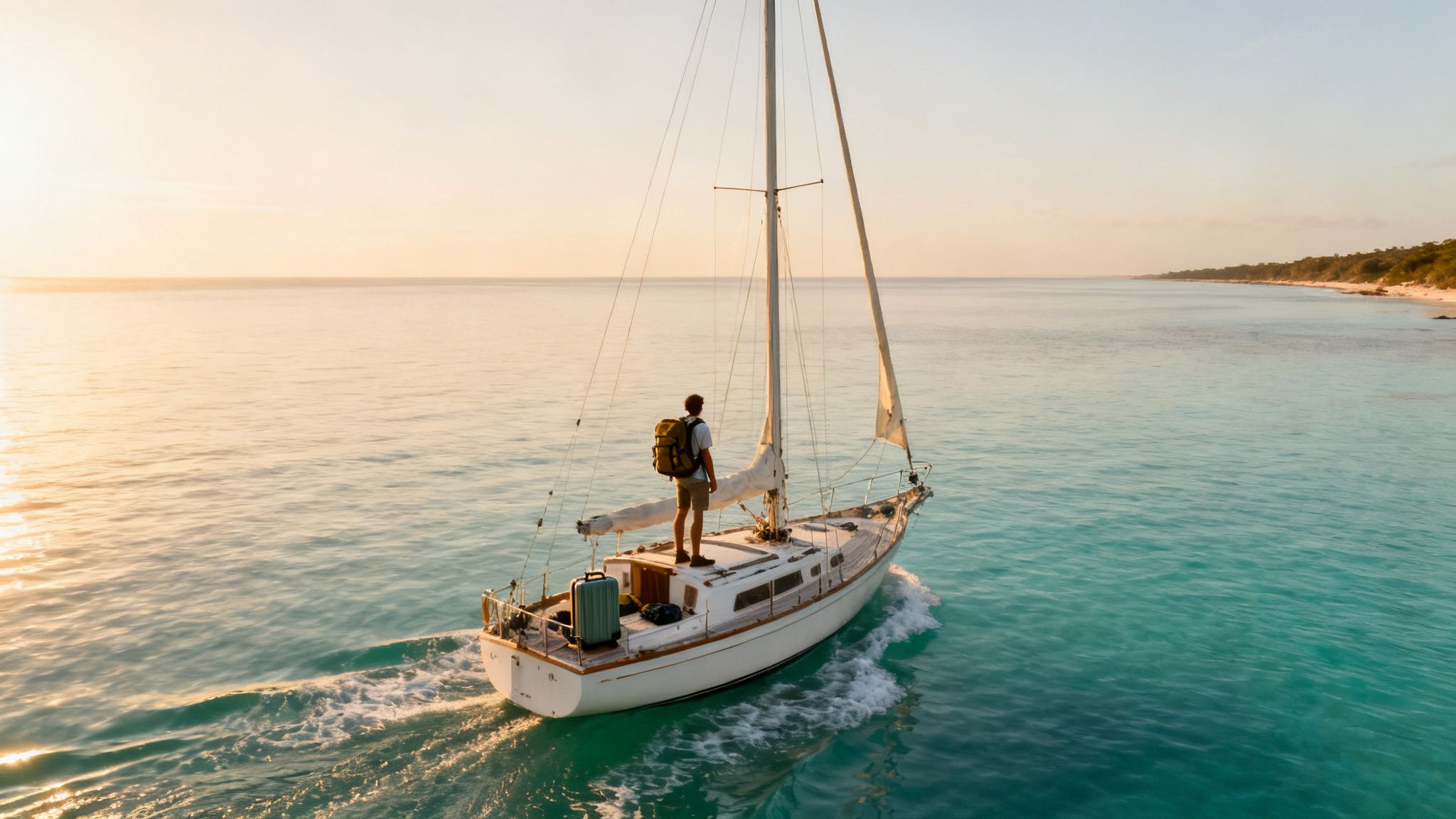
For anyone serious about low-impact travel, wind sailing isn’t just an activity; it’s a mindset. It’s a chance to journey slowly and connect deeply with the world by shifting the focus from simply arriving somewhere to savoring the voyage itself. This approach fits perfectly with a more sustainable way of thinking, where the environmental cost of our movement is a real consideration.
Unlike conventional travel that burns through finite fossil fuels, sailing taps into a clean, renewable energy source. The gentle hum of the wind in the sails replaces the roar of a jet engine, cutting out the noise pollution that disrupts fragile marine ecosystems. This isn’t just about shrinking your carbon footprint; it’s about actively choosing a quieter, more harmonious way to move through the world.
This guide is all about how to make that dream a reality, from quiet coastal hops to longer sea passages. We’ll even cover how to pack smart for life on the water, starting with essentials like a durable carry on backpack to keep your gear organized and within reach.
Why Wind Sailing Is the Future of Sustainable Travel
At its heart, wind sailing forces you to live at a more deliberate pace. You have to adapt to natural rhythms—tides, weather patterns, and wind direction—which is a powerful antidote for digital nomads and remote workers trying to escape the constant rush.
- Deeper Connections: When you spend more time in coastal communities instead of just passing through, you open the door to more meaningful interactions and a real understanding of local cultures.
- Reduced Stress: The meditative quality of being on the water is a genuine stress-reducer. It helps create a healthier, more sustainable work-life balance.
- Mindful Consumption: Life on a boat often demands a minimalist approach. It naturally encourages you to consume less and appreciate what you truly need.
You can learn more about how these principles are reshaping travel by exploring the future of sustainable tourism. This mindset is the core of making our travels a regenerative force, not a destructive one.
How Does Wind Sailing Actually Work?
At its heart, the idea behind wind sailing is elegantly simple, but it’s a concept most people get wrong. The common picture is a sail acting like a parachute—just catching the wind and getting pushed along. The reality is a whole lot smarter. It’s better to think of a sail not as a bag, but as a vertical airplane wing.
Just as air moving over a plane’s wing creates lift, the wind flowing on both sides of a curved sail creates a pressure difference. This difference generates a powerful force that pulls the boat forward and a little bit sideways. That sideways push is stopped by the boat’s keel (a big blade under the hull), which redirects all that energy into forward motion. It’s this bit of physics that lets a sailboat travel into the wind, not just with it.
For anyone just starting out, it helps to know the two main families of sailboats you’ll encounter.
Types of Wind Sailing Vessels
- Dinghies: These are the small, open sailboats perfect for learning the ropes. They’re quick, responsive, and give you immediate feedback, which makes them brilliant for mastering the basics on a lake or in a sheltered bay.
- Cruisers: These are the bigger sailboats built for longer trips and living on board. They’re more stable and come with cabins, kitchens (called galleys), and navigation gear, making them the go-to for exploring coastlines or crossing oceans.
A quick look at history shows just how efficient this has always been. Data from the era of tall ships (1750-1850) shows merchant vessels reliably averaged 5-7 knots (about 6-8 miles per hour) using only wind. You can dig into the data on historical sailing speeds and their economic impact to see how effective this power source was long before modern tech.
Modern Tools Make It All More Accessible
Today, technology has made wind sailing safer and more approachable than ever. Modern sailors aren’t just staring at the stars anymore; they use GPS for pinpoint location tracking and advanced weather apps to see exactly what the wind and seas are doing. These tools take a lot of the guesswork out of the equation, making for better planning and safer trips.
This blend of ancient principles and modern tech is what turns sailing into such a reliable, low-impact adventure. Whether you’re dreaming of island hopping in the Med or exploring quiet coastlines, the journey is well within reach. Our guide on sailing in Croatia, for instance, shows just how accessible this kind of travel is for eco-nomads.
And trust me, when you’re out on the water all day, packing a quality reef safe sunscreen is completely non-negotiable—for your skin and for the ocean.
The Real Environmental Impact of Wind-Powered Travel
Choosing to travel by wind sailing isn’t just a romantic idea—it’s one of the most powerful moves you can make to slash your travel footprint. But by how much, really? When you dig into the data, the difference between harnessing the wind and burning fuel becomes incredibly stark.
The most obvious win is near-zero fuel consumption. Think about it: a typical long-haul flight pumps out around 0.55 pounds of CO2 per passenger per mile (250 grams per passenger per kilometer). A modern car isn’t much better, at roughly 0.33 pounds (150 grams). A sailboat, on the other hand, gliding along on pure wind power? It produces virtually zero direct emissions. That simple reality makes it one of the cleanest ways to cover serious ground.
But it’s not just about what you aren’t putting into the air. Sailing quietly through the water also tackles noise pollution. The constant, low-frequency hum from massive ship engines messes with the way marine life communicates, hunts, and navigates. Swapping that engine drone for the sound of wind and water helps restore a little peace to fragile ecosystems.
A Clear Comparison of Emissions
To really get a feel for the difference, you have to look at the numbers. The carbon cost of moving one person one mile varies wildly depending on how you do it, and the comparison makes the case for wind power crystal clear. This table shows the significant difference in carbon emissions per passenger-mile for various transport methods, highlighting the clear environmental benefits of wind sailing.
Comparing Carbon Footprints Across Travel Modes
| Transport Mode | Average CO2 Emissions (Pounds per Passenger-Mile) |
|---|---|
| Long-Haul Flight | 0.55 lbs |
| Modern Car (Average) | 0.33 lbs |
| Intercity Train | 0.11 lbs |
| Ferry | 0.04 lbs |
| Sailboat (Under Wind Power) | ~0 lbs |
Note: Data is approximate and varies by specific model, occupancy, and fuel source.
The numbers don’t lie. While every form of travel has some kind of footprint (building the boat, for instance), the operational emissions of wind sailing are in a class of their own.
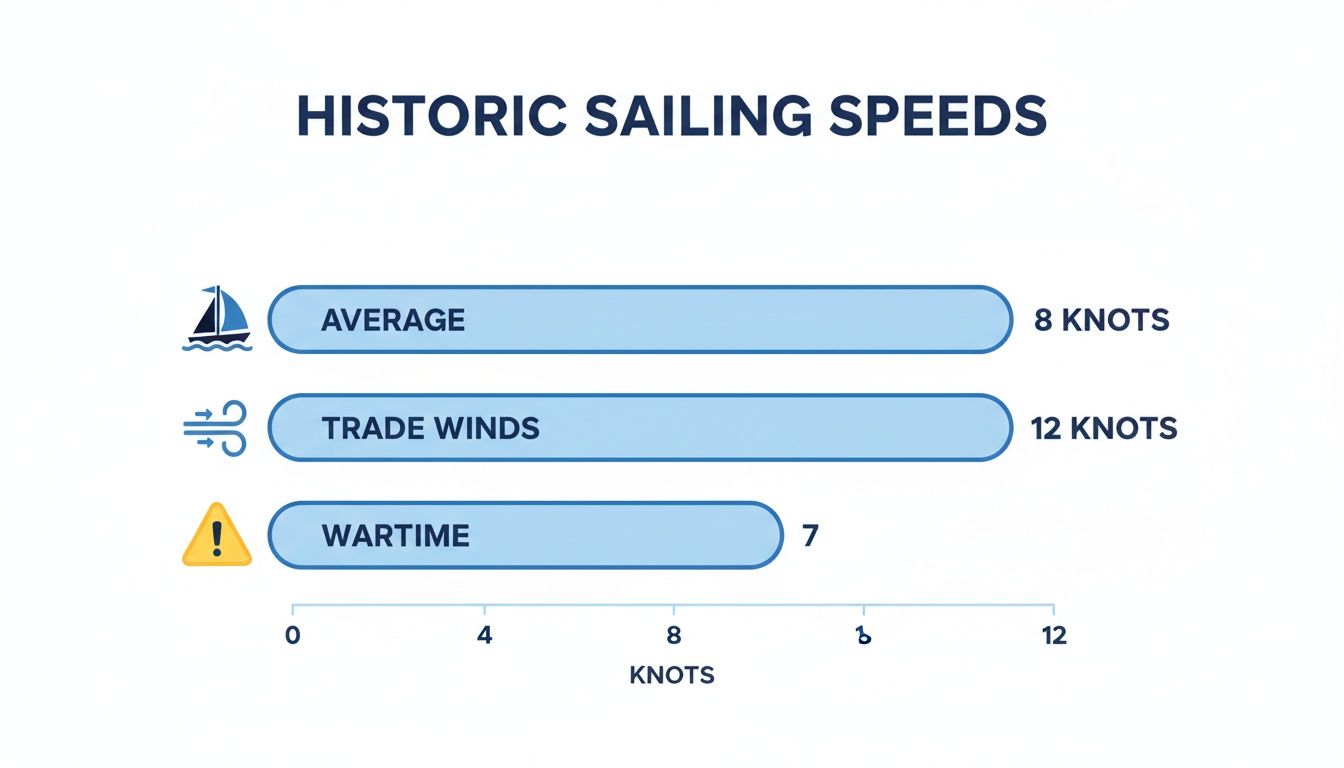
This chart just underscores how effective wind power has always been. Even before modern tech, historic sailing vessels moved at reliable speeds, proving that wind has long been a viable and powerful primary engine.
The Slow Travel Advantage
Beyond the hard data, wind sailing is the very embodiment of the ‘slow travel’ movement. It forces you to reject the frantic pace of modern tourism, where destinations are just items on a checklist. Instead of airport-hopping, you become part of the journey itself, learning to read the weather and move with the wind.
This slower, more deliberate pace naturally leads to a smaller overall footprint and a deeper connection to the places you visit.
If you want to get a better handle on how all your travel choices add up, our guide to understanding your travel carbon footprint and emissions is a great place to start. Making informed decisions begins with understanding the real-world impact.
Your First Steps to Becoming a Sailor
So, you’re ready to trade in the landlubber life for one on the water. The best part? You don’t need to own a boat—or even know the difference between a bow and a stern—to get your start in wind sailing. The path from novice to capable sailor is far more accessible than most people think, with a clear runway for anyone with a willingness to learn.
For most people, the journey begins with a certified sailing course. Internationally recognized bodies like the American Sailing Association (ASA) and the Royal Yachting Association (RYA) have built structured programs that take you from zero to hero, covering everything from basic knots and sail trim to essential safety drills.
These are hands-on, multi-day experiences designed to get you out on the water building real-world skills, not just classroom theory. It’s often during these first few days under sail that you’ll know for sure if the lifestyle is a good fit. Completing a foundational course like an ASA 101 gives you the confidence and the credentials to take the next step.
Before your first lesson, remember that staying hydrated on the water is non-negotiable. A simple reusable water bottle is one of the most practical things you can bring.
Gaining Experience Without a Boat
Once you’ve got the basics down, the real learning happens with time on the water. This is where crewing opportunities become your best friend. Forget about buying a boat; find one that just needs an extra pair of hands.
Platforms that connect captains with crew have completely changed the game. Skippers post their upcoming trips—anything from a weekend coastal run to a long ocean passage—and look for people to join them. It’s an incredible way to build sea miles, learn directly from seasoned sailors, and test out the liveaboard lifestyle to see if it meshes with your remote work routine.
You can find all sorts of arrangements, from simply helping with daily sailing duties to sharing watch rotations on longer voyages.
Editor’s Pick for Finding Crew Positions
Crewbay: For aspiring sailors looking to gain practical experience, Crewbay is a reliable and widely used platform. It connects boat owners with crew for all levels, from beginners to experienced hands. Its straightforward interface and global reach make it an excellent resource for finding your first berth on a wind sailing adventure without the hype of other services.
Finding Your Place in the Sailing Community
The sailing world is a surprisingly tight-knit community. Marinas are the social and logistical hubs of this lifestyle, and just spending time there is a great way to meet people and hear about opportunities organically. Many marinas have Wi-Fi, making them practical spots for digital nomads to catch up on work between sails.
If you need to travel to a sailing hub to get started, you can book your travel on Trip.com to find flights or ground transport. And for any kind of travel, especially one that involves boats and new countries, having solid travel insurance is a must. It’s worth looking into a plan from VisitorsCoverage to make sure you’re protected.
Ultimately, becoming a sailor is about building your skills and your connections, one nautical mile at a time.
Staying Productive While Working from the Water
For any digital nomad drawn to a life of wind sailing, the entire dream hinges on one thing: a reliable internet connection. Blending the freedom of the open water with the demands of remote work is absolutely possible, but it takes a bit of smart planning and the right tech. The days of being completely cut off are long gone—modern tools make working from a sailboat a practical reality.
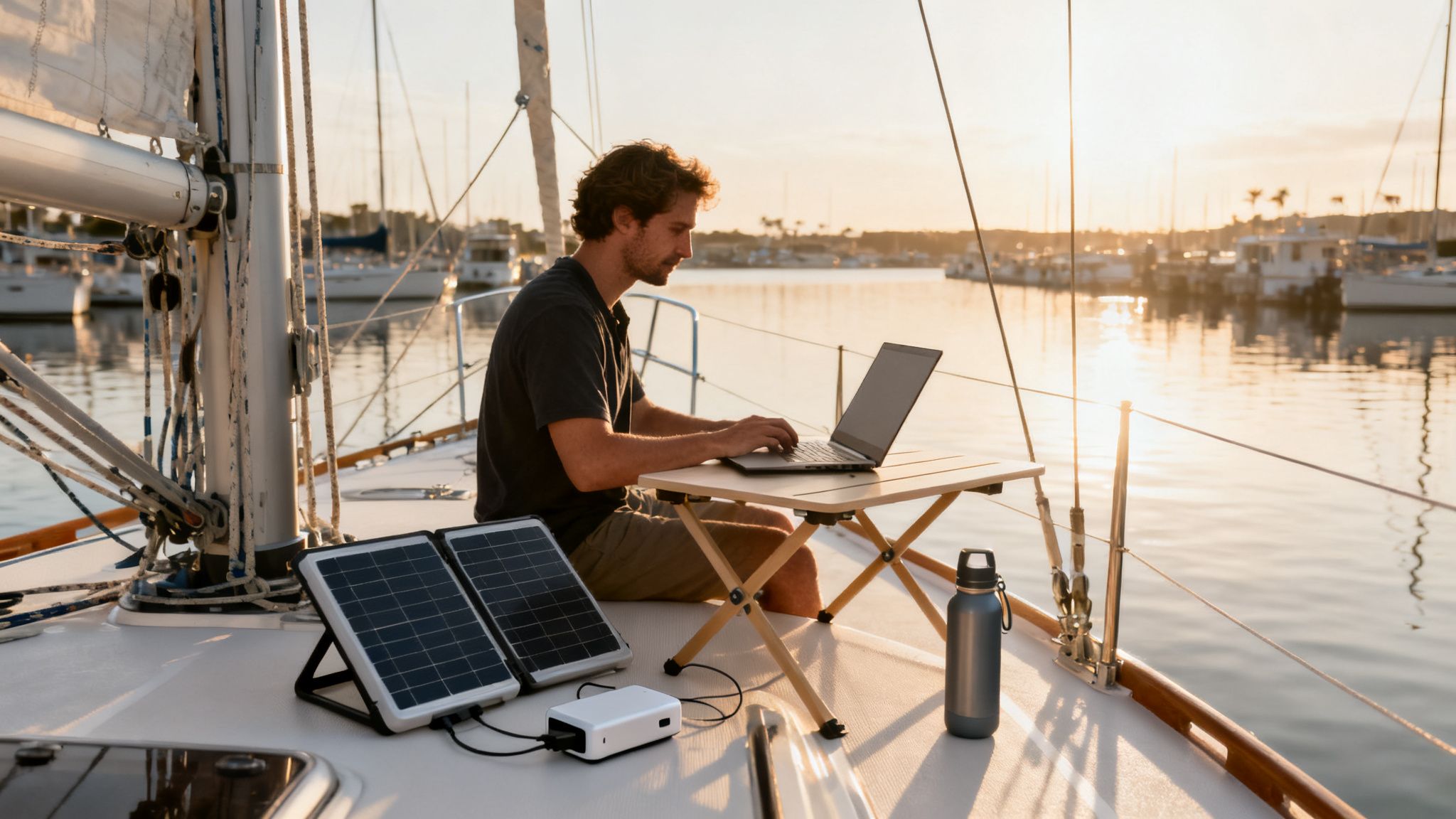
How you stay online really depends on where you’re sailing. For those ambitious open-ocean passages, satellite internet services like Starlink Maritime are the gold standard, giving you dependable, high-speed internet hundreds of miles from the nearest cell tower.
But for coastal cruising and island hopping, a much more flexible and affordable strategy works best. Using an eSIM from a provider like Airalo lets you connect to local cellular networks the moment you’re near shore. This gives you fast data for video calls and big uploads without the high cost of satellite, making it perfect for the day-to-day grind while exploring new coastlines.
Creating Your Floating Office
Your workspace on a boat has to be both functional and adaptable. Most sailors use the saloon table as their primary desk, but it’s a good idea to have a backup spot—maybe in the cockpit on a calm day—just for a change of scenery.
Good organization is everything in a small space. A dedicated cable organizer travel case will stop your charging cords from turning into a tangled mess.
Power management is the other non-negotiable part of this lifestyle. Most modern cruising sailboats come equipped with solar panels to keep the boat’s battery bank topped up. For your personal gear—laptop, phone, and camera—a high-capacity portable power bank is essential for getting work done without interruption, especially when you’re anchored far from marina shore power.
Finally, a quality universal travel adapter is a small but critical piece of kit. When you do dock at an international marina, you’ll need it to charge everything without a hitch.
By combining these simple tools, you can build a robust and productive office anywhere the wind takes you. To see how these items fit into a minimalist packing strategy, check out our guide to eco-friendly gear for digital nomads.
Inspiring Sail and Rail Itineraries for Eco Nomads
There’s something deeply satisfying about combining the quiet efficiency of Europe’s rail network with the wind-powered freedom of sailing. It’s a modern twist on ancient travel, letting you cover huge overland distances with a tiny footprint before casting off to explore coastlines at a slower, more intentional pace.
This approach actually follows a historical blueprint. During the Age of Sail, global trade was dictated entirely by wind patterns. Early Portuguese explorers mastered the volta do mar—looping hundreds of miles out into the Atlantic just to catch reliable winds for their return voyages. This principle of working with nature, not against it, is something today’s eco-nomad can replicate. You can learn more about how wind patterns shaped global history and trade routes.
Adriatic Dreams: Croatia by Train and Sail
Imagine arriving in Split, Croatia, refreshed after a scenic journey on Europe’s expanding sleeper train network. After a seamless transfer from the station to the marina, which you can pre-book with a service like Welcome Pickups, you’re stepping aboard your sailboat. This is the perfect setup for island hopping through the Dalmatian archipelago.
- Rail Route: Start in a major hub like Munich or Vienna and take an overnight train directly to Split. You’ll wake up right on the coast, ready for the sea.
- Sailing Path: From Split, the options are endless. Sail south to explore the stunning islands of Hvar, Vis, and Korčula, each with ancient towns, secluded coves, and walkable harbors.
- Nomad Tip: The coastal towns are rich with history and offer excellent connectivity, making it easy to balance a day of exploration with an evening of work. Packing a compact quick dry travel towel is a must for those impromptu swims.
Greek Odyssey: The Cyclades from Athens
Another classic route begins in Athens, easily reachable by train from other parts of Europe via connections in Italy and a short ferry ride. Once in Athens, you are at the gateway to the legendary Cyclades islands, where white-washed villages and brilliant blue waters await.
The journey itself becomes part of the adventure, offering a much more grounded and scenic alternative to the chaos of a short-haul flight. For a deeper dive into crafting these kinds of trips, check out our other flight-free travel itineraries. They prove that thoughtful, low-carbon travel isn’t just possible—it’s deeply rewarding.
Key Takeaways
- It’s genuinely eco-friendly. With sails up and engine off, you’re looking at practically zero operational emissions. For nomads serious about low-impact travel, this is one of the cleanest ways to cover long distances.
- You don’t need to be a sailor (yet). Don’t let inexperience stop you. Accredited courses from bodies like the RYA and ASA, plus crewing platforms like Crewbay, offer clear pathways to get on the water without owning a boat.
- Remote work is totally possible at sea. Staying connected used to be the biggest hurdle, but it’s a solved problem now. A setup like Starlink handles open-ocean work, while local eSIMs are perfect for cruising along the coast.
- The slow pace is the whole point. Sailing forces you to slow down, which is a powerful antidote to burnout. It also leads to much deeper connections with the small coastal towns and communities you visit along the way.
- Smart packing is crucial. Life on a boat requires minimalism. Essentials like a collapsible water bottle, biodegradable soap, and compression packing cubes save space and reduce your impact.
- Safety starts with good training. Certified courses provide the foundational skills and confidence needed to handle a boat safely, making the adventure enjoyable and responsible.
Low-Impact Travel Tools (Worth It)
Also, if you’re planning a trip and want to keep things simple, these tools help you travel smoother while staying mindful about impact.
Get an eSIM for reliable data → Disclosure: Partner link. No extra cost to you.
Pre-book a transfer for easy arrivals → Disclosure: Partner link. No extra cost to you.
Frequently Asked Questions About Wind Sailing
If you’re an eco nomad curious about trading airport queues for open water, you probably have a few questions. This is where we tackle the common ones, from safety and costs to finding a boat and staying connected while you work.
Is Wind Sailing Dangerous for Beginners?
Like any real adventure, sailing has its risks, but it’s surprisingly safe when you do it right. Good training courses are built around safety first, teaching you how to read the weather, handle emergencies, and use your gear properly. The whole idea is to build your confidence step by step, always sail within your limits, and learn to respect the wind and water.
How Much Does It Cost to Start Sailing?
Getting started costs a lot less than most people think. Forget about buying a boat—that’s a massive commitment. Instead, your first move should be an accredited sailing course, which usually runs between $500 and $1,000 USD. After that, you can crew for other sailors, often for free or by just chipping in for food and fuel. It’s the perfect way to rack up valuable experience without the huge financial anchor of ownership.
Do I Need to Be Super Strong to Sail a Boat?
Not at all. Modern sailboats are designed with clever systems like winches and pulleys that multiply your force. It’s all about leverage, not brute strength. Good technique and clear communication with your crew will always beat raw muscle power. Understanding the physics of how a sail catches the wind is far more important.
Can You Actually Work Remotely from a Sailboat?
Absolutely, and it’s getting easier every year. When you’re cruising along the coast, you can tap into local mobile networks using a flexible eSIM from a provider like Yesim. For those longer offshore passages, satellite internet keeps you connected. The real keys are managing your power—solar panels are a game-changer—and sticking to a disciplined work routine. A reliable USB C charger is also non-negotiable for keeping your gear topped up.
What’s the Best Way to Find a Boat to Crew On?
Online platforms are your best friend here. A site like Crewbay is a great starting point. You just create a profile, list your experience (even if it’s just a basic sailing course), and say what kind of trip you’re looking for. It’s a simple, effective way to connect with captains who need an extra pair of hands.
How Long Does It Take to Really Learn to Sail?
You can get the basics down in a weekend or a week-long course. But becoming a truly competent sailor—the kind who feels confident handling a boat alone—takes time on the water. Most people start to feel comfortable in familiar waters after logging around 50 to 100 hours of practical experience.
What Should I Pack for My First Sailing Trip?
Pack light. Seriously. Space on a boat is always tight, so soft-sided bags like a lightweight travel backpack are a must; they can be stuffed into small lockers. Your essentials should include non-marking shoes (to protect the deck), layered clothing for changing weather, good waterproof gear, reef-safe sunscreen, and any personal medications. A solid shampoo bar is also a great way to cut down on plastic waste.
Can You Sail Anywhere in the World?
Technically, yes, but your experience level dictates where you can realistically go. Beginners should stick to protected coastal areas with predictable weather, like the Mediterranean in summer or parts of the Caribbean. Crossing an entire ocean is a massive undertaking that requires advanced skills, a seriously seaworthy boat, and meticulous planning. It’s something to work up to, not jump into.
This article was fact-checked using sustainability data from the World Green Building Council, the Global Ecotourism Network, and peer-reviewed architecture studies. All partner links are vetted for compliance with sustainable business certifications.
Join the Sustainable Work Movement
Want more rail-first itineraries, low-impact packing systems, and walkable base-city ideas?
